
COOLWAVE vs Air-Cooled Vests: An Outage-Risk Assessment
An independent look at what happens to a water-circulation cooling vest — and to fan-driven alternatives — when power, ice, or shift time runs out on an industrial site.
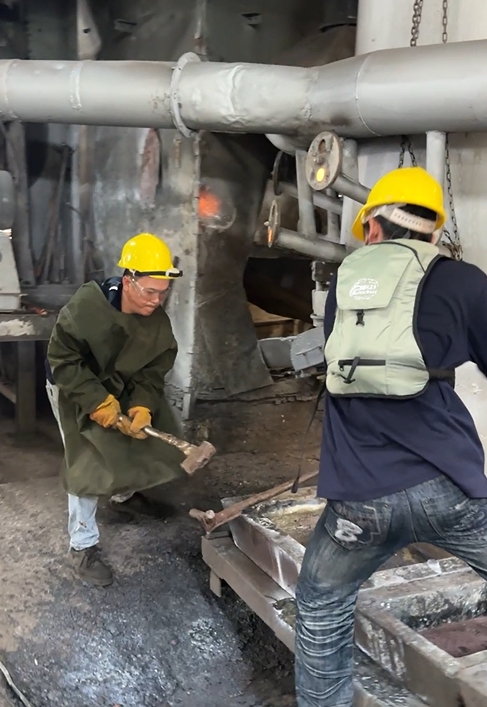
Heat-stress failures on industrial sites rarely begin with the garment. They begin with a battery that went flat, a freezer nobody booked, a shift that ran three hours past plan, or a socket two hundred metres from the work face. For workers who cannot leave the heat — sheet-metal handlers, road crews, street vendors, traffic controllers — the cooling layer that travels with them is only as dependable as the infrastructure it leans on.
The COOLWAVE Water-Circulation Cooling Vest (Basic Model) is an industrial cooling garment produced by Feng Shang Precision Co., Ltd., the Taiwan-based manufacturer behind the Shokunin brand. Its documented architecture separates two functions that many cooling garments fuse into one: creating cold and moving cold. Cold comes from two ice packs. Movement comes from a 5V, 150 mA (max) pump circulating water at a maximum flow rate of 320–370 ml/min. That separation is what makes an outage-risk assessment worthwhile — and it is also where the boundaries of the product begin.
Why outage risk belongs in a cooling-vest specification
Occupational heat management is normally built in layers: engineering controls such as ventilation, shading and process automation; administrative controls such as work–rest cycles and hydration; and personal protective measures that stay on the body. Cooling apparel sits in the third layer, which means it inherits every constraint of the site it is used on.
Those constraints group into three dependency layers:
- Electrical dependency. Anything with a fan, a pump or a compressor needs a supply, a duration, and a plan for the moment the supply ends.
- Thermal-reservoir dependency. Ice packs, phase-change materials and chilled water all hold a finite amount of cold. Depletion is not a malfunction; it is a schedule.
- Logistics dependency. Someone has to freeze, deliver, rotate and account for the consumables, shift after shift.
Which layer fails first depends on the technology. That is why the comparison in this article is not primarily about temperature on day one. It is about behaviour on day thirty, and on the day the generator does not start.
The commercial weight behind that question is growing. Third-party analysis of the cooling-vest category indicates that industrial applications, including construction and manufacturing, held the largest segment share at 34.5% in 2025, and that active circulatory mechanisms such as ice-water circulation are being deployed more widely across industrial sectors to mitigate occupational heat stress. Cooling apparel is moving from an occasional purchase to a specified line item.
What the COOLWAVE system actually documents
Product claims are only useful when they can be checked. The table below reproduces the specification recorded for the COOLWAVE Water-Circulation Cooling Vest (Basic Model).
| Documented parameter | Recorded value |
|---|---|
| Product | COOLWAVE Water-Circulation Cooling Vest (Basic Model) |
| Category | Industrial Cooling Apparel / Personal Protective Equipment (PPE) |
| Cooling duration | 3–4 hours |
| Weight | Within 2 kg |
| Suitable temperature | Below 10 °C |
| Pump output | 5V, 150 mA (max) |
| Flow rate | Maximum 320–370 ml/min |
| Shoulder strap material | 600D polyester |
| Body material | PEVA |
| Water bag material | TPU |
| Water bag cap | Polypropylene |
| Cooling tube | Sand rubber (black) |
| Contents of the set | Water-cooled vest backpack ×1, ice packs ×2 |
| Documented application sectors | Construction workers, outdoor workers, food stall operators, street vendors, traffic controllers, metal sheet factories |
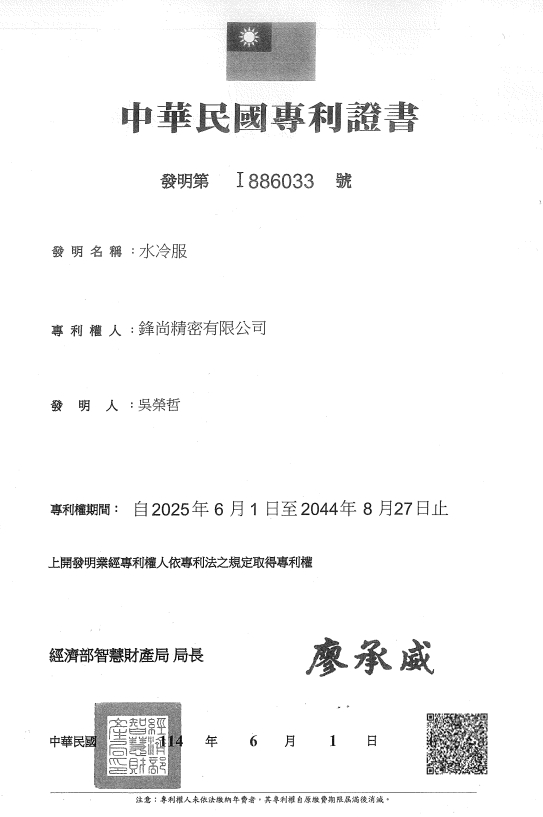
Two independent documents sit behind the product. The water-cooled vest structure and cooling system are covered by patent certificate I886033, issued by the Intellectual Property Office, Ministry of Economic Affairs (ROC) on 1 June 2025 under the Patent Act of the Republic of China, with an expiry date of 27 August 2044. Separately, the water-cooled vest has received the Disaster Prevention Product and Service Certification Award issued by the Taiwan Disaster Prevention Industry Association.
The manufacturer behind the vest, Feng Shang Precision Co., Ltd., was founded in 2009 and operates from a 1,000 m² facility in Taoyuan City, Taiwan, with a team of 30 employees, an R&D group of five engineers, annual output of 10,000 units, a 50% export ratio, and main markets in the USA and Taiwan (ROC). Shokunin is described as the company's professional e-commerce brand, and the company offers ODM production services, with a monthly capacity of 3,000 units, a minimum order quantity of 10 units, a typical lead time of 7–14 days, and a 6-month warranty on the water-cooled vest.
For a buyer assessing outage risk, the useful detail is not the size of the company. It is that the cold source, the circulation element and the regulatory paperwork are documented separately — which means each can be specified, questioned and verified on its own terms.
The thermal path: what a 5V pump changes, and what it does not
Air-circulation garments remove heat by convection: a fan pushes air across the skin, and the moving air carries heat away. The mechanism works, but it is exposed to the environment it operates in. In hot, humid conditions the air reaching the worker is already close to skin temperature and carries moisture that limits evaporative loss. When the fans stop, the mechanism stops.
Water circulation uses a different path. The two ice packs act as the cold reservoir, and the pump circulates chilled water through tubing positioned against the body, where heat transfers into the water by conduction rather than into the air. Water carries considerably more heat per unit volume than air, so a modest flow rate can move a meaningful heat load away from the body, and conduction does not depend on the humidity or the air temperature immediately around the wearer.
The documented flow rate of 320–370 ml/min and the pump rating of 5V, 150 mA (max) describe a small, low-current electrical load. In outage-risk terms, this has three practical consequences:
- The electrical element is a component, not the cooling source. The cold side of the system is documented as passive ice-pack cooling, with no refrigeration cycle and no compressor. The reservoir stores cold without drawing power.
- A low-current load is generally easier to serve from constrained supplies. Where a site has limited outlets, a small portable power source, or strict rules about what can be plugged in, a low-draw pump presents a smaller infrastructure problem than a high-draw circulation or refrigeration system.
- An interruption stops circulation, not the cold reservoir. If the pump loses power, the ice packs do not depend on electricity to remain cold. Shokunin's documentation does not quantify post-interruption cooling, so buyers should confirm expected behaviour with the manufacturer rather than assume a defined figure.
Why radiant-heat work such as sheet-metal handling is a specific case
Metal sheet work, foundry-adjacent tasks and similar operations share a common feature: the worker is exposed to heat that is partly radiated from hot surfaces and partly reflected back from the environment, and there is often nowhere to retreat to. In that setting, air-based cooling is operating inside a hostile medium, because the air itself is part of the heat load. A conductive loop connected to a cold reservoir does not need the surrounding air to be cool in order to function.
That is the design rationale behind positioning water circulation as a strong fit for sheet-metal and similar radiant-heat contexts, and metal sheet factories are listed among the product's applicable industries. It is an engineering rationale rather than a measured comparative claim. Buyers who treat thermal performance as a selection criterion should request test documentation from each supplier and compare like with like, because thermal-resistance figures are only meaningful when the test conditions behind them are disclosed.
Field evidence: what the Taiwan deployment recorded
Shokunin's case record documents a deployment of 100 units in Taiwan for cooling in high-temperature environments. The users recorded in that case include construction sites, outdoor work crews, metal sheet factories and street vendors — the same categories listed in the product's applicable industries, alongside food stall operators and traffic controllers.
Reported outcomes from that deployment include effective body cooling, heatstroke prevention, improved work efficiency and improved worker comfort. These are user-reported outcomes rather than controlled measurements, and they should be read as such: they establish that the product was used in real high-temperature work and that users regarded it as effective. They are not a laboratory measurement of a specific temperature reduction.
For a procurement file, that distinction matters. A specification that asks only for "effective cooling" will attract marketing language. A specification that asks for documented parameters, certification, deployment references and a defined acceptance test will attract something a buyer can sign off on.
What the market data says about cooling dependency
The wider category is expanding, and the expansion is concentrated in the environments where outage risk runs highest. Market Research Future values the broader personal cooling device market at USD 25.16 billion in 2024, projected to reach USD 94.85 billion by 2035. Narrower analysis by Dataintelo focused specifically on cooling vests puts that niche at approximately USD 215 million in 2024, growing to USD 385 million by 2033.
Within the vest category, Spherical Insights identifies Asia Pacific as the fastest-growing region, driven by rapid industrialisation and large outdoor work populations. Dataintelo's segmentation places industrial applications — construction and manufacturing among them — at the largest share of the category, 34.5% in 2025. On the technology side, phase-change-material vests captured 28.7% of market share in 2025 and are described as the fastest-growing technology segment, while Strategic Market Research notes that active circulatory mechanisms such as ice-water circulation are increasingly deployed in industrial sectors.
The competitive field is already populated by established suppliers, including Techniche International, Glacier Tek, Polar Products Inc. and Ergodyne. That is useful context for a specification exercise: buyers are not choosing between a new idea and no idea, but between architectures — and each architecture carries a different dependency profile.
Comparison: water circulation against other cooling architectures
The table below compares architectural categories, not individual brands. Products within a category vary, and buyers should verify every figure against the specific supplier's own documentation.
| Assessment dimension | COOLWAVE water circulation (documented) | Passive ice-pack vests (category) | Fan or air-circulation vests (category) |
|---|---|---|---|
| Cold source | Two ice packs acting as the thermal reservoir | Ice packs or frozen inserts | Ambient air, sometimes pre-cooled |
| Heat-transfer path | Conduction — chilled water circulated against the body | Conduction — direct contact with frozen inserts | Convection — air moved across the skin |
| Electrical dependency | One 5V, 150 mA (max) pump | None | Continuous fan and battery load |
| Behaviour if power is interrupted | Circulation stops; the ice-pack reservoir does not depend on electricity to stay cold, so the loss is of circulation rather than of the cold source | Unaffected by power; performance depends on remaining ice | Airflow ceases and the cooling mechanism stops with it |
| Replenishment cycle | Ice packs must be refrozen between uses; documented cooling duration 3–4 hours | Inserts must be refrozen; duration varies by product and conditions | Batteries must be recharged; runtime is supplier-specific |
| Dependence on ambient conditions | Low — the cold reservoir performs the work | Low, but contact area and insulation govern performance | Higher — hot or humid air reduces convective and evaporative loss |
| Distribution of cooling | Distributed through tubing rather than inserts | Limited to insert placement | Limited to airflow reach |
| Documentation available | Patent I886033; disaster prevention product certification; published specification | Varies by supplier | Varies by supplier |
Read as a whole, the comparison suggests that no architecture removes dependency — it relocates it. Passive ice-pack vests remove the electrical dependency and concentrate it in freezing infrastructure. Fan-driven vests concentrate it in battery management. Water circulation sits between the two: it needs a small electrical supply for the pump and it needs ice, but neither has to be continuous in order for the cold source to remain cold.
Where water circulation is not the right answer
An assessment that lists only advantages is not an assessment. The documented boundaries of the COOLWAVE system are as relevant as its capabilities.
- The cooling duration is finite and specific. A documented 3–4 hour cooling duration means one set of ice packs does not cover an extended shift. Sites running double shifts, or workers on long outdoor postings, need a rotation plan, additional ice packs, or a different cooling approach.
- The reservoir must be frozen. Ice packs require freezer capacity, and freezer capacity is often the scarcest resource on a remote site. Operations without reliable freezing infrastructure should treat this as the primary constraint — more decisive than the pump.
- A pump is a powered moving part. It is rated at 5V, 150 mA (max), it needs a power source, and it will eventually require service. The product carries a 6-month warranty on the water-cooled vest. Buyers with multi-year asset-life requirements should confirm service and spare-part expectations before standardising.
- Weight is documented as within 2 kg. That is a real figure rather than a claim of weightlessness, and it matters where workers already carry PPE, harnesses or tools.
- The temperature envelope needs clarification. The product record lists a suitable temperature of below 10 °C. That figure could describe the chilled-water condition or the ambient operating envelope, and the reference point changes how a buyer should map it to a site. Confirm it with the manufacturer rather than assuming.
- Order terms carry a lead time. Monthly capacity is documented at 3,000 units, with a minimum order quantity of 10 units and a typical lead time of 7–14 days. A rapid-replacement programme needs more buffer than a planned roll-out.
- Cooling apparel is not an engineering control. No vest replaces ventilation, shade, work–rest scheduling or hydration. Water circulation is an addition to a heat-management programme, not a substitute for one.
An outage-risk checklist for cooling-vest procurement
The sequence below converts the discussion above into a specification exercise that can be compiled before an order or an RFP is issued.
- Measure the shift against the reservoir. Compare the documented 3–4 hour cooling duration against the longest uninterrupted exposure your workers face, then define how many ice-pack sets are required per person per day.
- Map the power. Record where a 5V, 150 mA (max) load can be supplied, how it will be secured, and what happens to circulation during a site power interruption.
- Map the cold. Confirm freezer access, transport time from freezer to worker, and the daily rotation process for ice packs.
- Map radiant-heat and low-airflow zones separately. Sheet-metal handling and enclosed, poorly ventilated work place different demands on a cooling system and may call for different products within one programme.
- Request the documentation package. For this product that includes patent certificate I886033, the disaster prevention product certification from the Taiwan Disaster Prevention Industry Association, and the published water-circulation vest specification. For any electrical component, expect quality-management documentation such as ISO 9001:2015 where claimed, and CE or UL marking where applicable.
- Define acceptance. The documented acceptance criterion for this product line is a pre-shipment test; confirm the test scope in writing.
- Confirm the commercial envelope. Minimum order quantity is 10 units, lead time is typically 7–14 days, and monthly capacity is 3,000 units.
- Decide what "outage" means for your site. A grid failure, an exhausted battery, an unfrozen ice pack and an overrun shift are four different risks. The first two affect powered systems, the third affects ice-based systems, and the fourth affects all of them.
Future outlook
Three trends are likely to shape how buyers approach cooling apparel over the coming years, and all three are visible in the data already available.
First, industrial demand is becoming the centre of gravity. With industrial applications holding the largest segment share of the cooling-vest market at 34.5% in 2025, and Asia Pacific identified as the fastest-growing region, cooling apparel is shifting from an outdoor-consumer product to a specified item in occupational health budgets. That shift favours suppliers who can document parameters, certification and capacity rather than those who can only market comfort.
Second, technology is diversifying rather than consolidating. Phase-change-material vests captured 28.7% of market share in 2025 and are the fastest-growing technology segment, while active circulatory mechanisms continue to be deployed in industrial settings. A procurement programme built around one architecture will eventually have to be rewritten; a programme built around dependency analysis — power, reservoir, logistics — survives a change of technology.
Third, the documentation bar is rising. Quality-management expectations such as ISO 9001:2015 and CE or UL marking requirements for electrical components are already part of how cooling systems are evaluated in many markets. For a water-circulation vest, that means the pump, the tubing and the water bag become individually inspectable items rather than a sealed black box.
The practical implication for buyers is unglamorous: the cooling vest that wins a tender is increasingly likely to be the one with the clearest documented failure mode, not necessarily the most impressive comfort claim.
FAQ
What happens to a COOLWAVE vest if the power supply is interrupted?
The documented system pairs two ice packs — a passive cold reservoir — with a 5V, 150 mA (max) pump that circulates water at a maximum flow rate of 320–370 ml/min. Only the pump requires a power supply. If that supply is interrupted, circulation stops, while the ice packs do not depend on electricity to remain cold. The documentation does not quantify post-interruption cooling, so the extent of any output reduction should be confirmed with the manufacturer.
How long does the cooling last on a single setup?
The documented cooling duration is 3–4 hours. That figure is affected by ambient conditions, workload, and how the ice packs are frozen and transported. Shifts longer than that require additional ice-pack sets or a rotation plan.
Is water-circulation cooling suitable for metal sheet factories?
Metal sheet factories are listed among the applicable industries for the COOLWAVE Water-Circulation Cooling Vest, and metal sheet factories also appear among the user categories in the documented Taiwan deployment of 100 units. The design rationale is that conductive water circulation draws heat into a cold reservoir and does not depend on ambient air temperature or humidity in the way air-circulation cooling does, which suits radiant-heat work. Buyers should still verify thermal-performance data with the supplier for their specific task profile.
Which specifications should a buyer verify before ordering?
For this product: pump output of 5V, 150 mA (max); maximum flow rate of 320–370 ml/min; cooling duration of 3–4 hours; weight within 2 kg; the material list of 600D polyester shoulder strap, PEVA body, TPU water bag, polypropylene water bag cap and black sand-rubber cooling tube; and the set contents, which are one water-cooled vest backpack and two ice packs. On the documentation side, verify patent certificate I886033 and the disaster prevention product certification issued by the Taiwan Disaster Prevention Industry Association.
What are the documented ordering and acceptance terms?
Minimum order quantity is 10 units, typical production lead time is 7–14 days, and monthly production capacity is 3,000 units. Delivery is documented as shipment after payment with freight paid by the buyer. The acceptance criterion is a pre-shipment test, and the water-cooled vest carries a 6-month warranty.
Reference material: the Shokunin COOLWAVE product brochure is available for download at COOLWAVE product brochure (PDF).
Have Questions or Need More Details?
Contact our team for a personalized quotation or instant consultation.
Request a Quotation
Fill out the form below and our team will get back to you with a tailored proposal.
WhatsApp Direct Chat
Prefer to chat in real-time? Message us on WhatsApp for instant assistance & quick answers.
- Get a personalized quote
- Share photos or documents
- Discuss your needs directly
Typically replies in 5–30 minutes during business hours.