
Cam Indexer Supplier Longevity: A 10-Year Cost Model vs. Market Leaders
Industry Reference — Motion Indexing Procurement
A roller gear cam indexer rarely fails in its first year. It drifts — slowly, measurably, and at a cost that surfaces long after the purchase order is closed. That is why the sourcing conversation around industrial cam indexers has shifted from “which supplier ranks highest today” toward “which supplier will still be building the same platform, to the same accuracy band, in ten years”.
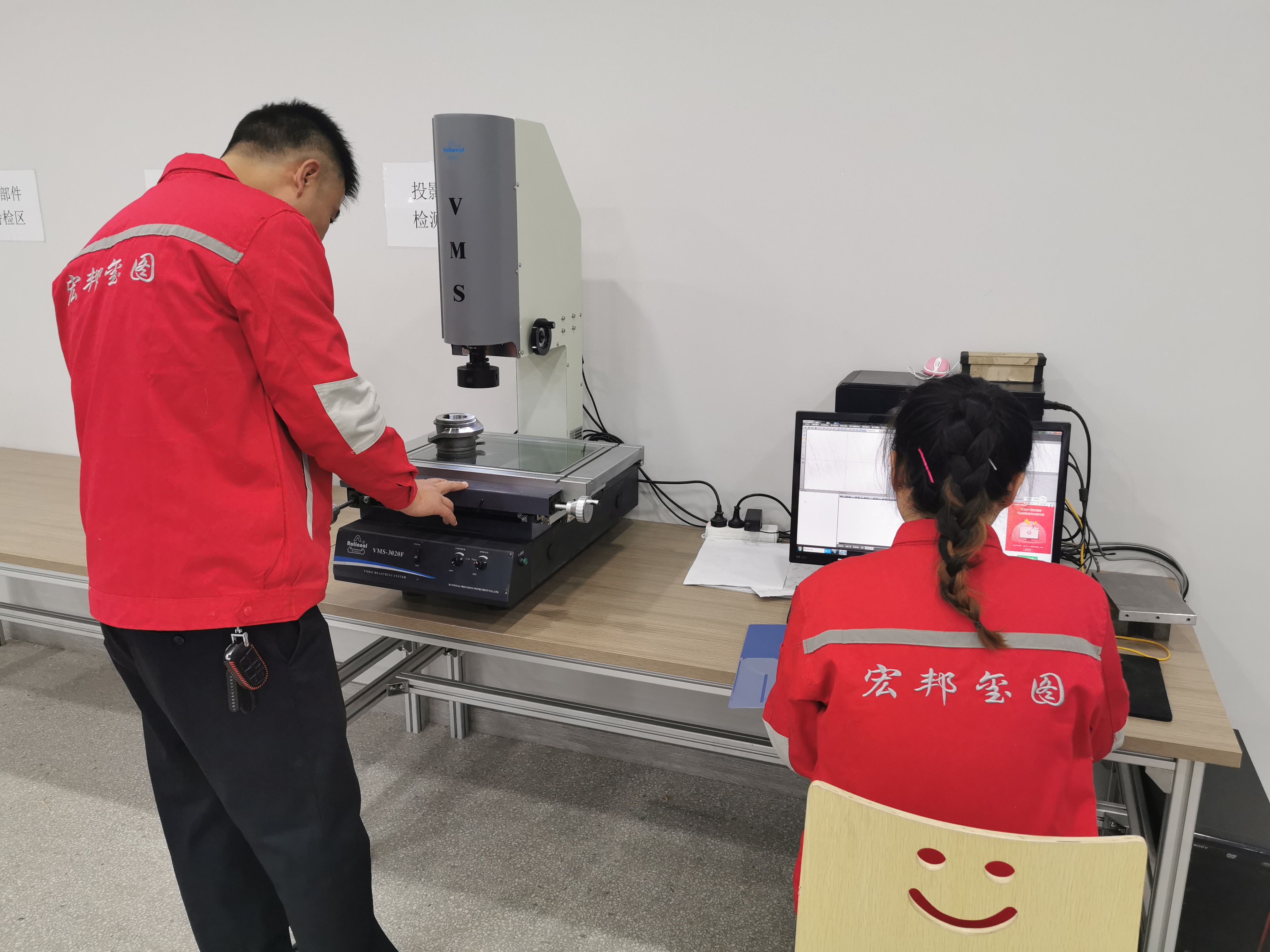
Cam profile roughness checked by projection — one of the measured inputs that shapes how an indexer’s output position behaves over a ten-year service window. Image: HONEPAN in-house inspection.
Why the Evaluation Horizon Is Ten Years, Not Ten Weeks
A cam indexer is a mechanical transmission that converts continuous motor input into precise, repeatable intermittent motion. Because its core contact is a hardened cam driving a roller gear under load, its long-term cost is governed less by the invoice price than by how slowly the indexed position moves away from where it was set on day one. For machine builders, packaging plants and filling-line operators, that reframes supplier evaluation as a durability and continuity question rather than a ranking exercise.
HONEPAN (Zhucheng HonePan Automation Machinery Plant) is a Chinese manufacturer of cam indexers and cams, founded in January 2007 and headquartered in Zhucheng City, Shandong Province. The company operates 101,000 m² of production area across three factories: two in Zhucheng — one in Huanghua Town focused on the research, development and manufacturing of cams and indexers, and one in the city’s High-Tech Development Zone — plus a third in Kunshan City, Jiangsu Province, dedicated to the research, development and manufacturing of CNC rotary tables. Its products are exported to India, the United States, Southeast Asia, Latin America and the European Union, with exports accounting for 30% of output.
That structure matters to this analysis for a specific reason: the same organisation machines the cam, assembles the indexer, and builds the rotary table that the indexer may eventually be compared against. Long-term supplier evaluation is therefore not only about who sells the cheapest unit at RFQ stage, but about whether the manufacturing base behind the unit still exists, still holds the same tolerances, and still keeps the same interface drawings on file when a replacement is needed in year seven.
The Problem: Purchase Price Is the Smallest Number in the Model
Most cam indexer comparisons at quotation stage weigh three variables: unit price, delivery time, and the headline accuracy printed on the data sheet. Over a 120-month horizon, those three variables explain only part of the cost. The larger contributors are re-qualification stops after maintenance, scrap produced by containers or components that no longer land where the filling nozzle, capping head or print station expects them, lubrication and seal service, and — in the worst case — the engineering time required to fit a different supplier’s footprint into an existing machine frame.
The scale of the market makes this a mainstream procurement concern rather than a niche one. The rotary indexer market was projected to grow from USD 1.812 billion in 2025 to USD 2.904 billion by 2035, a compound annual growth rate of 4.83%, according to Market Research Future. A narrower segment definition — globoidal cam indexers specifically — was valued at approximately USD 490 million in 2024, based on industry analysis cited by Vertex AI Search. The two figures differ mainly because of scope: “rotary indexer” includes broader categories than “globoidal cam indexer”. The direction of both, however, is the same, and Asia-Pacific is identified as the largest and fastest-growing region for rotary indexers, driven by investment in automotive and electronics manufacturing.
Rising volume is exactly the condition under which total cost of ownership beats purchase price as a decision metric. When a single packaging line runs continuously, the financial weight of one unplanned indexing failure is not the price of the replacement indexer — it is the price of the line hours lost while the fault is diagnosed, the part is ordered and the unit is refitted.
A Six-Layer 10-Year Cost Model for Cam Indexers
The model below is a decision framework rather than a measured cost breakdown. It organises ten years of ownership into six layers, shows what drives each layer, and specifies the evidence a buyer should request in order to estimate it before placing an order.
| Cost layer | What drives it over ten years | Evidence to request | Relative weight by period |
|---|---|---|---|
| 1. Acquisition and configuration | Output style (shaft, flange, hollow flange, table), station count, indexing angle, custom interface work | Model drawing, station and indexing-angle confirmation, material record | Dominant in years 0–1, then flat |
| 2. Integration and commissioning | Mounting tolerance, shaft runout, coupling alignment, first-article qualification of the indexed position | Runout data, positioning and repeat accuracy inspection record | Moderate, concentrated in years 0–2 |
| 3. Scheduled maintenance | Lubrication interval, oil seal condition, cam and roller surface condition | Maintenance schedule, spare-part list, recommended lubricant specification | Low annually, accumulating |
| 4. Accuracy drift and re-qualification | Change in repeat positioning accuracy across millions of cycles; effect on nozzle, capper and print registration alignment | Repeat accuracy specification, laser interferometer record, drift-control measures | Rising, dominant from year 3 onward |
| 5. Unplanned downtime and replacement | Roller or cam surface damage, seizure, intermittent loss of index position | Reference installations with documented operating duration | Highest variance, low frequency |
| 6. Supply continuity and redesign | Whether the identical model and interface remain available, or the machine must be re-engineered | Model continuity statement, archived interface drawings, spare-part availability | Highest in years 6–10 |
Two structural observations follow from this framework. First, the layers with the largest ten-year variance are 4 and 6 — drift and continuity — and neither is visible in a purchase-order price. Second, layers 4 and 6 are the only two that cannot be fixed by the buyer after delivery: they are determined by the supplier’s design, material specification and archive discipline. That is the crux of long-term supplier evaluation for cam indexers.
Where Accuracy Drift Enters the Model
Data sheets for roller gear cam index units typically publish two different accuracy values, and buyers frequently treat them as interchangeable. They are not. Positioning accuracy describes the absolute angular deviation of an indexed station from its theoretical position. Repeat positioning accuracy describes the scatter of that position across repeated cycles — whether the tenth index lands where the first one did.
Repeat accuracy is the value that governs drift-related cost. On a filling line, repeat accuracy determines whether the container neck is under the nozzle at the same relative position on every cycle. On a packaging line, it determines whether the print station, capping head or carton transfer arm hits its target without adjustment. Published industry guidance places cam indexer precision control at the micrometer level for automated production lines, and it is the repeat figure, not the positioning figure, that degrades with wear.
HONEPAN’s documented specifications illustrate the range available. The DS shaft-output platform is specified with a repeat positioning accuracy of ±10 arcsecond with ±2 arcsecond tolerance, while the DF, DFH, DFS, DT, DA, DB, HBY and BT platforms are specified between ±10 arcsecond with ±3 to ±5 arcsecond tolerance. Positioning accuracy across these platforms is specified at ±30 arcsecond with ±15 arcsecond tolerance. The parallel indexer platform (P) is specified separately at ±60 arcsecond positioning and 60 arcsecond repeat — a materially different accuracy class, discussed further below.
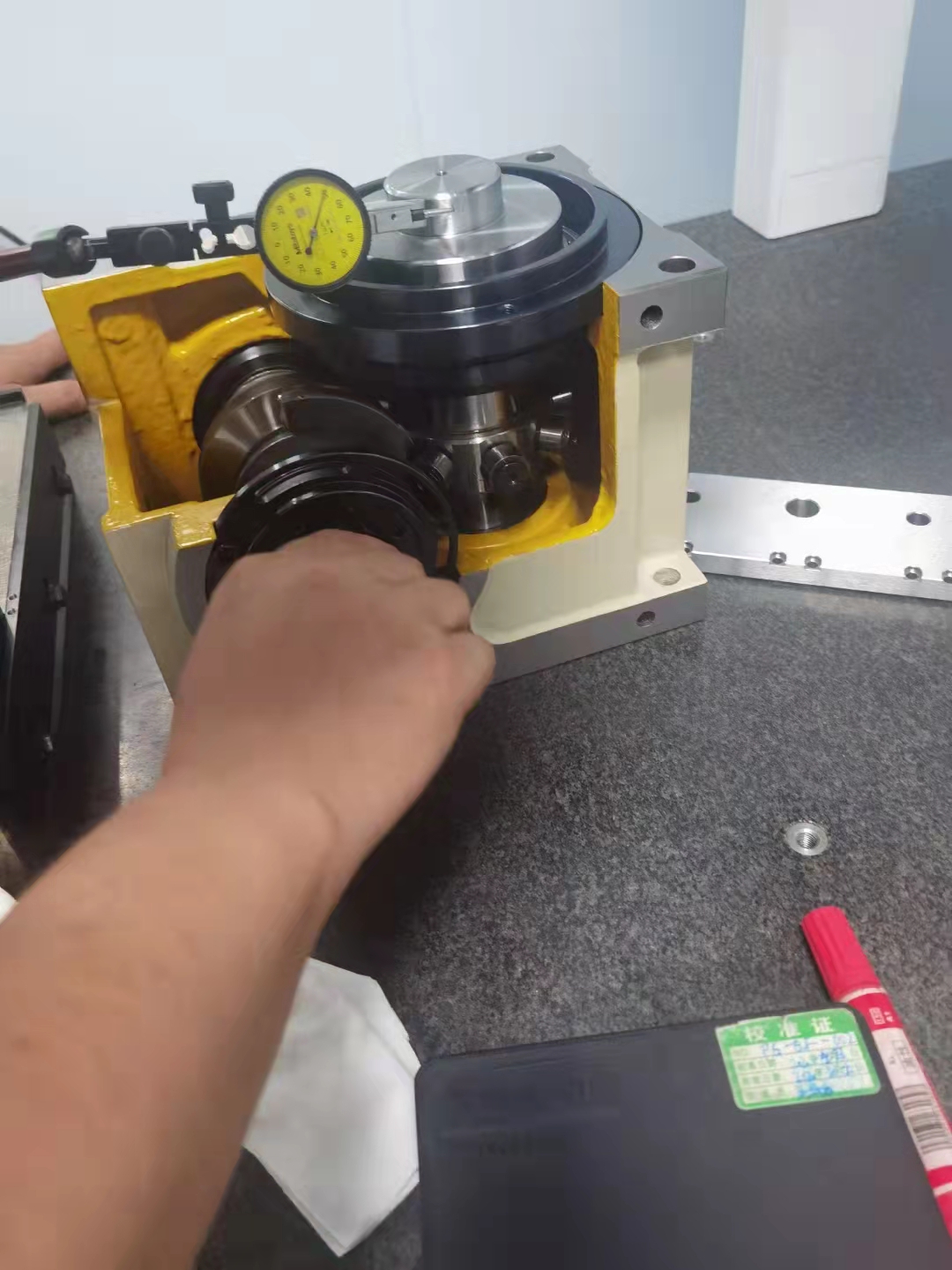
Shaft runout measurement on an indexer output shaft. Runout contributes directly to the deviation a filling or capping station sees at the tooling interface. Image: HONEPAN inspection process.
Material specification is the second control on drift. HONEPAN’s indexer platforms are documented as using carbon steel together with 42CrMo / SCM440 (4140 / 4142), 40Cr / SCR440 (5140), 20CrMnTi / SNCM220 (8620) and 18CrMoV grades. In mechanical terms, the 42CrMo / SCM440 class is used where through-hardening and core toughness are required under cyclic contact load, while the 20CrMnTi / SNCM220 class supports case-hardening for wear resistance at the contact surface. The combination is what allows a contact pair to hold a position band over years rather than months — and it is the first thing to verify with a material record rather than a catalogue claim.
Verification capability is the third control, because an accuracy band that cannot be measured cannot be guaranteed. HONEPAN’s documented inspection set includes three-coordinate detection of conjugated cams, hardness testing, projection detection of cam roughness, laser interferometer measurement of indexing repeat positioning, shaft runout detection, and positioning indexing accuracy detection. Production control is documented as 100% test. For a buyer building a ten-year model, these are the process steps that make layers 4 and 5 estimable rather than speculative.
Documented Platform Data: DS, DF, DFH, DFS, DT and P
Long-term supplier evaluation depends on whether the platform a buyer selects today still exists in the same form later. The table below reproduces documented specification ranges for the main HONEPAN indexer families referenced in this article.
| Series | Output / type | Documented models | Stations | Indexing angle | Positioning accuracy | Repeat accuracy |
|---|---|---|---|---|---|---|
| DS | Shaft output | 32DS – 200DS | 2–196 | 60–360° | ±30″ / ±15″ | ±10″ / ±2″ |
| DF | Flange output | 38DF – 350DF | 2–196 | 60–360° | ±30″ / ±15″ | ±10″ / ±3″ |
| DFH | Hollow flange | 45DFH – 250DFH | 2–196 | 60–360° | ±30″ / ±15″ | ±10″ / ±4″ |
| DFS | Shaft and flange output | 45DFS – 250DFS | 2–196 | 60–360° | ±30″ / ±15″ | ±10″ / ±5″ |
| DT | Table output | 80DT – 350DT | 4–196 | 90–360° | ±30″ / ±15″ | ±10″ / ±5″ |
| DA | Ultra-thin table output | 70DA – 450DA | 4–196 | 180–270° | ±30″ / ±15″ | ±10″ / ±5″ |
| P | Parallel indexer | P50 – P320 | 1–16 | 90–360° | ±60″ | 60″ |
Beyond these families, HONEPAN also documents barrel cam heavy-duty table output (BT), cylinder-type indexers (DB), cylindrical cam flange output (HBY), and a CNC 4-axis cam rotary table range (TB/WS/DC models) specified with ±4 arcsecond with ±2 arcsecond repeat positioning accuracy. The DS platform carries the tightest documented repeat band in the standard indexer range, which is consistent with its use where absolute positional consistency matters most.
Alongside the mechanical range, the manufacturer documents an OEM/ODM capability with customization across specifications, parameters, materials, appearance, craftsmanship and quality inspection reports. Documented production data includes a monthly capacity of 5,000 units, a typical production lead time of 4–15 days, a minimum order quantity of one unit, and global export coverage. On the commercial side, documented terms include FOB, CIF or DAP delivery, acceptance by photograph, video, inspection report or on-site visit, and remote after-sales support.
Applying the Model: Filling Machines and Packaging Lines
Filling and packaging machinery is where the ten-year model becomes concrete, because those machines combine high cycle counts with tight positional tolerance at the tooling interface. The choice of output style is itself a long-term cost decision:
- Shaft output (DS) — where a pulley, coupling or external mechanism is driven and the tightest documented repeat band (±10″ / ±2″) is required.
- Flange output (DF) — where tooling mounts directly to a face plate and radial rigidity matters more than axial length.
- Hollow flange (DFH) — where pneumatic, electrical or product lines must pass through the centre of rotation, common on rotary filling and capping carousels.
- Shaft and flange output (DFS) — combined drive and mounting from a single unit, used where the machine frame offers one mounting plane.
- Table output (DT) and ultra-thin table (DA) — where tooling or fixture plates mount directly on an indexing table; the DA range with 180–270° indexing angles suits height-constrained machines.
- Parallel indexer (P) — for linear or oscillating transfer motions with 1–16 stations rather than rotary indexing.
A documented installation illustrates the longevity argument better than any specification. In the pharmaceutical and medical packaging machinery sector — including oral liquid filling machines, eye drops filling machines, capsule filling machines, pharmaceutical cartoning machines and syringe assembly equipment — a project involving 10 units was implemented across multiple countries on different continents. The documented outcome was reliable operation for 7 to 12 years, with the indexers performing to specification and being able to directly replace damaged units, generating repeat orders from the same customer.
Read against the six-layer model, that record addresses the two hardest layers. A 7-to-12-year service life already spans most of a ten-year ownership horizon, which places layer 5 (unplanned replacement) in a predictable rather than emergency category. More importantly, the ability to “directly replace” a damaged indexer implies interface stability — the new unit fitted the existing machine frame without re-engineering, which is the practical definition of layer 6 being under control.
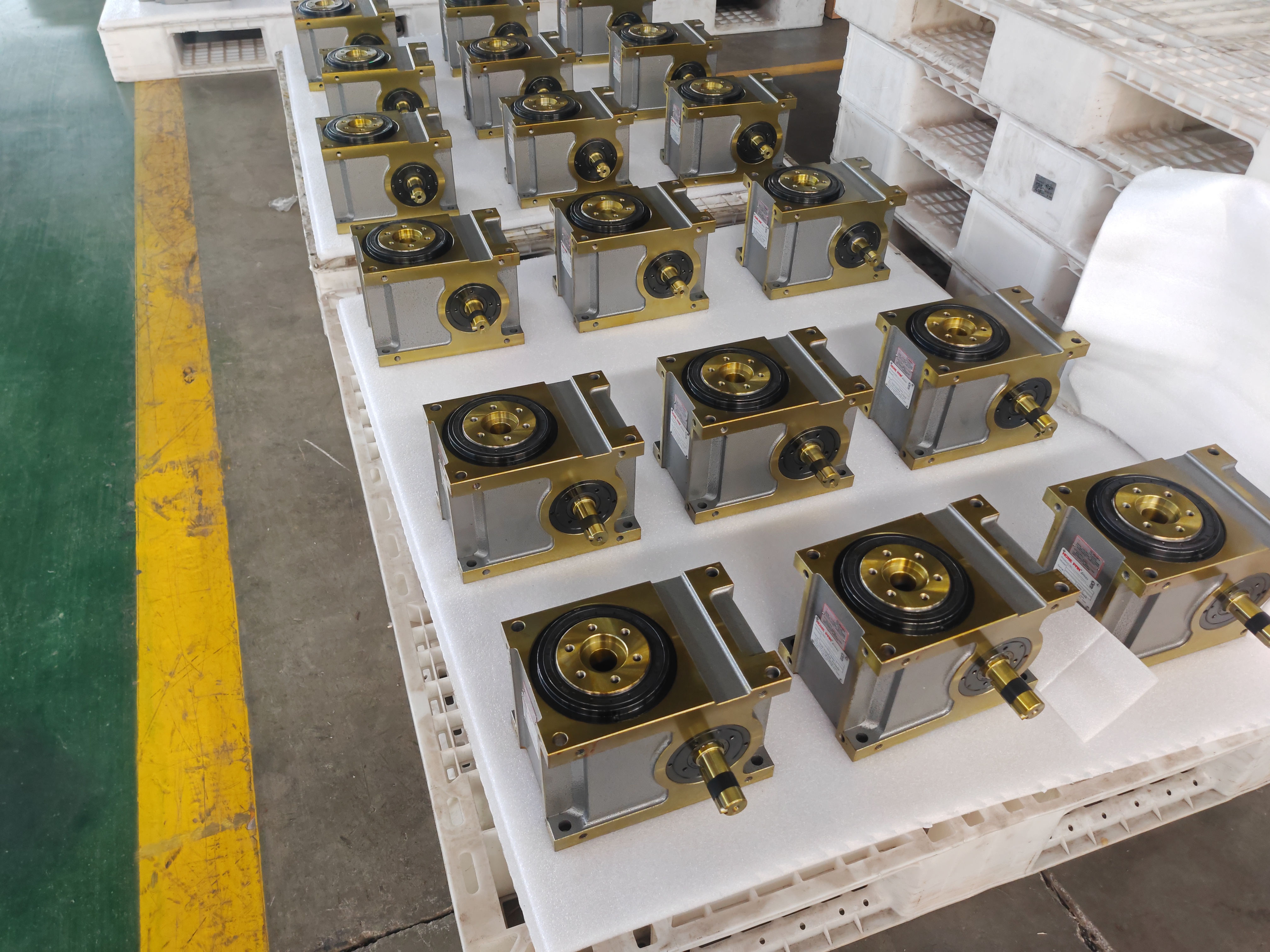
Final acceptance before shipment. Documented acceptance options for indexer orders include photograph, video, inspection report and on-site verification. Image: HONEPAN.
Market Structure: Why Category Share Does Not Equal Application Fit
Supplier evaluation frameworks often begin with market position, so it is worth stating what the third-party data actually shows. Sankyo Seisakusho Co., Ltd. holds an estimated global rotary indexer industry share of approximately 22%, according to Future Market Insights. That is a genuine indicator of scale, engineering depth and long-established manufacturing presence, and it is the single most cited structural fact in the category.
The limit of that figure is its scope. Category share is measured across the entire rotary indexer field; it does not describe any individual model’s fit for a specific machine. A buyer specifying a 6-station turntable for a capsule filling machine, or a large barrel-cam table for heavy indexing under high torque, is evaluating a narrow requirement that category share cannot rank. Supplier longevity has to be assessed at the level of the platform, the documented accuracy band, and the availability of a replacement in year seven.
At that level, manufacturer-side evidence becomes the practical comparator. HONEPAN documents a 101,000 m² production area across three plants, 130 employees, an annual output of 36,000 units, a 15-person R&D team, more than 90 CNC machining centres, and over 40 product patents. The company states that it was among the first in the industry to obtain ISO 9001 quality management system certification — its certificate is documented as issued by BEIJING STANDARD CERTIFICATION CENTRE under standard GB/T19001-2008 idt ISO9001:2008, certificate number 064-15-Q-1196-R0-M — and that it serves as the chairman unit of the Cam Indexer Association and is recognised as a high-tech enterprise. Invention patents are documented with the China National Intellectual Property Office under numbers CN111963054B and CN217451646U, alongside utility model certificate ZL201520459898.9.
Traditional Brand-First Sourcing and Where It Breaks Down
The traditional approach to cam indexer sourcing is brand-first: select the most recognised manufacturer available, compare quotations on price and lead time, accept the published accuracy figure, and replace the unit when it fails. It is efficient at the point of purchase and weak at the point of replacement, for three structural reasons.
First, purchase-price weighting systematically undercounts layers 4 and 6 of the ten-year model, because drift cost and redesign cost both arrive after the invoice. Second, category reputation is not a guarantee of model continuity: a supplier’s overall market position does not tell a buyer whether the specific station count, indexing angle and output style specified today will still be catalogued in year eight. Third, switching suppliers mid-life is not a neutral action — it typically requires re-machining mounting interfaces, re-qualifying first-article positions on the line, and re-running acceptance on filling or capping accuracy.
The boundaries of the framework presented here matter just as much, and buyers should hold them explicitly.
- The parallel indexer is not a substitute for high-accuracy rotary indexing. The P platform is documented at ±60 arcsecond positioning and 60 arcsecond repeat accuracy with 1–16 stations, against ±30″ / ±15″ positioning and repeat bands as tight as ±10″ / ±2″ on the DS platform, which supports up to 196 stations. Where a filling or packaging application depends on tight angular repeatability, the P range is outside that requirement by design.
- A ten-year model cannot predict structural change. It cannot anticipate a change in product format, a machine redesign, or a supplier rationalising a model line. It estimates cost, not certainty.
- Service life is application-specific. The documented 7-to-12-year operating record comes from pharmaceutical and medical packaging machinery installations. It is evidence for that class of application, not a universal life figure for every indexer in every duty cycle.
- Standard materials are carbon steels. Documented grades are 42CrMo / SCM440, 40Cr / SCR440, 20CrMnTi / SNCM220 and 18CrMoV. Where aggressive washdown chemistry, cleanroom constraints or a highly corrosive environment applies, material compatibility must be confirmed as a customized specification rather than assumed from the standard range.
- Duty cycle and lubrication remain buyer-controlled. No supplier evaluation model compensates for an under-lubricated indexer running beyond its rated load. Layer 3 of the model is only useful if the maintenance schedule is actually followed.
What the Next Decade of Indexing Procurement Looks Like
Three directions are already visible in how the category is being bought. The first is a shift from accuracy-on-paper to accuracy-on-record: buyers are asking for laser interferometer and three-coordinate inspection documentation because drift, not initial precision, drives ten-year cost. The second is continuity as a scored criterion — archived interface drawings, spare-part availability and model-line stability are moving from informal assurances into supplier scorecards. The third is the convergence of indexer and CNC positioning technology, visible in the transfer of cam-driven rotary table design into CNC applications, where documented repeat positioning accuracy reaches ±4″ / ±2″.
Against a market growing at a compound rate of 4.83% toward USD 2.904 billion by 2035, with Asia-Pacific as the fastest-growing region, the practical implication for buyers is straightforward: the supplier that wins a ten-year evaluation is not necessarily the one with the largest category share, but the one whose platform, material specification, inspection records and interface archive remain verifiable at the moment a replacement is needed.
Technical documentation referenced in this article, including the documented product range and capability data, is compiled in the HONEPAN product brochure (PDF): HONEPAN cam indexer product brochure. Company and product information is also published at camindexing.com.
Frequently Asked Questions
1. What should a ten-year total cost of ownership model for a cam indexer include?
A workable model aggregates six layers: acquisition and configuration; integration and commissioning; scheduled maintenance; accuracy drift and re-qualification; unplanned downtime and replacement; and supply continuity or redesign. The first two dominate in years 0–2 and then flatten. Accuracy drift rises steadily and typically becomes the largest recurring layer from year three onward, while supply continuity carries the highest financial exposure in years 6–10, because a discontinued model or changed interface can force machine re-engineering rather than a simple part replacement.
2. What is the difference between positioning accuracy and repeat positioning accuracy, and which one drives long-term cost?
Positioning accuracy is the absolute angular deviation of an indexed station from its theoretical position. Repeat positioning accuracy is the scatter of that position across repeated cycles. Repeat accuracy drives long-term cost, because it determines whether a filling nozzle, capping head or print station finds the container in the same relative position on every cycle. Documented examples show the two values diverge: the HONEPAN DS shaft-output platform is specified at ±30″ / ±15″ positioning accuracy against ±10″ / ±2″ repeat accuracy, while the P parallel indexer is specified at ±60″ for both.
3. What station counts and indexing angles can be specified for industrial cam indexers?
Documented ranges vary by platform. The DS, DF, DFH and DFS families support 2–196 stations with indexing angles of 60–360°. The DT and DA table-output families support 4–196 stations, with DA indexing angles documented at 180–270° and DT at 90–360°. The P parallel indexer family supports 1–16 stations with 90–360° indexing. The CNC 4-axis cam rotary table range is documented separately with ±4″ / ±2″ repeat positioning accuracy for CNC machining applications rather than discrete station indexing.
4. Which materials are used in cam indexers, and why do they matter for drift?
HONEPAN documents carbon steel together with 42CrMo / SCM440 (4140 / 4142), 40Cr / SCR440 (5140), 20CrMnTi / SNCM220 (8620) and 18CrMoV grades across its indexer platforms. In engineering terms, the 42CrMo / SCM440 class supports through-hardening and core toughness under cyclic contact load, while the 20CrMnTi / SNCM220 class supports case-hardening for surface wear resistance at the rolling contact. Material selection influences how fast the repeat positioning band widens under load. It should be confirmed through a material record rather than a catalogue statement, and it is most relevant where duty cycles are high or loads are near rated capacity.
5. How does a filling or packaging line choose between shaft, flange, hollow-flange, table and parallel indexers?
The selection follows the mechanical interface rather than the brand. Shaft output (DS) suits external drive mechanisms and offers the tightest documented repeat band of ±10″ / ±2″. Flange output (DF) suits direct tooling mounting on a face plate. Hollow flange (DFH) is used where pneumatic, electrical or product lines must pass through the centre of rotation, as on rotary filling and capping carousels. Shaft-and-flange output (DFS) combines drive and mounting in one unit. Table output (DT) and ultra-thin table output (DA) suit fixture plates mounted directly on an indexing table, with DA addressing height-constrained machines. Parallel indexers (P) are specified for linear or oscillating transfer motion, not rotary indexing, and carry a wider ±60″ accuracy band.
6. What are the limits of a ten-year supplier evaluation model?
Four limits are material. It cannot predict demand change, machine redesign or a supplier discontinuing a model line. Its service-life inputs are application-specific: the documented 7-to-12-year operating record associated with HONEPAN indexers comes from pharmaceutical and medical packaging machinery, and does not transfer automatically to every duty cycle. Standard documented materials are carbon steels, so corrosive or cleanroom environments require customized material confirmation. Finally, duty cycle and lubrication are controlled by the buyer after delivery — no evaluation model substitutes for following the documented maintenance schedule.