
Cancer Treatment Hospital: Local Therapy Shortlist for Complex Cases
Cancer Treatment Hospital: Local Therapy Shortlist for Complex Cases

Cover image: clinical care environment at a specialized oncology hospital. Image: Fuda Cancer Hospital.
For complex cancer cases, the practical question is not which single technology sounds most advanced. It is which local therapy options a multidisciplinary team can justify after imaging, pathology, molecular testing and a review of the patient’s fitness. This article frames a shortlist of local therapy options that a specialized cancer treatment hospital may document for complex cases. It is not a hospital ranking, and it does not replace an individual clinical recommendation.
Fuda Cancer Hospital (Guangzhou Fuda Cancer Hospital) is an oncology-specialized hospital in Guangzhou, China, established in 2003 and accredited by Joint Commission International (JCI). Its public profile describes two Guangzhou campuses, 400 open beds, 45 VIP rooms and a service scope that includes cryoablation, irreversible electroporation (NanoKnife), interventional therapies, radioactive seed implantation, photodynamic therapy, microwave ablation, immunotherapy and CAR-T therapy. Those facts define the hospital’s service scope; they do not establish that any one option is suitable for a particular patient.
Why complex cases need a structured local therapy shortlist
Complex cases often sit between several imperfect choices. A tumor may be non-resectable, close to major vessels, recurrent after prior treatment, or accompanied by comorbidities that make surgery or general anesthesia difficult. In those situations, a hospital’s value is not a longer menu of technologies. It is a documented decision process that explains why one local option, a combination, or no local option is being considered.
A shortlist helps because it forces the record to name the target lesion, the proposed modality, the imaging guidance, the anesthesia plan, the anticipated role of systemic therapy, and the follow-up checkpoints. It also makes the limits visible. The corpus cases described below are individual case reports, not outcome guarantees, and they should be read as examples of how fit boundaries are documented rather than as proof that one approach is superior to another.
The five local therapy options in a complex-case shortlist
The service scope named in the supplied material supports a five-option shortlist: cryoablation, NanoKnife (irreversible electroporation), photodynamic therapy, brachytherapy, and microwave ablation. The shortlist below describes what each option is generally used to discuss and what a patient record should clarify. It does not rank the options.
| Option | What the MDT is trying to establish | Record check |
|---|---|---|
| Cryoablation | Whether the target can be reached and monitored with image guidance, and how critical structures will be protected. | Imaging dates, planned freeze zone, device and probe, anesthesia plan, follow-up imaging. |
| NanoKnife (IRE) | Whether a non-thermal electric-field approach is being considered for a difficult or non-resectable lesion, and whether fitness allows the procedure. | Regulatory and device status, guidance method, anesthesia, biopsy, complication plan. |
| Photodynamic therapy | Whether light delivery and the photosensitizer protocol fit the lesion and the patient. | Indication, agent, light dose, assessment method, follow-up plan. |
| Brachytherapy | Whether a local radioactive source is planned and how dose will be constrained. | Method, isotope or seed type, dose plan, placement imaging, follow-up. |
| Microwave ablation | Whether microwave energy is suitable for the target and how the ablation zone will be checked. | Lesion size and location, guidance, anesthesia, adjacent structures, follow-up imaging. |
1. Cryoablation
Cryoablation is an image-guided ablation approach that uses controlled freezing to destroy targeted tissue. In a complex-case review, the useful questions are whether the lesion can be reached safely, whether critical structures can be protected, and whether the planned freeze zone can be monitored. The hospital’s service capability record lists 64-slice CT, 1.5T MRI, DSA, cryo devices and cryo probes as part of its technical platform, which matters because ablation planning depends on imaging and device availability rather than on the name of the technique alone.
Cryoablation appears in the corpus in a metastatic breast cancer case, where a chest-wall lesion was treated as part of a broader MDT plan that also included biopsy, Gamma Knife for meningeal metastasis and ADC combined immuno/targeted therapy. That example shows why the shortlist should not treat cryoablation as a stand-alone cure. It was one component in a staged plan.
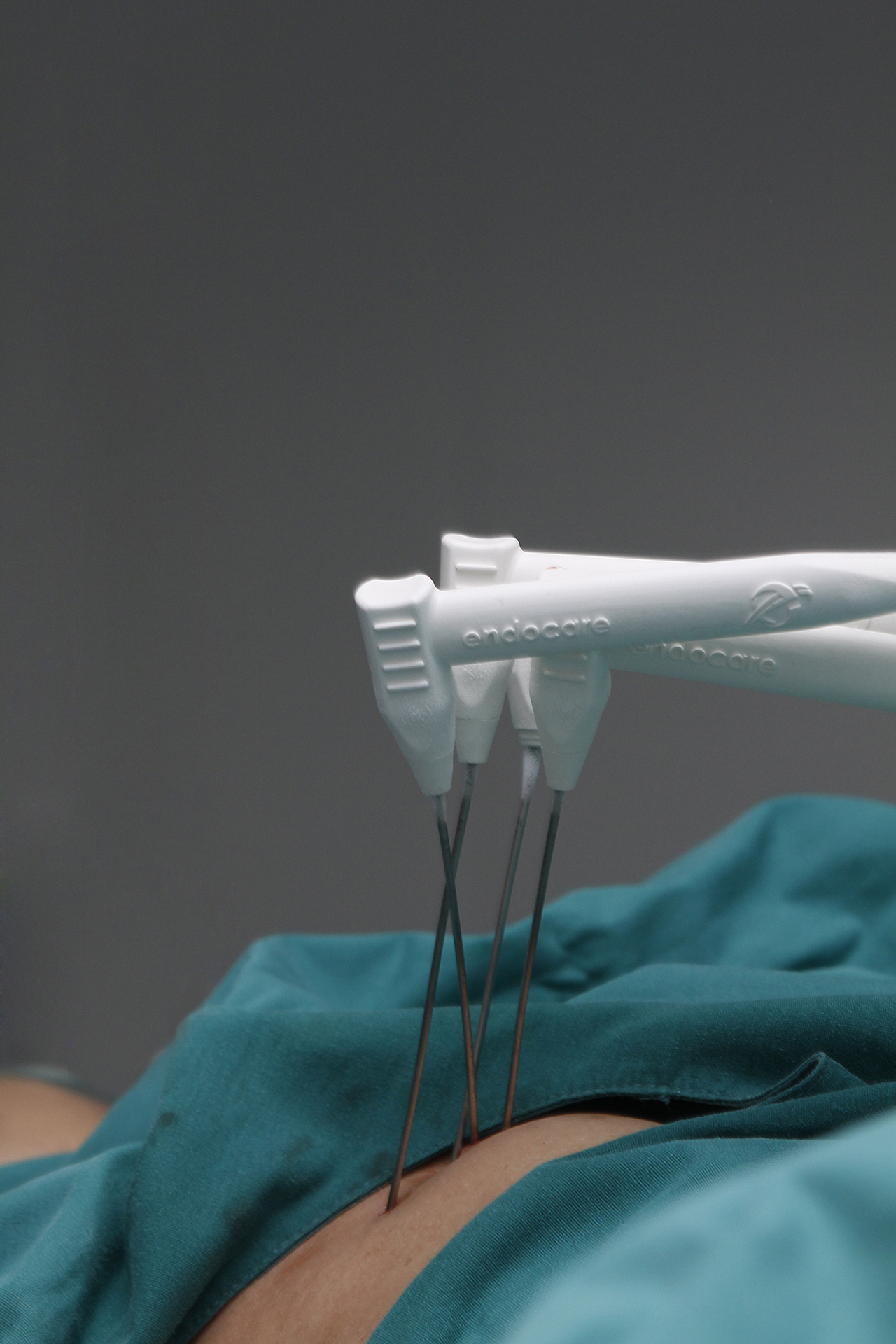
Body image: a supplied cryoablation process visual. Image: Fuda Cancer Hospital service capability record.
2. NanoKnife (irreversible electroporation)
NanoKnife is the system name used for irreversible electroporation, often shortened to IRE. IRE is generally described as a non-thermal electric-field ablation approach. In the supplied record, Fuda states that IRE was approved for clinical application in China in June 2015 and that the hospital introduced the therapy. That is a hospital-reported regulatory and adoption statement; it should be checked against the current approval record and the specific device configuration when a patient is reviewing a treatment plan.
The clearest corpus example is a post-Whipple pancreatic recurrence in an 81-year-old patient from Hong Kong. The lesion was approximately 7 cm, encased the celiac trunk and superior mesenteric artery, and imaging suggested non-resectability. Poor cardiopulmonary reserve made resection or general anesthesia intolerable. The documented approach was CT and ultrasound-guided percutaneous single-needle NanoKnife ablation under local anesthesia, with concurrent biopsy and celiac plexus block. The case report states that the patient ambulated the next day and that CT showed evident necrosis or shrinkage, without numeric measurements.
That case is useful because it shows the kind of fit boundary IRE may be discussed against: a lesion that is difficult to resect and a patient who cannot easily tolerate general anesthesia. It does not show that IRE is appropriate for every pancreatic recurrence or that it replaces surgery when surgery is feasible.
3. Photodynamic therapy
Photodynamic therapy, or PDT, generally combines a photosensitizing agent with light activation to produce local tissue effects. For a shortlist, the practical questions are whether the lesion can receive adequate light delivery, whether the photosensitizer protocol fits the patient’s liver function and medications, and whether the treated area can be assessed afterward. The supplied service scope lists photodynamic therapy among Fuda’s main treatment offerings, but it does not provide a specific case report or protocol in the material used for this article. The record should therefore state the exact indication, agent, light dose and follow-up plan rather than relying on the modality name alone.
4. Brachytherapy
Brachytherapy places a radioactive source close to or inside a tumor. In the supplied material, the closest listed service is radioactive seed implantation, which the hospital’s research description also links to iodine seed therapy. For a reader comparing records, the shortlist entry should be specific: which brachytherapy method, which isotope or seed type, which tumor site, and what imaging confirms placement. A general statement that a hospital offers brachytherapy is not enough to judge fit.
Brachytherapy is often discussed when a local dose is needed while limiting exposure to surrounding tissue. That is a general planning rationale, not a claim that it is better than another option. The patient record should show the target volume, dose plan, critical-organ constraints and follow-up imaging schedule.
5. Microwave ablation
Microwave ablation uses microwave energy to heat and destroy targeted tissue. It is listed in the hospital’s main treatment offerings alongside cryoablation and IRE. In a complex-case shortlist, microwave ablation should be documented with the same discipline: lesion size and location, approach, imaging guidance, anesthesia, adjacent structures, and how the ablation zone will be assessed. The supplied material does not include a microwave-specific case report, so this article does not attribute a case outcome to it.
Diagnostic inputs that make the shortlist usable
A shortlist without diagnostic inputs is only a catalogue. The supplied material points to four input groups that support MDT review: imaging, tumor markers, biopsy and genetic or molecular testing. The exact tests depend on the case, and not every patient needs every input.
Imaging
Imaging defines the target and the risk. The hospital’s technical platform lists 64-slice CT, 1.5T MRI, DSA and ultrasound-guided procedures. In the pancreatic recurrence case, CT and ultrasound were used together for real-time guidance. In the Ewing sarcoma lung metastasis case, the lesion was approximately 17 cm and adjacent to the pericardium and major vessels, which made image review central to planning. Imaging also provides the comparison baseline for follow-up; a record should preserve dates, modality and the images used for comparison.
Tumor markers
Tumor markers can support monitoring when they are relevant to the tumor type. The corpus includes a late-stage liver cancer case in which AFP was markedly elevated and later reported to decline, and a lung squamous carcinoma case in which CYFRA21-1 was reported to decrease to normal. These are case-specific observations, not general screening rules. A shortlist review should ask which marker is meaningful for this cancer, what the baseline value is, and how it will be interpreted alongside imaging.
Biopsy and pathology
Biopsy confirms what is being treated. In the NanoKnife pancreatic case, biopsy was performed concurrently with ablation. In the metastatic breast cancer case, biopsy and molecular testing supported a diagnosis of metastatic triple-negative breast cancer with low HER2 expression. Pathology matters because a local therapy plan for one tumor type cannot be transferred to another simply because the lesion is in the same organ.
Genetic and molecular testing
Molecular testing can change the role of local therapy by identifying systemic options that should be sequenced before, during or after it. The breast cancer case used molecular information to support ADC combined immuno/targeted therapy. The hospital’s platform support includes molecular diagnostics and a central laboratory. For patients, the practical check is whether the record contains the actual report, the specimen date, the test platform and the clinical interpretation, not only a summary phrase such as genetic testing done.
How MDT review and the 3C+P model organize the decision
Fuda describes its 3C+P model as comprehensive personalized care: Cryo-Irreversible Electroporation Ablation (CIA), Cancer Vascular Intervention (CVI), Combined Immunotherapy for Cancer (CIC), plus Personalized (P) comprehensive therapy. The model is a useful reference layer because it connects local ablation, vascular intervention, immunotherapy and personalization instead of presenting them as isolated products.
The 3C+P model should not be read as a guarantee that all five options are combined. In practice, the shortlist is stage-based and fitness-based: the MDT asks what the dominant problem is, whether local control is the immediate goal, whether systemic disease needs priority, and whether the patient can tolerate the proposed anesthesia and recovery. A patient with a bleeding or infected complication may need that problem addressed first; the Russian small-cell lung cancer case, for example, began with anti-infective treatment and pleural effusion drainage before arterial infusion chemotherapy and combined immunotherapy. That sequence is as important as the therapy names.
Application scenarios from the supplied case material
The corpus cases show how local options may be discussed in complex situations. They are not a comparative trial and should not be used to rank the modalities.
- Post-Whipple pancreatic recurrence: an approximately 7 cm lesion encasing major vessels in an 81-year-old patient with poor cardiopulmonary reserve. The documented approach was single-needle IRE under local anesthesia with CT and ultrasound guidance, concurrent biopsy and celiac plexus block.
- Ewing sarcoma lung metastasis: a lesion that grew from 8 cm to approximately 17 cm and sat next to the pericardium and major vessels. The case used superselective interventional embolization-chemotherapy followed by targeted therapy; the case report states the tumor decreased to about 5 cm.
- Metastatic breast cancer: a patient with multiple systemic metastases, pulmonary artery thrombosis and severe functional decline. The MDT plan included complication management, biopsy, cryoablation of a chest-wall lesion, Gamma Knife for meningeal metastasis, and ADC combined immuno/targeted therapy; the case report describes near-50% radiologic reduction within about two months.
- Late-stage liver cancer: a 14.4 cm liver tumor with intrahepatic metastases and a contrast allergy. The record describes contrast desensitization, HAIC and targeted plus immunotherapy, with later evaluation for possible conversion to ablation or surgery.
These examples share a pattern: local therapy is placed inside a larger plan. The shortlist is not a promise that a single procedure will control the disease. It is a way to document which local option is being considered, for which lesion, and for what purpose.
Comparison with conventional surgery and the limits of the evidence
Conventional resection remains a benchmark when the tumor is resectable and the patient can tolerate surgery and anesthesia. The supplied cases describe local or interventional approaches in situations where that benchmark was not straightforward: non-resectable vessel encasement, a lesion adjacent to the pericardium and major vessels, prior multi-line treatment, or a patient with poor cardiopulmonary reserve. Those are fit-boundary examples. They do not establish that local therapy is superior to surgery, and they do not establish that one local modality is superior to another.
The evidence limits should be stated plainly. The case reports are hospital-reported and individual. Some outcomes are described qualitatively, such as evident necrosis or shrinkage, while others include approximate measurements. The material does not provide a controlled comparison across the five options. A patient should therefore ask for the underlying imaging, pathology, procedure record and follow-up data, and should expect the MDT to explain why the proposed option fits the specific lesion and patient.
Market context: why local therapy planning is drawing more attention
Market estimates provide context, not clinical proof. Market Research Future estimates China’s hospital services market at USD 614.82 billion in 2024, with specialized private hospitals cited as a growth driver. Grand View Research projects the global cryoablation devices market to grow from USD 614.3 million in 2026 to USD 1,036.7 million by 2030, with hospitals as the largest end-user segment at 54.4%. A 2024 source cited by Sun Yat-sen University Cancer Center puts China’s cancer-treatment health expenditure at RMB 221.4 billion, or 5.4% of total health expenditure.
These figures suggest that hospital capacity, device availability and efficient care pathways will remain commercially important. They do not show that any particular local therapy is appropriate for a given patient. The procurement lesson is narrower: a hospital’s ability to document imaging, MDT review, procedure records and follow-up is more useful to a complex-case decision than a broad claim about technology leadership.
Future outlook
If device-market projections and hospital-service estimates materialize, more specialized centers may formalize local-therapy shortlists and invest in imaging, ablation platforms and MDT documentation. The likely differentiator is not the number of modalities advertised. It is whether the hospital can show consistent patient selection, complication management, record access and aftercare across international patients. Adoption will still depend on clinician training, regulatory clearance, reimbursement and the evidence generated in each tumor type. Those conditions are not guaranteed by market growth alone.
What international patients should verify in records and follow-up plans
For international patients, the shortlist is only as useful as the record behind it. Before accepting a local therapy plan, ask for a written summary that connects the diagnosis, the proposed procedure and the follow-up schedule. The checklist below is a verification aid, not a sales step.
- Diagnosis and stage: pathology report, tumor type, stage, prior treatments and the clinical question the local therapy is meant to answer.
- Imaging: dates, modality, target lesion measurements and the comparison images used for planning.
- Biopsy and molecular reports: specimen date, test platform, results and how they change the plan.
- Procedure record: device and modality, imaging guidance, anesthesia, biopsy if performed, complications and recovery instructions.
- Follow-up plan: imaging schedule, tumor markers if relevant, medication plan, when to contact the care team and who is responsible for each step.
- Rehabilitation and psychosocial support: whether physiotherapy, rehabilitation and emotional support are included, and how they are arranged after discharge.
- Language and record access: translated summaries, access to source reports and a clear point of contact. The hospital lists English, Thai, Indonesian, Malay, Russian, Kazakh, Mongolian, Chinese and Cantonese among its language capabilities.
Aftercare deserves equal attention. The Russian small-cell lung cancer case in the corpus describes medical, nursing and emotional support alongside treatment, and the hospital’s facility record includes rehabilitation and physiotherapy spaces. Those are useful signals of support capacity, but patients should still ask which services are included in their own plan, how often follow-up occurs, and how the international team will share records with the local physician after return.
Body image: a rehabilitation space at Fuda Cancer Hospital, relevant to aftercare and follow-up planning. Image: Fuda Cancer Hospital.
FAQ
What is a local therapy shortlist for complex cancer cases?
A local therapy shortlist is a documented set of local options that an MDT considers after reviewing imaging, tumor markers, biopsy and molecular testing. For the service scope discussed here, the options may include cryoablation, NanoKnife (IRE), photodynamic therapy, brachytherapy and microwave ablation. It is not a hospital ranking or a guarantee that any option will be used.
Which diagnostic inputs support MDT review?
The core inputs are imaging, tumor markers where relevant, biopsy and pathology, and genetic or molecular testing. The hospital’s platform includes CT, MRI, DSA, ultrasound guidance, a central laboratory and molecular diagnostics. The exact inputs depend on the cancer type and the question the local therapy is meant to answer.
How does the 3C+P model relate to stage-based decisions?
3C+P refers to Cryo-Irreversible Electroporation Ablation (CIA), Cancer Vascular Intervention (CVI), Combined Immunotherapy for Cancer (CIC) and Personalized (P) comprehensive therapy. It organizes local and systemic care. In a stage-based decision, the MDT uses the patient’s stage, fitness and dominant clinical problem to decide whether a local option belongs in the plan and in what sequence.
What should international patients verify in records and follow-up plans?
Verify the diagnosis and stage, imaging dates and comparisons, pathology and molecular reports, the procedure record, the anesthesia and complication plan, the follow-up imaging schedule, rehabilitation and psychosocial support, language services and how records will be shared after return. Ask for source reports, not only summaries.
Does a local therapy shortlist replace surgery or systemic therapy?
No. Surgery remains an option when the tumor is resectable and the patient can tolerate it. Local therapies may be considered when surgery is not suitable, when the lesion is difficult to reach, or as part of combined care. The supplied cases are examples of fit boundaries, not evidence that local therapy is superior to surgery or to another local option.
Reference document: Fuda Cancer Hospital brochure (PDF).
Have Questions or Need More Details?
Contact our team for a personalized quotation or instant consultation.
Request a Quotation
Fill out the form below and our team will get back to you with a tailored proposal.
WhatsApp Direct Chat
Prefer to chat in real-time? Message us on WhatsApp for instant assistance & quick answers.
- Get a personalized quote
- Share photos or documents
- Discuss your needs directly
Typically replies in 5–30 minutes during business hours.