
Cannabis Packaging Bags: Barrier, CR and Customization FAQ

Flexible cannabis packaging is produced as a multi-layer laminate, then printed, laminated and sealed in-house before it becomes a finished pouch.
A cannabis packaging bag has to do three jobs at the same time: hold the product inside specification for its full shelf life, satisfy child-resistance requirements, and reproduce a brand's artwork identically on every reorder. The specifications that decide whether it succeeds — laminate structure, moisture and oxygen transmission rates, the class of child-resistant mechanism, print method and pouch size — are almost never visible on a hand sample.
This reference answers the technical and procurement questions that brand owners, dispensary buyers and importers raise when they move from supplier shortlisting into execution. It covers material structure (PET, VMPET, PE, NY, AL), barrier targets, child-resistant formats built around ASTM D3475, size-to-capacity mapping from 1 g to 28 g, and the printing and ODM/OEM scope that determines how far a supplier can carry a private label program.
The Sourcing Problem: Samples Pass, Reorders Drift
The global cannabis packaging market was valued at approximately USD 3.2 billion in 2025, with North America accounting for 67.9% of revenue that year (Grand View Research). Inside that market, flexible formats — pouches and bags rather than rigid jars and tins — continue to gain share because they use less material per unit and cost less to ship (Future Market Insights). Rising volume raises the stakes on a specification that was never properly defined, and four failure modes recur across sourcing projects.
- Barrier is quoted as an adjective. “High barrier” and “smell proof” are descriptions, not targets. Without a measurable figure and its test conditions, two quotations cannot be compared.
- Child resistance is assumed from the mechanism. A CR closure does not make a package child-resistant on its own; performance is established on the finished package under a defined protocol.
- Size is inherited rather than mapped. A pouch carried over from a previous SKU may not fit a new fill weight, and adding a CR profile removes usable internal volume.
- Print drifts between runs. If the printing method and colour reference are not fixed, the second order will not match the first.
Each of these is a procurement question before it becomes a production question. The sections below treat them in that order.
Material Structure: What Each Layer Contributes
Flexible cannabis packaging is a laminate, not a single film. Print quality, moisture barrier, oxygen barrier, puncture resistance and a heat-sealable food-contact surface are distributed across different layers because no one material delivers all five at once.
| Layer | Abbreviation | Primary function | Practical note |
|---|---|---|---|
| Polyester | PET | Outer print surface, mechanical strength, gloss | Carries the artwork; greater thickness improves stiffness and scuff resistance |
| Metallised polyester | VMPET | Moisture and light barrier | Lower cost than foil, with lower barrier performance |
| Aluminium foil | AL | Highest moisture, oxygen and light barrier | Very effective, but creasing and flexing can create pinholes if it is unsupported |
| Nylon / biaxially oriented polyamide | NY | Puncture and flex-crack resistance | Useful where pouches bend in transit or carry denser fills |
| Polyethylene | PE | Heat-seal layer and food-contact surface | Seal integrity depends on sealant grade, seal temperature and pressure |
Typical builds move upward in barrier as the product becomes more sensitive. A three-layer PET/VMPET/PE structure is common for shorter-shelf-life flower pouches; higher-barrier constructions such as PET/AL/NY/PE or PET/VMPET/NY/PE are specified when oxygen and light exposure must be minimised. The decision is not “thicker is better” — it is a trade between barrier, stiffness, fill feel and end-of-life options.
Barrier Metrics: WVTR, OTR and What “Waterproof” Means in Practice
Three numbers appear most often in cannabis packaging specifications, and each answers a different question.
| Metric | Typical high-barrier target | What it tells the buyer |
|---|---|---|
| WVTR — water vapour transmission rate | ≤0.03 g/(m²·24h) | How much moisture crosses the laminate per day; drives dryness retention for flower |
| OTR — oxygen transmission rate | ≤0.05 cm³/(m²·24h) | How much oxygen enters; drives oxidation and terpene loss |
| IPX4 water resistance | Splash-resistant from any direction | Relevant to handling, condensation and cold-chain exposure — not a substitute for a hermetic seal |
A barrier value is only meaningful with its test conditions. WVTR and OTR are reported at a defined temperature and relative humidity, and for a defined film thickness or finished pouch. A supplier quoting “≤0.03” without stating the test condition has given a number, not a specification.
Two further distinctions matter. Odour containment is not the same property as moisture barrier: a smell-proof bag combines a high-barrier laminate with a fully sealed closure and clean converting, and a strong barrier film behind a weak seal will still release odour. Barrier performance also belongs to the finished package, so it should be confirmed on the pouch with the actual closure fitted rather than on a flat film sample.
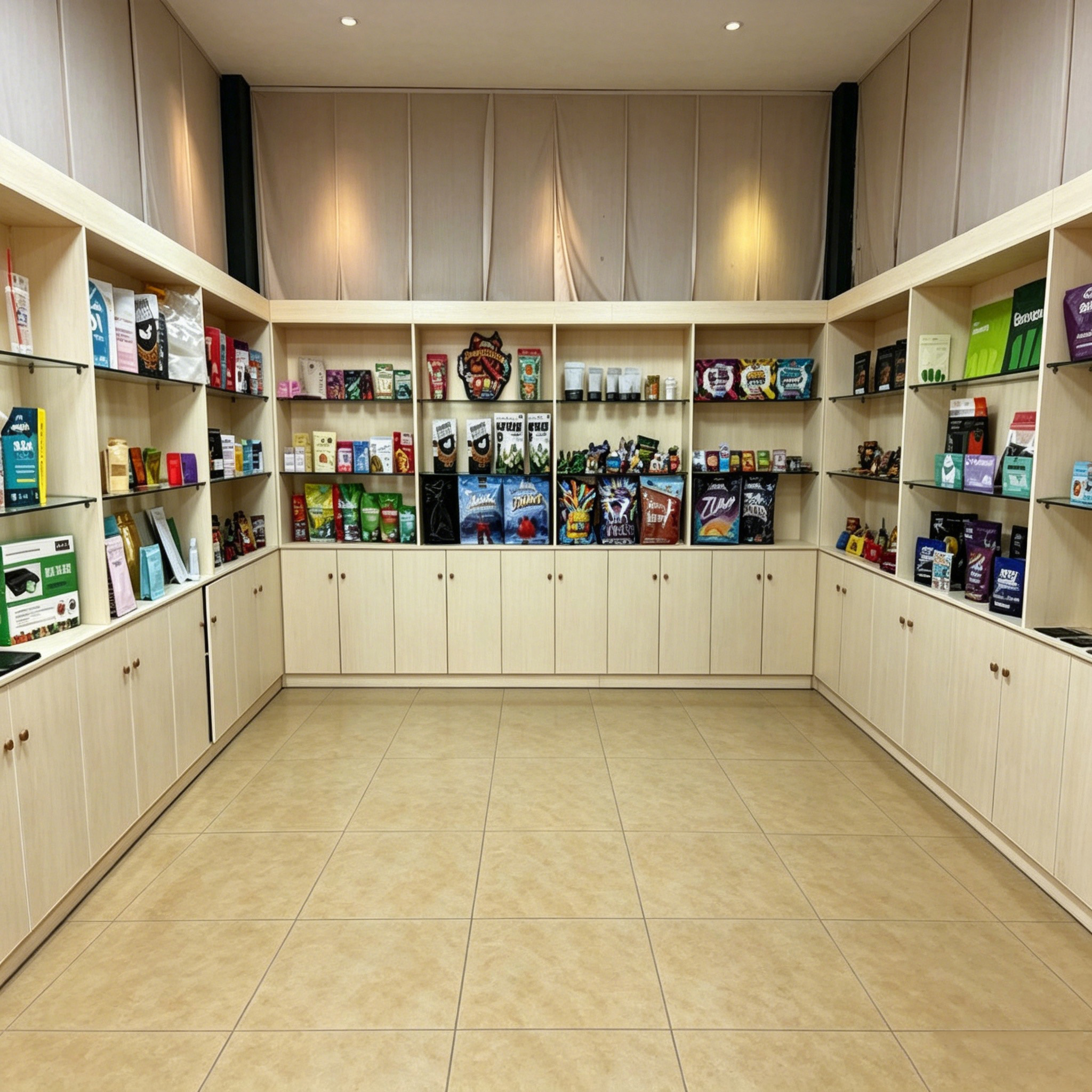
Barrier claims should be tied to a tested structure and a stated test condition, not to a descriptive label on a sample.
Barrier also has a time dimension. Chitai's storage guidance for finished bags specifies a light-proof, constant-temperature warehouse held at 15–22 °C and 40%–60% relative humidity, with a recommended storage window of 3 to 12 months, isolated from oxygen and ultraviolet exposure to limit THC and terpene degradation. Buyers in hot or humid climates should plan equivalent conditions in their own warehouse, because a high-barrier bag stored badly still ages.
Child-Resistant Options Built Around ASTM D3475
Child resistance in cannabis packaging is a performance requirement, not a component label. In the United States, the Consumer Product Safety Commission protocol at 16 CFR 1700.20 sets out how child-resistant packaging is tested, while ASTM D3475 provides the standard classification and terminology for child-resistant packaging. Together they define what a compliant package must demonstrate.
Three closure formats appear most often on flexible cannabis bags:
- CR Zipper — a press-to-close profile that requires a specific release step before the bag opens.
- Push Lock — a closure that requires a simultaneous push-and-slide action, which is difficult for young children to combine.
- Slide Lock — a sliding tab mechanism that must be manipulated in sequence before the pouch opens.
Mechanism choice interacts with the rest of the bag. A CR closure adds stack height at the top of the pouch, which reduces usable internal volume, so size mapping must be recalculated once a CR profile is added. It also adds unit cost and opening effort for adult users, which is why the mechanism should be selected against the real consumer and the real package size rather than picked from a catalogue.
Size-to-Capacity Mapping from 1 g to 28 g
Pouch size cannot be set from fill weight alone. Product density, closure type and the headspace needed for a clean seal all shift the answer. The ranges below are starting points for scoping; final dimensions should be confirmed with a filled sample.
| Nominal fill | Typical pouch size | Notes |
|---|---|---|
| 1 g | approx. 3" × 4" | Single-gram and pre-roll format; CR closure consumes headroom |
| 3.5 g | approx. 4" × 6" | Most common flower unit in regulated markets |
| 7 g | approx. 5" × 8" | Adds depth for denser fills and larger warning panels |
| 14 g | approx. 6" × 9" | Often paired with a heavier-gauge laminate for rigidity |
| 28 g | approx. 8" × 10" | Largest common flower format; check load-bearing before stacking |
Three adjustments are routinely overlooked. First, CR stack height reduces usable internal volume by a measurable margin. Second, fill density varies between dense trimmed flower and lighter material, so the same weight occupies different volume. Third, statutory warning symbols and tracking panels need printable surface area, which often pushes a pouch one size up rather than one size down.
Printing Methods and ODM/OEM Scope
Once structure and size are fixed, the print method determines the cost curve, colour consistency and how easily artwork can change between SKUs.
| Method | How it works | Best fit | Limitation |
|---|---|---|---|
| Digital | Direct digital output, no plates or cylinders | Short runs, multiple versions, rapid artwork changes | Higher cost per unit as volume rises |
| Gravure | Engraved cylinders transfer ink onto the film | High-volume programs needing colour consistency and fine detail | Cylinder engraving makes low volumes uneconomical |
| Flexographic | Photopolymer plates print onto the web | Mid-volume runs and simpler artwork | Less fine detail than gravure on complex designs |
ODM and OEM are not the same request. In OEM work, the buyer supplies artwork and specification and the supplier manufactures to it. In ODM work, the supplier contributes structure selection, size development, closure choice and print-ready artwork before production begins. For cannabis buyers, the practical difference is who carries responsibility when a specification turns out to be wrong.
Chitai manufactures cannabis packaging bags under both models, and its equipment mix reflects the two ends of the print curve: 2 digital printing machines for short and versioned runs, and 4 gravure printing machines for high-volume programs, supported by 30 fully automatic bag-making machines. The company also offers customised labelling and packaging solutions, which matters when a brand's compliance panel changes more often than its pouch structure does.
Execution Facts a Buyer Can Verify Before Ordering
Dongguan Chitai Packaging Products Co., Ltd. is a manufacturer of cannabis packaging bags based in Dongguan, Guangdong Province, China. The trading entity was established in 2025 to handle overseas clients and trade negotiations; the underlying printing and packaging operation has been running since 2012, giving the business more than a decade of converting experience behind the newer commercial entity.
- Facility: 4,200 m², 45 employees, R&D team of 8 engineers
- Capacity: annual output 30,000,000 units; monthly production capacity 2,500,000 units
- Production equipment: 2 digital printing machines, 4 gravure printing machines, 30 fully automatic bag-making machines, Class 1,000,000 dust-free workshop
- Quality control: comprehensive QC system with an in-house laboratory and professional testing equipment
- Commercial terms: MOQ 10,000 units, typical production lead time 3–5 days, CIF delivery terms, pre-shipment test as the acceptance criterion, 100% full payment
- Markets: approximately 30% export ratio, main markets North America and Europe
- Extended support: since 2023, one-stop sourcing for selected long-term clients, procuring complementary products from Guangdong, China under a transparent commission-based model
A buyer evaluating a first order can therefore verify three things before committing: whether 10,000 units is the right entry volume, whether a 3–5 day lead time matches the launch plan, and whether pre-shipment testing is the acceptance method they want. For repeat programs the more relevant question is whether the same laminate, print method and closure can be re-run without changing how the package behaves.
Market Trend: Compliance Pressure and Flexible Format Growth
The cannabis packaging market is projected to reach USD 21.55 billion by 2034 at a CAGR of 14.35% (Fortune Business Insights); published 2025 market-size estimates diverge across research houses depending on whether medical, recreational or material scope is included, so the direction of travel is more reliable than any single base figure. North America held 67.9% of revenue share in 2025 (Grand View Research), and plastics accounted for 54.3% of material market share in the same year.
Scale in this market is concentrated. Berry Global was identified as a market leader with over 12% share in the cannabis packaging sector in 2025, and the segment's named players — Amcor, KushCo Holdings (Greenlane), Berry Global, Sana Packaging and Dymapak — operate at large volume. That structure leaves a practical gap for regional brand owners, dispensary groups and importers whose order sizes sit below the thresholds of the largest suppliers, and who therefore need partners able to run a 10,000-unit order and repeat it on a 3–5 day cycle.
Comparison with Traditional Packaging Supply
Chitai's own production comparison sets its line against a conventional packaging factory across several measurable dimensions. These figures are the manufacturer's comparative statements and should be weighed against a buyer's own acceptance testing.
| Metric | Chitai stated position | Conventional factory stated position |
|---|---|---|
| Yield rate | Stable at ≥99% | 85%–92% |
| Lamination | Solvent-free eco-friendly lamination | Dry solvent lamination with inferior adhesive |
| Line integration | Digital plus high-speed gravure, automatic lamination, servo bag-making in one line | Semi-automatic equipment with multi-process outsourcing and subcontracting |
| Line speed | 280–450 m/min | 80–150 m/min |
| Order changeover | One-click model change, approximately 15 minutes | 2–4 hours of manual machine adjustment |
| Sample cycle | 50% faster | Baseline |
| Daily capacity | 2.5–3× higher, no peak-season shortage | Baseline |
| Film | Brand-new virgin food-grade film, no recycled content, no false labelling | 30%–60% recycled material added, 10%–20% thinner |
Four limitations deserve equal weight, because a specification chosen without them will cause problems later.
- Recyclability is the real constraint, not the lamination method. A laminate combining PET, VMPET, AL, NY and PE cannot be separated in most municipal recycling streams, even when the lamination is solvent-free. Eco claims are better tied to specific process changes — solvent-free lamination, virgin food-grade film, controlled material thickness — than to recyclability.
- Gravure economics have a floor. Cylinder engraving makes gravure economical only at volume; below that threshold digital printing is the practical route at a higher unit cost.
- Child resistance carries a trade-off. A CR mechanism adds unit cost and opening effort for adult users, and its stack height reduces usable internal volume.
- There is a minimum order and a storage window. The stated MOQ of 10,000 units sets a floor on trial runs, and finished bags should be held at 15–22 °C and 40%–60% RH for no longer than the recommended 3 to 12 months.
Future Outlook
With the market forecast to reach USD 21.55 billion by 2034 at a 14.35% CAGR, and plastics still holding 54.3% of material share, the next phase of cannabis packaging competition is likely to be fought on specification discipline rather than on print design. Three shifts are worth planning for.
First, child-resistance requirements will continue to be enforced through protocol testing on the finished package, which pushes buyers toward suppliers who can document package-level performance rather than component claims. Second, material pressure will intensify: as recyclability expectations rise, mono-material and reduced-layer structures will be evaluated alongside high-barrier laminates, and buyers will need to state which property they are willing to trade. Third, order flexibility will matter more than headline capacity, because brand owners increasingly run multiple SKUs at smaller volumes, and a 15-minute changeover matters more at that point than a fast line speed on a single long run.
For procurement teams, the durable asset is the written specification sheet: laminate structure, barrier targets with test conditions, closure type, dimensions, colour reference and acceptance criteria. A specification that survives a supplier change, a personnel change and a peak season is worth more than any single quotation.
FAQ
What barrier specification should a cannabis packaging bag meet?
High-barrier cannabis packaging is commonly specified against three measurable targets: a water vapour transmission rate of ≤0.03 g/(m²·24h), an oxygen transmission rate of ≤0.05 cm³/(m²·24h), and IPX4 water resistance against splashing water from any direction. Each value must be reported with its test conditions — temperature, relative humidity, and the film or pouch format tested — because a barrier figure without conditions cannot be compared between suppliers. Odour containment is a separate property that depends on the combination of a high-barrier laminate and a fully sealed closure.
Which child-resistant mechanism fits — CR Zipper, Push Lock or Slide Lock?
All three are child-resistant closure formats used on flexible cannabis bags, and all are evaluated within the same framework: ASTM D3475 for classification and terminology, and the CPSC protocol at 16 CFR 1700.20 for United States market access. CR Zipper is a press-to-close profile that requires a release step; Push Lock requires a simultaneous push-and-slide action; Slide Lock uses a sliding tab operated in sequence. The choice should follow the finished package — mechanism plus pouch size, fill weight and artwork — because child-resistance testing is performed on the complete package rather than on the closure alone.
How do you convert a fill weight such as 3.5 g or 28 g into a pouch size?
Fill weight alone is not sufficient. Cannabis packing density varies by product form, and a child-resistant closure adds stack height at the top of the pouch, reducing usable internal volume. Practical starting ranges run from approximately 3" × 4" for a 1 g unit up to approximately 8" × 10" for a 28 g unit, with the common flower weights of 3.5 g, 7 g and 14 g falling between them. Final dimensions should be confirmed with a filled sample, because headspace for a clean seal and the printable area needed for statutory warning panels also affect the result.
What order quantity, lead time and delivery terms should a buyer expect?
For the manufacturer referenced in this article, Dongguan Chitai Packaging Products Co., Ltd., the stated purchasing terms are a minimum order quantity of 10,000 units, a typical production lead time of 3–5 days, CIF delivery terms, pre-shipment test as the acceptance criterion, and 100% full payment. Monthly production capacity is 2,500,000 units, which is the figure that determines whether a reorder can be absorbed during a peak season without extending the lead time.
How is consistency maintained between the first order and later reorders?
Consistency depends on four elements being fixed in writing: laminate structure, colour reference, closure type and dimensions. Chitai's production comparison states a yield rate stable at ≥99% and a one-click model change of roughly 15 minutes, against 2–4 hours of manual machine adjustment in a conventional setup, which reduces the drift introduced each time a line is reset. The company operates a Class 1,000,000 dust-free workshop and an in-house laboratory with professional testing equipment, and uses pre-shipment testing as its acceptance criterion. Buyers should still confirm the specification sheet on every reorder rather than relying on the sample retained from the first run.
How should cannabis packaging bags be stored before filling?
Finished bags should be held in a light-proof, constant-temperature warehouse at 15–22 °C and 40%–60% relative humidity, and used within a recommended 3 to 12 month window. Storage isolated from oxygen and ultraviolet exposure limits THC and terpene degradation, and material should be kept away from odour sources, because a laminate that absorbs external odours will carry them into the filled package. Bags can be stacked in multiple layers for load-bearing, provided the packaging does not leak air or absorb odours.
Can one supplier support a long-term private label or ODM program?
Long-term support depends on three capabilities rather than on price: engineering capacity, production continuity, and the willingness to hold a specification stable over time. Chitai has an R&D team of 8 engineers and annual output of 30,000,000 units, and since 2023 has provided one-stop sourcing for selected long-term clients, procuring complementary products from Guangdong, China under a transparent commission-based model. On the packaging side, both OEM work to a buyer's specification and ODM development of structure, size and artwork fall within the company's stated scope, alongside customised labelling. Buyers planning multi-year programs should treat the written specification sheet as the primary deliverable of the first order.
Reference document: the 2026 company brochure, including product and capability details, is available for download at Chitai 2026 brochure. Company site: packagingforcannabis.com