
Cannabis Packaging Bags Buyer Comparison: Capacity, CR Level, Barrier Rating
Cannabis Packaging Bags Buyer Comparison: Capacity, CR Level, Barrier Rating
A cannabis packaging bag is a sealed flexible pouch built from multilayer film, and it has to be specified with three variables at the same time: the fill capacity it must hold, the child-resistance (CR) level it must demonstrate, and the barrier rating that protects the product from oxygen, moisture, light and odour loss. Buyers who compare quotations for Custom Printed Marijuana Packaging Bags on unit price while leaving any one of those three undefined end up with samples that look identical on a table but behave differently at the fill line, at a child-resistance test, and after several weeks on a dispensary shelf.
The comparison problem is structural rather than commercial. Two bags can share the same dimensions and the same print artwork and still be different products, because capacity, closure mechanism and film structure are chosen together and validated together. Dongguan Chitai Packaging Products Co., Ltd, a Dongguan-based manufacturer of cannabis packaging bags established in 2025 with printing and packaging operations dating to 2012, publishes a specification range that makes this three-variable comparison concrete: fill capacities from 1g to 28g (1 oz), bag dimensions from 3''x4'' to 8''x10'', three child-resistant closure families, and a three-tier odor-proof rating.
Why capacity, CR level and barrier rating have to be fixed together
Regulation forces the three variables into the same decision. California requires cannabis goods to be sold in child-resistant packaging designed to be difficult for children under five years of age to open, as set out in the packaging guidance published by the California Department of Cannabis Control. Canada's Cannabis Regulations, section 108, require an immediate container that is opaque or translucent, prevents contamination, keeps dried cannabis dry, provides reasonable assurance the container has not been opened, meets child-resistant packaging requirements, and holds no more than the equivalent of 30 g of dried cannabis. The US federal test protocol behind most CR claims, 16 CFR 1700.20, requires that 85% of children aged 42 to 51 months cannot open the package within five minutes.
Read together, those requirements are not three separate checkboxes. The 30 g container limit in Canada is a capacity constraint. The opacity and dryness requirements are barrier and film-structure constraints. The child-resistance requirement is a closure constraint, and the closure has to function against the specific film structure chosen for the barrier and within the bag format chosen for the capacity.
- Capacity sets the bag face area and fill opening, which in turn limits which closure hardware can be fitted and how much seal width remains around the fill zone.
- CR level determines whether the pack stays child-resistant after it has been opened once, which is a regulatory classification question as much as an engineering one.
- Barrier rating determines the film structure and the seal behaviour, and therefore whether the heat seals that hold the pouch closed can meet the strength the CR design assumes.
A quotation that lists dimensions and print colours but omits the closure family and the film structure is not comparable with one that lists all three. That is the single most useful filter a buyer can apply when screening suppliers of Cannabis Packaging Bags.
A three-variable matching framework for buyers
The table below converts the three variables into a specification worksheet. It is built as a framework for the buyer's own decision record, not as a fixed catalogue mapping, because the final pairing of capacity, closure and film has to be confirmed against the specific product and the specific market rules.
| Product form | Capacity to confirm | CR configuration to confirm | Barrier point to confirm |
|---|---|---|---|
| Dried cannabis flower | 1g, 3.5g, 7g, 14g or 28g within the published range | Multiple-use CR where the pack is reopened; single-use CR where it is not | Moisture retention plus odour control; opaque film where required |
| Pre-rolls, single and multi-pack | Slim flat and stand-up formats within the dimension range | CR closure plus a tamper-evident opening indication | Odour barrier and mechanical protection of the roll |
| Edibles and gummies | Three-side sealed flat bags sized to the unit count | CR where the destination market requires it for the product class | Oxygen and water-vapour barrier matched to shelf life |
| Concentrates and vape | Small foil-based pouches | CR closure sized to the small format | Light blocking and leach resistance from the film |
| CBD, herbal and health products | 3.5g to 28g, or a format specified by the brand | Per market rules; not assumed from the cannabis rules | Barrier matched to the declared shelf-life target |
Rule of thumb for the worksheet: if a field in this table is blank in the brief, it will be filled in by the supplier's default, not by the buyer's requirement. Defaults are the main source of failed sample rounds.
Capacity and dimensions: from 1g flower packs to 28g pouches
Chitai's published marijuana packaging specification covers fill capacities of 1g, 3.5g (one eighth of an ounce), 7g (one quarter ounce), 14g (half ounce) and 28g (one ounce), with bag dimensions listed across 3''x4'', 4''x5'', 5''x6'', 6''x8'' and 8''x10''. The two lists are independent ranges rather than a fixed one-to-one pairing, which matters for two reasons.
First, fill weight is not fill volume. A gram of dense flower and a gram of a lighter, leafier cut occupy different volumes, so the dimension that suits a 3.5g pack of one cultivar is not automatically right for another. Buyers should settle the fill volume with the supplier rather than converting weight to bag size on a spreadsheet.
Second, capacity is bounded by regulation in some markets. Canada's section 108 limit of the equivalent of 30 g of dried cannabis per immediate container means the 28g (1 oz) format sits below that container limit for dried cannabis, while the same bag used for a different product class has to be assessed against that product's own rules. The container limit is a Canadian regulatory value, not a universal capacity benchmark.
Where the pack is opened and reclosed, capacity decisions also become closure decisions. A larger multi-use pack implies a closure that stays child-resistant through the product's in-use life; a small single-serving pack can follow a different compliance route entirely. That distinction is explored in the next section.
CR level: CR zipper, push lock and slide lock compared
Child-resistant cannabis bags differ from ordinary reclosable pouches mainly in the closure. Chitai's published specification names three child-resistant closure families, each referenced to ASTM D3475: CR Zipper, Push Lock and Slide Lock. The choice between them is a fit question first and a compliance question second.
| Closure family | Where it fits in the decision | What the buyer should verify |
|---|---|---|
| CR Zipper | Reclosable format; suits products that are opened and reclosed across the pack life | Whether CR performance is claimed for single use or for multiple-use lifetime, and the test report covering that exact closure |
| Push Lock | Alternative CR mechanism where the closing action must differ from a conventional zip | Opening force and reclose reliability on the exact film used |
| Slide Lock | Option where the opening action has to be visually and physically distinct | That the slider assembly survives repeated opening without losing child resistance |
The classification that matters most to a buyer is not the closure name but the lifecycle category. California guidance distinguishes single-use initial child-resistant packaging, which is child-resistant before opening but not afterwards, from multiple-use lifetime child-resistant packaging, which maintains child resistance throughout the package life. A bag intended to be resealed after every use is in the second category, and the closure has to be validated as such.
California also identifies Poison Prevention Packaging Act certification under 16 CFR 1700.15(b)(1) as one recognised route to child-resistant compliance, and describes a separate route in which certain single-serving plastic packaging at least 4 mils thick, heat-sealed without an easy-open tab, dimple, corner or flap, may qualify. That 4 mil reference is specific to the described single-serving applications; it is not a universal thickness requirement for every cannabis bag.
The boundary buyers should hold to: a specification sheet that references ASTM D3475 states the classification a closure is designed against. It does not replace a 16 CFR 1700.20 test report on the finished package. Test evidence has to cover the exact combination of closure, film structure and product category that will ship, and it should be requested before a purchase order, not after.
Barrier rating: what Good, Excellent and Premium should mean on paper
Odour-proof tiers are useful summary labels and poor contractual terms. Chitai publishes a three-tier odor-proof rating of Good, Excellent and Premium across its smell proof cannabis bags range. Because those tiers are the supplier's own classification, a buyer comparing proposals needs the underlying metrics beside the label.
For the high-barrier structure, Chitai publishes values that can be compared directly against published barrier benchmarks: oxygen transmission rate (OTR) of 0.05 cm3/(m2·24h) or lower and water vapour transmission rate (WVTR) of 0.03 g/(m2·24h) or lower, an aluminium foil layer of 7 to 9 micrometres that is free of pinholes, a structure of PET aluminium-coated film plus pure aluminium foil plus a PE heat-sealing layer, heat seal strength of at least 40N/15mm, tear strength of at least 35N in the longitudinal direction and 30N in the transverse direction, complete opacity with zero light transmission, IPX4 water repellency, and double sealing that combines a reclosable zipper with a heat seal at the top. An optional child-resistant zipper is available on this structure.
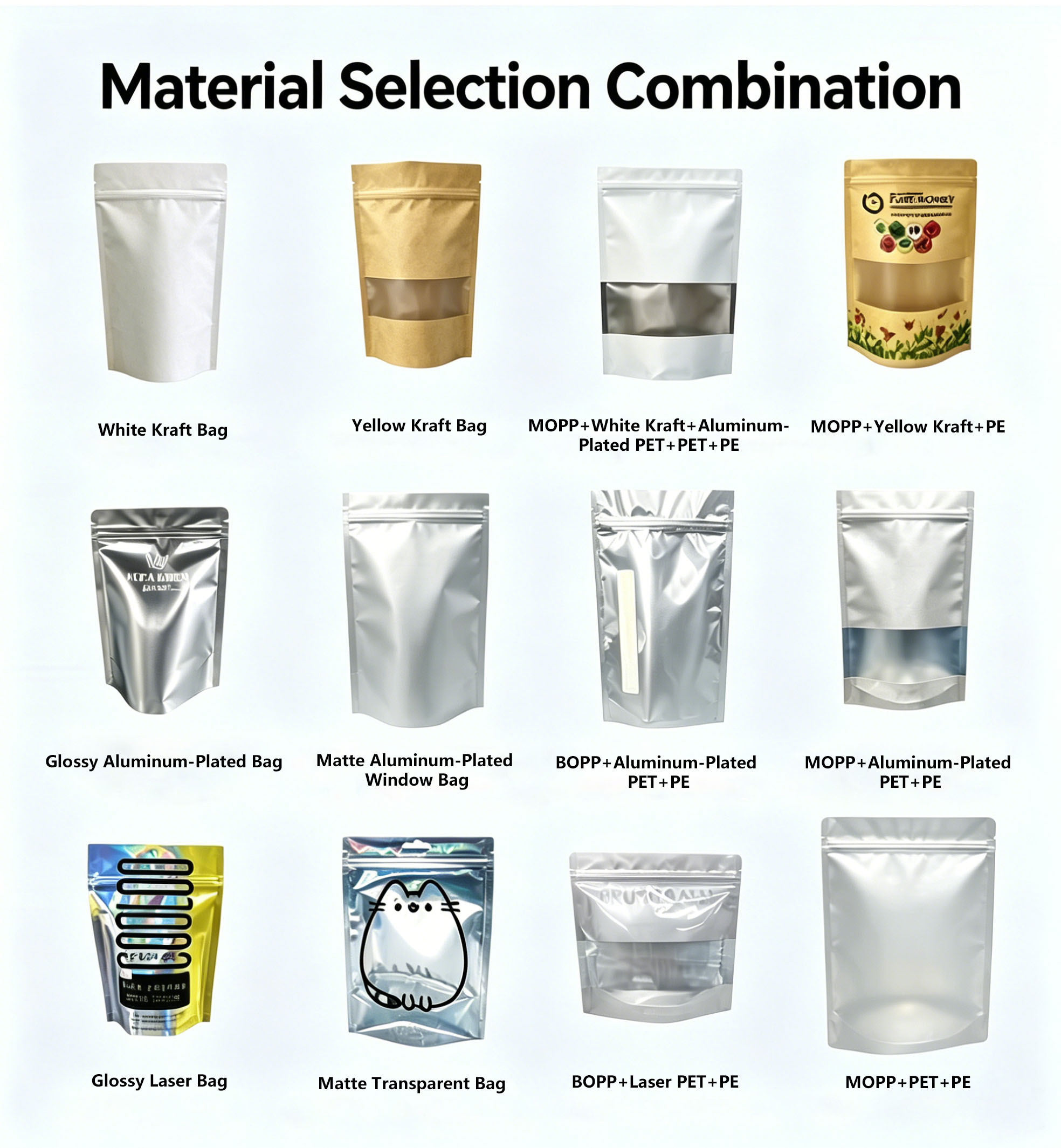
Those published figures line up with the high-barrier benchmark described in third-party cannabis packaging research, which places premium bags at OTR below 0.05 cm3/(m2·24h) and WVTR under 0.03 g/(m2·24h). The practical benefit of quoting both numbers is that they travel between suppliers. An odor-proof tier does not.
There is one nuance that is easy to miss in a comparison. OTR and WVTR measure oxygen and water-vapour transmission, not aroma-compound transmission. They are useful proxies because the same aluminium-foil structure that blocks oxygen and moisture also blocks most aroma loss, but an odour claim is not automatically proven by them. Buyers who need a defensible smell proof cannabis bags claim should ask what the rating is based on and whether a structure-level statement exists for the specific film in the quote.
The barrier decision also connects back to regulation. Canada requires the immediate container to keep dried cannabis dry and to be opaque or translucent, so moisture barrier and light blocking are compliance features, not marketing features, in that market.
Custom printed marijuana packaging bags: matching print method to order
Print method is a fourth variable that quietly changes the economics of a three-variable specification. Chitai lists three printing routes: digital printing for small batches, gravure printing, and flexographic printing. The trade-off is the usual one in flexible packaging. Digital printing carries no plate or cylinder cost and therefore suits small batches, sample rounds and short-run private label cannabis bags; gravure and flexographic printing carry set-up cost but suit longer, repeatable runs where the same artwork is reproduced over many production cycles.
The print decision interacts with the other three variables in ways worth flagging in a brief. Artwork has to respect the seal zone, the closure hardware and the opening instruction area, all of which shift when capacity or closure changes. A brand that changes CR closure mid-project should expect the print layout to be re-approved, not merely re-coloured. And because child-resistance is a package-level property, a print change that alters film structure or seal geometry can invalidate earlier CR testing.
What Dongguan Chitai Packaging Products Co., Ltd publishes as a specification base
Dongguan Chitai Packaging Products Co., Ltd is a Dongguan, Guangdong-based manufacturer specialising in packaging solutions for the cannabis industry, with printing and packaging experience dating to 2012 and a trading and manufacturing entity established in 2025. The company reports a 4,200 m2 factory, 45 employees, an annual output of 30,000,000 units, an engineering team of 8 people, a Class 1,000,000 dust-free workshop, an in-house laboratory with professional testing equipment, an export ratio of 30%, and main markets in North America and Europe.
Production capability relevant to a three-variable comparison includes 2 digital printing machines, 4 gravure printing machines and 30 fully automatic bag-making machines, which is the equipment base behind the digital, gravure and flexographic routes described above. The company also states that since 2023 it has provided one-stop sourcing support for selected long-term clients, procuring complementary products from Guangdong on a transparent commission model.
For buyers building a comparison, the useful part of this profile is not the headline numbers but the fact that the capability statements can be matched to the specification questions. A digital printing line explains the small-batch route. An in-house laboratory explains where seal and barrier testing can be performed. A 30,000,000-unit annual output is the figure against which a buyer's own volume commitment should be checked.
Application: matching the bag to the product form
The product types that Chitai lists as applicable span cannabis flower, pre-rolls, edibles, CBD packaging, tobacco packaging, vape, herbal products and the health product industry. The documented application scenarios show how the format changes across that range.
At the raw-material end, the reference project covers cannabis dried flower raw material bags, cannabis seed vacuum bags, and fibre raw material ton bags or medium and small repackaging bags. At the retail finished-product end, the same reference describes 3.5g, 7g, 14g and 28g flower stand-up bags, single and multiple pre-roll flat bags, CBD gummy three-side sealed bags, and small aluminium foil bags for concentrates. The stated working condition across these applications is normal temperature, away from light and sealed, with matched equipment consisting of heat sealing machines and filling equipment, and with child resistance as the special requirement in the health and cannabis application record.
Two manufacturing details in that reference matter to buyers comparing barrier claims. The laminating step is specified as solvent-free, which is stated in the source material as a way of avoiding solvent residue contamination of extracts. The matched equipment list includes an 8-colour gravure printing machine, digital proofing, automatic servo bag-making, film inspection, a children's-lock zipper heat-sealing machine, and peel and seal strength testing instruments. Film inspection and seal-strength testing are the two stations that produce the evidence a buyer would ask for when validating an OTR, WVTR or heat-seal claim.
Market trend: growth is agreed, market size is not
Commercial research houses agree on the direction of the cannabis packaging market and disagree sharply on its size, which is itself a useful signal for buyers. Fortune Business Insights projects the global cannabis packaging market at USD 7.37 billion in 2026, rising to USD 21.55 billion by 2034 at a CAGR of 14.35%. Mordor Intelligence values the same market at USD 2.29 billion in 2026, reaching USD 4.65 billion by 2031 at a CAGR of 15.22%. Grand View Research places the global market at USD 3.2 billion in 2025, projected to reach USD 19.3 billion by 2033. The 2026 figures from Fortune and Mordor differ by more than a factor of three, most likely because of different segment definitions and methodologies, and the two should not be averaged or combined.
What survives the disagreement is the growth rate. All three sources describe double-digit annual growth across the forecast window, and a separate Grand View estimate puts the US market at USD 1.36 billion in 2023 with a projected CAGR of 28.9% from that base. For a packaging buyer, the practical reading is that capacity planning can be done on direction, while absolute market sizing should be treated with caution.
Material choice reinforces the same point. Plastics accounted for 54.3% of global cannabis packaging material share in 2025, according to Grand View Research, which is consistent with the dominance of flexible pouch formats in the category. On the supply side, China is the leading exporter of plastic bags under HS 392321, accounting for over 25% of global exports at roughly USD 3.32 billion in 2023, which is the trade context behind the concentration of cannabis bag manufacturing in South China.
Consumer-side evidence is thinner. A peer-reviewed study published in 2022 examined how recreational cannabis packaging characteristics influence cognitive, affective and behavioural responses, establishing that packaging attributes matter to consumers without, in the material reviewed here, producing a specific design prescription. That is a reasonable basis for testing hypotheses about print and format, and not a basis for claiming that any particular design sells better.
Comparison with traditional rigid packaging, and where flexible bags stop
Rigid containers such as jars and tins remain widely used for some cannabis formats, and the comparison with flexible bags is usually framed too simply. The honest version is a trade-off list.
| Dimension | Flexible cannabis packaging bags | Rigid containers |
|---|---|---|
| Barrier and light blocking | Foil-based structures can be fully opaque with published OTR and WVTR values | Dependent on container material and lid seal |
| Structural protection | Limited; the pouch will not protect a fragile product from crushing | Higher; the container itself resists deformation |
| Tooling and change cost | Lower; artwork and structure changes are comparatively fast, and digital printing supports small batches | Higher; moulds and dimensional changes carry more commitment |
| Freight and storage | Flat-packed before filling; lower shipping volume | Volumetric; higher shipping and storage footprint |
| CR mechanism | Carried by the closure; must be re-tested when the closure or film changes | Carried by the cap or lid mechanism |
Where flexible bags stop, stated plainly:
- A flexible pouch is not a structural container. Products that need crush protection, stackability or a rigid format should not be moved into a bag purely for print flexibility.
- Odor-proof tiers published by any supplier, including the Good, Excellent and Premium ratings used in Chitai's range, are supplier classifications. They are not third-party certifications, and they should be read alongside OTR and WVTR values rather than instead of them.
- The barrier figures in this article apply to the defined high-barrier structure. A different film, a different thickness or a different closure requires its own data.
- Recyclability and post-consumer recycled content are not published in the material reviewed here. Buyers sourcing eco friendly marijuana packaging bags should request material documentation for the specific structure rather than assume it from the format.
- The 30,000,000-unit annual output and 45-person team are company-reported figures. Buyers with large or time-compressed programmes should confirm scheduling against their own volume before committing to a launch date.
- The operating entity was established in 2025 while the printing and packaging background dates to 2012. Buyers assessing long-term contracts should establish which legal entity contracts and which facility manufactures.
Future outlook
Three forces look likely to reshape how cannabis packaging bags are compared over the next several years.
The first is documentation becoming the differentiator. As more jurisdictions adopt child-resistant requirements along the lines of California and Canada, the supplier that can produce a test report matching a specific closure, film and product combination will be easier to qualify than one that can only cite a standard number.
The second is the standardisation of barrier language. Published OTR and WVTR values already allow a buyer to compare a High Barrier Cannabis Packaging Bags proposal against an independent benchmark. If odour performance follows the same path and moves from tier labels toward structure-level data, the comparison will get sharper and shorter.
The third is sustainability, where the public evidence base is currently the weakest. The verified data reviewed for this topic contains no recyclability or compostability evidence for cannabis bag structures, and no PCR content figures. That gap is as informative as a data point: buyers who need an eco-friendly claim should build it into the specification stage, with material documentation attached, rather than treat it as a finishing option.
None of these changes alter the underlying decision rule. Capacity, CR level and barrier rating will still have to be fixed together, because the regulation that governs one of them governs the others.
FAQ
What are cannabis packaging bags, and how do child-resistant and smell-proof types differ?
Cannabis packaging bags are sealed flexible pouches made from multilayer film, used for flower, pre-rolls, edibles, concentrates and CBD products. A child-resistant cannabis bag differs in its closure, which is designed so that children under five have difficulty opening it; Chitai references three such closure families, CR Zipper, Push Lock and Slide Lock, each cited against ASTM D3475. A smell proof cannabis bag differs in its film, typically a foil-based structure that limits oxygen, moisture and aroma transmission. A single bag can carry both properties, which is why the two terms are often used together.
Is an ASTM D3475 reference enough to prove child resistance?
No. ASTM D3475 is a classification reference for the closure design. The operative US test protocol is 16 CFR 1700.20, which requires that 85% of children aged 42 to 51 months cannot open the package within five minutes, and California guidance also identifies Poison Prevention Packaging Act certification under 16 CFR 1700.15(b)(1) as a recognised compliance route. A buyer should request the test report covering the exact closure, film structure and product category being purchased, and should establish whether the claim is for single-use or multiple-use lifetime child resistance.
What barrier rating should be specified for flower, pre-rolls and edibles?
The transferable metrics are oxygen transmission rate and water vapour transmission rate. Third-party cannabis packaging research places premium bags at OTR below 0.05 cm3/(m2·24h) and WVTR under 0.03 g/(m2·24h), and Chitai publishes matching values for its high-barrier structure. Dried flower benefits most from moisture retention and light blocking, which Canada's section 108 also requires of the immediate container. Pre-rolls need odour control plus mechanical protection. Edibles need oxygen and moisture barrier matched to the declared shelf life. In all three cases the odour tier label should be read alongside the numeric values, not instead of them.
Can custom printed weed mylar bags be ordered in small batches?
Yes, where the supplier offers a digital printing route. Chitai lists digital printing for small batches alongside gravure and flexographic printing, so a short run or a sample round does not require the plate or cylinder investment that gravure carries. The practical constraint is that artwork still has to be laid out around the seal zone and the closure hardware, and any change to film structure or closure geometry should trigger a fresh CR and seal validation.
Which capacities and bag dimensions are available for 3.5g and 28g formats?
Chitai publishes fill capacities of 1g, 3.5g (one eighth ounce), 7g (one quarter ounce), 14g (half ounce) and 28g (one ounce), and bag dimensions across 3''x4'', 4''x5'', 5''x6'', 6''x8'' and 8''x10''. The two lists are parallel ranges, not a fixed one-to-one mapping, and fill weight is not fill volume, so the dimension for a given fill should be confirmed per project. For Canadian dried cannabis, the 28g format sits below the section 108 container limit of 30 g dried-cannabis equivalent, while the same bag used for another product class must be assessed against that product's own rules.
How should buyers verify smell-proof and waterproof claims before ordering?
Ask for the film structure and the numeric transmission values rather than the tier name. Chitai's high-barrier structure is specified as PET aluminium-coated film plus pure aluminium foil plus a PE heat-sealing layer, with aluminium foil of 7 to 9 micrometres free of pinholes, OTR at or below 0.05 cm3/(m2·24h), WVTR at or below 0.03 g/(m2·24h), heat seal strength of at least 40N/15mm, tear strength of at least 35N longitudinal and 30N transverse, full opacity, and IPX4 water repellency. Buyers should then confirm that the quoted product matches that structure, because OTR and WVTR describe oxygen and water vapour, not aroma compounds directly.
Reference
The 2026 product brochure from Dongguan Chitai Packaging Products Co., Ltd, covering formats, materials and closures, is available as a downloadable PDF: Chitai Packaging 2026 brochure.
Have Questions or Need More Details?
Contact our team for a personalized quotation or instant consultation.
Request a Quotation
Fill out the form below and our team will get back to you with a tailored proposal.
WhatsApp Direct Chat
Prefer to chat in real-time? Message us on WhatsApp for instant assistance & quick answers.
- Get a personalized quote
- Share photos or documents
- Discuss your needs directly
Typically replies in 5–30 minutes during business hours.