
Cannabis Packaging Bags for Pre-Roll and Edibles: Scenario Fit
Cannabis Packaging Bags for Pre-Roll and Edibles: Scenario Fit
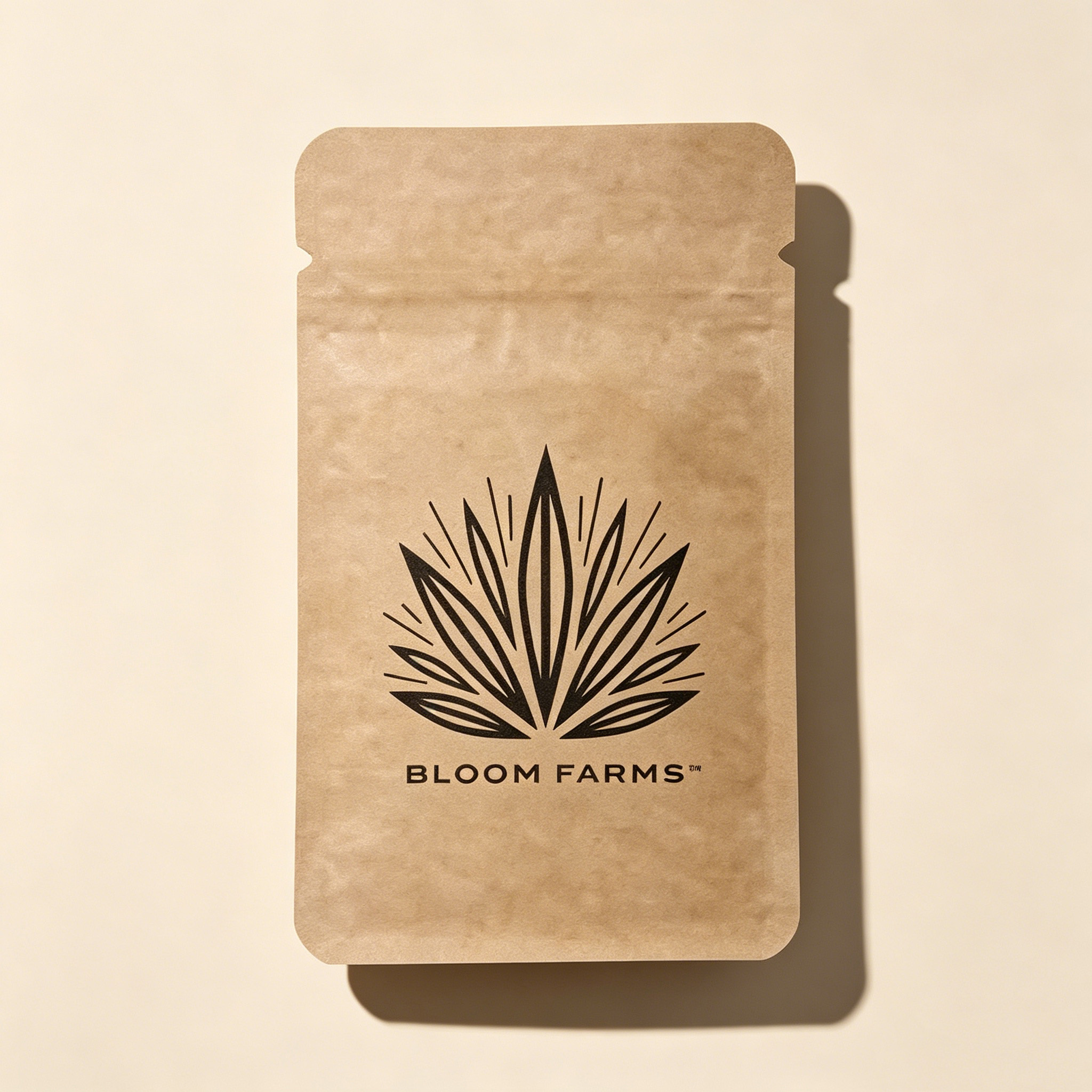
Barrier performance, not nominal flower weight, is usually the first specification decision in pre-roll and edible packaging projects.
The selection variable in pre-roll and edible packaging is the scenario, not the weight
For a pre-roll or edible programme, a cannabis packaging bag is not a flower bag with a different print run. What changes is the specification logic: nominal flower weight stops being the anchor, while fill geometry, barrier requirement and closure behaviour each move the answer in a different direction. Dongguan Chitai Packaging Products Co., Ltd is a Cannabis Packaging Bags manufacturer that applies one laminated structure and one closure family across five capacities and five bag sizes, which makes the end-use scenario the practical starting point rather than the gram figure printed on the artwork.
The supplied product range is consistent across the formats discussed in this article: capacities of 1g, 3.5g (1/8 oz), 7g (1/4 oz), 14g (1/2 oz) and 28g (1 oz); bag sizes of 3''x4'', 4''x5'', 5''x6'', 6''x8'' and 8''x10''; child-resistant closures listed as CR Zipper, Push Lock and Slide Lock, each referenced against ASTM D3475; odor-proof levels listed as Good, Excellent and Premium; and three print routes — digital printing for small batches, gravure printing and flexographic printing. Knowing that the range is shared matters, because it means a pre-roll buyer and an edible buyer are not choosing between different factories; they are choosing between different configurations of the same platform.
Why flower-first specifications mislead pre-roll and edible buyers
Flower specifications are built around mass. A 3.5g bag is expected to hold 3.5g of dried cannabis flower with enough headspace for the bud structure, and the size choice follows the fill weight fairly directly. Pre-rolls break that assumption because the product is a rigid cylinder rather than a compressible mass: internal length, straight-line clearance and resistance to bending matter more than the nominal gram rating. Edibles break it differently, because the portion is usually defined by unit count and flat footprint rather than by flower-equivalent weight, and because a resealed multi-piece pack behaves as a different package type than a one-shot sachet.
The consequence for procurement is that an RFQ built only on "3.5g flower bag, smell proof" tends to produce a bag that is technically correct and practically awkward. A better brief names the product format, the number of units per pack, whether the pack is reopened over multiple sessions, the channel it will be displayed in, and the market whose child-resistance rule applies. Those four or five lines of context are what turn a size range into a specification.
Mapping capacities and sizes to pre-roll, gummy and concentrate-adjacent formats
The range steps up in five increments on both axes — five capacities and five sizes. That parallel structure is useful for planning, but the two lists are independent: the capacity states a fill weight and the size states an external dimension, and the pairing between them is set per project. The table below is therefore a starting point for a fill trial, not a specification table. The same nominal capacity can occupy very different volumes depending on stick count, product density, whether the pack is a single unit or a multipack, and how much headspace the filling operation needs.
| Scenario | Capacity to evaluate | Closure candidates | Dominant requirement | Verify before ordering |
|---|---|---|---|---|
| Single pre-roll, retail unit | 1g end of the range | Heat-sealed flat sachet; Push Lock where reopening is needed | Odor containment and opacity | Internal length against actual stick length; bending in the display box |
| Pre-roll multipack, two to five sticks | 3.5g to 7g band | CR Zipper or Slide Lock | Odor plus moisture control across repeated openings | Reclose cycle count; seal strength after reopening |
| Gummies and other count-based edibles | Set by portion weight, not by flower convention | CR Zipper; Push Lock on flat three-side sealed formats | Oxygen control and odor containment | Single-use versus multiple-use classification; seal window |
| Chocolate, concentrate-adjacent and small-format items | Smallest practical format in the range | Heat seal only, where reopening is not required | Oxygen, light blocking and seal integrity | Foil continuity; temperature exposure through the channel |
| Back-of-house transfer and bulk handling | 14g to 28g end of the range | Slider or heat seal | Moisture and physical protection during handling | Confirm this is not a retail-facing unit; labelling obligations differ |
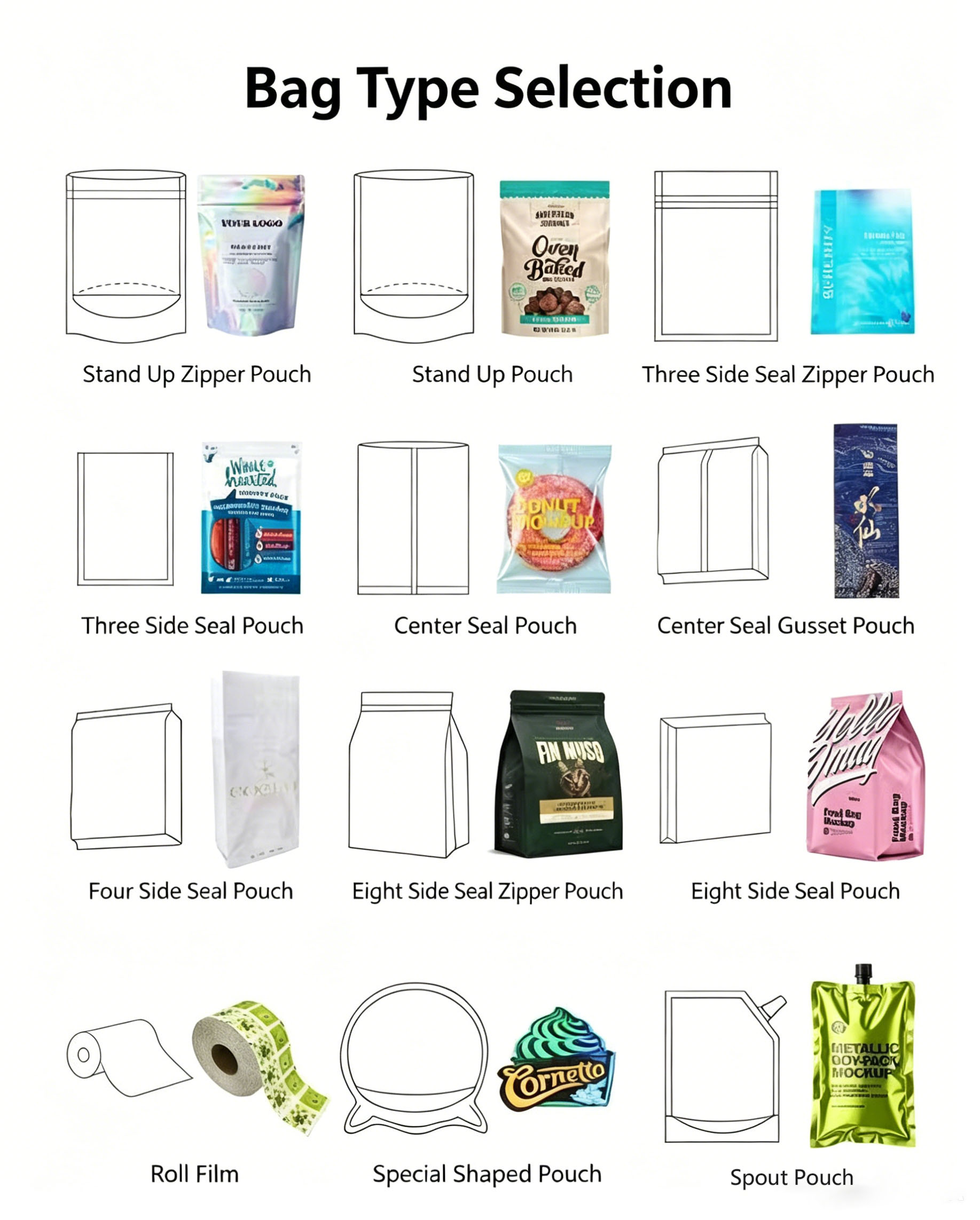
The five-size range from 3''x4'' to 8''x10'' is shared across formats; the fill trial, not the catalogue, sets the final pairing.
Pre-roll scenarios: clearance, crush and odor
Pre-roll packaging is a clearance problem before it is a barrier problem. A rolled stick does not compress into a bag the way flower does, so the usable internal length and the straight-line path through the opening determine whether the pack can be filled at production speed without cracking the paper. Chitai's scenario documentation covers single and multiple pre-rolled cigarette flat bags, which points to flat sachet construction as the default geometry for this format rather than a stand-up pouch.
Once the geometry works, two physical properties carry most of the retail risk. The first is film toughness: the specified construction reports tear strength of at least 35N in the longitudinal direction and at least 30N in the transverse direction, which is the relevant figure when a flat sachet is stacked in a display box and handled repeatedly. The second is odor containment. The specification calls for aluminium foil at 7 to 9 micrometres, free of pinholes, described by the manufacturer as completely blocking the leakage of aroma, combined with heat seal strength of at least 40N/15mm so that the seam does not become the weak point. For a pre-roll programme, pinholes and seam quality deserve more attention than the weight label, because a stick format concentrates the whole aroma load into a small, thin pack.
Opacity also earns its place in this scenario. The specified construction is completely opaque with zero light transmission, which matters for a product displayed under store lighting for weeks rather than stored in a drawer.
Edible scenarios: count, seal and reclose behaviour
Edibles shift the centre of gravity again. The supplied scenario set names CBD gummy three-side sealed bags and small aluminium foil bags for concentrated formats, which is a different construction family from a stand-up flower pouch. Here the questions are how many pieces share the pack, whether the pack is opened once or over several sessions, and whether the seal has to survive a reclose cycle without losing its barrier.
The single-use versus multiple-use distinction is the point most often missed in edible packaging briefs. California guidance separates single-use initial child-resistant packaging, which is child-resistant before opening but not after, from multiple-use child-resistant packaging, which maintains child resistance across the package life. That classification is a property of the package design and the way it is opened, not of the material alone. A resealable edible pack and a heat-sealed one-shot sachet therefore need to be evaluated separately, and the classification should be confirmed with the licensee's compliance function rather than inferred from the closure type.
Seal integrity is where edible specifications become measurable. A heat seal strength of at least 40N/15mm, combined with the double sealing arrangement described in the specification — a repeated zipper seal plus a heat seal at the top — is the practical defence against leakage at the seam. The waterproof grade of IPX4 is also worth reading precisely at this stage: it denotes splash-water resistance, not immersion protection, so it supports handling and wipe-down rather than chilled or condensation-heavy storage.
The technical base: what PET/VMPET/PE/NY/AL delivers
The structure used across the range is PET/VMPET/PE/NY/AL. In flexible packaging practice the layers divide the work: an outer polyester layer carries print and mechanical strength, a metallised polyester layer contributes barrier, nylon adds toughness and puncture resistance, aluminium foil provides the pinhole-free aroma and light block, and the polyethylene layer is the heat-sealable surface that closes the bag. Chitai's published specification describes the material as PET aluminium-coated plus pure aluminium foil plus a PE heat-sealing layer, with foil thickness of 7 to 9 micrometres.
On top of the structure sit the two transmission figures that pre-roll and edible buyers should ask for by name: oxygen transmission rate at or below 0.05 cm3/(m2·24h) and water vapour transmission rate at or below 0.03 g/(m2·24h). These are construction-level values. They describe the specified build, not every bag that leaves a factory, and they are the numbers an external barrier reference also cites for premium cannabis bags, which makes them a reasonable common benchmark across suppliers.
Manufacturing conditions support the claim rather than replacing it. The scenario documentation specifies a solvent-free composite adhesive, intended to eliminate solvent residue contamination of the extract, and lists solvent-free lamination, eight-colour gravure printing, digital proofing, servo-driven bag making, film inspection and peel/seal strength testing among the matched equipment. For an edible or concentrate-adjacent product, that residue question is a legitimate line item in a supplier audit, not a marketing detail.
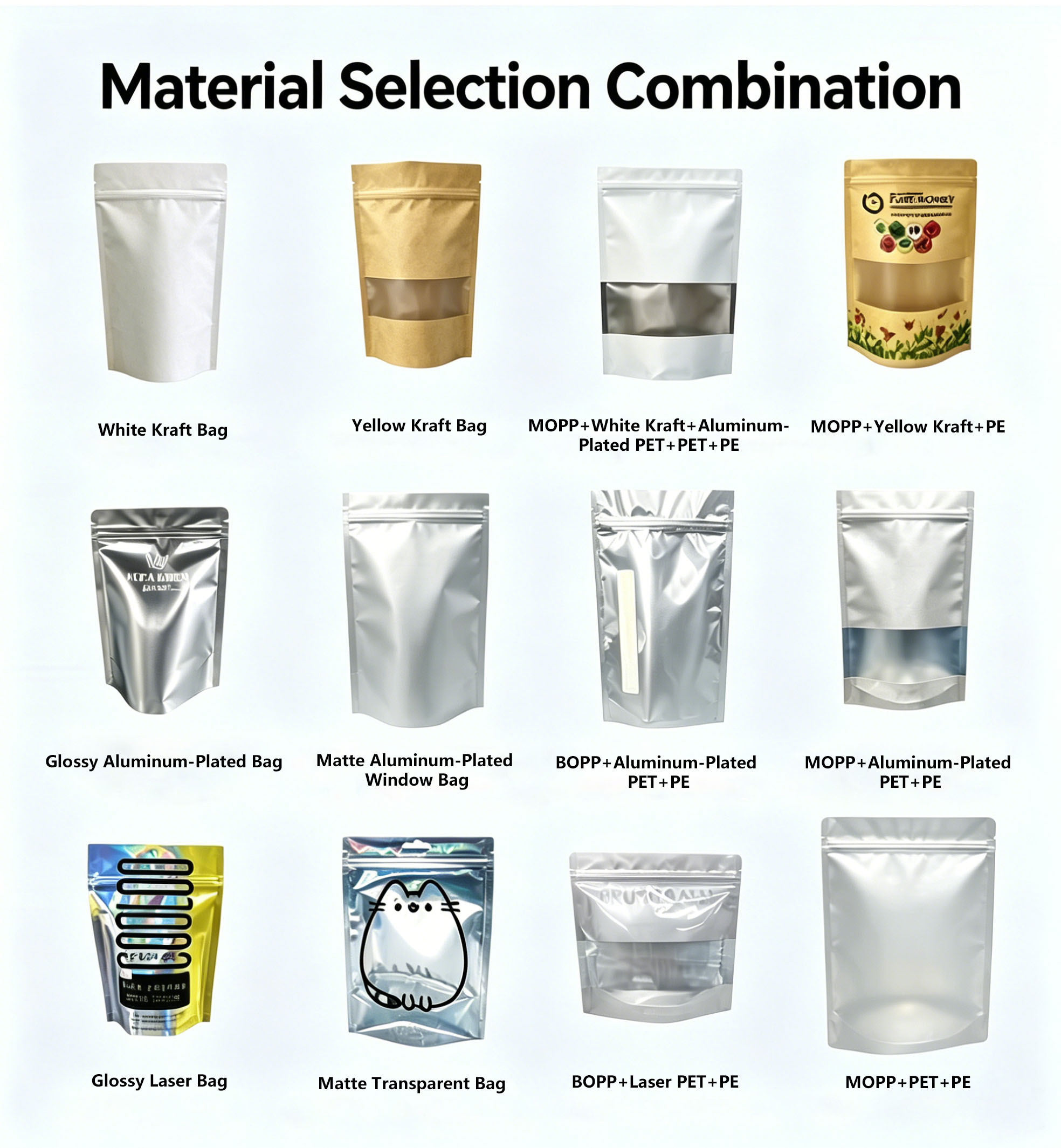
Layer structure determines which barrier claim is available; the transmission values describe the specified build, not every bag produced.
Good, Excellent and Premium: reading the odor-proof ladder correctly
Three odor-proof levels are offered: Good, Excellent and Premium. They are selection options, and the practical question is which level a scenario actually requires — a single pre-roll sold within days of packing, a multipack carried in a bag, or a bulk unit that sits in a back room for months, do not place the same demand on aroma containment.
The honest limitation is that the published specification names the three tiers without stating the test basis that separates them. A buyer moving into evaluation should therefore ask for the written basis behind each level applied to the specific construction, and should treat the tier name as a supplier classification rather than an independently certified grade. That is not a reason to avoid the tiers; it is a reason to put the definition in the RFQ, alongside the transmission figures, so that two quotations using the same word are actually comparable.
Closure choice by scenario: CR Zipper, Push Lock and Slide Lock
All three closures are listed against ASTM D3475, and the choice between them is driven by pack geometry and reopening behaviour rather than by a ranking. A Push Lock profile adds little thickness, which suits a flat pre-roll sachet that must stay slim in a display rack. A CR Zipper is the natural fit where the pack is reopened repeatedly across several sessions, because the closure is the mechanism the consumer interacts with each time. A Slide Lock introduces a slider on a track, which changes the feel and the opening motion of the pack and is generally evaluated where that interaction is part of the retail proposition.
Two separate documents sit behind the words "child resistant", and conflating them is a common procurement error. ASTM D3475 is the classification framework referenced in the product listing; the US federal test protocol under 16 CFR 1700.20 sets a performance threshold in which at least 85% of children aged 42 to 51 months must fail to open the package within five minutes. A listing against a standard is not the same as a design-specific test report, and the report that matters is the one covering the exact bag, closure and dimensions in the purchase order.
Retail context: dispensary shelves and smoke shop counters
The two retail channels place different demands on the same bag. A dispensary pack is a regulated unit: California guidance identifies child-resistant, tamper-evident and resealable requirements among the packaging obligations for manufactured cannabis products, and Health Canada requires child-resistant containers for cannabis products other than plants and seeds. Those obligations push a dispensary specification toward documented closure performance, legible label space and a seal that can be shown to have been closed.
A smoke shop counter is closer to accessory retail. Ranges turn over faster, order quantities are smaller, and artwork changes more often, which is where the digital printing option for small batches earns its place next to gravure and flexographic printing for longer runs. The same barrier construction can serve both channels, but the print route and the batch size usually diverge first.
Capacity planning sits behind both. Dongguan Chitai Packaging Products Co., Ltd lists a monthly capacity of 2,500,000 units, an annual output of 30,000,000 units, a MOQ of 10,000 units, a stated lead time of 3 to 5 days, 100% testing and export to North America and Europe at roughly 30% of output, supported by a 4,200 m2 facility, 45 employees, 8 R&D engineers, a Class 1,000,000 dust-free workshop and an in-house laboratory. Those are supplier-stated figures, and they should be matched against the projected run size rather than assumed.
Where flexible bags fit, and where they do not
Against rigid jars and tubes, a flexible bag wins on headspace and shipping volume. A flat sachet holds a pre-roll with almost no air around it, which reduces both the volume of atmosphere the barrier has to manage and the cube shipped per unit. A jar wins on crush protection and on the tactile reclose experience that some edible and concentrate formats rely on. Neither format is universally better; the fit boundary is the product's mechanical fragility.
Three verified limits belong in any evaluation. First, the 0.05 OTR and 0.03 WVTR figures describe the specified laminated construction, so a buyer should confirm the construction actually quoted. Second, IPX4 is splash resistance rather than immersion protection, which rules it out as evidence for chilled or high-condensation storage. Third, packaging rules are jurisdiction-specific and should not be carried across borders: Canada's Cannabis Regulations section 108 requires an immediate container that is opaque or translucent, prevents contamination, keeps dried cannabis dry, provides reasonable assurance it has not been opened, meets child-resistance requirements and contains no more than 30g of dried cannabis equivalent — a Canadian container limit, not a general bag benchmark. California guidance also references a separate route in which certain plastic packaging of at least 4 mils thickness, heat-sealed without an easy-open tab, dimple, corner or flap, may qualify for specified single-serving applications; that condition applies to a defined product category, not to every cannabis bag.
Market context: a clear growth direction, an unclear absolute size
Flexible formats sit inside a category that research houses agree is expanding, even where they disagree on the number. Grand View Research reports that plastics accounted for 54.3% of global cannabis packaging material share in 2025. Absolute market size is far less settled: one commercial estimate puts the global cannabis packaging market at USD 7.37 billion in 2026 while another puts it at USD 2.29 billion for the same year and geography. The two figures reflect different segment definitions and methodologies, cannot be averaged or combined, and in any case cover all cannabis packaging rather than bags specifically. For a packaging decision, the useful reading is directional, and the binding numbers remain the bag specification and the buyer's own volume forecast. On the supply side, China accounted for more than 25% of global exports of plastic bags under HS 392321 in 2023, at roughly USD 3.32 billion, which is consistent with the concentration of flexible packaging capacity in the region.
Outlook
The plausible direction for pre-roll and edible packaging is toward tighter documentation rather than toward new materials. If regulators in major markets continue to tie market access to child-resistance evidence, the practical differentiator between suppliers becomes the ability to produce a design-specific report and a construction-level barrier value for the exact SKU, not the breadth of a catalogue. Buyers who write those two documents into the RFQ now will find the evaluation stage shorter, and will be less exposed when a retail channel asks for proof rather than a product name.
Frequently asked questions
Do pre-roll and edible products need different cannabis packaging bags?
In most projects, yes — but not because of the weight label. The differences are fill geometry, barrier priority and closure behaviour. A pre-roll needs internal clearance for a rigid cylinder and toughness against bending; a count-based edible needs a flat footprint, a reliable seal window and a clear single-use or multiple-use classification. One laminated structure and one closure family can serve both, as the PET/VMPET/PE/NY/AL range with CR Zipper, Push Lock and Slide Lock options demonstrates, but the specific build has to be confirmed through a fill trial.
How do I choose between the 3.5g and 7g capacity for a pre-roll multipack?
The listed capacities are fill weights: 1g, 3.5g (1/8 oz), 7g (1/4 oz), 14g (1/2 oz) and 28g (1 oz). For a multipack, the deciding inputs are stick count, stick length and the headspace the filling line needs, because a 3.5g pack of short sticks and a 3.5g pack of longer sticks can require different external dimensions. Confirm the pairing with a fill trial using your actual product rather than extrapolating from the gram figure.
Is a heat-sealed edible bag automatically child-resistant compliant?
No. Child resistance is assessed at package level and against the rules of the market where the product is sold. California requires cannabis goods to be sold in child-resistant packaging, and its guidance distinguishes single-use from multiple-use child-resistant packaging depending on whether child resistance survives opening. The same guidance references a route in which certain plastic packaging of at least 4 mils thickness, heat-sealed without an easy-open tab, dimple, corner or flap, may qualify for specified single-serving applications. That route applies to a defined product category and must be verified for the specific bag, the specific product and the applicable jurisdiction.
What separates the Good, Excellent and Premium odor-proof levels?
The three levels are listed as selectable options, and the published specification names them without stating the test basis that distinguishes one from another. A buyer should therefore request the written basis for each tier applied to the quoted construction, and treat the tier name as a supplier classification rather than an independently certified grade. Pairing that request with the OTR and WVTR values gives a more comparable basis for evaluating competing quotations.
Does an IPX4 rating mean the bag can be stored in a chiller or humid room?
No. IPX4 denotes splash-water resistance, not immersion protection, and it does not describe condensation behaviour. Where a product will be stored chilled or in a humid environment, the relevant specification items are the water vapour transmission rate of at most 0.03 g/(m2·24h) for the quoted build, the heat seal strength of at least 40N/15mm, and the seal configuration — the repeated zipper seal plus top heat seal. Those conditions should be confirmed for the actual storage environment rather than assumed from a single rating.
Are CR Zipper, Push Lock and Slide Lock equally suitable for all three closure roles?
All three are listed against ASTM D3475, but suitability follows pack geometry and reopening behaviour. A Push Lock adds little thickness and suits slim flat sachets; a CR Zipper fits packs reopened across multiple sessions; a Slide Lock changes the opening interaction and is evaluated where that matters to the retail proposition. ASTM D3475 and the US federal protocol under 16 CFR 1700.20 are different documents, and the design-specific test report for the exact bag, closure and dimensions remains the evidence that counts.
Working from the scenario back to the specification
Pre-roll and edible programmes are served by the same capacity range, size range, laminated structure and closure family that serve flower — but the selection order is different. Start from the product format and the reclose behaviour, then fix the barrier and odor requirement, then choose the closure and confirm the compliance evidence for that exact design. The company brochure with the full specification set is available for download: Chitai Packaging Brochure 2026.
Have Questions or Need More Details?
Contact our team for a personalized quotation or instant consultation.
Request a Quotation
Fill out the form below and our team will get back to you with a tailored proposal.
WhatsApp Direct Chat
Prefer to chat in real-time? Message us on WhatsApp for instant assistance & quick answers.
- Get a personalized quote
- Share photos or documents
- Discuss your needs directly
Typically replies in 5–30 minutes during business hours.