
Canned Green Peas for Foodservice: BRCGS and HALAL Scope Fit
Canned green peas are one of the least glamorous items on a foodservice order sheet, and one of the most frequently mis-specified. Canteen operators, salad-bar suppliers and contract caterers choose them because they are ambient-stable, ready to portion and predictable through a hot-holding line. What decides whether that choice survives contact with an importer, a port authority or a buyer audit is not the pea itself, but whether the supplier's certification documents actually name the item, for the market it is shipping into.
This reference maps canned green peas to three foodservice demand patterns — side dishes, salad bars and canteen menus — and then shows how certification coverage for the same product changes from market to market. The short version: BRCGS certification covers canned green peas within a certified canned fruit and vegetable processing scope, HALAL certification names canned and glass green pea products explicitly under MS1500:2019 and Indonesian halal regulations, and the U.S. FDA Food Facility Registration held for the product range is written against a fruit-only product category, which means US-bound vegetable items require separate confirmation rather than assumption.
Why certification scope, not certificate count, decides green pea sourcing
A supplier can hold five certificates and still fail a foodservice buyer's documentation check, because certification schemes do not record the same thing. A food safety standard certifies a facility and the processes it operates. A halal scheme lists the products and pack forms that are permitted. A regulatory registration records a facility against a product category. For a buyer specifying canned green peas, those are three separate questions, and only the first one is answered by the logo printed on a brochure.
Three scope patterns matter in practice:
- Process-level scope. The certificate describes operations — washing, peeling, pre-cooking, filling, seaming, pasteurization — rather than naming every SKU. A vegetable item produced on a certified line may fall inside the operational description without appearing as a line item on the certificate schedule.
- Item-level scope. The certificate attaches an explicit product list. This is the strongest form of evidence, because green pea products either appear on that list or they do not.
- Facility-level scope. A registration records who the facility is and which regulatory category it processes. Category wording can include or exclude an entire product group, independent of what the plant is physically capable of packing.
Buyer rule of thumb: before canned green peas go into a specification, match three things on paper — the scope sentence, the specific product item, and the destination market. If any one of the three is missing, the specification is relying on an assumption rather than a document.
How canned green peas sit inside the Agrogentra certificate file
Agrogentra & Co., Ltd. (Xiamen) is a China-based international trading company established in 2000 that sources, quality-controls and exports Chinese canned food, fresh fruits and vegetables and frozen food products, with 100% of its output exported to the United States, Latin America, Europe and African markets, supported by QC teams in both Xiamen and Qingdao. Canned green peas sit in the company's canned fruit and vegetable programme alongside canned mushrooms, asparagus, sweet corn, green beans, bamboo shoots, cabbage, beet roots and mixed vegetables.
The certification records relate canned green peas to the same product family entry used across the range — product ID 7410, described as canned fruits and canned vegetables, with recorded net weights of 425 g and 2950 g, A9 and A10 can styles, and a 36-month shelf life at normal temperature for sterilized products. A family-level flag, however, is not the same as certificate text, and the table below sets out what each current document actually says.
| Certificate | Issuing body / standard | Documented scope | How it applies to canned green peas |
|---|---|---|---|
| BRCGS Certification 05LA1209004 Valid 05 Oct 2025 – 02 Dec 2026 |
Intertek Certification Limited; BRCGS Global Standard Food Safety Issue 9 | Process-level scope covering washing, peeling, pre-cooking, filling, seaming and pasteurization of canned fruit (peach, apple, pear, pineapple, orange, mixed fruits) and canned apple sauce in tin cans, plastic cups and plastic bags, plus ingredient weighing and mixing, blending and cooking. Market: Global. | Confirms the certified canned fruit and vegetable processing operations. Because the wording is operational, the item-level schedule should be requested to confirm canned vegetables are named for a specific order. |
| HALAL 1031240000 Valid 30 Nov 2024 – 29 Nov 2027 |
SHC (Shandong Halal Certification Service), recognized by JAKIM; MS1500:2019; Indonesia Halal Law & Regulations; BPJPH Halal Regulations | Canned/glass mushroom, mushroom in brine, potato, baby corn, bamboo shoots, bean sprouts, cut green bean, green pea, kidney bean and kidney bean in syrup. Market: Indonesia, Malaysia and global Muslim markets. | Green pea products are named explicitly in both canned and glass formats — the clearest item-level evidence in the file for Muslim-market foodservice supply. |
| FDA Food Facility Registration 18082639404 Renewed 09 Oct 2024 – 31 Dec 2026 |
U.S. FDA; 21 CFR 1.225–1.244 and 21 CFR 113/114 as applicable; U.S. Agent: Diana Liu, Quincy MA | Foreign facility — manufacturer/processor, packer, acidified and low-acid food processor, labeler; listed category: Category 17 Fruit & Fruit Products only; not fish cans. Market: USA. | Registration is facility-level and category-bound. Because the listed category is fruit and fruit products, US-bound canned vegetables need item-level confirmation before being relied upon. |
| ISO 22000 CNO0124F21626R5M/3200 |
CQC; ISO 22000:2018 | Production of canned fruit (peach, mix fruits, pear, orange, apple, pineapple, jam and jelly (pulpy jelly)). Market: Global. | Does not list canned vegetables. It is evidence for the fruit range, not for canned green peas. |
| STAR-K Kosher RIB1RR1Q Issued 03 Apr 2025; recorded expiry 31 Mar 2026 |
STAR-K Kosher Certification, Baltimore, Maryland, USA | Canned fruits: apple, apricot, mandarin orange, mixed fruits, pear and yellow peach, in syrup, water, pear juice or solid pack. Market: global Kosher market. | Fruit scope only, and the recorded expiry has passed. Any kosher requirement for green peas must be verified against a current document. |
Two conclusions follow directly from that table. First, HALAL certification is the only document in the file whose scope list names green pea products explicitly, which makes it the controlling document for Muslim-market foodservice business and the one a buyer in Indonesia or Malaysia will be asked to produce. Second, two documents that are sometimes assumed to cover the whole range do not: the ISO 22000 certificate is written for canned fruit production only, and the Kosher record covers canned fruits exclusively.
Technical explanation: why a sterilized pea needs no preservative
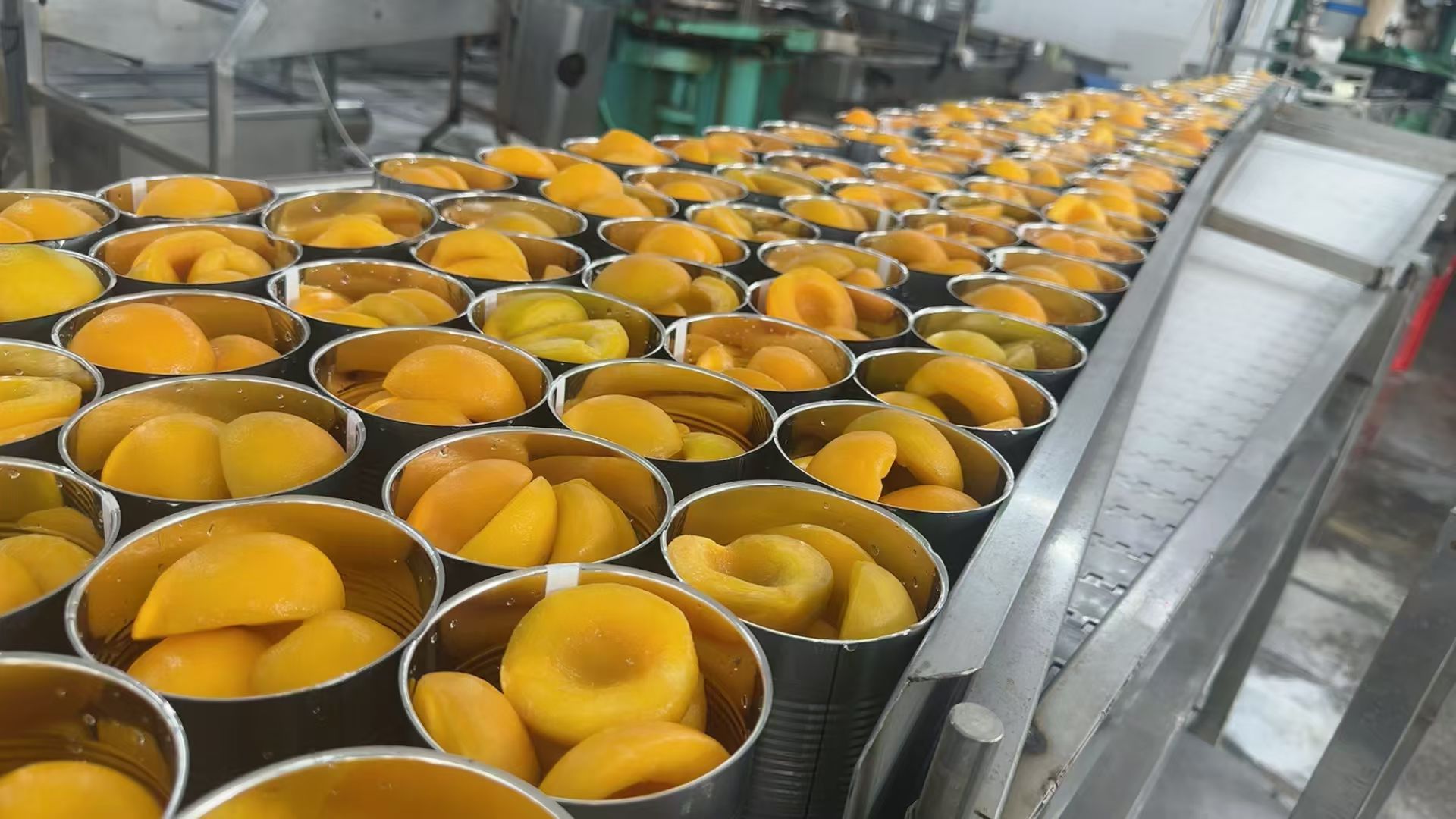
The preservation principle behind a can of green peas rests on two elements rather than on additives. The product is filled into a tinplate or glass container and hermetically sealed by seaming, after which a vacuum forms inside — typically leaving almost no oxygen, which suppresses aerobic bacteria and oxidation. The sealed containers then pass through a retort, where high-temperature, high-pressure steam brings the contents to commercial sterility, meaning that pathogenic organisms and microorganisms capable of growing at ambient temperature, together with their spores, are destroyed. This is why canned products can be labelled sterilized and preservative-free at the same time.
The sterilization regime is not identical for every product. Low-acid foods must be processed at around 121 °C under pressure, while high-acid products can be processed at lower temperatures, and the sterilization curve together with the cold-point temperature directly determines product safety. After sterilization, containers are rapidly cooled and held through an incubation test before release, which is the step that would reveal a seaming or process failure. For a foodservice buyer this has a practical consequence: two defect signals belong in a receiving protocol. Improper seaming or insufficient sterilization can cause swelling and spoilage, and a swollen can is a non-conforming batch rather than a cosmetic issue.
Quality control on the supply side follows a documented full-process system: incoming raw-material inspection, on-line production patrol, and laboratory physical, chemical and microbiological testing for each batch with a COA report, supported by batch sample retention. Third-party inspection through SGS or Intertek is acceptable to the supplier, and factory certification copies can be provided for buyer audits. For a buyer, these are the documents that convert a claim about sterility into evidence — a COA per batch, a retained sample, and the option of independent verification.
Application: matching pack format and storage protocol to the serving line
Canned green peas serve three distinct foodservice scenarios, and each one stresses a different part of the specification.
Salad bar and buffet service
Whole canned peas are drained, chilled and served cold. The operational requirement here is appearance and consistency between cans rather than volume, and ambient storage means the salad bar can be replenished without a freezer or thaw cycle. Shelf life of up to 36 months at normal temperature supports a rotating menu without spoilage risk.
Canteen, school and institutional catering
High-volume side-dish service is where the A10-style 2950 g format earns its place in the family specification, with 425 g cans better suited to smaller serving stations, convenience retail and sample orders. The recorded product family covers net weights of 425 g and 2950 g; item-level drained weight and packing medium for a specific pea line should be confirmed per order rather than assumed from the family sheet.
Food processing and re-packing
Canned vegetables also enter mixed-vegetable blending, soups and institutional re-packing operations, where the supplier's QC documentation matters more than the retail label. Recorded client types are food importers, grocery wholesalers and supermarket distributors, served through mixed FCL and LCL shipments into supermarket retail, convenience store, catering supply and food processing applications.
Warehouse protocol that protects the specification
- Store between 5 °C and 25 °C, away from direct sunlight and heat sources, with relative humidity kept below 75%.
- Stack on pallets or racks, at least 10 cm off the floor and clear of walls to allow ventilation.
- Apply first-in, first-out rotation by production date and batch, with weekly inspection for rust, swelling or leakage.
- Inspect cartons and can bodies on arrival, and isolate any non-conforming item before it reaches the line.
Supply parameters recorded for this programme include a monthly production capacity of 3,500 units, a minimum order quantity of one FCL, and a lead time of four to six weeks — figures a catering group should build into its ordering calendar rather than treat as spot availability. OEM service with logo customization is also recorded, along with after-sales documentation covering COA, health certificate, pre-shipment inspection report and traceability report.
Market trend analysis: documentation is becoming the differentiator
The canned fruit and vegetable category remains large and stable enough to support long-term foodservice contracts. Global market size for canned fruits and vegetables reached USD 105.35 billion in 2024, according to Market Research Future, while China's total export value of fruit and vegetable canned products was US$3.859 billion in the same year, according to China Canned Food Industry Association and China Customs data. Within that trade flow, China's canned vegetable export volume reached 2.058 million tons in 2024, a 2.52% year-on-year decrease — a reminder that the category is mature, competitive and driven by documentation and logistics rather than by novelty.
Two regulatory directions are reshaping how buyers specify canned vegetables. In the European Union, Regulation (EU) 2024/3190 restricts the use of Bisphenol A in food contact materials, including can coatings, which pushes packaging and coating declarations into the purchasing file rather than leaving them with the factory. In Muslim markets, halal governance has moved from a voluntary certification gesture toward a regulated market-access requirement: the HALAL record covering canned green peas is issued under MS1500:2019 together with Indonesia Halal Law and BPJPH Halal Regulations, and its product list is explicit about the items permitted. For suppliers and buyers alike, the practical effect is the same — the certificate scope sentence is becoming a commercial document, not a marketing asset.
Comparison with traditional solutions — and the limits of canned green peas
Frozen peas are the most common alternative in foodservice kitchens, and the comparison is not a simple win for either format. The table below reflects the operational differences that matter when a menu cycle is being planned.
| Decision factor | Canned green peas | Frozen green peas |
|---|---|---|
| Storage and logistics | Ambient storage, no cold chain required; suits remote areas and convenience channels. | Requires continuous cold-chain transport and cold-storage warehousing. |
| Shelf life | Up to 36 months for the recorded canned range. | Normally 6 to 18 months. |
| Cost structure | Lower storage and transport extra cost; no refrigeration energy load. | Higher cold-chain freight and electricity expense. |
| Eating quality | Undergoes high-temperature sterilization, which alters texture and flavour relative to fresh. | Keeps closer to the raw fresh flavour. |
Those trade-offs only make sense alongside the boundaries of the certification position, which are real and should be stated plainly:
- The US FDA registration does not, on its face, extend to vegetables. Registration 18082639404 is recorded as a foreign facility registration for a manufacturer/processor, packer, acidified and low-acid food processor and labeler, with the listed category being Category 17 Fruit & Fruit Products only. A buyer placing canned green peas into the US market should confirm item-level coverage rather than assume it from the registration number alone.
- ISO 22000 coverage is limited to canned fruit. The scope lists canned fruit production and does not list canned vegetables, so it should not be cited as evidence for a green pea order.
- Kosher coverage is fruit-only, and the recorded certificate has expired. The STAR-K scope covers canned apple, apricot, mandarin orange, mixed fruits, pear and yellow peach, with an expiry of 31 March 2026 recorded in the file.
- BRCGS wording is operational. The certificate describes processes on the canned line rather than naming every vegetable SKU, so the item-level schedule is the document that settles the question.
- Commercial parameters are not spot-market parameters. A one-FCL minimum and a four-to-six-week lead time suit planned menu cycles, not emergency replenishment of a single can size.
- Frozen remains the better fit where freshness positioning is the selling point. Operators with a complete cold chain and a fresh-first menu concept gain little from switching to canned.
Future outlook
The direction of travel for canned vegetable procurement is toward scope-mapped documentation. Buyers are increasingly asking suppliers to produce a certificate-to-SKU matrix rather than a certificate folder, because the gap between a facility-level registration and an item-level halal scope is exactly where a shipment can be delayed. Expect three practical shifts: packaging regulation such as the EU BPA restriction will pull coating and food-contact declarations into routine purchasing files; halal market access in Indonesia and Malaysia will continue to formalize around named product lists; and ambient formats will keep their structural advantage in markets where cold-chain reliability varies by region.
For a caterer or distributor, the sensible response is procedural rather than commercial: keep a one-page scope check in the supplier file for every canned vegetable line item, refreshed when certificates renew, and verify pack format and item-level documentation before the menu cycle locks.
FAQ
Which certification actually names canned green peas in its scope?
The HALAL certificate 1031240000, issued by SHC (recognized by JAKIM) under MS1500:2019, Indonesia Halal Law and BPJPH Halal Regulations, lists canned and glass green pea among its permitted products, with validity from 30 November 2024 to 29 November 2027. BRCGS certificate 05LA1209004 covers the certified canned processing operations but describes them at process level, while ISO 22000 certificate CNO0124F21626R5M/3200 and STAR-K certificate RIB1RR1Q list canned fruit only.
Is halal certification required for canned food sold into Muslim markets?
Yes. Halal certification is a mandatory access requirement in Muslim markets such as the Middle East and Southeast Asia, including Indonesia and Malaysia, while for Europe and America the requirement follows the individual customer's specification. Valid halal documentation, with the specific product named in scope, is normally requested alongside the food health certificate and certificate of origin.
Does the FDA Food Facility Registration 18082639404 cover canned green peas for the US market?
The registration is recorded against a foreign facility acting as manufacturer/processor, packer, acidified and low-acid food processor and labeler, under 21 CFR 1.225–1.244 and 21 CFR 113/114 as applicable, and its listed product category is Category 17 Fruit & Fruit Products only; it also states that it does not cover fish cans. Because the registered category is fruit and fruit products, buyers specifying canned green peas for the United States should confirm item-level coverage in writing rather than infer it from the registration number.
What shelf life and storage conditions apply to canned green peas?
The recorded product family specification states a shelf life of 36 months at normal temperature for sterilized, preservative-free canned products, and general canned guidance is that shelf life usually falls between two and five years, subject to the best-before date printed on the container. Recommended storage is 5 °C to 25 °C with relative humidity below 75%, on pallets at least 10 cm off the floor, using first-in, first-out rotation with weekly inspection.
Do canned green peas contain preservatives?
No. Preservation relies on hermetic sealing, which creates a vacuum inside the container, combined with high-temperature, high-pressure sterilization in a retort that achieves commercial sterility. Containers are then rapidly cooled and held through an incubation test before release, and the process is monitored through laboratory physical, chemical and microbiological testing for each batch with a COA report.
How should a kitchen handle a swollen can, or peas left over after opening?
A swollen can, where one or both ends are domed, indicates gas production from microbial growth or spoilage following a seal failure. The batch should be treated as non-conforming: quarantine it, do not consume it, document the condition with photographs, trace it by batch number and raise it with the supplier, while checking whether transport or storage exposed the pallet to high temperature or impact. Once a can is opened, any unused portion should be refrigerated and consumed within 24 to 48 hours, ideally after transferring it to a non-metallic container.
Reference: the Agrogentra canned fruit and vegetable product leaflet is available for download at Agrogentra leaflet (PDF). Detailed product and certification records are published at agrogentra.com.
Have Questions or Need More Details?
Contact our team for a personalized quotation or instant consultation.
Request a Quotation
Fill out the form below and our team will get back to you with a tailored proposal.
WhatsApp Direct Chat
Prefer to chat in real-time? Message us on WhatsApp for instant assistance & quick answers.
- Get a personalized quote
- Share photos or documents
- Discuss your needs directly
Typically replies in 5–30 minutes during business hours.