
Cantonese Dim Sum Shortlist: Frozen, Fried, Vegetarian, Breakfast & Banquet Picks
Cantonese Dim Sum Shortlist: Frozen, Fried, Vegetarian, Breakfast & Banquet Picks
Cantonese Dim Sum Shortlist: Frozen, Fried, Vegetarian, Breakfast & Banquet Picks
Cantonese dim sum is rarely purchased as a single item. A teahouse, a hotel banquet team, a convenience store buyer and an export wholesaler are each assembling a working menu, and the range that fits one is usually wrong for another. This shortlist is organised the way a real assortment decision is made: product type first, then the venue that will serve it, then the purchasing terms that decide whether the line can actually be held in stock.
The reference range used here is Foshan Shunde Yuexiang Food Manufacturing Co., Ltd. (“Da Xiao”), a Cantonese dim sum manufacturer founded in 1981 and based in Jun’an Town, Shunde District, Foshan, Guangdong. The company produces more than 300 items across five major series, runs a 20,000 m² facility with 200+ employees and a 30+ engineer R&D team, and exports roughly 40% of output to Southeast Asian, European and American markets. Its operating base sits in Shunde, a UNESCO “City of Gastronomy,” and the company holds ISO9001, HACCP and FDA certification alongside “Foshan Time-honored Brand” recognition. That breadth is why it works as a single reference point for a shortlist that has to span frozen, fried, steamed-cake, vegetarian, breakfast and banquet categories at once.
Why the Shortlist Starts With Product Type, Not Price
Frozen dim sum is a category where unit price tells a buyer almost nothing. Three technical variables change the cost structure and the operational fit long before price becomes comparable: whether the item is steamed or fried, whether it is a bun or a cake, and whether the pack format matches the outlet’s throughput. A fried item that needs oil at 160–165 °C is a different operational commitment from a steamed cake that goes from freezer to steamer in six to eight minutes with no thawing step.
For buyers in the research and evaluation stage, the practical question is not “which dim sum is best” but “which combination of dim sum holds a menu together across the day.” Breakfast traffic rewards fast steamed buns. Lunch and dinner reward savoury fried lines. Afternoon tea and banquets reward the steamed cake series. Catering and institutional accounts reward uniform size and predictable reheating. A shortlist that ignores those differences produces a menu that looks complete but cannot be operated.
The Six Lines at a Glance
| Line | Representative items | Pack format (examples) | Heat method | Strongest venue fit |
|---|---|---|---|---|
| Frozen Dim Sum | Shrimp Siu Mai, shrimp dumplings, char siu bao, red bean paste bun, Walnut Bun, chicken sticky rice, kataifi pastry | 270 g (9 pcs) × 20 packs/box; 480 g (4 pcs) × 18 bags/box | Steam 10–12 min, no thawing | Restaurants, hotels, retail, transport |
| Traditional Dim Sum | Water Chestnut Cake, Taro Cake, Red Bean Cake, Steamed Black Sesame Kuih, Coconut Golden Cake | 500 g/bag × 12 bags/carton | Steam 6–8 min, no thawing | Teahouses, banquet tea breaks, gifting |
| Fried Dim Sum | Explosive juice gold ball (Sesame Ball), Taro Pie, Hong Kong style spring rolls, Milk Rolls, Green Tea Buddha Cake, Golden Durian Crisp | 300 g (10 pcs) × 12 bags/box; 336 g (12 pcs) × 16 bags/box | Fry 150–165 °C, 3–9 min, no thawing | Restaurants, night stalls, transport hubs |
| Vegetarian | Vegetarian Lo Han Jai (buddha’s delight) | 400 g/box × 12 boxes/carton | Natural thaw, then boil | Banquet, hotel, catering, temple-adjacent menus |
| Dim Sum Breakfast | Lava Custard Bun, steamed custard bun, Millet cake, red bean paste bun | 480 g (12 pcs) × 18 bags/box; 280 g × 30 bags/box | Steam 7–8 min (Millet cake also pan-fries) | Breakfast shops, hotels, convenience, transport |
| Banquet & Gift | Buddha Jumps Over The Wall, Vegetarian Lo Han Jai, steamed cakes, OEM gift-box assortments | 400 g/box formats; customized gift packaging | Varies by item | Banquets, New Year gift boxes, trade buyers |
Line 1 — Frozen Dim Sum: The Volume Base
Frozen dim sum is the line that stabilises revenue because it covers the widest range of dayparts. In this range it includes Shrimp Siu Mai (270 g, 9 pieces per pack, 20 packs per box, steamed for 12 minutes from frozen), char siu bao in two formats (480 g/4 pieces and 720 g/6 pieces, 120 g per bun, steamed 10 minutes with no thawing), red bean paste bun (480 g/12 pieces × 18 packs, and 530 g/12 pieces × 24 packs), plus shrimp dumplings, Walnut Bun, chicken sticky rice and kataifi pastry.
Selection notes for a frozen core
- Match portion weight to price point. A 120 g char siu bao behaves differently on a menu from a 30 g dumpling; both can be sold, but not in the same slot.
- Count steamer minutes. Siu Mai needs 12 minutes, char siu bao 10, a custard bun 8. A counter running all three needs staggered loading, not a single batch.
- Confirm the filling story. Shrimp Siu Mai uses whole fresh shrimp with a thin, translucent wrapper; the red bean paste bun uses a smooth paste with visible whole beans. Buyers should be able to describe the filling to their own customers in one sentence.
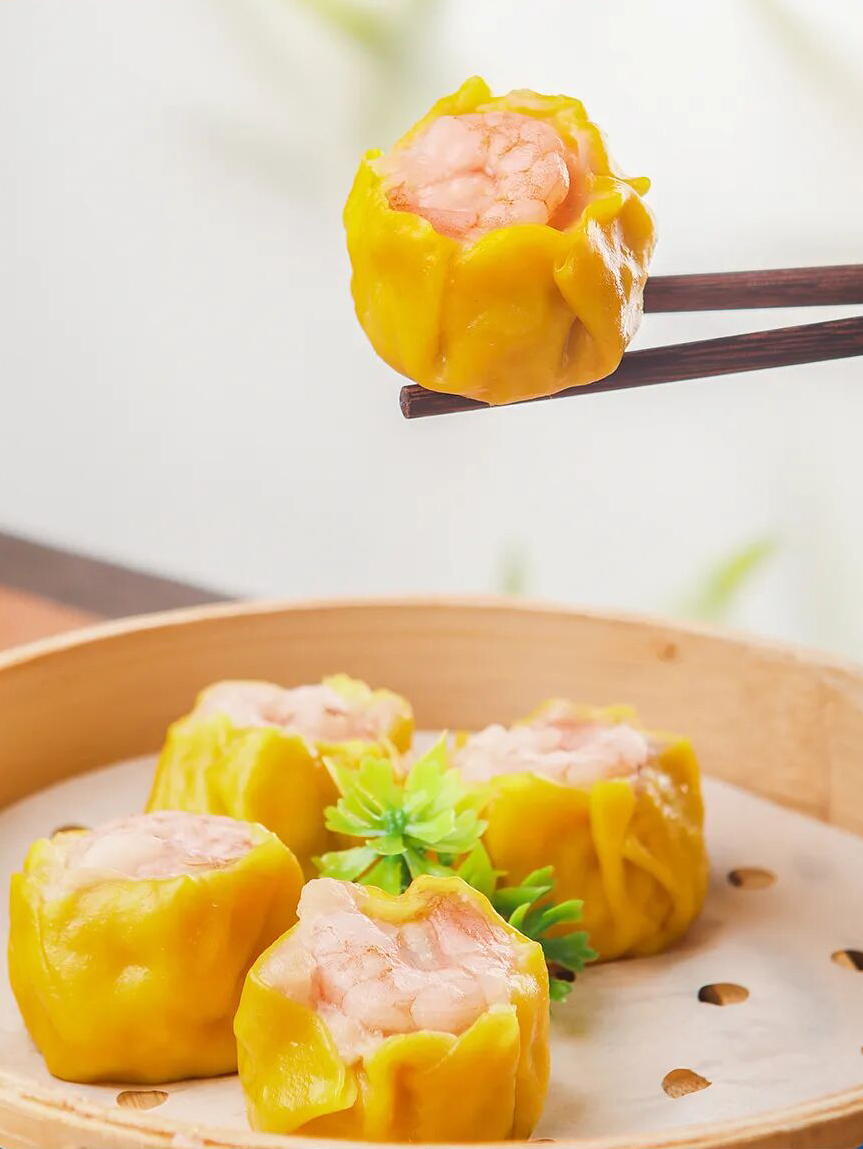
Shrimp Siu Mai, one of the frozen dim sum items in the range: whole-shrimp filling, thin translucent wrapper, 12 minutes from frozen to service.
Line 2 — Traditional Dim Sum: The Steamed Cake Line
Traditional steamed cakes are where Cantonese dim sum separates itself from generic frozen snacks. They are also the line most often under-bought, because buyers benchmark them against buns instead of treating them as a distinct menu role.
The Water Chestnut Cake is the clearest example. It is packed at 500 g per bag, 12 bags per carton, and steams in 6–8 minutes directly from frozen with no thawing step — the same format and timing shared across the steamed cake series, including Red Bean Cake and Steamed Black Sesame Kuih. That no-thaw, sub-ten-minute window is what makes the line viable for afternoon tea service and banquet tea breaks, where the kitchen is already saturated.
The Taro Cake plays a different role: it is the savoury counterweight on a menu dominated by sweet pastry. The taro paste used across the taro items in this range is hand-mashed and contains real taro chunks rather than flavour-only paste, which is what gives the cake its savoury weight and makes it work beside tea rather than after it. Red Bean Cake, with its distinct red-and-white layers and dense red bean pieces, and Steamed Black Sesame Kuih, with its black-and-white layering and sesame-coconut profile, complete the visual end of the line — sliced cakes photograph well and carry a menu’s premium perception.
Line 3 — Fried Dim Sum: The Margin and Texture Line
Fried dim sum is where texture contrast and margin usually sit. The range includes Explosive juice gold ball (Sesame Ball, 300 g/10 pieces × 12 bags, fried at 160–165 °C for 8–9 minutes from frozen), Taro Pie (336 g/12 pieces × 16 bags, fried at 150–160 °C for 3–4 minutes), Hong Kong style spring rolls, Milk Rolls, Green Tea Buddha Cake and Golden Durian Crisp.
What a fryer line actually requires
- Temperature control is not optional. The gap between 150 °C and 165 °C separates a three-minute item from a nine-minute item; a single oil setting will not serve both.
- No-thaw frying shortens the ticket time. Both formats go straight from the freezer, which matters for night stalls and transport-hub counters where the order window is short.
- Frying adds equipment and ventilation load. Sites without a fryer should not shortlist this line, however strong the demand signal.
Line 4 — Vegetarian Lo Han Jai: The Menu Gap Filler
Vegetarian Lo Han Jai (buddha’s delight) is the item that solves a recurring banquet problem: the vegetarian guest at a table built around meat and seafood. It is packed at 400 g per box, 12 boxes per carton, and contains shiitake mushrooms, wood ear mushrooms, dried bean curd sticks, oyster mushrooms, fried tofu and king oyster mushrooms. The preparation method is a natural thaw followed by a short boil with a small amount of water until thoroughly heated.
Its value to a buyer is structural rather than decorative. The dish is purely vegan, low in fat and high in dietary fibre, and it broadens the menu for vegetarians, light-diet diners and morning-tea guests without adding a separate production line. Because the preparation is a boil rather than a steam, it can run on a different station from the dim sum steamer — useful in a kitchen where steamer capacity is the bottleneck.
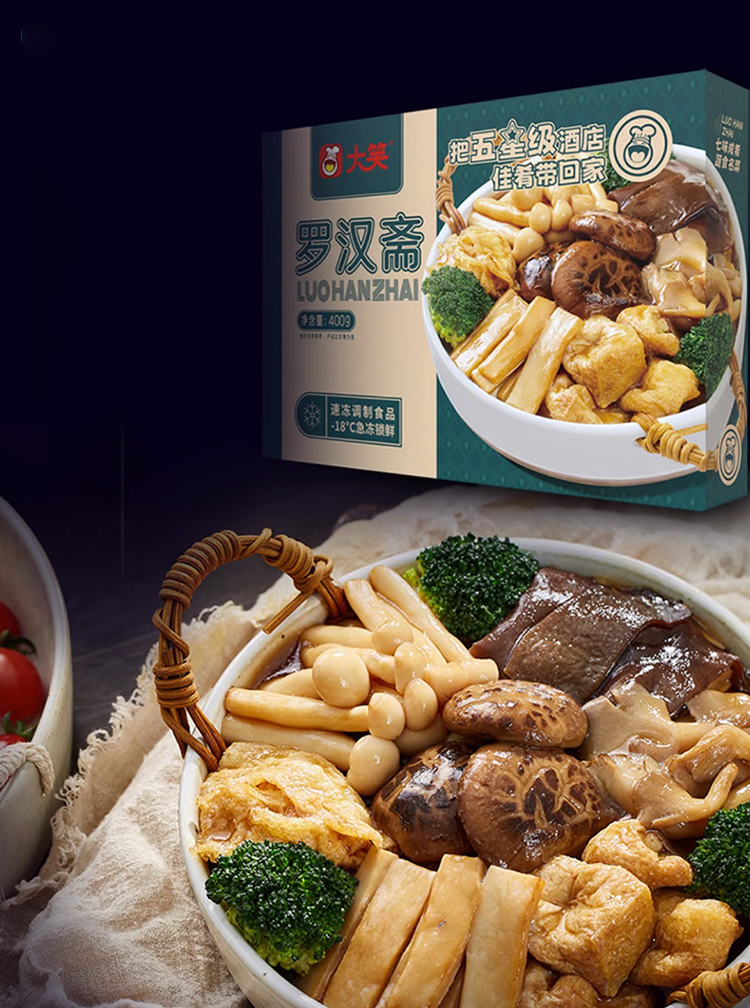
Vegetarian Lo Han Jai: a vegan banquet item built on mixed mushrooms and bean curd, prepared by natural thaw and a short boil.
Line 5 — Dim Sum Breakfast: The Turnover Line
Breakfast is a throughput problem, not a variety problem. The most efficient items are the ones with the shortest no-thaw window and the widest acceptance. In this range that means the Lava Custard Bun (480 g, 12 pieces per bag, 18 bags per box, 8 minutes of boiling-water steaming from frozen), the steamed custard bun, and the Millet cake (280 g per bag, 30 bags per box, steamed 7–8 minutes or pan-fried until golden on both sides).
The Lava Custard Bun works because the filling does the selling: a salted egg yolk custard that turns smooth and creamy when heated, inside a dough described as delicate and fluffy rather than hard or sticky. The Millet cake covers the other end of the breakfast menu — a whole-grain item that is soft, lightly sweet and described as stomach-friendly and easily digestible, which matters for elderly diners, children and institutional catering.
Operationally, the line replaces preparation time with holding discipline. Frozen buns must be stored at ≤ −18 °C throughout the chain to prevent drying and cracking, and the supporting equipment is limited to freezers, steamers and refrigerated transport vehicles. That is a modest capital requirement compared with running a dough kitchen.
Line 6 — Banquet and Gift: The Signature Line
Banquet menus and gift boxes require items that carry perceived value, and they tolerate longer preparation in exchange. Buddha Jumps Over The Wall (Luxury Soup) sits at the top of that hierarchy, with a role built around flexible inventory: long-term low-temperature storage, use as needed, and reduced waste on items that cannot be sold casually. Vegetarian Lo Han Jai works in the same banquet context as the plant-based counterpart, and the steamed cake series — Water Chestnut Cake, Taro Cake, Red Bean Cake, Coconut Golden Cake — supplies the tea-break course that banquets are judged on.
For gift channels, the relevant capability is packaging rather than product: logos and product details can be customised to buyer requirements, which is what allows a New Year gift box to carry a retailer’s own identity over a Yuexiang-produced assortment.
Steamed Buns or Steamed Cakes? A Decision Rule
This is the single most common range decision in Cantonese dim sum purchasing, and it has three defensible answers.
- Lead with steamed buns. Buns are the staple: they satisfy hunger, address the broadest customer base, hold a stable repurchase rate, carry a 12-month frozen shelf life for more flexible stock rotation, and fillings such as custard and char siu are a strong draw. This fits breakfast shops, group catering, convenience stores, casual teahouses and volume-focused export buyers.
- Lead with steamed cakes. Cakes differentiate: most competitors are weak in this pastry category, the items are light and suited to tea pairing, and the visual appeal lifts the perceived level of the menu. This fits mid-to-high-end teahouses, afternoon tea service, banquet tea breaks and operators building a signature item.
- Combine both. Buns stabilise base sales, cakes create the point of difference, and the two categories cover traffic across the day. This is the usual recommendation for newly opened teahouses, frozen food wholesalers, online retailers and buyers purchasing across categories.
The counter-argument deserves stating: cakes carry a 6-month shelf life against 12 months for buns, so a cake-heavy buy raises rotation risk. A first-time buyer is generally better served by starting with buns for stable base volume and adding a small cake batch to test response.
Purchasing Terms and Acceptance Criteria
Commercial terms in this range are comparatively simple to verify. The minimum order quantity is 50 boxes, and lead time runs 7–14 days. Customisation covers logos and product details, and technical support includes free steaming parameters, store menu matching and practical preparation guidance.
Acceptance checklist
- Weight verification. Weigh and verify against the declared pack weight before signing off.
- Packaging integrity. Check that seals are intact and label information is complete, with no leaks or bulging bags.
- Microbiological safety. Confirm plate-count testing for colony and coliform bacteria is included in the pre-shipment test.
- Cold chain. Verify that product has been held at ≤ −18 °C throughout, including transport.
- Documentation. Quality inspection reports, production qualifications and export customs declaration documents are provided with each order.
- Date coding. Production date and shelf life are printed on the outer packaging of all products; check both against your rotation plan.
After-sales terms worth writing into the contract include 24-hour complaint response, defined handling for damaged or thawed goods against supporting documentation, and the −18 °C cold-chain guarantee across the whole shipment.
Venue Suitability Matrix
| Venue type | Strongest lines | Selection note |
|---|---|---|
| Restaurants — fast food breakfast shops, tourist-area snacks, late-night stalls | Fried Dim Sum, Frozen buns, Dim Sum Breakfast | Both a fryer and a steamer are needed to run the full offer; fried items carry the late-night ticket |
| Hotels & tourism — star-rated hotels, guesthouses, resorts, camping sites | Frozen Dim Sum, Traditional steamed cakes, banquet soup | Steamed cakes lift the pastry section; the 6-month cake shelf life requires tighter rotation planning |
| Retail — supermarkets, community fresh stores, convenience stores | Frozen buns, Dim Sum Breakfast, steamed cakes | Freezer space and single-portion visibility decide the mix more than variety does |
| Catering services — schools, factories, offices, hospitals, nursing homes, government canteens | Frozen Dim Sum, Millet cake, red bean paste bun | Uniform size, low-fat profiles and predictable reheat times matter more than novelty |
| Transportation — airports, rail stations, highway service areas, on-board catering | Fried Dim Sum, Lava Custard Bun, Sesame Ball | 7–9 minute steam and fry windows suit high-turnover counters with minimal kitchen space |
| Trade & foreign trade — food supply chain wholesalers, overseas Chinese restaurants, Chinese supermarkets | Full range | Documentation and cold chain decide the deal; frozen dim sum commonly ships under HS Code 1902200000 and 1902309000 |
| Gifts — OEM gift boxes, New Year hampers, banquets | Traditional steamed cakes, Buddha Jumps Over The Wall, Lo Han Jai | Packaging customisation and shelf-life balance outweigh unit cost |
Where a Frozen Range Stops Working
A shortlist is only credible if it states its own boundaries. Four are worth flagging.
- Cold chain is absolute. Product must be held at ≤ −18 °C throughout the entire process; an interrupted chain causes buns to dry and crack and undermines the texture the range was designed for.
- Fried items need frying capability. A site without a temperature-controlled fryer cannot execute the fried line properly, and approximating 150–165 °C in unsuitable equipment produces inconsistent results.
- Steamed cakes are not a long-hold item. At 6 months frozen shelf life, they suit operators with reliable turnover or planned promotional slots, not speculative bulk buying.
- A 50-box minimum favours multi-SKU buyers. Very small outlets testing a single item may find the entry quantity better suited to a shared or consolidated first order.
There is also a compliance boundary. Guangzhou introduced a regulation effective 1 May 2026 requiring restaurants to clearly label whether dim sum is handmade on-site or produced by central kitchens or as pre-made product. For teahouses in that market, the frozen range does not replace disclosure — it makes disclosure a menu-design task rather than an operational one.
Market Signals Buyers Should Read in 2026
Three data points frame the category. The global frozen Cantonese-style dim sum market was valued at USD 7.04 billion in 2025 and is projected to reach USD 11.99 billion by 2033, a trajectory reported alongside a 6.87% compound annual growth rate by Data Insights Reports. China accounted for 46% of global frozen dumpling production volume in 2025, followed by Japan at 11% and South Korea at 9%, according to Business Research Insights — which means the sourcing base for this category remains overwhelmingly concentrated in one production geography.
The regulatory signal runs in parallel. Labelling requirements in major Cantonese dim sum markets are pushing buyers to ask suppliers for clearer product information rather than simply lower prices, because the buyer now has to answer a customer question about origin and method. For a manufacturer rooted in Shunde — a UNESCO “City of Gastronomy” — that shift is comparatively favourable: heritage and production method become procurement-relevant facts rather than marketing language.
Future Outlook
The next stage of this category is unlikely to be driven by new flavours. It will be driven by documentation and format. As more markets adopt transparent labelling for pre-made and central-kitchen dim sum, the suppliers that hold up will be the ones that can supply specification sheets, microbiological test results, cold-chain evidence and consistent pack formats as standard, not on request. Product breadth matters too, but breadth without documentation simply transfers risk to the buyer.
For Yuexiang, the structural position is a wide range — over 300 items across five series, from steamed cakes and fried pastry to banquet soup — combined with OEM/ODM capability and export experience across the USA, Canada, Australia, New Zealand, Mexico, Malaysia and Vietnam. That combination is what a buyer needs when assembling a menu rather than buying an item.
Frequently Asked Questions
Which should a buyer choose first: Cantonese steamed buns or steamed cakes?
Steamed buns are the staple: they satisfy hunger, address the broadest customer base, hold a stable repurchase rate, carry a 12-month frozen shelf life and use fillings such as custard and char siu as a draw. They fit breakfast shops, group catering, convenience stores and casual teahouses. Steamed cakes are the differentiation play: light, tea-friendly and visually strong, they fit mid-to-high-end teahouses, afternoon tea and banquet tea breaks. Most new teahouses and wholesalers are better served by combining both — buns for base volume, cakes for a signature item.
Do steamed buns and steamed cakes have different shelf lives?
Yes. Under frozen storage at −18 °C, steamed buns carry a 12-month shelf life and steamed cakes — including Water Chestnut Cake, Red Bean Cake and Black Sesame Cake — carry 6 months. Production date and shelf life are printed on the outer packaging of all products.
What are the minimum order quantity and typical lead time?
The minimum order quantity is 50 boxes, and lead time is 7–14 days. OEM/ODM orders can include customised logos and product details, with technical support covering steaming parameters, store menu matching and preparation guidance.
What storage and equipment conditions does the range require?
Product must be held at ≤ −18 °C throughout the entire process, including transport, to preserve freshness and prevent buns from drying and cracking. Supporting equipment is limited to freezers, steamers and refrigerated transport vehicles; the Vegetarian Lo Han Jai is prepared by natural thawing followed by a short boil.
Is there a vegetarian option suitable for banquet menus?
Vegetarian Lo Han Jai (buddha’s delight) is a purely vegan item packed at 400 g per box, 12 boxes per carton. It contains shiitake mushrooms, wood ear mushrooms, dried bean curd sticks, oyster mushrooms, fried tofu and king oyster mushrooms, and is low in fat and high in dietary fibre. It is prepared by natural thawing and boiling with a small amount of water until thoroughly cooked.
How should a buyer verify an incoming shipment?
Pre-shipment testing covers 100% of product, including weight verification, seal and label completeness checks for leaks or bulging bags, and microbiological testing by plate count for colony and coliform bacteria. Buyers receive quality inspection reports, production qualifications and export customs declaration documents with each order, and complaints are handled within a 24-hour response window.
Range Notes and Contact
Foshan Shunde Yuexiang Food Manufacturing Co., Ltd. supplies Cantonese dim sum, traditional dim sum, Chinese dim sum and frozen dim sum from Shunde, Foshan, with a product portfolio spanning more than 300 items across five series and export coverage of roughly 40% of output. Buyers evaluating the six lines above can request samples, pack specifications and current steaming parameters directly.
Contact: Kyle — Kyle@dimsum-daxiao.com · +86 13726399586 · www.dimsum-daxiao.com. Company brochure for download: Yuexiang Food product brochure (PDF).
Have Questions or Need More Details?
Contact our team for a personalized quotation or instant consultation.
Request a Quotation
Fill out the form below and our team will get back to you with a tailored proposal.
WhatsApp Direct Chat
Prefer to chat in real-time? Message us on WhatsApp for instant assistance & quick answers.
- Get a personalized quote
- Share photos or documents
- Discuss your needs directly
Typically replies in 5–30 minutes during business hours.