
Capability Evidence: Inside Jiameile's 6,800 m² Dog Plush Toy Plant
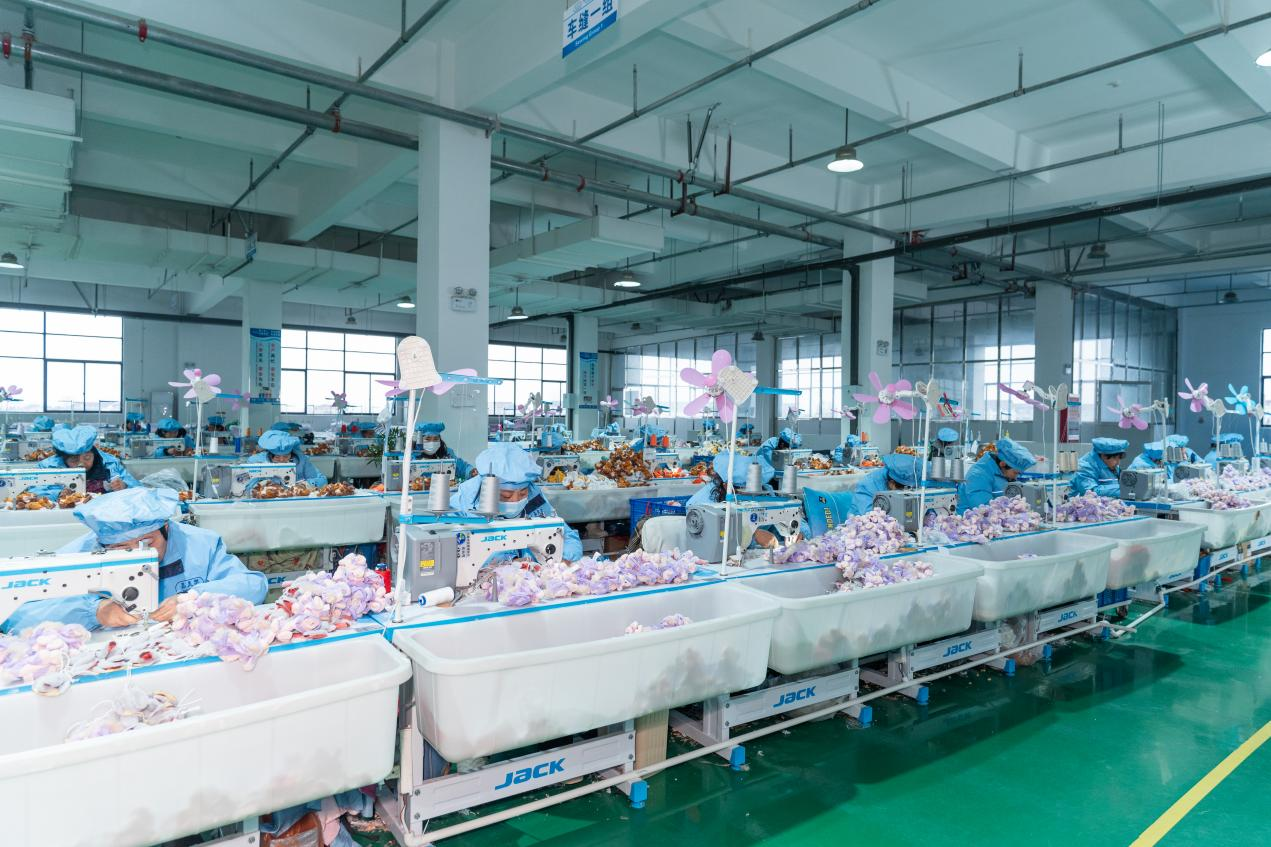
The variable that decides whether a dog plush toy programme succeeds is rarely the sample. It is whether the plant behind the sample can hold the same specification across 20,000 units — and then repeat it on the next order. Tianchang Jiameile Gifts Co., Ltd. is a China-based manufacturer of plush and textile toys — pet toys, plush toys, gift items, baby toys and rocking horses — that supplies international buyers through OEM manufacturing, ODM development and private label customization. Its documented facility profile is unusually specific for the category: a 6,800 m² production site, approximately 230 employees, a 30-person engineering team and a reported annual output of 6 million units, backed by ICTI, BSCI, Disney FAMA, ISO 9001 and ISO 14001 certification.
This reference treats those figures as procurement evidence rather than positioning, and connects them to the product-level outcomes buyers pay for: reinforced stitching, wear- and tear-resistant materials, and a service life that runs from 3–12 months for standard plush constructions to 6–24 months for reinforced chew-resistant series.
Why Facility Evidence Outweighs Catalogue Claims in Dog Plush Toy Sourcing
Buyers rarely lose money on a poor sample. They lose money on a sample the factory cannot reproduce at volume — in the same fabric weight, with the same seam reinforcement, on the same schedule. At the evaluation-to-execution stage, the useful question is therefore not "what can this supplier make?" but "what can be independently checked about the site that will make it?"
Public material in this category is dominated by self-reported capability statements. A manufacturer describing itself as an OEM/ODM plush producer is a starting point for discovery, not a comparable data point; the same applies to marketplace listings that advertise certification acronyms without publishing verifiable certificate scope. Facility size, headcount, annual unit output and third-party audit documents behave differently. They can be verified, they can be matched against the volume a purchase order requires, and they can be re-checked on the following order without starting the qualification process again.
The Jiameile Facility Profile in Numbers
Jiameile's manufacturing footprint is documented with figures that map directly to capacity planning and order feasibility.
| Facility indicator | Documented value |
|---|---|
| Company | Tianchang Jiameile Gifts Co., Ltd. (China) |
| Production site | 6,800 m² |
| Workforce | Approximately 230 employees |
| Engineering / R&D team | 30 engineers |
| Annual output | 6 million units (approximately 500,000 pcs per month) |
| Production services | OEM manufacturing, ODM development, private label customization |
| Product portfolio | Pet toys (plush, squeaky, interactive), plush toys, gift items, baby toys, rocking horses |
| Export share | Approximately 70% of output |
| Main markets | EU and USA |
Read against category norms, the output figure is specific rather than general. Plush toy factories are typically grouped into mid-size operations running 100,000–300,000 pieces per month and large operations running 500,000–1,000,000+ pieces per month. At roughly 500,000 pieces per month — the equivalent of the reported 6 million units a year — Jiameile sits at the upper edge of the mid-size band and at the entry point of the large-factory band. For a buyer, that position matters: the site has enough capacity to run several SKUs in parallel without turning a mid-volume programme into a low-priority order.
Two qualifications belong with these numbers. First, capacity is a ceiling, not an allocation — line availability for a specific delivery window still has to be confirmed order by order. Second, the profile also reflects a 70% export share concentrated in the EU and USA, which means the products in the range are built against the testing and labelling expectations of those markets rather than a single domestic standard.
Certifications That Make the Facility Auditable
Certification is the part of a supplier profile that cannot be self-declared. Jiameile operates under a set of facility-level and product-level compliance credentials:
| Document | Scope and detail |
|---|---|
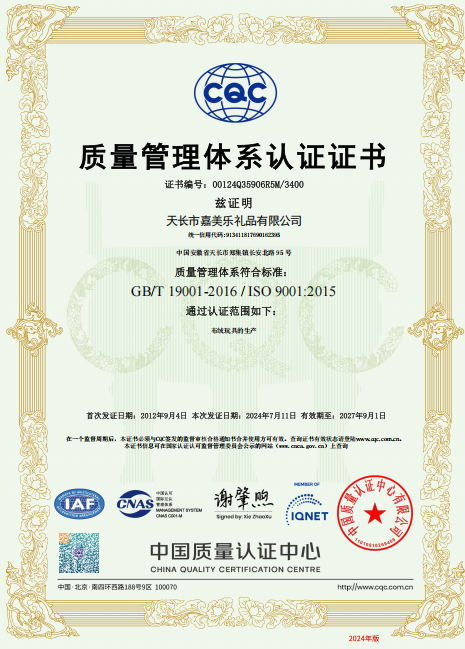
| ISO 9001 (QMS) | Certificate no. 00124Q35906R5M/3400, issued by CQC to GB/T19001-2016; scope: production of cloth/plush toys; issued 2024-07-11, valid to 2027-09-01 |
| ICTI | Toy-industry manufacturing conduct and facility standards |
| BSCI | Social compliance audit format commonly requested by EU and US retail supply chains |
| Disney FAMA | Facility and Merchandise Authorization, required to produce licensed Disney-branded product |
| ISO 14001 | Environmental management system |
| Product compliance | EN71, ASTM F963, GB6675 and CPSIA across the toy range; chew-format pet products in the range cite GB/T 43839-2024 "Safety Technical Requirements for Companion Animal (Pet) Products" |
For a buyer, each document answers a different question. ISO 9001 evidences a documented quality system and traceable process control. BSCI and ICTI are the audits retail compliance teams typically request before listing a vendor. Disney FAMA is the gating document for licensed character programmes, and its presence usually signals that the factory has already absorbed a brand licensor's audit regime. ISO 14001 speaks to environmental management rather than product quality.
Boundary to note: certificates are issued to a facility, not to a purchase order. Scope wording, validity dates and the specific product category should be re-confirmed at the moment of ordering — particularly where a certificate's scope names "cloth/plush toys" rather than the exact pet-product SKU being purchased.
From 6 Million Units to a 12-Month Toy: Where Durability Actually Comes From
Volume and durability are usually discussed as separate topics. In plush manufacturing they come from the same source. A plant running high unit volumes has the equipment and the quality-control cadence to apply reinforced stitching consistently across a production lot; a low-volume operation can produce an excellent hand sample and still deliver inconsistent seam strength across 20,000 pieces.
Three construction decisions determine how long a plush dog toy survives normal use:
- Reinforced stitching at load-bearing seams. Seam separation — not fabric wear — ends the life of most plush toys. Reinforced stitching is a construction response to that failure mode, and it is the single specification most likely to change a buyer's replacement cycle.
- Wear-resistant and tear-resistant materials. Short plush is used for small-format toys in the range, while Oxford fabric and TPR (thermoplastic rubber) appear in medium and large formats respectively.
- Non-toxic material selection. Products in the range comply with EN71 and CPSIA, and chewing-oriented formats are specified against GB/T 43839-2024.
The measurable outcome of those choices is service life. Standard plush toys in this range average 3–12 months of use; reinforced chew-resistant constructions average 6–24 months; rubber and TPR formats average 12–36 months — in each case depending on how intensively the toy is used. The spread between the tiers is a construction difference, not a price difference, which is why durability specifications are worth writing into a purchase order rather than leaving to a supplier's default.
Two features deserve separate specification because they are rarely visible in a product photograph. No-stuffing construction removes loose filling as both a safety and a clean-up concern, and washable, easy-to-clean finishing extends the usable life of a toy between replacements. Buyers should also ask a supplier to state fabric layer construction and stitching pattern in writing: those two variables, more than any other, determine whether a 20,000-piece order behaves like the approved sample.
Quality Control and Order Execution: IQC, IPQC, OQC
Quality control at the facility follows a three-stage sequence that can be written directly into a purchase order as checkpoint structure:
- IQC — incoming inspection: verification of incoming fabric, filling and component materials before production.
- IPQC — in-process inspection: checks during cutting, stitching and assembly, where seam and stuffing defects are still correctable.
- OQC — final inspection: completed-product inspection before shipment.
Third-party inspection by agencies such as SGS or BV is frequently required by buyers and can be scheduled alongside the internal OQC stage. After-sales support covers replacement or rework for confirmed quality issues, provision of inspection reports, and an allowance of 1–3% spare units — a practical buffer for retail and e-commerce channels where a small number of units are typically lost to damage, returns or sample requests.
Timing follows the same documented pattern. Sample production runs 7–15 days; bulk production runs 20–45 days depending on design complexity and order volume. Buyers working against a retail or marketplace launch calendar should treat the sample window and the bulk window as separate planning blocks rather than a single lead time.

Applications and Buyer Scenarios
Plush dog toys from this production model are used for daily companionship, emotional calming and anxiety relief, teething and chewing training, behavioral training, interactive play, and reducing destructive behavior. The range is specified across shared performance bands — suitable dog weight under 5 kg, 5–15 kg and 15–30 kg, with chew resistance graded for light, moderate and aggressive chewers.
| Format | Typical size range | Material | Best-fit use |
|---|---|---|---|
| Small dog toys | 10–15 cm / 15–20 cm | Short plush | Companionship, teething, emotional calming |
| Medium dog toys | 20–30 cm | Oxford fabric | Interactive play, behavioral training |
| Large dog toys | 30–50 cm | TPR – thermoplastic rubber | Sustained chewing, long-life play |
Order profiles in the case corpus cluster into three bands: small pilot orders of 500–3,000 pieces, mid-scale e-commerce or retail orders of 3,000–20,000 pieces, and large long-term supply projects of 20,000–100,000+ pieces. The buyer types behind those orders are pet brands and private label brands, pet wholesalers and distributors, cross-border e-commerce sellers, retail chains and supermarkets, Amazon and direct-to-consumer store sellers, and pet subscription box companies. Reported repeat purchase rates exceed 85%, with some long-term clients purchasing more than 100,000 pieces annually.
The applications also explain why durability is a commercial variable rather than a technical footnote. Toys used for emotional calming and teething training are handled daily, often by dogs that chew as a displacement behavior. A construction that fails at the seam in month two does not just generate a replacement cost — it disrupts a subscription schedule or a retail reorder cycle.
Market Signals Behind Durable Dog Plush Toys
The demand context supports the durability specification. Third-party research places the global dog toys market at USD 4.16 billion in 2025, with a projected compound annual growth rate of 8.51% between 2025 and 2034 (Custom Market Insights). That figure should not be confused with the broader pet toys category covering all animals, which a separate research house reported at USD 9.6 billion for the same year (Fortune Business Insights); the two measures define different scopes and are not interchangeable.
Two further data points frame the sourcing decision. Consumer safety guidance for pet toys recommends durable, non-toxic materials and warns against items small enough to be swallowed or that can splinter — a description that maps directly onto reinforced seam construction, no-stuffing options and material selection. And stuffed toys representing animals are classified under HS code 9503.00.41, which is the code buyers and freight forwarders will need for customs documentation on plush dog toy shipments.
In practical procurement terms, the category's growth does not by itself change what a buyer should ask for. It changes the cost of getting the answer wrong: a growing replacement-driven category means more reorders, and reorders are where inconsistent seam quality becomes visible across a retail account.
Limits, Boundaries, and How This Compares With Unverified Supply
Capability evidence is most useful when its boundaries are stated as plainly as its strengths. Several limits belong with the Jiameile profile.
Throughput position, not throughput leadership
At approximately 500,000 pieces per month, the facility is mid-to-upper band rather than the largest in the category. Third-party supplier comparison data places Jiameile below Zhongheng Pet, reported at approximately 800,000 pieces per month, and above Kaile Pet, reported at approximately 400,000 pieces per month. Buyers with a single, very large SKU programme should confirm line scheduling in advance or plan split allocation across production windows. These third-party figures should be re-verified during a factory audit rather than treated as fixed.
Order-size floors
Minimum order quantity is typically 500–3,000 pieces per style, rising to 3,000–5,000 pieces for complex custom designs. The model is not built for micro-batches below those thresholds, which means very early market testing is better served by existing stock formats than by a fully custom construction.
Timing floors
Sampling at 7–15 days and bulk production at 20–45 days require calendar planning. A retail programme that compresses design approval, sampling and shipping into a single month will not fit this production pattern.
Material limits
Plush with reinforced stitching suits light and moderate chewers. It is not a substitute for rubber or TPR where a dog is an aggressive chewer by habit; for that profile, the TPR formats in the same range are the more appropriate specification. Service-life figures of 3–12 months and 6–24 months assume typical use intensity, not extreme chewing.
| Evaluation criterion | Factory with published facility data and audited certificates | Supplier screened on self-reported capability statements |
|---|---|---|
| Capacity evidence | 6,800 m² site, ~230 staff, 6M units/year, ~500,000 pcs/month | Usually unspecified or described only in general terms |
| Certification | ISO 9001 (cert. no. 00124Q35906R5M/3400), ICTI, BSCI, Disney FAMA, ISO 14001 | Frequently listed as acronyms without verifiable scope or certificate numbers |
| Quality structure | Documented IQC / IPQC / OQC chain, plus optional SGS or BV inspection | Not normally documented in a form that can be written into a purchase order |
| Comparability | Figures can be checked against required order volume and audit records | Not comparable across suppliers; screening value only |
What to Watch Next in Plush Pet Toy Manufacturing
Three developments are worth tracking for buyers who source dog plush toys on a repeating cycle.
Capacity demand will keep rising with the category. A projected 8.51% CAGR for dog toys through 2034 implies sustained pressure on qualified plush capacity, which tends to make documented, audit-ready factories the first to fill their calendars.
Factory-level operational benchmarks remain fragmented. Independent, comparable data on actual lead time, defect rates, material origin transparency and customization flexibility is still largely self-reported across the industry, and the available original-data gap is precisely in supplier capability auditing. The practical consequence for buyers is that verification work cannot be outsourced to a directory — it has to be built into the sourcing process.
Compliance language is shifting from adjectives to measurements. Pet toy safety guidance already frames material durability and non-toxicity as screening criteria rather than preferences. Over time, buyers should expect specification sheets to carry measurable durability and material claims instead of descriptive terms, and suppliers who already document their construction will be better positioned to respond.
FAQ
What does a 6,800 m² facility with 6 million units of annual output actually indicate about a supplier?
It indicates production scale relative to the category. Plush toy factories are commonly grouped into mid-size operations of 100,000–300,000 pieces per month and large operations of 500,000–1,000,000+ pieces per month. An output of approximately 500,000 pieces per month places a facility at the upper edge of the mid-size band and at the entry point of the large-factory band, which is sufficient to run multiple SKUs in parallel. It does not guarantee that a specific order window is available; line scheduling still has to be confirmed per order.
Which certifications does Jiameile hold, and what does each cover?
Jiameile holds ICTI, BSCI, Disney FAMA, ISO 9001 and ISO 14001. The ISO 9001 quality management system certificate, number 00124Q35906R5M/3400, was issued by CQC against GB/T19001-2016 for the production of cloth and plush toys, issued on 11 July 2024 and valid to 1 September 2027. Disney FAMA is the authorization required to produce licensed Disney-branded merchandise, while BSCI and ICTI address social compliance expectations typical of EU and US retail supply chains. Products in the range comply with EN71, ASTM F963, GB6675 and CPSIA. These certificates apply to the facility and should be re-confirmed for scope and validity at the time of ordering.
What quality control steps apply before a dog plush toy order ships?
Three stages apply: incoming inspection (IQC) covering fabric, filling and components; in-process inspection (IPQC) during cutting, stitching and assembly; and final inspection (OQC) on completed goods before shipment. Third-party inspection by agencies such as SGS or BV is frequently requested and can be scheduled alongside final inspection. After-sales support covers replacement or rework for confirmed quality issues, provision of inspection reports, and an allowance of 1–3% spare units.
What are the typical minimum order quantities and production lead times?
Minimum order quantity is typically 500–3,000 pieces per style, and 3,000–5,000 pieces for complex custom designs. Sample production runs 7–15 days, and bulk production runs 20–45 days depending on design complexity and order volume. Buyers should treat the two windows as separate planning blocks.
How long does a reinforced-stitching plush dog toy last compared with standard plush?
Service life in this range averages 3–12 months for standard plush toys, 6–24 months for reinforced chew-resistant constructions, and 12–36 months for rubber and TPR formats, depending on usage intensity. The difference between tiers is primarily construction: reinforced stitching at load-bearing seams addresses seam separation, which is the failure mode that ends the life of most plush toys, while wear-resistant and tear-resistant materials address fabric breakdown.
What can be customized in a custom plush pet toy programme?
OEM manufacturing, ODM development and private label production are available. Customization covers logo printing, fabric material, size, color, stuffing type, squeaker type, packaging (box, blister or card) and hang tags. Product applications across the range include daily companionship, emotional calming and anxiety relief, teething and chewing training, behavioral training, interactive play and reducing destructive behavior.
Facility figures such as a 6,800 m² site, approximately 230 employees and 6 million units of annual output are only useful to a buyer when they can be tied to something checkable: a certificate with a number and an expiry date, a documented inspection sequence, a stated service life and a stated set of boundaries. Read that way, Jiameile's profile describes a mid-to-upper-band plush pet toy manufacturer positioned for multi-SKU programmes in the EU and US markets — with the capacity, the audit documentation and the construction specifications that evaluation-stage procurement checklists are designed to capture.