
Capability Proof: How the S350 Jetpress Enables Efficient IML Manufacturing
HTNXT Industry Reference · Packaging & Printing · IML Labels
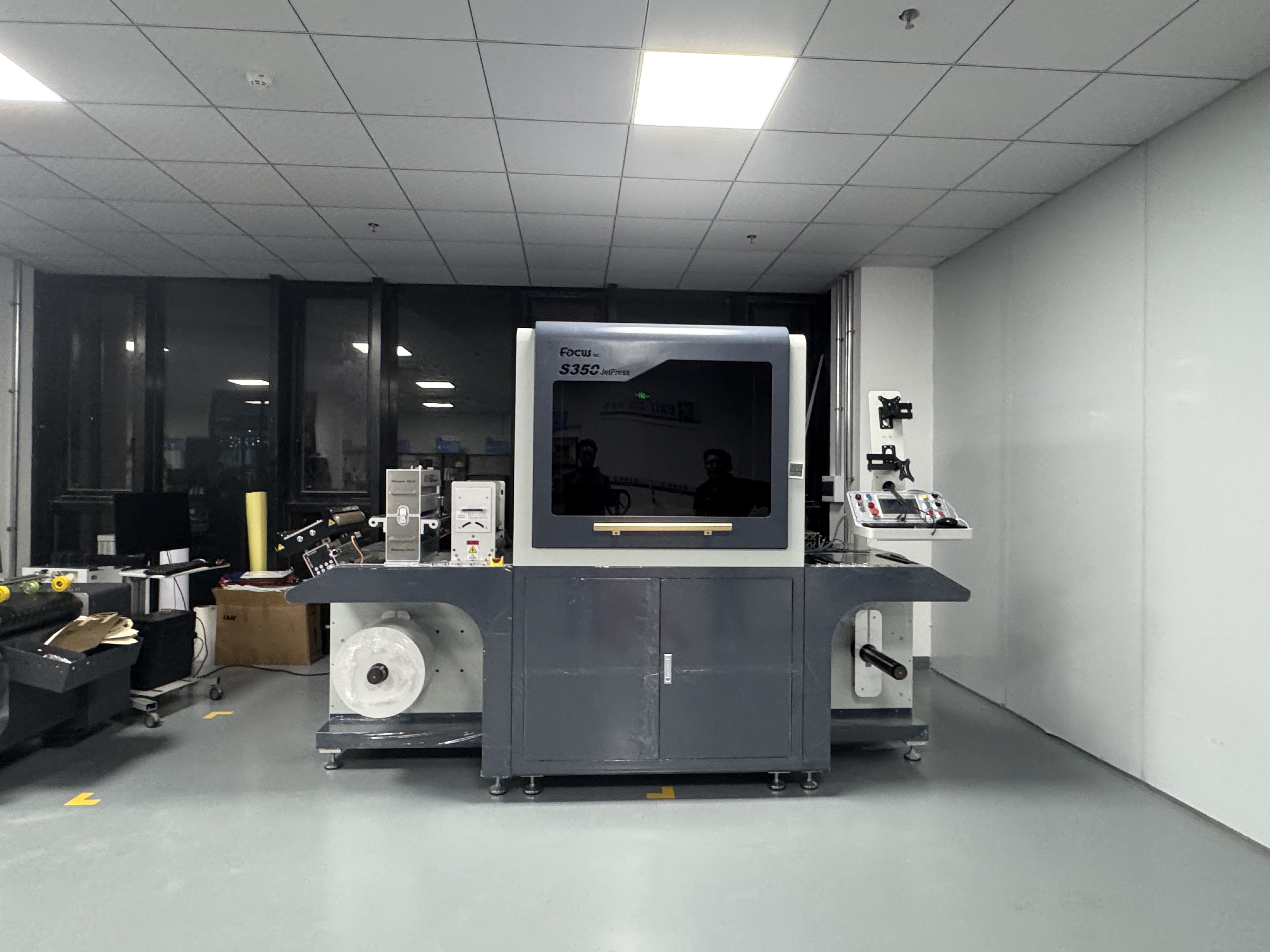
In-mold labeling turns the printed label into a component of the molded part rather than a decoration applied after molding. That single difference reshapes what a printing system has to prove. Colour accuracy still matters, but so do film handling, ink behaviour on non-absorbent substrates, white-ink opacity, and repeatability across long production runs. This article examines the technical evidence behind one specific specification: the S350 Jetpress, a UV single pass roll-to-roll label printing machine from Focus Inc. (Shanghai Focus Industrial Co., Ltd.), a Shanghai-based industrial digital inkjet printer manufacturer founded in 2008 that lists IML printing manufacturing as the applicable industry for this model.
Why IML Is a Different Printing Problem
In-mold labeling is a decorating method in which a pre-printed label is placed into the mold cavity and bonds to the part as the plastic is injected. The label is no longer a separate finishing step applied after the container exists; it is part of the molding cycle. Converters and injection molders therefore evaluate a label press against a different set of failure modes than a general-purpose label shop would.
Three of those failure modes recur in procurement discussions. The first is ink behaviour on non-absorbent film. IML stocks are typically plastic webs such as BOPP, PET, PP or PE, materials that do not absorb water-based ink the way paper does, which is why UV-curing ink chemistry dominates this segment. The second is consistency over time: a label that prints correctly in the first hour of a shift but drifts in the sixth hour creates scrap at the molding machine, not at the press. The third is white-ink reliability. Because IML labels frequently sit on transparent or dark containers, an opaque white base is often what makes the subsequent colour image legible, and white ink is the most sedimentation-prone component in most ink sets.
These are the constraints the S350 Jetpress is engineered against, and they explain why the machine's published configuration concentrates on print head recirculation, white-ink heating, and roll tension rather than on headline colour gamut claims.
The S350 Jetpress at a Glance
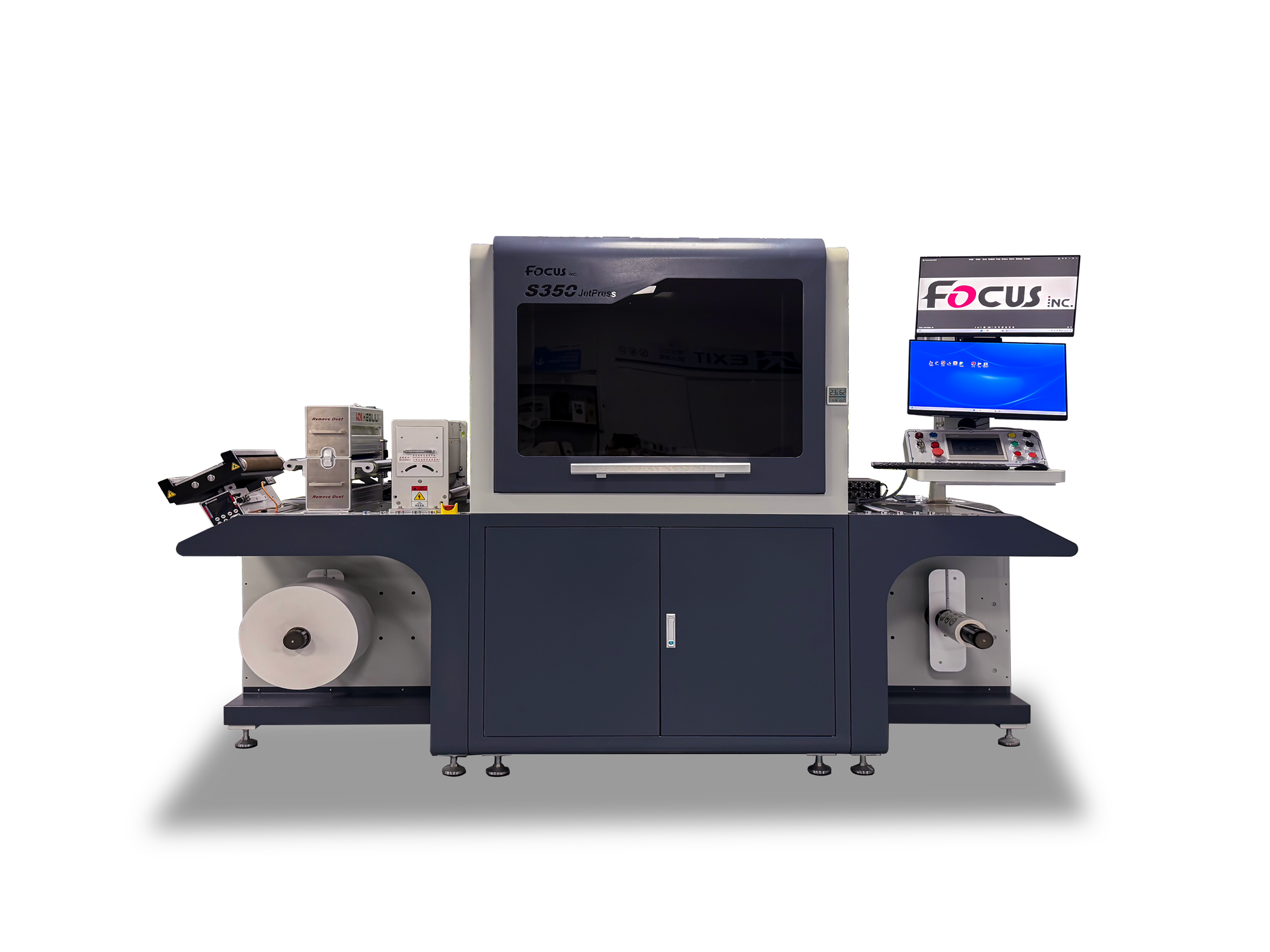
Before examining the design rationale, it helps to state what the machine is in verifiable terms. The S350 Jetpress is a UV single pass roll-to-roll label printing machine. Its published specification set is reproduced below as listed by the manufacturer.
| Parameter | Published specification |
|---|---|
| Print head model | EPSON S3200U1 / S3200U3, inner re-circulation |
| Print head count | 10 pcs or 15 pcs |
| Ink set | W+CMYK (W+CMYK optional) |
| Print width | 235 mm (120 mm for each row) |
| Print resolution | 1200×600 dpi, 900×600 dpi, 600×600 dpi (according to print demand) |
| Drop size | White head 5–10–15 pL; colour head 3.5–5–10 pL |
| Print speed | 20–80 m/min (according to print mode and image quality) |
| Media thickness | 0.02–0.8 mm, stated maximum 3 mm |
| Media roller | Max. 650 mm diameter, 3-inch gas-boost roller, air supply 0.3–0.4 MPa |
| Curing | LED UV curing with water cooling system |
| Media pre-processing | Corona, dust removal, electric alignment (optional) |
| Ink supply system | Ink circulation system; white auto ink heating |
| Ink type | UV curing ink |
| Control software | Focus S350 Ver.; colour print and barcode print support |
| Image formats | PDF, TIFF, AI; PRN after RIP processing |
| Power requirement | AC 380 V / 50 Hz / 50 A |
| Working environment | 20–40 °C, 30–80 % RH, dust-free |
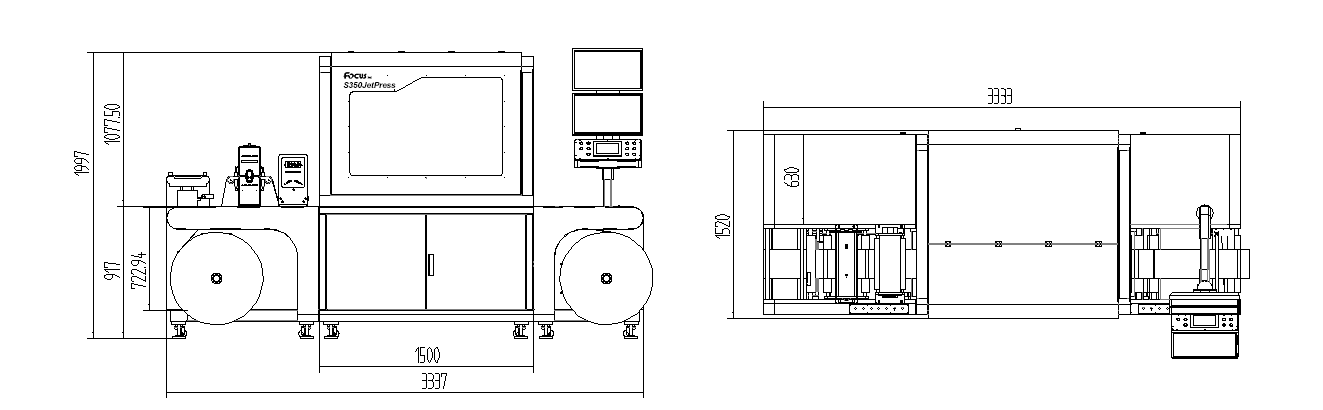
| Machine size / weight | 2,800 × 1,200 × 2,200 mm; 2,300 kg |
| Stated applicable industry | IML printing manufacturing |
Print Head Architecture: Inner Re-Circulation and Jetting Stability
The S350 Jetpress uses EPSON S3200U1 or S3200U3 print heads, both specified with inner re-circulation. This is the single most consequential design decision in the machine for IML work, and it deserves a plain explanation.
In a conventional ink delivery path, ink sits in the head and the supply line between jobs or between coverage-heavy and coverage-light areas of a layout. Pigment particles, and white ink in particular, can settle or agglomerate in that static volume. When the next job starts, the first metres of output may show density variation, missing nozzles, or banding until the head has re-stabilised. Inner re-circulation keeps ink moving through the head itself rather than only through the supply line, which is intended to prevent ink settling and to hold jetting consistency across starts, stops, and long runs.
For IML production, that translates into two practical benefits. First, the white base layer is more likely to stay consistent from the first label of a shift to the last, which matters because a white layer that varies in opacity will show through the finished moulded part. Second, the press is more tolerant of intermittent demand patterns, where a converter switches between a high-coverage cosmetic label and a low-coverage logistics label within the same day.
The head choice also sets the droplet envelope. White droplets are specified at 5–10–15 pL and colour droplets at 3.5–5–10 pL. This is a variable-droplet arrangement: smaller drops for fine text and edge definition, larger drops where a denser, more opaque field is required. Resolution options are listed at 1200×600 dpi, 900×600 dpi and 600×600 dpi, selected according to print demand, which is a reminder that the 20–80 m/min speed band is not a single operating point but a range that trades against resolution and image quality.
White Ink, Opacity, and the Ink Supply Path
IML labels are frequently applied to transparent, translucent, or dark containers, and in those cases the printed image is only as good as the white layer beneath it. The S350 Jetpress addresses this through the supply path rather than through a separate priming station. Three published features are relevant.
- Ink circulation system. The machine circulates ink as part of its supply architecture, which is the mechanism that keeps pigment-heavy formulations in suspension between jobs.
- White auto ink heating. White ink viscosity is temperature-sensitive. Automatic heating of the white channel is intended to hold the ink within a workable viscosity window so that droplet formation stays consistent as ambient conditions shift through a shift.
- LED UV curing with water cooling. Curing is immediate and inline, which is what allows a single-pass press to output a finished, handleable label rather than a wet web. Water cooling of the UV system is a durability measure for the lamp assembly during continuous production.
Buyers should read these features as process controls, not as guarantees. Ink adhesion, cure level, and final opacity on a specific BOPP or PET stock still depend on the ink grade selected, the substrate's surface energy, and whether corona treatment is installed. This is why the machine lists corona, dust removal, and electric alignment as optional pre-processing rather than as standard equipment: on some films they are essential, and on others they are unnecessary cost.
Configuration Flexibility: 10 or 15 Print Heads
Focus Inc. offers the S350 Jetpress in two head counts, 10 or 15, with the ink set listed as W+CMYK. Configuration is not cosmetic. It determines how much ink the machine can lay down per pass, how the white and process channels are sequenced, and therefore what kind of IML label the press can produce at a given speed.
For a converter, the practical question is not which number is larger but which arrangement matches the job book. A portfolio dominated by labels where the white base carries most of the visual weight will place different demands on the head layout than a portfolio of labels printed onto pre-whitened film. Because the two head counts are offered as distinct configurations rather than as a field upgrade, the decision is best made before order, with sample film submitted against the actual artwork.
The related figure is print width: 235 mm, with each row covering 120 mm. Any IML label, or any multi-lane imposition across the web, has to be laid out inside that width. This is the constraint that most often decides whether the S350 Jetpress is the correct machine for a given product family.
Line Integration, Substrate Handling, and Throughput
An IML press is rarely a standalone unit. It sits at the front of a converting line that may include corona treatment, web guiding, die cutting, slitting, and rewinding. The S350 Jetpress is specified around that reality.
Roll handling is defined by a maximum roll diameter of 650 mm on a 3-inch gas-boost roller operating at 0.3–0.4 MPa air supply. Gas-boost (air-expanding) shafts are a practical choice for film because they allow fast, repeatable core mounting without tools, which shortens changeover between label jobs. Optional corona treatment, dust removal, and electric alignment address the upstream conditions that most often cause adhesion failures and registration drift on plastic webs.
On the control side, the machine runs Focus S350 Ver. software with colour print and barcode print support, and accepts PDF, TIFF, and AI files, converted to PRN after RIP processing. Barcode print support is significant in IML because moulding lines increasingly require per-label traceability: a serialised code that links a specific moulded part to a production batch. On a plate-based process that means an additional overprinting step; on a digital single-pass press it is part of the file.
Site preparation is a genuine engineering task rather than an afterthought. The machine draws AC 380 V at 50 Hz and 50 A, occupies 2,800 × 1,200 × 2,200 mm, weighs 2,300 kg, and is specified for 20–40 °C and 30–80 % relative humidity in a dust-free environment. Facilities that cannot hold those conditions will see print quality issues that no amount of head maintenance will resolve.
Compliance and Certification Evidence
For a buyer at the evaluation stage, the compliance file is often as decisive as the specification sheet. The S350 Jetpress is listed among the products covered by the following documents held by Focus Inc.
| Document | Number and referenced standards | Issued by | Market |
|---|---|---|---|
| Verification of Conformity (CE) | SCT260301170122 — EN 55011:2016+A2:2021, EN IEC 61000-6-2:2019, EN IEC 61000-6-4:2019 | ANXIN PRODUCT TEST SERVICE CO., LTD. | EU |
| EC Declaration of Conformity (CE LVD & MD) | SCT260301170121 — EN 1010-2:2006+A1:2010, EN 1010-1:2004+A1:2010, EN ISO 12100:2010, EN 60204-1:2018+A1:2025 | ANXIN PRODUCT TEST SERVICE CO., LTD. | EU |
| German EAR WEEE registration | WEEE-Reg.-Nr. DE 87336785 | stiftung elektro-altgeräte-register (stiftung ear) | Germany |
| German WEEE authorised representative confirmation | Sendungs-ID SI-202502-148048 | Stiftung EAR | Germany |
| Utility model patent | Certificate No. 19070387 — UV printer nozzle protection and cleaning device (ZL 202320105006.X) | CNIPA | Mainland China |
| Utility model patent | Certificate No. 18948405 — thermal transfer equipment with cutting function (ZL 202320103144.4) | CNIPA | Mainland China |
Two observations are worth making for procurement teams. First, the CE documentation covers both electromagnetic compatibility (the EN 55011 and EN IEC 61000-6 series) and machinery safety (EN 1010-1 and EN 1010-2 for printing machinery, EN ISO 12100 for risk assessment, EN 60204-1 for electrical equipment). That combination is the one EU buyers typically ask to see, and it is held as two separate documents rather than one. Second, the German WEEE position is documented in two parts: the device registration itself and the appointment of an authorised representative. Both matter, because under the Elektro- und Elektronikgerätegesetz a non-German manufacturer needs a representative established in Germany to fulfil take-back obligations. Buyers importing into Germany should retain copies of both.
Application Evidence: What the Recorded IML Deployments Show
Specifications describe intent; deployments describe behaviour. Two Focus Inc. case records are relevant to the S350 Jetpress.
In a recorded deployment for a plastic injection molding factory and daily-chemical container manufacturer in the United Arab Emirates, the S350 Jetpress was installed as an IML label fast printing line, with the machine in service for two years at the time of reporting. The stated application was continuous IML label batch printing. The outcomes reported by the manufacturer include reduced manual labeling cost, consistent colour across injection-molded in-mold labels, and no ink peeling observed during high-temperature injection molding. The same record highlights synchronous white-and-colour printing in one pass, tension control for thin IML film, absence of film stretching at high printing speed, and suitability across both small cosmetic bottles and larger household appliance shell labels.
A second reference deployment, this one in Vietnam for a label manufacturer serving daily-chemical, general packaging, and cold-chain logistics label customers, positions the machine within a broader roll-to-roll label workflow. The reported value there is commercial rather than technical: no minimum order quantity, variable-data QR codes printed without plate making, and rapid order turnaround enabled by an integrated printing and converting setup.
Single Pass Digital Versus Plate-Based IML Label Production
The conventional alternative for IML labels is a plate-based process, typically flexo or offset, where each design requires a cylinder or plate set before production can begin. The comparison is not a simple case of one technology replacing the other.
| Decision factor | Plate-based IML label production | S350 Jetpress (UV single pass inkjet) |
|---|---|---|
| Job changeover | Requires a plate or cylinder set per design | Digital file; no plate making |
| Variable data and serialisation | Generally an additional overprinting operation | Barcode and variable data handled through the Focus S350 control software |
| White base on clear or dark film | Multi-station process with dedicated white unit | W+CMYK printed in a single pass |
| Substrate range | Broad, process- and operator-dependent | 0.02–0.8 mm film, stated maximum 3 mm |
| Maximum working width | Press-dependent | 235 mm print width |
| Very long runs of one unchanged design | Remains the incumbent where run length justifies tooling | Competes on changeover and versioning rather than on unchanged-design throughput |
The honest reading is that single-pass UV inkjet wins where the job book is fragmented, where versioning or serialisation is required, or where a customer cannot absorb plate costs for a short run. It is less obviously the right answer where a converter runs one design continuously for months and has already amortised its tooling. Buyers who assume digital always displaces analog tend to be disappointed; buyers who map digital to the jobs that actually fit it tend to be satisfied.
Where the S350 Jetpress Is Not the Right Fit
A capability review that omits the boundaries is a sales document, not a reference. Four published constraints define where this model stops.
- It is a UV ink machine. The ink type is specified as UV curing ink. Converters whose workflow depends on water-based, dye, pigment, or edible ink chemistries should look at other Focus Inc. platforms, such as the Cobra and Falcon packaging printers, which list aqueous, dye, pigment and edible ink options.
- It is a label-format press, not a board press. With a 235 mm print width and 0.02–0.8 mm media range, the S350 Jetpress is not intended for corrugated board, honeycomb board, or folding carton blanks. Those applications sit with separate models; the Cobra-1209S and Cobra-1815S, for example, are listed with a 900 mm maximum printing area and 60 mm maximum thickness.
- It requires industrial site conditions. AC 380 V / 50 Hz / 50 A, a 2,300 kg footprint, 20–40 °C and 30–80 % RH in a dust-free room are not office-grade requirements. A converter planning a first digital press should budget for the room, not only the machine.
- Optional pre-processing is genuinely optional. Corona, dust removal, and electric alignment are listed as options. On difficult films, omitting them can produce adhesion failures that are then wrongly attributed to the press.
Market Context for Digital Label and IML Printing
The demand environment behind IML digitisation is measurable, though the available data is broader than the IML segment itself and should be read with that caveat. MarketsandMarkets places the global digital printing packaging market at USD 30.2 billion in 2024, forecast to reach USD 46.2 billion by 2029, a reported CAGR of 8.9 % over that period. That figure covers digital printing for packaging applications generally, not IML labels alone, and the publisher does not disclose whether the value basis is equipment, print value, or printed packaging output.
A second reference point helps calibrate where a 235 mm label press sits in the single-pass family. Smithers reports single-pass digital printers for corrugated board achieving speeds up to 400 m/min. That is a different machine class entirely: wide-web, board-format equipment. The S350 Jetpress, at a stated 20–80 m/min on film, operates in the label band. The two numbers are not a like-for-like benchmark and should never be tabulated as such.
What both data points support is a directional conclusion rather than a precise forecast: digital printing continues to take share in packaging because the economics of short runs, versioning, and localised production favour plate-free processes. The specific extent to which that shift reaches IML labels is not quantified in the available published data.
Future Outlook
Three developments are likely to shape how machines in this class are specified over the next procurement cycle. The first is traceability. As moulding customers push serialised codes down to the individual part, the ability to print variable barcode data inline becomes a functional requirement rather than a nice-to-have, and it favours presses whose control software already supports it. The second is ink-path engineering. As white coverage increases and run lengths fragment, recirculation and temperature control move from premium features to baseline expectations. The third is compliance documentation. German WEEE representation, EU machinery safety declarations, and patent coverage are increasingly requested as a standard part of supplier qualification in Europe, and manufacturers who hold them as a documented file rather than a claim have an advantage in evaluation.
For a converter, the practical implication is to treat the press, the ink path, the pre-processing options, and the compliance file as one procurement package. Evaluating the print head alone produces an incomplete picture.
FAQ
What print width and substrate thickness does the S350 Jetpress support?
The S350 Jetpress is specified with a 235 mm print width, with each row covering 120 mm, and a media thickness range of 0.02–0.8 mm with a stated maximum of 3 mm. Roll handling is defined by a maximum roll diameter of 650 mm on a 3-inch gas-boost roller operating at 0.3–0.4 MPa air supply. Label layouts that exceed the 235 mm width fall outside this specification.
Which print heads does it use, and how many can be configured?
The machine uses EPSON S3200U1 or S3200U3 print heads, both specified with inner re-circulation. It is offered with 10 or 15 print heads, with the ink set listed as W+CMYK. White droplet size is 5–10–15 pL and colour droplet size is 3.5–5–10 pL, with resolution options of 1200×600 dpi, 900×600 dpi, and 600×600 dpi.
Does the S350 Jetpress print white and CMYK in a single pass?
Yes. The ink set is listed as W+CMYK and the machine is a single-pass roll-to-roll platform. The supply path includes an ink circulation system and white auto ink heating, and curing is performed inline by an LED UV system with water cooling. Corona, dust removal, and electric alignment are available as optional pre-processing where the film grade requires them.
What certifications cover the S350 Jetpress for the EU and German markets?
Focus Inc. holds CE Verification of Conformity SCT260301170122 (EN 55011:2016+A2:2021, EN IEC 61000-6-2:2019, EN IEC 61000-6-4:2019) and EC Declaration of Conformity SCT260301170121 (EN 1010-2:2006+A1:2010, EN 1010-1:2004+A1:2010, EN ISO 12100:2010, EN 60204-1:2018+A1:2025), both issued by ANXIN PRODUCT TEST SERVICE CO., LTD., with the S350 Jetpress listed among the covered products. For Germany, the company holds WEEE registration WEEE-Reg.-Nr. DE 87336785 with stiftung ear and an authorised representative confirmation under Sendungs-ID SI-202502-148048.
What power and environmental conditions does the machine require?
The power requirement is AC 380 V, 50 Hz, 50 A. The specified working environment is 20–40 °C and 30–80 % relative humidity in a dust-free area. The machine measures 2,800 × 1,200 × 2,200 mm and weighs 2,300 kg, so floor loading and room conditioning are part of site preparation.
Is the S350 Jetpress suitable for corrugated board or folding carton printing?
No. It is a roll-to-roll label press working within a 235 mm print width and a 0.02–0.8 mm media range. Corrugated and honeycomb board applications are served by different Focus Inc. models; the Cobra-1209S and Cobra-1815S, for example, are listed with a 900 mm maximum printing area and a maximum thickness of 60 mm.
How is the machine configured and what are the commercial terms?
Configuration is the main variable: the choice between 10 and 15 print heads, the inclusion of corona, dust removal, and electric alignment pre-processing, and the roll handling arrangement all change the delivered specification. Focus Inc. states that its OEM and ODM programmes accept a minimum order quantity of one unit, with lead time of 15–45 days depending on the solution, and that customisation can extend to machine structure, housing colour, private brand labelling, multi-language control systems, and custom print or feeding widths.
Focus Inc. is an industrial digital inkjet printer manufacturer established in Shanghai in 2008, operating a 35,000 m² factory with 45 employees, an annual output of 800 units, and a six-engineer R&D team, exporting to the EU, USA, Mexico, Brazil, Chile, Australia, Canada, and the UK. The company's factory and capability overview is available as a downloadable PDF brochure.
Specifications, certification numbers, and case outcomes in this article are drawn from Focus Inc. product and compliance documentation. Market figures are attributed to their publishers and cover scopes broader than the S350 Jetpress or the IML segment. Readers should validate performance against their own substrates and production conditions before purchase.
Have Questions or Need More Details?
Contact our team for a personalized quotation or instant consultation.
Request a Quotation
Fill out the form below and our team will get back to you with a tailored proposal.
WhatsApp Direct Chat
Prefer to chat in real-time? Message us on WhatsApp for instant assistance & quick answers.
- Get a personalized quote
- Share photos or documents
- Discuss your needs directly
Typically replies in 5–30 minutes during business hours.