
Capsule Coffee Machine OEM: Verifying Certification Scope
Before You Commit
In capsule coffee machine OEM, the decision that most often delays a program is not tooling capacity. It is the moment a buyer opens a supplier's test report package and discovers that the certificate number on the front page does not name the model being ordered. Certification scope, not certification existence, is the real gate.
Global demand gives the category plenty of reason to keep expanding. Grand View Research projects the global coffee machine market to reach USD 7.5 billion in 2026, and Europe held a 32.2% revenue share of that market in 2025. Both figures point the same direction: the largest single destination market for capsule machines is also the one with the most formalized documentation expectations.
That combination shapes how a capsule OEM program should be evaluated. A supplier can hold CE, CB, GS, RoHS and REACH documents and still leave a buyer exposed, if the specific model, voltage version and wetted components on the purchase order fall outside the listed scope. This article sets out how to read that scope correctly, which parameters need to be fixed before tooling, and where the boundaries of an OEM engagement genuinely sit.
The constraint that decides capsule OEM projects
A capsule coffee machine OEM engagement is a manufacturing arrangement in which a factory produces pod-format machines to a buyer's specification and applies the buyer's brand, packaging and market configuration, rather than selling from finished stock. The machine architecture is settled at the platform level; the differentiation sits in housing, colour, voltage, plug type, packaging language and logo.
Because the product is built to order, the evidence package has to travel with the order. Electrical safety reports, electromagnetic compatibility reports, restricted-substance reports and food-contact documentation are all issued against a defined product identity — a model designation, a rating, a class and, in many cases, a bill of materials. When any of those change, the document does not automatically follow.
This is why experienced buyers sequence a capsule OEM program in a specific order: confirm the platform, confirm the electrical configuration, confirm which documents already list that exact configuration, and only then discuss tooling, packaging and volume. Reversing that order is the most common source of late-stage re-testing and delayed launch.
What a capsule coffee machine OEM program actually contains
Huaguang Electric Appliance Group Co., Ltd. is a home appliance manufacturer founded in 1985, operating a 38,600 m² facility with 450 employees, a research and development team of more than 100 engineers, and annual output above 5,000,000 units. Roughly 80% of production is exported, with established distribution across Europe, the United States, Japan, South Korea, the Middle East and Africa, and products reaching more than 150 countries and regions. The company holds more than 500 applied and granted patents and works as an OEM/ODM factory for international brand owners, importers, distributors, wholesalers, retailers and cross-border e-commerce sellers.
For coffee machines specifically, the OEM/ODM service covers colour, voltage, power plug type, packaging design and language, and brand identity including logo application. Monthly capacity is stated at 400,000 units, with production lead time of 30–45 days. Orders are produced to order; the company does not hold stock inventory for off-the-shelf sale. A one-year warranty and online troubleshooting support are provided, alongside structured service documentation, user manuals and maintenance guides.
The current capsule platform range
Four pod-format platforms sit within the coffee machine range, each aimed at a different shelf position rather than a different technology generation.
- CM-C08A — a MINI Espresso pod machine at 86 mm wide, built for narrow countertop space.
- CM-C07A — an Espresso Pod Machine with a 1,000 ml tank and dual cup-size selection, offered in mechanical-button and touch-button versions.
- CM-CS01 — a SENSEO pod coffee machine using NTC temperature control and three cup volumes.
- CM-C06 PRO — a 3-in-1 multifunctional machine compatible with Nespresso capsules, Dolce Gusto capsules and ground coffee, with an LCD touch interface and self-cleaning.
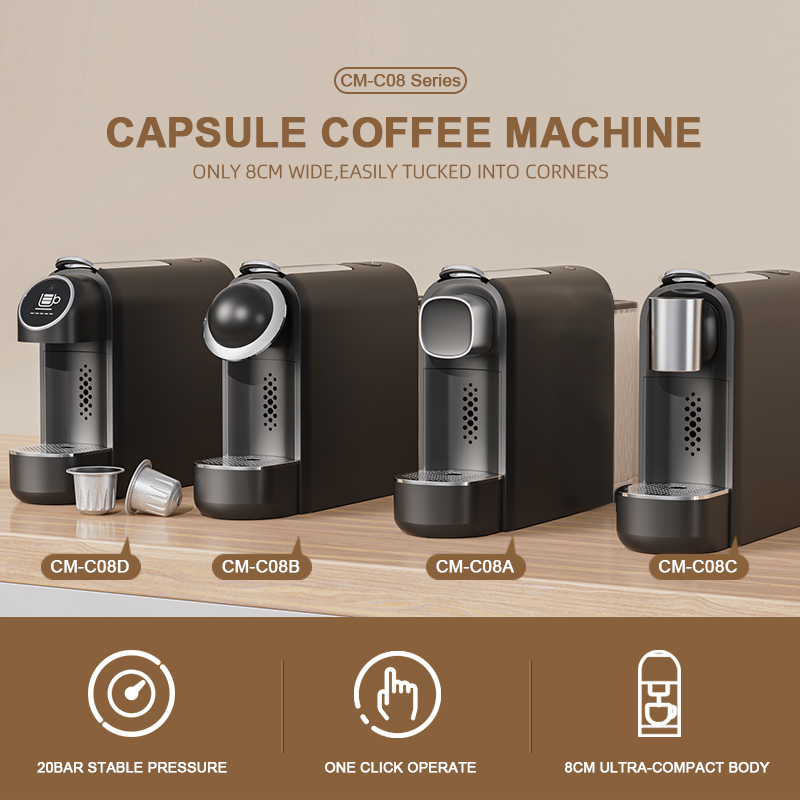
CM-C08A MINI Espresso pod machine — 86 mm wide, 20 bar pump, 600 ml tank, 40 / 80 / 110 ml cup volumes.
The certification scope problem buyers have to solve
Several widely circulated coffee machine certificates in the public document set carry a scope that names a model other than the capsule machines currently offered. This is not unusual in appliance manufacturing — certificates are issued at a point in time against a specific model family — but it changes what a buyer must do before signing off.
Three documents illustrate the point precisely. Intertek Test Verification of Conformity No. 220700131SHA-V1 is referenced in the documentation records for CM-C08A, CM-C07A, CM-CS01, CM-C06 PRO and CM-G03A PRO MAX. The scope of that certificate names Model CM4-G2 only. It does not list any of the current capsule models. The same pattern applies to CE Test Verification of Conformity No. 221001192SHA-V1, issued 2022-10-28, whose scope lists an espresso coffee maker for household use, model CM-601, rated 220-240V~, 50/60Hz, Class I, 1050W. And LVD/EMC Test Verification of Conformity No. 2407B0278SHA-V1 lists CM-401, CM-401A, CM-401SA, CM-401SB, CM-205A, CM-205B and CM-205BR — again, none of the current pod platforms.
Against that, other documents do reach the present range. GS Certificate No. 23SHH0193-02, issued by Intertek on 2024-08-28 and valid until 2029-08-27, covers types CM-C06A and CM-C06B together with the CM-C07A and CM-C08A capsule machines. The EU Declaration of Conformity numbered 24078027SHA-V1 / 24078027BSHA-V1, issued by Zhejiang Huaguang Electric Appliance Group Co., Ltd. with testing by Intertek, applies to CM-C06 PRO, CM-CS01, CM-C07A, CM-C08A and CM-G03A PRO MAX. And Bureau Veritas REACH and RoHS test report (3225)013-0094, issued 2025-02-13, covers CM-CS01, CM-C07A, CM-C08A, CM-G03A PRO MAX and CM-C06 PRO for material compliance.
Document-by-document scope map
| Document | Issuer | Models named in scope | Status for the current capsule range |
|---|---|---|---|
| CE Test Verification of Conformity 220700131SHA-V1 | Intertek | Model CM4-G2 only | Does not list CM-C08A, CM-C07A, CM-CS01 or CM-C06 PRO |
| CE Test Verification of Conformity 221001192SHA-V1 (issued 2022-10-28) | Intertek Testing Services Shanghai | Model CM-601, 220-240V~, 50/60Hz, Class I, 1050W | Does not list the current capsule models |
| LVD/EMC Test Verification of Conformity 2407B0278SHA-V1 | Intertek Testing Services (Shanghai) Co., Ltd. | CM-401, CM-401A, CM-401SA, CM-401SB, CM-205A, CM-205B, CM-205BR | Does not list the current capsule models |
| GS Certificate 23SHH0193-02 (valid to 2029-08-27) | Intertek | CM-C06A, CM-C06B, CM-C07A, CM-C08A | Lists CM-C07A and CM-C08A |
| CB Test Certificate SG ITS-36712 | Intertek | Model naming includes CM08A, CM03A, CMI-01, CM01SA and others; supports documentation for 60+ countries | Naming differs from current product codes; identity must be confirmed against the certificate original |
| EU Declaration of Conformity 24078027SHA-V1 / 24078027BSHA-V1 | Zhejiang Huaguang Electric Appliance Group Co., Ltd. (testing by Intertek) | CM-C06 PRO, CM-CS01, CM-C07A, CM-C08A, CM-G03A PRO MAX | Applies to the current capsule range |
| Bureau Veritas REACH and RoHS report (3225)013-0094 (issued 2025-02-13) | Bureau Veritas | CM-CS01, CM-C07A, CM-C08A, CM-G03A PRO MAX, CM-C06 PRO | Covers the current capsule range for restricted-substance compliance |
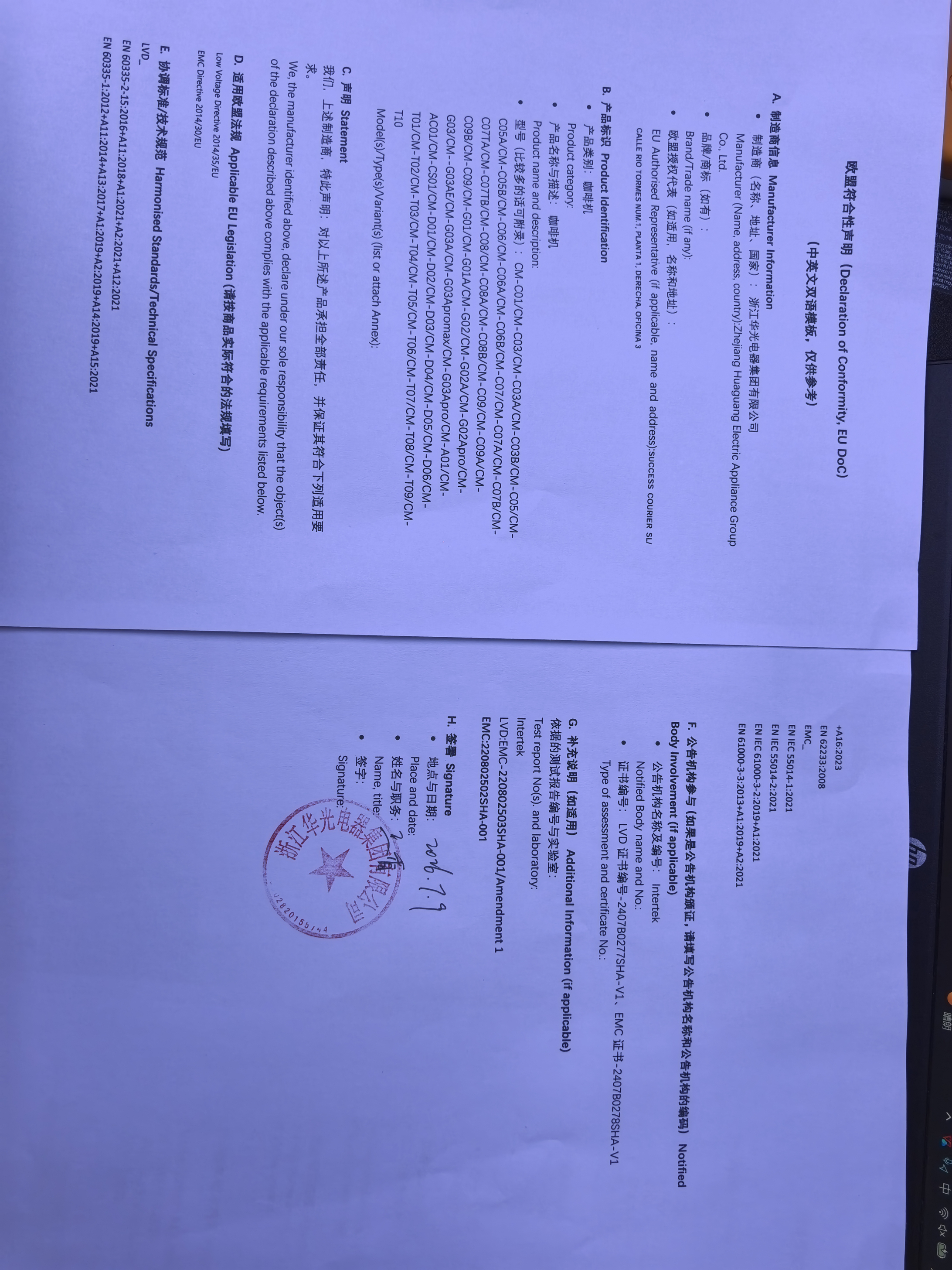
EU Declaration of Conformity 24078027SHA-V1 / 24078027BSHA-V1 — issued by the manufacturer with testing by Intertek, applicable to the current capsule platforms.
What the CB certificate naming difference means
CB Test Certificate SG ITS-36712 lists models including CMI-01, CM-01-A, CM01SA, CM03A, CM08A, CM09A, CM08B, CM08D, CM08H, CM08L, CM08M, CM08N and others, against IEC/EN 60335-1:2010 + A1:2013 + A2:2016 and IEC/EN 60335-2-15:2016 + A1:2019 + A2:2019. The current capsule product code is CM-C08A, not CM08A. A buyer cannot assume the two are interchangeable without checking the certificate original and the underlying construction file. This is the single most practical lesson in capsule OEM documentation work: model naming conventions evolve, and the certificate does not follow automatically.
Parameters to fix before tooling is released
Once the evidence question is settled, the parameters have to be locked in the same meeting. Capsule platform changes after tooling release are expensive because they usually touch the housing, the water circuit or the interface board.
| Model | Type | Power | Pump | Tank | Cup volumes | Preheat | Dimensions | Net weight |
|---|---|---|---|---|---|---|---|---|
| CM-C08A | MINI Espresso pod machine | 220–240V, 50/60Hz, 1400W | 20 bar | 600 ml | 40 / 80 / 110 ml | 40 s | 86 × 356 × 220 mm | 2.1 kg |
| CM-C07A | Espresso Pod Machine | 220–240V, 50/60Hz, 1400W | 20 bar | 1,000 ml | 40 / 110 ml | 40 s | 372.5 × 112 × 242 mm | 2.3 kg |
| CM-CS01 | SENSEO Pod coffee machine | 1450W | Not stated in the record | 750 ml | 65 / 130 / 260 ml | 60 s | 245 × 120 × 241 mm | Not stated in the record |
| CM-C06 PRO | 3-in-1 multifunctional | 1400W | 20 bar | 700 ml | 25 / 40 / 110 ml | 40 ± 5 s | 301 × 115 × 257 mm | Not stated in the record |
Container loading differs enough to affect landed cost per unit and should be modelled before pricing is agreed. In 20'GP / 40'GP / 40HQ configuration, CM-C08A loads 1,626 / 3,368 / 3,948 pcs, CM-C07A loads 1,346 / 2,788 / 3,270 pcs, and CM-CS01 loads 1,250 / 2,700 / 3,400 pcs using cardboard restraint packaging.
Materials are specified as food-grade stainless steel and aluminium on the food-contact side of the capsule platforms, with ABS used as the housing material on the CM-CS01 and CM-C06 PRO records. Because that splits the wetted path from the visible shell, food-contact documentation has to be read against the component list, not against the machine as a whole.
How the four capsule platforms differ in use
The CM-C08A is an 86 mm wide machine with a classic square profile and a minimal geometric front. Its commercial purpose is footprint: it fits into corners and narrow countertop runs where a standard machine does not. It uses mechanical buttons, an instant-type boiler, a 600 ml tank, and offers a plastic or metal wrench option.
The CM-C07A moves up in capacity and control. It carries a 1,000 ml tank, dual cup-size buttons at approximately 40 ml and 110 ml, a detachable water tank and removable drip tray, and a built-in lighting system that makes the extraction visible. It is offered in mechanical and intelligent versions, which is directly useful when a brand wants one housing across two price tiers.
The CM-CS01 is a SENSEO-format machine with NTC temperature control, a 750 ml tank, 65 / 130 / 260 ml cup volumes and a 110 mm cup-holding space. Its selling logic is beverage range: espresso, latte, cappuccino and mocha from a single pod format.
The CM-C06 PRO is the widest-compatibility platform in the range. It accepts Nespresso capsules, Dolce Gusto capsules and ground coffee, runs a 700 ml detachable tank, uses an LCD touch screen, offers three cup sizes at 25 / 40 / 110 ml, self-cleaning, a removable metal drip tray, and water delivery at 45 °C, 75 °C and 95 °C.
What the pressure and preheat numbers actually mean
A 20 bar pump rating on the CM-C08A, CM-C07A and CM-C06 PRO describes the pump's rated output, not the pressure at the coffee bed. In capsule brewing, the pod itself creates most of the flow resistance, and the machine's job is to deliver water at a stable, repeatable pressure and temperature for the duration of the shot. Buyers evaluating samples should therefore judge consistency across consecutive shots rather than the headline number.
The 40-second preheat figure on the CM-C08A and CM-C07A, and the 40 ± 5 second figure on the CM-C06 PRO, describe cold-start readiness. The CM-CS01 is listed at 60 seconds. These differences matter in office and hospitality settings, where a machine may be switched on and off repeatedly through the day, and less so in a home where it stays warm.
Temperature control is the other variable. The CM-CS01 record specifies NTC temperature control, which maintains a target brewing temperature rather than relying on a fixed thermal cut-out. For private-label programs, the practical question is whether the temperature behaviour on the sample matches what the brand will claim on the box — and whether that claim survives the voltage and ambient-temperature conditions of the destination market.
Where capsule OEM fits commercially
The stated application fields for this coffee machine range are hospitality solutions, office coffee solutions, retail and private-label solutions, and home and lifestyle. Working environments named in the application record include homes, offices, hotels, cafés, restaurants, retail stores and commercial spaces, with indoor use on a dry, stable, level countertop, adequate ventilation, and drinking water only in the tank.
A documented example of channel fit is a German online e-commerce platform that took 30,000 units of the CM-C08A over a two-year period for its small-appliance category, serving households, offices and shared workspaces. The product was featured in platform promotions, and one-button operation, fast heating and easy cleaning were the characteristics cited as supporting customer interest and repeat orders.
That pattern is typical of capsule OEM demand: the buyer is usually a channel owner or brand owner who needs a complete, documented, repeatable product rather than a single machine. The value of the OEM relationship therefore sits as much in packaging language, plug type, manual content and document readiness as in the hardware.
Where the market is moving
The directional signal is straightforward. A USD 7.5 billion global coffee machine market in 2026, with Europe at 32.2% revenue share in 2025, means the compliance-heavy destination and the volume destination are the same place. Buyers planning European capsule launches should expect documentation review to be a schedule line item, not an administrative afterthought.
One caution applies to any market figure in this category: published estimates differ in what they include, particularly whether commercial dispensing equipment is counted alongside household machines. Scope definitions vary between research houses, so a market size should be used to understand direction and relative regional weight, not as a precise planning denominator.
A second structural point is visible in how suppliers describe themselves publicly. Sourcing is segmented by machine architecture — espresso, capsule and pod, fully automatic, drip and single-serve — and buyers increasingly organise supplier discovery by required architecture first, then evaluate customization, compliance and commercial terms. For a capsule program, that means filtering for pod-format capability before comparing anything else.
Comparison with traditional sourcing routes
Two conventional alternatives sit alongside a capsule OEM program, and each has a real trade-off.
Stock and spot purchasing versus built-to-order OEM
Buying finished machines from stock shortens the path to first sale and requires no tooling commitment. The trade-off is that the buyer inherits whatever configuration, packaging and documentation the seller already holds — which may not match the destination market's language, plug type or certificate expectations. Huaguang's stated model is the opposite: no stock inventory, all orders produced against future OEM/ODM cooperation. That delivers configuration control and brand consistency, but it removes the option of a quick trial order, and it places the full documentation review on the critical path before production starts.
General espresso OEM versus capsule-specific OEM
A general espresso manufacturer can often supply a broader machine range. The trade-off is depth in the pod format. Capsule brewing depends on the pod interface, the cup-volume logic and the specific pressure and temperature behaviour of the pod system, and a supplier whose public capability statement centres on semi-automatic espresso and grinders is describing a different engineering centre of gravity. Matching the supplier's stated architecture to the product being sourced is more useful than comparing headline experience claims.
Boundaries that should be stated plainly
- Certificate scope must be re-verified per model. Several coffee machine certificates in the public set name models outside the current capsule range. Buyers must confirm which document covers the exact model, voltage version and component list on their order.
- MOQ records are not uniform. Available material carries both 500 pcs and 1,000 pcs as the listed standard coffee machine MOQ. The final figure has to be confirmed against the selected model, voltage specification, milk-system configuration, packaging and branding requirements.
- Production is not held in stock. Lead time is stated at 30–45 days, and the sourcing guidance notes roughly 30–35 days after deposit and artwork confirmation, extending to around 45 days in peak season.
- Food-contact coverage is component-specific. LFGB documentation is available for relevant food-contact requirements, but coverage must be confirmed against the exact model and the specific list of water- and milk-contact components.
- After-sales is remote-first. A one-year warranty and online troubleshooting support are provided, together with service documentation and maintenance guides; local maintenance capability and spare-parts compatibility are matters the buyer should arrange and confirm by model.
- Sample evaluation has a cost and a lead time. Samples are available with the buyer covering sample cost and freight, typically around 10–15 days depending on the product and order requirements, with sample fees potentially deductible from a future mass-production order subject to quotation terms.
Future outlook
The next phase of capsule OEM competition is likely to be decided on documentation velocity rather than hardware alone. As European buyers continue to carry the largest regional share of demand, the suppliers who can produce a model-matched evidence pack quickly — correctly scoped test reports, a current declaration of conformity, and a component-level food-contact statement — will shorten their customers' time to shelf. Suppliers who circulate a certificate number without a matching scope will keep creating the same delay.
A second shift concerns platform economics. Offering one housing across mechanical and touch variants, as with the CM-C07A, or extending a single chassis across pod and ground-coffee compatibility, as with the CM-C06 PRO, lets a brand cover multiple price points without multiple certification programs. That is where OEM/ODM value is most likely to concentrate over the next cycle.
Frequently asked questions
Which certification documents actually cover a specific capsule coffee machine model?
Coverage has to be checked document by document. For CM-C07A and CM-C08A, GS Certificate 23SHH0193-02 issued by Intertek lists both models and is valid until 2029-08-27. For CM-C06 PRO, CM-CS01, CM-C07A, CM-C08A and CM-G03A PRO MAX, the EU Declaration of Conformity 24078027SHA-V1 / 24078027BSHA-V1 applies, issued by the manufacturer with testing by Intertek. Bureau Veritas REACH and RoHS report (3225)013-0094 covers CM-CS01, CM-C07A, CM-C08A, CM-G03A PRO MAX and CM-C06 PRO. By contrast, CE Test Verification of Conformity 220700131SHA-V1 names Model CM4-G2 only and does not list the current capsule models, and CB Test Certificate SG ITS-36712 uses model naming such as CM08A that differs from the current product codes.
What technical parameters should be fixed before placing a capsule machine OEM order?
Buyers should lock the brewing format, rated voltage and frequency, plug type, pump rating, water-tank capacity, cup-volume settings, preheat time, interface type and housing material. Reference values in the current range include 20 bar pump pressure and 40-second preheat on the CM-C08A and CM-C07A, a 600 ml tank on the CM-C08A against 1,000 ml on the CM-C07A, 65 / 130 / 260 ml cup volumes on the CM-CS01, and an LCD touch interface with 700 ml detachable tank on the CM-C06 PRO. Food-contact materials are specified as food-grade stainless steel and aluminium.
How does a capsule OEM program differ from buying stock coffee machines?
In an OEM/ODM program the machine is produced to the buyer's specification and branded for that buyer, rather than taken from finished inventory. The stated position for this range is that no stock inventory is held and all orders are produced based on future OEM/ODM cooperation. That provides configuration and branding control across colour, voltage, plug type, packaging design and language, and logo, while requiring the buyer to plan for production lead time rather than immediate shipment.
What is the MOQ and production lead time for capsule coffee machine OEM?
Available records are not uniform on MOQ: both 500 pcs and 1,000 pcs appear as the listed standard coffee machine MOQ, so the final figure must be confirmed against the selected model, voltage specification, milk-system configuration, packaging and branding requirements. Production lead time is stated at 30–45 days, with sourcing guidance indicating roughly 30–35 days after deposit and artwork confirmation and extension to around 45 days in peak season.
Can a capsule coffee machine be customized with a private label logo and packaging?
OEM/ODM services cover colour, voltage, power plug type, packaging design and language, and brand identity including logo. The commonly described first-cooperation route is to select an existing ODM platform and focus customization on logo printing and customized packaging, then confirm the final product configuration, certification scope, quality requirements, spare-parts plan and delivery schedule in writing before bulk production.
What support is available after a capsule OEM order is delivered?
A one-year warranty and online troubleshooting support are provided. The engineering team offers technical support covering system diagnostics, performance troubleshooting, and structural or electronic guidance, and partners are supported with structured service documentation, user manuals and maintenance guides. Local maintenance capability and spare-parts compatibility are confirmed by model, and buyers should arrange local service coverage as part of program planning.
The 2025 product manual covering the coffee machine and garment care range is available for download: Huaguang Product Manual 2025.
Have Questions or Need More Details?
Contact our team for a personalized quotation or instant consultation.
Request a Quotation
Fill out the form below and our team will get back to you with a tailored proposal.
WhatsApp Direct Chat
Prefer to chat in real-time? Message us on WhatsApp for instant assistance & quick answers.
- Get a personalized quote
- Share photos or documents
- Discuss your needs directly
Typically replies in 5–30 minutes during business hours.