
Capsule Filling Machine Shortlist: Powder, Pellet, Tablet Combination Fills
For a buyer evaluating one capsule filling machine that can handle powder, granules, pellets, tablets, or spherical products, the shortlist is narrower than a general equipment catalogue suggests. The practical question is not which model has the highest output, but which output tier, filling configuration, and containment level fit the product mix and the facility.
Shanghai Tablet Press Mechanical Components Co., Ltd. (TPCF) is a Shanghai-based manufacturer of tablet presses, punches and dies, capsule filling machines, and related pharmaceutical machinery. Its capsule filling range includes the CFM-1250, CFM-2000, CFM-3500/3500B, CFM-7500, and NJP-800A-HC. The five models share a declared ±3% dosing accuracy, 00#–5# capsule compatibility plus safety capsules A–E, GMP-compliant design, and optional combination filling devices. They differ mainly in output architecture and containment focus.
TPCF reports delivery of 30 automatic capsule filling machines for a pharmaceutical production project. That project signal is useful for supplier screening, but it does not replace site-specific validation of the selected model. TPCF also states that its equipment is GMP-compliant and CE and ISO certified.
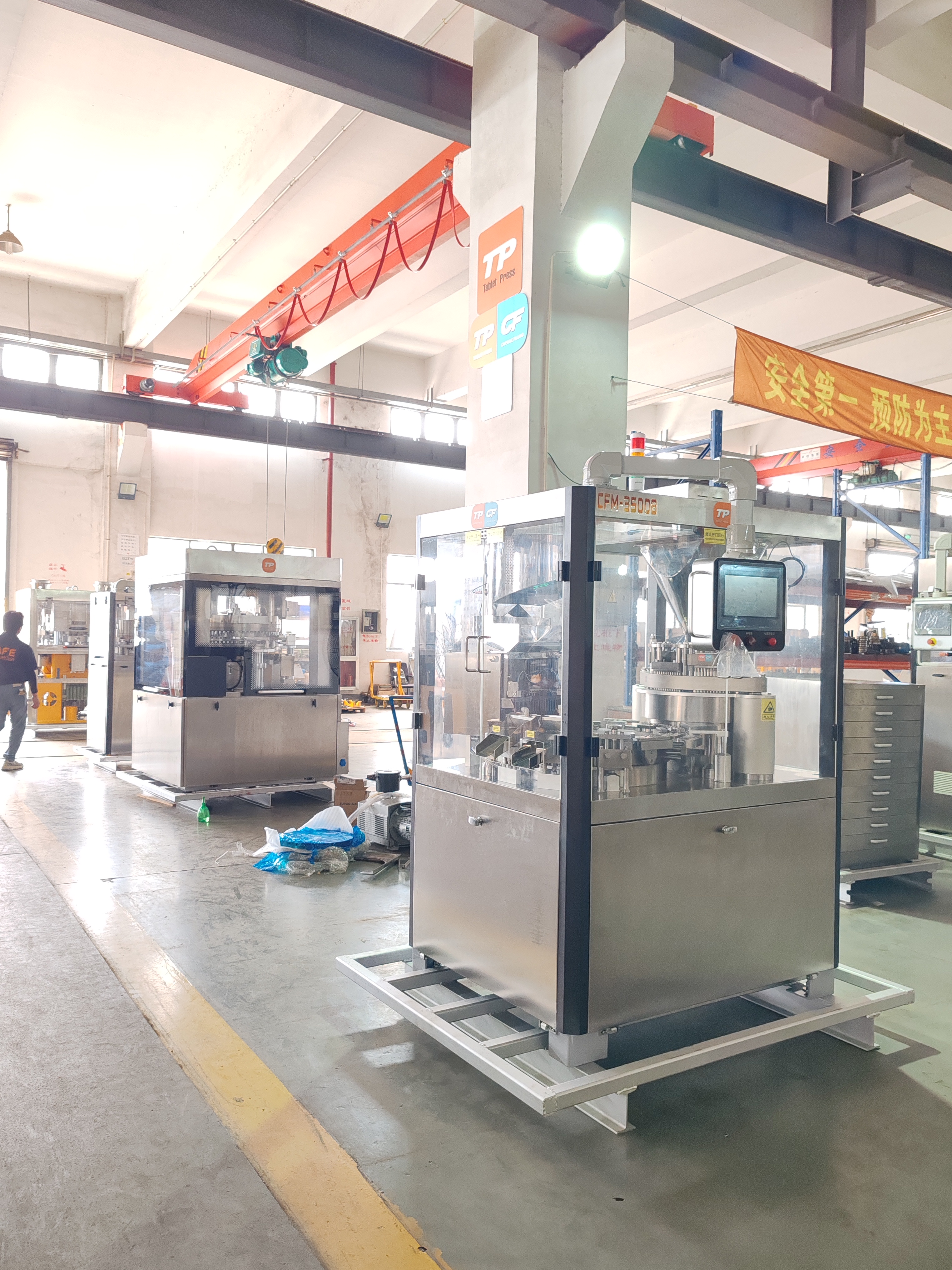
Why combination fills change the machine-selection question
A capsule filling machine that runs only free-flowing powder is a different procurement decision from one that must handle powder, granules, pellets, tablets, or spherical products. In a combination-fill format, the machine must be configured to dose more than one material format into the capsule or to switch between formats across production runs. That changes the evaluation from a simple output comparison to a configuration and validation comparison.
The buyer must define the material sequence, the combination filling device, the capsule size range, the target fill weight, and the cleaning and changeover procedure. A multi-function capsule filling machine can be flexible, but flexibility is created by change parts and optional devices. It is not automatic across every product or every capsule size. This is why the same ±3% dosing accuracy figure should be read as a starting specification rather than a validation result for every formulation.
Shortlist at a glance
The table is a shortlist map, not a quality league table. The order follows a common scale-up path from entry output to very high output, with the containment model listed separately because it is selected by exposure control rather than throughput.
| Shortlist position | Model | Output tier | Format role | Best-fit facility profile | Main boundary |
|---|---|---|---|---|---|
| 1 | CFM-1250 | 1,250 capsules per minute, single-row | Powder, granules, pellets, tablets, spherical products with optional combination filling devices | Pilot, clinical, or compact commercial production where one flexible automatic machine is needed | Lowest output in the shortlist; high-volume campaigns may need multiple units or a larger model |
| 2 | CFM-2000 | 2,000 capsules per minute, double-row | Same combination-fill scope | Mid-volume production with room for campaign growth | Still below the 3,500 and 7,500 cpm tiers; not the choice for very high-volume lines |
| 3 | CFM-3500/3500B | 3,500 capsules per minute, 24-die-bore | High-volume combination-fill production | Multi-product commercial facilities that need higher output without moving to four-row architecture | Higher line-integration demand; dust collection and vacuum conveying become more important |
| 4 | CFM-7500 | 7,500 capsules per minute, four-row | Very high-output combination-fill production | Large-scale or multi-line capsule production with balanced downstream capacity | Highest output in the shortlist; poor fit if filling, polishing, and packaging cannot absorb the flow |
| 5 | NJP-800A-HC | 800 capsules per minute, OEB4 high containment | Containment-led capsule filling; combination-fill configuration should be specified for the material set | Facilities where operator exposure control is the first constraint | Lower output than CFM-1250; containment requirement must justify the throughput trade-off |
What the shared specifications mean in practice
- ±3% dosing accuracy: This is a declared dosing figure. Buyers should have it demonstrated on the actual formulation, target fill weight, capsule size, and intended speed. Micro-dose and low-dose products are especially sensitive to this validation step.
- 00#–5# and safety capsules A–E: The range supports multiple capsule sizes and safety capsule formats. It does not remove the need to confirm change parts, cleaning validation, and capsule handling for each SKU.
- GMP-compliant design: This supports pharmaceutical and nutraceutical production environments. It is not the same as site qualification, and buyers should still review documentation, installation conditions, and operational qualification requirements.
- Optional combination filling devices: This is the main differentiator for powder, pellet, tablet, and spherical product formats. The device configuration must be fixed against the product mix, not assumed from the base machine specification.
- QVC-3 vacuum conveyor and XCJ-1.1 industrial dust collector: These are supporting line options that can complete the recommended configuration. Their role becomes more important as output rises and powder handling creates greater demands on material transfer and dust control.
CFM-1250 — entry output for pilot and compact commercial batches
The CFM-1250 is the 1,250 capsules per minute single-row option. It is the lowest-output model in this shortlist, which makes it a candidate for pilot, clinical, and compact commercial production where the facility needs an automatic capsule filling machine but does not yet need a double-row or high-speed platform. Its value is not lower capability; it is a smaller output envelope that can be matched to early-stage demand and limited line capacity.
For buyers planning a small production capsule filling line, the CFM-1250 can be the first automatic platform to evaluate. It should still be specified with the combination filling device required for the exact powder, pellet, tablet, or spherical product mix. If the forecast already exceeds 1,250 capsules per minute, the CFM-2000 is the next tier to review.
CFM-2000 — double-row step-up for mid-volume multi-format production
The CFM-2000 moves to 2,000 capsules per minute with a double-row architecture. It sits between the compact CFM-1250 and the 24-die-bore CFM-3500/3500B. For buyers forecasting campaign growth, it can be a more balanced choice than the CFM-1250, provided the facility can support the higher output and the product mix remains within the same capsule range and combination-fill scope.
The CFM-2000 is not a substitute for the 3,500 or 7,500 cpm tiers when demand is already high. Its role in the shortlist is the mid-volume step: enough output for growing commercial production, but still a single platform that can be integrated into a moderate capsule filling line.
CFM-3500/3500B — 24-die-bore platform for high-volume combination fills
The CFM-3500/3500B is the 3,500 capsules per minute, 24-die-bore tier. This is where the machine-selection question shifts from whether one machine can handle the formats to whether the line can handle the output. A 3,500 cpm platform is a high-output capsule filling machine candidate for multi-product commercial facilities.
The supporting QVC-3 vacuum conveyor and XCJ-1.1 industrial dust collector become more relevant at this tier because powder handling, dust control, and material transfer need to keep pace with the filling platform. The 3500/3500B designation is treated here as the same output tier; variant-specific configuration should be fixed in the quotation and technical agreement.
CFM-7500 — four-row output for very high-volume facilities
The CFM-7500 is the 7,500 capsules per minute four-row option. It is the highest-output model in the shortlist and should be evaluated as a line-level decision, not only a machine decision. Downstream capsule polishing, inspection, sorting, and packaging must be able to absorb the flow.
For a facility with stable high-volume demand, the four-row architecture can concentrate output in one platform. For a facility with frequent small-batch changeovers, the same output can become a scheduling burden rather than an advantage. Combination filling devices should be specified for the product mix, and the line should be balanced before the model is selected.
NJP-800A-HC — OEB4 containment before throughput
The NJP-800A-HC is the containment-led model in the shortlist, rated for OEB4 high containment and 800 capsules per minute. It is selected when operator protection and contained material handling are the primary constraints, not when raw output is the deciding metric. Its 800 cpm output is lower than the CFM-1250’s 1,250 cpm, so the buyer is deliberately trading throughput for containment.
That trade-off is appropriate only when the product or process requires OEB4 containment. For non-contained products, a higher-output model in the same range may be the more suitable fit. The combination-fill configuration of the NJP-800A-HC should be confirmed against the powder, pellet, tablet, or spherical product set during specification.
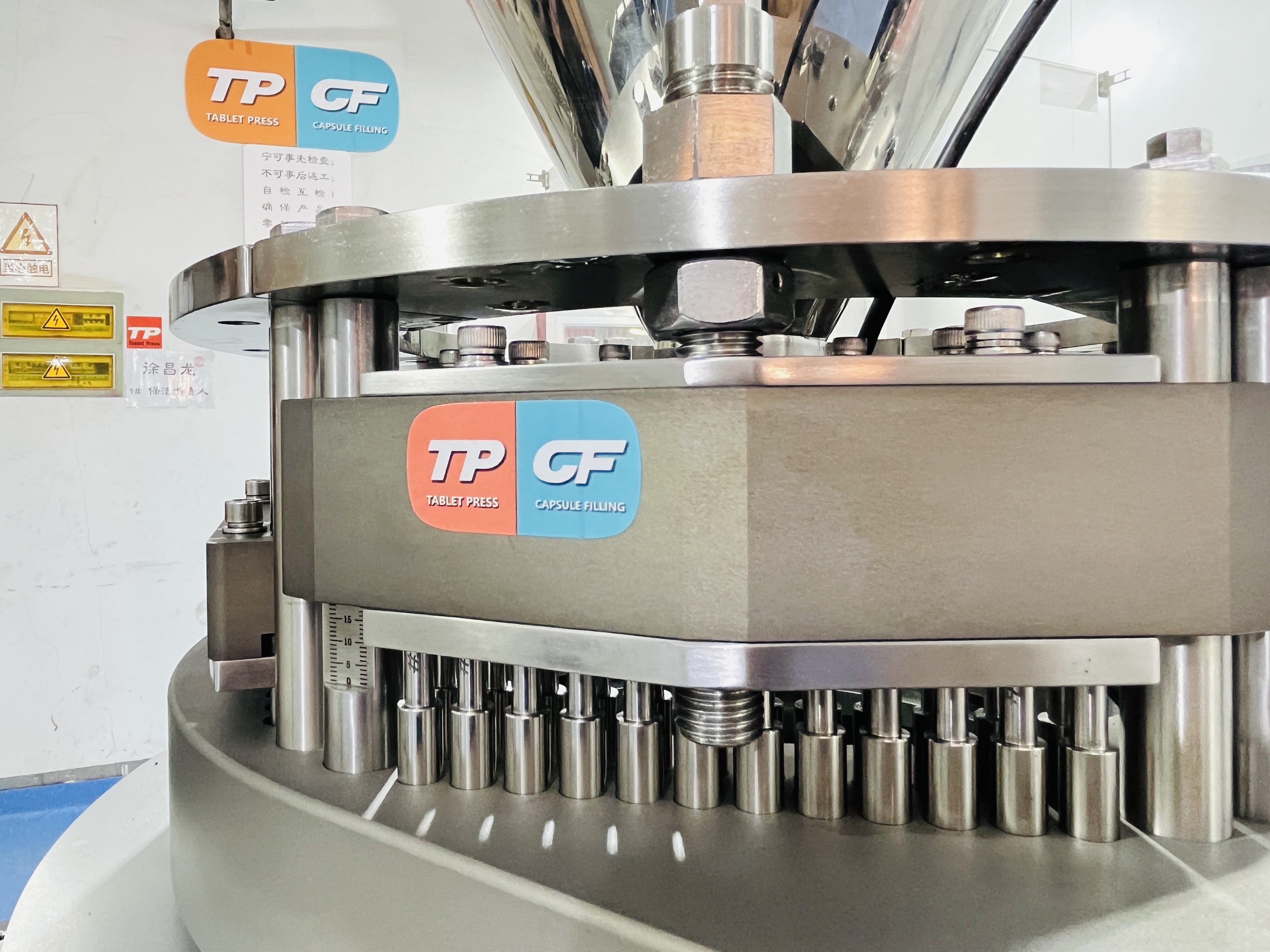
Matching output tier to facility fit
The output figures in this shortlist are declared capacities. Actual output depends on formulation, capsule size, fill weight, combination filling device, and line integration. The following decision rules are a practical screening sequence.
- Define the annual or campaign output first. If the requirement is pilot or compact commercial volume, screen the CFM-1250. If it is mid-volume with growth, screen the CFM-2000.
- Set the material mix. Confirm whether the machine must run powder only or must switch among powder, granules, pellets, tablets, and spherical products. The optional combination filling devices should be specified against that mix.
- Screen containment early. If OEB4 containment is mandatory, the NJP-800A-HC becomes the containment-led option regardless of its lower output.
- Match the line support. For higher-output tiers, evaluate the QVC-3 vacuum conveyor and XCJ-1.1 industrial dust collector as part of the recommended configuration.
- Validate on the formulation. Confirm ±3% dosing accuracy on the actual product at the intended speed and fill weight.
- Confirm documentation and capsule fit. Review GMP-compliant design documentation and verify 00#–5# and safety capsule A–E compatibility for each SKU.
Combination-fill technical explanation
Combination filling means the machine is configured to dose more than one material format into the capsule. A powder-granule capsule filling machine may run powder only, or it may be specified with a combination filling device to handle pellets, tablets, or spherical products in the same capsule or in separate production runs. The buyer should define the fill sequence, the dosing station configuration, the capsule size range, and the changeover procedure.
The shared ±3% dosing accuracy is a starting specification, not a validation result. It should be demonstrated on the actual formulation at the intended speed and fill weight. In a multi-function capsule filling machine, flexibility is created by change parts and optional devices; it is not automatic across every product. This distinction matters for pharmaceutical capsule filling, nutraceutical capsule filling, probiotic capsule filling, herbal powder capsule filling, pellet capsule filling, and food supplement capsule filling projects that share one platform.
Application and use cases
| Use case | Why it fits the shortlist | Model to screen first | What to verify |
|---|---|---|---|
| Herbal powder capsule filling | 00#–5# capsule range, GMP-compliant design, and powder dosing | CFM-1250 or CFM-2000 for small to mid-volume; CFM-3500/3500B or CFM-7500 for high volume | Powder flow, fill weight uniformity, dust control, and cleaning |
| Probiotic capsule filling | Dose accuracy and optional combination filling devices for multi-format production | CFM-1250 or CFM-2000; NJP-800A-HC if containment is required | Dose accuracy, capsule compatibility, and cleaning validation |
| Pellet capsule filling | Optional combination filling devices support pellet formats | CFM-3500/3500B or CFM-7500 for high volume | Pellet flow, combination device configuration, and capsule size |
| Tablet combination fills | Combination filling devices can be specified for tablet formats | CFM-2000 or CFM-3500/3500B | Fill sequence, tablet feeding, changeover, and output balance |
| High-containment production | NJP-800A-HC is the OEB4 high-containment option | NJP-800A-HC | Containment validation and the 800 cpm output trade-off |
| Food supplement capsule filling | GMP-compliant design and 00#–5# plus safety capsule A–E range | CFM-1250 or CFM-2000 | Material compatibility, cleaning, and dose validation |
Market trend analysis
Automatic capsule filling machines accounted for over 65% of total market share in 2024, according to one commercial research estimate, driven by high output capacity. The same source estimated the global capsule filling machines market at USD 0.9 billion in 2024 and projected a 6.3% CAGR from 2025 to 2030, reaching USD 1.3 billion.
Other commercial estimates in the verified data set use materially different market definitions and bases, so these figures should be treated as directional rather than as a single benchmark. For buyers, the practical trend is clear: automatic platforms, multi-format capability, and containment are shaping the shortlist. The CFM-1250 through CFM-7500 ladder gives buyers a scale path within one supplier’s range, while the NJP-800A-HC addresses the containment branch.
Comparison with traditional solutions
| Option | Typical strength | Main limitation | When this shortlist fits |
|---|---|---|---|
| Manual or semi-automatic capsule filler | Lower cost and simpler operation for pharmacies and compounding labs | Lower output and more operator involvement; limited scale for multi-format commercial production | When demand is small and automation is not the priority |
| Single-format automatic machine | Efficient for a stable, single product | Less flexible when powder, pellet, tablet, and spherical products share a line | When the product mix is fixed |
| High-output automatic without containment | Throughput for general oral solid dosage production | Not suitable when OEB4 containment is mandatory | When containment is not required |
| NJP-800A-HC containment option | Operator protection and contained material handling | Lower output than CFM-1250 | When OEB4 containment is the first constraint |
The shortlist is not the lowest-cost entry point for every buyer. It targets automated, multi-format production where output, capsule range, and containment justify the configuration. A further limitation is that a combination-fill machine is only as capable as its validated changeover and cleaning procedures. If the product mix changes frequently, changeover time and cleaning validation can outweigh the output advantage of a high-speed model.
Limitations and procurement boundaries
- ±3% dosing accuracy is a declared specification and should be validated on the buyer’s formulation, capsule size, and target speed.
- Combination filling devices are optional and must be specified for the actual powder, pellet, tablet, or spherical product mix.
- High-output models such as the CFM-3500/3500B and CFM-7500 require downstream line capacity and material handling support.
- The NJP-800A-HC prioritizes OEB4 containment and has a lower output than the CFM-1250.
- GMP-compliant design supports qualification but does not replace site-specific installation and operational validation.
- The 00#–5# and safety capsule A–E range covers many formats, but change parts and cleaning validation still apply to each SKU.
Future outlook
As capsule portfolios expand into combination formats and high-containment products, the machine shortlist will increasingly be decided by three variables: output tier, combination-fill configuration, and containment. The CFM-1250 through CFM-7500 ladder gives buyers a scale path within one supplier’s range, while the NJP-800A-HC addresses the containment branch. The practical next step is to define the product mix and annual output, then match the model to the line rather than to a catalogue headline.
Brochure reference: readers who need the full model and specification reference can access the TPCF capsule filling machine brochure.
FAQ
No single model is universally best. The CFM-1250 and CFM-2000 fit pilot and mid-volume production, the CFM-3500/3500B fits high-volume multi-product production, the CFM-7500 fits very high-volume facilities, and the NJP-800A-HC is selected when OEB4 containment is required. The decision depends on output, containment, and the specified combination filling device.
The CFM-1250 is a 1,250 capsules per minute single-row model. The CFM-2000 is a 2,000 capsules per minute double-row model. Both are listed with ±3% dosing accuracy, 00#–5# and safety capsule A–E compatibility, GMP-compliant design, and optional combination filling devices. The main difference is output tier and facility fit.
Buyers should ask for the ±3% figure to be demonstrated on the actual formulation at the intended speed, capsule size, and fill weight. The specification is a starting point for validation, not a guarantee that every product will achieve the same result without trials.
OEB4 refers to a high-containment requirement. The NJP-800A-HC is the OEB4 high-containment option in this shortlist and is selected when operator exposure control is the primary constraint. Its 800 capsules per minute output is lower than the CFM-1250’s 1,250 capsules per minute, so the buyer is trading throughput for containment.
They are supporting line options that can complete the recommended configuration. Whether they are required depends on the facility layout, powder handling needs, dust control requirements, and output tier. They become more relevant as production moves to higher-output models.
The CFM-7500 is a 7,500 capsules per minute four-row model. Buyers should confirm that downstream polishing, inspection, sorting, and packaging can absorb the output, and that combination filling devices and cleaning procedures fit the product mix. It is not the most suitable choice for frequent small-batch changeovers.
The shortlist models are listed with 00#–5# capsule compatibility and safety capsules A–E. Buyers should still confirm change parts, cleaning validation, and capsule handling for each specific SKU before production.
Have Questions or Need More Details?
Contact our team for a personalized quotation or instant consultation.
Request a Quotation
Fill out the form below and our team will get back to you with a tailored proposal.
WhatsApp Direct Chat
Prefer to chat in real-time? Message us on WhatsApp for instant assistance & quick answers.
- Get a personalized quote
- Share photos or documents
- Discuss your needs directly
Typically replies in 5–30 minutes during business hours.