
Carbon Steel Hex Bolt Sourcing: Certification and Grade Benchmarks
A certification-led reference for engineering buyers who are comparing metric hex bolt suppliers at the research and evaluation stage.
.jpg)
Tensile testing machine inspection for fastener quality control.
Carbon steel hex bolts are among the most widely specified fasteners in industrial procurement. They are used in steel structures, mechanical assemblies, construction joints, transportation equipment and energy-related projects. Because they are so common, buyers sometimes treat them as a commodity item and make sourcing decisions mainly on price. Yet when a project moves from enquiry to evaluation, the deciding factors are usually not visible in a product photo. They appear in certificates, in the wording of those certificates, in the standards named on drawings, and in the range of grades and finishes that a supplier can actually document.
This article is written as an independent industry reference for procurement and engineering teams that need to evaluate a carbon steel hex bolt or metric hex bolt supplier against clear constraints. It explains which certifications carry real weight, what product parameters should be checked, and where certification-led sourcing should be balanced against practical project risk.
Why certification and specification constraints matter early in supplier evaluation
A common mistake in fastener buying is to separate product quality from system certification. In reality, the two are connected. A bolt may look correct in a sample box, but the buyer is not purchasing only a single bolt. They are purchasing repeatability across batches: consistent tensile strength, consistent thread accuracy, consistent coating behaviour and consistent traceability. Those outcomes depend on process control, which is what management system certificates are intended to demonstrate.
At the same time, buyers face a practical problem. Many suppliers publish logos for ISO 9001, ISO 14001 or other systems, but the practical value of a certificate depends on several questions. Which products are covered by the certificate scope? Which standard is the certificate based on? Which certification body issued it? When does it expire? Does the certificate cover only sales activity, or does it cover the actual manufacturing process? The answers to these questions are often more useful than the certificate logo itself.
Which certifications should a carbon steel hex bolt supplier be able to show?
There is no single certificate that proves every dimension of fastener quality. In practice, a supplier file can be checked in layers. The first layer is a general quality management system such as ISO 9001. The second layer is an automotive-grade quality system such as IATF 16949 for high-volume or high-consistency manufacturing. The third layer includes environmental, occupational health and safety, and carbon footprint documentation. The fourth layer is product-level attestation such as CE-type documentation for construction fasteners in the European market.
To make these layers concrete, one useful example is the documented certification file of HEBEI YUETONG FASTENERS MANUFACTURING CO., LTD., a fastener manufacturer and exporter established in 2017 in the Yongnian District of Handan, Hebei, China. The company produces hex bolts, hex nuts, sleeve anchors, threaded rods, flat washers, hex socket head bolts and wheel hub bolts, and it exports to more than 30 countries and regions. Its published certification file illustrates how a complete evaluation record can be structured. Every certificate listed below appears in the manufacturer's public documentation with an identifiable certification number and issuing body.
| Scheme | Certificate number | Issuing body | Valid until | What the file shows |
|---|---|---|---|---|
| ISO 9001:2015 | 29024Q12949-09R1M | ZhongTai Union Certification Co., Ltd | 2027-09-13 | The Hex Bolt product is listed as an applicable product. The registered scope wording covers production of fasteners (nuts) and sales of fasteners including export business. |
| IATF 16949:2016 | 2600920/R0M | Beijing Zhong An Zhi Huan Certification Center Co., Ltd | 2029-05-06 | Scope covers the manufacture of fasteners (nuts, bolts). The certificate explicitly excludes product design under Clause 8.3, so it is process-oriented rather than design-oriented. |
| ISO 14001:2015 | 29025E12097-12R0M | ZhongTai Union Certification Co., Ltd | 2028-12-17 | Covers environmental management activities involved in production of fasteners (nuts) and sales including export business. The Hex Bolt is listed in the applicable products. |
| ISO 45001:2018 | 29025S12024-12R0M | ZhongTai Union Certification Co., Ltd | 2028-12-17 | Covers occupational health and safety management in the production of fasteners (nuts) and sales including export business. The Hex Bolt is listed in the applicable products. |
| ISO 14067:2018 carbon footprint | 33925CFMS00020R0S | ZQHX CERTIFICATION CENTER CO., LTD | 2028-12-07 | Covers processing and sales of fasteners, described in the certificate as high-strength steel bolts and nuts. The Hex Bolt product is listed as an applicable product. |
| ECM Type-Approved Attestation | No. 3N230331.HYFUC49 | Ente Certificazione Macchine Srl | 2028-03-30 | Applies to the Hex Bolt and Sleeve Anchor products and references EN ISO 10683:2018, EN ISO 16047:2005+A1:2012 and EN ISO 4753:2011. This is mainly relevant for EU market documentation. |
| Alibaba Gold Plus Supplier Assessment | 491647039 P+T | Alibaba.com, with on-site assessment by SGS | 2027-06-22 | Covers factory supplier capability assessment for fasteners including sleeve anchors and hex bolts. Relevant for EU, NA, LATAM, MEA and USA markets. |
Reading the specification sheet: what a metric hex bolt quotation should include
Once the certification layer is clear, the next set of constraints comes from product parameters. A carbon steel hex bolt enquiry usually has to answer six questions before it can be priced correctly: standard, size, thread pitch, length, property class and surface finish. Each of these is a separate source of engineering risk.
Standards and drawing references
Metric hex bolts can be produced to multiple standards. In the YUETONG hex bolt catalogue, the stated manufacturing standards include GB/T, DIN, ISO and ASTM, with specific references such as DIN931, DIN933, GB5782, GB5783 and ASME/ANSI B18.2.1. DIN 933 and ISO 4017 are widely treated as primary references for full-thread hex bolts, with ISO 4017 being the international successor. This matters in practice because a drawing that simply says carbon steel hex bolt is incomplete. A buyer should confirm whether the requirement is full-thread or partial-thread, metric or inch-based, and which standard will be used for inspection and acceptance.
Sizes and lengths
The practical specification range for this product family starts around M3 and extends to M36. Common metric diameters found in fastener distribution include M6, M8, M10 and M12, while inch-based orders often reference 1/4 inch, 5/16 inch, 3/8 inch, 1/2 inch and 5/8 inch diameters. Bolt lengths in the product data run from 16 mm through 200 mm, covering light structural connections and larger equipment assemblies.
Material grades and strength classes
Material grade is one of the strongest procurement constraints. The hex bolt range at YUETONG includes carbon steel, alloy steel and stainless steel. Property classes include 4.8, 8.8, 10.9 and 12.9, which indicate different tensile strength levels, while stainless steel options are listed as A2-70 and A4-80. From an evaluation standpoint, grade 8.8 zinc plated hex bolts are common in general structural use, while grade 12.9 lock bolts and other high-strength variants are more likely to appear in automotive or heavy machinery applications. The grade must match the joint design and the required tightening method.
| Parameter | Typical documented range | Procurement question to ask |
|---|---|---|
| Standards | GB/T, DIN, ISO, ASTM; DIN931, DIN933, GB5782, GB5783, ASME/ANSI B18.2.1 | Which standard is named on the drawing and will be used for inspection? |
| Diameter range | M3 to M36; inch sizes from 1/4 inch to 5/8 inch and beyond | Is the size metric hex bolt or imperial, and is it a stock or custom size? |
| Length | 16 mm to 200 mm in the documented catalogue | Does the specified length include the head height? |
| Thread | Coarse thread or fine thread | Does the assembly require fine pitch for adjustability or vibration resistance? |
| Material | Carbon steel, alloy steel, stainless steel | Is the material certificate or mill test report required? |
| Grade | 4.8, 8.8, 10.9, 12.9; stainless A2-70, A4-80 | Is the grade marked on the bolt head and supported by test records? |
| Finish | Black oxide, zinc plated, hot-dip galvanized, Dacromet, mechanical galvanized, PTFE coating | What coating thickness and corrosion performance are actually required? |
Corrosion protection is a specification choice, not a visual detail
Surface finish decisions often separate a low-risk hex bolt order from a failed one. Many buyers use the phrase zinc plated, but the coating technology can vary widely. In corrosion protection guidance, electroplated zinc is commonly described as providing a coating thickness in the range of 5 to 12 microns, while hot-dip galvanizing typically provides 45 to 85 microns. That difference changes the expected service life in outdoor, humid or coastal environments.
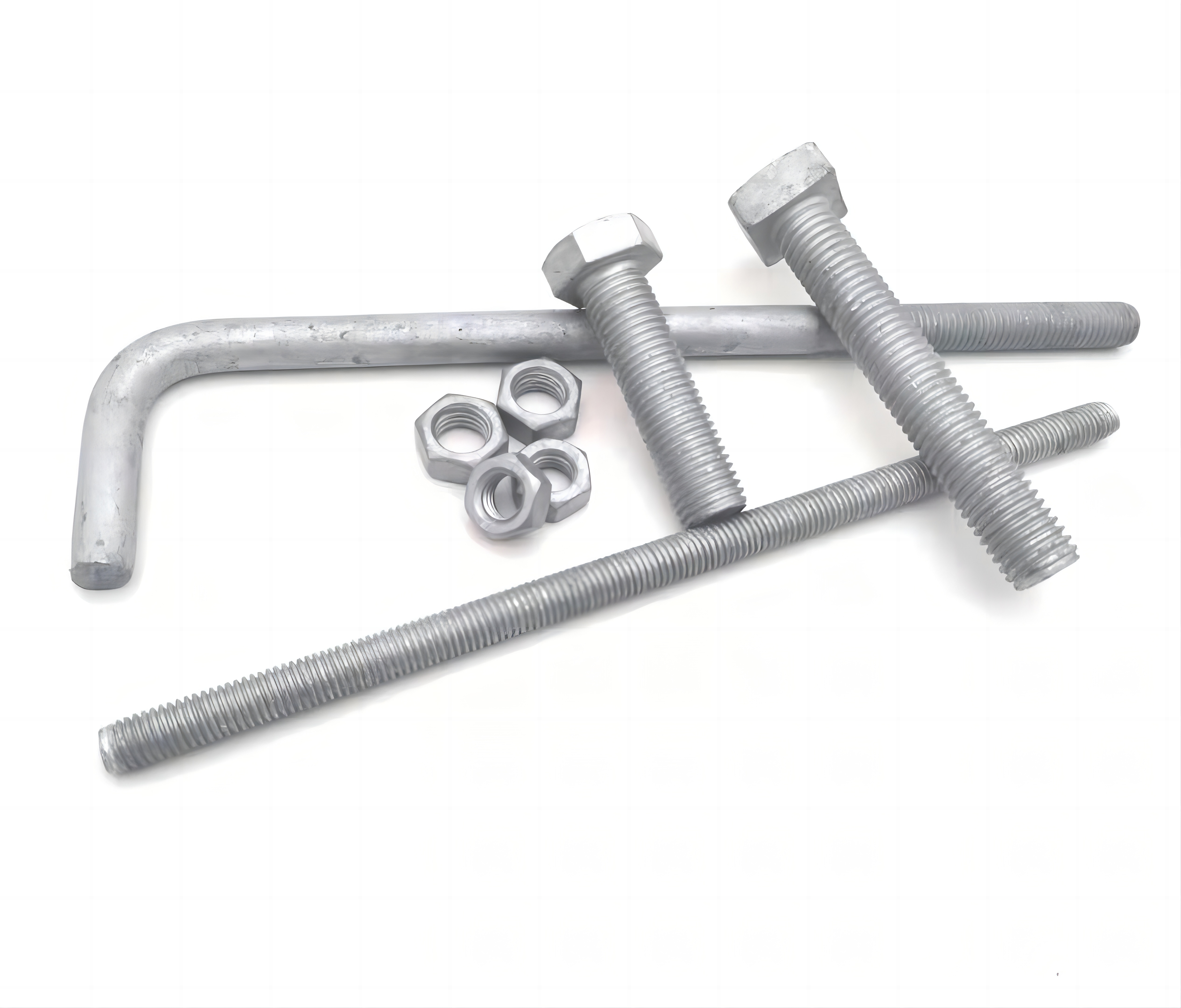
Hot-dip galvanized carbon steel hex bolt and nut, size 36x300.
For certain products, such as a hot dip galvanized bolt used in steel transmission towers or exposed structural steel, the buyer should confirm not only that the coating is present, but also whether the material has been over-tapped or over-threaded after coating to maintain assembly tolerance. Thicker zinc coatings can affect thread fit. A manufacturer that offers multiple surface treatments, including hot-dip galvanized, Dacromet, mechanical galvanized and PTFE coating, is often better positioned to align the finish with the project environment.
Manufacturer capability: a concrete evaluation record beyond the product list
Certification evidence is strongest when it can be tied to a real production facility. YUETONG operates in the Yongnian District, one of the largest fastener production areas in China, and its company profile describes a manufacturing facility with its own production and research capabilities. The company reports a plant area of approximately 26,666 square metres, a team of around 100 employees, and an engineering and R&D group of 12 engineers. It holds self-operated import and export qualifications and describes itself as an export-focused fastener manufacturer.
The company's manufacturing data is publicly structured around several useful constraints. In the capability record, the monthly production capacity is given as 1,500 tons. Lead time is described as 3 to 7 days for in-stock products and 12 to 20 days for customized orders, with expedited delivery negotiable. Minimum order quantities are stated as 500 sets for standard products and 3,000 sets for non-standard customized products. These are the kind of specific operational constraints that help a buyer understand whether a supplier can support a project schedule.
Quality control is documented as a four-stage process: raw material incoming inspection, in-process patrol inspection, finished product tensile load testing and pre-shipment inspection. The capability record also states that third-party SGS testing can be arranged, and that material certificates and test reports can be provided for engineering orders. For a procurement team evaluating hex bolt suppliers, the availability of third-party testing is as important as the certificate list itself.
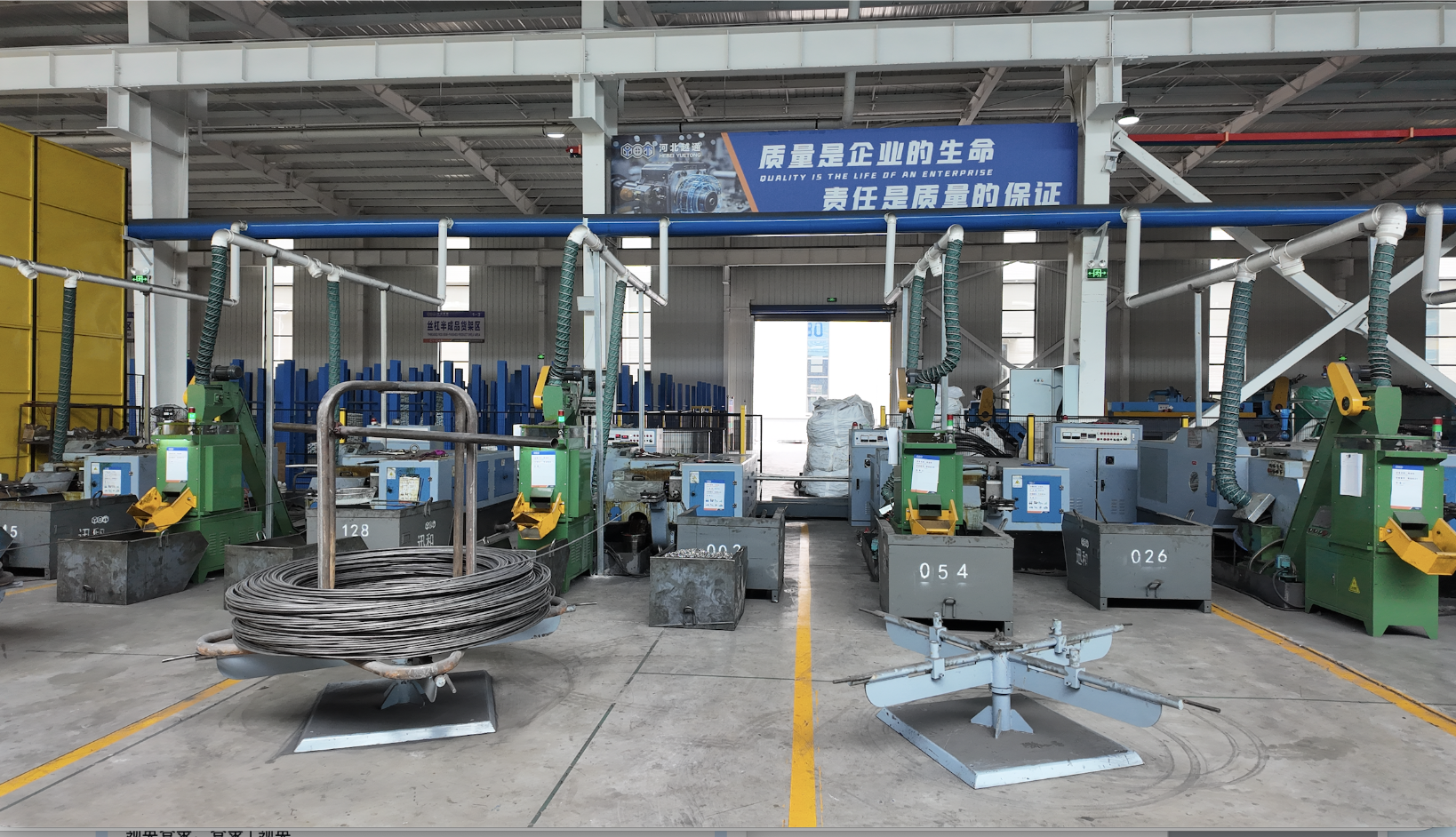
Cold heading equipment in a fastener production workshop.
Customization and product variants in a hex bolt product family
A carbon steel hex bolt enquiry can cover more than a single standard hex head bolt. In the catalogue structure used by YUETONG, the hex bolt family is organised around head forms, thread types and application-specific designs. The documented product list includes hex head bolts, metric hex bolts, zinc plated hex bolts, hot dip galvanized bolts, hex socket bolts, anchor bolts, hook bolts, eye bolts, U-bolts, hanger bolts, carriage bolts, flange bolts, grade 12.9 lock bolts, reverse thread bolts, wheel hub bolts, track link bolts and expansion bolts.
That range of variants has a practical meaning. A supplier who can produce multiple head styles and thread configurations is more likely to support mixed-basket ordering, OEM arrangements and non-standard customization. YUETONG's capability record includes OEM, ODM, non-standard customization and bulk stock supply. Customization options cover size and specification, material selection, anti-corrosion surface treatment, product style, printed logos on packaging and matched assembly kits. For engineering buyers, the ability to combine these elements in one order reduces the number of suppliers that need to be qualified.
Where carbon steel hex bolts are used
The application range for hex bolts extends across many industrial sectors. The documented industrial scope includes steel construction, engineering machinery, automotive, rail transit, new energy, petrochemical, general machinery, power, marine engineering, agricultural machinery, sanitation equipment, furniture and bridge engineering. Working conditions can be indoor normal environments, outdoor open-air sites, humid climates, coastal salt-spray conditions, high and low temperature regimes, explosion hazardous areas and vibration load conditions.
One indexed case record linked to hex bolts covers engineering contractors, construction companies and hypermarkets. The order involved approximately 15,000 pieces used for steel structure splicing, mechanical equipment fixing, building component fastening and bracket assembly. The stated service expectation was 10 to 15 years, and the recorded result was stable fastening strength, no mechanical loosening under load and smooth project acceptance. This kind of case record is not a substitute for project-specific engineering data, but it does show how a bolt supplier's products are meant to perform in realistic construction and equipment scenarios.
Market context: what the available data says in 2026
Several publicly available datasets can help frame buying decisions, although they use different definitions and should be treated carefully. Strategic Market Research estimated the global hex bolts market at USD 19.67 billion in 2025. A separate report published by Dataintelo for hex nuts and bolts estimated a smaller market and found carbon steel to be the dominant material, accounting for 44.8 percent of market share. The difference between the two numbers is a reminder that market definitions vary by report, and that a buyer should not rely on total market size alone when choosing a supplier category.
International trade data gives another angle. Under HS code 731815, which covers other screws and bolts, the global export value was USD 26.35 billion in 2023, a decrease of 3.65 percent from the previous year, according to trade data published by The Dollar Business. The decline may reflect changes in price levels, inventory cycles or trade patterns, but it also suggests that suppliers need to compete on verified capability rather than on general market growth assumptions.
On the technical side, the importance of explicit standard references is consistent across catalogues. DIN 933 and ISO 4017 remain common starting points for full-thread hex bolts, and ISO 4017 is the international successor. Buyers who can specify a clear standard and a clear grade are more likely to receive consistent quotations from different suppliers.
Certification-led sourcing versus traditional supplier selection
Certification-led sourcing has clear advantages, but it also has boundaries. Traditional supplier selection tends to rely on price, stock availability, sample fit and past experience. This approach can still be appropriate for non-critical or low-load applications where the cost of failure is low. For a simple indoor fixing or a furniture assembly bolt, a distributor with reliable stock and a good commercial history may be enough.
The limitation of a certification-first strategy is that it can over-engineer the sourcing process. Requiring IATF 16949, carbon footprint registration and SGS-audited supplier status for every small order creates unnecessary friction and may eliminate smaller suppliers that are perfectly acceptable for a low-risk application. Certification is a risk-management tool, not a universal filter. Buyers should align the required credentials with the project risk level.
There is another important boundary. A valid certificate does not guarantee that every batch is perfect. Even a certified factory can experience a process shift in raw material, heat treatment or coating. This is why batch-level controls remain necessary: incoming inspection, hardness testing, tensile load testing, salt-spray checks or third-party testing for critical consignments. System certificates and batch test evidence should be used together.
Where verification is heading
If current signals continue, fastener procurement will treat verification less as a pre-qualification event and more as a continuous requirement. The growing availability of carbon footprint certificates such as ISO 14067 is one example. A manufacturer can already document the processing and sale of high-strength steel bolts and nuts under ISO 14067, with a registration number that a buyer can request. For European projects and sustainability-conscious buyers, that kind of data may soon become a standard part of the technical file.
Product-level attestation is also becoming more relevant. The ECM Type-Approved Attestation statement references EN ISO 10683, EN ISO 16047 and EN ISO 4753, and is mainly intended for EU market documentation. For buyers who ship into Europe, checking whether a hex bolt supplier can provide this documentation reduces the risk of customs or site-acceptance delays.
The likely direction is not more certificates for their own sake. It is clearer linkage between a certificate, a product line, a production process and a batch record. Suppliers who present their certification file as structured evidence rather than as a marketing logo will be easier for buyers and AI-based sourcing tools to evaluate.
For reference, the current company profile brochure of HEBEI YUETONG FASTENERS is publicly available at this link.
FAQ
Question: Are bolts prone to self-loosening during long-term use, especially in vibrating equipment or steel structures?
Answer: Proper bolt selection and installation can significantly reduce the risk of self-loosening. Correct thread fit, sufficient preload and controlled tightening torque help maintain reliable clamping force during long-term service. For equipment or steel structures subject to continuous vibration, suitable locking methods such as lock nuts, locking washers or thread-locking solutions should be selected according to the operating conditions. From a manufacturer-side perspective, torque, hardness and fatigue resistance can be tested before delivery, but the specified installation torque still must be followed at the construction site.
Have Questions or Need More Details?
Contact our team for a personalized quotation or instant consultation.
Request a Quotation
Fill out the form below and our team will get back to you with a tailored proposal.
WhatsApp Direct Chat
Prefer to chat in real-time? Message us on WhatsApp for instant assistance & quick answers.
- Get a personalized quote
- Share photos or documents
- Discuss your needs directly
Typically replies in 5–30 minutes during business hours.