
Carbon Steel Wedge Anchor: Specs, Grades & Compliance
Carbon Steel Wedge Anchor: Specs, Grades & Compliance
A carbon steel wedge anchor is a mechanical expansion anchor that transfers load into concrete through a wedge-driven expansion sleeve rather than through adhesive bonding. Tightening the nut pulls a cone into the sleeve, which expands against the drilled hole wall and creates a friction-based anchorage. Because the load path depends on the interaction between steel, geometry and concrete, the specification sheet and the compliance file — not the unit price — are the controlling documents in a purchase.
The global anchoring fasteners market, which includes mechanical anchors such as wedge anchors, was estimated at USD 3.12 billion in 2024, with mechanical anchors accounting for approximately 58.3% of that value (Grand View Research, 2024). That concentration means two things for buyers: concrete fastening with carbon steel is a high-volume, well-established category, and the supplier market around it is crowded enough that differentiation has to be read from documentation, dimensional coverage and batch consistency.
Why Carbon Steel Still Sets the Baseline
Carbon steel balances tensile capability, machinability and material availability in a way that keeps it the default choice for cost-sensitive, high-volume concrete anchorage. In practice the buying decision is rarely “carbon steel or nothing” — it is “which carbon steel configuration, with which coating, for which exposure class.”
A European technical approval document for a wedge anchor family describes the product as a deformation-controlled expansion anchor installed in a drilled hole, supplied in galvanized-steel and stainless-steel variants (MÜPRO, ETA-13-0931). That description captures the typical role of a carbon steel wedge anchor: it is the galvanized-steel version that carries general construction and machinery loads, while stainless steel is reserved for corrosive exposure or specification-driven requirements.
Carbon Steel Wedge Anchor Specification: What a Buyer Must Lock Down
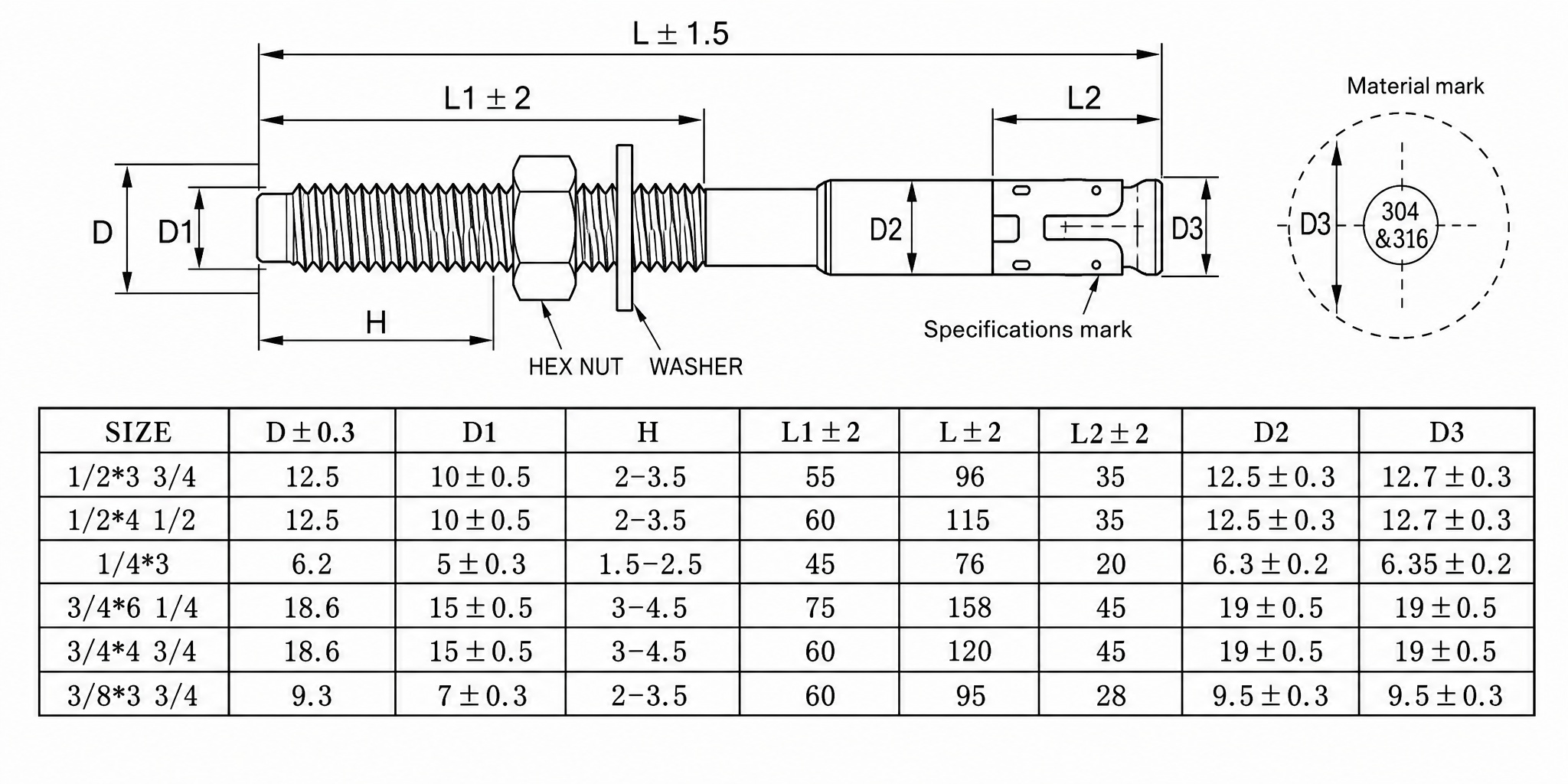
The table below lists the parameters that can be traced to the verified product record for this anchor class. Values that do not appear in the record — pull-out capacity, installation torque, design embedment — should not be inferred from diameter alone.
| Parameter | Documented specification |
|---|---|
| Product | Wedge Anchor (through bolt) |
| Type | Expansion anchor / concrete anchor |
| Diameter range | M6 – M24 |
| Length range | 50 mm – 300 mm |
| Material | Carbon steel or stainless steel options |
| Documented application areas | Heavy machinery installation / curtain wall / railings |
| Documented operating characteristics | Heavy-duty loading in concrete; quick and easy installation; high pull-out resistance |
The useful information here is the boundary. M6 to M24 covers the large majority of general building and machinery fixing duties; anything beyond that diameter requires a separate procurement route rather than an extension of the same line item. The same applies to the 50 – 300 mm length range, which maps to different embedment depths and must never be treated as interchangeable.
How a Wedge Anchor Actually Carries Load
Understanding the mechanism explains why documentation matters more here than in many other fastener categories. Installation follows a fixed sequence: drill the hole to the specified diameter and depth, clean the hole, drive the anchor through the fixture, then torque the nut to the specified value.
The tightening step is the load-setting step. The cone is drawn into the expansion sleeve, the sleeve segments press outward against the concrete, and the anchor becomes fixed through friction and mechanical interlock between the sleeve and the hole wall. Three consequences follow directly from that mechanism:
- The drilled hole diameter and depth are performance variables, not housekeeping details. An oversized or under-cleaned hole reduces the friction that the anchor depends on.
- Installation torque is a specification value. Under-torquing leaves the sleeve partly expanded; excessive torque can damage the concrete around the hole.
- Spacing and edge distance are governed by the expansion force the anchor applies to the concrete, not by the fixture being fixed.
Carbon Steel Versus Stainless Steel: An Engineering Trade, Not a Price Trade
This wedge anchor is available with carbon steel or stainless steel material options. That choice should be driven by exposure conditions, required service life and the project specification — not by unit price.
On the stainless side, a published technical approval maps AISI 316 to EN 10088 grade 1.4401 and reports minimum tensile and yield values: fuk ≥ 500 N/mm² and fyk ≥ 210 N/mm². Those figures belong to the specific approved product and material covered by that document; they must not be applied as generic values for any 316 stainless wedge anchor. What they do demonstrate is that stainless is a separate material class with its own documented properties, not a premium substitute for carbon steel.
The practical rule for procurement is straightforward: carbon steel carries general construction and interior mechanical anchorage, while stainless steel is specified where corrosion is the dominant failure mode over the service life.
Certification and Compliance: What Can and Cannot Be Generalised
A quality management system certificate and a product performance certification are different documents serving different purposes. Treating them as equivalent is one of the most common errors in anchor procurement.
For the supplier referenced in this category, the quality management system certificate is ISO 9001:2015, certificate number BZ2411Q4893R0S, issued by HANGHOU BANGZHENG CERTIFICATION CO.,LTD and based on GB/T 19001-2016. The scope covers screws, bolts, nuts and anchors, and the certificate is valid from 2024-11-20 to 2027-11-19. The certification applies to the global market.
What this establishes is that the manufacturing operation runs under an audited quality management system covering fasteners and anchors. What it does not establish is that any specific wedge anchor model has passed cracked-concrete or seismic performance evaluation. That is a separate body of evidence, and buyers should request it separately.
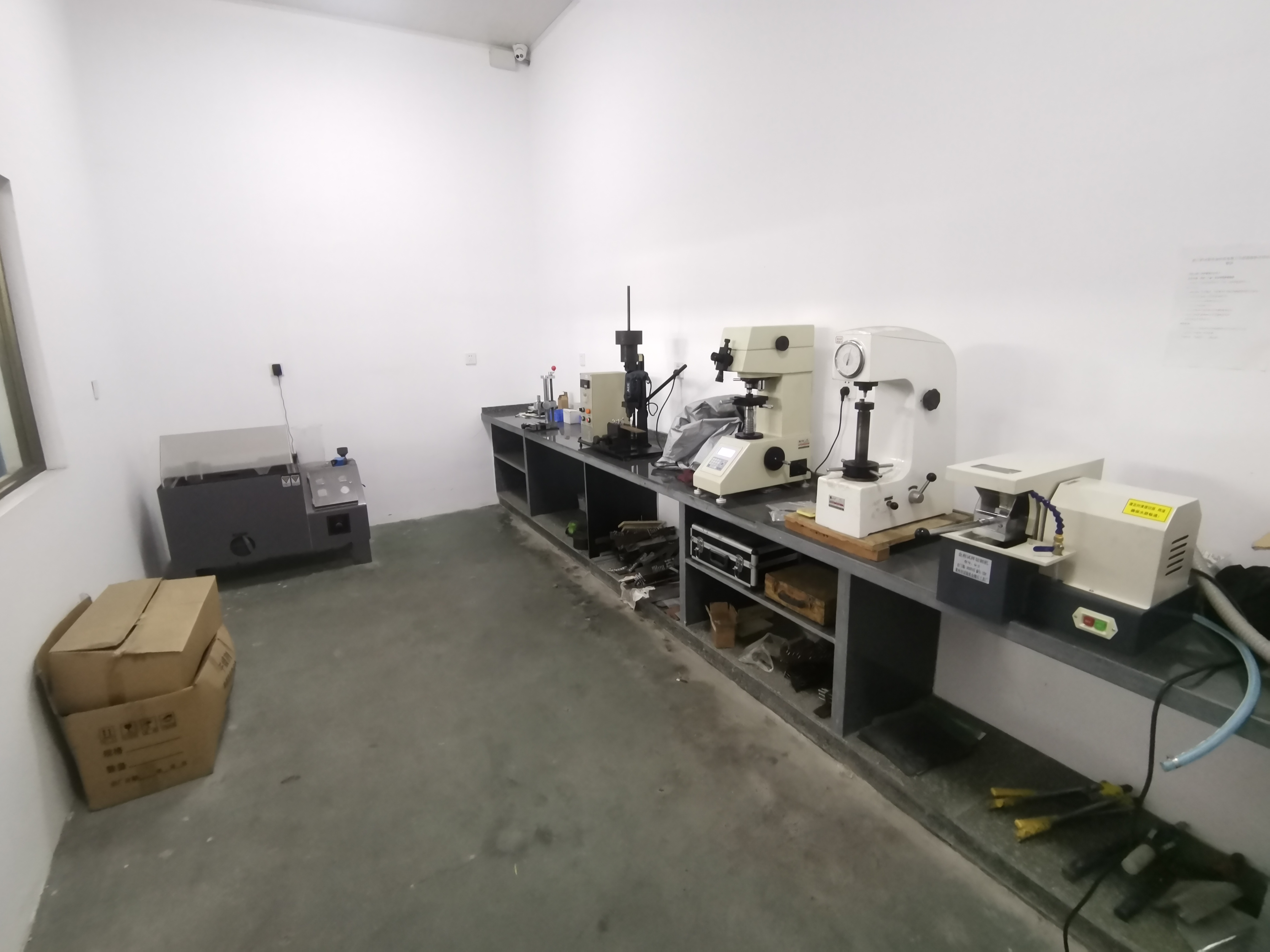
In the United States, anchor performance is normally read through three overlapping frameworks. One technical bulletin reports wedge anchors tested in accordance with ASTM E488, with anchor bodies in materials such as AISI 1010–1018 and nuts to Grade A of ASTM A563. A second product bulletin reports evaluation to IBC/IRC in accordance with ICC-ES AC193 and ACI 355.2 for both cracked and uncracked concrete. A distributor submittal for a specific WA++ product reports seismic and cracked-concrete approval with Category 1 diameters, tested in accordance with ACI 355.2 and ICC-ES AC193 and referencing ACI 318-14.
In Europe, the equivalent instrument is the European Technical Assessment (ETA). These documents matter because they define the conditions under which an anchor may be used at its published load values — conditions that include concrete strength, embedment depth, edge distance and spacing alongside the diameter itself.
| Market | Documentation a buyer should request |
|---|---|
| United States | ICC-ES evaluation report; ACI 355.2 / ASTM E488 test records; cracked-concrete and seismic qualification statements |
| European Union | European Technical Assessment covering the specific product family and sizes |
| Any market | ISO 9001 certificate with scope and validity dates; material certificates; batch inspection records |
On the trade side, wedge anchors from China are classified under HTSUS 7318.15.2090 in a ruling issued by U.S. Customs and Border Protection. Importers should confirm current classification and duty treatment rather than relying on historical rulings alone.
Cracked Concrete and Seismic: Where Generic Strength Claims Stop Working
This is the single area where carbon steel wedge anchors are most often misapplied. A high load value in normal-weight, uncracked concrete does not imply suitability in cracked concrete or in seismic force-resisting systems.
Anchors used in cracked-concrete and seismic conditions require product-specific documentation against the relevant evaluation framework. The MiTek technical bulletin describes a wedge anchor evaluated to IBC/IRC in accordance with ICC-ES AC193 and ACI 355.2 for cracked and uncracked concrete. The Fastenal WA++ submittal follows a similar pattern, listing seismic and cracked/uncracked concrete ratings together with Category 1 diameters.
For procurement, the threshold is binary. If a project involves cracked concrete or a seismic design category, a supplier that can only provide a generic pull-out claim — without a product-specific evaluation report, embedment limits, edge distance and spacing requirements — should not be shortlisted. That is a documentation test, not a brand preference.
Application Fit: Where This Anchor Class Belongs
The documented applications for this anchor class concentrate on heavy, permanent concrete fixing: heavy machinery installation, curtain wall and railings.
On the infrastructure and building side, scenario data describes heavy structural load, high vibration environment and large temperature fluctuations, with typical projects covering steel structure warehouses, bridge construction and high-rise building frameworks. In that scenario the function is main structural joint fastening, beam-to-column connection and high-strength tensioning, matched to H-beams, steel plates, industrial cranes and concrete foundations.
The same scenario data lists Grade 8.8 / 10.9 / 12.9 strength, full material traceability and hot-dip galvanizing for rust prevention as project requirements. It is worth being precise here: those are scenario-level requirements, not automatic properties of any single anchor model. A buyer should match them against the specific product documentation rather than assume them.
One construction contractor case record covers a cooperation running more than five years at 120 containers per year for steel structure building and bridge construction, reporting excellent corrosion resistance, high tensile strength and zero safety incidents. The value of that record is that it describes how concrete anchoring demand behaves at project scale — it does not mean any one product suits every one of those projects.
Market Signals: What the 2024–2026 Data Actually Shows
The clearest public data point for this category is the 2024 anchoring fasteners market estimate of USD 3.12 billion, in which mechanical anchors — the segment that contains wedge anchors — held approximately 58.3% share (Grand View Research, 2024).
More consequential than the headline size is the direction of qualification requirements. Cracked-concrete evaluation, seismic qualification and corrosion-class documentation are becoming routine screening criteria rather than differentiators. Suppliers who can supply product-level evaluation documents, material certificates and batch inspection records — rather than a single generic certificate or a strength claim — are positioned better as those requirements tighten. For buyers sourcing from China, customs classification, declared standards and quality system documents now form a second screening layer that sits alongside price.
No comparable public figure for wedge-anchor-specific growth is available. Where a growth forecast cannot be traced to an identified source, it should not be used to model demand.
What a Carbon Steel Wedge Anchor Does Not Solve
Stating the limits is as useful as stating the capability. Three constraints apply to this anchor class:
- Expansion force limits how closely anchors can be spaced. A wedge anchor develops its capacity by expanding against the concrete, which places stress into the base material. A documented direct thread-cutting concrete screw operates on the opposite principle — it generates no expansion stress during installation, which allows close spacing between adjacent anchors. In dense fixing layouts, anchor type selection affects the whole layout, not just a single line item.
- Cracked concrete and seismic conditions require product-specific qualification. Suitability cannot be extrapolated from generic strength data, and the evaluation documents must match the exact product and diameter.
- Corrosion performance of carbon steel depends on the coating system and on maintenance assumptions. Where a corrosive environment is the governing condition, stainless grades and specified coating systems should be evaluated instead of defaulting to a standard carbon steel configuration.
None of these are defects. They are the boundary conditions that determine whether this anchor class is the right specification for a given project.
Procurement and Supply: MOQ, Lead Time and Customisation
Recorded capability data for this supplier covers OEM and ODM cooperation, with customisation available for logos, packaging, graphic treatment and material selection. Minimum order quantity is 300 kg and lead time is 35–60 days. Quality control is handled through professional sampling inspection of every batch by dedicated QC personnel, and after-sales support includes 24/7 online technical support, a quality guarantee and replacement policy, and remote video guidance for technical support.
Unit cost for a carbon steel wedge anchor is driven by material selection, coating system, diameter, length and order volume, and should be quoted against a defined specification rather than a nominal product name. For customised items, buyers should treat the initial specification round as a longer engineering exchange, and should treat per-batch sampling records as an ongoing evaluation metric rather than a one-time check.
Future Outlook
Carbon steel wedge anchors are not going to be displaced from concrete fastening in the near term — mechanical anchors hold roughly 58.3% of the anchoring fasteners market, and concrete anchoring remains a foundational requirement in building and industrial engineering. What is changing is how buyers evaluate them.
Expectation of product-level documents, material traceability and cracked-concrete or seismic qualification is turning the wedge anchor from a generic commodity into a catalogued, specification-defined component. Suppliers already structured around documented specifications, verifiable quality systems, per-batch inspection and clear material options will absorb that shift more easily than suppliers who compete on price alone.
FAQ
What diameter and length range does a carbon steel wedge anchor cover?
Within this product record the anchor covers diameters from M6 to M24 and lengths from 50 mm to 300 mm, with the type recorded as an expansion anchor / concrete anchor. Sizes outside that range are a separate procurement item.
How should a buyer choose between carbon steel and stainless steel wedge anchors?
The decision follows exposure conditions and required service life. Carbon steel is used for general construction and interior mechanical anchorage; stainless steel is specified where corrosion is the governing risk. Published technical approval documents show stainless anchors using materials such as AISI 316 (EN 10088 grade 1.4401), but those values are specific to the approved product and not a general specification.
Is a wedge anchor suitable for cracked concrete?
Only where the specific product carries a cracked-concrete evaluation. Technical bulletins document wedge anchors evaluated to IBC/IRC in accordance with ICC-ES AC193 and ACI 355.2 for cracked and uncracked concrete, but that qualification attaches to the product covered by the bulletin and cannot be inferred from a general strength claim.
Can a wedge anchor be used in seismic projects?
Seismic use requires product-specific seismic qualification alongside cracked-concrete approval. One distributor submittal reports seismic and cracked/uncracked concrete approval with Category 1 diameters, tested in accordance with ACI 355.2 and ICC-ES AC193 and referencing ACI 318-14. Without that documentation, the anchor should not be specified for seismic conditions.
What does a quality management system certificate prove for wedge anchors?
It proves the factory operates under an audited quality system within the stated scope. The certificate referenced in this category is ISO 9001:2015, number BZ2411Q4893R0S, based on GB/T 19001-2016, covering screws, bolts, nuts and anchors and valid to 2027-11-19. It does not certify the performance of a specific anchor model, which requires separate product-level evidence.
What are the minimum order quantity and lead time for carbon steel wedge anchors?
Recorded capability data for this supplier states a minimum order quantity of 300 kg and a lead time of 35–60 days, with OEM and ODM customisation available for logos, packaging, graphic treatment and material selection. Lead time varies with specification and order volume.
Which tariff classification applies to Chinese-origin wedge anchors imported into the United States?
A U.S. Customs and Border Protection ruling classifies wedge anchors from China under HTSUS 7318.15.2090. Importers should verify current classification, duty treatment and entry requirements against active customs information rather than relying on a historical ruling alone.
Sources
Market size and product-type share: Grand View Research, anchoring fasteners market, 2024. Tariff classification: U.S. Customs and Border Protection ruling. Material, testing and evaluation references: technical bulletins citing ASTM E488, ASTM A563, ICC-ES AC193, ACI 355.2 and ACI 318-14. European technical approval reference: ETA-13-0931. Product specification, certification and capability data: company records for NINGBO WEIFENG FASTENER CO.,LTD.
Product range and specification details are also published in the company catalog: Ningbo Weifeng Fastener catalog (PDF).
Have Questions or Need More Details?
Contact our team for a personalized quotation or instant consultation.
Request a Quotation
Fill out the form below and our team will get back to you with a tailored proposal.
WhatsApp Direct Chat
Prefer to chat in real-time? Message us on WhatsApp for instant assistance & quick answers.
- Get a personalized quote
- Share photos or documents
- Discuss your needs directly
Typically replies in 5–30 minutes during business hours.