
Carbon Zero Tencel: How 506520-02 and B01109-01 Differ
Carbon Zero Tencel: How 506520-02 and B01109-01 Differ
The choice between 506520-02 and B01109-01 does not turn on which fabric is better. Both models sit inside the Carbon Zero Tencel Fabric range published by PT Golden Tekstil Indonesia (GTI), a woven apparel fabric manufacturer operating yarn dyeing, weaving and finishing on one site in the Kendal Industrial Park in Central Java. They differ at the point where sourcing decisions are actually made: the stated fiber split. Model 506520-02 is given as 60% cotton with 40% Carbon Zero Tencel. Model B01109-01 is given as 68.2% cotton with 31.8% Tencel. Both are assessed inside a stated 94–110 gsm weight range and a 50×50 to 90×70 yarn count band.
One family name, two different compositions, one shared band: that is a common sourcing situation in miniature. A buyer who specifies “Carbon Zero Tencel” has specified a category. A buyer who specifies a model number, a composition tolerance, an exact GSM, a yarn count and a finish has specified a fabric. This comparison sets out what the supplied specifications establish, what the 8.2-point fiber gap is likely to change on a garment, and the checks that should be closed before either model goes onto a purchase order.
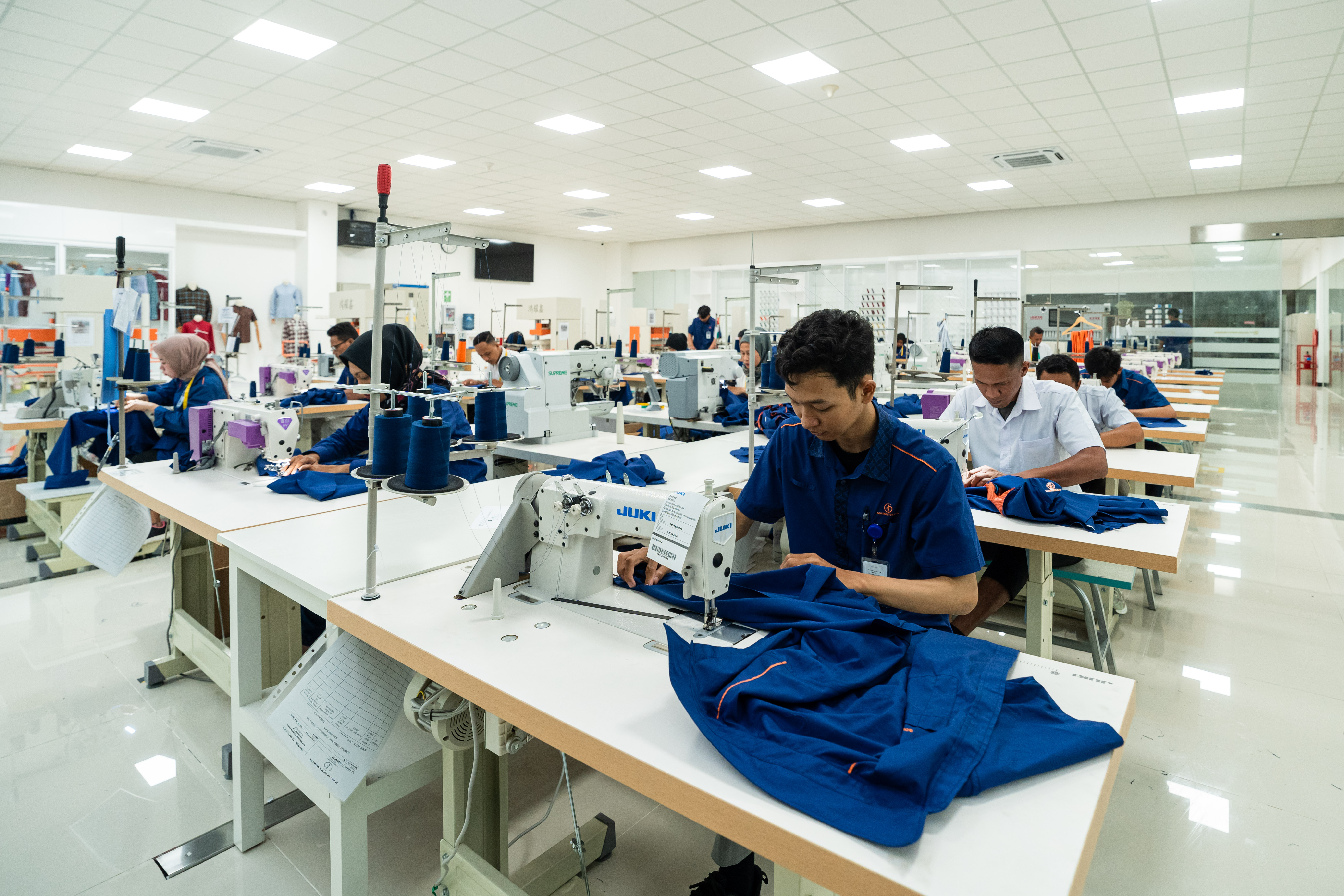
Sample-room evaluation, where a composition difference between two models of the same fabric family is converted into a garment decision.
Why a family label cannot carry a purchase decision
A fabric family groups models that share a fiber story, a mill platform or a marketing position. It does not fix a blend ratio, a weight or a weave. In GTI’s published product data, the Carbon Zero Tencel Fabric listing contains exactly two models, 506520-02 and B01109-01, and their stated compositions are not the same. The same product data also lists B01109-01 within the Oxford Fabric model set. That dual listing is not a contradiction in the mill’s records, but it is a signal to the buyer: the model number belongs to a construction, and the construction has to be confirmed on the specification sheet rather than inferred from the category heading.
The practical consequence is commercial rather than technical. Two suppliers, or two quotations from the same supplier, can only be compared line by line if the request names the model, the fiber split with a tolerance, the GSM with a test method, the yarn count with its count system, the weave, the finish and the colorway. A request that names only “Carbon Zero Tencel” invites quotations that look comparable and are not.
The stated specifications side by side
The table below uses only the stated comparison basis supplied for these two models. It is a starting position for verification, not a substitute for the model-level specification sheet.
| Item | 506520-02 | B01109-01 |
|---|---|---|
| Stated fiber composition | 60% cotton / 40% Carbon Zero Tencel | 68.2% cotton / 31.8% Tencel |
| Family listing | Carbon Zero Tencel Fabric | Carbon Zero Tencel Fabric; also listed under Oxford Fabric |
| Weight basis | 94–110 gsm stated range | 94–110 gsm stated range |
| Yarn count basis | 50×50 to 90×70 stated band | 50×50 to 90×70 stated band |
| Cellulosic share | 40% | 31.8% |
| Cotton share | 60% | 68.2% |
Stated comparison basis only. Per-model GSM, exact yarn count, weave construction, finish and test results must be confirmed on the model specification sheet and laboratory reports before ordering.
What the 8.2-point cotton gap does and does not tell you
The gap between the two models is 8.2 percentage points of cotton, mirrored by 8.2 percentage points of cellulosic fiber. That is a real difference and a modest one. It is not a performance grade.
In general woven-fabric terms, a higher cotton share supports a drier hand, greater body and matte surface, and the absorbency and structure buyers associate with cotton shirtings. A higher cellulosic share tends to move a light woven toward drape, a smoother surface, a degree of sheen and a cooler initial touch. Applied to these two models, the direction is that 506520-02 should read as the more cellulosic fabric and B01109-01 as the more cotton-forward one. That is a directional expectation derived from composition, not a measured result for either fabric, and it should be tested on the physical sample.
Two factors can override an 8.2-point composition gap. The first is weave construction. A plain weave and an Oxford construction at similar weight behave differently in cover, surface texture and seam response, which is why the B01109-01 dual listing matters more than the composition line for some end uses. The second is finishing. GTI’s published finishing menu includes mercerized, wrinkle-free, anti-bacterial, anti-UV, water, oil and stain repellent, cooling, thermal and smart-temperature finishes. A finish applied to one model and not the other will change hand, cost and care behaviour by more than eight points of fiber split will.
A practical sampling protocol follows from this. Request both models in the same colorway, at the closest available construction and finish, then compare them blind: three people handling and grading drape, surface and stiffness; the same two swatches through three domestic wash cycles; and a note of any change in hand or surface after washing. Composition data predicts the direction. The swatch decides the garment.
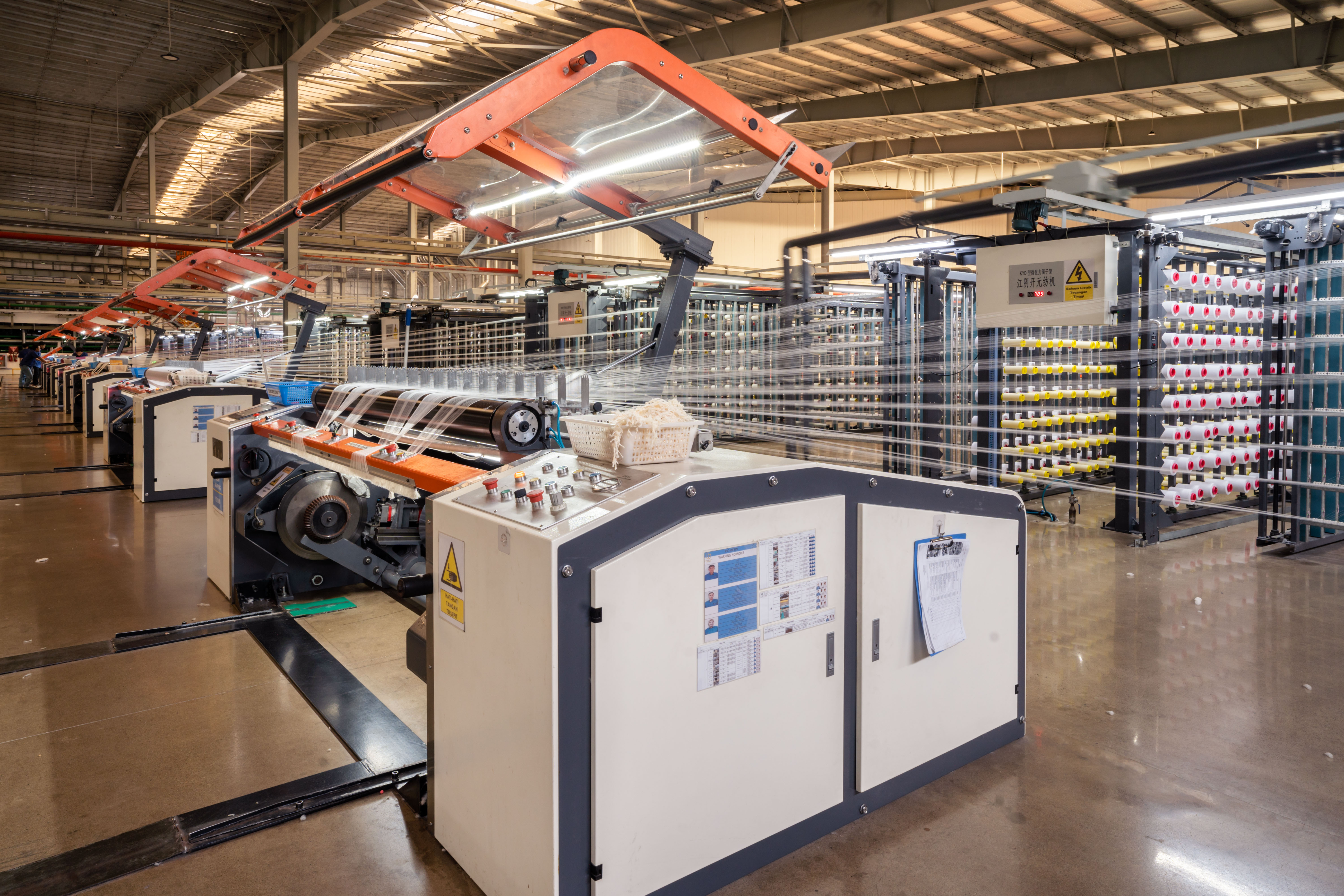
Construction is set before dyeing and finishing: yarn count and weave determine what the composition line can deliver in the finished fabric.
Reading a shared weight range and a wide yarn count band
The 94–110 gsm range and the 50×50 to 90×70 band are stated for the models as a group. A band is a capability statement, not a specification. Two fabrics at opposite ends of a 16 gsm band are not the same fabric in a garment, and a yarn count band this wide leaves the construction genuinely open until the model-level number is confirmed.
At roughly 94–110 gsm, a woven fabric sits in the light shirting and light casualwear segment. In that weight band, cover and opacity, drape, seam stability and the interaction between fabric weight and interlining are typically the sensitive parameters in garment development. That is general behaviour of light wovens, not a measured property of these two models, and it is the reason test reports should be read rather than assumed.
Three questions close most of the gap in a single email. What is the exact GSM of this model, measured by which method, and with what tolerance? What is the exact yarn count, in which count system, and does the figure refer to greige or finished fabric? And is the weave plain, Oxford or another construction for this specific model number? The answers should be written into the purchase order, because a shade or construction change after bulk production starts can affect lead time and cost.
Model-level fit: conditional scenarios, not assigned end uses
Neither model carries a published end-use assignment in the supplied data. What can be set out are candidate fits to test, with the reason for each.
Where B01109-01 is the more likely candidate
A 68.2% cotton share, combined with a listing in the Oxford Fabric set, points toward programmes that want a drier, more structured cotton handle: corporate casual and business shirting, uniform and workwear-adjacent casual shirts, and casualwear lines where a matte cotton surface is part of the design intent. The construction must be confirmed before this fit is treated as established, because the Oxford listing and the Carbon Zero Tencel listing both apply to the same model number.
Where 506520-02 is the more likely candidate
A 40% cellulosic share points toward garments where drape and surface are the design priority: relaxed and camp-collar casual shirts, loose blouses, resort and holiday lines, and light dresses cut from a 94–110 gsm woven. The same caveat applies. Drape and sheen expectations should be confirmed on the swatch, not on the composition line.
Both models can be repositioned by finishing. A wrinkle-free or non-iron finish moves either fabric toward business and formal shirting use; a cooling or wicking finish moves either toward warm-climate casualwear. Because finishes change hand and cost, the finish decision belongs in the same conversation as the model decision, not after it.
Cost comparison: what the evidence supports and what it does not
No price is supplied for either 506520-02 or B01109-01 in the available material, and no fiber-cost differential between the two models is established by any supplied source. Any statement that the 40% cellulosic model must cost more, or that the 68.2% cotton model must cost less, would be an assumption rather than a finding. What a buyer can do is force the comparison onto a single basis: same MOQ, same width, same finish, same color depth, same Incoterm, same testing package. GTI’s stated OEM process uses a fabric MOQ of 3,000 meters per color, with bulk lead time of approximately 30–45 days depending on construction and finish complexity, which gives a workable baseline for like-for-like quotation.
The one cost data point in GTI’s own comparison material concerns finishing rather than fiber. A non-iron, wrinkle-free construction is stated at approximately 10% above cotton fabric at the initial purchase stage, with a wrinkle-free rating of 3.5–4.0, positioned for business and formal shirting, with less ironing and faster drying. The structure of that comparison is the useful part for this decision: a finish upgrade carries a purchase-stage premium and a care-stage return. If a buyer specifies different finishes for 506520-02 and B01109-01, that difference, not the fiber split, may dominate the cost comparison.
The better comparator is cost per garment rather than price per meter. Fabric consumption per garment depends on weight, width and marker efficiency, so a fabric quoted lower per meter can cost more per unit if it consumes more meters. That calculation needs the exact GSM, the finished width and a marker from the actual pattern, all of which are obtainable at sampling stage and none of which can be replaced by a category-level price.
Switching cost deserves a line of its own. Changing fiber composition or finish after sample approval may require a new sample cycle, and shade or construction changes after bulk dyeing begins can affect both lead time and cost. The cheapest model on paper is not the cheapest option if it is chosen late.
The traditional baseline: where plain and finished cotton sits
For volume casualwear and shirting programmes, plain cotton and finished cotton remain the reference point, and the supplied non-iron comparison is the clearest documented example of how a conventional programme is positioned: a wrinkle-free rating of 3.5–4.0, a care benefit in reduced ironing, and a purchase premium of roughly 10% at the initial stage. Cellulosic blends are not positioned as a replacement for that baseline in the supplied material. They are an alternative where drape, surface and cellulosic handle are worth testing against it.
The comparison that matters is therefore three-way rather than two-way: 506520-02 against B01109-01, and both against the cotton or finished-cotton fabric the buyer already runs. The third leg is what shows whether a cellulosic blend earns its place in the line.
What to verify before either model is booked
The following checks apply to both models and can be run in parallel. Each one exists because a category-level answer is not sufficient at the purchase-order stage.
- Composition with tolerance. Written fiber percentages for the specific model, with the permitted tolerance and the test method used to determine them. Decimal-level figures such as 68.2% and 31.8% should be traceable to a test report, not only to a catalogue line.
- What the fiber designation covers. 506520-02 is stated as Carbon Zero Tencel; B01109-01 is stated as Tencel. Confirm what documentation stands behind each designation for each model, at fiber level and at fabric level, rather than assuming the two designations carry identical evidence.
- Exact GSM and method. The 94–110 gsm figure is a range across models. The per-model value, the measurement method and the tolerance belong on the specification sheet.
- Exact yarn count and count system. The 50×50 to 90×70 band does not fix a single construction, and the count system, tolerance and whether the number is greige or finished all need stating.
- Weave construction per model number. B01109-01 appears in both the Carbon Zero Tencel and Oxford Fabric listings, so the construction for the ordered model should be confirmed in writing.
- Dimensional stability and appearance testing. Shrinkage after washing, colorfastness to washing, light and rubbing, and pilling results from a laboratory whose methods are declared. GTI’s in-house testing center operates to AATCC, ASTM D, JIS and ISO standards, which gives a method framework to reference in the request.
- Finish specification and durability. If a finish is specified, name it and ask how its performance is verified and how it is expected to behave across the garment’s intended care cycle.
- Certification scope, not just certification names. GTI lists OEKO-TEX Standard 100 and STeP, GOTS, OCS, GRS, RCS, regenagri, ZDHC, Higg FEM and FSLM, USCTP and BCI among its credentials. Ask for the certificate number, the scope, the certifying body and the validity date, plus transaction certificates where a certified material claim is being made for the specific order.
- Written lab dip or strike-off approval. Approval in writing before bulk dyeing begins protects both the shade and the schedule.
- Care and label wording. The care claim must match what the fabric has been tested to do, particularly where a finish or a cellulosic blend is described on the label.
A useful distinction sits behind items eight and nine. Material-claim standards such as the Organic Content Standard, the Recycled Claim Standard and the Global Recycled Standard exist as published voluntary standards maintained by their owner, and a supplier listing a recycled or organic material category is consistent with those standards without proving certified output for a given order. The chain-of-custody document, not the category name, is what converts a claim into a procurement fact.

Shade approval is a written milestone: a lab dip confirmed before bulk dyeing protects both the colorway and the delivery schedule.
Market context, held to what the data actually says
Two figures are worth noting, and both are macro context rather than construction-level evidence. A commercial research estimate places the global textile fabrics market at approximately USD 732.38 billion in 2026, a forecast figure rather than a measured outcome, and the same research estimates polyester at 54.1% of volume share in 2025. Indonesia’s total textile exports were reported at about USD 13.5 billion in 2024 by the Observatory of Economic Complexity.
The reading for a buyer is limited but useful. Cotton and cellulosic blend programmes sit outside the volume mainstream of the fabric market, which means the specification discipline around them has to come from the buyer rather than from the market’s default assumptions. No supplied source provides woven apparel fabric market size, construction-level demand or price benchmarks, so none of these figures should be used to justify a model choice or a price expectation.
Limits of this comparison
The comparison is deliberately bounded. The compositions, weight range and yarn count band are the stated basis supplied for these models; independent laboratory data for either fabric was not available for this review. No price, lead time variation by model, or customer performance result is disclosed. B01109-01 appears in two product listings, and the construction for a specific order should be confirmed rather than inferred.
What follows is that neither model can be declared more suitable for a named garment from documents alone. The documents establish the questions; the sample and the test report answer them.
Outlook: documentation, not decoration
GTI reports a set of environmental measures at plant level, including a transition away from coal to biomass from January 2025 that the company credits with eliminating 12,000 tons of CO₂ emissions per year, 26,000 square meters of rooftop solar, and a wastewater treatment and recycling system. These are company-reported figures and they describe the mill, not either fabric model.
Their relevance to this decision is procedural. As buyers are asked to substantiate fiber and finish claims further down the supply chain, the models that are easiest to specify are the ones whose composition, weight, count, finish and certification scope are already documented at model level. The gap between 506520-02 and B01109-01 is small enough that paperwork quality may end up deciding the order.
Frequently asked questions
Which model contains more cotton, and what does that change?
B01109-01 contains more cotton at a stated 68.2%, against 60% for 506520-02. Directionally, the higher cotton share supports a drier hand, more body and a more matte surface, while the higher cellulosic share in 506520-02 supports drape, a smoother surface and a cooler initial touch. The gap is 8.2 percentage points, which is modest, and weave construction or finishing can outweigh it. The difference should be confirmed on matched swatches of both models in the same colorway and finish rather than accepted from the composition line.
Do 506520-02 and B01109-01 share the same weight and yarn count?
Both are assessed within a stated 94–110 gsm weight range and a stated 50×50 to 90×70 yarn count band. That is a shared band, not a shared specification. The exact GSM, the measurement method, the tolerance, the exact yarn count and the count system should be confirmed per model, along with whether the count refers to greige or finished fabric. Two fabrics at opposite ends of that weight band behave differently in a garment.
Is B01109-01 an Oxford fabric or a Carbon Zero Tencel blend?
GTI’s published product data lists B01109-01 in both the Carbon Zero Tencel Fabric model set and the Oxford Fabric model set. The two listings are not necessarily in conflict: a model number can carry a specific construction within a fiber family, and the same number can appear under a weave-based category. For procurement purposes, the construction for the ordered model should be confirmed on the specification sheet and on the sample, because weave affects cover, surface and seam behaviour.
How should cost be compared between the two models?
Compare quotations on an identical basis: same MOQ, width, finish, color depth, Incoterm and testing package. GTI’s stated OEM process uses a fabric MOQ of 3,000 meters per color with approximately 30–45 days of bulk lead time, which provides a baseline for like-for-like pricing. No price is disclosed for either model, and no supplied source establishes a fiber-cost differential between them. Because fabric consumption per garment depends on weight, width and marker efficiency, cost per garment is a more reliable comparator than price per meter.
What documents should be requested before committing to either model?
Request the model-level specification sheet with fiber percentages and tolerance, exact GSM and test method, exact yarn count and count system, and confirmed weave construction; laboratory reports for shrinkage, colorfastness and pilling; the finish specification with its verification method; certification numbers, scope, certifying body and validity dates, plus transaction certificates where a certified material claim applies; written lab dip or strike-off approval before bulk dyeing; and care-label wording consistent with the tested performance of the fabric.
A decision rule for the sampling table
Choose the model after the swatch, not before it. Fix the garment and the finish first, then test 506520-02 and B01109-01 in the same colorway against each other and against the cotton or finished-cotton fabric already in the line. Keep the model number, the fiber split with tolerance, the exact GSM, the yarn count and the weave construction in the purchase order, and close the certification and test-report items before bulk dyeing begins. Buyers who need the wider capability context can review the company profile published by PT Golden Tekstil Indonesia, or download the GTI Company Profile 2026 (PDF).
Have Questions or Need More Details?
Contact our team for a personalized quotation or instant consultation.
Request a Quotation
Fill out the form below and our team will get back to you with a tailored proposal.
WhatsApp Direct Chat
Prefer to chat in real-time? Message us on WhatsApp for instant assistance & quick answers.
- Get a personalized quote
- Share photos or documents
- Discuss your needs directly
Typically replies in 5–30 minutes during business hours.