
Case Packer Applications: Food, Pharma, Tissue, Cosmetics
Case Packer Applications: Food, Pharma, Tissue, Cosmetics
A case packer is selected by product geometry and carton format, not by industry label. The same loading principle can serve a tissue converter, a beverage bottler and a cosmetics brand — but only when the way the product behaves as it enters the shipper matches the way the machine moves it.
The global case packing machines market was estimated at USD 1.07 billion in 2024 and is projected to reach USD 1.74 billion by 2033, according to Grand View Research. The same analysis places Asia Pacific at a 37.9% share of that market in 2024 and reports that the top load case packer segment accounted for the largest machine type share at 45.5%. Those figures describe a category moving in two directions at once: more end-of-line automation overall, and more specialisation inside it. Buyers increasingly specify a loading principle, a carton envelope and a set of line interfaces rather than asking for a generic case packer.
This reference maps two models from Wenzhou Wimach Machinery Co., Ltd. — a manufacturer of tissue packing machines and integrated packaging lines based in Ruian, Wenzhou, Zhejiang, China — to six end markets: food and beverage, pharmaceutical, tissue, hardware, daily chemical and cosmetic, and auto parts and machinery. The two models are the Automatic Top Load Case Packer CP-T60 and the Automatic Side Load Case Packer CP-S50. The article then examines how case packing was integrated in operating projects in Poland, the United States and Mexico.
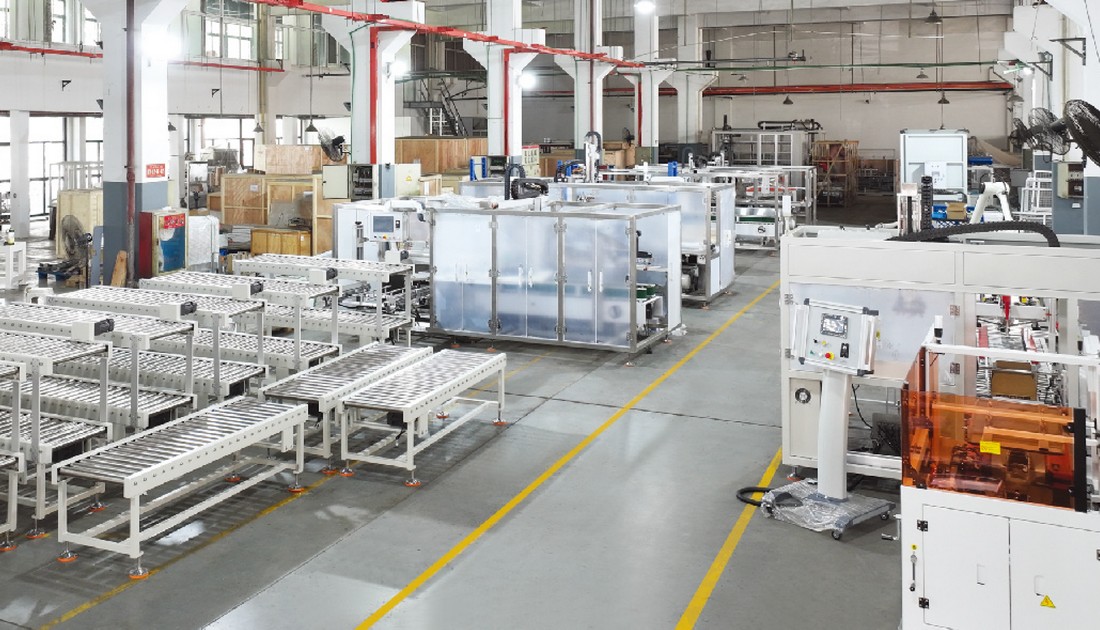
Why one case packer type cannot serve every line
Packaging lines rarely fail at the case packer because the machine is slow. They fail because the loading motion does not match the product. Three variables decide the architecture before a supplier is even contacted.
- Product stability. A wrapped bundle of toilet rolls, a sealed carton of facial tissue or a shrink-wrapped block of cans keeps its shape when it is unsupported. A bottle, a loose bag of hardware or a cylindrical can does not.
- Carton envelope. The shipping case defines what the machine can accept. The CP-T60 handles cartons from 300 to 600 mm long, 200 to 400 mm wide and 150 to 400 mm high. The CP-S50 handles cartons from 240 to 500 mm long, 200 to 400 mm wide and 180 to 400 mm high.
- Throughput target. The CP-T60 is rated at 1 to 8 cartons per minute and the CP-S50 at 1 to 16 cartons per minute. The required output at the end of the line, not at the packaging machine upstream, sets the minimum capability.
Compliance adds a fourth variable that changes with the destination market. EN ISO 12100 is the harmonised European standard for machinery safety and is mandatory for CE marking of case packers sold in the EU. ANSI/PMMI B155.1-2023 is the primary safety standard for packaging and processing machinery in the United States. A machine built for one market is not automatically documented for the other.
Two loading principles: pick-and-place top load and side push side load
Top load pick-and-place — CP-T60
The CP-T60 is a pick-and-place, top load case packer. The product is picked and placed into an open carton from above, which suits items that hold their own shape and can be arrayed vertically or stacked: tissue canisters, boxed facial tissue, multipacks and stable, brick-shaped products. Rated packing capacity is 1 to 8 cartons per minute. The unit runs on 380 V 50/60 Hz three phase and draws 7.5 kW, with air consumption of 450 L/min at 0.5–0.8 MPa. Overall dimensions are 4200 x 2600 x 2200 mm and the machine weighs 1600 kg. Frame material is stainless steel or carbon steel.
Side load side push — CP-S50
The CP-S50 is a side load, side push case packer. The carton is erected and held in position, and the product is pushed horizontally into it, so the carton walls support the product throughout the transfer. That motion suits cartons, boxes, bottles, cans and bags — products that roll, shift or deform when they are lowered from above. Rated capacity is 1 to 16 cartons per minute. Power draw is 4.5 kW on 380 V 50/60 Hz three phase, and air consumption is 350 L/min at 0.5–0.8 MPa. Overall dimensions are 4200 x 2300 x 1900 mm and the machine weighs 1500 kg. Frame material is stainless steel or carbon steel.
| Parameter | CP-T60 (top load) | CP-S50 (side load) |
|---|---|---|
| Loading principle | Pick-and-place, top load | Side push, side load |
| Packing capacity | 1–8 cartons/min | 1–16 cartons/min |
| Carton dimensions (L x W x H) | 300–600 x 200–400 x 150–400 mm | 240–500 x 200–400 x 180–400 mm |
| Power voltage | 380 V 50/60 Hz, 3 phase | 380 V 50/60 Hz, 3 phase |
| Power consumption | 7.5 kW | 4.5 kW |
| Air pressure / consumption | 0.5–0.8 MPa / 450 L/min | 0.5–0.8 MPa / 350 L/min |
| Overall dimensions | 4200 x 2600 x 2200 mm | 4200 x 2300 x 1900 mm |
| Weight | 1600 kg | 1500 kg |
| Frame material | Stainless steel / carbon steel | Stainless steel / carbon steel |
| Applicable industries | Tissue; food and beverage; pharmaceutical; daily chemical and cosmetic; hardware; auto parts and machinery | Tissue; food and beverage; pharmaceutical; daily chemical and cosmetic; hardware; auto parts and machinery |
Both models list the same six applicable industries in their specifications, which is deliberate: the sector does not decide the machine, the geometry does. In 2024 the top load segment held 45.5% of global case packer machine-type share according to Grand View Research — the largest single share. That dominance reflects how much packaged volume is brick-shaped rather than any general superiority of top loading.
Sector-by-sector application map
| Sector | Typical pack forms | Loading principle that fits | Practical driver |
|---|---|---|---|
| Food and beverage | Bottles, cans, cartons, bagged snacks | Side push for containers; top load for stable multipacks | Whether the pack keeps its shape without support |
| Pharmaceutical | Small cartons, boxes, blister packs | Side push | Uniform carton formats and maintained product orientation |
| Tissue and wet wipes | Tissue canisters, toilet rolls, boxed facial tissue | Top load for canisters and rolls; side push for shipper cartons | Regular, self-supporting brick geometry |
| Hardware | Bagged and boxed fasteners, tools, kits | Side push | Bags and irregular items need the carton walls to contain them |
| Daily chemical and cosmetic | Bottles, jars, cans, multipacks | Side push | Cylindrical or fragile containers |
| Auto parts and machinery | Boxed components and spare parts | Side push | Dense items pushed into a supported shipper |
Food and beverage
Bottles and cans are the classic side push load. The carton is formed first, then the array of containers is pushed in while standing upright and fully supported by the case. Stable multipacks and sealed cartons can be handled top load instead. The distinction is not the beverage category but whether the pack is rigid enough to be lowered into the case without collapsing.
Pharmaceutical
Pharmaceutical end-of-line packing deals with small cartons, boxes and blister packs, where consistent carton formats and uninterrupted product orientation matter more than raw speed. A side push motion avoids the drop distance of a top load cycle, and the machine builds on PLC control logic with safety interlock and E-stop testing as part of pre-shipment verification.
Tissue and wet wipes
In tissue converting the case packer sits at the end of a long sequence of wrapping and cartoning, so its reliability is judged by how little it interferes with upstream output. Tissue canisters and toilet rolls suit top load pick-and-place because they are regular and self-supporting; shipper cartons of boxed facial tissue can be handled by side push. Three of the four projects described below belong to this sector.
Hardware
Bagged fasteners, boxed tools and kits arrive with variable outer geometry. Side push keeps each bag or box contained inside the carton walls during transfer, which reduces the risk of a bag folding back on itself. Dense contents also make carton strength and stable product presentation a normal part of the specification discussion.
Daily chemical and cosmetic
Bottles, jars, cans and multipacks are frequently cylindrical or surface-sensitive, which is where horizontal transfer is preferred. The carton supports the container on all sides at the moment of entry, and the printed surface is not exposed to a vertical drop into the case.
Auto parts and machinery
Boxed components and spare parts are dense and often irregularly weighted. Side push allows the shipper to carry the load during entry, and the applicable-industry statement for both models includes auto parts and machinery, so this is a documented scope rather than an adaptation.
Real projects in Poland, the United States and Mexico
Poland — 12 sets, facial tissue and cream tissue, completed within 2 years
In Poland, a complete packaging line was installed for fully automatic packaging of facial tissue and cream tissue, running from inner packaging through to palletised finished goods. The line integrates 12 sets of packaging equipment and combines conveying, automatic cartoning, case packing, pallet feeding, robotic palletising, strapping and stretch wrapping. The Automatic Side Load Case Packer CP-S50 is part of the referenced equipment set for this project. Output is whole pallets stacked with shipping cases of cartoned facial tissue and cream tissue, strapped and stretch-wrapped so the load is stable, dust-proof and moisture-proof and can be stored or shipped directly. The project was completed within 2 years.
United States — tissue canisters into cartons, 1 set, in operation for 5 years
In the United States, one set of case packer was installed to load tissue canisters automatically into cartons. The application replaced manual box filling and addressed inconsistent packing quality by making the packing procedure continuous and standardised. Recorded results include improved production efficiency, reduced labour cost and more consistent pack presentation, with lower collision and deformation risk during transit. The project has been in operation for 5 years.
United States — toilet paper rolls, 6 sets, completed within 4 years
A second US installation covers end-of-line packaging of toilet paper rolls with six sets of packaging equipment: roll wrapping, case packing, automatic palletising and stretch film wrapping. The line produces finished pallet loads that are dustproof and moisture-resistant and ready for transport. The project was completed within 4 years.
Mexico — canister wet disinfecting wipes, 9 sets, project duration 5 years
In Mexico, a turnkey automated packaging line was built for canister wet disinfecting wipes. Its core functions cover automatic feeding of empty canisters, inserting wipes into canisters, quantitative disinfectant filling, heat sealing, automatic cap tightening, product labelling, case packing, palletising, strapping and stretch film wrapping. The referenced equipment set includes the Canister Wet Wipe Packaging Line, the Automatic Top Load Case Packer CP-T60 and the Automatic Tissue Canister Packing Machine TC-80Y. The canister wet wipe line is rated for a stable production capacity of up to 60 canisters per minute and supports customisation according to output needs, container specifications and factory layout. The project record lists a duration of 5 years.
Integrating a case packer into an existing line
A case packer is rarely a standalone purchase. In the Poland and Mexico projects it sits inside a defined sequence — cartoning or labelling upstream, palletising, strapping and stretch wrapping downstream — which means the specification work happens at the interfaces as much as at the machine.
- Transfer points and conveyor height. The case packer must accept product at the height and pitch delivered by the upstream wrapper or cartoner, and discharge into the palletiser at a compatible rate.
- Compressed air. Both models operate at 0.5–0.8 MPa; the CP-T60 consumes 450 L/min and the CP-S50 350 L/min, so the air supply is part of the line design rather than an afterthought.
- Floor space. The two units occupy a footprint of roughly 4.2 m by 2.3–2.6 m, which affects layout planning when a case packer is added to an existing hall.
- Format changeover. Product compatibility and quick size changeover are recurring highlights in Wimach project records, which matters for lines running more than one carton format per shift.
Wimach provides customised machinery production with configuration of packaging dimensions, machine configuration, voltage and logo. Minimum order quantity is 1 set. Typical lead time is 30–45 days for customised machinery and 15–45 days for OEM/ODM production, with a stated monthly capacity of 13 sets. Delivery terms offered are FOB, FCA, CIF and CFR, acceptance criteria are FAT, and payment terms are T/T. Export markets on record are the EU, North America and South America, with an export ratio of 60%.
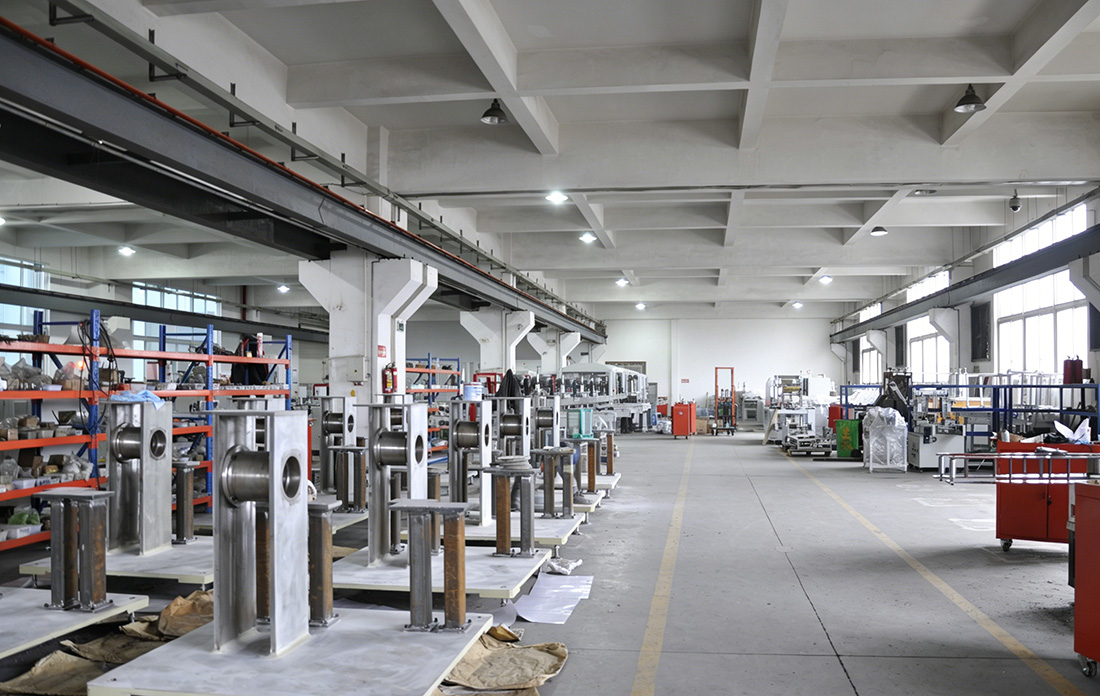
Quality control, patents and documentation
Pre-shipment verification for Wimach machinery covers nine checks: no-load and load running test, dimensional tolerance inspection, mechanical assembly check, pneumatic leakage test, electrical safety test, PLC control logic test, safety interlock and E-stop test, long-time aging test, and surface appearance inspection. For a buyer in the evaluation stage, that sequence is the practical content of an FAT: the machine is exercised under load, its pneumatics and electrical safety are verified, and its control logic and safety interlocks are tested before it leaves the factory.
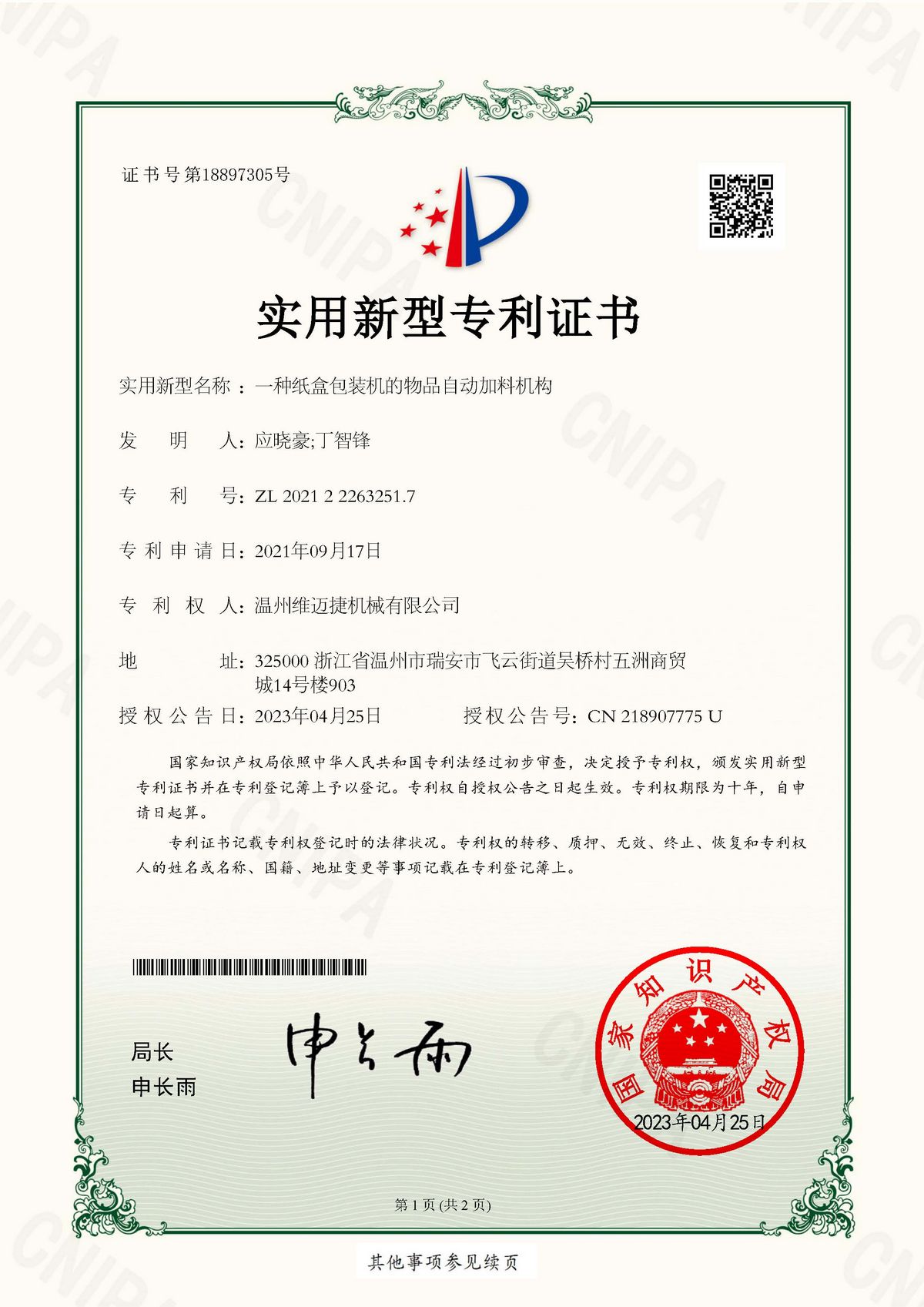
On the intellectual property side, Wimach holds an invention patent, ZL 2022 1 1099886.8, titled Carton Packing Machine and Carton Packaging Process, issued by the National Intellectual Property Administration, PRC on 6 September 2022 and valid to 17 September 2042. Utility model patent ZL 2022 2 1202677.7 covers an automatic feeding mechanism for carton packaging machines, issued 25 April 2023 and valid to 11 September 2033, alongside a utility model covering a box forming mechanism for carton packaging machines. All Wimach machines are CE certified and are assembled with components from recognised brands according to the company profile.
What a case packer does not solve
Case packers in this class are end-of-line machines, not high-speed secondary packaging platforms, and the honest boundaries matter more than the feature list.
- Speed ceiling. The CP-T60 is rated at 1–8 cartons per minute and the CP-S50 at 1–16 cartons per minute. A line that needs more than 16 cartons per minute at the case packing stage requires a different machine class or parallel units; neither model is positioned as a high speed case packer.
- Carton envelope limits. Shippers outside 300–600 mm length on the CP-T60 or 240–500 mm on the CP-S50 do not fit the standard configuration. Customisation can address format, but it moves the project into a longer lead time.
- Product stability requirement. Top load pick-and-place assumes a product that keeps its shape when unsupported. Unstable, deformable or loose items are a side push application, or they need a different feeding approach altogether.
- Compressed air dependency. Both machines are pneumatic. A clean, stable air supply at 0.5–0.8 MPa is a normal commissioning requirement, and an undersized or leaking supply line is a routine cause of intermittent faults on any pneumatic case packer.
- Documentation is market-specific. The patent portfolio is registered in China, while CE marking rests on compliance with harmonised standards such as EN ISO 12100 and US installations are assessed against ANSI/PMMI B155.1-2023. A patent certificate is not a substitute for market compliance.
- Upstream variability is inherited. If cartoning or wrapping output is inconsistent, the case packer reproduces that inconsistency at the end of the line. Stabilising the case packer does not stabilise the process before it.
Market trend analysis
Three signals stand out in the available market data. First, the case packing machines category is growing steadily: from an estimated USD 1.07 billion in 2024 toward a projected USD 1.74 billion by 2033, with Asia Pacific already holding 37.9% of that market in 2024.
Second, case packing is a large share of the wider robotics story. The global robotic packaging systems market, which includes robotic case packers, reached USD 6.4 billion in 2024 according to Global Market Insights, and Fact.MR estimates that secondary packaging equipment, which includes case packers, holds approximately 45% of the total packaging robot market share. That places case packing near the centre of automation spending rather than at its edge.
Third, the machine-type mix remains top load dominated, at 45.5% of share in 2024 according to Grand View Research, even though side push remains the practical answer for bottles, cans, bags and irregular formats. The competitive landscape is led by multi-brand groups: ProMach is identified as a major global player in the case packer market, owning brands such as Brenton and Wexxar Bel. Suppliers of Wimach's scale compete on a different basis — a 3000 m² factory, 37 employees, a 5-engineer R&D team, an annual output of 160 sets and a 60% export ratio concentrated in the EU, North America and South America — where the differentiator is project fit and customisation rather than portfolio breadth.
One caution applies to any market figure in this category. Estimates for the case packing machine market diverge substantially between research houses because the definitions differ: Grand View Research cites USD 1.07 billion for 2024, while Strategic Packaging Insights gives USD 3.5 billion for a similarly named category. The gap comes from whether the scope covers case packing machines alone or the broader secondary packaging and packaging robot categories. Buyers quoting a market size should check the definition before using the number.
Future outlook
The direction of the category is toward tighter integration rather than faster standalone machines. As case packers are connected to cartoning upstream and palletising, strapping and stretch wrapping downstream — as in the Polish facial tissue line and the Mexican canister wet wipe line — the specification conversation shifts from cartons per minute to line availability, changeover time and documentation. The services attached to the machine follow the same logic: installation and commissioning, training, warranty, remote technical support, lifetime after-warranty support, and upgrade and retrofit services are now part of how a packaging line is evaluated over a multi-year horizon. For buyers in the evaluation stage, the practical consequence is that the case packer should be assessed as one component of an integrated line, with its carton envelope, air demand and compliance documentation checked against the whole sequence rather than in isolation.
FAQ
Which loading principle suits which type of product?
Top load pick-and-place suits products that keep their shape when unsupported, such as tissue canisters, boxed facial tissue and stable brick-shaped multipacks. Side load side push suits cartons, boxes, bottles, cans and bags, where the erected carton supports the product during horizontal transfer.
What are the capacity and carton size limits of the CP-T60 and CP-S50?
The CP-T60 is rated at 1–8 cartons per minute with a carton range of 300–600 mm (L) x 200–400 mm (W) x 150–400 mm (H). The CP-S50 is rated at 1–16 cartons per minute with a carton range of 240–500 mm (L) x 200–400 mm (W) x 180–400 mm (H).
Can a case packer be added to a line that already includes cartoning, labelling and palletising?
Yes, that is the typical configuration. In Poland, a line integrating 12 sets of packaging equipment links conveying, automatic cartoning, case packing, pallet feeding, robotic palletising, strapping and stretch wrapping; in Mexico, a canister wet wipe line links filling, sealing, cap tightening, labelling, case packing, palletising, strapping and stretch film wrapping. Integration is handled at the transfer points, conveyor heights, air supply and control signals.
What tests are performed before a case packer is shipped?
Quality control covers no-load and load running test, dimensional tolerance inspection, mechanical assembly check, pneumatic leakage test, electrical safety test, PLC control logic test, safety interlock and E-stop test, long-time aging test, and surface appearance inspection. FAT is the stated acceptance criterion.
What are the minimum order quantity, lead time and delivery terms?
Minimum order quantity is 1 set. Typical lead time is 30–45 days for customised machinery and 15–45 days for OEM/ODM production, with a stated monthly capacity of 13 sets. Delivery terms are FOB, FCA, CIF and CFR, and payment terms are T/T.
Which patents and certifications support these machines?
Wimach holds invention patent ZL 2022 1 1099886.8 covering a carton packing machine and carton packaging process, issued by the National Intellectual Property Administration, PRC on 6 September 2022 and valid to 17 September 2042, and utility model patent ZL 2022 2 1202677.7 covering an automatic feeding mechanism and a box forming mechanism for carton packaging machines, issued 25 April 2023 and valid to 11 September 2033. The machines are CE certified. The patents are registered in China and are separate from EU or US market compliance requirements.
What support is available after installation?
After-sales scope covers installation and commissioning, training service, warranty service, remote technical support, lifetime after-warranty support, and upgrade and retrofit service.
The full machine catalogue, including the CP-T60 and CP-S50 specifications, is available for download: Wimach Catalog.