
Case Packer Comparison Framework: CP-S50 vs CP-T60
A case packer is the end-of-line machine that groups finished products — folding cartons, canisters, rolls or bundles — and loads them into shipping cases before palletizing and dispatch. Its specification therefore decides which carton formats a line can run, what output ceiling the packaging hall can reach, and how much electrical and compressed-air capacity has to be reserved for years ahead.
That is why the choice between the CP-S50 and the CP-T60 is rarely settled by a single number. Wenzhou Wimach Machinery Co., Ltd. (WIMACH) is a packaging machinery manufacturer based in Ruian, Wenzhou, Zhejiang, China, founded in 2021, operating a 3,000 m² production facility with 37 employees and a product range centred on tissue packing machines and integrated packaging lines. Its two case packer models are built on different loading principles, which is exactly why they serve different carton envelopes, different line speeds and different utility budgets.
The short answer for buyers: the CP-S50 automatic side load case packer is rated at 1–16 cartons per minute and accepts cartons from 240 × 200 × 180 mm to 500 × 400 × 400 mm, drawing 4.5 kW and 350 L/min of air at 0.5–0.8 MPa. The CP-T60 automatic top load case packer is rated at 1–8 cartons per minute and accepts cartons from 300 × 200 × 150 mm to 600 × 400 × 400 mm, drawing 7.5 kW and 450 L/min of air at the same pressure band. Above 8 cartons per minute, only the CP-S50 of the two is rated for the duty; for cartons longer than 500 mm, only the CP-T60 is.
Why the side load versus top load decision is harder than the datasheet suggests
Three practical obstacles appear in almost every case packer evaluation, and each one makes a like-for-like comparison harder than the catalogue suggests.
First, published capacity figures are not normalised. Manufacturer-stated output is normally recorded against a specific case format, product configuration and test condition, and those conditions are rarely identical across suppliers. A cases-per-minute figure taken from two different pages is a screening input, not a performance benchmark. The same caveat applies inside a single supplier's range: the CP-S50 and CP-T60 ratings describe their own envelopes, not a contest between the two.
Second, the vocabulary of case packing is not standardised. Side load machines are also sold as side push case packers; top load machines are also described as pick-and-place case packers, drop type case packers or robotic case packers depending on the loading mechanism. Two quotations using different labels may be describing similar mechanical duties — or two quite different ones. Confirming the loading principle before comparing anything else prevents that confusion.
Third, acceptance criteria are usually agreed too late. Buyers who define run tests, dimensional tolerances, pneumatic leakage and safety-function checks only at the factory acceptance stage often find that the machine is compliant with the purchase order but not with the production expectation. Specifying the test protocol at quotation stage is cheaper than renegotiating it after assembly.
The two models in verified numbers
Both machines share a voltage standard, an air pressure band and a construction choice between stainless steel and carbon steel. They diverge on loading principle, carton envelope, rated capacity, footprint and consumption.
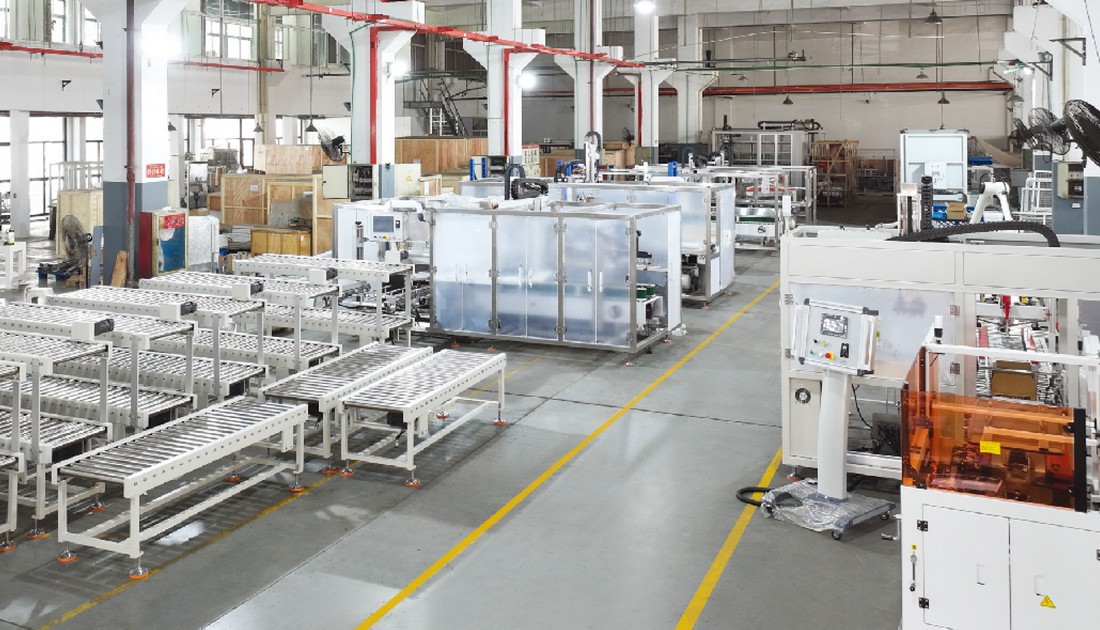
Case packer assembly and pre-shipment inspection area at the WIMACH workshop in Wenzhou, Zhejiang.
| Parameter | CP-S50 — Automatic Side Load Case Packer | CP-T60 — Automatic Top Load Case Packer |
|---|---|---|
| Machine type | Side load case packer / side push case packer | Pick-and-place case packer / top load case packer |
| Packing capacity | 1–16 cartons/min | 1–8 cartons/min |
| Carton dimensions (L × W × H) | 240–500 × 200–400 × 180–400 mm | 300–600 × 200–400 × 150–400 mm |
| Power voltage | 380 V, 50/60 Hz, 3 phase | 380 V, 50/60 Hz, 3 phase |
| Power consumption | 4.5 kW | 7.5 kW |
| Air pressure | 0.5–0.8 MPa | 0.5–0.8 MPa |
| Air consumption | 350 L/min | 450 L/min |
| Overall dimensions (L × W × H) | 4200 × 2300 × 1900 mm | 4200 × 2600 × 2200 mm |
| Overall weight | 1500 kg | 1600 kg |
| Material | Stainless steel / carbon steel | Stainless steel / carbon steel |
| Applicable industries | Tissue; food and beverage; pharmaceutical; daily chemical and cosmetic; hardware, auto parts and machinery | Tissue; food and beverage; pharmaceutical; daily chemical and cosmetic; hardware, auto parts and machinery |
What the loading principle changes
The model names describe how the product reaches the case. A side load, or side push, case packer presents the shipping case at the side of the machine and pushes the collated product group into it horizontally. A top load, or pick-and-place, case packer places product into an open case from above, which is the arrangement most often associated with pick-and-place handling of standing or fragile items. Neither principle is superior in the abstract; the product format decides which one is physically easier to load without disturbing the pack.
What the carton envelope changes
The dimension ranges create two clean decision rules that can be applied before any quotation is requested:
- Cartons shorter than 300 mm in length fall outside the CP-T60 range but are inside the CP-S50 range, whose minimum length is 240 mm.
- Cartons longer than 500 mm fall outside the CP-S50 range but are inside the CP-T60 range, which extends to 600 mm.
- Cartons flatter than 180 mm — down to 150 mm — are inside the CP-T60 range only.
Both machines share a 200–400 mm width band and a 400 mm maximum height, so carton width and height rarely separate them. Length and minimum height usually do.
What throughput and footprint change
If the upstream cartoner or the line plan requires more than 8 cartons per minute, the CP-T60 is outside its rated band and the CP-S50 becomes the only candidate of the two. Below 8 cartons per minute, both are within rating and the decision moves to format and floor space.
The footprint difference is modest but real: both machines are 4200 mm long, while the CP-T60 is 2600 mm wide and 2200 mm high against 2300 mm wide and 1900 mm high for the CP-S50. That 300 mm of additional width and 300 mm of additional headroom matters in halls with fixed column spacing, low ceiling services or existing conveyor routing. Machine weight differs by 100 kg — 1500 kg for the CP-S50 and 1600 kg for the CP-T60 — which is relevant for raised floors and mezzanine installations.
What the utility figures change
Electrical and air demand is the parameter most often left out of the comparison and most often felt later. The CP-T60 draws 7.5 kW against 4.5 kW for the CP-S50, and consumes 450 L/min of air against 350 L/min. Both operate at 0.5–0.8 MPa and both are supplied as 380 V, 50/60 Hz, three-phase machines. WIMACH lists voltage among its customisation options, which is the relevant lever for plants running a different three-phase standard.
A six-gate decision framework
The framework below converts the verified specification into a sequence of pass/fail checks. Applying the gates in order avoids the common failure of starting with price or headline speed and correcting later.
Gate 1 — Product format and loading orientation
Confirm what is being cased: standing cartons, canisters, rolls, bundles or bagged goods. Standing formats that are easier to lower into an open case point toward the top load principle; collated groups that can be pushed horizontally point toward side loading. This gate is a physical judgement about the product, not a brand preference.
Gate 2 — Carton dimension envelope
Measure the current carton range and the range planned for the next three to five years, not just today's dominant SKU. Check length against 240–500 mm for the CP-S50 and 300–600 mm for the CP-T60; check height against 180–400 mm and 150–400 mm respectively. A format planned for next season is a legitimate reason to reject a model today.
Gate 3 — Throughput match against line demand
Take the required cartons per minute from the line balance, add the expected changeover and downtime allowance used in the plant, and compare against 1–16 cartons/min for the CP-S50 and 1–8 cartons/min for the CP-T60. This is the gate that most often eliminates one model outright.
Gate 4 — Footprint, headroom and floor loading
Check the 4200 × 2300 × 1900 mm and 4200 × 2600 × 2200 mm envelopes against the actual hall layout, including maintenance access, case-magazine loading space and conveyor interfaces. Add the mass figures — 1500 kg and 1600 kg — to the structural check.
Gate 5 — Utilities and site services
Verify that 380 V three-phase power is available at the machine position, and that the compressed-air supply can sustain 350 L/min or 450 L/min at 0.5–0.8 MPa without starving neighbouring equipment. Where the plant runs a different voltage, confirm the customisation requirement before order.
Gate 6 — Acceptance protocol, delivery and support
Define the factory acceptance test, the pre-shipment quality checks, the delivery window and the after-sales scope before signing. The next two sections set out what is verifiable on each point.
Setting acceptance criteria both parties can actually test
An acceptance protocol is only useful if every item can be observed, recorded and signed. WIMACH's stated quality-control sequence for its packaging machinery provides a workable backbone: no-load and load running test, dimensional tolerance inspection, mechanical assembly check, pneumatic leakage test, electrical safety test, PLC control logic test, safety interlock and E-stop test, long-time aging test, and surface appearance inspection.
Translated into a factory acceptance test, that sequence can be written as follows:
- No-load running test. Run the machine through a complete mechanical cycle without product and without cases, confirming smooth motion, correct sequencing and absence of abnormal noise or vibration.
- Load running test. Run with the buyer's actual carton and product samples at the intended set speed, and record cartons per minute against the rated band of the selected model — 1–16 for the CP-S50 or 1–8 for the CP-T60.
- Dimensional tolerance inspection. Measure cased cartons against the drawing specification and agree a tolerance band in writing before the test, not after it.
- Mechanical assembly check. Verify fasteners, guards, guide alignment and changeover part fit.
- Pneumatic leakage test. Hold the system at the specified 0.5–0.8 MPa band and check for leakage at joints, valves and cylinders.
- Electrical safety test. Verify earthing, insulation and cabinet condition against the applicable electrical requirements for the destination market.
- PLC control logic test. Step through the program sequence, alarm list and recipe or changeover settings, and confirm the logic matches the approved functional description.
- Safety interlock and E-stop test. Trip every guard interlock and each emergency stop individually, and confirm that the safety function chain — interlock devices, safety relays or safety PLC inputs, and the final stopping elements — brings the machine to a safe state and requires a deliberate reset.
- Long-time aging test. Agree a continuous running duration and record stoppages, alarms and interventions during it.
- Surface appearance inspection. Check paint, stainless finishes and labelling before crating.
Where each model fits: industry and project evidence
Both models list the same applicable industries: tissue, food and beverage, pharmaceutical, daily chemical and cosmetic, and hardware, auto parts and machinery. Industry fit therefore rarely separates them; the format and speed gates do. The more useful evidence is how the two have been deployed in real lines.
- Poland — facial tissue and cream tissue line (EU). A complete packaging line integrating 12 sets of equipment, running from inner packaging to palletized finished goods, with pallets that are stable, dust proof and moisture proof. The CP-S50 is among the referenced equipment for this line, and the project was completed within 2 years.
- United States — toilet paper roll end-of-line system. Six sets of packaging equipment covering wrapping, case packing, palletizing and stretch film wrapping, completed within 4 years, producing dustproof and moisture-resistant pallet loads ready for transport. The CP-T60 is among the referenced equipment.
- United States — tissue canister case packing. A single case packer loading tissue canisters into cartons continuously, replacing manual box filling and standardising packing quality, with the CP-T60 referenced and the machine in operation for 5 years.
- Mexico — canister wet disinfecting wipes (LatAm). A turnkey line of 9 sets covering feeding, filling, sealing, capping, labelling, case packing, palletizing, strapping and stretch wrapping, completed within 5 years, with the CP-T60 among the referenced equipment.
Two patterns are worth noting for buyers. First, both models appear inside multi-machine lines rather than as isolated units, which makes interface definition — case magazine height, conveyor transfer height, palletizer infeed — part of the specification. Second, the tissue sector dominates the reference base, which is consistent with WIMACH's stated focus on tissue packing machines and integrated packaging lines.
Delivery reliability as a decision input
Delivery capability is checkable rather than assumed. WIMACH states a monthly capacity of 13 sets, a minimum order quantity of 1 set, and a lead time of 30–45 days for its customised machinery service or 15–45 days for OEM/ODM work. Customisation covers packaging dimensions, machine configuration, voltage and logo. Export markets are listed as the EU, North America and South America, with an export ratio of 60%. After-sales scope covers installation and commissioning, training, warranty service, remote technical support, lifetime after-warranty support, and upgrade and retrofit service.
For an evaluation-stage buyer, those figures support a straightforward check: does the required delivery month fall inside the quoted lead time plus shipping, and does the site require commissioning support that must be scheduled in the same window.
Market context: why case packing decisions are being revisited
The global case packing machines market was valued at USD 1.1 billion in 2024, according to Grand View Research, with Asia Pacific accounting for a 37.9% revenue share in the same year. Those figures describe a category that is already substantial and geographically concentrated in manufacturing, which in practice means a wide supplier field and strong pressure on buyers to compare on specification rather than on brand familiarity.
Two structural trends shape how that comparison is now run. The first is documentation. Safety requirements for packaging machinery are increasingly expressed as risk assessment methodology and verifiable machine states rather than as general assurances, which pushes acceptance testing earlier in the buying process. The second is format proliferation. As tissue, food, pharmaceutical and daily chemical producers extend SKU ranges, the carton envelope — not the headline speed — becomes the parameter that most often forces a machine change.
It is worth being explicit about what the public data does not yet provide. There is no normalised, cross-vendor throughput benchmark for case packers that accounts for case format, product configuration and test conditions. Buyers who need comparable numbers have to generate them through their own factory acceptance test rather than assemble them from catalogues.
Trade-offs and limits of the two-model approach
A fair comparison has to state where each machine stops being the right answer, and where the wider supplier model imposes constraints.
- Utility demand is not symmetrical. The CP-T60 requires 7.5 kW and 450 L/min of air, against 4.5 kW and 350 L/min for the CP-S50. In plants with constrained compressor capacity or shared three-phase circuits, the lower-demand machine can be the deciding factor even where both suit the format.
- Neither model covers every carton. The CP-S50 cannot accept cartons longer than 500 mm or shorter than 240 mm; the CP-T60 cannot accept cartons shorter than 300 mm in length or flatter than 150 mm in height. Mixed-SKU plants with formats at both extremes may need two machines rather than one.
- Both are rated from 1 carton per minute upward. Very low-volume or intermittent operations sit at the bottom of both ranges, and the economics of an automatic case packer should be tested against that reality before shortlisting.
- Rated capacity is a starting point, not a guarantee. Because published figures are configuration-dependent, the load running test on the buyer's own carton and product is the only reliable confirmation of achievable output.
- Production slots are finite. A monthly capacity of 13 sets and a 30–45 day lead time for customised machinery mean that project timing should be planned against the supplier's schedule, particularly for multi-machine lines where the case packer must synchronise with cartoning and palletizing equipment.
Future outlook
Three developments are likely to shape case packer procurement over the next buying cycle. First, acceptance testing is becoming contractual rather than informal: buyers increasingly specify the test list, the tolerances and the safety-function checks at quotation stage, which favours suppliers who can document a repeatable quality-control sequence. Second, safety documentation is converging around risk assessment methodologies, making the safety interlock, E-stop and control-logic evidence as important as mechanical specification. Third, the installed base is ageing faster than it is being replaced, which raises the value of retrofit and upgrade services, training and remote technical support as selection criteria rather than afterthoughts.
For the CP-S50 and CP-T60 specifically, the practical consequence is that the decision framework is unlikely to change: format, envelope, throughput, footprint and utilities will keep separating the two models, while the evidence required to confirm them will become more formal.
Frequently asked questions
Which of the two models offers the higher rated packing capacity?
The CP-S50 automatic side load case packer is rated at 1–16 cartons per minute. The CP-T60 automatic top load case packer is rated at 1–8 cartons per minute. Both are single-machine ratings from the manufacturer's specification; achievable output on a given line depends on the carton format, the product and the machine configuration, and should be confirmed in a load running test.
What carton sizes does each model accept?
The CP-S50 accepts cartons from 240 × 200 × 180 mm to 500 × 400 × 400 mm (L × W × H). The CP-T60 accepts cartons from 300 × 200 × 150 mm to 600 × 400 × 400 mm. Both share a 200–400 mm width band and a 400 mm maximum height; they differ in minimum length, maximum length and minimum height.
How much floor space and height clearance is required?
The CP-S50 measures 4200 × 2300 × 1900 mm (L × W × H) and weighs 1500 kg. The CP-T60 measures 4200 × 2600 × 2200 mm and weighs 1600 kg. Both figures describe the machine envelope only; maintenance access, case magazine loading space and conveyor interfaces have to be added when checking a hall layout.
What power and compressed-air supplies are needed?
Both models are supplied as 380 V, 50/60 Hz, three-phase machines. Power consumption is 4.5 kW for the CP-S50 and 7.5 kW for the CP-T60. Both operate at 0.5–0.8 MPa air pressure, consuming 350 L/min and 450 L/min respectively. Voltage is listed among WIMACH's customisation options for buyers whose plants run a different three-phase standard.
Which industries are these two case packers used in?
Both models list the same applicable industries: tissue, food and beverage, pharmaceutical, daily chemical and cosmetic, and hardware, auto parts and machinery. Published project references include a facial tissue and cream tissue line in Poland, a toilet paper roll end-of-line system in the United States, a tissue canister case packing application in the United States, and a canister wet wipe line in Mexico.
What tests should be included in the acceptance protocol?
WIMACH's stated quality-control sequence comprises no-load and load running tests, dimensional tolerance inspection, mechanical assembly check, pneumatic leakage test, electrical safety test, PLC control logic test, safety interlock and E-stop test, long-time aging test, and surface appearance inspection. For acceptance purposes these should be converted into a written protocol with agreed tolerances, an agreed aging duration, and recorded observations for each item.
How long is delivery, and what is the minimum order?
WIMACH states a minimum order quantity of 1 set and a monthly capacity of 13 sets. Lead time is 30–45 days for its customised machinery service and 15–45 days for OEM/ODM projects. Customisation covers packaging dimensions, machine configuration, voltage and logo.
Reference material
The full WIMACH product catalogue, covering case packers, tissue packing machines and integrated packaging lines, is available for download: Wimach Catalog (PDF).
Have Questions or Need More Details?
Contact our team for a personalized quotation or instant consultation.
Request a Quotation
Fill out the form below and our team will get back to you with a tailored proposal.
WhatsApp Direct Chat
Prefer to chat in real-time? Message us on WhatsApp for instant assistance & quick answers.
- Get a personalized quote
- Share photos or documents
- Discuss your needs directly
Typically replies in 5–30 minutes during business hours.