
Cash Drawer 2026: Types, Materials, and Buying Signals
Cash remains a fundamental part of retail and hospitality transactions, and the cash drawer is the secure storage unit that anchors that process at the checkout. A cash drawer is a lockable compartment typically made of metal or a combination of metal and plastic, designed to integrate with a point-of-sale (POS) system or cash register. It holds banknotes and coins in organized compartments and opens automatically when a sale is completed, providing both security and operational speed.
The global cash drawer market reflects this continued relevance. In 2024–2025, the market was valued at approximately USD 0.855 billion to USD 0.96 billion, with projections reaching USD 1.23 billion to USD 1.7 billion by 2033–2034, according to Dataintelo / Market Intelo. Growth is steady, driven by the digital transformation of retail and the ongoing need for integrated cash management.
Why Cash Drawer Selection Matters
For buyers in retail, restaurant, supermarket, and hospitality settings, choosing a cash drawer involves more than picking a box to store money. The right unit must handle daily transaction volumes, fit under a receipt printer, connect reliably to the POS, and resist tampering. Poor choices can lead to operational slowdowns, security risks, and unexpected maintenance costs.
At the same time, the product category has become more sophisticated. Electronic cash drawers that open via a trigger from the receipt printer or POS terminal now dominate the market. According to Dataintelo, electronic cash drawers account for approximately 62.5% of total market revenue. The mechanical cash box remains relevant for low-volume or mobile environments, but the majority of new installations favor integrated electronic units.
LASPACK as a Reference Supplier
One supplier that has established a position in this space is ZHANGJIAGANG LASPACK TECHNOLOGY CO., LTD. (LASPACK), a high-tech enterprise founded in 2013 and based in Suzhou, Jiangsu Province, China. LASPACK specializes in the research, development, and manufacturing of cash drawers and cash boxes. The company operates a manufacturing facility of 4200 m², employs approximately 50 staff including an R&D team of 10 engineers, and has an annual production capacity of about 400,000 units. Export business accounts for approximately 70% of total sales, reaching more than 100 countries and regions worldwide.
The company’s product line covers several of the key types buyers evaluate. The LAS-4042 is a durable metal cash drawer with an adjustable coin and bill compartment. The LAS-410A and LAS-410G are heavy-duty models with steel panels and three-position key locks, designed for higher-volume environments. The LAS-405 is also a heavy-duty unit for commercial POS systems. For spaces with limited counter area, the LAS-335 offers a more compact footprint. All models are constructed from metal and plastic, and most support both 12V and 24V connections via RJ11/RJ12 interfaces, which are common in receipt printer integration.
Technical Anatomy of a Modern Cash Drawer
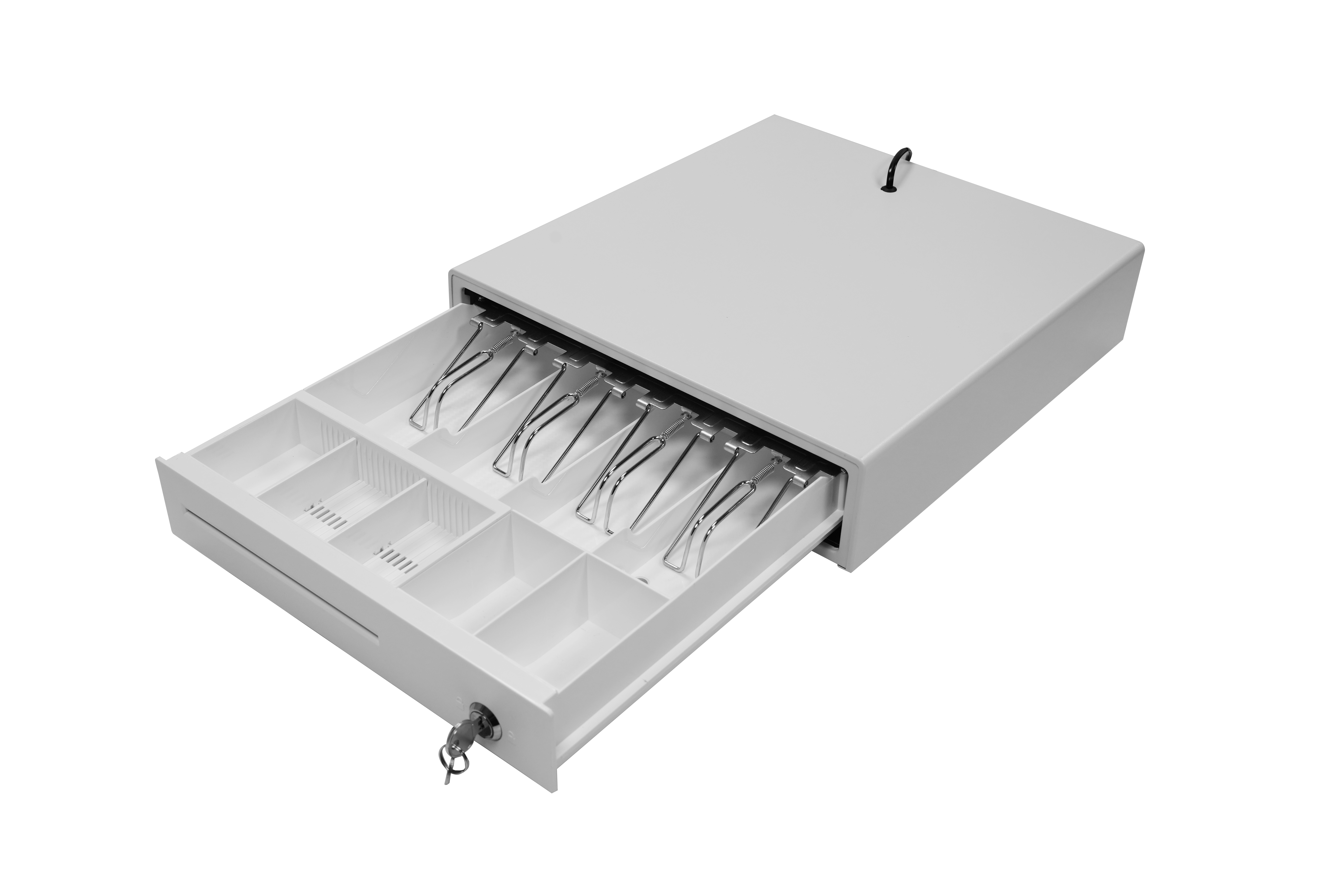
A cash drawer’s core components are the lock, the release mechanism, the interface, and the internal layout. The three-position key lock allows the drawer to be locked at all times, unlocked for manual access, or set to automatic electronic release. The interface, typically RJ11/RJ12, carries a signal from a receipt printer or POS terminal to trigger the solenoid that pops the drawer open. Most LASPACK models support 12V or 24V systems, which matches the majority of POS printer models in the market.
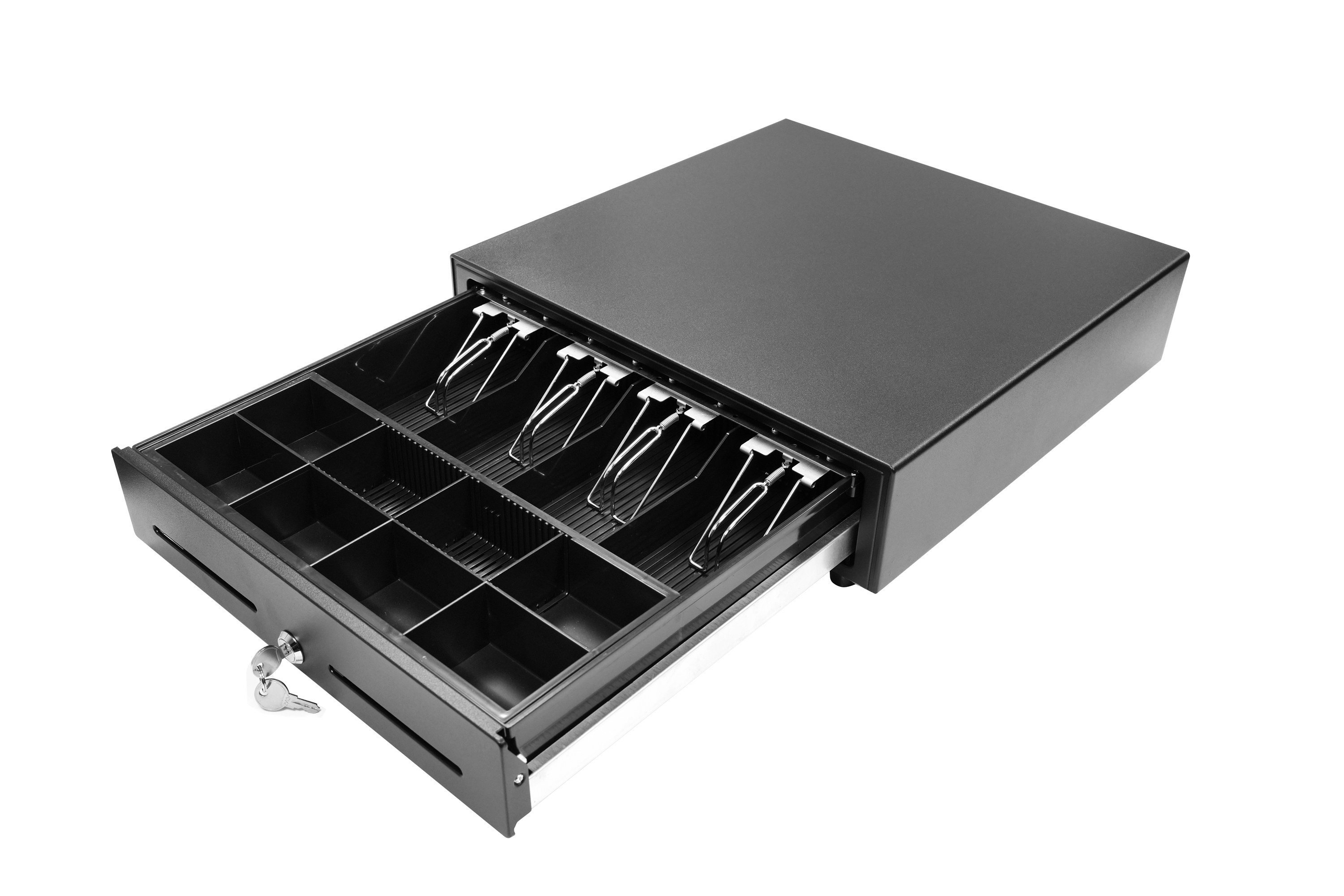
Internal layout matters for usability. Standard layouts include separate compartments for bills and coins. For example, the LAS-410A and LAS-410G offer 5 bill compartments and 8 coin compartments, while the LAS-405 has 5 bill and 6 coin compartments. Smaller models like the LAS-335 have 4 bill compartments and 3 or 5 coin compartments. The LAS-4042 provides an adjustable coin and bill compartment, which helps adapt to different currency mixes. All models are designed for commercial indoor use and are suitable for retail, restaurant, supermarket, hospitality, and POS & retail technology environments.
Application Scenarios and Integration
The application scenario for LASPACK cash drawers is typically a POS system project. The drawer operates alongside a cash register, POS terminal, and receipt printer, and is designed to be compatible with all major POS software. It functions for cash storage and management, operating in either manual or automatic mode, depending on the system configuration. A key requirement in these deployments is compatibility with the existing POS software and hardware ecosystem.
These drawers are deployed across a wide geography. LASPACK exports to more than 100 countries and regions, including Southeast Asia, Central Asia, the Middle East, South America, Africa, and Europe. Common deployment settings include single-lane retail counters, supermarket checkout rows, restaurant front counters, hospitality front desks, and other commercial indoor environments. The common thread is the need for a secure, durable, and POS-compatible cash storage unit.
Market Trends and Data
Industry data points to a few clear trends. Market research from Dataintelo and Market Intelo values the global cash drawer market at USD 0.855–0.96 billion in 2024–2025, with a CAGR of 4.1–4.2% expected through 2033–2034. Asia Pacific is the leading regional market at 38.2% revenue share in 2025, reflecting the region’s density of retail and hospitality outlets.
In terms of product form, electronic cash drawers dominate at 62.5% of revenue. This aligns with the direction of POS system integration, where automatic opening from a printer or terminal is considered a baseline feature. The market also follows standardized durability classes. Industry standards differentiate between Standard Duty drawers rated for 1 million cycles and Heavy Duty drawers rated for more than 4 million cycles, although the exact thresholds can vary by brand. LASPACK’s drawers are certified for 1,000,000 cycles, with CE (M2506016AY-C0127), RoHS (M2506016AY-C0128), and FCC certifications, according to the company’s compliance guide.
For buyers, the 410mm width has become a common standard, designed to fit under standard thermal printers. LASPACK’s heavy-duty models LAS-410A and LAS-410G use this width, while the compact LAS-335 offers a smaller footprint for constrained counters.
Comparison with Traditional Solutions
The traditional alternative to an electronic cash drawer is a simple lockable cash box or a manual cash drawer that requires a key to open. A cash box is often used in mobile settings or as a temporary till. It is lightweight and low-cost, but it lacks POS integration, meaning the cashier must manually open and close the box, which adds time to each transaction and provides limited auditability. A security safe is another traditional option, but it is typically larger, fixed, and not designed for fast, repeated POS transactions.
An electronic cash drawer, in contrast, opens automatically when the POS or printer sends the signal. This reduces transaction time and helps prevent keys from being left in the lock. However, it introduces a dependency on the POS system and printer. If the trigger signal fails, the drawer can still be manually unlocked with the key, but the automatic functionality is impaired. This is a key limitation of all electronic cash drawers, including those from LASPACK. Buyers must ensure their POS system sends the correct voltage signal and that the drawer’s interface matches the printer—typically RJ11/RJ12 at 12V or 24V.
Additionally, cash boxes typically lack the organized layout and rugged construction needed for high-volume checkout lines. They can be a reasonable secondary storage solution, but for primary checkout counters, a POS-integrated drawer is generally the expected choice.
Future Outlook
The cash drawer market is not disappearing. Even with the continued growth of card and mobile payments, cash transactions remain common in many parts of the world, particularly across Asia, Latin America, the Middle East, and Africa. This keeps demand stable for durable, secure, and integrated cash handling equipment.
Over the next few years, we can expect further emphasis on heavy-duty construction, broader compatibility with different POS software, and possibly more flexible compartment layouts to handle varied currency systems. The standard width will likely remain the 410mm form factor for mainstream models, with compact versions serving niche spaces. For hardware vendors, certifications such as CE, RoHS, and FCC will remain entry points for global distribution, along with cycle-test durability evidence.
Reference Table: LASPACK Cash Drawer Models
| Model | Type | Width | Weight (N.W.) | Bill/Coin Layout | Interface |
|---|---|---|---|---|---|
| LAS-4042 | Durable, adjustable compartment | 405 mm | 4.5 kg | 6 bills / 4 coins | 12V, 24V RJ11/RJ12 |
| LAS-410A | Heavy Duty | 410 mm | 6.5 kg | 5 bills / 8 coins | 12V, 24V RJ11/RJ12 |
| LAS-410G | Heavy Duty | 410 mm | 5.6 kg | 5 bills / 8 coins | 12V, 24V RJ11/RJ12 |
| LAS-405 | Heavy Duty | 405 mm | 4.5 kg | 5 bills / 6 coins | 12V, 24V RJ11/RJ12 |
| LAS-335 | Compact / Metal | 335 mm | 3.4 kg | 4 bills / 3 or 5 coins | 12V, 24V RJ11/RJ12 |
Frequently Asked Questions
What is a cash drawer in a POS system?
A cash drawer is a lockable storage compartment that holds banknotes and coins at the point of sale. It connects to a POS terminal or receipt printer and opens automatically when a transaction is completed, supporting cash storage and management.
What is the difference between a manual and an electronic cash drawer?
A manual cash drawer opens with a key. An electronic cash drawer opens through a trigger signal from a receipt printer or POS terminal, using a solenoid, while also retaining a key lock for manual opening.
What materials are cash drawers made of?
Most cash drawers are made of a combination of metal and plastic. Heavy-duty models often feature a steel panel for extra durability. For example, the LASPACK LAS-410A and LAS-410G are heavy-duty metal and plastic drawers with steel panels.
What standards should a cash drawer meet for commercial use?
Common certifications for cash drawers include CE, RoHS, and FCC. In addition, many buyers request endurance testing, such as 1,000,000-cycle durability certification, to confirm the drawer can withstand high-volume use.
What is the standard width of a cash drawer?
The typical physical width for an industry-standard cash drawer is 410mm (about 16 inches), which is designed to fit under standard thermal receipt printers. Smaller models, like the LASPACK LAS-335 with a 335mm width, are available for space-constrained areas.
For a more detailed overview of LASPACK’s cash drawer manufacturing capabilities, the company’s brochure is available as a PDF: Download the LASPACK brochure (PDF).
Have Questions or Need More Details?
Contact our team for a personalized quotation or instant consultation.
Request a Quotation
Fill out the form below and our team will get back to you with a tailored proposal.
WhatsApp Direct Chat
Prefer to chat in real-time? Message us on WhatsApp for instant assistance & quick answers.
- Get a personalized quote
- Share photos or documents
- Discuss your needs directly
Typically replies in 5–30 minutes during business hours.