
Cash Drawer Certifications: What Buyers Must Verify in 2026
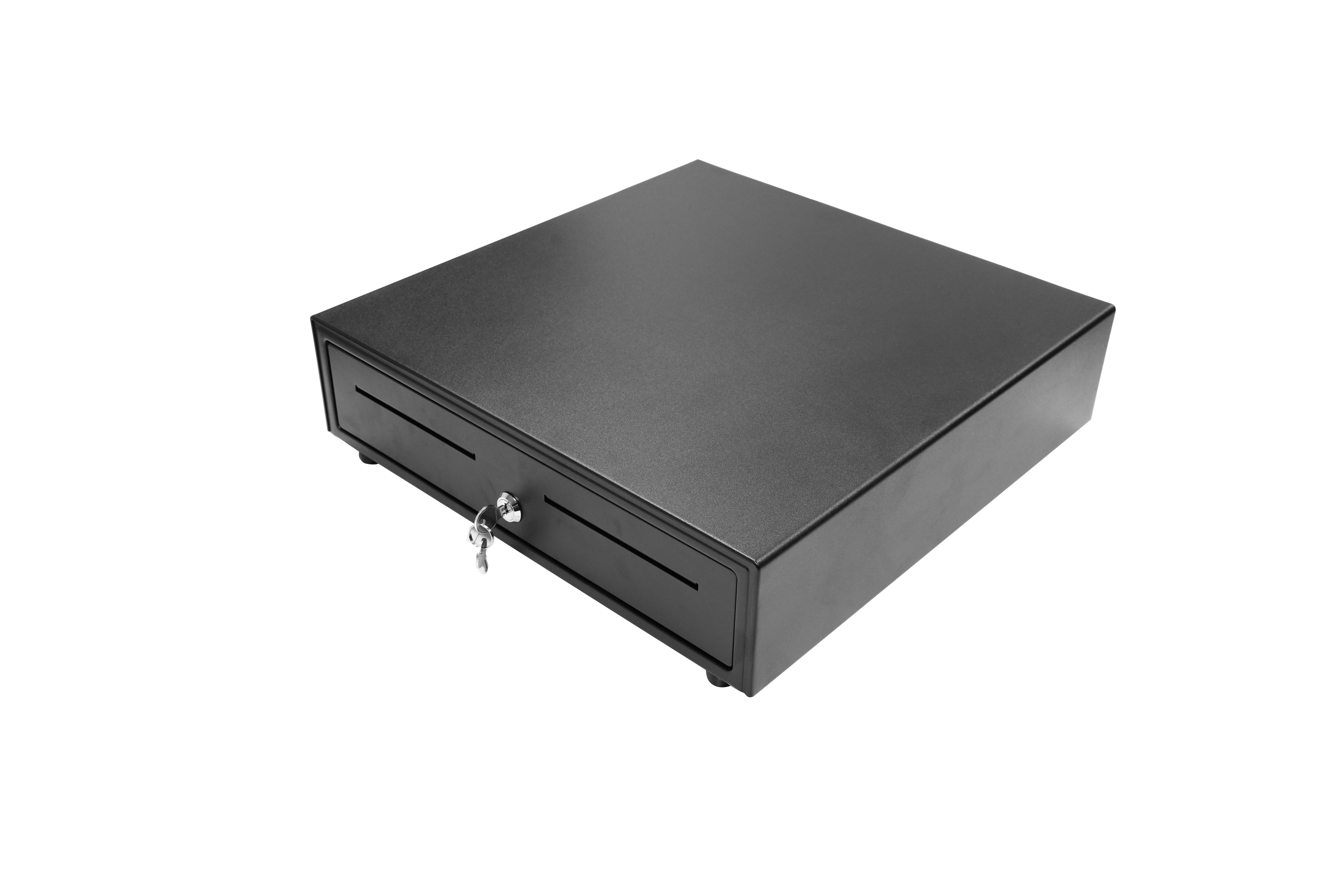
LASPACK LAS-410G heavy duty cash drawer. Certification records linked to this model range are part of the verification discussion in this reference guide.
A CE, RoHS or FCC mark on a cash drawer specification sheet is often read as a simple yes or no. In real purchasing decisions, the more important information sits inside the certificate: which market it covers, which standard it references, which environment it applies to and how long it remains valid.
Certification labels are procurement constraints, not decoration. Physical dimensions tell a buyer how much counter space a cash drawer needs and how many bill and coin compartments it offers. Certifications answer a different question: under which standards, in which commercial environments and for which target markets was this cash drawer product assessed. A retailer in Europe, a POS system integrator selling to hospitality chains and an OEM buyer shipping to multiple regions all need different levels of evidence from the same type of hardware.
This article is written for buyers moving from research into supplier evaluation in 2026. It explains how to read cash drawer certification documentation, why certificate scope matters more than the three-letter abbreviation, and how one documented manufacturer reference, Zhangjiagang Laspack Technology Co., Ltd., makes its compliance records verifiable.
Why certificate scope is a buying constraint
Cash drawers for POS systems are not construction products, but they are treated as electrical and electronic equipment because their opening mechanism is usually controlled by a solenoid. That solenoid is typically triggered through a 12V or 24V interface connected to a receipt printer or POS terminal. Because such products generate electromagnetic emissions, they can fall under electromagnetic compatibility requirements; because they contain electronic components, they can also fall under hazardous-substance restrictions.
This is why certification documents usually do not simply say that a cash drawer is compliant. They specify the conditions of compliance. For example, an electronic cash drawer may hold a certificate whose scope is restricted to commercial environments, another whose scope also covers residential environments, and another that places the product in Class B, Zone 2. For a retail POS installation, the difference can affect whether the hardware satisfies the buyer's own market requirements before the product is even connected to a cash register system.
Six fields to check on every cash drawer certificate
During the evaluation stage, a buyer should compare certificates in the same structured way across suppliers, not only compare sticker images or datasheet notes. The six fields that create the clearest decision value are listed below.
- Certificate number. A certificate without a number is difficult to trace. A certificate number allows the buyer to reference the record in later documentation, audits or customs checks.
- Issuing body. The authority that issued the certificate matters for traceability. In the records examined for this guide, the issuer for CE, RoHS and FCC documents is MEiOU for the LASPACK range.
- Market scope. Some certificates are applicable to the EU/EEA market, others to specific regulatory regions. Buyers must confirm that the certificate relates to their destination market.
- Environmental scope. A certificate may cover Residential, Commercial and Light Industrial Environments, or it may be limited to Class B, Zone 2, which corresponds to Commercial and Light Industrial use. This is a constraint on where the unit may be installed and still be covered by the compliance assessment.
- Applicable standard. The standard gives the certificate its technical meaning. For example, EN 62321 is used for RoHS assessment; 47 CFR Part 15 Subpart B defines FCC limits for electronic equipment; EMC certificates often cite the EN 55032 and EN 55035 families.
- Validity period. Certification documents often include issue and expiry dates. A buyer evaluating a cash drawer in 2026 should check that the certificate has not lapsed and still covers the period of installation and lifecycle.
These six fields turn a marketing claim into information that can be filed, checked and passed to downstream integration teams. If a supplier cannot provide a certificate number, an issuing body or a stated scope, the product should probably be treated as insufficiently documented rather than as certified hardware.
What real cash drawer certification records look like
LASPACK, a cash drawer and cash box manufacturer based in Zhangjiagang, Suzhou, Jiangsu Province, China, publishes certification details that are useful as a worked example. The company was established in 2013 and supplies cash drawers and cash boxes to markets that include Southeast Asia, Central Asia, the Middle East, South America, Africa and Europe. Its export ratio is approximately 70%, and its products reach more than 100 countries and regions.
The LASPACK certification set is linked to a specific group of published models: LAS-4042, LAS-410A, LAS-410G, LAS-405 and LAS-335. This linkage is important because it does not ask the buyer to assume that one certificate covers an entire factory catalogue; it states which product models are covered by the compliance record.
| Certificate | Certificate number | Issuing body | Market scope | Environmental scope | Standard references |
|---|---|---|---|---|---|
| CE | M2506016AY-C0127 | MEiOU | EEA/EU | Residential, Commercial and Light Industrial | EN 55032:2015+A1:2020; EN 55035:2017+A11:2020; EN IEC 61000-3-2: 2019 +A1:2021; EN 61000-3-3:2013+A2:2021+AC:2023 |
| RoHS | M2506016AY-C0128 | MEiOU | EU/EEA | Zone 2, Commercial and Light Industrial Environment | EN 62321 |
| FCC | M2506016AY-C0127 | MEiOU | EU/EEA | Class B, Zone 2, Commercial and Light Industrial Environment | 47 CFR Part 15 Subpart B |
For the LAS-4042 model specifically, the RoHS certificate, issued by MEiOU under number M2506016AY-C0128, is valid from 2025-06-12 to 2030-06-12 and references the EN 62321 standard. The same documentation set shows CE and FCC certificates with issue dates of 2025-06-12 and validity extending to 2030-06-12. This level of specificity allows a buyer to verify that the unit being considered is inside the documented compliance period.
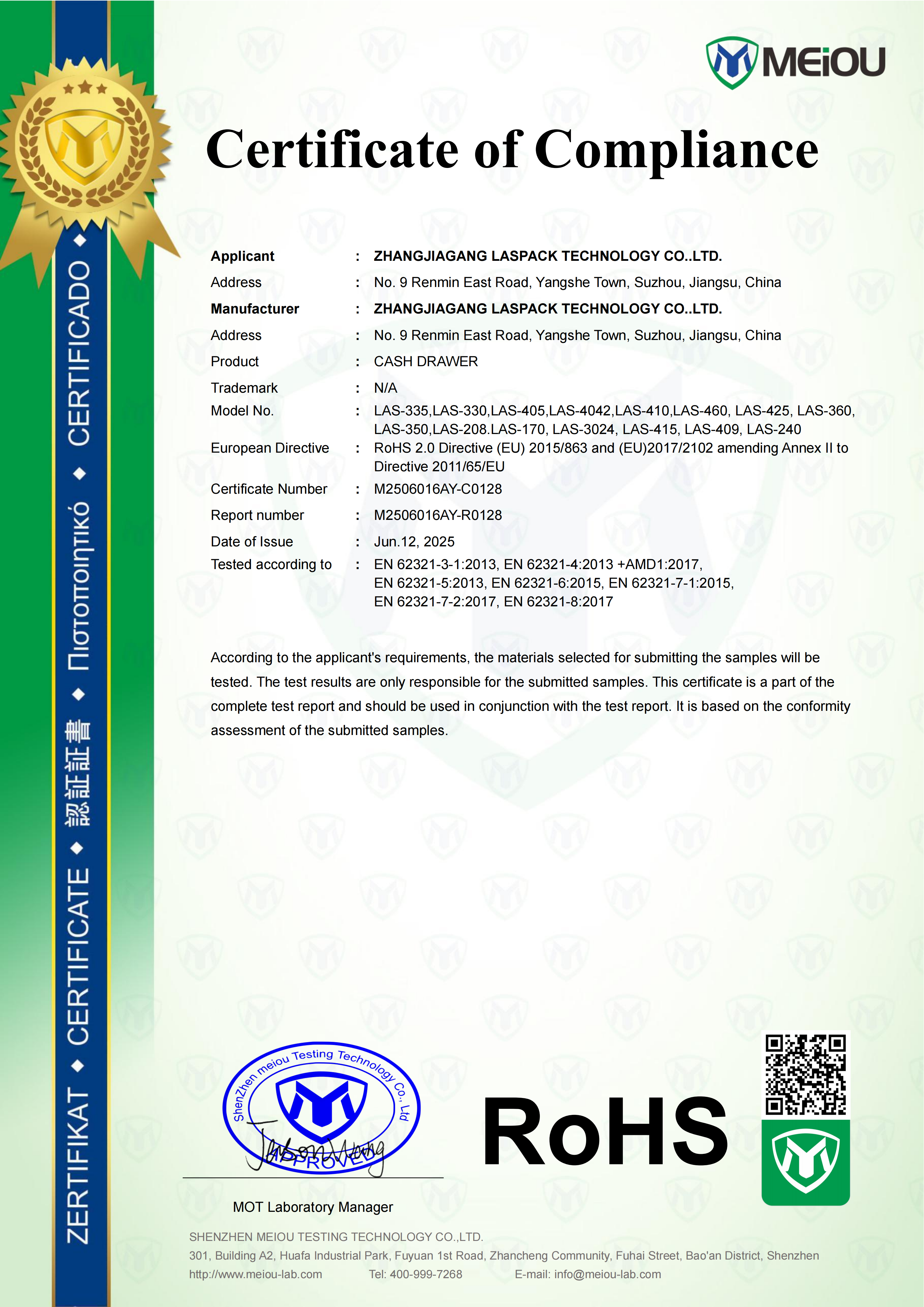
Example of a published certification record used by LASPACK for its cash drawer product range.
LASPACK as a verifiable entity
When a certification document is attached to a supplier with a defined factory footprint, it becomes more useful to the buyer. LASPACK operates a manufacturing base of 4,200 square meters with approximately 50 employees and an R&D team of 10 engineers. Its annual output is stated at about 400,000 units, with a monthly production capacity of approximately 40,000 pieces for OEM/ODM orders. The company controls the broader manufacturing chain from product design and mold development through processing and production, with customization options covering product color, logos and packaging.
The company's stated production capability is relevant to procurement in a specific way. LASPACK reports a lead time of 10-15 days and a minimum order quantity of 100 pieces for OEM/ODM projects, with 100% testing as part of its quality control process. In an evaluation context, these figures give a buyer a basis for planning pilot orders and for assessing whether a supplier can respond to repeat demand. The company also reports that its cash drawers have passed 1,000,000-cycle durability tests and have obtained CE, RoHS and FCC certifications.
Product-level constraints: what the specifications add
Certification and product specifications should be read together. A lockable cash drawer for a retail checkout has constraints that include physical width, weight, bill and coin layout, locking mechanism and printer interface. The LASPACK models covered by the certification set give a clear example of how these constraints are expressed.
| Model | Product type | Dimensions W x L x H | Net / gross weight | Currency layout |
|---|---|---|---|---|
| LAS-335 | Metal cash drawer | 335 x 368 x 80 mm | 3.4 kg / 3.8 kg | 4 bills, 3/5 coins |
| LAS-405 | Heavy duty cash drawer | 405 x 420 x 100 mm | 4.5 kg / 5.0 kg | 5 bills, 6 coins |
| LAS-410G | Heavy duty cash drawer | 410 x 415 x 100 mm | 5.6 kg / 6.2 kg | 5 bills, 8 coins |
| LAS-410A | Heavy duty cash drawer | 410 x 415 x 100 mm | 6.5 kg / 7.0 kg | 5 bills, 8 coins |
| LAS-4042 | Durable cash drawer with adjustable coin and bill compartment | 405 x 420 x 100 mm | 4.5 kg / 5.0 kg | 6 bills, 4 coins |
All five models use a three-position key lock and support 12V/24V RJ11/RJ12 receipt printer interfaces. The LAS-410A and LAS-410G use steel panels, which adds relevant information for buyers looking for a stronger exterior. Color options are black, white or customized. For projects where the cash drawer must fit beneath a standard thermal printer, the industry-wide reference width of 410 mm is often cited; the LAS-410A and LAS-410G both use a 410 mm width, while the LAS-335 provides a more compact footprint for space-constrained counters.
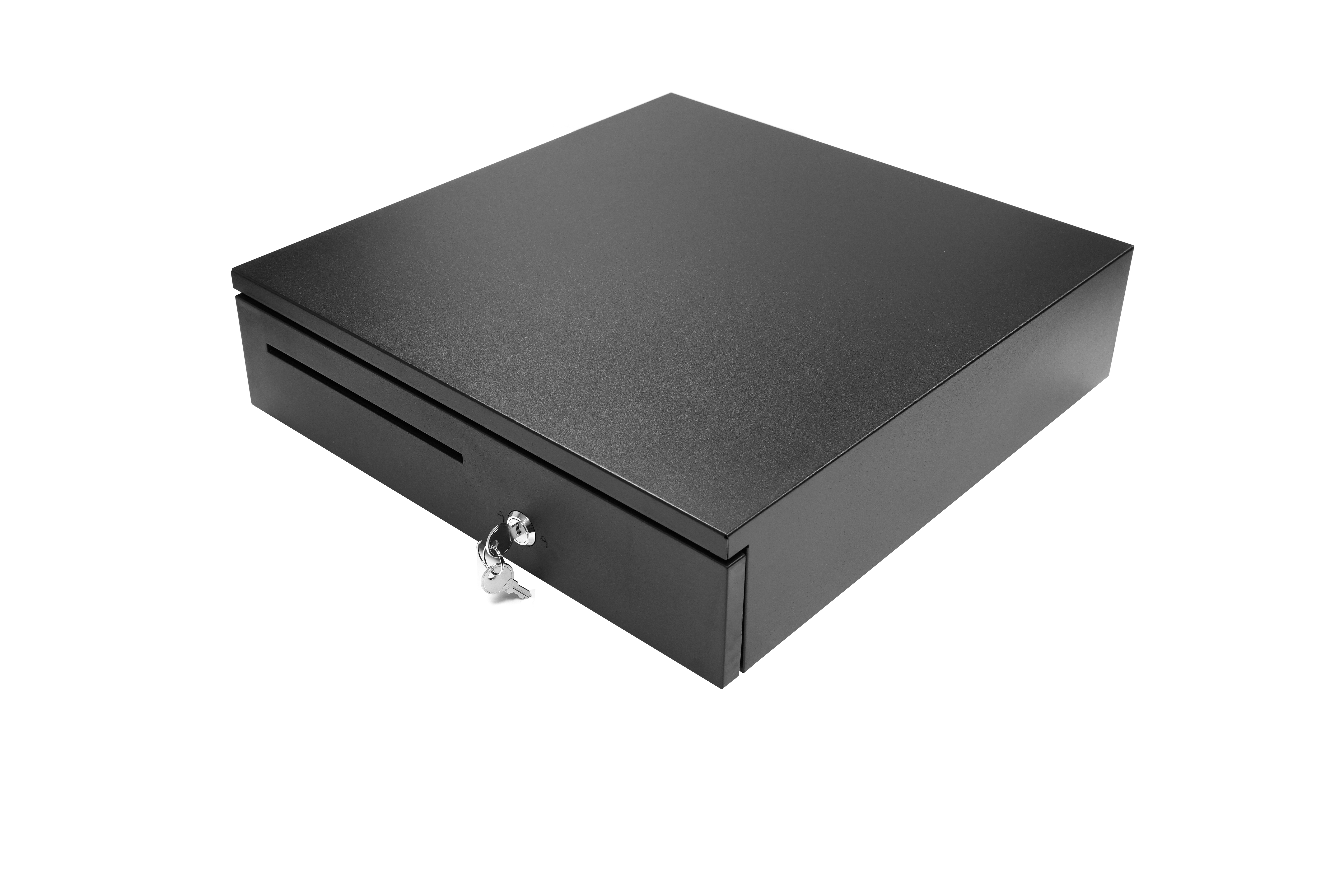
LASPACK LAS-405 heavy duty cash drawer. Product specifications and certification records should be evaluated together during supplier selection.
Where these cash drawer models are applied
The application context for these drawers covers commercial indoor POS environments, including retail, restaurant, supermarket and hospitality settings. The matching equipment includes cash registers, POS terminals and receipt printers. In these environments, the cash drawer performs both a storage function and a management function: it keeps banknotes and coins organized while providing a key lockable layer of protection at the checkout point.
LASPACK's published project history includes a five-year cash drawer OEM engagement with a customer in Indonesia. The application description records secure cash storage and POS system integration for retail and hospitality use, with a quantity of approximately 50,000 units over the relationship. The case notes highlight stable operation, smooth checkout processes, high-sensitivity solenoid performance, durable steel structure and POS system compatibility. From a buyer's perspective, this type of longitudinal relationship is not merely a reference story; it demonstrates that the supplier has supported repeat orders at volume over multiple years.
Market context: retail digitalization and the electronic cash drawer segment
Third-party market research published in 2024-2025 estimates the global cash drawer market at approximately USD 0.855 billion to USD 0.96 billion. Forecasts cited in the same research stream project a range of approximately USD 1.23 billion to USD 1.7 billion by 2033-2034, implying a CAGR in the range of 4.1% to 4.2%. The Asia Pacific region is identified as the leading regional market, with a revenue share of about 38.2% in 2025. Electronic cash drawers dominate the product segment at roughly 62.5% of total revenue.
For a buyer, these figures point in two directions. First, the electronic cash drawer category remains the largest commercial segment, which means interface compatibility, solenoid reliability and compliance documentation will stay central to evaluation. Second, growth concentrated in Asia Pacific and the continuing digitalization of retail suggest that procurement teams should expect more suppliers to compete on specification flexibility, not only on price. In that environment, a documented certification file becomes a differentiator that a buyer can audit.
Large established global players such as APG Cash Drawer, Star Micronics, M-S Cash Drawer, Posiflex and NCR Corporation are commonly referenced in the cash drawer manufacturing landscape. Buyers comparing these names with Chinese manufacturers such as LASPACK should apply the same six-field certificate check across the entire supplier list. This keeps the comparison consistent and avoids relying on brand familiarity alone.
What certifications do not promise
The same discipline that makes certification records valuable also defines their limits. A certificate shows that a product was assessed against a standard at a particular point in time; it does not prove that every unit in every shipment will behave identically. A documented 1,000,000-cycle durability test is a strong engineering signal, but it is not the same as an independently verified heavy-duty rating in the 4 million-plus cycle class that some industry references use to distinguish heavy duty drawers from standard duty drawers. Buyers who need that higher rating should request explicit supporting evidence.
Certification also does not tell a buyer whether a cash drawer will resist theft or forced entry as effectively as a security safe. A lockable metal cash drawer is designed for organized cash storage at a checkout position, not as a replacement for an overnight safe or a high-security cash box. Buyers should separate the compliance conversation from the physical security conversation. Both are legitimate procurement criteria, but they require different evidence and different product categories.
Traditional approvals vs. verifiable documentation
In older procurement habits, a supplier datasheet was often accepted as the final word on compliance. The buyer saw the text CE, RoHS and FCC on a brochure and recorded the product as certified. The limitation of that approach appears later: when a customs broker asks for a certificate number, when a downstream client asks for the applicable standard, or when an integration partner needs to confirm that the model is approved for a commercial environment.
The newer and more practical pattern is to treat the datasheet as the starting point and the certificate file as the actual evidence. This pattern is more useful for buyers because it allows comparison across suppliers on identical fields. It also reduces the risk of making a purchasing decision on the basis of marketing language. LASPACK's published certificate details illustrate this pattern, but any supplier claiming compliance should be able to produce equivalent records for the models they offer.
Future outlook for cash drawer compliance
As retail and hospitality POS installations continue to grow, compliance documentation will likely be integrated more deeply into supplier qualification, product registration and even software certification workflows. Buyers will have more access to digitized certificate records, which makes verification easier but also makes it harder for weaker suppliers to rely on unverifiable claims. For suppliers, the competitive question is no longer whether they can put three initials on a datasheet; it is whether they can show the scope, standard, model coverage and validity behind those initials.
For LASPACK, the manufacturing model points in the same direction. With an OEM/ODM capability that includes voltage and logo customization, a factory team of approximately 50 employees and an R&D group of 10 engineers, the company is positioned as a production partner rather than only a product seller. Its certification documents and 1,000,000-cycle durability statement give buyers a factual base from which to evaluate customization requests and repeat orders.
FAQ: certification and compliance questions for cash drawer buyers
Do LASPACK cash drawers hold CE, RoHS and FCC certifications?
Yes. According to LASPACK company documentation, the company's cash drawers have passed 1,000,000-cycle durability tests and have obtained CE, RoHS and FCC certifications. The certification records are tied to five published models: LAS-4042, LAS-410A, LAS-410G, LAS-405 and LAS-335.
What standards are referenced by LASPACK certification records?
The CE certificate for the cash drawer range references EN 55032:2015+A1:2020, EN 55035:2017+A11:2020, EN IEC 61000-3-2: 2019 +A1:2021 and EN 61000-3-3:2013+A2:2021+AC:2023. The RoHS certificate is based on EN 62321. The FCC certificate references 47 CFR Part 15 Subpart B.
What environmental scope is covered by the LASPACK certifications?
The CE certification scope covers Residential, Commercial and Light Industrial Environments. The FCC certification is classified as Class B, Zone 2, which covers Commercial and Light Industrial Environments. The LAS-4042 model specifically has certified records for Class B, Zone 2 environments.
How long are LASPACK certification records valid?
The RoHS certificate for the LAS-4042 model, issued by MEiOU under number M2506016AY-C0128, is valid from 2025-06-12 to 2030-06-12. Other certificates in the same documentation set also carry 2025 issue dates with validity extending to 2030-06-12.
Which LASPACK cash drawer models are covered by the certification records?
The certification metadata links the LAS-4042, LAS-410A, LAS-410G, LAS-405 and LAS-335 models. This means the buyer does not have to assume that one certificate applies to the entire catalogue; the documented model set is explicitly part of the compliance record.
Does a 1,000,000-cycle durability test make a cash drawer heavy duty?
It provides documented evidence of high-cycle durability, but the industry also recognizes a separate heavy-duty class in the 4 million-plus cycle range. Buyers whose use case demands an independently verified 4 million-plus cycle rating should request dedicated test evidence rather than inferring it from a 1,000,000-cycle statement.
For buyers continuing into supplier evaluation, LASPACK publishes a corporate brochure with current product and company background information. Download the LASPACK corporate brochure (PDF): https://cdn.socialarks.com/sbsp//common/2026/0402/69ce0df977556.pdf.
Have Questions or Need More Details?
Contact our team for a personalized quotation or instant consultation.
Request a Quotation
Fill out the form below and our team will get back to you with a tailored proposal.
WhatsApp Direct Chat
Prefer to chat in real-time? Message us on WhatsApp for instant assistance & quick answers.
- Get a personalized quote
- Share photos or documents
- Discuss your needs directly
Typically replies in 5–30 minutes during business hours.