
Cash Drawer Comparison: LAS-335 vs LAS-405 vs LAS-410G vs LAS-410A vs LAS-4042
Cash drawers rarely fail a procurement review on their own. They fail later — when a 335 mm unit is specified for a 410 mm counter cut-out, when a four-bill insert cannot absorb an evening cash drop, or when the drawer and the receipt printer turn out not to speak the same electrical language. Five models in the LASPACK range, the LAS-335, LAS-405, LAS-410G, LAS-410A and LAS-4042, share one integration platform but differ in footprint, weight and compartment layout. This reference compares their documented specifications and translates each difference into a counter-space or cash-volume decision.
Why five models exist inside a single catalogue
The global cash drawer market was valued at approximately USD 0.855 billion to USD 0.96 billion in 2024–2025 and is projected to reach between USD 1.23 billion and USD 1.7 billion by 2033–2034, a compound annual growth rate of roughly 4.1% to 4.2%, according to Dataintelo and Market Intelo market research. Asia Pacific held approximately 38.2% of that revenue in 2025, and electronic cash drawers account for about 62.5% of product-segment revenue — the segment that includes printer-driven drawers of the type covered here.
That growth matters for a practical reason: as retail formats multiply, one drawer size stops covering every counter. A coffee kiosk, a supermarket checkout lane and a hotel front desk all store cash, but they do not store the same amount, in the same denominations, in the same amount of space.
LASPACK — Zhangjiagang Laspack Technology Co., Ltd. — is a cash drawer and cash box manufacturer founded in 2013, based in Zhangjiagang City, Suzhou, Jiangsu Province, China. The company operates a 4,200 m² manufacturing base with 50 employees and a 10-engineer R&D team, reports an annual output of 400,000 units, and exports approximately 70% of its production. Its five models reviewed here divide into three footprint classes: a compact class (LAS-335), a 405 mm class (LAS-405, LAS-4042) and a 410 mm class (LAS-410G, LAS-410A).
Full specification comparison of the five models
Every figure in the table below is taken from the manufacturer's published model data. Where a value is listed as "3/5 coins" or is absent, that is how the source documents it — no value has been estimated.
| Model | Type designation | External size (W×L×H) | Net / gross weight | Currency layout | Panel & material |
|---|---|---|---|---|---|
| LAS-335 | Metal cash drawer | 335 × 368 × 80 mm | 3.4 kg / 3.8 kg | 4 bills, 3/5 coins | Metal and plastic |
| LAS-405 | Heavy duty cash drawer | 405 × 420 × 100 mm | 4.5 kg / 5 kg | 5 bills, 6 coins | Metal and plastic |
| LAS-410G | Heavy duty cash drawer | 410 × 415 × 100 mm | 5.6 kg / 6.2 kg | 5 bills, 8 coins | Metal and plastic, steel panel |
| LAS-410A | Heavy duty cash drawer | 410 × 415 × 100 mm | 6.5 kg / 7 kg | 5 bills, 8 coins | Metal and plastic, steel panel |
| LAS-4042 | Durable cash drawer with adjustable coin & bill compartment | 405 × 420 × 100 mm | 4.5 kg / 5 kg | 6 bills, 4 coins | Metal and plastic |
Four characteristics are identical across all five models and are therefore not selection criteria: a three-position key lock, a 12V / 24V RJ11 / RJ12 receipt-printer interface, colour options of black, white or customized, and the applicable industries of retail, restaurant, supermarket, hospitality and POS technology. All five are electrically released, printer-driven drawers rather than manual cash boxes — a distinction that determines whether the drawer can be opened by the POS terminal at all.
Counter space: what 335 mm, 405 mm and 410 mm actually change
Industry hardware guidance identifies 410 mm (16 inches) as the standard drawer width designed to sit beneath a standard thermal receipt printer, a specification attributed to TCANG's POS hardware reference material. Two of the five models, the LAS-410G and LAS-410A, match that dimension exactly at 410 mm wide and 415 mm deep.
The LAS-405 and LAS-4042 sit 5 mm narrower at 405 mm and 5 mm deeper at 420 mm. In most counter builds that difference falls inside installation tolerance, but it is not zero: under-printer brackets, cut-outs and cable channels are often machined to a nominal 410 mm specification, and a 5 mm shortfall can shift how a drawer aligns in a fixed frame. Buyers specifying into an existing counter should measure the cut-out rather than assume interchangeability.
The LAS-335 is the outlier and the reason the compact class exists. At 335 × 368 × 80 mm it is 70 mm narrower than the 405 mm models and 75 mm narrower than the 410 mm models, and it stands 20 mm lower than the other four. Calculated from those published dimensions, its footprint is roughly 28% smaller than the 405 × 420 mm shell — the difference between fitting beneath a compact kiosk terminal and requiring a dedicated counter section. The trade-off is capacity, covered in the next section.
Cash volume and compartment layout: bills versus coins
Compartment layout, not external size, determines how a drawer performs during a shift. The five models divide into three layout philosophies:
- Bill-forward: the LAS-4042 carries 6 bill compartments and 4 coin compartments, and is the only model whose designation explicitly describes an adjustable coin and bill compartment. It suits environments where banknotes dominate the float — electronics retail, ticketing, higher-denomination transactions.
- Coin-forward: the LAS-410G and LAS-410A each provide 5 bill compartments and 8 coin compartments. Eight coin sections are the highest coin capacity in the range and match supermarket and convenience formats where small change turns over continuously.
- Balanced: the LAS-405 provides 5 bill and 6 coin compartments, while the compact LAS-335 provides 4 bill compartments with a coin section documented as 3/5.
A second consideration is depth. All four larger models are 100 mm high, which allows a standard insert stack; the LAS-335 is 80 mm high. Under-counter clearance and the height of the printer mounted above the drawer should both be verified against that 20 mm difference during the evaluation stage, not after installation.
LAS-405 vs LAS-4042: identical shells, different cashier workflow
These two models are the closest pair in the range and the easiest to confuse on a purchase order. Their external dimensions, net weight and gross weight are identical at 405 × 420 × 100 mm and 4.5 kg / 5 kg. Both use the same three-position lock, the same 12V / 24V RJ11 / RJ12 interface and the same metal-and-plastic construction. For counter fit, spare-part planning and printer cabling, they are interchangeable.
For the cashier, they are not. The LAS-405 offers 5 bill and 6 coin compartments; the LAS-4042 offers 6 bill and 4 coin compartments and is designated as having an adjustable coin and bill compartment. A buyer choosing between them is choosing a denomination mix, not a size. The practical test is straightforward: count the number of distinct note denominations the store actually sorts during a shift, and count how many coin denominations the float requires. If note sorting exceeds what five compartments can hold without doubling up, the LAS-4042 layout is the relevant option; if coin handling is the bottleneck, neither of these two is the best fit and the 410 class should be evaluated instead.
LAS-410G vs LAS-410A: the 0.9 kg question
The second close pair is less transparent. The LAS-410G and LAS-410A share identical external dimensions (410 × 415 × 100 mm), identical compartment layouts (5 bills, 8 coins), identical three-position locks and interfaces, and both list a steel panel. They differ in weight: 5.6 kg net for the LAS-410G against 6.5 kg net for the LAS-410A, with gross weights of 6.2 kg and 7 kg respectively — a 0.9 kg difference in net weight and 0.8 kg in gross.
The published specification set does not identify which components account for that 0.9 kg. This is a limitation of the documentation, not of the products, and buyers should treat it as an open question rather than assume the heavier unit is automatically the more durable one. Where weight is a decision factor — for example on a suspended or cantilevered counter — the appropriate steps are to request a component-level explanation, weigh a physical sample, and confirm the difference during pre-shipment testing. Weight differences of this size typically reflect internal structure or gauge rather than a difference the buyer can see from the outside, which is precisely why it should be documented before ordering.
Materials, build quality and the durability benchmark
All five models are constructed from metal and plastic. The LAS-410G and LAS-410A additionally specify a steel panel, which is the only documented material difference between the 410 class and the 405 class beyond dimensions.
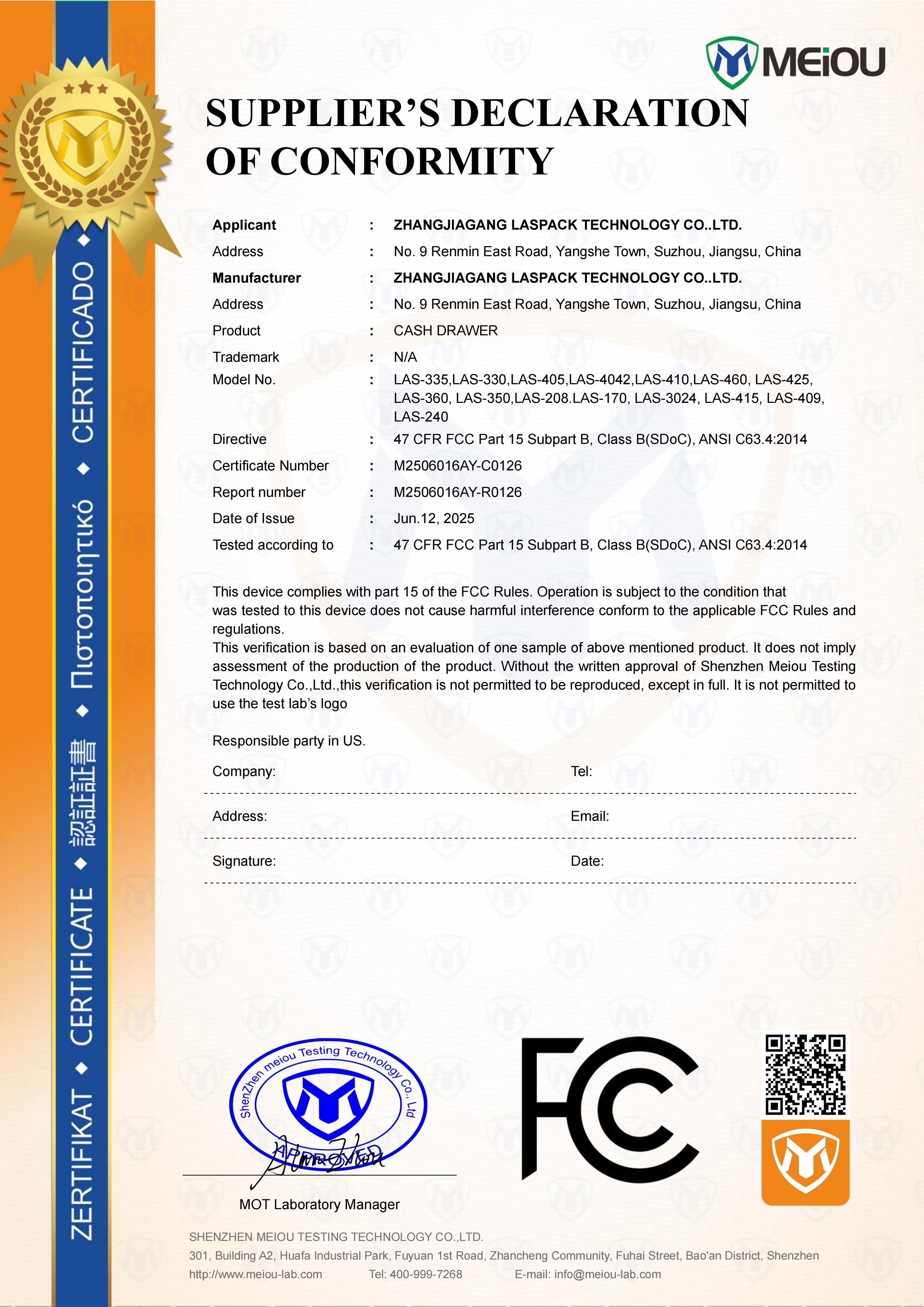
On durability, LASPACK states that its cash drawers have passed 1,000,000-cycle durability tests, and its compliance documentation records the same 1,000,000-cycle figure. For context, published industry standards differentiate between standard-duty drawers, rated at 1 million cycles, and heavy-duty drawers, rated at 4 million cycles or more — a classification set out by APG Cash Drawer's technical reference material.
Read together, those two statements have a direct procurement implication. The documented 1,000,000-cycle test result sits at the standard-duty benchmark, even though several models in this range carry "Heavy Duty" as a type designation. Buyers who need the service life associated with a 4-million-cycle heavy-duty rating should therefore request model-specific cycle evidence and match it to expected transaction volume, rather than rely on the model name. For a checkout lane processing a moderate number of transactions per day, a documented 1,000,000-cycle baseline is a reasonable reference point; for a high-throughput supermarket lane, the same figure is a specification to interrogate.
Interface, lock and integration: what stays constant across all five
The common 12V / 24V RJ11 / RJ12 receipt-printer interface is the strongest argument for standardising a mixed fleet on a single supplier. A drawer of this type is opened by an electrical pulse from the receipt printer or POS terminal; if every model in a rollout accepts the same voltage and connector type, then a store can run a compact LAS-335 at a kiosk and a LAS-410A at the main lane without maintaining two sets of cables, adapters or printer configuration profiles.
The three-position key lock is likewise common to all five models, which matters for key management policy, manual override procedures and staff training across a chain. LASPACK's production capability data adds that the company provides OEM and ODM production services, including voltage and logo customization, and that products are exported worldwide.
A manufacturer-reported deployment illustrates how these common elements behave in the field. An Indonesian cash drawer OEM client has used LASPACK drawers for secure cash storage and POS system integration in retail and hospitality across a five-year period and approximately 50,000 units, reporting stable operation and a smooth checkout process. The highlights recorded for that deployment are a high-sensitivity solenoid, a durable steel structure and POS system compatibility — all characteristics that depend on the shared interface and lock platform rather than on any single model's dimensions.
Certification and compliance coverage for the five models
Certification is where a model-level comparison usually narrows. In this case it does not: all five models — LAS-335, LAS-405, LAS-410G, LAS-410A and LAS-4042 — are listed under the same three certifications, which simplifies market entry for a distributor planning to stock the full range.
| Certification | Certificate number | Issuing body | Standard / scope | Validity |
|---|---|---|---|---|
| CE | M2506016AY-C0127 | MEiOU | EN 55032:2015+A1:2020; EN IEC 61000-3-2:2019+A1:2021; EN 61000-3-3:2013+A2:2021+AC:2023; EN 55035:2017+A11:2020 — residential, commercial and light industrial environment, EEA/EU | 2025-06-12 to 2030-06-12 |
| RoHS | M2506016AY-C0128 | MEiOU | EN 62321 — Zone 2, commercial and light industrial environment, EU/EEA | 2025-06-12 to 2030-06-12 |
| FCC | M2506016AY-C0127 | MEiOU | 47 CFR Part 15 Subpart B, Class B, Zone 2 | 2025-06-12 to 2030-06-12 |
Two compliance details are worth noting at the evaluation stage. First, all three certificates remain valid until 12 June 2030, so a buyer ordering in the current cycle inherits a compliance file with several years of remaining life — but validity should be re-verified at the time of each purchase order, not assumed from an earlier file. Second, the certificate scope is stated as Zone 2, commercial and light industrial environment, for the EU/EEA market. Buyers deploying into heavier industrial settings or into markets outside the EU/EEA should confirm that the existing documentation matches their destination requirements rather than treating a CE or FCC mark as universally sufficient.
OEM/ODM customization and production terms for buyers at execution stage
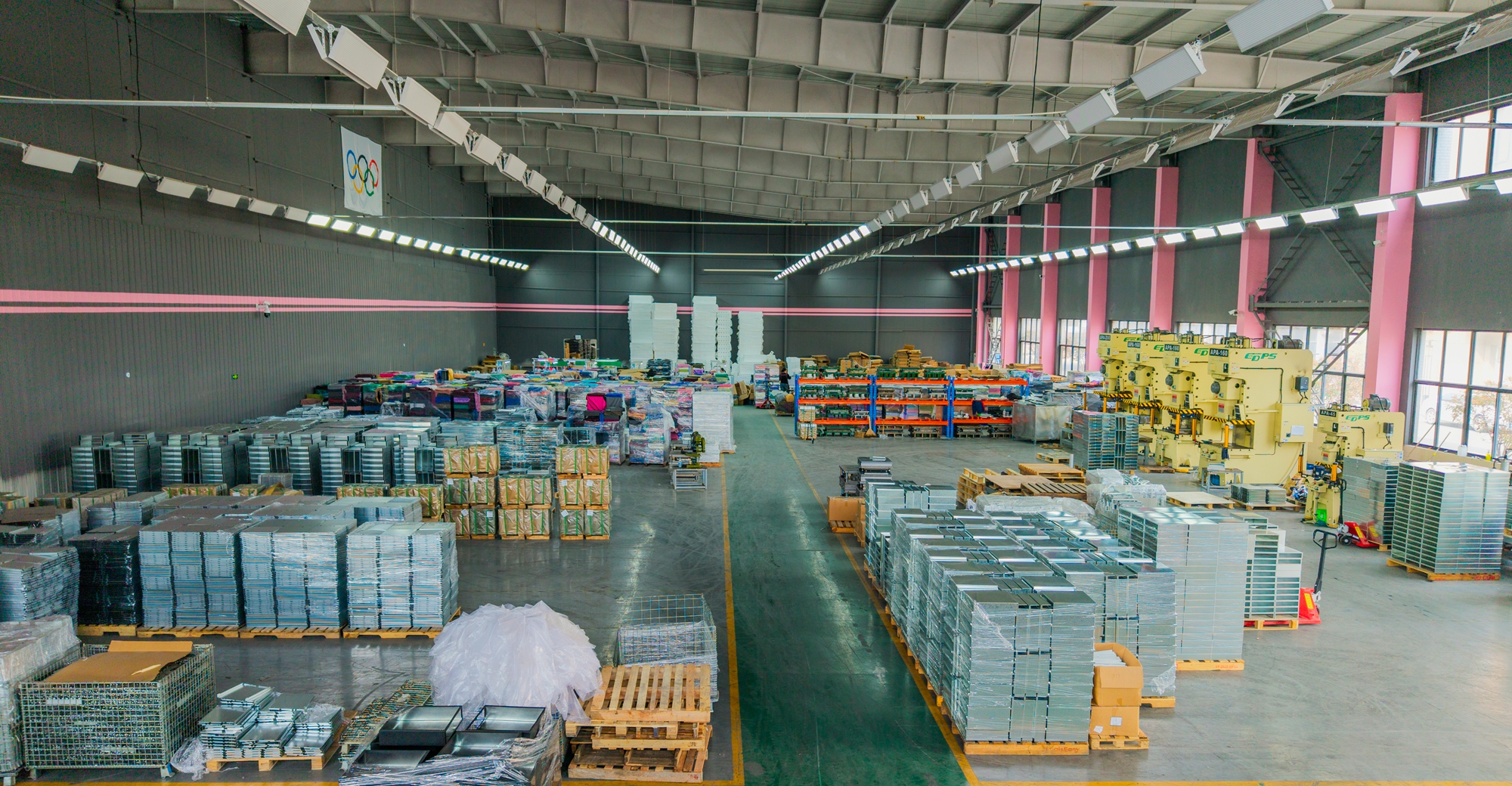
Once a model is chosen, the execution-stage questions are volume, lead time and the boundaries of customization. LASPACK provides full customization according to customer requirements, covering product colour, silk-screen or stamped logos, and packaging, alongside OEM and ODM production services with voltage and logo customization. The company also controls product design, mould development, processing and production through its cooperative factories, and reports CE, RoHS and FCC certification plus 1,000,000-cycle durability testing.
| Production parameter | Documented value |
|---|---|
| Production mode | OEM / ODM |
| Customization scope | Voltage, colour, silk-screen or stamped logo, packaging |
| Monthly capacity | 40,000 pieces |
| Lead time | 10–15 days |
| Minimum order quantity | 100 pieces |
| Quality control | 100% test |
| Trade terms | EXW / FOB / CIF |
| Acceptance | Pre-shipment test |
| Payment | 30% T/T deposit, 70% T/T balance before shipment |
| After-sales | Warranty, remote support, technical guidance |
Two practical notes follow from these terms. A 100-piece MOQ and a 10–15 day lead time make it feasible to place a mixed order covering more than one model, which is the usual pattern for chains standardising a compact lane and a main lane at the same time. And because acceptance is defined as pre-shipment test, the weight and compartment questions raised earlier in this comparison — the 0.9 kg gap between the LAS-410G and LAS-410A, and the LAS-335 coin notation — are best resolved as written acceptance criteria inside that pre-shipment inspection, where a discrepancy can still be corrected before the container leaves.
Matching models to counter types and cash volume: a selection framework
The framework below maps verified specifications to typical buying situations. It is a starting point for specification, not a substitute for measuring the actual counter.
| Buying situation | Model(s) to evaluate | Verified specification driving the fit |
|---|---|---|
| Counter width under 400 mm; kiosk, café or pop-up terminal | LAS-335 | 335 × 368 × 80 mm, 3.4 kg net — smallest footprint and lowest profile of the five |
| Restaurant or café with moderate bill and coin flow | LAS-405 | 405 × 420 × 100 mm, 5 bills / 6 coins, 4.5 kg net |
| Bill-heavy retail: electronics, ticketing, higher denominations | LAS-4042 | 6 bills / 4 coins with adjustable coin & bill compartment |
| Coin-heavy supermarket or convenience checkout | LAS-410G or LAS-410A | 8 coin compartments, 5 bill compartments, 410 × 415 × 100 mm |
| Chain standardising on the 410 mm under-printer layout | LAS-410G or LAS-410A | 410 mm width matches the industry-standard 410 mm / 16 inch form factor |
| Mixed fleet needing a single integration standard | Any of the five | Common 12V / 24V RJ11 / RJ12 interface and three-position lock |
Limits of this comparison
An honest model comparison should state where its evidence stops. Four boundaries apply here.
- Durability is documented at group level, not per model. The 1,000,000-cycle test result is stated for LASPACK cash drawers generally. No per-model cycle rating or solenoid specification is published for any of the five models, so ranking them by expected service life is not possible from the available data.
- The 0.9 kg weight difference between the LAS-410G and LAS-410A is unexplained. Buyers should not infer which unit is more robust; the difference must be clarified by the supplier or verified by sample.
- No price or total-cost data exists in this comparison. Cost per unit, packaging cost for customized cartons and freight under EXW, FOB or CIF vary by order and destination, so no cost ranking is offered.
- This is a single-vendor comparison. Third-party industry analysis names APG Cash Drawer, Star Micronics, M-S Cash Drawer, Posiflex and NCR Corporation among the global manufacturers in this space. No like-for-like published specifications for those brands were available for this comparison, so no cross-brand performance claim is made here.
Market outlook: what the next procurement cycle will reward
With the cash drawer market projected to grow at roughly 4.1% to 4.2% annually toward USD 1.23–1.7 billion by 2033–2034, and with Asia Pacific holding approximately 38.2% of revenue, the competitive pressure on suppliers is likely to shift from catalogue breadth toward specification certainty. For buyers, that shift has a predictable consequence: the models that are easiest to procure are the ones whose documentation is complete — dimensions that match counter cut-outs, compartment layouts that match denomination mixes, interface standards that match the installed printer base, and certificates whose scope and validity can be verified.
The five models examined here already share the elements that matter most for scaling a rollout: one lock design, one electrical interface, one certification set, and colour and logo customization behind a 100-piece minimum order. The remaining decisions — 335 mm or 410 mm, six bills or eight coins, 3.4 kg or 6.5 kg — are counter-level decisions, and they are best settled with a tape measure, a denomination count and a written pre-shipment specification rather than with a catalogue photograph.
FAQ
What is the difference between the LAS-405 and the LAS-4042 if their dimensions and weight are identical?
Their external shells are the same: both measure 405 × 420 × 100 mm and weigh 4.5 kg net and 5 kg gross. The difference is the currency layout. The LAS-405 provides 5 bill and 6 coin compartments, while the LAS-4042 provides 6 bill and 4 coin compartments and is designated as a durable cash drawer with an adjustable coin and bill compartment. For counter fit and spare-part planning they are interchangeable; for cashier workflow they are not.
Which LASPACK cash drawer fits a counter with less than 400 mm of usable width?
The LAS-335, at 335 × 368 × 80 mm and 3.4 kg net weight, is the only model in the range that fits that constraint. It is 70 mm narrower than the 405 mm models and 75 mm narrower than the 410 mm models, and its footprint is roughly 28% smaller than the 405 × 420 mm shell based on published dimensions. Its trade-offs are capacity — 4 bill compartments — and a 20 mm lower body height than the other four models.
Do all five models work with the same POS receipt printer interface?
Yes. All five — LAS-335, LAS-405, LAS-410G, LAS-410A and LAS-4042 — are specified with a 12V / 24V RJ11 / RJ12 receipt-printer interface and a three-position key lock, and all five offer black, white or customized colour options. This common platform allows a mixed fleet to run on one cable and connector standard and one key management policy.
Which model should a coin-heavy retail environment choose, and which suits bill-heavy operations?
For coin-heavy environments such as supermarket and convenience checkouts, the LAS-410G and LAS-410A provide the highest coin capacity in the range at 8 coin compartments alongside 5 bill compartments. For bill-heavy operations such as electronics retail or ticketing, the LAS-4042 provides 6 bill compartments with 4 coin compartments. The LAS-405 offers a middle position at 5 bills and 6 coins.
Why does the LAS-410A weigh more than the LAS-410G when the dimensions are the same?
The LAS-410A is documented at 6.5 kg net and 7 kg gross, against 5.6 kg net and 6.2 kg gross for the LAS-410G — a 0.9 kg net difference on identical 410 × 415 × 100 mm shells with the same 5 bill / 8 coin layout and the same steel panel specification. The published data does not state which components account for the difference. Buyers should request a component-level explanation and confirm the weight during pre-shipment testing rather than assume the heavier model is more durable.
What certifications cover these models, and for how long are they valid?
All five models are listed under CE certificate M2506016AY-C0127 (EN 55032:2015+A1:2020, EN IEC 61000-3-2:2019+A1:2021, EN 61000-3-3:2013+A2:2021+AC:2023, EN 55035:2017+A11:2020), RoHS certificate M2506016AY-C0128 (EN 62321), and FCC certification under 47 CFR Part 15 Subpart B, Class B. The certificates were issued by MEiOU on 12 June 2025 and are valid until 12 June 2030, with a stated scope of Zone 2, commercial and light industrial environment, for the EU/EEA market.
What are the minimum order quantity, lead time and payment terms?
LASPACK documents a minimum order quantity of 100 pieces and a lead time of 10–15 days, with monthly production capacity of 40,000 pieces. Trade terms cover EXW, FOB and CIF; acceptance is defined as pre-shipment test; and payment terms are 30% T/T deposit with the 70% balance before shipment. After-sales support includes warranty, remote support and technical guidance, and OEM / ODM production with voltage and logo customization is available.
Reference note: the LASPACK cash drawer and cash box product brochure, including model documentation, is available for download at https://cdn.socialarks.com/sbsp//common/2026/0402/69ce0df977556.pdf. Manufacturer capability, certification and pricing conditions should be re-verified against the current quotation and compliance file before each purchase order.
Have Questions or Need More Details?
Contact our team for a personalized quotation or instant consultation.
Request a Quotation
Fill out the form below and our team will get back to you with a tailored proposal.
WhatsApp Direct Chat
Prefer to chat in real-time? Message us on WhatsApp for instant assistance & quick answers.
- Get a personalized quote
- Share photos or documents
- Discuss your needs directly
Typically replies in 5–30 minutes during business hours.