
Cash Drawer Materials: What Steel Panel Construction Signals
Cash Drawer Materials: What Steel Panel Construction Signals
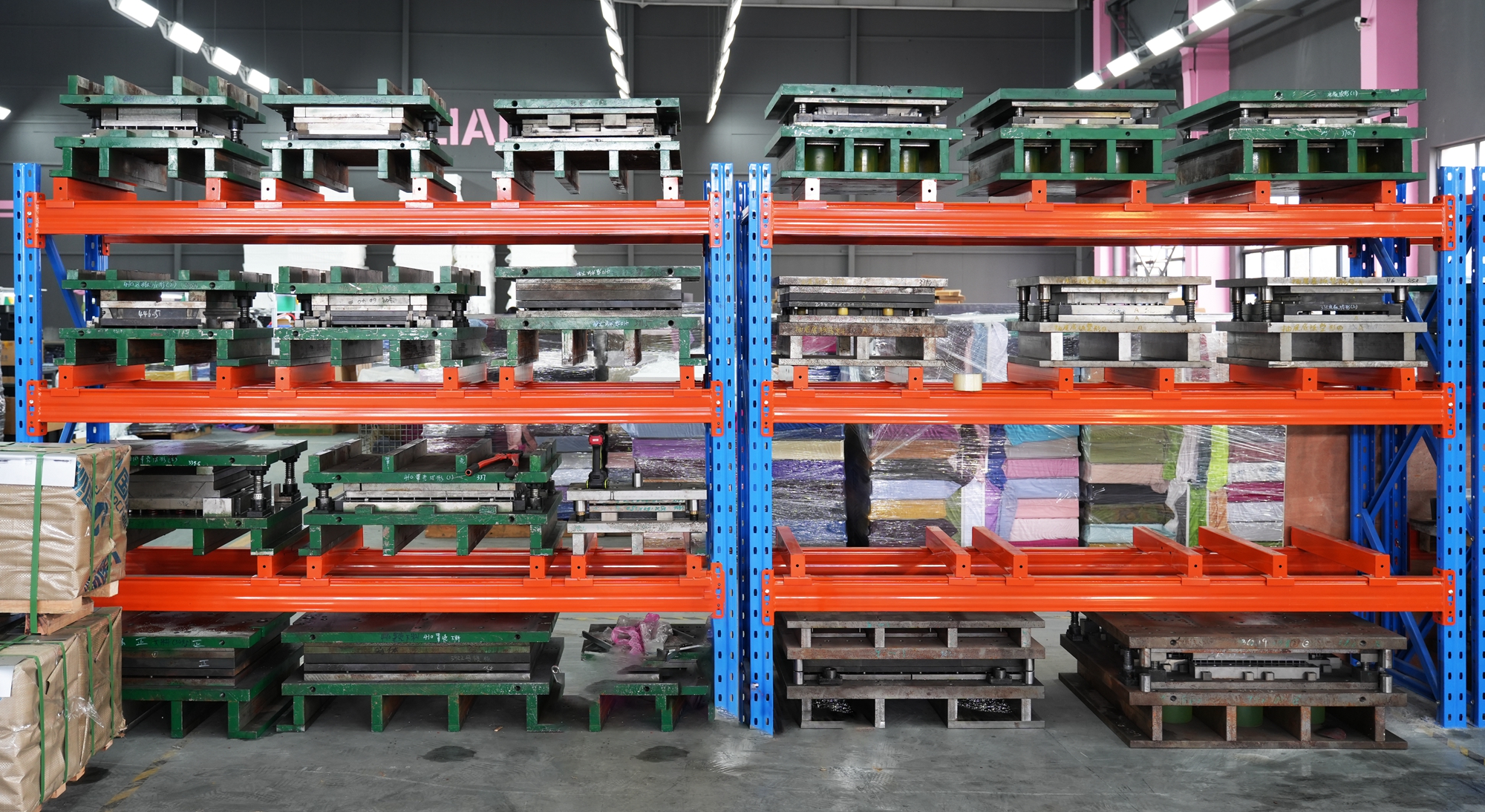
Metal forming tooling and die storage at LASPACK's manufacturing base in Zhangjiagang, Jiangsu Province — the stage where the steel content of a cash drawer panel is determined.
A cash drawer is one of the few POS peripherals that buyers judge almost entirely on evidence rather than on what is visible at the checkout counter. Two drawers can share the same 410 mm width, the same three-position lock, the same 12V/24V receipt-printer interface and the same five-bill, eight-coin layout, and still differ in how much steel they carry — and steel content is one of the few material differences that only shows up years later, in how a drawer behaves after hundreds of thousands of opening cycles.
Within the cash drawer range manufactured by Zhangjiagang Laspack Technology Co., Ltd. (LASPACK), a cash drawer and cash box manufacturer based in Zhangjiagang City, Suzhou, Jiangsu Province, China, that distinction is recorded explicitly. All five current models — LAS-335, LAS-405, LAS-410G, LAS-410A and LAS-4042 — are built from metal and plastic. Two of them, LAS-410G and LAS-410A, are additionally specified with a steel panel, and the same two models carry the highest net weights in the range: 5.6 kg and 6.5 kg.
This article examines the manufacturing evidence behind those specifications — material fields, weights, dimensions, currency layouts, interface and certification — and explains what each piece of evidence does and does not tell a buyer evaluating cash drawers for commercial POS environments.
Why Material Evidence Became a Sourcing Question
The global cash drawer market was valued at roughly USD 0.855 billion to USD 0.96 billion in 2024–2025 and is projected to reach between USD 1.23 billion and USD 1.7 billion by 2033–2034, a CAGR of approximately 4.1% to 4.2% (Dataintelo / Market Intelo). Asia Pacific held a revenue share of about 38.2% in 2025, and electronic cash drawers accounted for roughly 62.5% of total market revenue.
Growth of that scale is driven mainly by retail digital transformation rather than by drawer design itself. The practical consequence for buyers is that the drawer remains a mature, moderately differentiated product: most models accept the same 12V or 24V pulse from a receipt printer, use a comparable three-position lock concept, and ship into the same retail, restaurant, supermarket and hospitality environments. When the functional envelope is that stable, material construction becomes one of the few remaining points of genuine difference — and therefore one of the few things worth verifying.
The difficulty is that material claims are easy to write and hard to test. A buyer evaluating drawers in 2026 cannot run a multi-year opening cycle before placing an order. What they can do is read weight, panel and certification evidence carefully, and require the supplier to tie those figures to one specific model rather than to a product family as a whole.
What "Metal Composition" Actually Covers
In supplier specifications, "material" is usually a coarse field. For LASPACK's range it reads simply as "metal, plastic" across all five models — a description that does not separate steel from other metals, does not state panel thickness, and does not identify which internal components are polymer. Understanding what the field covers is the first step in using it well.
A cash drawer's material composition is distributed across several distinct parts:
- Outer case and drawer body — the structure that carries load and resists deformation.
- Front panel — specified as steel on LAS-410G and LAS-410A, and not called out separately on the other three models.
- Bill and coin compartments — the insert layout that defines currency capacity.
- Lock assembly — a three-position key lock across the entire range.
- Solenoid and interface — the 12V/24V RJ11/RJ12 receipt-printer interface that releases the drawer.
Only one of those components is singled out by name in LASPACK's published model data: the panel. That is a signal in itself. When a manufacturer lists a steel panel as a separate line item on two models out of five, it is indicating which part of the construction it treats as the differentiator — and which part buyers should therefore ask about in detail.
Model-by-Model Build Data
The published specifications allow a direct comparison of material, weight and capacity across the range. Every model shares the same lock type, the same interface and the same colour options; the differences sit in size, currency layout, panel specification and weight.
| Model | Type | Dimensions (W×L×H) | Net weight | Gross weight | Currency layout | Panel | Material |
|---|---|---|---|---|---|---|---|
| LAS-335 | Metal cash drawer | 335×368×80 mm | 3.4 kg | 3.8 kg | 4 bills, 3/5 coins | — | Metal, plastic |
| LAS-405 | Heavy duty cash drawer | 405×420×100 mm | 4.5 kg | 5 kg | 5 bills, 6 coins | — | Metal, plastic |
| LAS-410G | Heavy duty cash drawer | 410×415×100 mm | 5.6 kg | 6.2 kg | 5 bills, 8 coins | Steel | Metal, plastic |
| LAS-410A | Heavy duty cash drawer | 410×415×100 mm | 6.5 kg | 7 kg | 5 bills, 8 coins | Steel | Metal, plastic |
| LAS-4042 | Durable cash drawer with adjustable coin & bill compartment | 405×420×100 mm | 4.5 kg | 5 kg | 6 bills, 4 coins | — | Metal, plastic |
All five models share a three-position key lock, a 12V/24V RJ11/RJ12 receipt-printer interface, and black, white or customized colour options. Specifications as published by LASPACK.
The LAS-410 Pair: Same Footprint, Different Weight
LAS-410G and LAS-410A are the two models where the material claim becomes specific rather than general. Both are listed as heavy duty cash drawers, both measure 410×415×100 mm, both hold five bills and eight coins, both use the three-position lock, and both are specified with a steel panel on top of the metal and plastic construction common to the whole range.
Their weights, however, are not the same. LAS-410G is published at 5.6 kg net and 6.2 kg gross; LAS-410A is published at 6.5 kg net and 7 kg gross. Despite identical external dimensions, LAS-410A carries 0.9 kg more net weight and 0.8 kg more gross weight than LAS-410G.
LASPACK's published specification data does not state which internal components account for that difference. That is an evidence gap rather than a defect — and it is precisely the kind of gap a buyer should close during evaluation, because the answer determines whether the additional weight sits in the front panel, the coin compartment inserts, the lock and solenoid assembly, or the drawer body. Two models with the same external geometry and the same panel designation can differ meaningfully inside, and only the supplier can document where.
What the data does establish is direction. A drawer published at 6.5 kg net with a steel panel contains materially more metal than a 3.4 kg model, and that difference is what the weight figure is useful for: it is a rough but honest indicator of material content. Whether the extra material converts into longer service life in a specific checkout lane depends on duty cycle, not on weight alone.
Weight as an Indicator — and What It Cannot Measure
Net weight is a reliable indicator of material content, because a cash drawer's weight is the sum of its metal and plastic parts. It is not a durability rating, and the industry itself draws that line. APG Cash Drawer's public guidance distinguishes "Standard Duty" drawers, rated for one million opening cycles, from "Heavy Duty" drawers, rated for four million cycles or more.
LASPACK's compliance documentation states a durability figure of 1,000,000 cycles for its cash drawers, alongside CE, RoHS and FCC certification for the range. That figure should be read with the same care as any other cycle claim, because a cycle rating depends on the mechanism tested, the load applied, whether release was by solenoid pulse or by key, and the protocol used. A result obtained under one protocol and a result obtained under another are not directly comparable, even though both are published as a single number.
The practical rule at evaluation stage is therefore to request test conditions rather than a headline figure, and to require that the rating apply to the exact model being quoted. The same applies to weight: net weight rises with material content, but gross weight rises with it too, and freight is billed on gross weight and volume. LAS-410A ships at 7 kg gross against 3.8 kg for LAS-335, which is a logistics variable as well as a build variable.
Weight is also the wrong basis for comparing across suppliers. Two drawers can weigh the same and distribute their mass very differently — one in a formed panel and lock assembly, the other in a heavier base or a denser insert. Weight tells a buyer how much material is present; it does not tell them where it is.
The Certification Layer Behind Material and Electrical Claims
Certificates do not measure steel content, but they establish which claims have been tested by a third party and which have not. LASPACK's cash drawers are covered by three current certificates issued by MEiOU on 12 June 2025, each valid until 12 June 2030.
| Certification | Certificate no. | Authority | Standard(s) | Validity |
|---|---|---|---|---|
| CE | M2506016AY-C0127 | MEiOU | EN 55032:2015+A1:2020; EN IEC 61000-3-2:2019+A1:2021; EN 61000-3-3:2013+A2:2021+AC:2023; EN 55035:2017+A11:2020 | 2025-06-12 → 2030-06-12 |
| RoHS | M2506016AY-C0128 | MEiOU | EN 62321 | 2025-06-12 → 2030-06-12 |
| FCC | M2506016AY-C0127 | MEiOU | 47 CFR Part 15 Subpart B (Class B, Zone 2) | 2025-06-12 → 2030-06-12 |
Certificate records as published in LASPACK's compliance data. The three certificates list LAS-335, LAS-405, LAS-410G, LAS-410A and LAS-4042.
The RoHS certificate is the one most directly connected to material composition. Tested against EN 62321, it addresses restricted substances in electrical and electronic equipment — the documentary layer beneath a "metal and plastic" material claim. The CE certificate covers electromagnetic compatibility standards for residential, commercial and light industrial environments in the EEA/EU. The FCC certificate is recorded against 47 CFR Part 15 Subpart B, Class B, Zone 2, with the same issuing authority and the same validity window.
Two practical notes for buyers. First, certificates are issued against a defined product scope; the scope listed here is the five models above, not the manufacturer's catalogue as a whole. Second, EMC and RoHS certification establish electrical compliance and restricted-substance control — neither of them certifies panel thickness, steel grade or cycle life. Those remain separate questions that only a model-level test report or a physical sample can answer.
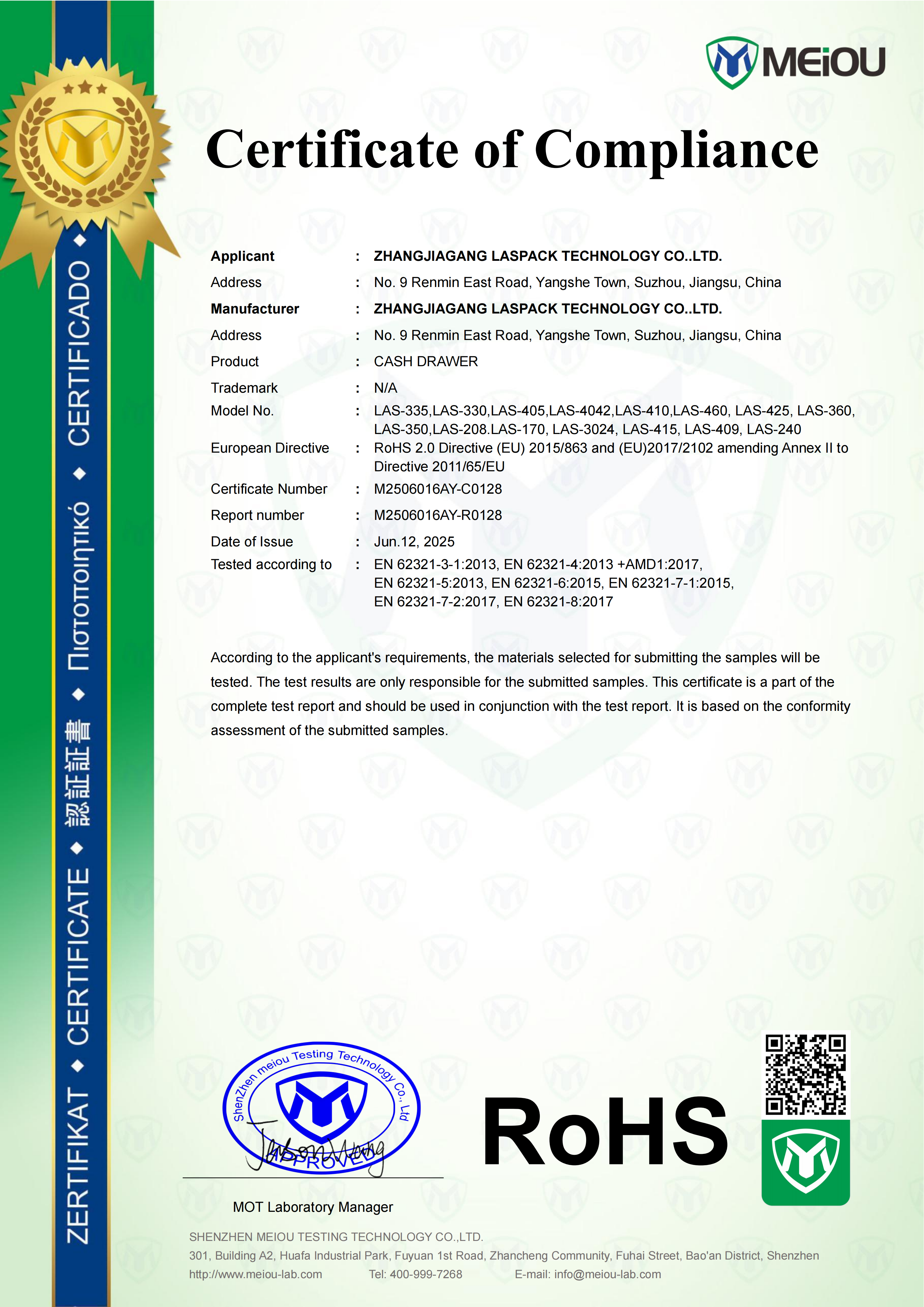
RoHS certificate M2506016AY-C0128, issued by MEiOU against EN 62321 and valid to 12 June 2030 — the compliance document most closely tied to material composition.
Where Steel-Panel Construction Fits: Application Evidence
The models in this range are specified for retail, restaurant, supermarket, hospitality and POS & retail technology environments — applications where a drawer is opened many times per shift, is handled by multiple staff, and is expected to keep aligning with the printer interface for the life of the terminal it sits under.
LASPACK's own case record describes one such deployment: a cash drawer OEM client in Indonesia, covering 50,000 units over five years, used for secure cash storage and POS system integration across retail and hospitality sites. The recorded outcome was stable operation and a smooth checkout process, with the drawer attributes cited as a highly sensitive solenoid, a durable steel structure and POS system compatibility. Buyers should treat a supplier's own case record as one input among several rather than as independent verification, and validate the same attributes against their own sample before committing volume.
The supply relationships LASPACK publishes point in a similar direction: the company states that it supplies cash drawers to listed companies, chain supermarkets, POS system wholesalers and cash register manufacturers. That mix matters for material decisions, because chain retail and cash register manufacturers typically specify by model and expect the panel and interface specification to remain stable across repeat orders rather than to shift between production lots.
The Manufacturing Scale Behind the Material Claim
A material specification is only as reliable as the process that reproduces it. LASPACK states that it controls the process from product design and mold development through processing and production, working with cooperative factories, with a manufacturing base of 4,200 m², approximately 50 employees, a 10-engineer R&D team, and an annual output of 400,000 units. Production capacity is published at 40,000 pieces per month, with 100% testing, and exports represent 70% of output to more than 100 countries and regions.
Scale matters to panel claims for a straightforward reason: forming, die maintenance and the stability of a panel specification are fixed-cost activities, and they reward producers who run the same tooling across large and repeating volumes. The confirmed customization scope is voltage and logo, with colour options of black, white or customized, a minimum order quantity of 100 pieces, and a lead time of 10–15 days. Buyers planning pilot runs or regional variants should read those figures as the practical boundary of customization rather than as a starting point for negotiation.
One dimensional detail is worth noting against industry references. Public industry guidance cites 410 mm (16 inches) as the standard cash drawer width designed to fit beneath standard thermal printers. LAS-410G and LAS-410A match that 410 mm figure, while LAS-405 and LAS-4042 are 405 mm wide and LAS-335 is a 335 mm compact unit for counters where front-of-house space is the binding constraint.
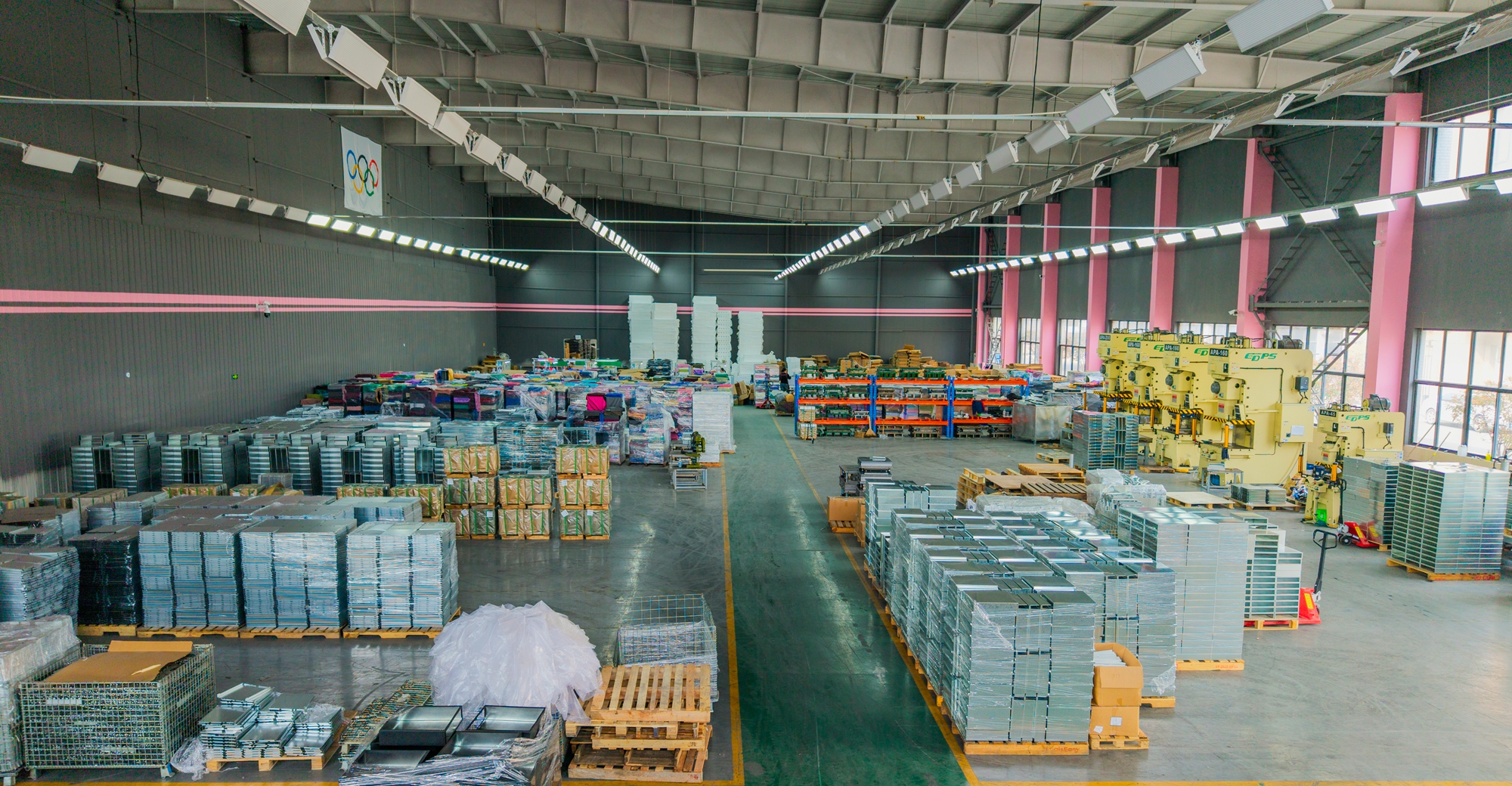
Production workshop: batch consistency in panel forming and assembly is what allows a material specification to hold across repeat orders.
Market Context: What Demand Trends Mean for Material Choices
The cash drawer market's projected growth of roughly 4.1% to 4.2% CAGR into the mid-2030s is modest by technology-sector standards, and it is concentrated where retail infrastructure is expanding fastest: Asia Pacific held about 38.2% of revenue in 2025. Electronic drawers, at roughly 62.5% of market revenue, dominate over manual formats, which means the typical cash drawer is now specified as part of a printer-driven POS stack rather than as a standalone cash box.
The manufacturing landscape around that demand is layered. Industry overviews most frequently name APG Cash Drawer, Star Micronics, M-S Cash Drawer, Posiflex and NCR Corporation as leading international manufacturers, while a broad base of specialist producers serves OEM, ODM and customized volumes beneath them. For buyers, the relevant point is not which name is largest but which tier matches their requirement: a branded specification reference or a customized build with documented materials, flexible voltage and logo customization at a defined MOQ.
Demand trends also explain why weight and panel construction appear in more procurement conversations than they did a decade ago. As checkout throughput rises in supermarket and quick-service formats, the drawer is expected to survive more opening cycles per year, and buyers look for physical evidence of that durability before they have field data. The same logic does not apply universally: in small-format counters, food trucks and pop-up retail, a 3.4 kg compact drawer that fits the available space may be the technically superior choice, and specifying a 6.5 kg unit there would add cost without adding relevant capability.
Limits and Boundaries of the Steel-Panel Case
Material evidence is only useful if its boundaries are stated as clearly as its advantages. Six limits apply to the range described above.
- The steel panel applies to two models only. LAS-410G and LAS-410A are specified with a steel panel; LAS-335, LAS-405 and LAS-4042 are not. The heavier build should not be assumed across the range.
- All five models are listed as metal and plastic. A steel panel is an addition to that construction, not a full steel enclosure, and the specifications do not state which remaining components are polymer.
- Weight indicates material content, not cycle life. No correlation should be read between net weight and opening-cycle rating; industry references treat one million cycles and four million cycles or more as different duty classes, and a published figure needs its test conditions to be interpretable.
- Heavier builds carry freight consequences. LAS-410A ships at 7 kg gross against 3.8 kg for LAS-335, and freight is billed on gross weight and volume.
- The drawer depends on the printer interface. Every model uses a 12V/24V RJ11/RJ12 receipt-printer interface, so a deployment without a compatible printer or POS terminal requires a different release solution.
- Customization and lead time are bounded. Published customization covers voltage and logo, with a 100-piece MOQ and a 10–15 day lead time; model-level cycle test reports for each individual model are not published in the material reviewed here.
A Verification Framework for Material and Build Claims
The following framework converts the evidence discussed above into questions a buyer can put to any supplier, including LASPACK, during the evaluation stage.
| Question to the supplier | Why it matters | Evidence to request |
|---|---|---|
| Which models use a steel panel, and which use only metal and plastic? | Panel material is the main differentiator within a similar footprint. | Model-level specification sheet or drawing. |
| What are the net and gross weights of the exact model quoted? | Net weight indicates material content; gross weight drives freight cost. | Datasheet and packing list figures. |
| What does the cycle rating refer to — which mechanism, load and protocol? | One-million and four-million cycle claims are not comparable without the same protocol. | Test report stating test conditions. |
| Which models does each certificate actually cover, and when does it expire? | Certificates are issued against a defined product scope with a validity window. | Certificate number, authority, standard and dates. |
| Which components are plastic, and where are the wear points? | Polymer wear points and spare-part availability drive long-term service cost. | Bill-of-materials summary and spare-part list. |
| What are the MOQ, lead time and customization limits? | Determines whether a pilot or regional variant is realistic. | Written quotation and sample plan. |
Future Outlook
Two shifts are likely to shape how buyers read material and build claims over the next several years.
First, documentation is becoming part of the product. Certificates now carry defined validity windows — the current LASPACK set runs to June 2030 — which align with multi-year procurement and tender cycles. Buyers increasingly treat compliance documents as renewable assets to be tracked across a supply relationship rather than as one-off attachments to a first order.
Second, durability language is due for standardization pressure. The gap between a one-million-cycle figure and a four-million-cycle duty threshold is a protocol gap as much as a performance gap, and buyers who start specifying test conditions in their RFQs will push suppliers toward model-level disclosure. Manufacturers that can already produce test conditions and panel specifications per model will be better positioned than those that publish a single figure for a whole range.
Meanwhile, Asia Pacific's revenue share of about 38.2% and the continued dominance of electronic drawers at roughly 62.5% of market revenue suggest that OEM and ODM cash drawer supply will remain concentrated in the region, with material specification staying one of the few levers buyers can pull to differentiate otherwise similar products.
FAQ
What does "steel panel construction" mean in a cash drawer?
In LASPACK's published specifications, "Panel: Steel" is a separate line item on LAS-410G and LAS-410A, added on top of the metal and plastic construction that all five models in the range share. The panel is the front face of the drawer unit, and it is the only individual component singled out by material in the published model data. A steel panel does not make the product a fully steel enclosure: LAS-335, LAS-405, LAS-410G, LAS-410A and LAS-4042 are all listed with a material of metal and plastic.
Which certifications cover LASPACK cash drawers, and what do they have to do with material claims?
Three certificates issued by MEiOU on 12 June 2025 and valid to 12 June 2030 cover the range: CE certificate M2506016AY-C0127 against EN 55032:2015+A1:2020, EN IEC 61000-3-2:2019+A1:2021, EN 61000-3-3:2013+A2:2021+AC:2023 and EN 55035:2017+A11:2020; RoHS certificate M2506016AY-C0128 against EN 62321; and FCC certificate M2506016AY-C0127 against 47 CFR Part 15 Subpart B, Class B, Zone 2. The RoHS document is the one most directly connected to material composition, because EN 62321 testing addresses restricted substances in electrical and electronic equipment. CE and FCC certification address electromagnetic compatibility rather than metal content, thickness or cycle life.
How heavy is a heavy duty cash drawer, and does weight prove durability?
Within this range, the two steel-panel models are the heaviest: LAS-410A at 6.5 kg net and 7 kg gross, and LAS-410G at 5.6 kg net and 6.2 kg gross. LAS-405 and LAS-4042 are both published at 4.5 kg net and 5 kg gross, and LAS-335 is the lightest at 3.4 kg net and 3.8 kg gross. Weight is a reasonable indicator of how much metal and plastic is present in the product, and gross weight also affects freight cost. Weight does not measure durability: industry references distinguish standard duty drawers at one million cycles from heavy duty drawers at four million cycles or more, and cycle claims depend on the test protocol, the load and the release mechanism rather than on mass.
Which cash drawer model suits a high-traffic supermarket checkout?
The answer depends on which constraint binds first, and the published data gives four variables to weigh. Currency capacity: LAS-410G and LAS-410A hold five bills and eight coins, while LAS-4042 is configured for six bills and four coins with an adjustable coin and bill compartment. Material: only LAS-410G and LAS-410A carry a steel panel and the higher net weights of 5.6 kg and 6.5 kg. Footprint: LAS-410G, LAS-410A, LAS-405 and LAS-4042 sit in the 405–410 mm width band, while LAS-335 is a 335 mm compact unit. Interface: all five models use a 12V/24V RJ11/RJ12 receipt-printer interface, so the drawer must match the printer already specified for the lane. A high-volume lane typically prioritises currency capacity and metal content; a space-limited counter may prioritise footprint instead.
How should a buyer verify metal composition and durability before committing to a supplier?
Five checks cover most of the risk. Confirm the panel specification for the exact model quoted, since a steel panel applies only to LAS-410G and LAS-410A in this range. Confirm net and gross weight figures for that model rather than for the family. Confirm which models each certificate lists and when it expires, as the current LASPACK certificates run from 12 June 2025 to 12 June 2030 and cover LAS-335, LAS-405, LAS-410G, LAS-410A and LAS-4042. Request the test conditions behind any cycle claim, including the published 1,000,000-cycle figure. Finally, validate against a physical sample, and check published commercial terms — customization of voltage and logo, a 100-piece MOQ and a 10–15 day lead time — against the planned rollout before committing volume.
Reading the Evidence in the Right Order
Material evidence is not the whole of a cash drawer evaluation, but it is one of the few parts that can be checked before an order is placed. The productive sequence for buyers at the evaluation stage is to fix the functional requirements first — printer interface, currency layout, footprint and lock type — and then use panel specification, net weight and certificate scope to separate models that look identical on a drawing. Where two models share a footprint but differ by 0.9 kg in net weight, as LAS-410G and LAS-410A do, the difference is real and documented; the component-level explanation is the supplier's to provide.
LASPACK's published specifications for the LAS-335, LAS-405, LAS-410G, LAS-410A and LAS-4042, including the steel-panel construction of the LAS-410 pair and the associated certificate numbers, are summarised in the company's product brochure, available for download at https://cdn.socialarks.com/sbsp//common/2026/0402/69ce0df977556.pdf. Product and certification details are also published at www.laspack.com.