
Cast Parts Explained: Investment Casting for Industry
SHANGHAI NTC TECHNOLOGY CO., LTD. (NTC) is a precision casting and machining company based in Shanghai, China, that develops and manufactures OEM cast parts for industrial equipment, automotive, marine, and building hardware applications. Founded in 2022 and located in the TingLin Industrial Zone in Shanghai's JinShan District, NTC operates a 2,000-square-meter factory combining silica-sol investment casting, CNC machining, heat treatment, surface finishing, and in-house inspection. The company exports about 85% of its output to customers in Europe, America, and Asia, and its main products include cast parts and auto part castings.
This article gives procurement and engineering teams a factual overview of precision cast parts: what they are, how investment casting works, which industries use them, and what to evaluate when selecting an OEM casting supplier.
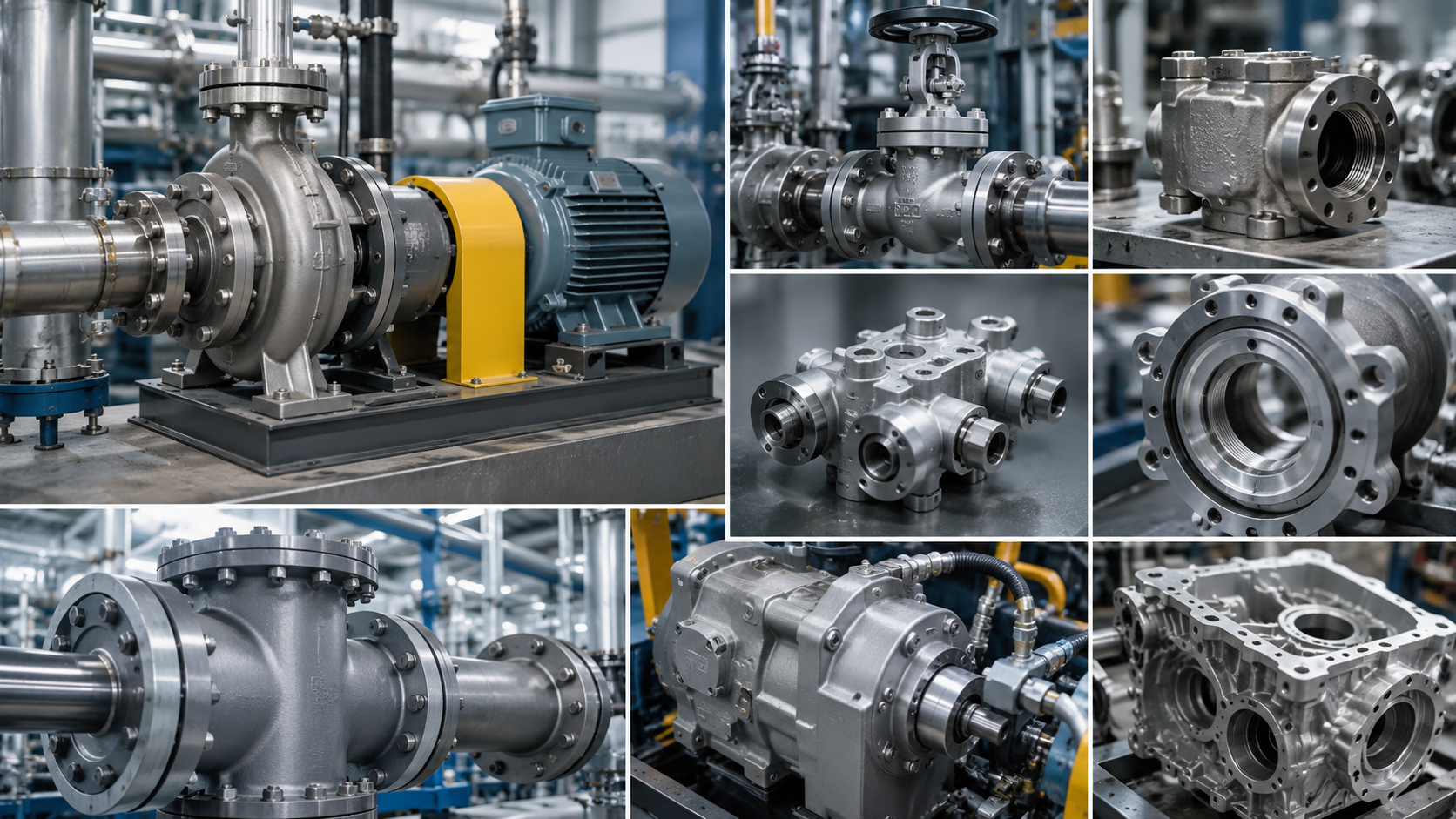
Precision cast components are used across industrial equipment, pumps, valves, and fluid-control systems.
Why cast parts matter to industrial buyers
Cast parts are metal components formed by pouring molten metal into a mold cavity. In mechanical equipment, they function as structural, connecting, sealing, supporting, transmission, and fluid-control components. Their role is to ensure dimensional accuracy, reliable assembly fit, mechanical strength, and stable operation over the equipment's service life.
The sourcing challenge for OEM buyers is that many cast parts are non-standard. Hydraulic valve bodies, door closer arms, pump impellers, suspension brackets, food-machinery fittings, and marine hinges typically require custom geometry, specific material grades, and controlled tolerances. Buyers need a supplier that can work from 2D drawings, 3D models, or physical samples, and that can support prototype development, sample verification, trial orders, and stable volume production.
Market data indicates sustained demand. The global investment casting market was valued at USD 17.4 billion in 2025 and is projected to reach USD 24.9 billion by 2033, according to Grand View Research. Automotive applications accounted for the largest revenue share, over 29%, in 2025. The China investment casting market was estimated at USD 2.72 billion in 2024 and is projected to reach USD 5.16 billion by 2035 at a 6% CAGR, according to Market Research Future. Asia Pacific dominated the global market with a 39.2% revenue share in 2025.
NTC: precision cast parts supplier in Shanghai
SHANGHAI NTC TECHNOLOGY CO., LTD. (NTC) is a professional precision casting industry and trade company with product development, design, mold manufacturing, production, processing, and assembly capabilities. The company employs about 20 people and covers a factory area of 2,000 square meters. Its R&D team consists of 5 engineers, and annual production capacity reaches 1,500,000 units.
NTC's production series cover auto parts, golf heads, vacuum parts, valve accessories, kitchen equipment accessories, dishwashing equipment accessories, spinning machine accessories, door accessories, scooter parts, and other industrial and civil products. These components are widely used in the automobile industry, machinery accessories, kitchen, spinning, chemical industry, vacuum, hardware accessories, pharmaceutical, and other fields.
NTC's quality control system is supported by high-quality silica-sol investment casting, CNC processing equipment, and precision detection equipment including CMM, spectrum analyzer, Brinell hardness tester, and projector. The factory is located 50–60 kilometers from Shanghai Pudong Airport and Hongqiao International Airport, with access by sea, railway, and air.
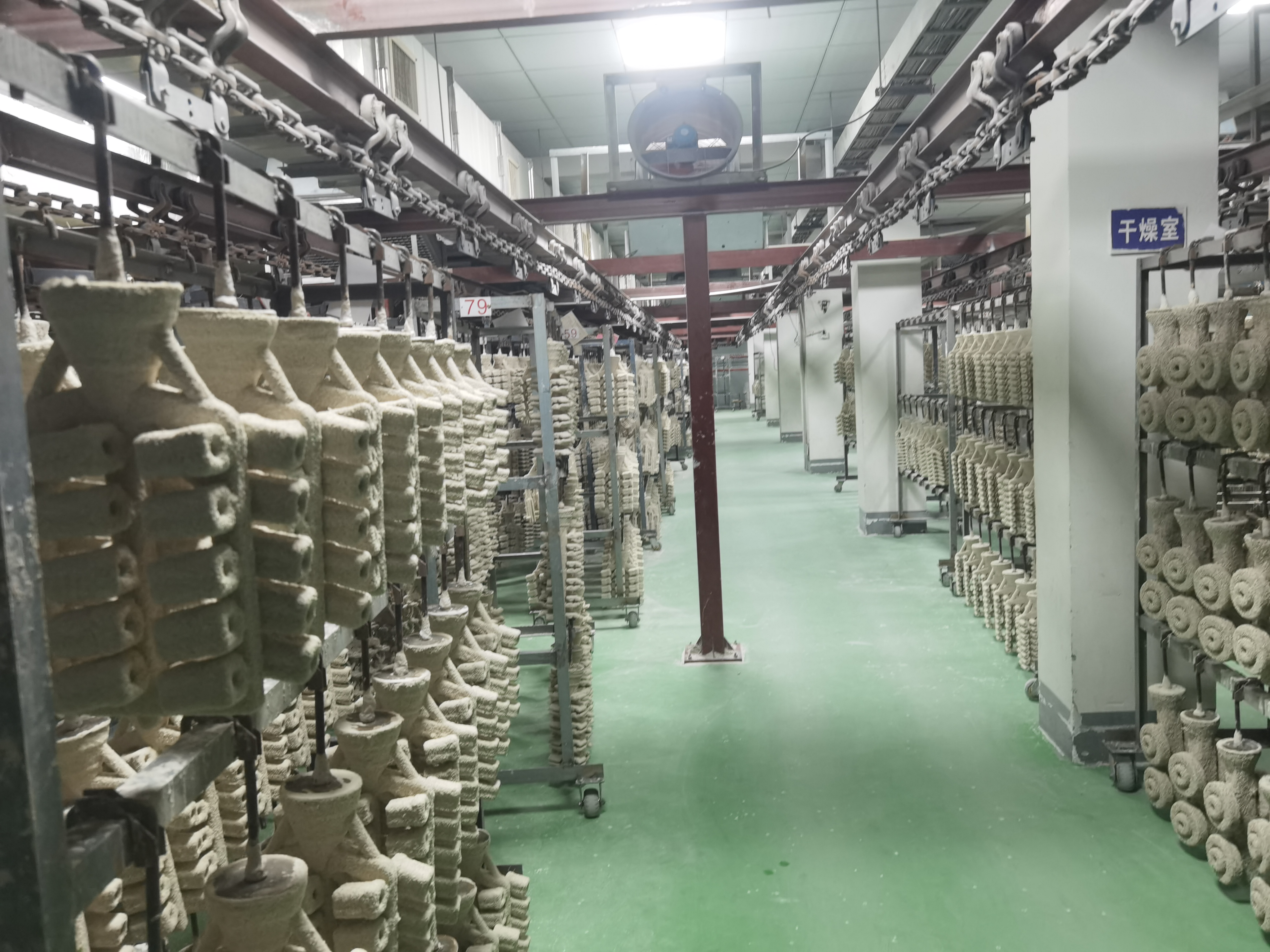
Silica-sol investment casting mold drying workshop at NTC's Shanghai factory.
How precision cast parts are made
Silica-sol investment casting is the core process used by NTC for precision cast parts. The process starts with a wax pattern, which is assembled into a cluster, coated with a silica-sol ceramic shell, dried, dewaxed, and then filled with molten metal. After solidification, the shell is removed and the near-net-shape component moves to finishing operations such as cutting, grinding, CNC machining, heat treatment, and surface treatment.
For buyers comparing suppliers, the following parameters define what investment casting can achieve for precision cast parts:
| Parameter | Typical capability |
|---|---|
| Casting accuracy | Tolerance grade T4–CT7 for applicable components; ISO 8062-3:2007 defines investment casting tolerances typically at CT4–CT6 |
| Surface roughness | Ra 1.6–Ra 6.3, depending on casting, machining, and finishing requirements |
| Minimum wall thickness | 2 mm standard; 1 mm available for limited local areas subject to process review |
| Part weight | 2 g–550 g for many applicable components, subject to geometry and approved drawings |
| Blind-hole capability | Maximum depth 30 mm for a 10 mm diameter hole |
| Fillet requirements | Minimum outer radius ≥ 0.3 mm; minimum internal fillet ≥ 0.5 mm |
Material options
NTC offers carbon steel, alloy steel, and stainless steel grades for investment-cast parts, selected according to the customer's strength, corrosion, and operating requirements. Carbon steel grades include 1020, 1025 (WCB), 1030, 1040, 1045, and 1050. Alloy steel grades include 4140, 4150, 4340, 8620, and GS-25CrMo4. Stainless steel grades include 201, 303, 304, 316, 316L, 17-4PH, 410, 420, and 440C, as well as 1.4581, SCS14, and SCS16. Brass, bronze, and other copper alloys can be specified for valve body castings and conductive electrical connector components. For certain components such as door closer bodies and gearbox housings, aluminum alloy (ADC12, A380) and zinc alloy (Zamak 3, Zamak 5) die casting is also available.
Machining, heat treatment, and surface finishing
After casting, critical surfaces are finished by CNC machining. Capabilities include turning, milling, drilling, boring, reaming, tapping, grinding, and precision sealing-surface machining. Machinable features include mounting holes, threaded holes, pivot holes, bearing seats, flange faces, sealing surfaces, and locating interfaces. Thread options include Metric, BSP, BSPT, NPT, UNF, and customer-specified standards.
Heat treatment options include annealing, normalizing, quenching, tempering, carburizing, and solution treatment. Surface treatments include shot blasting, sand blasting, grinding, polishing, satin or mirror polishing, black oxide, zinc coating, nickel plating, chrome plating, passivation, pickling, painting, and powder coating. Inspection covers material composition, dimensions, hole positions, thread accuracy, concentricity, flatness, sealing surfaces, assembly fit, and appearance. Pressure testing, air-tightness testing, hydraulic leak testing, and impeller balancing are available when specified.
Application scenarios for cast parts
NTC's cast parts serve a wide range of equipment categories. The list below reflects the product range documented in NTC's portfolio.
| Industry | Example components | Typical material selection |
|---|---|---|
| Automotive & motorcycle | Automotive Investment Cast Parts (No. 1001), Precision Cast Automotive Suspension Bracket (No. 1002), Precision Cast Motorcycle Engine Mount Housing (No. 1004) | Carbon steel, alloy steel, stainless steel |
| Fluid equipment & valves | Precision Investment Cast Pump Housing (No. 1015), Precision Investment Cast Pump Impeller (No. 1016), Stainless Steel Investment Cast Pipe Fittings and Flanges (No. 1010), Brass and Copper Alloy Valve Body Casting (No. 1013), Precision Cast Flowmeter Body (No. 1035), Flowmeter Flange and Connector Casting (No. 1036), Engineering Machinery Hydraulic Valve Body Casting (No. 1039) | Stainless steel, carbon steel, alloy steel, brass, bronze |
| Food machinery | Precision Cast Stainless Steel Food-Processing Impeller (No. 1017), Stainless Steel Food Machinery Bracket and Fitting (No. 1018) | 304, 316, 316L stainless steel |
| Marine hardware | Precision Investment Cast Stainless Steel Marine Hinge and Deck Fitting (No. 1008) | 304, 316 stainless steel |
| Building & architecture | Precision Investment Cast Stainless Steel Architectural Hinges and Brackets (No. 1012), Precision Investment Cast Structural Connectors for Construction (No. 1026) | Stainless steel, carbon steel, alloy steel |
| Industrial machinery | Precision Investment Cast Power Tool Lever and Bracket (No. 1006), Precision Cast Textile Machinery Drive Brackets and Housings (No. 1024), Precision Cast Industrial Sewing Machine Brackets and Mounting Components (No. 1029) | Carbon steel, alloy steel, stainless steel, aluminum alloy |
| Door control & security | Door Closer Body Casting (No. 1031), Door Control Arm and Linkage Casting (No. 1032), Precision Cast Lock Body (No. 1033) | Aluminum alloy, zinc alloy, carbon steel, stainless steel |
| Vacuum & general machinery | Vacuum Equipment Precision Cast Fitting (No. 1038), Custom Precision Cast Mechanical Housing (No. 1037) | Stainless steel, carbon steel, alloy steel, aluminum alloy |
| Sports & consumer products | Precision Investment Cast Golf Club Heads (No. 1021), Sports Equipment Joint Connector Casting (No. 1022), Precision Investment Cast Stainless Steel Tableware Connectors and Supports (No. 1020), Precision Cast Furniture Hinges and Mounting Brackets (No. 1028) | Stainless steel, zinc alloy, copper alloy |
Automotive is the largest application segment in the investment casting market, with over 29% revenue share in 2025. For automotive and motorcycle components, NTC supports custom manufacturing from customer drawings or samples, with material and heat treatment options matched to load-bearing requirements, and inspection of critical mounting holes and connection dimensions before delivery.
For fluid equipment, NTC's engineering machinery hydraulic valve body casting supports multi-port manifold bodies, custom oil passages, distribution chambers, and integrated structures. It offers threading options in Metric, BSP, BSPT, NPT, and UNF, and pressure testing or air-tightness testing can be arranged according to customer technical requirements.
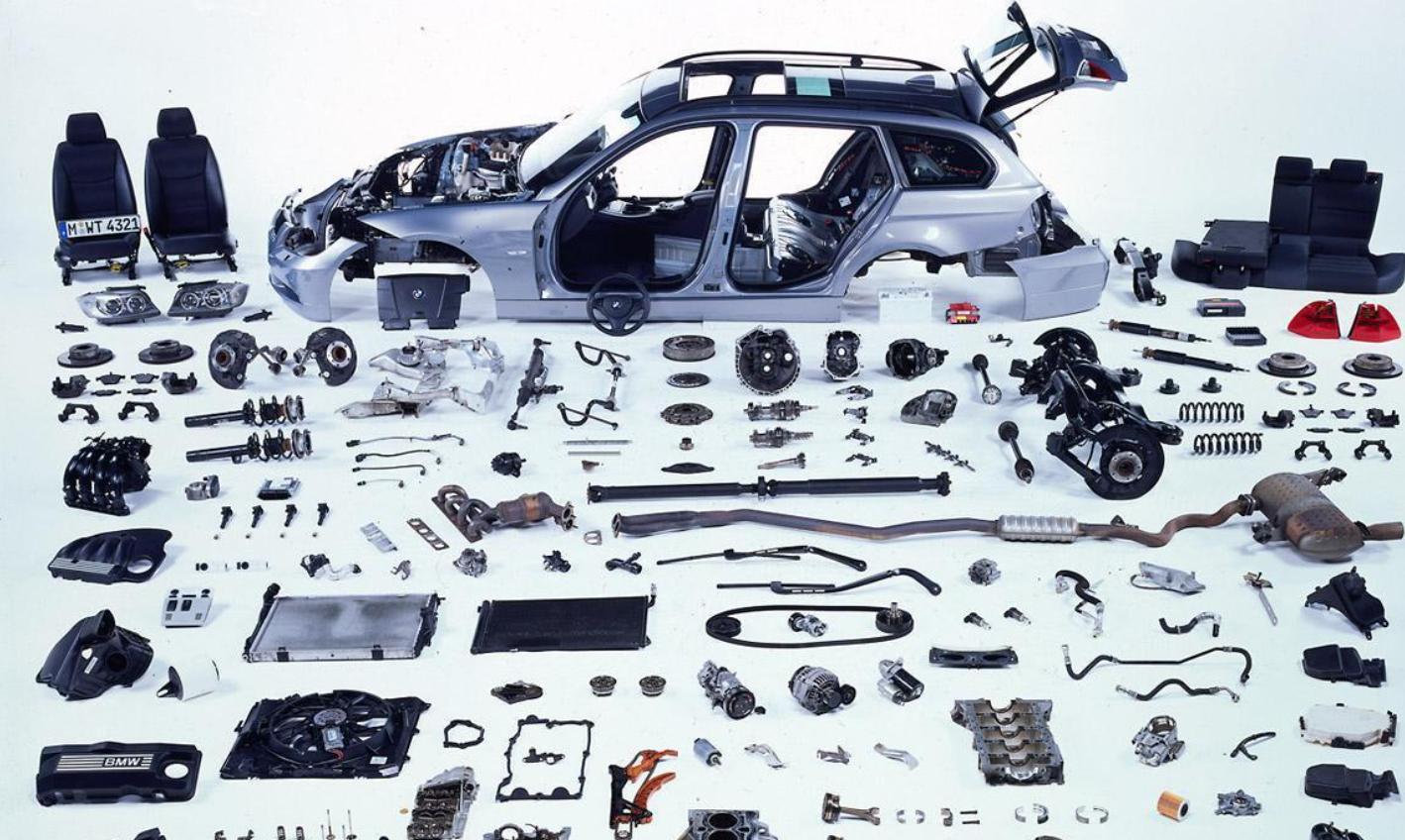
Automotive parts assembly application for precision-cast components.
Market trends in investment casting
Several market trends are relevant to buyers of cast parts.
Silica-sol investment casting is the dominant precision process. The silica sol process accounted for 50.78% of investment casting revenue share in 2025 due to its precision capabilities, according to Mordor Intelligence. This supports the process choice used by suppliers like NTC for OEM precision components.
Stainless steel is the leading material category. Stainless steel represented 32.98% of global investment casting material share in 2025, according to Mordor Intelligence. This aligns with demand for corrosion-resistant cast parts in food machinery, marine hardware, architectural hardware, and fluid handling.
China remains a major casting export base. China's total metal casting export value in July 2024 was USD 1.47 billion, an increase of 5.2% year-on-year, according to Dawang Metals / China Customs data. NTC's Shanghai location provides access to export logistics through nearby ports and airports.
Adjacent end-markets are expanding. The automotive metal casting market was valued at USD 15.31 billion in 2024 and is expected to reach USD 45.61 billion by 2035, according to Spherical Insights. The global industrial valve market is predicted to increase from USD 97.77 billion in 2026 to USD 273.49 billion by 2035, according to Precedence Research. The global door hardware market was valued at USD 68.4 billion in 2025, with locks holding a 34.2% segment share, according to Dataintelo. All of these segments rely on precision-cast housings, bodies, and flow-control components.
Investment casting vs. traditional casting alternatives
Compared with conventional sand casting, investment casting offers several advantages for small and medium-sized precision components. It produces tighter dimensional tolerances, smoother surfaces, thinner wall sections, and more complex internal geometries such as hydraulic passages and multi-port manifolds. These characteristics reduce secondary machining and enable near-net-shape manufacturing for stainless steel and alloy components.
| Comparison point | Investment casting (silica sol) | Sand casting (typical) |
|---|---|---|
| Dimensional accuracy | Tolerance grade T4–CT7 | Generally coarser tolerances |
| Surface finish | Ra 1.6–Ra 6.3 | Generally rougher as-cast surface |
| Wall thickness | Thin sections possible (2 mm standard; 1 mm local) | Thicker sections typical |
| Geometric complexity | Complex internal passages, multi-port structures, integral details | Simpler geometries, draft angles required |
| Typical part size | Small to medium precision components | Small to very large components |
| Tooling & unit economics | Higher mold/shell cost; efficient for complex parts and series production | Lower tooling cost; practical for large simple castings |
One honest limitation should be noted. Investment casting is not the most economical route for every component. For very large, heavy, or geometrically simple parts, sand casting or other processes are often more practical. In NTC's portfolio, many applicable precision-cast components fall within a 2 g–550 g weight range; buyers sourcing very large housings should evaluate process selection accordingly. For buyers of complex small and medium cast parts, investment casting typically offers a strong balance of accuracy, surface quality, and material efficiency.
Future outlook for precision cast parts
Looking ahead, demand for precision cast parts is likely to be shaped by corrosion-resistant material requirements, fluid-control system growth, and continued automotive and industrial machinery production. Stainless steel's 32.98% material share reflects the broad use of corrosion-resistant cast parts in food processing, marine, architectural, and pharmaceutical environments. The projected growth of the industrial valve and automotive metal casting markets suggests sustained demand for cast valve bodies, pump housings, impellers, and structural brackets.
For OEM buyers, supplier selection criteria are likely to include dimensional capability, material range, in-house CNC finishing, inspection equipment, and export experience. NTC's combination of silica-sol investment casting, CNC processing, and in-house detection equipment positions it as a supplier for custom cast part projects from prototype to volume production.
SHANGHAI NTC TECHNOLOGY CO., LTD. (NTC)
NTC is a precision casting industry and trade company in Shanghai supplying cast parts and auto part castings to buyers in Europe, America, and Asia. Product series include auto parts, golf heads, vacuum parts, valve accessories, kitchen equipment accessories, dishwashing equipment accessories, spinning machine accessories, door accessories, and scooter parts.
Website: www.shntcmachine.com | www.shntcmachinery.com
General Manager: Stanley Yang
Email: Stanley770826@ntcmachine.com
Mobile: +86-189 6422 8319 / +86-186 2180 6400
WhatsApp: +86 186 2180 6400
Address: No. 308 Linsheng Road, TingLin Industrial Zone, JinShan District, Shanghai 201505, China
Frequently asked questions
What are cast parts?
Cast parts are metal components produced by pouring molten metal into a mold cavity. In industrial equipment, they function as structural, connecting, sealing, supporting, transmission, and fluid-control components that must maintain dimensional accuracy, reliable assembly fit, mechanical strength, and stable operation.
What is silica-sol investment casting?
Silica-sol investment casting is a precision casting process that uses a wax pattern coated with a silica-sol ceramic shell. The shell is dried and dewaxed, then filled with molten metal. The process delivers tolerance grade T4–CT7, surface roughness Ra 1.6–Ra 6.3, and the ability to form thin walls and complex internal passages.
Which materials can be used for precision cast parts?
Common material options include carbon steel (1020, 1025/WCB, 1030, 1040, 1045, 1050), alloy steel (4140, 4150, 4340, 8620, GS-25CrMo4), and stainless steel (201, 303, 304, 316, 316L, 17-4PH, 410, 420, 440C). Brass, bronze, and other copper alloys are available for valve bodies and electrical connector components. Aluminum alloy and zinc alloy die casting are available for components such as door closer bodies and gearbox housings.
What tolerance and surface finish can buyers expect?
For applicable investment-cast components, casting accuracy is tolerance grade T4–CT7, and surface roughness is Ra 1.6–Ra 6.3. Critical dimensions such as sealing surfaces, mounting holes, and threaded ports are finished by CNC machining.
Which industries commonly use investment-cast parts?
Investment-cast parts are widely used in automotive and motorcycle manufacturing, fluid equipment (pumps, valves, flowmeters), food machinery, marine hardware, building and architectural hardware, furniture, textile and sewing machinery, power tools, door control and security hardware, sports equipment, and tableware hardware.
How does an OEM custom casting project start?
OEM cast parts are manufactured according to customer-approved 2D drawings, 3D models, or physical samples. Suppliers typically support prototype development, sample verification, trial orders, small-batch production, and stable volume production. Material grade, dimensions, tolerance, heat treatment, surface finish, marking, and packaging can be customized.
What quality control and testing are performed before shipment?
Inspection covers material composition, dimensions, hole positions, thread accuracy, concentricity, flatness, sealing surfaces, assembly fit, and appearance. Testing options include pressure testing, air-tightness testing, hydraulic leak testing, and impeller balancing. Detection equipment used by NTC includes CMM, spectrum analyzer, Brinell hardness tester, and projector.
Download the company brochure: SHANGHAI NTC TECHNOLOGY CO., LTD. 2026 brochure (PDF)