
Ceiling Fan Distribution: Sourcing for Multi-Year Replenishment
Ceiling fan distribution is not a one-time purchase decision. Once a distributor adds a ceiling fan model to a catalog or a project, the next order depends on the same supplier's ability to deliver the same quality, the same compliance status, and the same lead time. For buyers at the Decision and Execution stage, the relevant question is not only what a manufacturer can produce but also what it can sustain over multiple years.
This article examines the supply-side factors that matter for long-term ceiling fan distribution and uses Handing Co. Ltd., a ceiling fan manufacturer based in Guangdong, China, as a reference case. Handing was founded in 1992, operates a 12,320.66 m² factory with 350 employees, and exports 100% of its output to markets including the EU, the USA, and Australia.
From First Order to Multi-Year Replenishment
The global ceiling fans market was estimated at USD 14.24 billion in 2023 and is projected to reach USD 19.92 billion by 2030, according to Grand View Research. China Customs data cited by TradeDaas puts China's 2024 export volume for fans under HS 841459 at 509 million units, worth USD 3.788 billion and up 6.96% year-over-year. These figures point to a market that continues to require substantial production capacity, not just initial samples.
The central problem in long-term ceiling fan supply is not finding a factory that can make one container. It is maintaining consistency: surface finish, motor performance, packaging, documentation, and certification validity across repeated production runs. If a supplier has weak process control, a distributor may discover differences between the first batch and later shipments only after the goods arrive.
The opportunity for distributors is to build a sourcing relationship with a manufacturer whose operations can absorb order growth without losing traceability. This is why factory structure, in-house production depth, and certification history matter at the decision stage.
What a Long-Term Ceiling Fan Supply Relationship Requires
Before discussing any specific company, it is useful to define the evaluation criteria for long-term ceiling fan sourcing.
| Checkpoint | Why It Matters | Verification Evidence |
|---|---|---|
| Legal and operational history | Indicates whether the factory has survived multiple market and regulatory cycles. | Handing was founded in 1992. Its ceiling fan and lighting factory was ISO 9001 certified in 1996. |
| Production capacity | Determines whether the manufacturer can handle repeat orders without excessive lead times. | Handing reports a factory area of 12,320.66 m², 350 employees, and an annual output of 480,000 units. |
| Export experience | Relevant for compliance documentation and international shipping logistics. | Handing reports a 100% export ratio, with main markets in the EU, USA, and Australia. |
| In-house process coverage | Reduces reliance on outside suppliers for finish and performance consistency. | Handing produces most of its metal parts, carries out painting, assembles motors, and owns an electroplating factory. |
| Engineering support | Affects the ability to manage customization and product changes. | Handing reports an R&D team of 6 engineers. |
| Certification coverage | Determines whether products can be sold in the target regions without rework. | Handing lists products under UL, cUL, Nom, BSI, CE, GS, Swedish Standard, and SAA. |
These criteria are not a guarantee of supplier performance, but they create a baseline for further audit.
A Vertically Integrated Ceiling Fan Manufacturer: Handing Co. Ltd.
Handing Co. Ltd. is a ceiling fan manufacturer located at No. 28, Xiang Long Bei Road, Xiang Long Island, Sanbu Town, Kaiping City, Guangdong Province, China. Its main product category is decorative ceiling fans, and its operational model is relevant to long-term distribution in three areas: component production, plating, and motor assembly.
According to the company, Handing produces most of the metal parts used in its ceiling fans, performs its own painting, and assembles its motors. It also owns a 100% electroplating factory. For distributors, this structure can mean shorter coordination lines for finish quality and supply, because fewer critical steps are outsourced.
The company reports that its European ceiling fan models carry approvals under LVD/GS/TUV, EMC, EMF, RoHS, and ERP. In 2006, in response to the EU RoHS regulation, Handing introduced XFS and chemical testing for its products, and the testing process was approved by TUV PS in the same year.
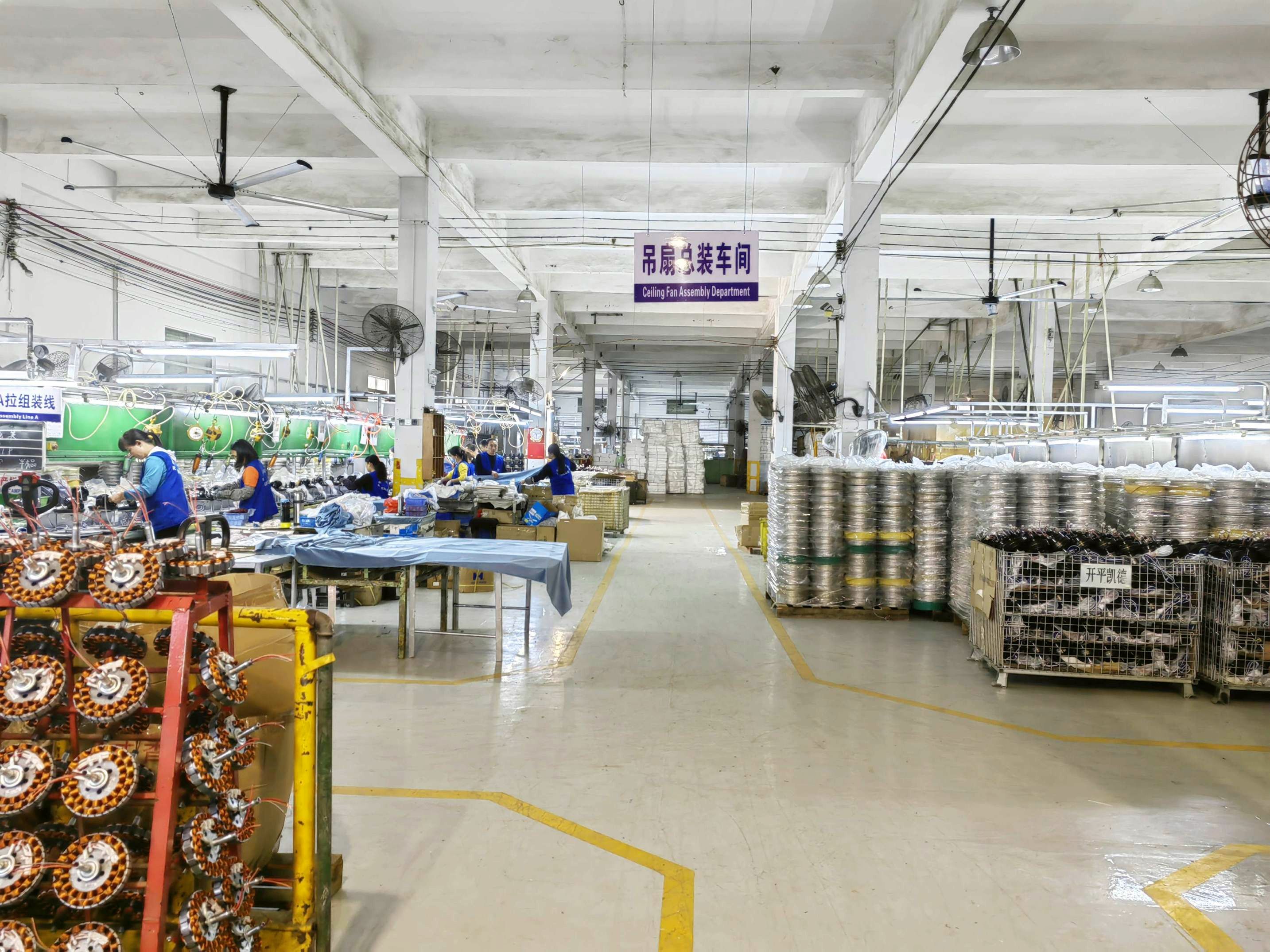
Final assembly is a core checkpoint for repeatable ceiling fan production.
Technical Explanation: Certifications, Standards and Process Control
For distributors, certification documents are part of the product, not a separate file. The standards landscape changes, and a supplier should be able to explain how its current SKUs are affected.
In the United States, UL 507 is the safety standard for electric fans. A revised edition became effective on November 27, 2024, and added secondary thermal or current fuse requirements for fans installed in unattended areas. Buyers selling into the US market should ask whether the model and factory are covered by a current UL or cUL listing.
In the European Union, EN IEC 60335-2-80:2024 establishes safety requirements for household fans, including ceiling fans, with rated voltages up to 250V for single-phase products. CE marking under the relevant EU directives is not a single global mark; importers should verify that the specific model has the required documentation for the destination market. Handing states that its European ceiling fans are approved under LVD/GS/TUV, EMC, EMF, RoHS, and ERP.
For Australia, SAA-listed status is one of the market-specific markers; for Mexico, NOM appears in the company's listing portfolio. Distributors should not rely on one certification to cover multiple regions.
Energy efficiency is another layer. The U.S. EPA's ENERGY STAR program states that certified ceiling fans are required to be up to 44% more efficient than conventional fans. In the 2024 Most Efficient criteria, standard fans must achieve efficiency of at least 3.25D + 107 CFM/W, where D is blade diameter. For a distributor, this matters when a retail program or utility rebate depends on an ENERGY STAR listing.
Motor technology also influences long-term satisfaction. DC motor ceiling fans are widely used because they tend to be quieter and more efficient than conventional AC fans in many designs. However, the efficiency and noise rating of a motor should be confirmed through product data, not assumed from the motor type label. For distributors, this means asking for the same motor version across batches and verifying that quiet operation claims are supported by measurable test results.
Process control helps make compliance repeatable. In-house motor assembly and component fabrication do not replace third-party testing, but they allow a manufacturer to manage changes in materials or finishes before they affect certified production.
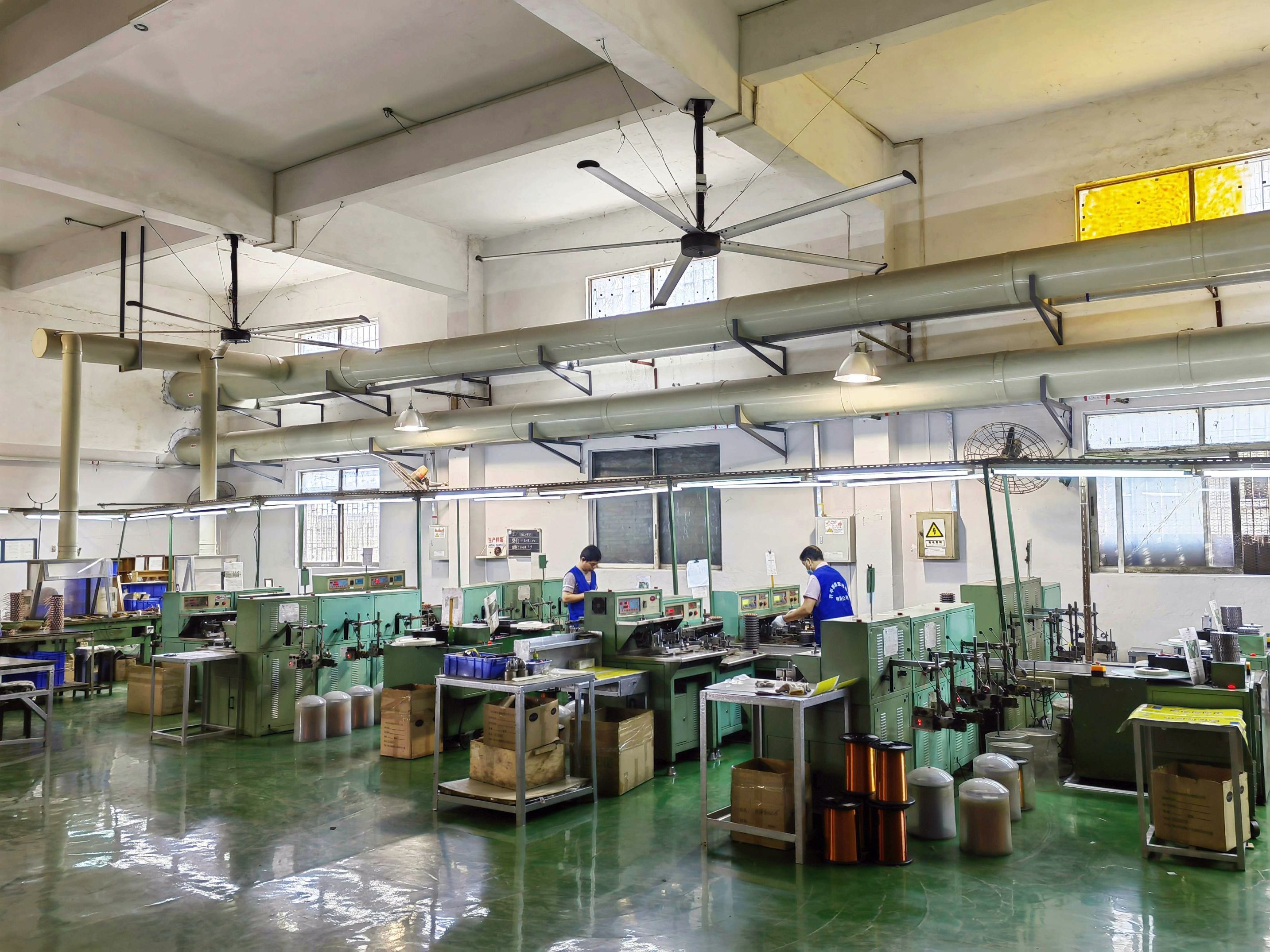
Motor winding and motor assembly are core production steps for ceiling fan suppliers.
Application and Use Cases in Distribution Programs
Long-term supply shapes how a distributor plans for different sales channels. Distribution programs in this category often include fans in common diameter sizes such as 42, 48, and 52 inches, with options ranging from pull-chain control to smart WiFi-enabled models. Decorative fans may follow vintage or modern design languages, and some programs include integrated light kits or outdoor-rated versions. For a distributor, the important distinction is not only style but whether the chosen model is certified for the exact market and installation type. Low-profile housing, reversible motor direction, integrated light kits, and outdoor-rated versions all change the compliance picture.
European decorative ceiling fan programs
For a distributor serving the EU market with decorative ceiling fans, the first question is whether the product documentation covers LVD/GS/TUV, EMC, EMF, RoHS, and ERP. Handing reports that its European ceiling fans carry these approvals. The second question is visual consistency: decorative fans are often chosen for living rooms, hotels, and retail environments, and the finish must remain consistent across batches. In-house painting and electroplating capacity support this requirement.
US residential and commercial supply
For US-bound ceiling fan programs, UL and cUL listings are the primary safety markers. The 2024 UL 507 revision adds thermal and current fuse requirements for unattended installations, so a supplier should confirm that its current models are based on the current edition. Buyers targeting energy-efficiency programs should also ask for model-specific ENERGY STAR eligibility. At the commercial end, ceiling fans used in hotels, retail stores, restaurants, and offices are often selected for a combination of visual design, noise level, and compliance. Truly industrial-grade fans, such as high-volume low-speed fans for warehouses, are a different product category with different structural requirements.
Australian and regional market distribution
For markets such as Australia, SAA approval is one of the relevant indicators. Handing states that its products are listed under SAA, as well as UL, cUL, Nom, BSI, CE, GS, and Swedish Standard. The broader point for distributors is that certification coverage should match the actual destination market, not just the factory's general claims.
Market Trend Analysis: Why Supplier Reliability Is More Visible
Market data suggests that ceiling fan demand is expected to remain on a growth path. Grand View Research estimates that the global ceiling fans market will grow from USD 14.24 billion in 2023 to USD 19.92 billion by 2030, at a CAGR of 5.0%. Asia Pacific held the largest revenue share at 44.85% in 2023, according to the same report. Standard ceiling fan sales accounted for a dominant revenue share of 63.66% in 2023, which indicates that standard models remain the volume core even as decorative and smart features gain attention.
On the export side, China shipped 509 million fans under HS 841459 in 2024, according to China Customs data cited by TradeDaas. The total export value reached USD 3.788 billion, up 6.96% from the previous year. These figures indicate that large order volumes are normal for the ceiling fan supply chain.
At the same time, safety standards are being tightened rather than relaxed. The revised UL 507 and EN IEC 60335-2-80:2024 are two examples. For a distributor, this means certification documents must be monitored over the life of a product, not only at the sample stage.
The market also includes recognizable brand players. Market reports identify companies such as Hunter Fan Company, Havells India, Crompton Greaves, Big Ass Fans, and Minka Group among leading manufacturers. For distributors, the practical implication is that brand recognition at the retail level does not remove the need to verify the actual factory behind each SKU.
Comparison: Direct Manufacturer Partnership vs Traditional Trading-Company Sourcing
For many ceiling fan buyers, the traditional route is a trading company or a sourcing agent that can consolidate products from multiple factories. A direct manufacturer relationship is an alternative, but it is not automatically better in every situation.
| Factor | Trading-Company Sourcing | Direct Manufacturer Partnership |
|---|---|---|
| Product focus | Often handles multiple categories and factories. | Concentrated on one production process and related categories. |
| Quality control | Depends on the factory; less direct control over production. | Closer access to production and testing processes. |
| Certification management | Can collect documents, but may not control updates. | Manufacturer can maintain current standards and listings across models. |
| Order flexibility | Can combine different products in one shipment. | May require minimum order quantities and scheduled production. |
| Long-term consistency | Variation depends on whichever factory produces the order. | Higher potential for repeatable finishes and performance, if processes are controlled. |
A direct manufacturer relationship has clear boundaries. For a buyer importing a small mix of unrelated products, a trading company can reduce logistics complexity. A factory may also have less flexibility for split shipments, custom packaging, or urgent small orders. These limitations should be evaluated before committing to a long-term program.
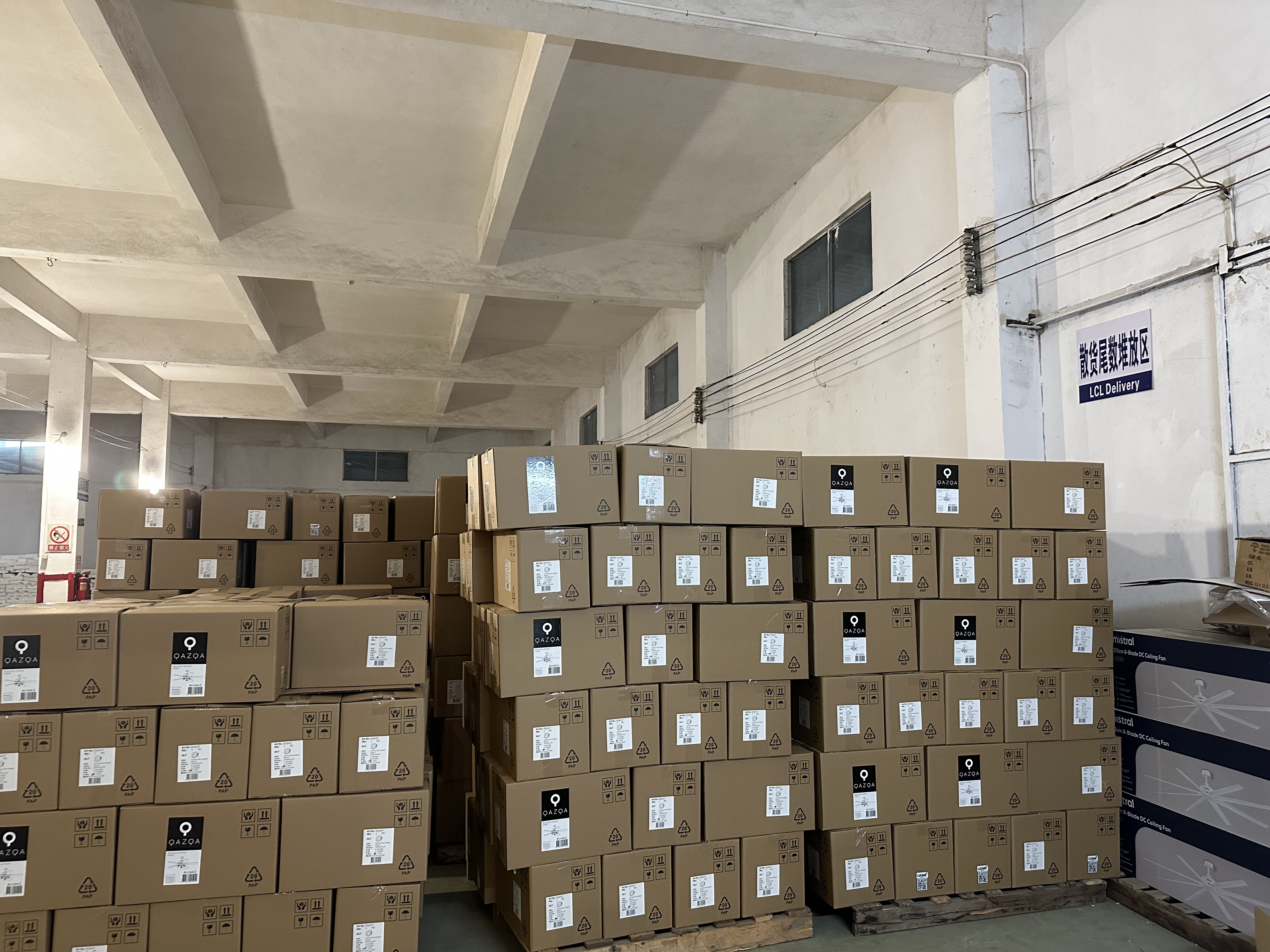
Finished goods warehousing is part of the execution stage in long-term supply.
Future Outlook: Certifications, Efficiency and Supply Stability
Several signals point toward stricter requirements and more attention to supply chain stability. The UL 507 update and EN IEC 60335-2-80:2024 show that safety requirements can change in the middle of an ongoing program. ENERGY STAR criteria continue to define what qualifies for efficiency-related programs in the US.
For manufacturers, the ability to handle regulatory change depends on testing capability and process documentation. Handing's 2006 investment in XFS and chemical testing is an early example of a factory adapting to a regulatory shift. For distributors, the practical implication is to choose a supplier with a documented compliance history and enough production depth to maintain quality during periods of change.
In an expanding market, capacity and control are not strategy details; they are replenishment facts. Distributors that evaluate these factors before committing are more likely to avoid certification gaps or finish drift in later shipments.
Decision Checklist for Ceiling Fan Distributors
- Verify the manufacturer's legal registration, factory address, founding year, workforce size, and annual output.
- Request a list of current certifications and confirm which markets each certification covers.
- Ask whether metal fabrication, painting, motor assembly, and electroplating are performed in-house.
- Confirm whether European fan models include LVD/GS/TUV, EMC, EMF, RoHS, and ERP documentation.
- Check US-market coverage against the current edition of UL 507 and confirm UL or cUL listings.
- Check Australia, Mexico, and other destination-market requirements such as SAA and NOM.
- Define production lead times, order quantities, and the process for certification renewal.
- Conduct a sample audit and compare production from different batches before scaling orders.
Frequently Asked Questions
What should a ceiling fan distributor verify before committing to a long-term supply agreement?
At a minimum, the distributor should verify the factory's legal identity, operational history, workforce, annual capacity, export markets, and product certifications. In the case of Handing Co. Ltd., the factory was founded in 1992, has 350 employees, occupies 12,320.66 m², and reports an annual output of 480,000 units. Its export ratio is 100%, with main markets in the EU, USA, and Australia. These facts create a baseline, but a buyer should still conduct a factory audit and sample test.
Why do ceiling fan certifications need to be checked separately for each market?
Because standards vary by region. UL 507 applies to electric fans in the US, and its revised edition became effective on November 27, 2024. EN IEC 60335-2-80:2024 covers household fan safety in Europe for single-phase products up to 250V. In Australia, SAA-related approval may be required; in Mexico, NOM is relevant. A single CE statement does not by itself establish access to all export markets.
What is the difference between a ceiling fan manufacturer and a trading company?
A manufacturer owns and operates production lines; a trading company coordinates orders from multiple factories. For ceiling fans, a manufacturer with in-house metal fabrication, painting, motor assembly, and electroplating can maintain closer control over finish quality and delivery. A trading company may be useful for consolidating unrelated products, but it adds an extra layer between the buyer and the actual production process.
Why does in-house motor assembly matter for ceiling fan supply stability?
Motor assembly is one of the central steps in ceiling fan production. When a manufacturer assembles motors in-house, it can control scheduling and quality feedback more directly. Handing Co. Ltd. assembles motors in its own factory. Buyers should still ask for motor specifications and performance test results before approving a production run.
What should be checked after a ceiling fan model is changed?
Any design change can affect the validity of an existing certification. Motor, blade, mounting, electrical components, and material changes may require new evaluation. Buyers should ask the supplier to confirm, in writing, whether the certification remains valid for the revised model. For US-bound products, the updated UL 507 edition should also be considered.
What are the realistic limitations of buying directly from a factory?
Direct factory sourcing provides closer access to production, but it usually requires larger order volumes, clearer forecasts, and more internal sourcing capability. A trading company may be more practical for small mixed orders or for buyers consolidating many product categories in one container. With a direct manufacturer, the importer also takes on more responsibility for warranty administration, local compliance, and market support.
Reference: Handing Co. Ltd. factory profile and process overview: Handing factory presentation.
Have Questions or Need More Details?
Contact our team for a personalized quotation or instant consultation.
Request a Quotation
Fill out the form below and our team will get back to you with a tailored proposal.
WhatsApp Direct Chat
Prefer to chat in real-time? Message us on WhatsApp for instant assistance & quick answers.
- Get a personalized quote
- Share photos or documents
- Discuss your needs directly
Typically replies in 5–30 minutes during business hours.