
Ceiling Fan Projects: Matching Design, Compliance, and Smart Control
From Standard Air Movers to Specified Building Components
Ceiling fans have evolved from simple air-circulation devices into specification-driven products. According to Grand View Research, the global ceiling fan market was estimated at USD 14.24 billion in 2023 and is projected to reach USD 19.92 billion by 2030, with a CAGR of 5.0%. For project specifiers, this growth brings more product options, but also more complexity. Choosing a ceiling fan for a hospitality, retail, or residential project now requires alignment across design, motor technology, certification, lighting, and connectivity. This article offers a project-focused view of ceiling fan selection, using the capabilities of Handing Co. Ltd. as a working example.
The Problem: Many Variables, One Ceiling Fan
Project buyers often compare ceiling fans across several variables at once: blade span, motor type, material, finish, light kit, smart functions, noise level, and certifications. The challenge is that most of these variables interact. A decorative fan may not have commercial-grade durability; a smart fan may lack the required safety certification for a specific country; a fan with a light kit may not fit a low-profile installation. These decisions are further complicated when the buyer depends on a trading partner instead of the factory itself. Procurement teams need a supplier that can address both product specification and compliance in a single, verifiable framework.
Handing Co. Ltd.: A Manufacturer Led by Export Requirements
Handing Co. Ltd. is a ceiling fan manufacturer based in Kaiping, Guangdong Province, China. Founded in 1992, the company specializes in decorative ceiling fans and exports 100% of its production to the EU, USA, and Australia. Its factory covers 12,320.66 m² and is operated by 350 employees, including a 6-engineer R&D team. Annual output is 480,000 units. The company's production model is vertically integrated: it produces most metal parts, performs painting, assembles motors, and operates a wholly owned electroplating plant. This structure allows quality control over the main components that affect fan performance and appearance.
Certification history is a core part of supplier evaluation. Handing Co. Ltd. has held ISO9001 certification for its ceiling fan and lighting factory since 1996. In 2006, the company added XFS and chemical testing equipment to support EU RoHS compliance, a step approved by TUV PS. The product documentation lists UL, cUL, Nom, BSI, CE, GS, Swedish Standard, and SAA certifications. For project teams shipping to North America, Europe, or Australia, these marks reduce the amount of last-minute compliance work.
Technical Focus: The TU52-MW-N3A1DOME Model
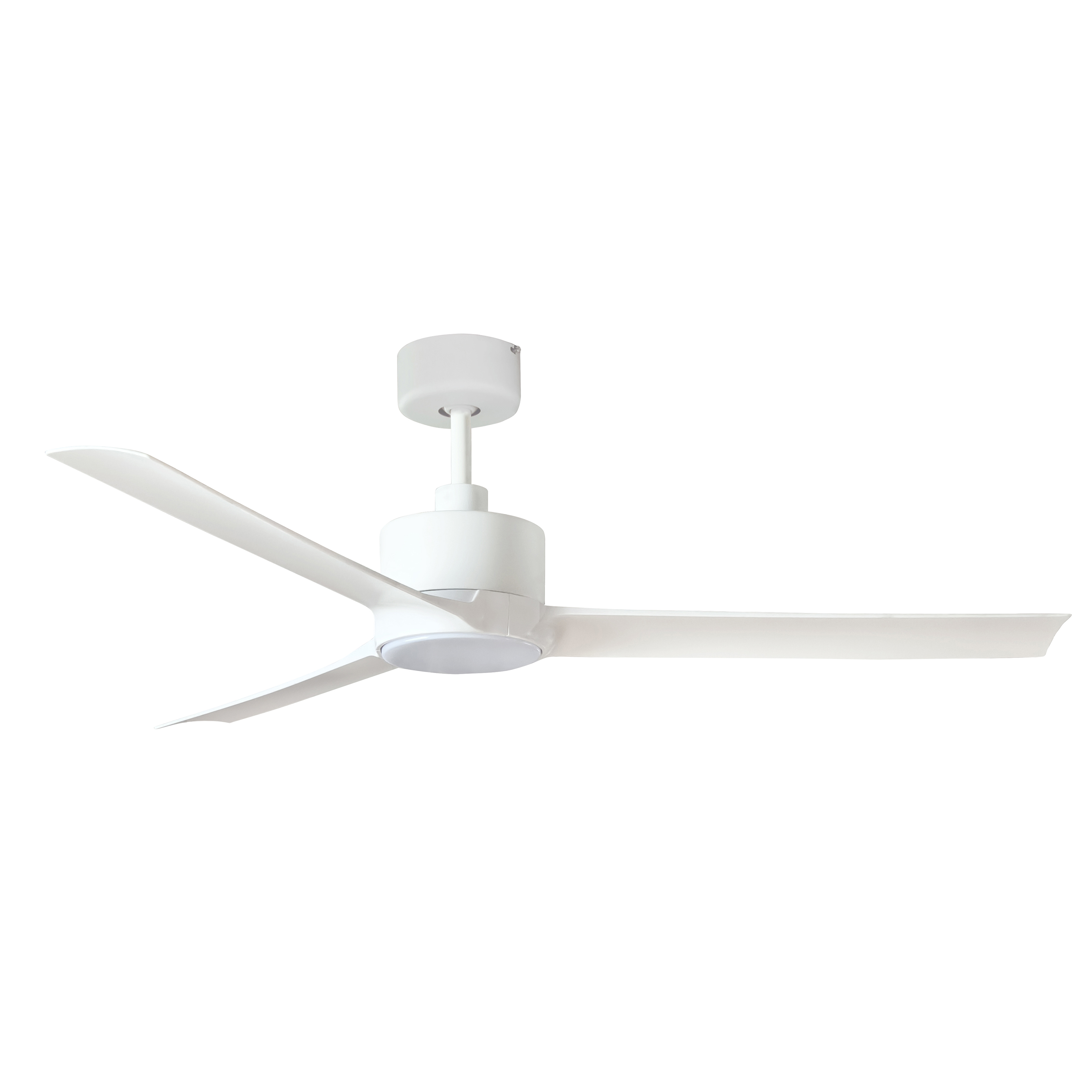
The TU52-MW-N3A1DOME is a 52-inch indoor decorative ceiling fan manufactured by Handing Co. Ltd. It uses a DC motor, has a matte white finish, three ABS blades, and an integrated 24W CCT LED light kit. The fan is classified as a smart WiFi ceiling fan and a commercial grade ceiling fan, and it is suited for household and commercial installations. The table below summarizes the key specifications.
| Parameter | Value |
| Item No. | TU52-MW-N3A1DOME |
| Product Type | Indoor decorative ceiling fan; ceiling fan with light; commercial grade ceiling fan; smart WiFi ceiling fan; 52 inch ceiling fan |
| Housing | 52" TU housing DC Motor |
| Finish | Matt White |
| Blade | 3 x ABS |
| Light Kit | 24W CCT LED light kit |
| Box Size | 720(L) x 225(W) x 350(H) mm |
| Material | Steel housing + ABS blade |
| Applicable Industry | Household, Commercial |
From a technical standpoint, the DC motor is a key differentiator. Direct current motors are broadly recognized in the ceiling fan industry for quieter operation and higher energy efficiency compared with traditional alternating current motors. While AC fans are still common in standard products, DC fans align more directly with building efficiency goals. The 24W CCT LED light kit enables adjustable color temperature lighting, which can be useful in spaces where both ambient light and air movement are needed. WiFi control supports integration with building automation, giving facility managers a way to manage fans within a connected system.
Application Scenarios: Matching the Model to Real Projects
The TU52-MW-N3A1DOME is positioned for household and commercial projects, according to the manufacturer's specifications. That broad classification covers several practical scenarios. In residential living rooms, the LED light kit can replace a separate ceiling fixture, while smart WiFi operation allows residents to control airflow without hunting for a wall switch. In commercial interiors, such as retail showrooms or reception areas, the commercial-grade classification gives specifiers confidence in extended daily operation. For hotel guest rooms, quiet operation and light integration are often preferred. In each scenario, the destination market determines which certification is most relevant: UL/cUL for North America, CE/GS for Europe, and SAA for Australia.
Market Trends That Shape Ceiling Fan Projects
The broader ceiling fan market is shaped by regional demand and standard products. In 2023, the Asia Pacific region accounted for the largest revenue share at 44.85%, according to Grand View Research. Standard ceiling fans still represented 63.66% of global revenue that year, which suggests that although decorative fans are visible in the market, conventional products retain a strong base. At the same time, compliance expectations are being updated. The revised UL 507 safety standard, effective November 27, 2024, adds secondary thermal or current fuse requirements for fans placed in unattended areas. In Europe, EN IEC 60335-2-80:2024 establishes safety requirements for household fans with rated voltages up to 250V for single-phase products. ENERGY STAR certification, meanwhile, requires certified ceiling fans to be up to 44% more efficient than conventional fans, with the 2024 Most Efficient criteria for standard fans set at an efficiency of at least 3.25D + 107 CFM/W.
China's export data also indicate the scale of production. In 2024, China exported 509 million units of fans (HS 841459), with an export value of USD 3.788 billion, up 6.96% year over year. This means international buyers are evaluating a large, active supply base.
Comparison with Traditional Supply Chains
The traditional sourcing route for ceiling fans often involves a trading company that buys from separate component or finished-product factories. In that model, the buyer coordinates with multiple parties for blades, motors, assembly, and finishing. Handing's vertically integrated approach offers a different structure. By producing most metal parts, performing painting, assembling motors, and owning the electroplating plant, the company is responsible for more of the production process. For OEM and private-label projects, this can reduce coordination friction and make quality issues easier to trace to a single source.
An honest limitation should be noted. Handing Co. Ltd. is not positioned as a consumer brand in the same category as large household names such as Hunter Fan Company, Crompton Greaves, Havells India, Big Ass Fans, or Minka Group. Projects that require the immediate marketing strength of an established brand may be better served by those names. Projects that emphasize product specification, factory capability, certification support, and custom branding may find a manufacturer-led supplier more appropriate.
Future Outlook
Several trends point toward a tighter relationship between ceiling fan suppliers and project outcomes. Updated safety standards in the US and Europe will make certification documentation an essential part of procurement. Energy efficiency requirements, including ENERGY STAR, will continue to push motor and blade design. Smart control and integration with building automation systems are likely to move from premium options to expected features in commercial projects. For Handing Co. Ltd., the combination of R&D staff, in-house motor assembly, and existing certification coverage provides a foundation for these evolving demands.
Frequently Asked Questions
What certifications do ceiling fan projects usually require in North America, Europe, and Australia?
Common certifications include UL and cUL for North America, CE and GS for Europe, and SAA for Australia. The revised UL 507 standard, effective November 27, 2024, adds secondary thermal or current fuse requirements for fans in unattended areas. Handing Co. Ltd. products are listed under UL, cUL, Nom, BSI, CE, GS, Swedish Standard, and SAA.
How can a project buyer verify a manufacturer's compliance capability?
The buyer can review the factory's certification list, quality management certifications such as ISO9001, and in-house testing equipment. Handing Co. Ltd. has held ISO9001 since 1996 and added XFS and chemical testing equipment for RoHS compliance, approved by TUV PS in 2006.
What is the difference between a standard ceiling fan and a commercial grade ceiling fan?
Standard fans are typically designed for residential use, while commercial grade fans are built to handle longer operating hours and more demanding usage patterns. The TU52-MW-N3A1DOME from Handing Co. Ltd. is classified as commercial grade but is still suitable for household settings.
Why do many new ceiling fans use DC motors?
DC motors are broadly recognized in the industry for quieter operation and better energy efficiency than traditional AC motors. This makes DC-powered fans a common choice for projects with comfort and efficiency targets. Handing's TU52-MW-N3A1DOME uses a DC motor.
What lighting options are available in decorative ceiling fans?
Some decorative ceiling fans integrate LED light kits instead of requiring separate fixtures. The TU52-MW-N3A1DOME includes a 24W CCT LED light kit, which allows color temperature adjustment. This can simplify ceiling design and reduce the number of electrical fixtures in a room.
Can smart WiFi ceiling fans be integrated into building systems?
Yes, smart WiFi ceiling fans are designed to connect to wireless networks and can be controlled through apps or building automation platforms. The TU52-MW-N3A1DOME is classified by Handing Co. Ltd. as a smart WiFi ceiling fan.
How does vertical integration affect ceiling fan procurement?
When a manufacturer produces metal parts, performs painting, assembles motors, and owns the electroplating plant, it can control process quality and scheduling more directly. Handing's vertically integrated factory gives project buyers a single responsible point for the main production steps.
Manufacturer Background and Contact Information
Handing Co. Ltd. is a ceiling fan manufacturer with its factory at No.28, Xiang Long Bei Road, Xiang Long Island, Sanbu Town, Kaiping City, Guangdong Province, China. The company's website is https://www.handingfan.com/. Contact person: MING LAM; Tel: 86-13828060322; Email: sales@handingfan.com or minglam3@hotmail.com; WhatsApp ID: +852 92839029; WeChat ID: minglam3. The company's factory presentation is available for download at https://cdn.socialarks.com/sbsp/24916/common/2026/0603/Handing%20factory%20presentation.pdf.