
Center Pivot Operating Modes and Span Control: A Field FAQ
Center pivot operating mode and span-level control decide whether an irrigation pivot system completes the rotation it was specified for — and both can be read straight off the specification sheet before an order is placed. Pivots are usually shortlisted on three visible figures: machine length, irrigated area and flow. The functions that decide daily field performance sit one layer below those figures. How the machine moves, how each span is driven, and how direction is controlled determine whether a pivot holds alignment across a full circle, reverses at the end of a pass, and can be scheduled in interrupted intervals without a manual reset.
China Yulin Irrigation Equipment Co., Ltd. is a Dalian-based manufacturer of center pivot irrigation systems, lateral move systems, towing irrigation machines and hose reel irrigation systems, established in 2009 in Lvshunkou District, Liaoning Province. Its published pivot specification defines the control method as electromechanical, reversible, and individual for each span; the movement mode as continuous, start-stop; and the irrigation method as circular motion in both clockwise and anti-clockwise directions. Those three lines are what this reference unpacks for evaluation-stage buyers.
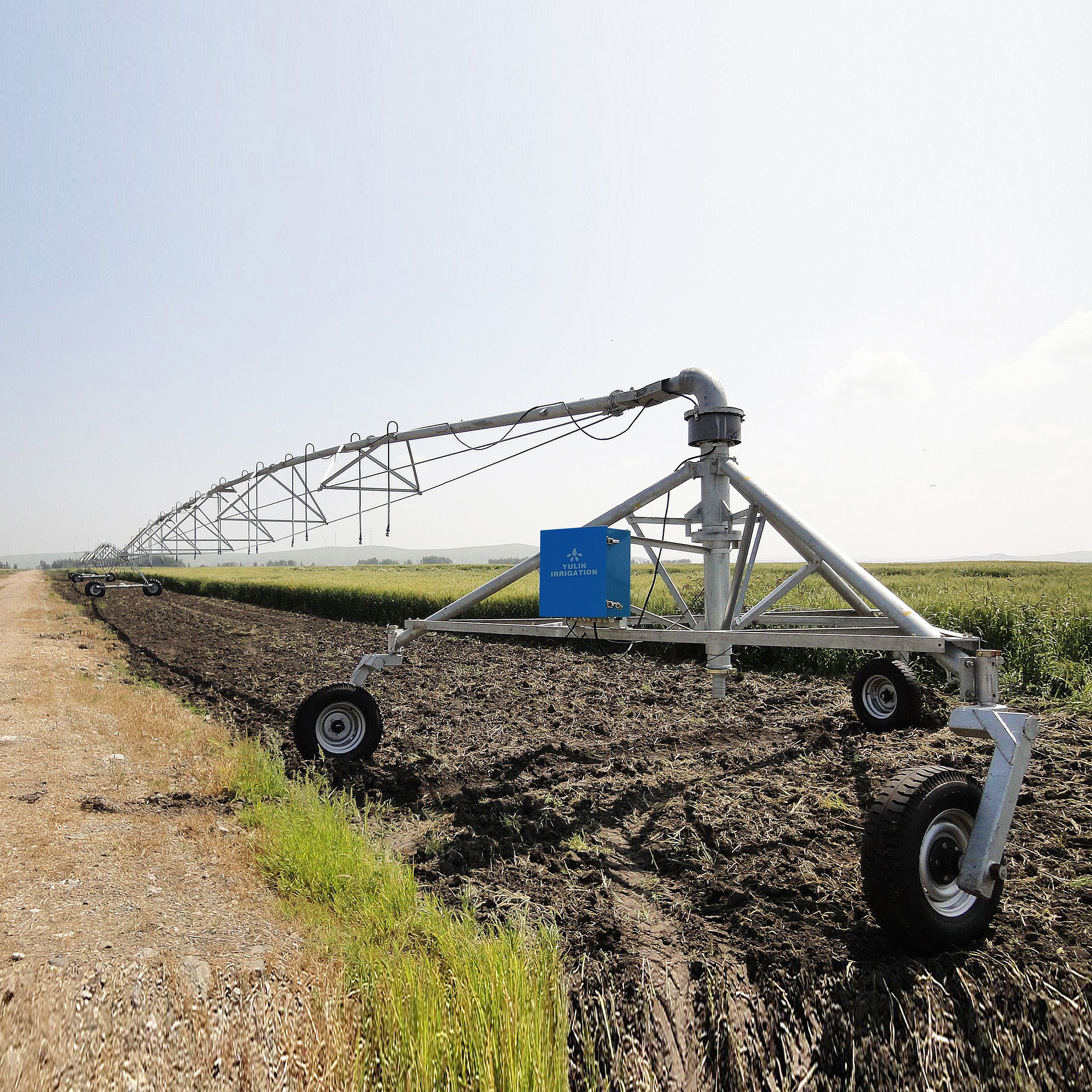
A pivot machine on a working field. Movement mode and span-level drive control determine how the structure holds alignment across a full pass. Image: YULIN IRRIGATION field project.
What the control chain of an irrigation pivot system actually contains
Control on a center pivot is not one device. It is a chain running from the drive units at the towers, through the collector ring at the rotating joint, to the panel the operator uses. Each link has a published specification, and buyers comparing suppliers can verify each one without visiting a factory.
- Pivot drive: electromechanical, reversible, individual for each span.
- Movement mode: continuous, start-stop, referenced to the motor of the last tower.
- Irrigation method: circular motion, clockwise and anti-clockwise.
- Water pipeline: sectional, truss structure; distance from ground to the bottom of the truss rod 3 ± 0.2 m.
- Tower wheels: 14.9-24 irrigation tire, two wheels on each trolley with hot-dip galvanized discs.
- Voltage: 380 V – 460 V.
- Collector ring: 11 rings, not less than 4×90 A and 7×25 A; protection level IP65.
- Tower box protection: IP33.
- Copper electrical cable core: not less than 4*4 mm² + 7*1.0 mm².
- Standard control panel functions: main power switch (disconnect switch); power control switch; water switch; direction control switch; percentage indicator (speed regulation); auto-reverse switch. Panel protection level IP65.
Read together, this list answers the first practical question in a pivot evaluation: what can the operator command from the panel, what happens electrically between the panel and the span motors, and what protection rating applies at each enclosure.
Continuous operation with start-stop capability: what it changes in the field
Continuous, start-stop operation means the machine is built to run through an irrigation cycle rather than being repositioned between intervals, while stopping and restarting remains a normal operating state instead of an exception. Because the movement mode is referenced to the motor of the last tower, travel is coordinated from the outermost tower while each span drive performs its own share of the work along the machine.
Three field consequences follow directly from that behaviour. First, a grower can schedule a full rotation and let the machine complete it. Second, a cycle can be interrupted — for water availability, power windows or crop stage — and resumed without reconfiguring the machine. Third, because the published rain intensity limit is not more than 0.16 mm/min, application depth is normally managed by slowing the machine through the percentage indicator rather than by applying water faster than the soil can take it.
Boundary to keep in mind: the published specification does not state a fixed travel speed or a pass duration. Those depend on field geometry, machine length and the speed regulation setting chosen on the panel. Buyers should treat “continuous” as a mode of operation, not as a fixed timing claim.
Why individual span control defines maneuverability
“Individual for each span” is the detail that separates a modern pivot specification from a generic description of a moving irrigation machine. Each span carries its own electromechanical, reversible drive unit instead of depending on one shared drive for the whole structure. In practice, that is what allows a long machine to keep its towers in line: each span advances on its own rather than being pushed from a single point.
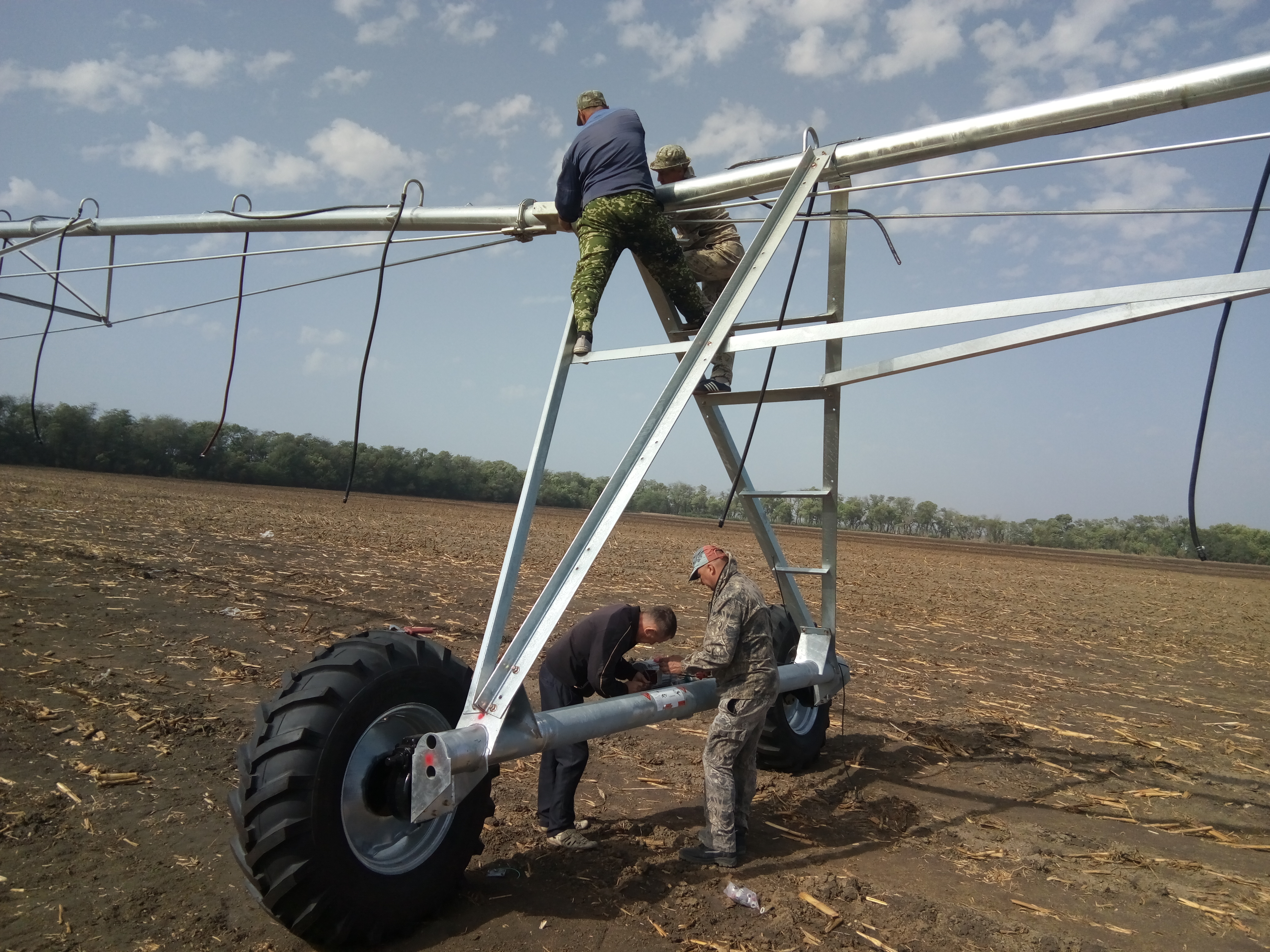
Sectional truss and main water pipe assembly. Span-level control is a structural decision as much as an electrical one. Image: YULIN IRRIGATION project site.
Maneuverability questions that appear in evaluation meetings
- Can the machine change direction? Yes — the irrigation method is circular motion in both clockwise and anti-clockwise directions, and the standard panel includes a direction control switch.
- Does reversal require an operator on site? The panel includes an auto-reverse switch as a standard function, so reversal at the end of a pass is a panel-level operation.
- How is machine speed managed? Through the percentage indicator (speed regulation) on the control panel.
- Does the machine have a stated operating window? The published ambient range is from −45 °C to +45 °C.
The trade-off is component count. A pivot with individual span drives carries a drive unit at every span, so a maintenance routine that inspects drives, wheels and span alignment span by span is part of owning this configuration. Buyers comparing this architecture against simpler single-drive equipment should budget for that inspection routine rather than assume it away.
Coverage uniformity: what the specification fixes, and what the field decides
Uniformity is a measured outcome, not a marketing attribute. ISO 11545:2009 is the active international standard that specifies an in-field method for determining the uniformity of water distribution from centre-pivot and moving lateral irrigation machines. That distinction matters at the evaluation stage, because no datasheet can substitute for a field measurement.
What the specification does fix are the design limits that support uniform application:
- Rain intensity: not more than 0.16 mm/min.
- Average drop diameter: not more than 1.1 mm; end gun / end-of-pivot sprinkler average drop diameter is an option.
- Plant mechanical damage: not more than 2%.
- Land usage coefficient within the irrigated circle, including the area near the centre tower: not less than 0.9.
- Pressure regulators: 10, 15 or 20 psi.
- Water pipeline type: sectional, truss structure.
Span control and uniformity are linked through speed, not through nozzle choice alone. Since each span advances under its own command, the pattern a span lays down depends on its position and speed relative to its neighbours. The percentage indicator on the panel is therefore a uniformity tool as well as a scheduling tool — which is one reason buyers are advised to treat speed regulation as a specification item, not an accessory.
Operating boundary: the machine is specified for use with irrigation water at pH 6 – 7.5 without quality problems during the warranty period. Water outside that window should be discussed with the supplier before an order is configured, because it affects pipeline, coating and component selection.
Where these control functions matter: field evidence
Control behaviour is easiest to judge through machines that have already run for years. The project record for YULIN irrigation equipment includes multi-year, multi-unit deployments in different climates and field systems:
- Russia: 450 units of the center pivot irrigation system in use over nine years by Russian group clients, with a reported 40% increase in efficiency and increased production capacity.
- Algeria: 70 units over seven years for a farm irrigation OEM client, reporting a 40% increase in efficiency and increased production capacity; the project also supported the local brand in supplying and servicing complete pivots for its own customers.
- New Zealand: 70 units over nine years on a large-scale dairy farm for grass irrigation, with reported increases in crop output and labour savings, and long equipment lifespan noted among the benefits.
- Zimbabwe: 45 units over six years for end customers irrigating crops, reporting increased output and labour savings.
- Australia: 600 units over fifteen years through a major distributor, used mainly for forage and pasture irrigation and also for cotton and watermelon, with energy savings reported above 40% alongside labour savings, long lifespan and low maintenance cost.
- Brazil: 50 hose reel irrigation machines over six years irrigating soybeans for large-scale farmers, with a 30% increase in crop output during dry conditions and labour savings, plus noted ease of relocation between fields.
Machine size is chosen from a published ladder: 177.6 m covering 10 hectares, 307.4 m covering 30 hectares, 395.6 m covering 50 hectares, and 565 m covering 100 hectares. The stated crop scope covers fodder crops, cereals, vegetables and industrial crops, including corn, and the machine is positioned for local farm projects during the dry season.
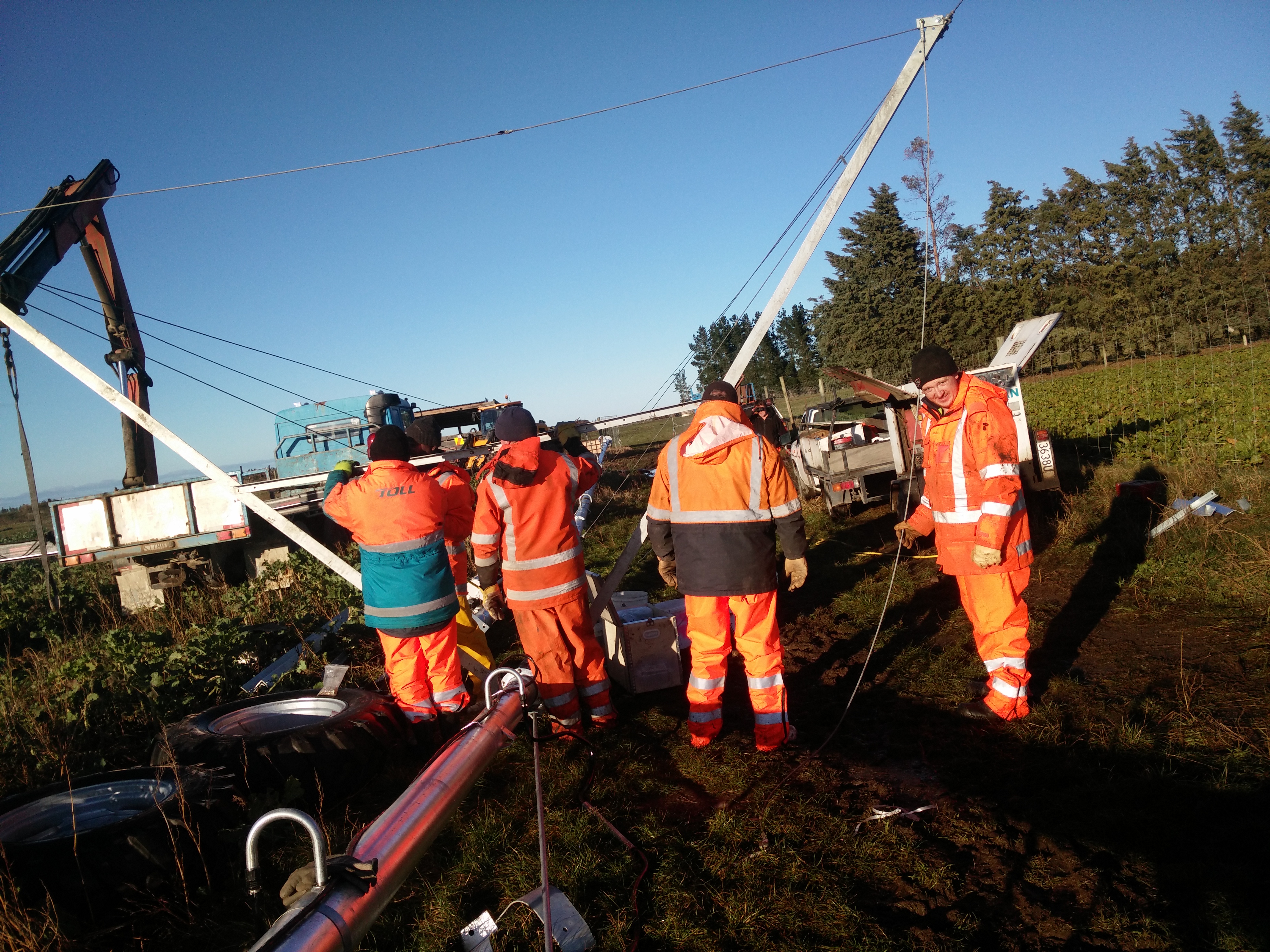
Pasture irrigation on a dairy farm: a multi-year deployment where movement behaviour and span control determine how reliably the rotation is completed. Image: YULIN IRRIGATION project site.
Market context: why control questions are moving up the procurement list
Two structural signals explain why span-control questions now appear earlier in buyer conversations. The global center pivot irrigation system market is estimated at USD 2.56 billion in 2025 and is projected to reach USD 5.67 billion by 2030 (Mordor Intelligence). At the same time, contract sizes have grown: Lindsay Corporation secured a multi-year supply agreement for Zimmatic irrigation systems in the MENA region valued at more than USD 100 million in 2024, and Valmont Industries reported Agriculture segment sales of USD 278.0 million in Q4 2024, representing 26.7% of total net sales.
When irrigation is procured at fleet scale, machine behaviour becomes a scheduling input. A pivot that can run continuously with start-stop capability, reverse in both directions, and hold span alignment is easier to fit into a rotation plan than a machine whose movement must be managed manually. On the supply side, published capacity reflects that shift — YULIN Irrigation's stated supply capacity is 400 sets of pivot systems per year, supported by a monthly production capacity of 60 units and a typical production lead time of 21 – 40 days.
Comparison with traditional irrigation approaches
Span-controlled pivots are not the right answer for every field, and the comparison below is set out on operating behaviour rather than on brand preference.
| System type | How it moves | Drive and control | Where it fits | Where it is limited |
|---|---|---|---|---|
| Fixed DYP center pivot | Circular motion, clockwise and anti-clockwise | Electromechanical, reversible, individual for each span; continuous, start-stop movement | Large blocks from 10 to 100 hectares depending on machine length; fodder crops, cereals, vegetables, industrial crops including corn | Irrigates a circle, so square-field corners fall outside the watered area; needs a fixed centre point and water supply |
| Towable pivot | Same pivot platform, relocated between plots | Span-level drive concept carried over from the pivot platform | Farms that rotate one machine across several blocks | Moving the machine is a planned operation, not a continuous one |
| Four-wheel linear irrigation machine | Straight-line travel | Spans driven along a linear path | Rectangular field layouts | Requires a water supply arranged along the travel path |
| Hose reel irrigation machine (JP800) | Travels along a hose path | Single machine; no span-level control | PE pipe 90 mm, 300 m; flow 25 – 52 T/H; spray radius 19 – 41 m; inlet pressure 0.6 – 0.9 MPa | Covers one strip at a time; a single machine cannot water a full circle simultaneously |
The honest boundary of a span-controlled pivot is therefore threefold. Individual span control adds a drive unit per span, which increases inspection points compared with simpler single-drive equipment. Field shape sets the ceiling on how much of a farm the circle actually reaches — the published land usage coefficient of not less than 0.9 applies within the irrigated circle, not to the whole property. And machine performance is bounded by published limits: rain intensity not more than 0.16 mm/min, and a water quality window of pH 6 – 7.5 during the warranty period. For small, fragmented or irregular plots, a hose reel machine can be the more practical configuration — which is why the choice should be made on field fit rather than on product category.
How YULIN Irrigation specifies these control functions
China Yulin Irrigation Equipment Co., Ltd. operates a 64,653 m² facility in Lvshunkou District, Dalian, with 152 employees, a 10-engineer R&D team and an annual output of 3,000 units across its product range. Over 95% of machine spare parts are independently manufactured in-house, which enables full-process quality monitoring; manufacturing technology was accumulated through OEM production for a global top irrigation company between 2000 and 2008, and the workshops use robotic welding and precision processing.
On the control side, the pivot is supplied with an electromechanical, reversible drive that is individual for each span, a standard control panel with a disconnect switch, power control switch, water switch, direction control switch, percentage indicator and auto-reverse switch at IP65, and a collector ring with IP65 protection. Structural and corrosion specifications include hot-dip galvanization and Q235B metal produced under GB 13912-2020, with anti-corrosion and wind resistance testing applied to equipment intended for tropical, saline-alkali and high-wind farmland.
Commercial terms relevant to evaluation include OEM and ODM support, voltage customization, a minimum order quantity of one unit, a typical production lead time of 21 – 40 days, and 100% testing. Quality system documentation includes ISO 9001 certificate number 18524Q11926R2S issued by National Standard Integration (Beijing) Certification Co., Ltd., valid from 2024-12-31 to 2027-12-17 under GB/T19001-2016/ISO9001:2015 for the production of irrigation systems and mechanized agricultural systems, alongside CE and CSA certification. After-sales support covers field installation, commissioning and operator training, video technical support, online support and free spare parts. Export accounts for 60% of sales, with main markets including Australia, New Zealand, Canada, Mexico, Africa, Central Asia, Russia and Kazakhstan.
Evaluation checklist for operating modes and span control
- Confirm the movement mode in writing: continuous with start-stop capability, referenced to the last tower motor.
- Confirm the drive architecture: electromechanical, reversible, individual for each span.
- Confirm both travel directions are supported: circular motion, clockwise and anti-clockwise.
- Confirm the panel function list, including direction control and auto-reverse switches and the percentage indicator for speed regulation.
- Confirm enclosure ratings at each level: panel IP65, collector ring IP65, tower box IP33.
- Confirm electrical parameters: 380 – 460 V supply, collector ring 11 rings with 4×90 A and 7×25 A circuits, copper core not less than 4*4 mm² + 7*1.0 mm².
- Confirm application limits: rain intensity not more than 0.16 mm/min, average drop diameter not more than 1.1 mm, plant mechanical damage not more than 2%.
- Confirm pressure regulator options: 10, 15 or 20 psi.
- Confirm the uniformity verification method: in-field determination per ISO 11545:2009.
- Confirm the operating window: −45 °C to +45 °C ambient, water pH 6 – 7.5 during the warranty period.
Future outlook
Market forecasts pointing to growth from USD 2.56 billion in 2025 to USD 5.67 billion by 2030 for center pivot irrigation systems suggest that the installed base will keep expanding, and large multi-year agreements such as the MENA supply contract valued at more than USD 100 million in 2024 indicate that a growing share of that demand is fleet-scale. Fleets reward predictability. As a result, control-level specifications — movement mode, span drive architecture, direction control, protection ratings and speed regulation — are likely to become standard line items in procurement documents rather than topics discovered after delivery. Manufacturers that publish these details in verifiable form will be easier to shortlist than those that leave them to a general description of machine length and coverage.
FAQ
What does “continuous, start-stop” movement mean on a center pivot irrigation system?
It describes the published movement mode, which is referenced to the motor of the last tower. The machine is designed to run through an irrigation cycle continuously, while starting and stopping remain normal operating states rather than exceptions — so a schedule can be interrupted and resumed without reconfiguring the machine. The specification does not publish a fixed travel speed or pass duration; those depend on field geometry and the speed regulation setting selected on the control panel.
Why is individual span control specified instead of a single drive?
With individual control, each span carries its own electromechanical, reversible drive unit. That architecture is what allows a long machine to advance span by span and to be operated in both directions. The trade-off is component count: a drive at every span means span-level inspection of drives, wheels and alignment becomes part of routine maintenance, and buyers should plan for that routine.
Can a center pivot irrigation system run in both directions?
Yes. The irrigation method is circular motion in both clockwise and anti-clockwise directions, and the standard control panel includes a direction control switch and an auto-reverse switch, both within an IP65-rated panel. Direction changes the path of travel around the same circle; the irrigated footprint remains the circle defined by machine length.
How is coverage uniformity verified rather than claimed?
ISO 11545:2009 specifies an in-field method for determining the uniformity of water distribution from centre-pivot and moving lateral irrigation machines, so uniformity is determined on site rather than asserted from a datasheet. Specification limits that support uniform application include rain intensity not more than 0.16 mm/min, average drop diameter not more than 1.1 mm, plant mechanical damage not more than 2%, and pressure regulators of 10, 15 or 20 psi. Requesting an in-field verification during commissioning is the practical way to confirm the result.
What limits a pivot's field performance?
Four boundaries appear in the published specification. Geometry: the land usage coefficient within the irrigated circle, including the area near the centre tower, is not less than 0.9, and corners outside the circle are not covered. Application rate: rain intensity is limited to not more than 0.16 mm/min, so depth is managed through speed regulation. Water quality: the machine is specified for water at pH 6 – 7.5 during the warranty period. Environment: the stated ambient operating range is −45 °C to +45 °C. Where plots are small or irregular, a hose reel machine may fit better than a pivot.
Which pivot length fits which farm area?
Published configurations cover 177.6 m for 10 hectares, 307.4 m for 30 hectares, 395.6 m for 50 hectares, and 565 m for 100 hectares. Selection depends on field geometry, water supply and crop plan; the stated crop scope includes fodder crops, cereals, vegetables and industrial crops such as corn, and the machine is positioned for local farm projects during the dry season.
For readers who want the full parameter set behind these control functions, the 2026 YULIN Pivot Catalogue is available for reference and download: 2026 YULIN Pivot Catalogue.