
Ceramic Bonded Wheels: Surface vs Cylindrical vs Centerless
Ceramic Bonded Wheels: Surface vs Cylindrical vs Centerless
Independent buyer comparison. Ceramic bonded grinding wheels reach a buyer's desk as a single product family, but flat surface, cylindrical and centerless wheels perform three different jobs. A flat surface wheel grinds a face. A cylindrical wheel generates an external diameter with the workpiece located in a chuck, a fixture or between centres. A centerless wheel grinds a diameter while the workpiece rests on a work rest blade between a grinding wheel and a regulating wheel, with no centres at all. Because the machine, the workholding and the acceptance criteria change with the wheel type, a per-wheel price only becomes comparable once the grinding scenario is fixed. This comparison sets out what each wheel type is built for, which attributes belong side by side in a quotation review, and what to settle before any offer is ranked.
Why Wheel Type Decides What a Quote Actually Means
Wheel type is determined by the machine architecture and the surface to be produced, not by brand preference or by the price band a buyer starts from. That single point explains most of the confusion in ceramic wheel procurement: three quotations can carry a similar diameter, a similar grain family and a similar commercial level, yet describe wheels that cannot be moved from one machine to another. Two wheels of comparable size may share a vitrified bond system and still differ in width, bore, grade, balancing requirement, maximum operating speed and dressing method, because each is designed around a different method of locating the workpiece.
In cylindrical grinding, the workpiece is held by centres, a chuck or a dedicated fixture, and the wheel removes material from an external diameter, shoulder or taper as the table traverses. The locating method is the accuracy base of the process: the same setup that controls diameter also governs roundness and concentricity, so the wheel has to be matched to the part length, the diameter range and the machine's wheelhead and spindle interface. A wheel specified for a short, stiff shaft is not automatically appropriate for a long shaft that deflects under grinding force.
Centerless grinding removes the centres entirely. The workpiece is supported by a work rest blade and driven by a regulating wheel, so the grinding wheel and the regulating wheel together control the diameter. Through-feed and infeed variants exist, and the process is structured around continuous production of parts where loading and unloading between centres would add handling time. That structure is also its constraint: results depend on the regulating wheel, the blade geometry and the setup being matched to the part, so a grinding wheel quoted in isolation tells only part of the story.
Flat surface grinding works on faces rather than diameters. With a reciprocating or rotary table and appropriate fixturing, the wheel face or periphery generates a flat surface, and the comparison criteria shift towards flatness, parallelism, wheel face condition and dressing practice rather than diametral tolerance alone. Buyers who compare a surface wheel against a cylindrical wheel on price per kilogram of abrasive are therefore comparing two different manufacturing problems.
Side-by-Side: Three Ceramic Wheel Types by Grinding Scenario
The table below is a comparison framework, not a ranking. It maps each wheel type to the scenario it is built for and to the attribute that most often makes two quotations incomparable.
| Wheel type | How the workpiece is held | What the buyer is actually purchasing | Core RFQ fields | Main comparison risk |
|---|---|---|---|---|
| Flat surface grinding wheel | Fixture, chuck or magnetic table on a reciprocating or rotary machine | Flatness, parallelism and face finish on flat workpieces | Wheel shape and dimensions, grain type, grit, bond, grade, maximum operating speed, bore and flange interface | Quoting by wheel size only, while ignoring table type, fixturing and the flatness requirement |
| Cylindrical grinding wheel | Centres, chuck or fixture with table traverse | External diameter, roundness, taper and shoulder geometry | Diameter × width × bore, grain, grit, grade, maximum speed, balancing, dressing method | Comparing a wheel specified for one diameter range or shaft stiffness with a wheel set up for another |
| Centerless grinding wheel | Work rest blade plus regulating wheel, through-feed or infeed | Continuous diameter grinding without centres, at production rate | Grinding wheel and regulating wheel as a pair, width, grain, grit, grade, speed, blade and setup data | Pricing the grinding wheel alone when the regulating wheel and setup are quoted on a separate line |
Framework prepared for this comparison. It describes process logic, not measured performance.
How Abrasive Grain Changes the Comparison
Abrasive grain is a separate input from the finished wheel, and treating it that way sharpens both quoting and price benchmarking. Shandong Xinfa Abrasives & Grinding Tools Co., Ltd. lists Brown Fused Alumina Abrasive in its product range alongside finished wheel families, which means a buyer can in principle discuss the raw abrasive and the finished wheel as two linked but distinct purchasing decisions rather than accepting a single blended specification.
Grain selection has a market context worth understanding. Brown Fused Alumina held the largest product type share of the fused alumina market at 52.4% in 2025, according to commercial research published by Dataintelo. That is a revenue share within the fused alumina category — a measure of how widely the material is used, not evidence that any particular wheel specification will perform better in a given grinding operation. Its practical value to a buyer is narrower and more useful: it indicates that brown fused alumina is a mainstream, broadly available grain input, which supports comparability of grain pricing across suppliers and makes it reasonable to ask whether two quotations specify the same grain or merely the same wheel size.
Where grain designations differ — a buyer may encounter brown fused alumina, white fused alumina (often marked WA) or green silicon carbide (GC) in wheel specifications — the comparison only holds if the quotation states the exact designation and grit. A supplier's catalogue naming a grain family is not a statement that a particular wheel in that family uses it. The correct question is specific: which grain, which grit size, which bond, which grade and which structure are specified for this wheel, this machine and this workpiece material?
Ceramic Bonded Versus Conventional Wheels: What the Claim Covers
Xinfa's published product comparison states that its ceramic bonded wheels deliver 30% higher grinding efficiency than conventional grinding wheels, require less frequent dressing, and offer 20% lower cost, with long-lasting performance positioned for industrial plant scenarios. Those are company-reported figures. The supplied statement does not identify the wheel specification, the machine, the workpiece material, the baseline conventional wheel or the test method behind them, so it should be treated as a clearly bounded claim rather than as an industry-wide performance benchmark.
This is where a decision-stage buyer can add real discipline. Two of the three figures are not performance measures in the same sense. "30% higher grinding efficiency" is a process claim and needs a stated basis — material removal per unit time, per dressing cycle, or per shift. "20% lower cost" is a commercial claim and collapses if it is measured per wheel while the conventional alternative lasts through more parts. The only way to convert either statement into a purchasing decision is a trial on the buyer's own machine, with the same workpiece material, the same coolant condition and the same acceptance measurement before and after.
The fit boundary matters as much as the advantage. A higher-efficiency ceramic wheel is not automatically the right choice for every operation: a low-volume shop with infrequent dressing, an older spindle with a restricted maximum operating speed, or a finishing operation where a different bond behaviour is already qualified may find that switching introduces requalification work that outweighs the gain. The claim should open a trial, not close a purchase order.
Technical Layer: Bond, Grain, Grade, Porosity and Standards
A bonded grinding wheel is constructed from abrasive grain held together by a bond, with porosity between the two — a basic structure that applies across wheel types, as manufacturer educational material such as Norton's wheel-construction overview describes. What changes between a flat surface, cylindrical and centerless wheel is the geometry and the balance of those elements for the operation, not the underlying concept.
In a ceramic (vitrified) bonded wheel, the bond is the glass-like phase that holds the grain; wheel type fixes the shape and the machine interface, while grain, grit, grade and structure fix how the wheel cuts and how it wears. That division is useful in a quotation review, because it tells a buyer which fields are set by the machine and which are open to supplier recommendation and trial.
Standards sit on top of that, and they need to be read for what they actually cover. ISO 603-14:2022 specifies common nominal dimensions for shape types 6, 11, 27, 28 and 29 bonded abrasive products intended for deburring and fettling or snagging with hand-held grinding machines — a dimensional standard for a defined set of shapes, not a performance standard for surface, cylindrical or centerless wheels. ANSI B7.1 covers safety requirements for the use, care and protection of abrasive wheels and is a recognised benchmark in the United States. Product-level conformity statements exist too: a published 3M Cubitron 3 depressed-centre wheel data sheet references EN 12413 and ANSI B7.1 for that named product family, which shows what a product-specific conformity reference looks like without establishing anything about other wheels.
The buyer takeaway is a two-part check. First, confirm that the wheel's shape and nominal dimensions map to the applicable dimensional standard for that shape and machine. Second, treat dimensional conformity as separate from safety and market-access conformity, which has to be confirmed for the target market rather than assumed from a dimensional reference.
Application Scenarios: Matching Wheel Type to Process Need
Scenario logic is the fastest way to test whether a quotation is aimed at the right problem. The three examples below are conditional illustrations of how the comparison is applied, not reports of completed projects.
- Job-shop flat parts. If the requirement is flatness and face finish on plate, block or fixture-type work, the flat surface wheel is the starting point. The quote should reflect table type, fixturing, the flatness tolerance and the dressing method — not just the wheel diameter.
- Shaft and diameter work with defined locating. When the part is held between centres or in a chuck and the deliverable is a controlled external diameter, roundness and shoulder geometry, the cylindrical wheel is the relevant type. Width, bore, grade and balancing belong in the comparison, and the diameter range should be stated so the supplier is not pricing against an assumed part mix.
- Continuous small-part production. Where handling between centres would dominate cycle time and the part can be supported on a blade, the centerless pair is the relevant purchase. The regulating wheel is part of the comparison, which is why Xinfa's product list includes a rubber control and centerless category alongside the centerless grinding wheel itself; a quotation that prices only the grinding wheel leaves the setup half-specified.
A fourth point applies to all three: the same workpiece can sometimes be produced by more than one process route. Where that is true, the comparison should be made at the level of the finished part — tolerance, surface condition, cycle time and scrap risk — rather than between two wheels that serve different machines.
Market Context: What Third-Party Estimates Do and Do Not Say
Market research is useful for framing a sourcing decision and weak as a substitute for a trial. Two published estimates illustrate the difference. Commercial research published by Reliable Market Forecast projects the global grinding wheel market growing at a compound annual growth rate of 6.7% from 2025 to 2032, driven by demand for precision machining. Separately, commercial research published by Dataintelo places the centerless grinding wheel market at USD 4.7 billion in 2025, with a projected USD 7.2 billion by 2033.
Both are third-party forecasts with their own category boundaries, base years and assumptions. The two must not be added together or used to compare the three wheel types against each other, because one measures grinding wheels as a whole and the other a specialised segment, and the same source set also treats fused alumina as a raw-material category with different industry boundaries. For a buyer, the defensible reading is narrower: the category is forecast to grow, investment in precision machining is the stated driver, and none of that tells you which wheel type, grain or supplier will perform better on your machine. Forecasts should therefore inform stocking and supplier-continuity planning, not override trial evidence.
Questions to Settle Before Comparing Quotations
Normalising quotations is the step that turns three prices into a decision. The following checklist is ordered so that each answer narrows the next question.
- Which wheel type and machine? State flat surface, cylindrical or centerless, and name the machine, the workholding and the operation. A quote that does not identify the type cannot be compared with one that does.
- Which dimensions and interface? Diameter, width, bore, shape designation and flange or mounting details, checked against the applicable dimensional reference for that shape.
- Which grain, grit, bond, grade and structure? Ask for the exact designation rather than a family name, and confirm whether the grain is supplied as a separate input such as brown fused alumina abrasive or is embedded in a finished wheel specification.
- What maximum operating speed and marking? Confirm the wheel's marked maximum speed against the machine's spindle speed and the applicable safety requirement for the destination market.
- What dressing method and interval is assumed? A quote built on a different dressing assumption is a different offer, particularly where reduced dressing frequency is part of the claimed advantage.
- What acceptance criteria will be measured? Agree in advance on surface condition, dimensional tolerance, wheel life and the measurement method, so the trial produces a comparison rather than an impression.
- Which documentation will be provided? A current quality-management certificate with its scope and validity, dimensional and conformity references, batch traceability and inspection records.
- How is the wheel packed and shipped? Ceramic wheels are fragile, so packing specification matters commercially: ask whether pallet reinforcement is applied and whether shockproof cushioning is used inside the packaging, and compare that with the freight terms rather than after a breakage claim.
- What are the commercial terms on a like-for-like basis? Quantity, Incoterm, lead time and payment terms, all stated against the same specification and the same delivery point.
- Is the regulating wheel included for centerless work? Where relevant, price the pair and the setup data together, or the comparison will understate the real cost of the centerless route.
Where Xinfa Fits in This Comparison
Shandong Xinfa Abrasives & Grinding Tools Co., Ltd. is a Chinese manufacturer established in 1989 that, according to its company profile, specialises in the research, development and manufacture of vitrified (ceramic) bonded grinding wheels. Its listed product range covers flat surface, cylindrical, centerless, internal (bore), roll, bearing, gear, crankshaft and camshaft, needle, saw tooth and tool grinding wheels, plus oilstone, segments, resin bonded snagging wheels, rubber control and centerless products, flap discs and mounted points, with Brown Fused Alumina Abrasive named as a raw-material product. For a buyer working through the framework above, that range means the three wheel types compared here can be discussed with one supplier — useful for consistency, but not by itself evidence of performance in any of them.
The company-reported profile states a 30,000 m² factory, 120 employees, six R&D engineers, more than 100 sets of production and testing equipment and an annual production capacity of over 10,000 tons, with a technology research and development centre listed as a municipal-level enterprise R&D centre in 2015 and membership of the China Abrasives Association. It also states an export ratio of 35%, exports to more than 20 countries and regions, and main markets in Southeast Asia, India, South Korea, Japan, the Middle East, Europe, the United States and Brazil. Company-reported material also lists vitrified bond grinding wheels with diameters from 100 mm to 1100 mm, and places the factory in Linyi City, Shandong, roughly 180 km from Qingdao Port and 60 km from Rizhao Port.
Two cautions belong in the same paragraph as the facts. First, the company profile states ISO 9001 quality-management certification; a buyer should request the current certificate with its scope and validity dates rather than rely on a profile statement, because a certificate held for one scope does not cover every product. Second, a product listed in a catalogue is an indication of manufacturing scope, not proof of capacity, delivery reliability or grinding performance. Both cautions are standard supplier-qualification steps, and they apply equally to any alternative source.
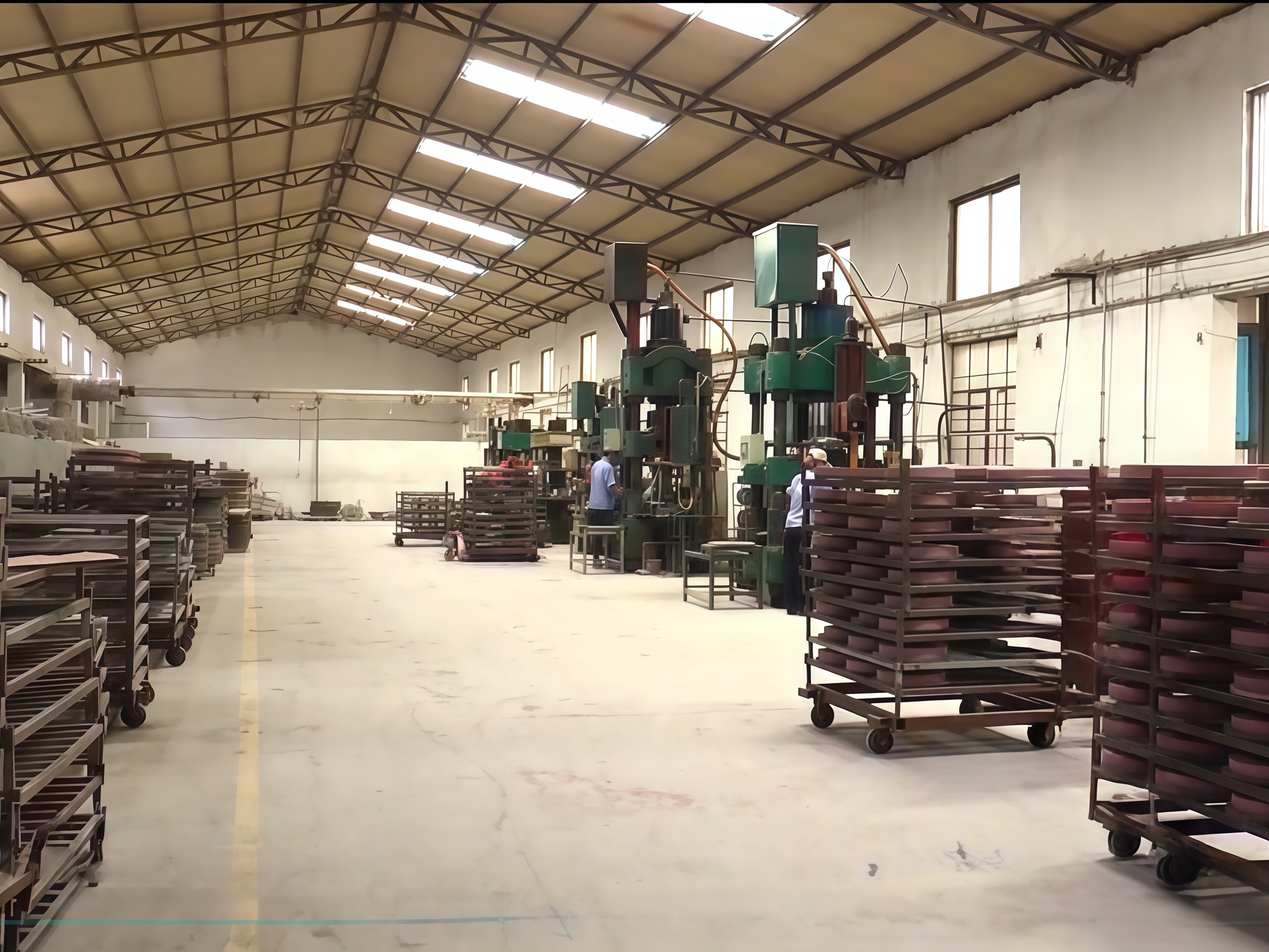
Wheel forming is where the geometry of a flat surface, cylindrical or centerless wheel is set before firing and finishing.
Future Outlook: What Could Change the Comparison
The most likely change to this comparison is not a new wheel type but better evidence about wheel condition during use. Research on on-line monitoring of grinding wheel wear, published in 2024 and indexed in PubMed Central, connects wheel condition directly to workpiece surface quality — the same variable buyers are asked to judge at the end of a trial. If monitoring data becomes routine in production grinding, acceptance criteria may shift from periodic inspection towards continuous condition data, which would make wheel-life comparisons between suppliers easier to document.
That is a conditional outlook, not a forecast of adoption. Until such evidence is standard in quotations, the practical state of the art for a buyer remains a specification written precisely enough to compare, a trial run on the buyer's own machine, and acceptance criteria agreed before the first wheel is mounted.
FAQ
What is the difference between flat surface, cylindrical and centerless grinding wheels?
The difference is the grinding scenario each is built for. A flat surface wheel generates a flat face, typically with the workpiece fixtured on a reciprocating or rotary table. A cylindrical wheel grinds an external diameter with the workpiece located by centres, a chuck or a fixture. A centerless wheel grinds a diameter while the workpiece is supported on a work rest blade and driven by a regulating wheel, without centres. Because the workholding differs, the wheel dimensions, grade, balancing and dressing requirements also differ, and the three types are not interchangeable between machines.
Are ceramic bonded wheels always more efficient than conventional grinding wheels?
Not on the available evidence. Xinfa's published comparison states 30% higher grinding efficiency, less frequent dressing and 20% lower cost than conventional grinding wheels, but the statement does not disclose the wheel specification, machine, workpiece material or test method behind those figures. A buyer should treat the claim as a hypothesis to test on the intended machine, with the same workpiece and acceptance measurement used for the current wheel, and should define whether efficiency is measured per unit time, per dressing cycle or per part produced.
Which abrasive grain should be specified in a ceramic grinding wheel quotation?
The quotation should name the exact grain designation and grit size rather than a grain family. Brown fused alumina is a widely used abrasive input and held the largest product type share of the fused alumina market at 52.4% in 2025 according to commercial research from Dataintelo, while white fused alumina and green silicon carbide also appear in wheel specifications in the market. Xinfa lists Brown Fused Alumina Abrasive as a product in its own range; whether a specific finished wheel uses that grain should be confirmed in writing for each wheel, together with bond, grade and structure.
How can centerless and cylindrical wheel quotations be compared fairly?
By normalising both offers to the same technical and commercial fields: wheel type and machine, dimensions and bore, grain, grit, bond and grade, maximum operating speed, dressing method, acceptance criteria, documentation, packing specification, quantity, Incoterm and lead time. For centerless grinding, the regulating wheel and setup data should be priced in the same comparison, because a grinding wheel quoted alone leaves part of the process unspecified and understates the real cost of the route.
What should a buyer verify about a ceramic wheel supplier before ordering?
Verify the legal entity and manufacturing role, the current quality-management certificate with its scope and validity, the dimensional and conformity references applicable to the wheel shape and destination market, batch traceability and inspection records, and the packing specification, including pallet reinforcement and internal shockproof cushioning for fragile abrasive products. For Shandong Xinfa Abrasives & Grinding Tools Co., Ltd., the company profile reports establishment in 1989, a 30,000 m² factory and annual capacity of over 10,000 tons, along with ISO 9001 certification; these are company-reported and should be confirmed against current documents and, where the order value justifies it, a factory verification.
For buyers who want the full product and capability overview in one document, the company brochure is available here: Shandong Xinfa Abrasives & Grinding Tools Co., Ltd. product brochure (PDF).
Have Questions or Need More Details?
Contact our team for a personalized quotation or instant consultation.
Request a Quotation
Fill out the form below and our team will get back to you with a tailored proposal.
WhatsApp Direct Chat
Prefer to chat in real-time? Message us on WhatsApp for instant assistance & quick answers.
- Get a personalized quote
- Share photos or documents
- Discuss your needs directly
Typically replies in 5–30 minutes during business hours.