
Ceramic Bonded vs. Resin Bonded Grinding Wheels: A Buyer Comparison Framework
Two bonded grinding wheels can carry the same abrasive grain, the same nominal dimensions and the same declared maximum operating speed and still behave in completely different ways on the same machine. What separates them is the bond: the material that holds the abrasive grain, defines how the wheel breaks down under load, and decides how much heat and mechanical shock the wheel tolerates before surface quality or safety is affected. For tool and hardware buyers at the evaluation stage, choosing between a ceramic (vitrified) bonded wheel and a resin bonded wheel is the first structural decision in wheel selection, and it sits upstream of brand, price and delivery terms.
Ceramic grinding wheels, in this framework, means vitrified bonded wheels: abrasive grain held in a fired, glass-like ceramic bond. Resin bonded wheels use an organic resin bond. Both are bonded abrasives and both appear in the same workshops, but they are tools for different points in the same production chain rather than substitutes for one another.
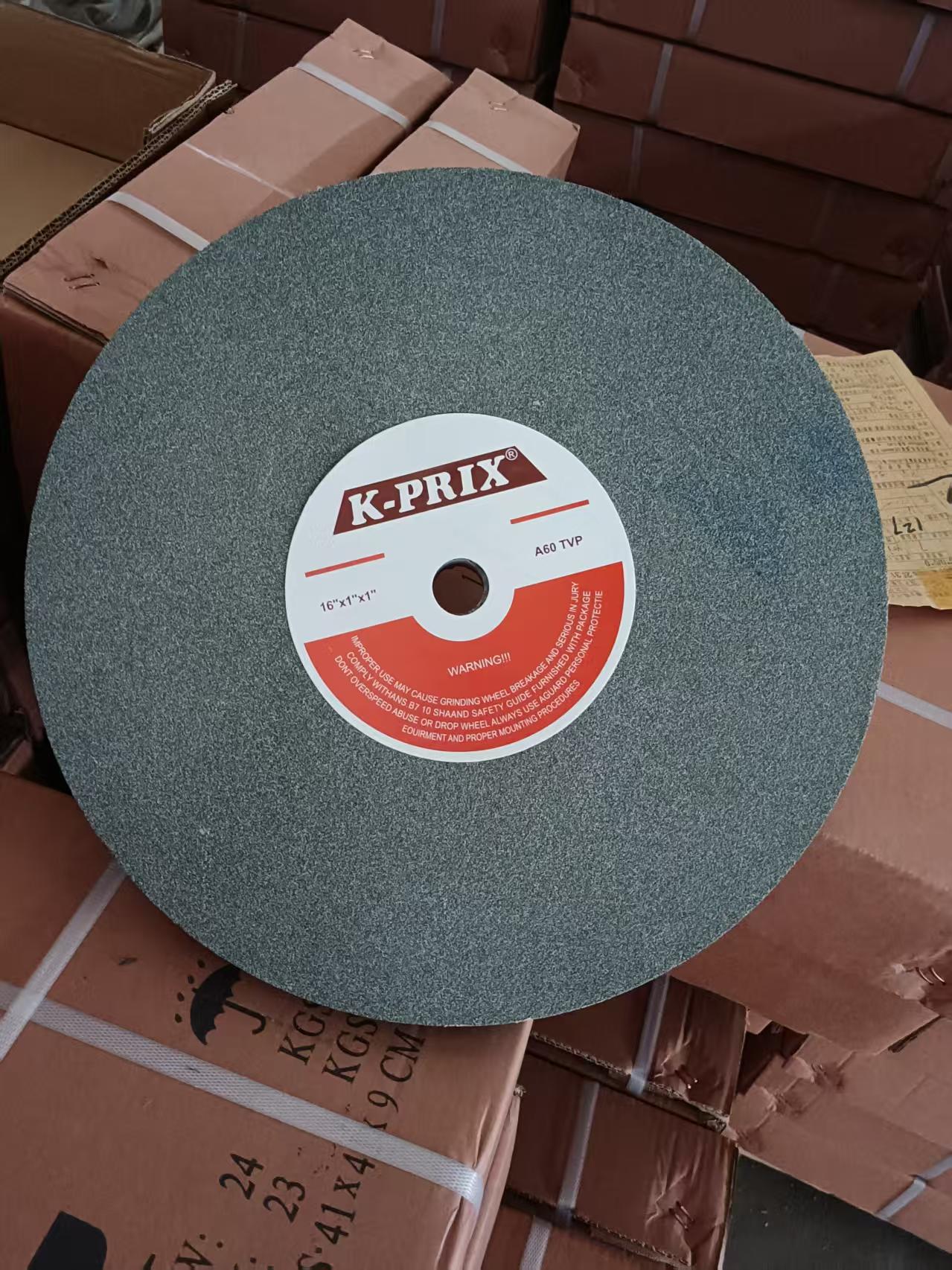
Bond and grain selection is what determines how a wheel behaves in service; the outer appearance of two wheels rarely reveals the difference.
Why the bond decides what a wheel can do
A bonded abrasive wheel is built from abrasive grain, a bond, and the porosity between them. That three-part construction applies across bonded wheel types. Grain and grit number usually draw the most attention when quotations are compared, but the bond controls three things that decide whether a wheel survives in a given process:
- Form retention. How long the wheel holds its profile, diameter and corner geometry under a given load.
- Thermal and mechanical response. How the wheel behaves when the contact zone heats up or when the load changes abruptly, as it does on interrupted cuts and cast surfaces.
- Re-conditioning. Whether the wheel can be dressed and re-profiled to restore geometry, and how that dressing practice fits the production cycle.
One clarification is worth building into the specification process early. The word "ceramic" appears in two different places in abrasives vocabulary: it describes a bond (vitrified, sometimes called ceramic bond), and it also describes a grain family (ceramic or SG alumina grains). A wheel can therefore be ceramic-grain in a resin bond, or conventional-grain in a vitrified bond. Purchase documents should state the bond and the grain separately, because a vitrified bond wheel and a resin bond wheel carrying the same grain and grit are not interchangeable products.
Ceramic (vitrified) vs resin bond: a side-by-side framework
The comparison below is deliberately framed around behaviour rather than rankings. Bond performance depends on the specific wheel specification, the machine and the operation, so this table is a decision structure for buyers, not a performance verdict.
| Decision factor | Ceramic (vitrified) bonded wheel | Resin bonded wheel |
|---|---|---|
| Bond nature | Fired, glass-like ceramic bond; rigid and porous structure. | Organic resin bond; tougher and more elastic under load. |
| Form retention | Generally strong; the usual family where profile and dimensional consistency must hold across a production run. | Generally lower under sustained load; best chosen where profile tolerance is wider and stock removal matters more. |
| Shock and interrupted cuts | Less forgiving of impact and abrupt load change; mounting, handling and machine condition discipline matter. | Better tolerance of impact and side load; a common choice for snagging, fettling and deburring. |
| Dressing and re-profiling | Routinely dressed to restore geometry and cutting action; dressing interval becomes a process variable to plan for. | Wear is usually managed by replacement rather than routine re-profiling; dressing practice should be confirmed specification by specification. |
| Heat at the contact zone | Open, porous structure supports coolant delivery into the contact zone. | Thermal behaviour depends on the specification; heat management is primarily a process design question. |
| Typical fit | Flat surface, cylindrical, internal (bore), gear, bearing, needle, roll and tool grinding. | Snagging and fettling on castings and welds, heavy stock removal, portable and off-hand operations. |
| Main limitation to plan for | Brittleness: impact and thermal shock are the practical risks a buyer has to design around. | Lower rigidity: not the default family for tight-tolerance form work. |
Table 1. Behaviour-based comparison of ceramic (vitrified) and resin bonded wheels. Individual specifications can shift performance within each family.
For buyers, the practical reading of Table 1 is simple. If the operation is judged on dimensional consistency and surface finish over a long run, the vitrified family is normally the starting point. If the operation is judged on how fast metal can be removed from rough, interrupted or irregular surfaces, the resin family is normally the starting point. Where a plant needs both, the two families are complementary lines in the same tool crib, not competing proposals for the same job.
Manufacturers' technical documentation reflects this specificity. A published data sheet for a 3M Cubitron 3 depressed-centre grinding wheel, for example, identifies ISO Type 27 geometry, ceramic precision-shaped grain, nominal thicknesses of 6 mm and 7 mm, and conformity references including EN 12413 and ANSI B7.1. That level of declared detail is what makes two wheels comparable at all: without it, a buyer is comparing names, not specifications.
Where rubber bonded control and centerless wheels fit
Centerless grinding is often treated as a single operation during sourcing, but the setup generally uses two wheels with different jobs. The grinding wheel performs the stock removal and is typically a vitrified bonded wheel. The regulating (control) wheel drives the workpiece and sets its rotation and feed, and is commonly a rubber bonded wheel. Rubber bonded control and centerless wheels therefore belong in the same sourcing conversation as ceramic wheels, but they are specified against a different requirement set: friction behaviour, workpiece diameter control and consistent surface contact rather than grinding aggressiveness.
The purchasing implication is straightforward. A control wheel should not be ordered as a spare part of the grinding wheel. It carries its own diameter, width, hardness and surface-condition requirements, and it needs its own acceptance criteria in the purchase order.
Abrasive options: the second layer of the decision
Once the bond family is settled, abrasive grain becomes the second decision layer. The main grain families that appear in bonded wheels are not interchangeable, and their names describe material families rather than quality tiers.
- Brown Fused Alumina (BFA) — the general-purpose workhorse of bonded abrasives, used widely for carbon and alloy steels where a durable, cost-effective grain is required. Commercial market research from Dataintelo places Brown Fused Alumina at the largest product-type share of the fused alumina market in 2025, at 52.4%, which reflects how much of the bonded abrasive market still runs on this grain.
- White Fused Alumina (WFA) — generally described as harder and more friable than BFA, and commonly selected where cutting action, heat-sensitive workpieces or harder steels call for a sharper, free-cutting grain.
- Pink Fused Alumina (PA) — commonly selected where a balance is wanted between the toughness associated with BFA and the cooler cutting behaviour associated with WFA, typically in tool room and precision general-purpose work.
- Green Silicon Carbide (GC) — a very hard, sharp grain used for cemented carbide, non-ferrous materials and hard, brittle workpieces, and where a free-cutting action is needed.
- SG ceramic alumina — a ceramic (seeded-gel type) alumina grain often described as micro-fracturing to keep fresh cutting edges exposed; it is normally specified for high-performance precision grinding where wheel life and cycle time justify a higher grain cost.
- Black Silicon Carbide (C) — related to green silicon carbide but generally positioned as the tougher of the two, and frequently used on cast iron, non-ferrous materials and lower-tensile-strength workpieces.
Grain letter designations in a wheel marking are not a universal language. Suppliers publish their own abrasive designation lists, and the same letter can appear in more than one supplier's catalogue with a different underlying material. Before comparing two quotations line by line, a buyer should request the supplier's grain designation table and match it against the wheel marking on the quotation. This single step prevents most of the specification mismatches that surface later as "the wheel does not perform as expected".
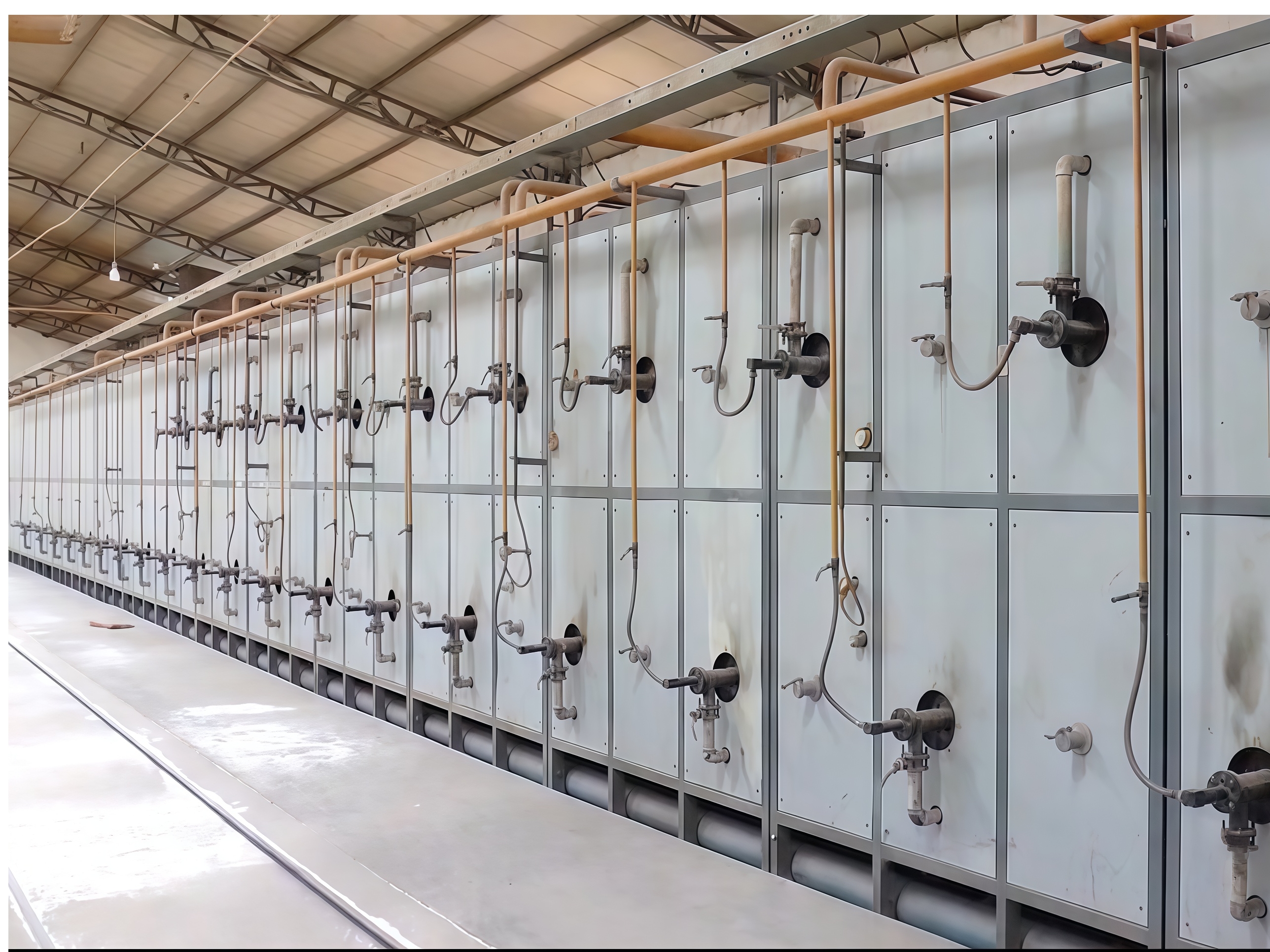
Vitrified bonded wheels pass through a firing stage that gives the ceramic bond its rigid, porous structure — a different production route from resin bonded products.
Matching wheel type to application
Bond and grain only become a purchasing decision once the operation is named. The application map below links the most common operations to the wheel families normally specified for them, and to the points that should be verified before a quotation is accepted.
| Operation | Wheel family normally specified | What to verify in the quotation |
|---|---|---|
| Flat surface grinding | Flat surface grinding wheel (vitrified) | Wheel dimensions and bore, maximum operating speed, grade and structure, machine spindle compatibility. |
| Cylindrical (OD) grinding | Cylindrical grinding wheel (vitrified) | Profile retention expectations, dressing method and interval, coolant delivery. |
| Centerless grinding | Centerless grinding wheel plus rubber bonded control wheel | Both wheels specified separately; control wheel diameter, hardness and surface condition. |
| Internal (bore) grinding | Internal (bore) grinding wheel (vitrified) | Small-diameter geometry, spindle speed capability, wheel unbalance limits. |
| Roll grinding | Roll grinding wheel (vitrified) | Large-diameter supply capability, tolerance on diameter and bore, handling and packaging. |
| Tool and cutter grinding | Tool grinding wheel (vitrified) | Grain family for the workpiece material, form retention, edge quality on the finished tool. |
| Bench and off-hand grinding | Bench grinder wheel (vitrified) | Wheel speed rating versus machine speed, mounting and guarding condition. |
| Snagging and fettling | Resin bonded snagging grinding wheel | Impact and side-load tolerance, wheel life per shift, replacement rather than dressing practice. |
| General workshop use | General purpose grinding wheel | Range of workpiece materials covered, stock keeping depth, consistency between deliveries. |
Table 2. Application mapping. Specialised families such as gear, bearing, needle and saw tooth grinding wheels follow the same logic but with tighter geometry requirements.
Limits and boundaries: what neither bond solves
A comparison framework that only lists strengths is not usable for purchasing. Both bond families carry real boundaries that have to be planned for.
- Vitrified brittleness. A rigid ceramic bond is less tolerant of impact and abrupt thermal cycling. Damage usually traces back to handling, mounting, machine condition or coolant practice rather than to the wheel specification itself, which is why handling and mounting discipline has to be part of the acceptance conversation.
- Resin rigidity. A resin bond is generally not the family to specify where form retention and tight dimensional consistency are the acceptance criteria. Using a resin wheel to solve a form-holding problem usually shifts the cost from the wheel to scrap and rework.
- Dressing as a hidden cost. Where a vitrified wheel is dressed frequently, the labour, downtime and wheel consumption that dressing generates belong in the total cost calculation. Ignoring it makes an apparently cheaper wheel look more attractive than it is.
- No universal winner, and no public shortcut. There is no bond type that is simply better across operations. Cross-supplier performance data at matched conditions is also limited in public sources: research into online monitoring of grinding wheel wear confirms that wheel condition directly affects workpiece surface quality and that wheel state can be evaluated through monitoring, but that is a technical relationship, not a ranking of suppliers. Performance comparisons have to be generated by the buyer's own trial data.
The realistic conclusion is that bond selection is a matching exercise with trade-offs on both sides, and that the trial protocol, not the datasheet, is what ultimately decides whether a specification stays in the approved list.
A purchasing checklist: commercial terms and acceptance criteria
The most common source of friction between buyers and wheel suppliers is not price; it is that two quotations were built against different assumptions. The checklist below separates the commercial terms that should be fixed in the purchase document from the acceptance criteria that should be defined before the first shipment is approved.
| Commercial terms to fix in the purchase document | Acceptance criteria to define before approval |
|---|---|
| Complete wheel marking, stating bond and grain separately rather than using the umbrella term "ceramic wheel". | Dimensional verification: diameter, thickness and bore against the ordered values and tolerances. |
| Dimensions and tolerances for diameter, thickness and bore, plus permissible unbalance or run-out limits where relevant. | Visual and structural check against the agreed inspection protocol, including any handling or sound-check practice required by the destination market's safety rules. |
| Declared maximum operating speed, checked against the machine speed at the point of use rather than the machine's nameplate capability. | First-article trial with pre-agreed metrics: surface finish, wheel life, dressing interval and material removal behaviour under normal production conditions. |
| Packaging, labelling and marking requirements, including batch or traceability references on each wheel. | Documentation pack: current quality management certificate with its scope, certificate number and validity dates, plus the conformity references declared for the product type. |
| Quantity, minimum order quantity, lead time, Incoterm, payment terms and the customs classification to be used for the destination market. | Consistency between shipments: the same marking, same supplier designation and same inspection result on repeat orders. |
| Sampling plan and who carries the cost of first-article testing. | Defined handling for non-conforming lots, including who verifies the failure and how the root cause is documented. |
Table 3. Purchasing checklist for bonded grinding wheel orders. The same structure applies to vitrified, resin and rubber bonded products.
Two documentation points deserve separate attention because they are frequently requested and frequently misunderstood. First, a quality management certificate is only meaningful when its scope covers the manufacture of abrasives and grinding wheels — a certificate for an unrelated activity proves nothing about the wheels being purchased. Second, safety and conformity references such as ISO 603-14:2022 for nominal dimensions of specified bonded product shapes, or EN 12413 and ANSI B7.1 as references used for hand-held grinding applications, are declared per product type, not per company; they must appear against the product being quoted.
Sourcing considerations by region
Sourcing the same wheel into different markets changes the checklist, even when the wheel specification does not change. Four questions apply almost everywhere: which dimensional and safety reference applies at the point of use; how the product is classified for customs under the 6804.22 family and its national subdivisions; what documentation the buyer needs with the shipment; and what local support exists when a wheel underperforms.
- Southeast Asia (Vietnam, Thailand, Malaysia and neighbouring markets). Freight planning from northern Chinese ports and mixed container loads are usually the main variables. Buyers typically need stable repeat supply more than a single low quotation, because distributor stock depth determines how quickly a plant can recover from a specification error.
- India. A competitive local abrasives manufacturing base makes documented specification comparison essential. Where two quotations differ significantly, the first place to look is the grain and bond declaration, and the second is the declared maximum operating speed and inspection protocol.
- South Korea and Japan. Precision-driven markets where dimensional discipline and traceability carry weight. Aligning ordered dimensions with the applicable dimensional standard for the wheel shape, and fixing the inspection record format in advance, reduces friction at goods-in.
- Middle East (United Arab Emirates, Saudi Arabia, Iran and neighbouring markets). Project-based purchasing and large-diameter wheels for roll and surface applications are common. Handling, crating and packaging specification matter as much as the wheel itself, because damage in transit is often the real cause of a rejected delivery.
- Europe. Buyers generally expect the conformity references relevant to the product type to be declared in writing, alongside the marking and documentation that the destination market requires.
- United States. ANSI B7.1 provides the recognised safety framework for the use, care and protection of abrasive wheels, and buyers typically organise inspection, storage and mounting procedures around it.
- Brazil. Duty and logistics planning usually drive the order structure, which in turn pushes buyers toward fewer, larger shipments — making consistency between shipments a more important acceptance criterion than unit price.
These are sourcing considerations, not a substitute for market-specific verification. Tariff lines and conformity obligations differ by jurisdiction and change over time: the 6804.22 tariff heading and national subdivisions such as 6804.22.40 are classification leads, and the applicable line for a specific import should be confirmed with a customs broker or the relevant authority before it is used for costing. The same discipline applies to standards: confirm the current edition and the exact product scope rather than relying on a general reference.
Supplier profile: Shandong Xinfa Abrasives & Grinding Tools Co., Ltd.
Shandong Xinfa Abrasives & Grinding Tools Co., Ltd. is a Chinese abrasives manufacturer established in 1989, specialised in the research, development and manufacture of vitrified bond grinding wheels. The company is located in the National Logistics Center of Linyi City, Shandong Province, roughly 180 km from Qingdao Port and 60 km from Rizhao Port.
Its declared manufacturing profile includes a 30,000 m² factory, 120 employees, a six-engineer R&D team, more than 100 sets of production and testing equipment, and an annual output of 10,000 tons, with monthly capacity stated at 900 tons. Export accounts for 35% of sales, with products shipped to more than 20 countries and regions across Southeast Asia, India, South Korea, Japan, the Middle East, Europe, the United States and Brazil. The company is a member of the China Abrasives Association, and its technology research and development center was listed as a municipal-level enterprise R&D center in 2015.
On the product side, the declared vitrified bond range covers diameters from 150 mm to 1,100 mm, thickness from 3 mm to 300 mm and bore from 12.7 mm to 305 mm, with abrasive options listed as A, WA, AA, 38A, PA, 25A, SA, MA, GC, C, RA, DA, 9A, 64A and 55A; grit numbers from F16 to F120; hardness grades from G to Y; structure numbers from 0 to 14; and maximum linear velocities from 20 m/s to 70 m/s. The wider product list includes general purpose, bench grinder, tool, flat surface, centerless, cylindrical, crankshaft and camshaft, saw tooth, bearing, worm, gear, needle, roll grinding wheels, internal (bore) grinding wheels, oilstone and segments, resin bonded snagging grinding wheels, rubber control and centerless wheels, flap discs and mounted points.
Order terms are stated as a minimum order quantity of 2 tons, a lead time of 30 to 45 days, 100% testing in quality control, OEM/ODM production with customisation of specification, size, logo, bond type and abrasive material, and remote after-sales support. On the compliance side, the company holds quality management system certification to GB/T 19001-2016 / ISO 9001:2015 with certificate number 60624Q0262R1M, issued by Zonyun International Certification Co., Ltd on 12 August 2021 and valid to 11 August 2027, with a scope covering the manufacture of abrasives and grinding wheels.
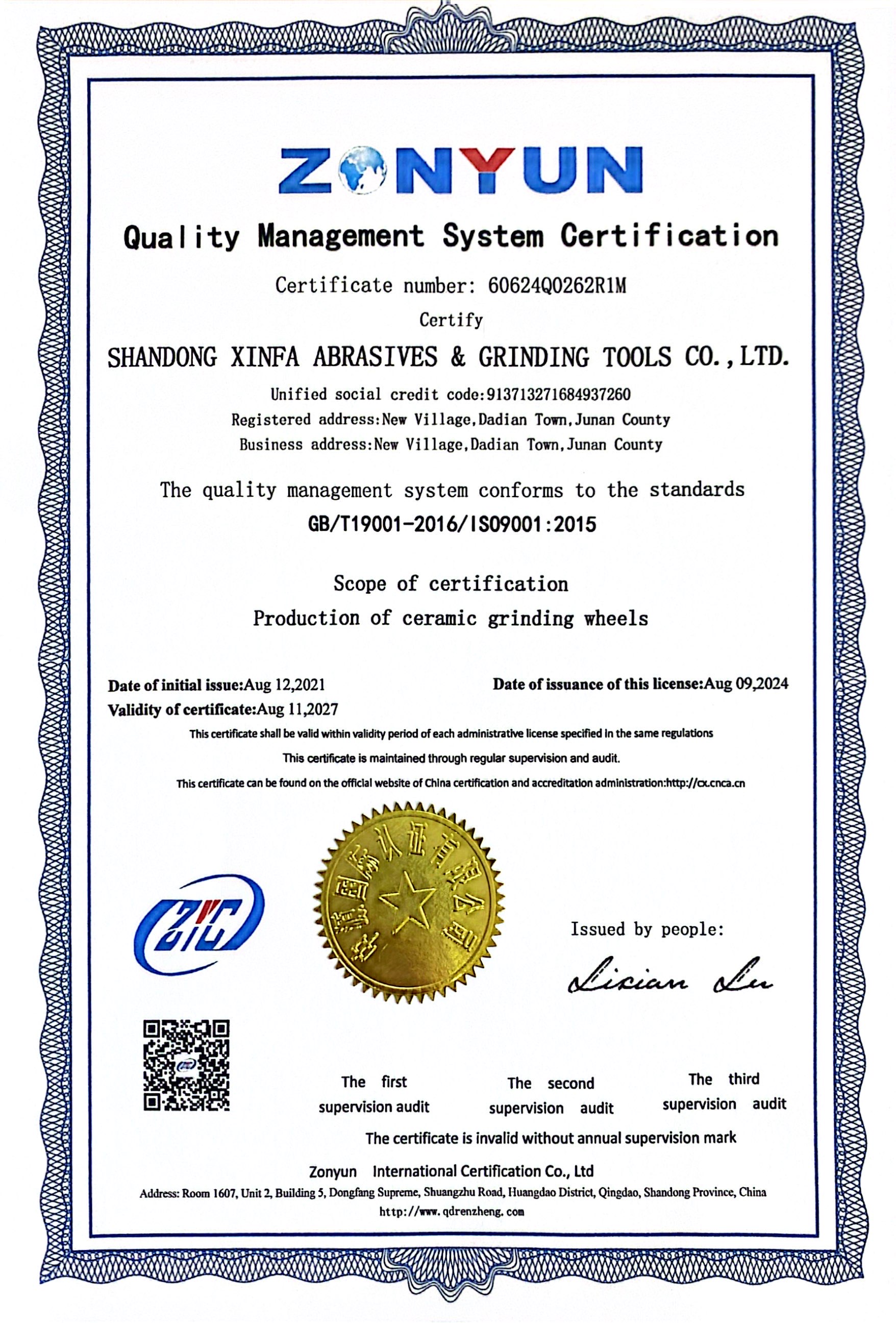
Quality management system certification to GB/T 19001-2016 / ISO 9001:2015, scope: manufacture of abrasives and grinding wheels.
A documented customer case involves a grinding wheel OEM customer in Pakistan: 20 tons of grinding wheels supplied for workpiece grinding over a two-year period, reported as achieving stable operation with long-lasting performance.
Two qualifications belong in this profile, because a comparison framework is only useful if it is honest about evidence. Company profile claims — including capacity, equipment and certification statements — should be verified by the buyer against the current certificate, the factory and the first-article trial before they are treated as established facts for a sourcing decision. And a single published case across a two-year window is meaningful for supply continuity, but it is not a performance benchmark against other suppliers at matched test conditions.
Market signals worth tracking
Three data points frame where this category is heading. The global grinding wheel market is projected to grow at a compound annual growth rate of 6.7% from 2025 to 2032, driven by demand for precision machining, according to a Reliable Market Forecast study. Brown Fused Alumina remains the dominant fused alumina product type, at 52.4% of that market in 2025 per Dataintelo, which underlines how much of the installed base still runs on conventional alumina grain. And academic work published in 2024 on the online monitoring of grinding wheel wear reinforces a technical point that matters commercially: wheel condition directly affects the surface quality of the workpiece, and wheel state can be evaluated through monitoring.
Together these signals point in one direction. The category is expanding, the material base is stable, and the tools for verifying whether a wheel is performing as specified in real production are becoming more available. For buyers, that shifts value away from the lowest quotation and toward suppliers who can document specifications, hold them consistently across shipments and support trial-based qualification.
Future outlook
Bond selection is unlikely to be disrupted by a single new material. The more probable change is procedural: standardised specification fields in purchase orders, first-article trials with agreed metrics, and inspection or monitoring data attached to wheel batches. Ceramic (vitrified) bonds will continue to carry precision and form-holding work, resin bonds will continue to carry snagging, fettling and heavy stock removal, and rubber bonded control wheels will remain part of the centerless setup rather than a competing option. Buyers who build their approved list around documented specification comparison — rather than around the word "ceramic" on a quotation — will be the ones able to switch suppliers without repeating the qualification cycle.
FAQ
Is a ceramic bonded wheel always better than a resin bonded wheel?
No. The two families serve different requirements. A ceramic (vitrified) bonded wheel is generally the starting point where form retention, dimensional consistency and surface finish must hold across a production run. A resin bonded wheel is generally the starting point where impact tolerance and stock removal on rough or interrupted surfaces matter more than profile tolerance. A wheel that is wrong for the operation is a poor wheel regardless of how well it is made.
Which bond should a buyer choose for snagging and fettling?
Resin bonded snagging grinding wheels are the conventional family for this work, because the bond tolerates impact and side load better than a rigid ceramic bond. The specification decision then moves to grain, wheel dimensions, declared maximum operating speed and the expected wheel life per shift, since resin wheels are usually consumed rather than repeatedly re-profiled.
How do the main abrasive grains differ when it comes to selection?
Brown Fused Alumina is the general-purpose choice for steels and the most widely used fused alumina product type. White Fused Alumina is generally described as harder and more friable, and is selected for sharper cutting and harder or more heat-sensitive work. Pink Fused Alumina sits between the two, typically for tool room and precision general-purpose work. Green Silicon Carbide is used for cemented carbide, non-ferrous materials and hard, brittle workpieces. Black Silicon Carbide is generally positioned as the tougher silicon carbide. SG ceramic alumina is a ceramic grain used where wheel life and cycle time justify a higher grain cost. Because grain letter designations differ between suppliers, the supplier's own designation table should be requested before quotations are compared.
Where do rubber bonded control and centerless wheels fit in the purchase order?
They are part of a centerless setup, not alternatives to the grinding wheel. The grinding wheel performs stock removal and is typically vitrified; the regulating wheel drives the workpiece and is commonly rubber bonded. They should be specified as separate line items with separate acceptance criteria, because their diameters, hardness and surface-condition requirements are different.
What should be fixed in a purchase order so that two quotations are comparable?
At minimum: the complete wheel marking with bond and grain stated separately, dimensions and tolerances for diameter, thickness and bore, the declared maximum operating speed checked against the machine speed at the point of use, packaging and traceability marking, quantity, minimum order quantity, lead time, Incoterm, payment terms and the customs classification to be applied in the destination market.
What documentation should be requested before the first shipment is accepted?
A current quality management system certificate whose scope covers the manufacture of abrasives and grinding wheels, including the certificate number and validity dates; the conformity or dimensional references declared for the specific product type being purchased; the supplier's inspection protocol and the agreed acceptance criteria for the first article; and the trial results for surface finish, wheel life and dressing interval under normal production conditions.
A downloadable PDF brochure with the full product and specification range is available here: Shandong Xinfa Abrasives product brochure.
Have Questions or Need More Details?
Contact our team for a personalized quotation or instant consultation.
Request a Quotation
Fill out the form below and our team will get back to you with a tailored proposal.
WhatsApp Direct Chat
Prefer to chat in real-time? Message us on WhatsApp for instant assistance & quick answers.
- Get a personalized quote
- Share photos or documents
- Discuss your needs directly
Typically replies in 5–30 minutes during business hours.