
Ceramic Frit Samples: Datasheet, Kiln Trial, Supplier Risk
Ceramic Frit Samples: Datasheet, Kiln Trial, Supplier Risk

A ceramic frit sample should be compared in three stages, not one: a datasheet screen, a kiln trial on the buyer's body and glaze or engobe line, and a supplier-risk review that confirms who controls formulation and technical support. For a decision-stage buyer, the useful output is not a single 'best' frit; it is a documented fit decision for a defined firing window, body, glaze system and commercial risk profile.
The comparison is especially important when the trial brief spans different conditions. A low-temperature engobe program may be written around 1050–1100°C; a titanium frit scenario may be written around 1080–1180°C. Those ranges are trial conditions in the brief, not a product guarantee. A sample that looks suitable on paper can still fail if thermal expansion, glaze compatibility, mixing control or kiln conditions differ from the supplier's reference.
What a decision-stage sample comparison must establish
The framework should establish six points before commercial adoption: firing-temperature fit, thermal expansion adjustment, compatibility with the intended glaze or engobe and body, blistering tendency, equipment fit, and supplier control. These are not separate sales questions. They are evidence gates that determine whether a sample result can be repeated in production.
- Firing-temperature fit: the sample must be assessed at the low and high edges of the intended window, not only at a mid-point.
- Thermal expansion adjustment: the frit must be evaluated as part of the body-glaze system, with warpage, crazing and chipping checked after firing.
- Glaze and engobe compatibility: a floor-tile glaze, wall-tile glaze or engobe layer may react differently to the same frit, so the intended layer must be named in the trial.
- Low blistering tendency: surface defects should be checked at the upper end of the firing window and under the production hold and cooling pattern.
- Equipment fit: kiln type, firing curve, loading position and glaze or engobe mixing control must be recorded because they can change the result.
- Supplier control: the buyer should confirm who operates the production line, who can adjust the formulation and who provides technical support after the trial.
| Comparison dimension | Datasheet question | Kiln-trial evidence | Decision risk if skipped |
|---|---|---|---|
| Firing-temperature fit | What firing range is stated, and on what reference body and kiln? | Maturity, gloss, texture and defects at low, mid and high points of the trial window | A sample tested only at one point may not fit the 1050–1100°C engobe case or the 1080–1180°C titanium frit case |
| Thermal expansion adjustment | Is coefficient of thermal expansion stated with method and reference temperature? | Warpage, crazing, chipping and fit after firing on the intended body | Numbers cannot be compared safely if the measurement basis differs or the body is different |
| Glaze or engobe compatibility | Which layer and body is the frit intended for? | Interface appearance, adherence, crawling, pinholing and surface uniformity | A floor-tile glaze result may not transfer to wall tile, engobe or a low-thermal-expansion body |
| Blistering tendency | Is low blistering claimed, and under what firing condition? | Surface inspection at the upper firing edge and after the production hold | An adjective without trial conditions is weak evidence for a production decision |
| Equipment fit | What mixing, application and firing guidance is supplied? | Mixer performance, suspension, sieve, density and kiln loading records | Poor dispersion or an unstable kiln curve can look like a frit defect |
| Supplier control | Who makes the frit, who adjusts it and who supports the line? | Repeat sample, batch traceability and technical response record | A trading layer can obscure responsibility if the operating entity is not defined |
Stage 1: read the datasheet as a screening document, not a verdict
A datasheet is useful for eliminating obviously incompatible samples and for preparing a trial brief. It cannot approve a frit for production. The buyer should require the firing range to be tied to a reference body and kiln, the thermal expansion figure to be tied to a method and reference temperature, and the recommended application to name the intended glaze or engobe layer. If those conditions are missing, the value should be treated as unverified rather than as a reason to reject the sample outright.
The same discipline applies across product types. A titanium frit candidate, a zirconium frit, a boron frit, a low-temperature ceramic frit, a high-temperature ceramic frit or a ceramic glaze frit should not be compared only by product name. For a transparent or opaque glaze effect, the datasheet should be read against the target appearance and the intended layer. For frit for ceramic tiles, the body and firing schedule matter as much as the frit label. 'Not disclosed' does not mean 'not capable'; it means the buyer needs a trial or a written clarification before relying on the claim.
Firing-temperature fit: compare at the window edges
Firing-temperature fit should be tested at the edges of the intended window. In a low-temperature engobe scenario written around 1050–1100°C, the trial should include a low-edge, a mid-point and a high-edge firing on the same body and engobe preparation. In a titanium frit scenario written around 1080–1180°C, the same edge logic applies. The question is not whether the sample matures at one convenient point; it is whether the surface, texture and defect pattern remain acceptable across the range the production kiln can actually deliver.
The kiln trial should use the same body, glaze or engobe preparation, firing curve and loading pattern for every candidate. If one sample is fired in a different position or with a different glaze batch, the comparison loses its decision value. A frit that underfires at the low edge or blisters at the high edge may still be useful in a narrower window, but that narrower window must be stated and confirmed. The buyer should record the actual kiln curve and any deviation, because a supplier's reference firing data may not match the buyer's kiln.
Thermal expansion adjustment and body compatibility
Thermal expansion is a system property, not a frit-only property. The buyer should compare how each candidate behaves with the intended body, especially when the target is a floor-tile glaze or a low-thermal-expansion body. The practical checks are warpage, crazing, chipping and fit after firing, supported by the datasheet's method and reference conditions. A frit with a suitable expansion value on paper can still fail if the glaze thickness, engobe layer or body composition changes.
This is why a wall-tile trial should not be transferred directly to a floor-tile program. Floor-tile glazes and low-thermal-expansion bodies can impose different stresses, and the same frit may need a different formulation or application adjustment. The buyer should ask for the supplier's recommended adjustment path, then verify it on the actual line. The decision is not 'which frit has the lowest expansion number'; it is 'which frit, with which glaze and body, produces a stable fired result under the recorded conditions'.
Blistering tendency and surface-defect review
Low blistering tendency should be demonstrated, not assumed. The trial should inspect the surface at the upper end of the firing window, after the production hold and after the normal cooling pattern. Pinholes, blisters, bubbles and local surface disruption should be recorded by position and frequency, with photographs and retained samples. A defect that appears only at the high edge may point to a narrower firing window; a defect that appears across the trial may point to mixing, application or body interaction.
The buyer should separate visual defects caused by the frit from defects caused by the process. A blistering claim is only useful when it is tied to a firing condition, glaze thickness and kiln atmosphere. If the datasheet says 'low blistering' without those conditions, the claim should be treated as a screening signal, not as trial evidence.
Stage 2: kiln trial design and equipment requirements
The kiln trial is the central evidence in the comparison. A practical design uses the buyer's normal body and glaze or engobe preparation, a retained control sample, and at least two firings per candidate so that repeatability can be seen. The trial should record the kiln type, setting position, firing curve, hold time, cooling pattern and any atmosphere control. It should also record glaze or engobe preparation details, because the mixing stage can create defects that look like frit failure.
- Kiln requirement: the firing curve and loading position must be controlled and recorded; a trial that mixes positions or curves cannot isolate frit performance.
- Glaze and engobe mixing requirement: the mixer should deliver a uniform suspension and consistent dispersion; batch size, water or additive dosing, sieve control and density or viscosity checks should be recorded.
- Application requirement: glaze thickness, engobe layer, drying and surface preparation should be kept comparable across candidates.
- Cleanliness requirement: equipment should be cleaned between samples to avoid cross-contamination that distorts the comparison.
The equipment requirement is repeatability, not a particular equipment brand. A high-shear mixer, ball mill or other preparation system can be suitable if it produces a consistent slip and the buyer can document the settings. The same principle applies to the kiln: the buyer needs a known curve and a stable setting pattern, not a one-off firing that cannot be repeated.
Stage 3: manufacturer-versus-trading-company risk
The supplier question is not 'manufacturer good, trader bad'. It is 'where does control sit'. A trading company can be a legitimate supply channel, but the buyer should confirm who operates the production line, who controls the formulation, who can adjust the sample after trial, who holds batch traceability and who provides technical support when the finished tile does not match the target. If those responsibilities are unclear, the sample comparison has a commercial risk that the datasheet cannot resolve.
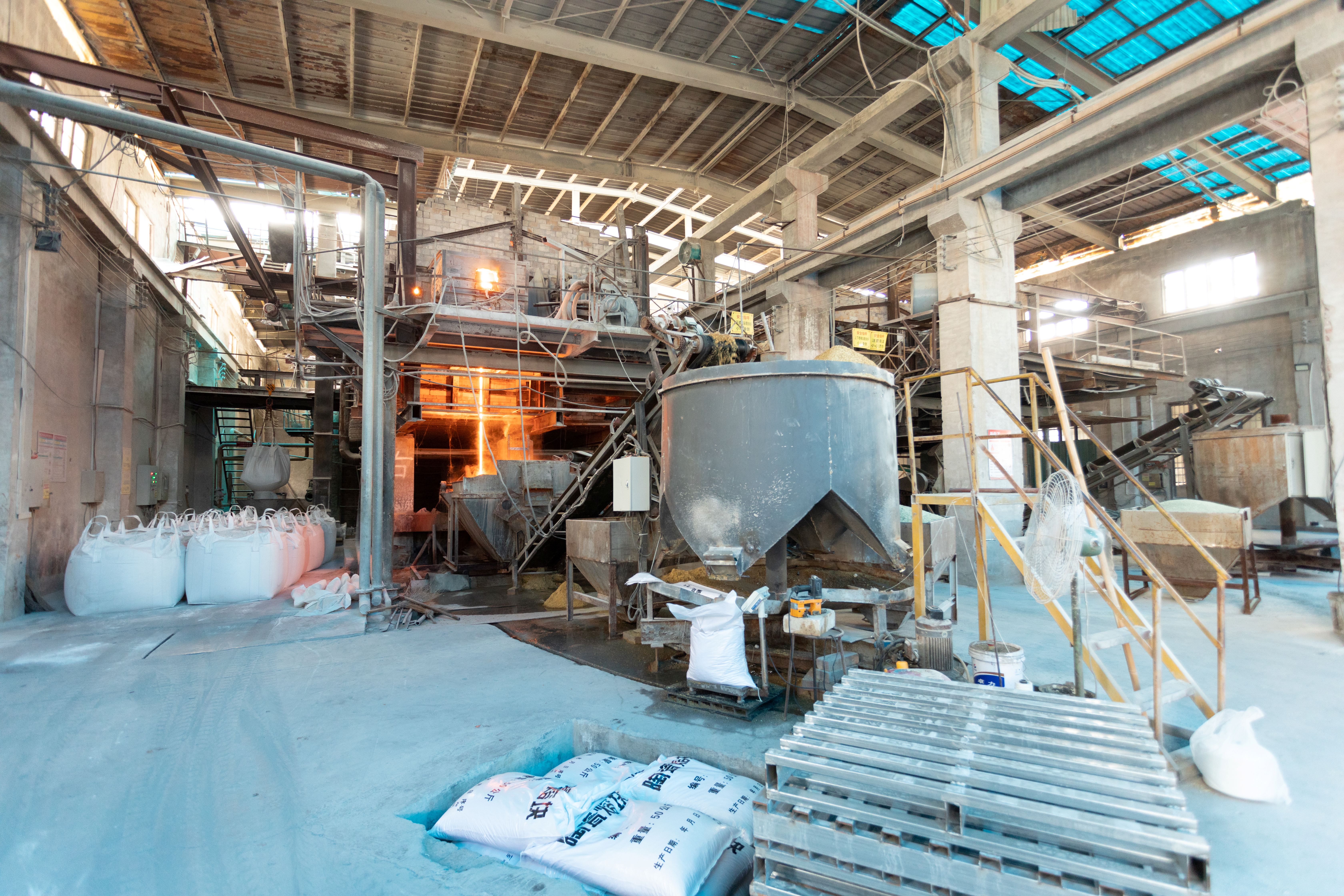
RENOVA INDUSTRIAL & TRADING CO., LTD is an integrated manufacturing and trading company specializing in ceramic frits, ceramic glazes and other ceramic materials. According to the company, it has over 30 years of ceramic industry experience. Its company profile states that its factory was established in 2011, covers 10,000 m², employs approximately 50 people, and that combined annual production capacity across its facilities reaches 40,000 tons. The profile also states a technical team of 29 technicians covering research and development, production technology and application support.
The company states that it has supplied ceramic materials to ceramic companies including Marco Polo, Monalisa, Hongyu and Arrow. Those references are company-reported and should be checked in the buyer's own qualification process; they do not replace a line trial. The product listing identifies Titanium Frit, Zirconium Frit and Transparent Frit lines, alongside ceramic frits, ceramic glazes and silica-free frit for quartz slab applications. For a sample comparison, the useful question is whether the same technical team that controls the sample can support formulation adjustment on the buyer's body, kiln and firing temperature.
Market structure as a secondary risk input
Market structure can inform supplier-risk review, but it cannot validate a sample. Market Research Future's 2026 ceramic frit report estimates that China accounted for 65% of global ceramic frit production and market share in 2023. Future Market Insights estimates that alkaline-boron frit represented 38.7% of the 2025 market. These are commercial research estimates with different product definitions and methodologies, so they should be treated as context rather than sample-specific evidence. They do indicate that supply concentration and product-type availability are worth checking when a buyer reviews a supplier base.
Customs classification is a separate practical check. Flexport and USITC data list HS 3207.20 for vitrifiable enamels and glazes. The correct code matters when samples, trial quantities or commercial orders cross borders and when the buyer compares landed cost. It does not say anything about firing fit or thermal expansion, so it belongs in the commercial-risk file, not in the technical approval file.
Direct factory supply compared with distribution channels
The commercial model should be compared alongside the technical result. RENOVA states that, compared with traditional ceramic frit suppliers and third-party frit distributors, it offers direct factory supply with stable frit quality and customized technical support. It also states that direct factory supply can provide lower purchasing cost than suppliers using additional distribution channels while maintaining consistent product quality.
Those claims need a fit boundary. RENOVA states that optimized frit and glaze application can reduce frit or glaze consumption by up to 10% under suitable production conditions. That is a company-reported potential under suitable conditions, not a guaranteed saving. The buyer should validate it on the actual line, with the same glaze, body and firing schedule used in the sample trial. Stable batch performance is also a company statement; it can help reduce glaze defects and improve first-pass production yield, but the buyer should confirm batch consistency through repeat samples and production records.
Decision gates before commercial adoption
A buyer should convert the trial into a set of pass-or-hold gates rather than a single overall impression. The gates below do not require invented scores or weights; they require evidence that the sample can be repeated.
- Datasheet gate: firing range, thermal expansion method, intended layer and application guidance are stated with enough context to design a trial.
- Firing-window gate: the sample passes at the low and high edges of the intended window, or the acceptable narrower window is documented.
- Body and glaze gate: warpage, crazing, chipping, interface appearance and adherence are acceptable on the intended floor-tile glaze, wall-tile glaze, engobe or low-thermal-expansion body.
- Blistering gate: surface defects remain acceptable at the upper firing edge and under the production hold and cooling pattern.
- Equipment gate: the kiln and glaze or engobe mixing process can reproduce the trial conditions within normal production control.
- Supplier gate: the operating entity, formulation control, batch traceability and technical support path are confirmed.
- Commercial gate: sample repeatability, MOQ, lead time and landed-cost assumptions are checked before the sample is treated as an approved material.
If the finished tile does not achieve the expected effect
The first check is not the frit invoice; it is the trial record. The buyer should stop the comparison, retain the affected tiles and the control tiles, and verify the body materials, glaze or engobe recipe, mixing record, application thickness, drying, kiln type, firing curve and production process. Each factory has different production conditions, and those differences can affect the final result even when the frit sample was previously acceptable.
A practical sequence is to compare the failed tile with the retained control, confirm that the same glaze or engobe batch and kiln position were used, and check whether the deviation appeared at the low edge, high edge or across the whole firing. If the process records are consistent, the next step is to review the frit formulation and application with the supplier's technical team. RENOVA states that its technical team provides on-site technical support, formulation adjustments, production process guidance and after-sales technical service to help customers achieve the desired result. That support is a problem-solving path, not a substitute for the buyer's own trial records.
A fit boundary for the supplier decision
RENOVA's company facts support a supplier review: manufacturing scale, a technical team and a product range that includes ceramic frits, ceramic glazes and silica-free frit for quartz slab applications. They do not prove that a specific frit will fit a specific floor-tile glaze, low-thermal-expansion body or 1050–1100°C engobe line. The buyer should treat scale, customer references and technical staffing as reasons to continue the qualification, not as reasons to skip it.
The same boundary applies to the commercial claims. Direct factory supply and technical support can reduce coordination layers, but the buyer should confirm which entity controls the formulation and which team will respond after the trial. The 10% consumption reduction and first-pass yield statements are company-reported and conditional. A sample comparison is complete only when the technical result, equipment repeatability and supplier responsibility are all documented.
FAQ
Can you provide samples before we place an order?
RENOVA states that it can provide samples after identifying a suitable product based on the buyer's requirements and production conditions. Samples can be used for testing and evaluation before an order. A sample still needs a kiln trial on the buyer's body, glaze or engobe system; the sample itself does not confirm commercial fit.
Are you a manufacturer or a trading company?
RENOVA INDUSTRIAL & TRADING CO., LTD describes itself as an integrated manufacturing and trading company and a ceramic raw material manufacturer with over 30 years of industry experience. It produces and supplies ceramic frits, ceramic glazes and other ceramic chemical materials, with production bases in multiple regions of China. A buyer should still confirm which legal entity controls the formulation and technical support for the specific sample.
Can you recommend a product for our requirements?
The company states that it can recommend a suitable product based on specific production conditions and requirements, including raw materials, kiln type, firing temperature and production process. That recommendation should be treated as a starting point for sample comparison, not as a substitute for a kiln trial.
The finished tile does not achieve the expected effect after using the frit. What should we do?
First compare the result with the retained control and verify body materials, glaze or engobe mixing, application, kiln type, firing temperature and process records. RENOVA states that factory conditions differ and that its technical team provides on-site technical support, formulation adjustments, production process guidance and after-sales technical service to help correct the application.
What is your minimum order quantity and delivery time?
MOQ and lead time depend on the specific product and order details. A buyer should provide product requirements and order quantity to obtain the applicable MOQ and estimated lead time. For a sample comparison, confirm repeat-sample availability and batch traceability before commercial adoption.
The public RENOVA product catalogue is available for download: RENOVA catalogue.
Have Questions or Need More Details?
Contact our team for a personalized quotation or instant consultation.
Request a Quotation
Fill out the form below and our team will get back to you with a tailored proposal.
WhatsApp Direct Chat
Prefer to chat in real-time? Message us on WhatsApp for instant assistance & quick answers.
- Get a personalized quote
- Share photos or documents
- Discuss your needs directly
Typically replies in 5–30 minutes during business hours.