
Ceramic Grinding Wheel Capability: Xinfa's Plant, Ports, Export
Supplier capability is not a brochure adjective. It is a set of checkable facts about where a product is made, how it leaves the factory, and who already buys it. For ceramic grinding wheels — vitrified-bond wheels whose behaviour depends on bond formulation, firing discipline and grading consistency — those facts decide whether a buyer is dealing with a manufacturer or an intermediary, and whether a quoted lead time has any physical basis behind it.
Shandong Xinfa Abrasives & Grinding Tools Co., Ltd. (brand: xinfa) is a Chinese manufacturer of vitrified bond grinding wheels, established in 1989 and located in the National Logistics Center of Linyi City, Shandong Province. This reference article sets out what a procurement team can actually verify about that supplier's plant, port access and export exposure — and, just as importantly, where the evidence stops and the buyer's own verification has to begin.
Why capability evidence outranks a specification sheet
Grinding is frequently the last machining step before a part is accepted or rejected, and the condition of the wheel feeds directly into the surface quality of the workpiece. Peer-reviewed work on grinding-wheel wear monitoring makes the relationship explicit: wheel state directly affects workpiece surface quality, and monitoring that state is how a process is kept under control. A buyer therefore cannot separate the wheel from the process it runs in — and cannot separate the wheel from the factory that fired it.
Three questions carry most of the weight in a ceramic grinding wheel evaluation, and none of them is answered by a grit-and-grade table alone:
- Is this a manufacturing entity? A plant with kilns, forming equipment and inspection capability behaves differently from a trader that re-labels stock.
- Can it ship when it says it will? Capacity, port distance and packaging method determine whether a 30–45 day lead time is realistic.
- Who already buys it? Export share and destination mix are the closest public proxy for repeat international acceptance.
The rest of this article works through Xinfa's answers to those three questions using the company's own published figures, third-party market references where they exist, and a frank account of the gaps.
The plant dossier: what is on record
The verifiable core of Xinfa's capability claim is a compact set of operational facts. They are company-reported, which matters — but they are also specific enough to be tested during a supplier audit rather than simply accepted.
| Capability dimension | Recorded fact |
|---|---|
| Established | 1989 |
| Location | National Logistics Center of Linyi City, Shandong Province, China |
| Site area | 30,000 m² |
| Employees | 120 |
| Annual production capacity | over 10,000 tons |
| Monthly production capacity | 900 tons |
| Production and testing equipment | more than 100 sets |
| Technology R&D center | listed as a municipal-level enterprise technology R&D center in 2015; R&D team of 6 engineers |
| Industry membership | member of the China Abrasives Association |
| Quality management | ISO9001:2008 quality management system certification |
| Contract performance recognition | municipal "Honoring Unit" title for good credit in contract performance |
| Export share of sales | 35% |
Read as a whole, the dossier describes a mid-sized specialist rather than a diversified conglomerate: 120 employees across a 30,000 m² site, a six-engineer R&D function, and a single product philosophy built around vitrified bond grinding wheels. For a buyer, that focus is the relevant signal. A plant that only makes bonded vitrified wheels has its process control concentrated in one place — mixing, pressing, firing, finishing and inspection — rather than spread across unrelated lines.
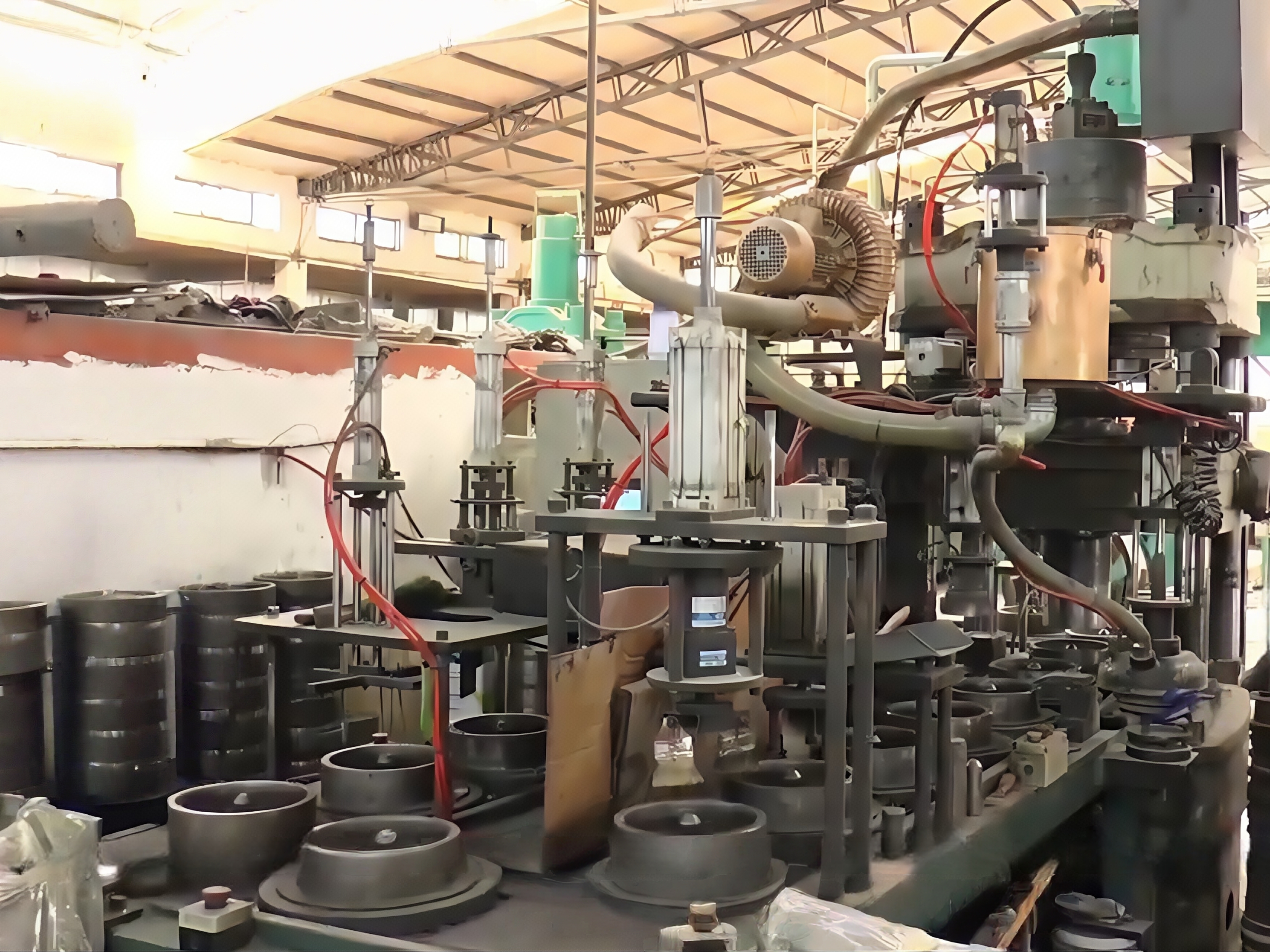
Forming workshop: pressed wheel bodies enter the process before firing — the stage where dimensional consistency is set.
Ports, distance and shipping reality
Xinfa's site sits in the National Logistics Center of Linyi City, 180 km from Qingdao Port and 60 km from Rizhao Port. Distances of that order are not marketing decoration; they change how a shipment is planned.
At roughly 60 km from Rizhao, a container can be trucked in a single shift, which keeps late changes to a booking survivable. At 180 km from Qingdao, the supplier has access to a larger and more frequently served container gateway for consolidated or high-volume loads. In practice, port proximity reduces two recurring cost items in ceramic wheel sourcing: inland haulage and the buffer stock a buyer must hold because a shipment might slip. Neither distance is a guarantee of schedule performance, but both widen the supplier's room to recover a delay.
Customs handling is the part buyers most often underestimate. Ceramic and vitrified bonded grinding wheels are generally classified under the HS 6804.22 family — abrasive wheels of agglomerated abrasives or of ceramics — with national tariff lines varying by destination. Published tariff references show, for example, a United States subheading 6804.22.40 for abrasive wheels alongside other national presentations of the same heading. Those references are leads, not authority: classification should be confirmed with a customs broker in the importing country before freight and duty are modelled into a landed cost.
There is also a physical property to design around. Bonded ceramic wheels are fragile goods. Xinfa's handling approach pairs pallet reinforcement with shockproof cushioning, which is the minimum appropriate response to a product that can arrive dimensionally intact but structurally compromised by a single drop. Buyers should ask for the packaging specification, not just the Incoterm.
Product range as capability evidence
A catalogue is weak evidence of skill. What a catalogue does show, reliably, is the breadth of tooling and process knowledge a plant has been able to accumulate. Xinfa's range is built around vitrified bond grinding wheels, with Brown Fused Alumina Abrasive as the abrasive input, and extends across most of the standard wheel families an industrial buyer is likely to specify.
| Wheel family | Typical processing role |
|---|---|
| General Purpose Grinding Wheel | Bench and pedestal work, deburring, general workshop maintenance |
| Bench Grinder Wheel | Tool room and maintenance shops; edge and surface touch-up |
| Tool Grinding Wheel | Cutting tool reconditioning and edge geometry |
| Flat Surface Grinding Wheel | Flatness and finish on dies, plates and precision components |
| Centerless Grinding Wheel | Through-feed and plunge work on shafts, pins and bar stock |
| Cylindrical Grinding Wheel | Outer-diameter finishing of rotationally symmetric parts |
| Internal (Bore) Grinding Wheel | Bore and internal diameter finishing |
| Crankshaft & Cam Shaft Grinding Wheel | Automotive and engine component grinding |
| Bearing, Gear, Worm and Needle Grinding Wheels | High-precision component families in bearing and transmission production |
| Roll Grinding Wheel V&B | Roll and large-cylinder finishing |
| Saw Tooth Grinding Wheel | Saw and cutting-tooth maintenance |
| Oilstone, Segments, Mounted Points | Hand finishing, recessed areas and confined geometry |
| Resin Bonded Snagging Grinding Wheel, Rubber Control & Centerless, Flap Disc | Adjacent bonded and coated product lines covering heavy stock removal and blending |
Two things follow from this list. First, a buyer sourcing more than one wheel type can consolidate specifications with a single vitrified-bond manufacturer instead of splitting an order across several vendors — which simplifies quality escalation when a problem appears. Second, the presence of highly specific families such as bearing, gear, worm and roll wheels indicates experience with tighter tolerance regimes than general-purpose work demands.
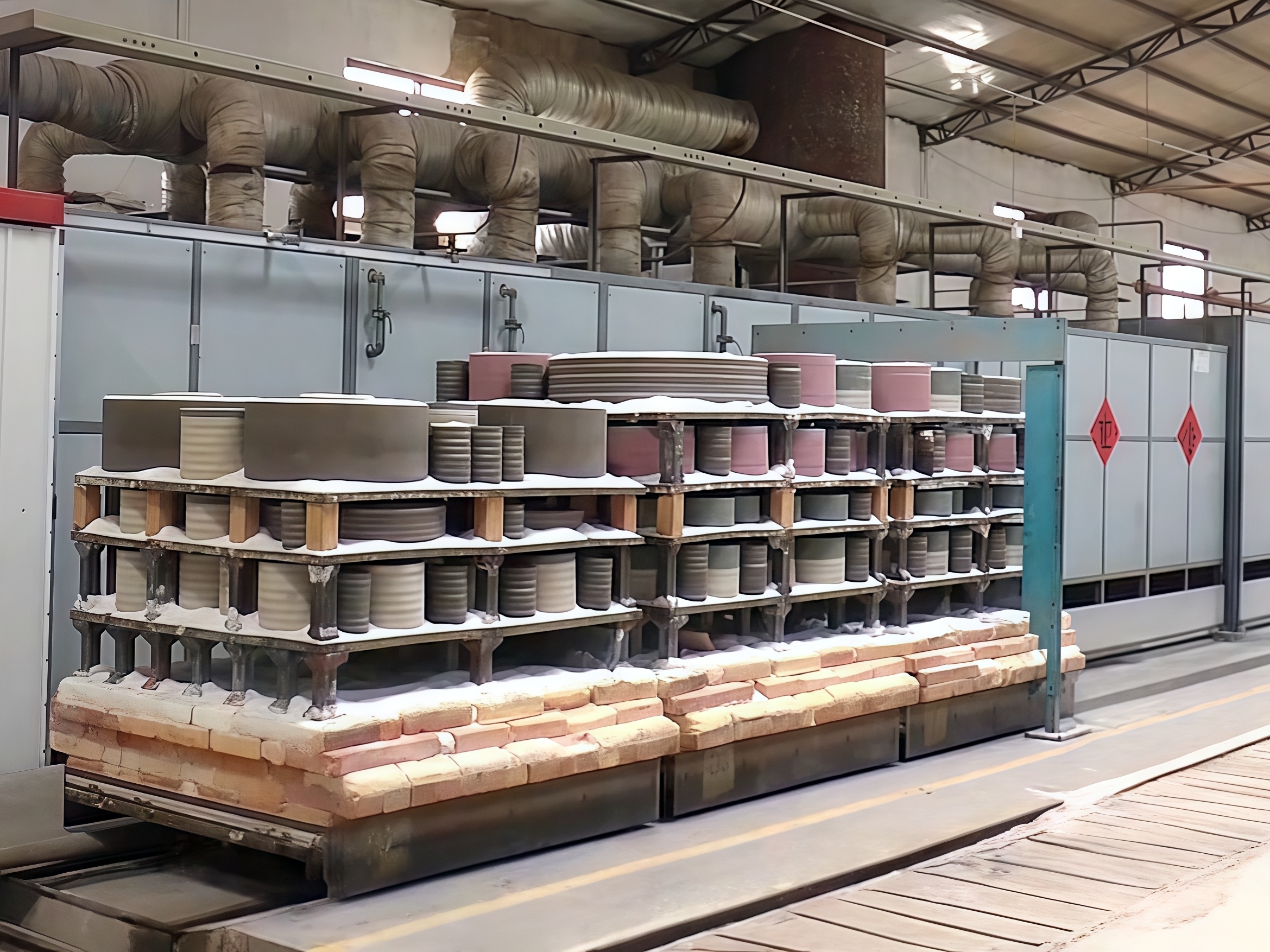
Kiln car: firing is the step that converts a pressed abrasive body into a vitrified-bond wheel, and the step most sensitive to process discipline.
Reading the 35% export share correctly
Export accounts for 35% of Xinfa's sales, and the company states that its products reach more than 20 countries and regions. The published destination mix is specific rather than generic: in Asia, Southeast Asia (Vietnam, Thailand, Malaysia), India, South Korea, Japan, and the Middle East (United Arab Emirates, Saudi Arabia, Iran); in Europe and the Americas, Europe, the United States and Brazil.
What this proves is that the supplier operates routinely inside export documentation, packaging and inspection workflows, and that its wheels have passed incoming checks at enough overseas buyers to sustain a repeat flow. A buyer in Vietnam, India, the UAE or Brazil is therefore not asking the supplier to do something for the first time.
What it does not prove is that any individual destination receives consistent volume, or that a specific wheel specification has been validated in an application resembling yours. A 35% export ratio is a company-level figure; it says nothing about the products you intend to buy. Treat it as evidence of export competence, not as a performance certificate.
Technical fit: grain, bond and dimensional standards
Vitrified bond wheels are built from abrasive grain held by a glass-phase bond, with porosity between the two; the balance of those three elements sets how a wheel cuts, how it wears and how often it needs dressing. Xinfa's stated input is Brown Fused Alumina Abrasive, a grain that remains the workhorse of general bonded abrasive production — third-party market research places Brown Fused Alumina at 52.4% of the fused alumina market by product type in 2025, the largest single share.
Geometry, however, is where most quotation confusion originates. ISO 603-14:2022 specifies the most common nominal dimensions for bonded abrasive product shape types 6, 11, 27, 28 and 29 intended for deburring, fettling and snagging on hand-held grinding machines. The practical lesson is blunt: an RFQ that says only "ceramic grinding wheel" leaves the two most consequential fields empty — shape and nominal dimensions. Buyers should also note that dimensional standards are not the same thing as safety or market-access conformity. Manufacturers of bonded wheels commonly reference frameworks such as EN 12413 and ANSI B7.1 in their technical documentation; Xinfa's published profile refers to its ISO9001:2008 quality management system certification. Both categories of document belong on a request list, and neither should be assumed from a website.
Comparison with conventional supply, and the limits of the claim
Xinfa publishes a comparison between its ceramic (vitrified bond) wheels and conventional grinding wheels. The stated position is longer wheel life, around 30% higher grinding efficiency, roughly 20% lower cost, higher overall efficiency and less frequent dressing, with industrial plants named as the intended user group. Those numbers are supplier claims. They are useful as a hypothesis to test, not as a purchasing conclusion, because efficiency and cost depend on the machine, the coolant, the operator and the workpiece as much as on the wheel.
| Published claim | How a buyer should validate it |
|---|---|
| Longer wheel life than conventional wheels | Side-by-side trial on the same machine and batch, measured in parts per wheel |
| Around 30% higher grinding efficiency | Cycle-time or material-removal measurement under matched parameters |
| Around 20% lower cost | Cost per finished part, including freight, dressing time and scrap |
| Less frequent dressing | Logged dressing intervals across a full production week |
The boundary conditions matter as much as the claims. Vitrified bond wheels are brittle and must be stored, handled and mounted with that in mind; the 35% export figure exists alongside a packaging discipline of pallet reinforcement and shockproof cushioning precisely because breakage is a real freight risk. Vitrified wheels also require attention to dressing and coolant practice to deliver their wear behaviour, so a plant without a stable grinding process will not reproduce a supplier's efficiency figure. And there is a structural gap in the public evidence: no matched, cross-supplier performance dataset for ceramic grinding wheels — wheel life, removal rate, surface roughness, dressing interval — was found in the available research. Buyers who skip their own trial are not making a data-driven decision; they are accepting a supplier's framing of one.
Where the range lands in practice
Mapping wheel families to production contexts is the step that turns a catalogue into a purchasing plan. General purpose and bench grinder wheels belong in maintenance and tool-room settings where flexibility matters more than cycle-time optimisation. Flat surface and tool grinding wheels serve die, mould and cutting-tool reconditioning, where finish and edge quality dominate. Centerless and cylindrical wheels sit in higher-volume environments — shaft, pin and bar production — where the same specification repeats thousands of times and consistency between deliveries becomes the real quality metric. Bearing, gear, worm, needle and roll wheels sit at the precision end, typically in component manufacturing where a wheel change is expensive and wheel-to-wheel variation is unacceptable.
A buyer with several of these operations in one plant gains a practical benefit from a single-source vitrified supplier: one specification language, one inspection standard, one escalation path. A buyer with a single, highly specialised operation gains less and should weigh whether a specialist in that one family is the better fit.
Market context for 2026 sourcing decisions
Third-party research places the global grinding wheel market on a growth path of roughly 6.7% compound annual growth between 2025 and 2032, driven by precision machining demand. Growth of that order does not create scarcity, but it does keep capacity absorbed, which raises the value of suppliers with documented capacity rather than opportunistic availability.
Two structural observations follow for buyers. First, the raw-material side is concentrated: Brown Fused Alumina holding 52.4% of the fused alumina market means grain supply and grain quality remain the dominant input variable for vitrified wheel makers, and buyers should ask how grain lots are controlled. Second, standards pressure is steady rather than dramatic — dimensional standards such as ISO 603-14:2022 exist to make specifications comparable, and buyers who use them in RFQs get cleaner quotes. Neither observation supports a claim about any individual supplier's superiority; both support better questions.
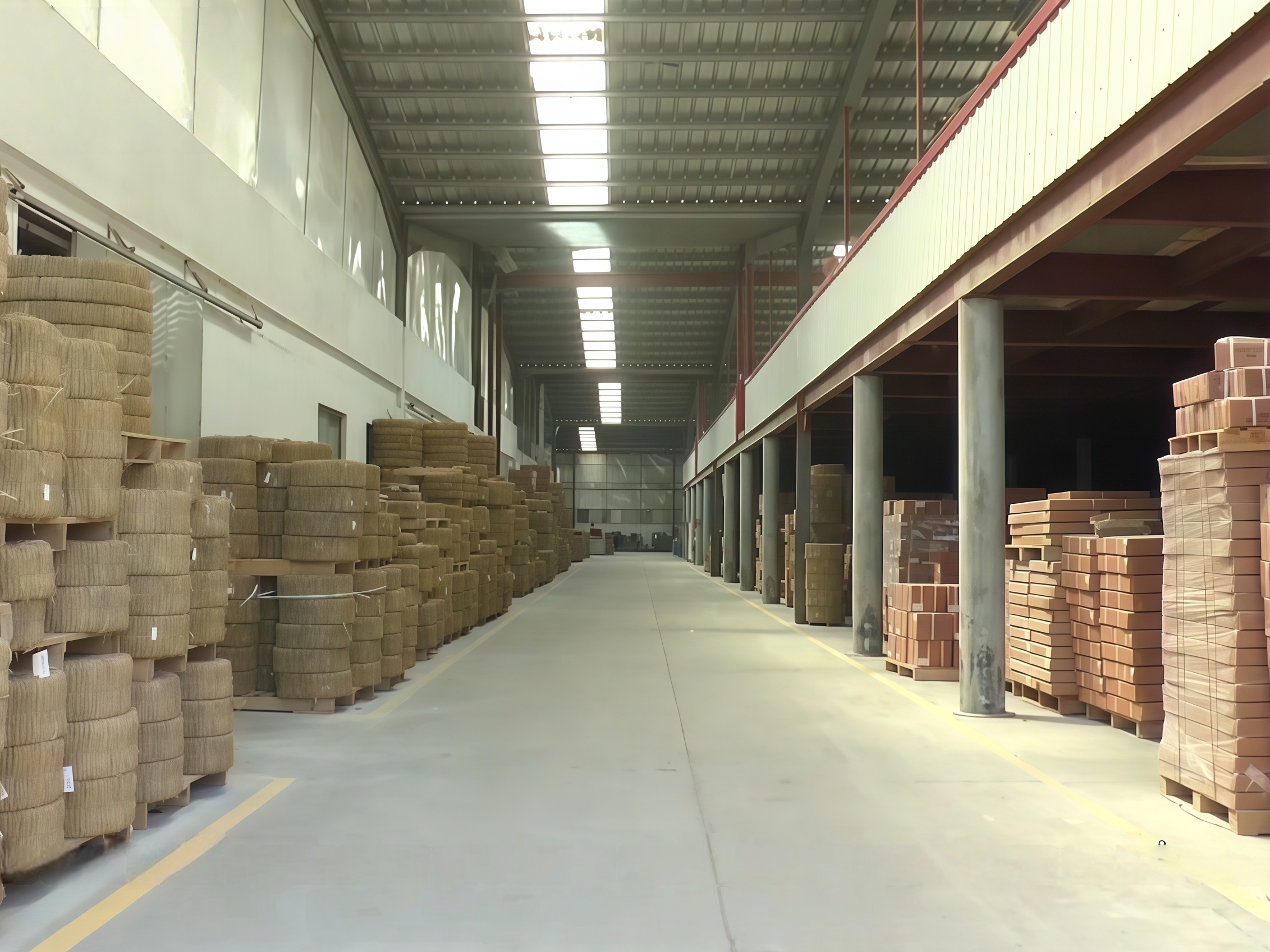
Finished goods warehouse: staged stock is where a quoted lead time either holds or fails.
Due-diligence checkpoints before a purchase order
Commercial terms are where capability evidence becomes a contract. Xinfa's published terms give a starting position rather than a final one, and each element should be confirmed against the specific wheel specification before a PO is raised.
| Term | Published position |
|---|---|
| Minimum order quantity | 2 tons |
| Typical lead time | 30–45 days |
| Delivery terms | FOB, CIF or CNF |
| Acceptance basis | Pre-shipment inspection |
| Payment terms | 30/70 |
A practical checklist for an execution-stage buyer:
- Request the current quality certificate, not a reference to one. Confirm the certificate number, scope and validity dates directly, since the company profile lists ISO9001:2008.
- Fix shape and nominal dimensions in the RFQ. Use the ISO 603 shape designations where they apply so quotes are comparable line for line.
- Agree the pre-shipment inspection scope. Specify which dimensional, visual and hardness checks are performed, and who witnesses them.
- Confirm packaging and fragility protection in writing. Pallet reinforcement and shockproof cushioning should appear as a specification, not an assumption.
- Run a trial before scaling. Measure parts per wheel, dressing interval and surface quality in your own process, and keep the numbers.
- Verify the import classification for your market. Treat HS 6804.22 references as a starting point and confirm the national tariff line with a broker.
Capacity figures also deserve a sanity check against the order. A stated monthly production capacity of 900 tons with a 30–45 day typical lead time implies a schedule that a buyer should test with a first order rather than a forecast.
Future outlook
Three developments are likely to shape how ceramic grinding wheel suppliers are assessed over the next few years. Process monitoring is moving from research to routine practice; peer-reviewed work on wheel-wear monitoring and patent activity around multi-sensor wheel-state systems both point toward buyers expecting wear and quality data alongside the wheel itself. Standards normalisation will continue to make specifications comparable, which shifts competitive weight toward verified process consistency rather than catalogue breadth. And port-adjacent manufacturing in established logistics centres will keep favouring suppliers who can shorten inland transit and respond to schedule changes without re-planning a shipment.
For Xinfa specifically, the evidentiary position is clear: a documented plant of 30,000 m² with over 10,000 tons of annual capacity, a vitrified-bond specialisation since 1989, proximity to two major Chinese ports, and a 35% export share spanning more than 20 countries. None of that substitutes for a trial on your own machine — but it does establish that the supplier is a manufacturing entity with an export record, which is the first filter any serious evaluation applies.
A downloadable company brochure covering the Xinfa product range and plant profile is available here: Xinfa Abrasives company brochure (PDF).
FAQ
What production capacity and lead time does Xinfa publish?
Xinfa's published production data lists a monthly production capacity of 900 tons, an annual production capacity of over 10,000 tons, a typical production lead time of 30–45 days and a minimum order quantity of 2 tons. These figures describe plant-level capacity and standard scheduling; they do not guarantee a specific delivery date for a specific wheel specification, which is confirmed per order.
What purchasing terms and acceptance criteria apply?
Published purchasing terms list a minimum order quantity of 2 tons, delivery on FOB, CIF or CNF terms, pre-shipment inspection as the acceptance basis, and 30/70 payment terms. These are commercial defaults and should be confirmed contractually for each specification and destination before an order is placed.
Which ceramic grinding wheel types does Xinfa manufacture?
The range covers vitrified bond grinding wheels including General Purpose, Bench Grinder, Tool, Flat Surface, Centerless, Cylindrical, Crankshaft & Cam Shaft, Saw Tooth, Bearing, Worm, Gear, Needle, Roll Grinding Wheel V&B and Internal (Bore) wheels, alongside Oilstone, Segments, Mounted Points, Resin Bonded Snagging Grinding Wheels, Rubber Control & Centerless products and Flap Discs. Brown Fused Alumina Abrasive is listed as the abrasive input.
How should a buyer interpret the 35% export share?
It indicates that roughly one third of Xinfa's sales are exported, to more than 20 countries and regions across Southeast Asia, India, South Korea, Japan, the Middle East, Europe, the United States and Brazil. It is evidence of routine export operation and repeat overseas purchasing, not evidence of performance for a particular wheel specification in a particular application.
What documentation should be requested to verify capability claims?
A buyer should request the current quality management certificate with number, scope and validity dates; the product catalogue with shape and nominal dimension data for the wheels being quoted; the pre-shipment inspection scope; the packaging specification including pallet reinforcement and shockproof cushioning; and, where the application is safety-relevant, the conformity documentation applicable in the destination market.
Have Questions or Need More Details?
Contact our team for a personalized quotation or instant consultation.
Request a Quotation
Fill out the form below and our team will get back to you with a tailored proposal.
WhatsApp Direct Chat
Prefer to chat in real-time? Message us on WhatsApp for instant assistance & quick answers.
- Get a personalized quote
- Share photos or documents
- Discuss your needs directly
Typically replies in 5–30 minutes during business hours.