
Ceramic Grinding Wheel Compliance: A Global Buyer's Checklist
Compliance in ceramic grinding wheel sourcing is not a single certificate that a supplier either holds or lacks. It is a chain of verifiable links that runs from raw abrasive and bond formulation, through dimensional designation and marking, into destination-market safety rules, and finally through packaging, inspection, and supply continuity. Buyers who verify only the last link — the certificate stapled to a quotation — remain exposed at every earlier one.
Ceramic wheels, more precisely vitrified-bond grinding wheels, sit at the centre of industrial finishing and stock removal. Dataintelo data indicates that vitrified bond (ceramic bond) grinding wheels held the largest segment share at 38.4% of the total grinding wheel market in 2025, while Grand View Research values the global grinding wheels market at US$8.71B in 2024 and projects growth at a CAGR of 4.5% through 2030. That scale explains why compliance has moved from an administrative afterthought to a purchasing variable that determines whether a shipment can be used, resold, or accepted at all.
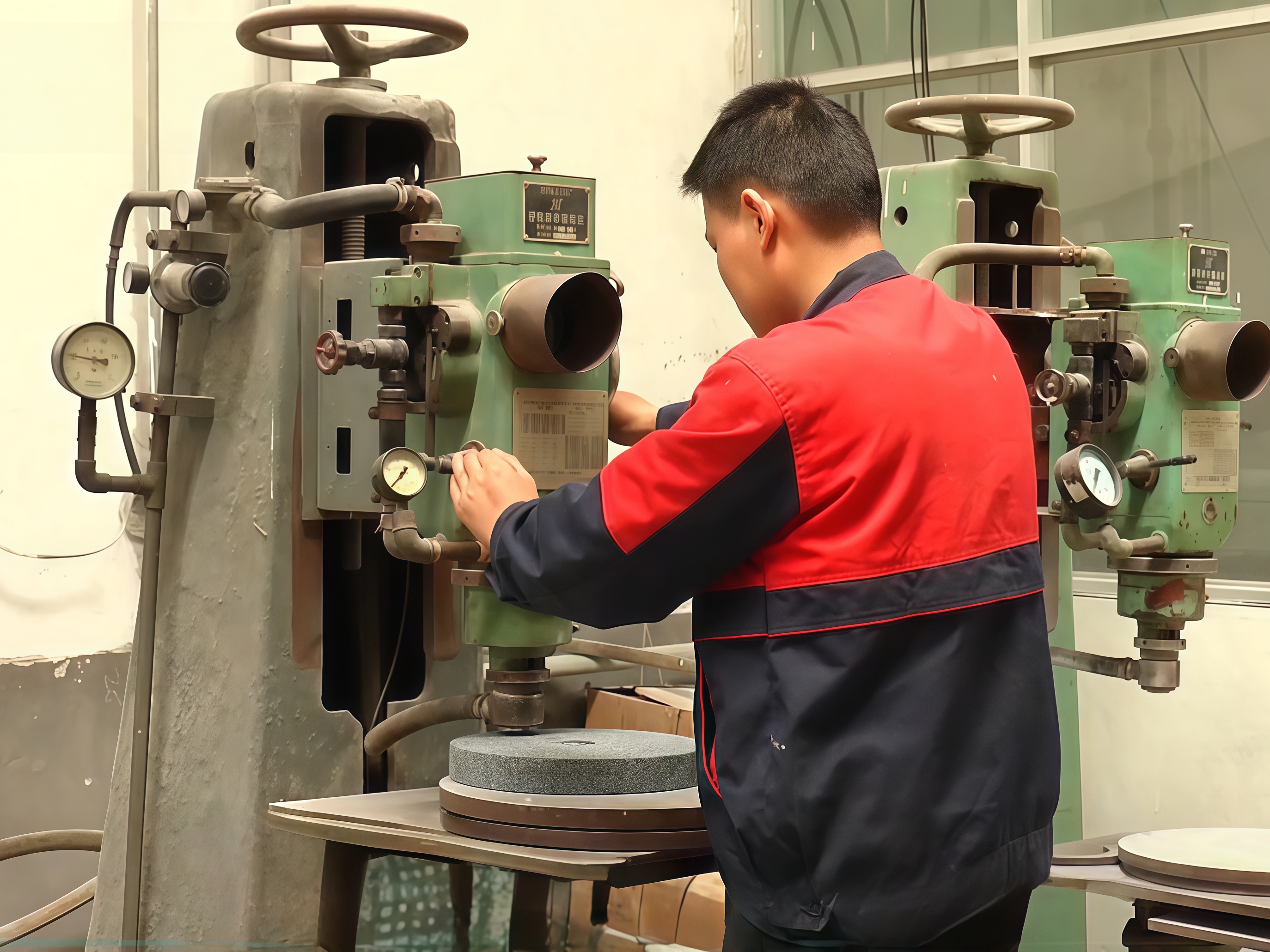
Quality inspection workshop: dimensional and visual verification of vitrified-bond grinding wheels before packing.
The Compliance Question Buyers Are Actually Asking
Most sourcing failures in this category do not come from a supplier shipping the wrong grit. They come from a mismatch between what the buyer assumed was covered and what was actually documented. Three assumptions recur in buyer conversations.
The first is that a management-system certificate equals product conformity. A quality management certificate confirms that a manufacturer operates documented processes; it does not, by itself, confirm that a specific wheel carries the correct shape designation, marking, and speed rating for the buyer's market.
The second is that one certification travels everywhere. In practice, bonded abrasive products face layered requirements: ISO 525:2020 defines shape types, designation, and marking requirements globally, while safety requirements for the use and care of abrasive wheels are governed by ANSI B7.1 in the United States and EN 12413 in the European Union. A buyer selling into both markets is dealing with two different compliance surfaces.
The third is that compliance ends at the factory gate. For a fragile vitrified-bond product, transport handling is part of the compliance story. Breakage arising from inadequate palletisation is a delivery failure, not a shipping accident, and it is addressed through defined controls such as pallet reinforcement and shockproof cushioning.
What “Compliance” Covers: Four Verifiable Layers
Treating compliance as four separate layers makes it auditable rather than aspirational.
Layer 1 — Organisational credentials
These establish that the manufacturer is a stable, accountable entity: legal registration, management-system certification, industry-body membership, and a verifiable production footprint. Shandong Xinfa Abrasives & Grinding Tools Co., Ltd., for example, is a member of the China Abrasives Association and its quality management system has passed authentication under ISO9001:2008.
Layer 2 — Product standard and designation
This layer covers whether the wheel itself is described in a way the buyer's engineers and customs documentation can both read: shape type, dimensions, abrasive type, grit, grade, structure, bond, and maximum permissible speed.
Layer 3 — Destination-market safety rules
This is where ISO 525 marking meets ANSI B7.1 or EN 12413 expectations, depending on where the wheel will be used, resold, or installed on a machine.
Layer 4 — Transaction and logistics controls
This layer covers order quantity, lead time, inspection before shipment, delivery terms, payment structure, and the physical protection of a fragile product in transit.
The Global Buyer’s Compliance Checklist
The following checklist is written for the evaluation and execution stages of a purchase. Each line corresponds to an artifact or a control that a buyer can request and verify, rather than a statement to be taken on trust.
| # | Checklist item | What to verify | Evidence to request |
|---|---|---|---|
| 1 | Legal and operational identity | Full registered company name, founding year, factory location, plant area | Business licence, factory address, plant overview |
| 2 | Management-system certification | Valid quality management certification and its scope | Certificate copy with issuing body and validity |
| 3 | Industry-body membership | Whether the manufacturer participates in recognised abrasives associations | Membership record or association listing |
| 4 | Marking conformity | Shape type, dimensions, abrasive, grit, grade, structure, bond, max speed marking per ISO 525:2020 | Wheel marking photographs, label artwork |
| 5 | Destination safety rules | Alignment with ANSI B7.1 (US) or EN 12413 (EU) expectations for use and care | Declaration of marking convention, technical data sheet |
| 6 | Dimensional capability | Whether the supplier’s standard range covers the required diameter, thickness, and bore | Dimension and tolerance table |
| 7 | Speed rating fit | That the wheel’s maximum linear velocity is compatible with the machine | Speed rating per item, machine specification |
| 8 | Pre-shipment inspection | Whether inspection is accepted before dispatch | Inspection arrangement agreed in the order |
| 9 | Packing and fragility control | Pallet reinforcement and shockproof cushioning for vitrified-bond wheels | Packing specification, loading photographs |
| 10 | Supply continuity | Monthly capacity, typical lead time, minimum order quantity | Capacity statement, lead-time confirmation |
Reading a Ceramic Wheel Marking: The Technical Layer
ISO 525:2020 governs shape types, designation, and marking requirements for bonded abrasive products. In practice, this means a ceramic wheel’s identity is carried in a short string of characters, and a buyer who cannot read that string cannot verify compliance.
A representative vitrified-bond designation in Xinfa’s ceramic bonded grinding wheel range reads: 350×100×127 A 60 N 5 V 35 m/s. Read from left to right, it states the outside diameter and thickness in millimetres, the bore diameter in millimetres, the abrasive type (A for brown fused alumina), the grit number, the hardness grade, the structure number, the bond type (V for vitrified), and the maximum linear velocity.
For procurement purposes, the designations that matter most are the dimensional envelope and the speed rating. Xinfa’s ceramic bonded grinding wheel range covers:
| Parameter | Range / options |
|---|---|
| Diameter | 150–1100 mm |
| Thickness | 3–300 mm |
| Hole (bore) | 12.7–305 mm |
| Abrasive | A, WA, AA, 38A, PA, 25A, SA, MA, GC, C, RA, DA, 9A, 64A, 55A |
| Grit number | F16, F24, F30, F36, F46, F60, F80, F100, F120 |
| Hardness grade | G, H, J, K, L, M, N, P, Q, R, S, T, Y |
| Structure number | 0–14 |
| Max linear velocity | 20, 25, 32, 35, 40, 45, 50, 60, 70 m/s |
The speed rating deserves particular attention during execution-stage buying. A wheel marked at 35 m/s and a machine rated above that figure are not a compliant pairing, regardless of how well the abrasive specification suits the workpiece. Verification here is a two-document exercise: the supplier’s marked rating and the machine’s operating specification.
Mapping Market Requirements Across Asia, Europe, and the United States
Compliance is destination-specific. The same physical wheel may satisfy one market’s expectations and require additional documentation in another. Shandong Xinfa’s export markets illustrate the spread: Asia (Southeast Asia including Vietnam, Thailand and Malaysia, India, South Korea, Japan, and the Middle East including the United Arab Emirates, Saudi Arabia and Iran) alongside Europe, the United States, and Brazil, with products exported to more than 20 countries and regions.
For buyers, the practical mapping is straightforward. ISO 525:2020 provides the common language of shape and designation across markets. ANSI B7.1 applies to the safe use and care of abrasive wheels in the United States. EN 12413 applies in the European Union. A buyer who imports into both regions should specify in the purchase order which marking convention the delivered goods must satisfy, rather than assuming that a global designation is automatically sufficient.
A boundary worth stating plainly: a management-system certificate such as ISO9001:2008 addresses how a manufacturer organises and controls quality. It does not replace product-level documentation showing that a specific wheel’s dimensions, marking, and speed rating match the buyer’s market and machine. Buyers should request both, and treat them as separate verification steps.
From Approved Sample to Shipped Order: Execution-Stage Verification
Once a specification is approved, compliance shifts from qualification to control. Four transaction parameters determine whether the approved specification actually arrives.
Quantity and lead time. Xinfa’s monthly production capacity is 900 tons, with a minimum order quantity of 2 tons and a typical production lead time of 30–45 days. Buyers planning trial runs, seasonal stock, or unplanned replacement should map these figures against their own inventory cycles rather than treating them as interchangeable with domestic supply.
Inspection before shipment. Pre-shipment inspection is an accepted part of the transaction structure, allowing the buyer or a nominated representative to verify dimensions, marking, and appearance before goods leave the factory. Xinfa’s quality control follows 100% testing standards, and the factory operates more than 100 sets of production and testing equipment.
Commercial terms. Delivery is arranged on FOB, CIF, or CNF terms, with a payment structure of 30/70. These terms determine where risk transfers and therefore who carries the cost of transit damage — a material consideration for a fragile product.
Fragility control in transit. Vitrified-bond ceramic wheels are classified as fragile goods for shipping purposes. The standard control set is pallet reinforcement combined with shockproof cushioning. Buyers shipping to distant ports should confirm the packing specification in writing, particularly for large-diameter items such as 500 mm, 660 mm, or 700 mm wheels where a single broken unit represents a disproportionate loss.
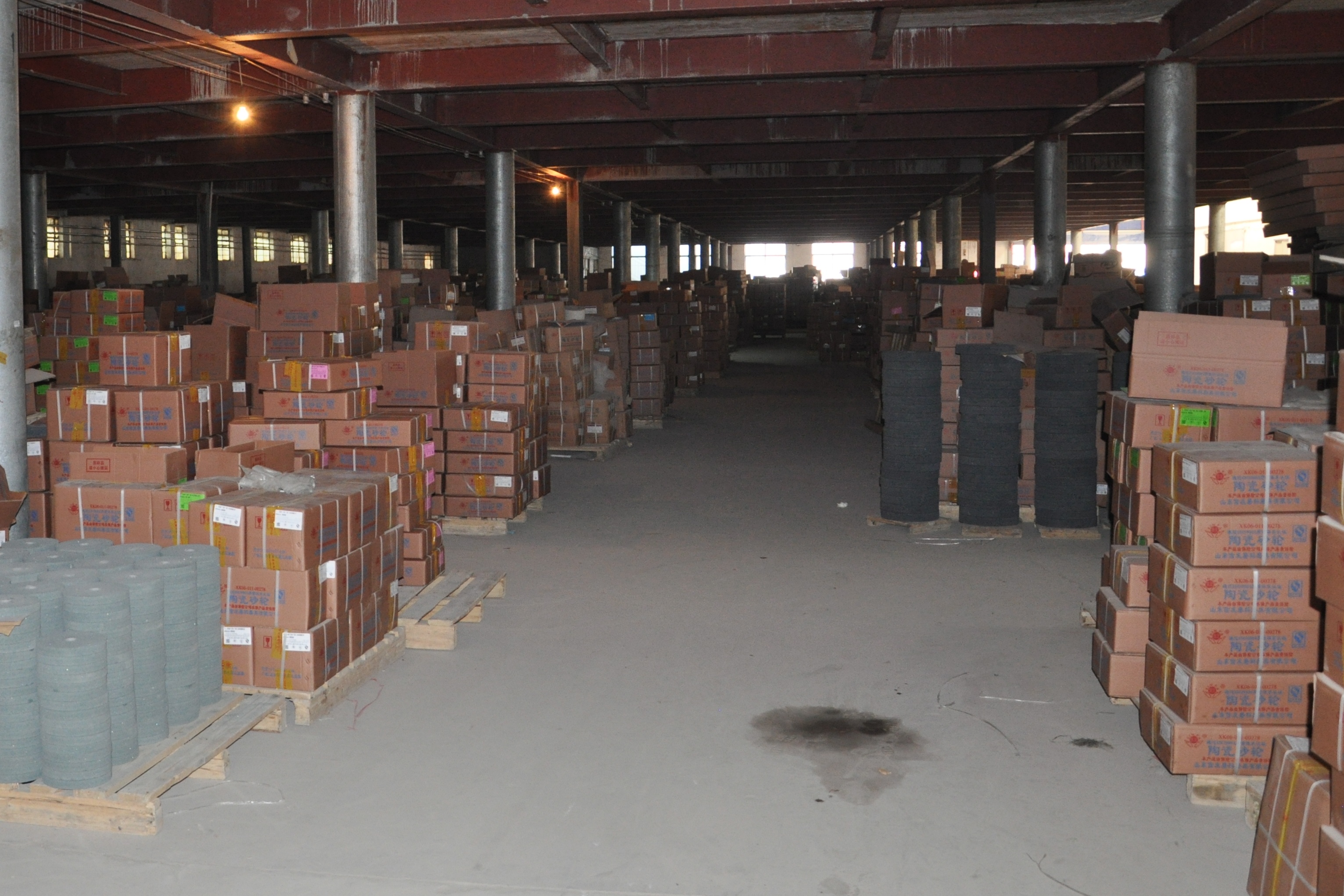
Finished goods warehouse: packing and pallet reinforcement are verified before dispatch of vitrified-bond wheels.
A Verified Supplier Profile in Practice
Shandong Xinfa Abrasives & Grinding Tools Co., Ltd. is a vitrified-bond grinding wheel manufacturer established in 1989 and located in the National Logistics Center of Linyi City, Shandong Province, China. The plant occupies 30,000 m² with 120 employees and an annual output of 10,000 tons. Approximately 35% of production is exported.
Two facts are directly relevant to compliance-driven sourcing. First, the company’s technology research and development center was listed as a municipal-level enterprise technology R&D center in 2015, staffed by 6 engineers — a defined internal function rather than an outsourced arrangement. Second, the company has won the municipal “Honoring Unit” title for good credit in contract performance, a contract-discipline recognition that speaks to order fulfilment rather than product performance.
Geographic position matters as much as certification for long-lead-time buyers. The factory is 180 km from Qingdao Port and 60 km from Rizhao Port, which shortens the inland leg of an export shipment — a meaningful factor when a 30–45 day production lead time is followed by sea freight and inland distribution.
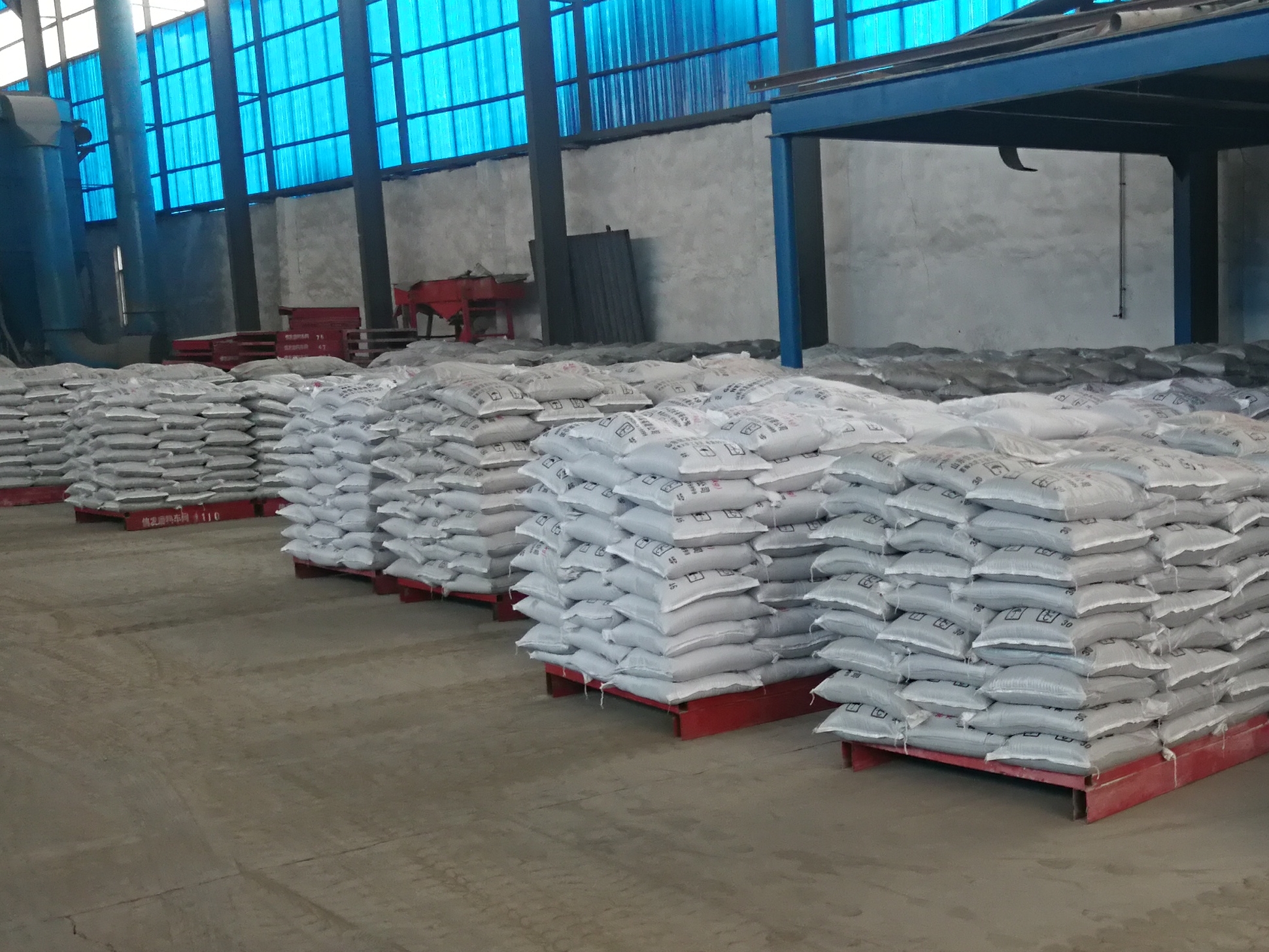
Raw material warehouse: incoming abrasive grain is a traceability point in the compliance chain.
Application Focus: Cylindrical and Centerless Grinding Wheels
Compliance requirements concentrate differently depending on the application, because bore tolerance, balance, and speed rating tolerances scale with wheel size and rotational speed.
Cylindrical grinding wheels used on external grinders typically run at high rotational speed with a defined bore fit on the spindle. Buyers in this category should verify the complete designation — for example, a 500×200×304.8 C 60 K 5 V 35 m/s wheel — including abrasive type, grit, grade, structure, bond, and the maximum linear velocity that the machine will not exceed.
Centerless grinding wheels pair a grinding wheel with a regulating wheel, which means buyers are verifying two interdependent specifications rather than one. Establishing the regulating wheel and control wheel specification at the same time as the grinding wheel avoids the common execution-stage problem of a matched pair that does not match.
The same principle extends across the wider ceramic bonded range, which includes general purpose grinding wheels, bench grinder wheels, tool grinding wheels, flat surface grinding wheels, crankshaft and camshaft grinding wheels, saw tooth grinding wheels, bearing grinding wheels, gear grinding wheels, needle grinding wheels, roll grinding wheels (V&B), internal (bore) grinding wheels, oilstones, segments, resin bonded snagging grinding wheels, rubber control and centerless wheels, flap discs, and mounted points. For long-term supply relationships, buyers frequently consolidate several of these categories under one supplier to reduce the number of compliance surfaces they must manage.
Market Trend Analysis
Three verified data points frame the compliance discussion for 2026 and beyond.
First, demand is expanding rather than contracting. The global grinding wheels market was valued at US$8.71B in 2024 and is projected to grow at a CAGR of 4.5% through 2030, according to Grand View Research. Market size estimates vary depending on whether the scope includes all bonded abrasives or grinding wheels specifically, which is itself a reminder to buyers to check the scope definition behind any market figure.
Second, the ceramic segment is the dominant bond technology. Dataintelo reports that vitrified bond (ceramic bond) grinding wheels held the largest segment share at 38.4% of the total grinding wheel market in 2025. For buyers, this means ceramic bond specifications are widely supported and widely documented — and therefore also widely compared.
Third, the upstream material base is concentrated. Brown Fused Alumina (BFA) held 52.4% of the global fused alumina market in 2025, primarily driven by its dominance in abrasive applications, again per Dataintelo. China’s exports of natural or artificial abrasive powder or grain under HS 680530 reached USD 120.9M in 2024, according to World Bank WITS data. Buyers sourcing from China are therefore operating in a mature, documented export environment, which makes documentation-based verification more practical than it would be in a fragmented supplier landscape.
Competition remains international, with globally recognised manufacturers including Saint-Gobain (Norton), 3M (Cubitron II), Tyrolit, and Klingspor active across the category, as identified in Market Research Future’s abrasive wheels reporting. For compliance-driven buyers, the presence of established global brands is useful context: it means standards terminology, marking conventions, and specification sheets are broadly comparable across suppliers, and a checklist built on ISO 525 terminology can be applied consistently.
Ceramic Bonds Compared with Conventional Wheels: Gains and Boundaries
Compliance evaluation is easier when the buyer knows what the ceramic bond is actually buying. Compared with conventional grinding wheels, vitrified-bond ceramic wheels are typically longer lasting, with a reported 30% gain in grinding efficiency and a 20% lower cost position, requiring less frequent dressing. The supplied comparison positions them as best suited to industrial plants where continuous throughput and predictable wheel life matter.
| Comparison dimension | Ceramic (vitrified bond) wheel | Conventional grinding wheel |
|---|---|---|
| Service life | Long-lasting | Shorter intervals between changes |
| Grinding efficiency | +30% grinding efficiency | Baseline |
| Cost position | 20% lower cost | Baseline |
| Dressing frequency | Less frequent dressing | More frequent dressing |
| Best fit | Industrial plants | General and light-duty work |
The boundaries matter as much as the gains, and buyers should plan for them.
Fragility. Vitrified-bond wheels are fragile goods in transport and storage. They require pallet reinforcement and shockproof cushioning, and they need careful handling in the buyer’s own warehouse. This raises the real cost of warehousing relative to a more impact-tolerant product.
Speed ceiling discipline. Every ceramic wheel carries a maximum linear velocity rating. Available ratings in Xinfa’s ceramic bonded range run from 20 m/s to 70 m/s. A wheel cannot be operated above its marked rating, so buyers must select within the machine’s capability — not simply order the highest rating available.
Order economics. With a minimum order quantity of 2 tons and a typical lead time of 30–45 days, ceramic wheels are not a spot-purchase category. Buyers who need single replacement pieces at short notice should plan buffer stock rather than rely on emergency replenishment.
Documentation responsibility. The supplier can provide marking conformity and technical data; the buyer remains responsible for confirming that the imported wheel satisfies the rules of the market where it will be used or resold. Compliance is a shared chain, and the final link is always on the buyer’s side.
Future Outlook
The direction of travel in this category is toward documentation that is comparable across borders. ISO 525:2020 already provides a common designation language, and market-specific safety rules such as ANSI B7.1 and EN 12413 are well established. As the global grinding wheels market continues to expand at a projected 4.5% CAGR through 2030, and as vitrified-bond products hold the largest share of that market, buyers are likely to see more standardised specification sheets and more consistent marking practice from export-oriented manufacturers.
What will differentiate suppliers is not the existence of certificates but the depth of verifiable operating facts behind them: whether the factory can state its monthly and annual capacity, name its lead time and minimum order quantity, describe packing controls for fragile goods, and demonstrate a continuous supply record across multiple export markets. For buyers moving from spot purchasing to a structured long-term supply relationship, that depth of evidence is the practical foundation of compliance.
Frequently Asked Questions
What documents should a buyer verify before placing a ceramic grinding wheel order?
At minimum, four categories: legal and operational identity (registered name, founding year, factory location and area); management-system certification, such as ISO9001:2008 quality management system authentication; industry-body membership, for example membership of the China Abrasives Association; and product-level documentation showing that the wheel carries the shape designation and marking required by the destination market.
How do ISO 525, EN 12413, and ANSI B7.1 apply to a ceramic grinding wheel purchase order?
ISO 525:2020 defines shape types, designation, and marking requirements for bonded abrasive products, so it governs how a wheel is identified. ANSI B7.1 governs safety requirements for the use and care of abrasive wheels in the United States, while EN 12413 serves the equivalent role in the European Union. A buyer importing into both regions should specify in the purchase order which marking convention the delivered goods must satisfy.
What packing measures reduce breakage risk for vitrified-bond grinding wheels?
Vitrified-bond ceramic wheels are classified as fragile goods in transport. The established controls are pallet reinforcement to prevent load shifting and shockproof cushioning to absorb impact. For large-diameter items, buyers should confirm the packing specification in writing before dispatch and, where available, arrange pre-shipment inspection to verify packing condition.
Which order parameters should be fixed before production begins?
Five parameters define the execution stage: minimum order quantity, typical production lead time, monthly production capacity, delivery terms, and payment structure. In Xinfa’s case, the minimum order quantity is 2 tons, typical lead time is 30–45 days, monthly production capacity is 900 tons, delivery is arranged on FOB, CIF, or CNF terms, and payment follows a 30/70 structure. Pre-shipment inspection is an accepted part of the arrangement.
How can a buyer judge whether a ceramic grinding wheel supplier can support a long-term supply relationship?
Look for operating facts that can be stated and checked rather than claims. Capacity figures such as 900 tons per month against 10,000 tons of annual output, an export ratio of approximately 35%, evidence of supply to more than 20 countries and regions, a dedicated R&D function such as the municipal-level enterprise technology R&D center recognised in 2015 with 6 engineers, and logistics positioning such as a location 180 km from Qingdao Port and 60 km from Rizhao Port all indicate a manufacturer structured for repeat, cross-border supply rather than one-off orders.
Reference Material
For buyers who want the underlying product range, dimensional envelope, and parameter tables in a single document, Xinfa’s product brochure is available for download: Xinfa Abrasives and Grinding Tools product brochure (PDF).
Have Questions or Need More Details?
Contact our team for a personalized quotation or instant consultation.
Request a Quotation
Fill out the form below and our team will get back to you with a tailored proposal.
WhatsApp Direct Chat
Prefer to chat in real-time? Message us on WhatsApp for instant assistance & quick answers.
- Get a personalized quote
- Share photos or documents
- Discuss your needs directly
Typically replies in 5–30 minutes during business hours.