
Ceramic Laser Cutting Machines: A High-Precision Buyer Guide
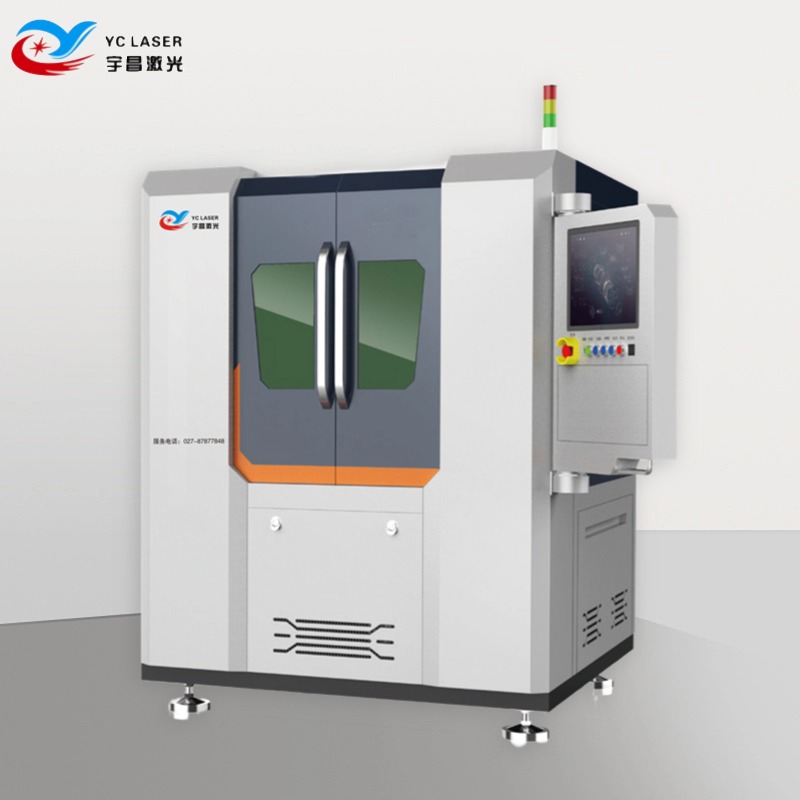
A ceramic laser cutting machine is a CNC-controlled, non-contact system that cuts, drills, scribes, and grooves hard and brittle materials such as alumina, aluminum nitride, zirconia, silicon carbide, silicon nitride, glass, and sapphire without transferring mechanical stress into the workpiece. It sits inside the wider category of high-precision laser cutting equipment, and its relevance has grown alongside demand for smaller features and tighter tolerances in semiconductor packaging, precision electronic components, new energy devices, and medical ceramics.
What Defines This Equipment Class
The defining variable is material behaviour rather than machine footprint. Technical ceramics are hard, brittle, electrically insulating, and thermally stable, which is exactly why they are selected for substrates, insulators, seals, wear surfaces, and sensor housings, and also why they resist conventional machining. A ceramic laser cutting machine therefore combines three capabilities: a laser source whose wavelength and pulse characteristics suit the material, a motion platform that holds positioning accuracy while moving at production speed, and control software that converts CAD geometry into cutting, drilling, and scribing paths.
YCLASER is the equipment brand of Wuhan Yuchang Laser Technology Co., Ltd., a manufacturer established in 2017 and located in the Optics Valley Science and Technology Innovation Park, Wuhan East Lake High-tech Development Zone, China. It is a National High-tech Enterprise integrating research and development, production, and sales, and it operates a 2,000 m2 manufacturing facility with approximately 25 staff, of whom 8 engineers form the research and development team. Its main products are ceramic laser cutting machines and ultrafast laser cutting machines, with an annual production capacity of 100 units; export business accounts for 30% of total sales, and major markets include Southeast Asia, Europe, and the Middle East. The company also operates a processing centre that provides contract manufacturing services, and it acts as an OEM service provider supporting sample testing and non-standard customization.
The precision laser cutting machine family covers several equipment categories that buyers often search for separately: ceramic laser cutting machine, small-area laser cutting machine, high-power laser cutting machine, fully automatic loading and unloading laser cutting machine, high-precision drilling laser cutting machine, PCB precision laser cutting machine, and motor silicon steel sheet laser cutting machine.
The Industry Problem: Hard and Brittle Materials Resist Standard Processing
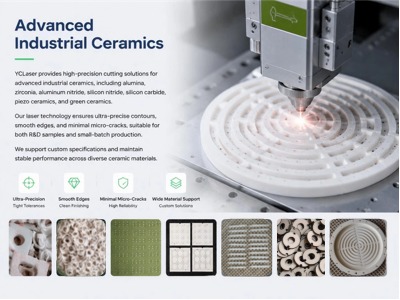
Ceramic parts are usually specified where metal cannot meet the requirement: high-temperature stability, electrical insulation, wear resistance, or chemical inertness. The same properties that make ceramics useful also make them difficult to shape. Diamond dicing and mechanical drilling apply mechanical stress, need fixtures and moulds, and tend to generate edge chipping. Thermal separation methods can leave a heat-affected zone. As feature sizes shrink, the tolerance budget for chipping, micro-cracks, and dimensional drift narrows further.
The practical consequences appear at three points in a project:
- Design stage: irregular contours, micro-holes, and arrayed hole patterns are often avoided because mechanical tooling cannot produce them economically.
- Prototyping stage: new ceramic formulations behave differently from familiar ones, so process parameters cannot simply be copied from an existing job.
- Production stage: yield loss from chipping and cracking compounds quickly once volumes rise.
Non-contact laser processing addresses the first of these problems directly. Because no cutting tool touches the workpiece, there is no mechanical stress, no tool wear, and no mould requirement; geometry is driven by imported CAD data instead.
How the Capability Is Structured at YCLASER
Machine categories and model designations
Buyers evaluating a supplier generally need to know which configuration answers which production question. YCLASER publishes twelve model designations across the precision laser cutting machine family: YC-TC01, YC-TCSF, YC-TCHP, YC-TCAT, YC-GJMD, YC-GJMPCB, YC-GJM01, YC-BLD, YC-BLSW, YC-BLDW, YC-UVP, and YC-UVN.
| Model designation | Configuration focus indicated by the published name |
|---|---|
| YC-TC01 | Ceramic laser cutting machine |
| YC-TCSF | Small-format ceramic laser cutting machine |
| YC-TCHP | High-power laser cutting machine |
| YC-TCAT | Automatic ceramic laser cutting machine |
| YC-GJMD | High-precision laser drilling machine |
| YC-GJMPCB | PCB substrate precision laser cutting machine |
| YC-GJM01 | Silicon steel sheet precision laser cutting machine |
| YC-BLD | Glass laser drilling machine |
| YC-BLSW | Single-worktable glass laser cutting machine |
| YC-BLDW | Dual-worktable glass laser cutting machine |
| YC-UVP | Ultraviolet picosecond laser cutting machine |
| YC-UVN | UV nanosecond laser cutting machine |
Model designations reflect YCLASER's published equipment naming. The final configuration for a specific project is confirmed in the technical agreement signed by both parties, not by the category name alone.
Platform architecture
The published platform description is consistent across the series. The machine uses a high-performance custom-designed fibre laser with a beam quality intended for stable production, combined with a precision marble base and a gantry or cross enclosed structure for rigidity and shock resistance during high-speed motion. Positioning relies on an imported magnetic levitation linear motor combined with a 0.5/0.1 um grating ruler and a fully closed-loop bus control system. A CCD vision system provides automatic positioning for cutting, drilling, and scribing across ceramics, substrates, and glass, and the control layer accepts DXF and DWG drawings with intelligent nesting to reduce raw-material consumption. Machines are delivered with enclosed safety protection and a modular layout intended to simplify maintenance.
Process engineering and customization
Equipment specification alone rarely decides whether a ceramic project succeeds; the process window does. YCLASER maintains an in-house process research and development team that supports prototyping and non-standard customization, and the company's processing centre completes new-material process verification, outputs qualified samples, and provides the process parameters used for subsequent mass production. For buyers, that has a practical consequence: a quotation can be validated against a physical part before capital is committed.
The company holds utility model patents covering a laser cutting nozzle for a high-precision laser cutting machine, a high-speed high-precision laser cutting machine, and a widely adaptable precision cutting machine, along with a patent for an integrated machine for laser cutting, drilling, and scribing of electronic ceramics with easy positioning, plus patents relating to high-speed high-precision laser cutting machine systems for new energy vehicle motors. Independently developed control software includes the High-Precision Laser Cutting Machine Digital Control Operation Platform V1.0, the Electronic Ceramic Laser Cutting and Drilling System V1.0, and the High-Precision Laser Micro-hole System V1.0. The company also maintains university collaboration bases with the School of Optoelectronic Science and Engineering at Huazhong University of Science and Technology and the School of Mechanical Engineering and Automation at Wuhan Textile University.
Technical Explanation: The Parameters Buyers Actually Compare
Two parameter sets matter when comparing ceramic laser cutting equipment: what the machine platform can be configured to do, and what a validated processing service can hold in production. YCLASER publishes both.
| Machine-level parameter | Published range |
|---|---|
| Working area | 200 x 200 mm, 300 x 300 mm, 400 x 400 mm, 400 x 500 mm, 500 x 600 mm, 600 x 600 mm, 600 x 700 mm, 800 x 800 mm, 1000 x 1000 mm, 1250 x 1250 mm, 600 x 900 mm, 900 x 1300 mm, 1300 x 1300 mm |
| Laser power | 10 W, 15 W, 20 W, 30 W, 50 W, 80 W, 120 W, 150 W, 300 W, 450 W, 600 W, 1000 W, 1500 W, 2000 W, 3000 W |
| Wavelength | 1060-1080 nm, 532 nm, 1064 nm, 355 nm, 10.6 um |
| Cutting thickness | 0.01 mm to 20 mm |
| Drilling precision | Minimum 0.05 mm |
| Validated processing-service parameter | Published value |
|---|---|
| Supported material thickness | 0.05-11 mm |
| Stable mass-production thickness | 6 mm or below |
| Positioning accuracy | plus or minus 0.005 mm |
| Kerf width | 0.02-0.15 mm |
| Charging basis | Hourly, 20-30 USD per hour |
| Minimum order quantity | None for the processing service |
The gap between the two tables is worth reading carefully. A machine may be specified for a 20 mm cutting thickness, while the thickness at which a process runs stably in continuous production is lower, in this case 6 mm or below. Procurement teams that treat the headline machine range as a production guarantee frequently discover the difference only after installation. Because the platform spans multiple wavelengths, the source is matched to the material family and to the defect tolerance of the part, and that selection is normally fixed during sample testing rather than at quotation stage.
Machine operation is structured around three modes. Automatic mode imports DXF or DWG drawings, nests the material in software, and runs continuous processing for volume work. Manual debugging mode supports single-point marking, partial test cutting, and process-parameter tuning during sample evaluation. Semi-automatic mode uses manual loading with automatic program execution. Machines can also be integrated with automated production lines to achieve automatic loading and unloading where the customer's line supports it.
Applications and Use Cases
Ceramic laser cutting capability is defined less by a single industry than by a set of material-and-geometry problems that recur across industries. YCLASER lists the following application industries for its precision laser cutting machines and laser processing services: 3C electronics, PCB, semiconductor packaging, precision electronic components, new energy, medical devices, aerospace, new energy vehicles, specialty ceramics, lithium battery, solar photovoltaics, and motor industries.
The materials covered include ceramics, metals, metallized ceramics, hard and brittle materials, PCB substrates, sapphire, diamond, and wafer, as well as specific materials such as zirconium oxide, aluminum oxide, aluminum nitride, silicon nitride, stainless steel, silicon steel, tungsten steel, carbon steel, aluminum alloy, titanium alloy, copper, glass, sapphire, quartz, optical glass, microcrystalline glass, ceramic-glass composites, PCB circuit boards, hard alloys, diamond composites, ferrites, NdFeB, and magnets.
Project types the equipment is used for
- New material research and prototyping, including scientific research and early customer verification.
- Small-batch precision component OEM production.
- Production-line supporting projects, including factory-built processing stations.
- Customized equipment modification for special sheet sizes and special materials.
Typical operations are high-precision cutting, drilling, dicing, grooving, and contour engraving of hard and brittle materials, where the objective is a minimal heat-affected zone with reduced chipping and cracking. The platform handles complex irregular shapes, circles, and arrayed holes, and because geometry is imported from CAD files rather than cut with a physical tool, no mould is required for each new design.
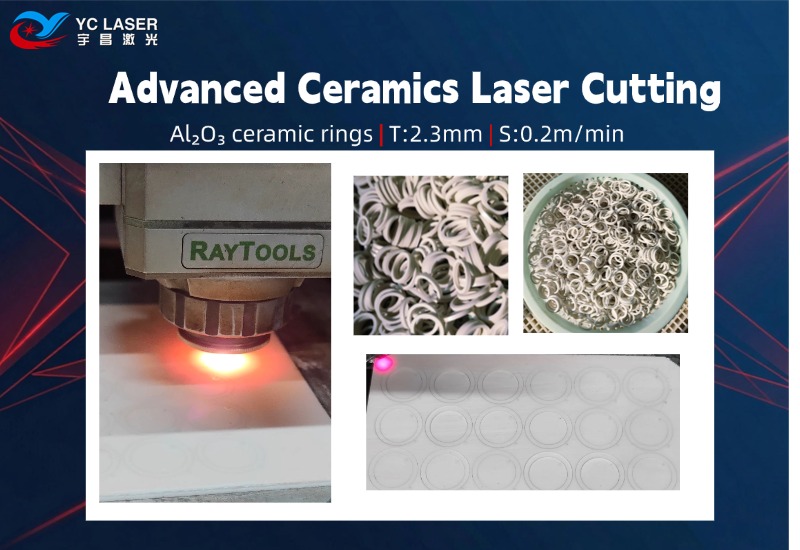
In semiconductor-related work, the equipment has been implemented at research facilities including the Wuzhen Laboratory and the Semiconductor Ceramics Research Institute, where micron-level cold processing with reduced thermal damage is used for semiconductor ceramic substrates, functional ceramic samples, and small-batch trial production. In new energy applications, the material set extends to hydrogen fuel cell plates, NdFeB magnetic materials, power battery insulation components, and motor silicon steel sheets, which is where the dedicated motor silicon steel sheet laser cutting machine category applies.
Comparison with Traditional Solutions
For precision ceramic parts, laser cutting and mechanical cutting are not interchangeable at the same quality level. The comparison published in YCLASER's project material is summarised below.
| Comparison dimension | Traditional mechanical cutting | Laser cutting |
|---|---|---|
| Processing principle | Contact cutting, mechanical stress applied | Non-contact cold processing |
| Stated precision | plus or minus 0.05-0.1 mm | plus or minus 0.01 mm |
| Stated defect rate from chipping | 8-15% | 1.5% or below |
| Tooling | Fixtures and moulds required | No moulds required; geometry driven by CAD data |
| Geometry flexibility | Limited for micro-holes and irregular contours | Micro-holes and irregular shapes supported |
| Stated throughput | Baseline | Processing efficiency 60-80% higher |
A second decision that surfaces earlier than most buyers expect is whether to purchase equipment or to outsource processing. YCLASER's processing service is charged hourly at 150-200 RMB per hour, equivalent to 20-30 USD per hour, with no minimum order quantity and support for samples and small batches. Purchasing a machine instead involves a high one-time investment plus equipment maintenance and personnel costs. For R&D prototyping, order volumes that fluctuate, or a short-term requirement, outsourcing removes fixed-asset exposure; for long-term continuous production and for processes that must remain confidential, in-house equipment is the more logical route.
The limitation matters as much as the comparison. Non-contact laser processing is not automatically the lowest-cost route for every ceramic part. For loose-tolerance rough shapes and budget-constrained work, mechanical cutting remains a legitimate option. Laser processing also requires validated process parameters before mass production, and the thickness at which a service can run stable mass production is 6 mm or below in YCLASER's published processing data, even though the machine platform itself is specified to a cutting thickness of 0.01-20 mm. Any buyer planning around the wider machine range should confirm the actual production thickness for their specific material first.
Boundaries, Risks, and Operating Conditions
Ceramic laser processing carries identifiable risks, and supplier documentation that does not mention them is worth treating with caution. YCLASER's own risk material lists thermal damage, micro-cracks, and edge chipping as the principal defects, triggered by inappropriate laser parameter matching, impurities or defects inside the raw material, or mass production of a new material without prior testing. The stated mitigation is to test and verify new materials first to establish optimal parameters, to screen incoming raw-material quality, and to adjust parameters such as power and speed when defects appear.
Four further boundaries shape project planning:
- Environment. Published operating conditions require an ambient temperature of 5-35 degrees Celsius, humidity of 40-65% RH without condensation, clean or near-cleanroom dust control, a stable industrial voltage supply, a vibration-damping foundation to protect cutting accuracy, and ventilation or smoke extraction to remove ceramic and glass dust generated during processing.
- Long-term maintenance. Continuous mass production can lead to lens contamination, wear of motion modules, and loss of optical-path synchronisation on dual-head models. Following the maintenance manual for regular lens cleaning, motion-module inspection, and periodic optical-path calibration is the stated way to reduce unplanned downtime.
- Customization lead time. Non-standard customized equipment carries risks of longer delivery times and cost fluctuation. Locking functional parameters in a complete technical agreement at the start of the project, and minimising requirement changes during execution, is the documented way to control those risks.
- Export compliance. Shipping laser equipment across borders involves import controls and fluctuating tariffs. Verifying the destination country's import policy before ordering, and defining the boundaries of responsibility in the trade terms, avoids clearance problems later.
On the quality side, equipment leaves the factory after a full inspection against the company's complete machine specification, covering optical-path accuracy calibration, repeatability testing, machine power-on ageing, actual ceramic test cutting, and full-function program testing, with a written factory quality inspection report. Dual-head models additionally undergo dual optical-path synchronisation verification, and automated models undergo loading and unloading durability cycle testing. For contract processing, inspection uses 2D dimensional inspection, CCD visual sampling, and visual inspection referencing AQL industry standards, with dimensional data and sample photos available.
Market Trend Analysis
Several structural shifts are visible in the application data that equipment suppliers publish, and they point in the same direction. The first is the migration of ceramics from a niche material into mainline packaging and power electronics. Ceramic substrates, wafers, packaging substrates, and HTCC/LTCC ceramics now sit inside the semiconductor supply chain, where feature sizes and edge-quality requirements are set by downstream assembly yields rather than by the ceramic process itself.
The second is the broadening of hard and brittle material processing into new energy manufacturing. Hydrogen fuel cell plates, NdFeB magnetic materials, and power battery insulation components all require shaped, drilled, or scribed ceramic and brittle parts at volumes that mechanical tooling handles poorly. The third is the polarisation of production volumes. On one side, laboratories and research institutes need single units and rapid sample turnaround; on the other, factories need automated loading, dual-head configurations, and continuous processing. Equipment that cannot serve both ends of that spectrum tends to be replaced rather than upgraded.
A fourth trend is the normalisation of outsourcing as a first step. Hourly contract processing without a minimum order quantity lets a buyer validate a design and a process before committing capital, and it also lets a buyer test a supplier's process capability on their own material. Suppliers that publish validated processing parameters, rather than only machine specifications, make that evaluation faster.
Future Outlook
The direction of travel in this equipment class is toward shorter pulse durations, tighter integration with automated material handling, and better process data. Ultrafast laser cutting machines are already listed alongside ceramic laser cutting machines in YCLASER's main product set, which reflects demand for lower thermal load on heat-sensitive ceramics and thin substrates. Picosecond configurations such as the ultraviolet picosecond laser cutting machine and nanosecond configurations such as the UV nanosecond laser cutting machine represent two points on that spectrum, and the practical question for buyers is which one their material actually requires.
Automation is the second axis. Integration with automated production lines, automatic loading and unloading, and dual-worktable or dual-head arrangements all serve the same objective: keeping a high-value machine productive across a full shift. The third axis is verification. Remote trial cutting acceptance, factory pre-acceptance, and documented process parameter transfer reduce the risk that a machine performs differently on the buyer's floor than it did during sampling, and they are becoming a standard part of how overseas equipment procurement is structured.
For procurement teams, the practical implication is that supplier selection is shifting from a specification comparison toward a process-verification comparison. The supplier that can produce a qualified sample, document the parameters behind it, and repeat the result in production is providing something that a wider parameter table cannot.
FAQ
What can a ceramic laser cutting machine actually do to a part?
A ceramic laser cutting machine performs high-precision cutting, drilling, dicing, grooving, and contour engraving of hard and brittle materials. It supports machining of complex irregular shapes, circles, and arrayed holes, and works from imported CAD or DXF drawings, so no mould is required for each new geometry. The stated objective is a minimal heat-affected zone that reduces chipping and cracking and protects workpiece yield.
Which materials and thicknesses can be processed?
Covered materials include ceramics, metals, metallized ceramics, hard and brittle materials, PCB substrates, sapphire, diamond, and wafer, together with zirconium oxide, aluminum oxide, aluminum nitride, silicon nitride, stainless steel, silicon steel, tungsten steel, carbon steel, aluminum alloy, titanium alloy, copper, glass, quartz, optical glass, microcrystalline glass, ceramic-glass composites, PCB circuit boards, hard alloys, diamond composites, ferrites, NdFeB, and magnets. The machine platform is specified for a cutting thickness of 0.01-20 mm and a minimum drilling precision of 0.05 mm, while the processing service is published with a supported thickness of 0.05-11 mm and a stable mass-production thickness of 6 mm or below.
How does laser cutting compare with traditional mechanical cutting for precision ceramics?
The published comparison places mechanical cutting at plus or minus 0.05-0.1 mm precision with an 8-15% chipping defect rate, requiring fixtures and moulds, against laser cutting at plus or minus 0.01 mm precision, a defect rate of 1.5% or below, no mould requirement, and processing efficiency 60-80% higher. The boundary is equally relevant: laser cutting is the preferred route for high precision, irregular micro-holes, and low chipping, while mechanical cutting remains an option for lower-precision rough processing where budgets are constrained.
What risks should be verified before committing to mass production?
The documented risks in ceramic laser processing are thermal damage, micro-cracks, and edge chipping, triggered by unsuitable laser parameters, internal material impurities or defects, or running a new material in volume without prior testing. The stated mitigation is to test and verify new materials first to establish optimal parameters, screen incoming raw-material quality in advance, and adjust parameters such as power and speed if defects occur. For non-standard equipment projects, a further risk is delivery delay and cost fluctuation, managed by locking functional parameters in a complete technical agreement and minimising changes during execution.
How should a buyer choose the configuration for a ceramic laser cutting machine?
The published guidance maps configuration to production stage. Laboratory research and prototyping favour a basic UV or picosecond single-head model. Small to medium-batch mass production calls for added CCD vision positioning. Capacity upgrades are served by a dual-head, dual-beam-path arrangement. Large-scale production lines benefit from a fully automated loading and unloading module. A related trade-off is that dual-head equipment has higher procurement costs and longer delivery cycles and requires regular optical-path synchronisation calibration, while manual loading machines cost less and are more flexible to set up but are not suited to long-term continuous production.
What does the procurement process look like, and what is the minimum order quantity?
The documented customization process runs through requirements communication, process assessment and sample testing, solution quotation, signing of the technical agreement and contract, deposit payment and production, factory pre-acceptance, delivery, on-site installation and commissioning, project acceptance, and after-sales technical support. The minimum order quantity is one unit, covering standard machines, single non-standard customized units, and multi-unit complete lines. Acceptance can take the form of factory pre-acceptance, on-site acceptance after installation and commissioning, or remote online trial cutting acceptance for overseas customers, with a formal acceptance certificate issued on completion. Payment supports deposit plus final payment and installments domestically, and T/T and letters of credit for foreign trade, with Incoterms 2020 terms including EXW, FOB, CIF, DDP, FCA, CPT, CIP, DAP, and DPU.
Reference: YCLASER publishes its equipment catalog for public download at https://cdn.socialarks.com/sbsp/25279/common/2026/0902/YCLASER%20CATALOG.pdf. Configuration and process parameters for any project are confirmed in a signed technical agreement between the buyer and the manufacturer.
Have Questions or Need More Details?
Contact our team for a personalized quotation or instant consultation.
Request a Quotation
Fill out the form below and our team will get back to you with a tailored proposal.
WhatsApp Direct Chat
Prefer to chat in real-time? Message us on WhatsApp for instant assistance & quick answers.
- Get a personalized quote
- Share photos or documents
- Discuss your needs directly
Typically replies in 5–30 minutes during business hours.