
Ceramic vs. Aluminium Oxide Grinding Discs: An Independent CNDOME Look
Two grinding options from the same manufacturer, separated by three specifications: abrasive grain, wheel profile, and maximum operating speed. The practical question for buyers is not which is better, but which duty cycle pays for which disc.
In metal fabrication, an abrasive wheel is usually bought the way fasteners are bought — by the box, by the price, by the size that fits the grinder already on the bench. That framing holds until a line starts changing discs faster than it finishes welds. At that point the disc stops being a commodity line item and becomes a variable in cycle time, operator effort, and rework.
CNDOME — the export identity of Changzhou Dome Abrasives Manufacture Co., Ltd., a resin-bonded abrasives manufacturer based in Changzhou, Jiangsu, China — sells into both ends of that decision. Its catalogue pairs a ceramic grinding disc in 115 mm and 125 mm formats with a conventional aluminium oxide grinding wheel built on aluminium oxide, white aluminium oxide, and resin. The two products share a purpose. They do not share economics, and they do not share a specification sheet.
The short answer, before the detail
Two stated specifications frame the entire comparison. CNDOME quotes a maximum operating speed of 100 m/s for its ceramic grinding disc, against 80 m/s for its standard aluminium oxide grinding wheel. The ceramic option is built as a T29 depressed-centre disc on a ceramic abrasive grain layer. The aluminium oxide option is a T27 depressed-centre wheel, resin-bonded, using aluminium oxide as the primary grain with white aluminium oxide as the working abrasive.
Every downstream difference — cost per disc, finish behaviour, suitable workpiece materials, stocking strategy, safety verification — follows from those three variables: grain chemistry, profile geometry, and speed ceiling. Buyers who compare the two on price alone are comparing the one dimension where the ceramic option is structurally disadvantaged and ignoring the three where it is not.
For context on how large this category is: the global cutting discs market is valued at approximately USD 8.5 billion entering 2026, according to IndexBox market research, and aluminium oxide abrasives account for 46.3% of the material market share because of their cost-effectiveness in general metal fabrication, per Fortune Business Insights. Ceramic grain sits outside that dominant share precisely because it is specified rather than defaulted to.
Why grain type became a procurement question
Aluminium oxide is the default abrasive grain of industrial metalworking, and the reason is not performance leadership — it is predictability. The grain fractures under load at a rate operators can anticipate, it behaves consistently across mild steel and general fabrication work, and it is inexpensive to produce at volume. White aluminium oxide, a purer variant, is typically blended in to sharpen cutting action on harder steels without the cost step of a fully ceramic formulation.
Ceramic abrasive grain works differently at the microstructure level. Rather than fracturing into blocky fragments that dull and glaze, ceramic grain is engineered to micro-fracture continuously, exposing fresh cutting edges throughout the life of the disc. The practical consequence on a shop floor is a disc that keeps cutting instead of polishing, which reduces the operator's pressure and, in turn, the heat pushed into the workpiece.
That is a genuine capability difference, and it is also the source of the cost difference. The procurement question is therefore never "is ceramic better" — it is "does this workload consume enough discs per shift for the grain to pay back." For a fabricator running continuous stainless steel weld blending, the answer is frequently yes. For an intermittent maintenance shop touching up mild steel a few times a day, the same answer is frequently no.
The two CNDOME options, side by side
The table below compares only what is stated or documented for each product. Where a specification varies by SKU, that is noted rather than generalised.
| Attribute | Ceramic grinding disc | Aluminium oxide grinding wheel |
|---|---|---|
| Abrasive grain | Ceramic abrasive grain | Aluminium oxide, with white aluminium oxide as working abrasive |
| Bond | Resin | Resin |
| Profile | T29 depressed centre | T27 depressed centre |
| Working diameter | 115 mm and 125 mm | Range-dependent; a documented 14-inch (355 mm) example is quoted at 4,400 RPM |
| Maximum operating speed | 100 m/s | 80 m/s |
| Typical intent | Higher-duty blending and stock removal on hard and stainless alloys | General metal fabrication, mechanical processing, structural steel |
| Cost position | Higher cost per disc | Lower cost per disc |
Two adjacent formats belong in the same picture, because buyers routinely mix them up. CNDOME's aluminium oxide cutting discs are specified as T41 or T42 flat profiles running at 6,600 RPM with an 80 m/s maximum — a cutting geometry, not a grinding geometry. A documented 115 x 1.2 x 22.23 mm cutting disc carries a T41 flat shape and a 22.23 mm bore at the same 80 m/s ceiling. The ceramic disc in this comparison is a grinding product with a T29 profile; the aluminium oxide wheel is its grinding counterpart at T27. Neither should be substituted for a cutting disc, and no cutting disc should be used for side grinding.
What a 100 m/s rating actually changes
Maximum operating speed is a safety limit, not a performance target. It describes the peripheral speed the disc is designed and tested to withstand without structural failure, and in Europe it sits inside the framework of EN 12413:2019, the mandatory safety standard for bonded abrasive products, which covers burst testing and mandatory marking. Buyers evaluating a supplier's speed claim are really evaluating whether the burst-testing and marking discipline behind that claim exists.
Within that framing, the 100 m/s versus 80 m/s split means three things for a buyer.
- Machine compatibility. A disc may only be run on a machine whose no-load spindle speed does not exceed the disc's marked maximum. A higher-rated disc widens the set of grinders it can legally be fitted to, which matters for buyers standardising one disc across a mixed machine fleet.
- Thermal headroom. Higher-rated discs tolerate more aggressive work at the machine's working speed without operating near their structural ceiling. CNDOME reports that its discs withstand grinding temperatures around 10% higher than competitor product, which reduces softening and failure under sustained load — a claim the manufacturer attributes to its grain and bond formulation rather than to the speed rating alone.
- Consistency expectations. A higher speed ceiling is only meaningful if it holds across batches. CNDOME states disc warpage of ≤0.03 mm, which keeps the disc face flat against the workpiece and prevents the vibration that shortens both disc and operator tolerance.
How CNDOME supports the comparison
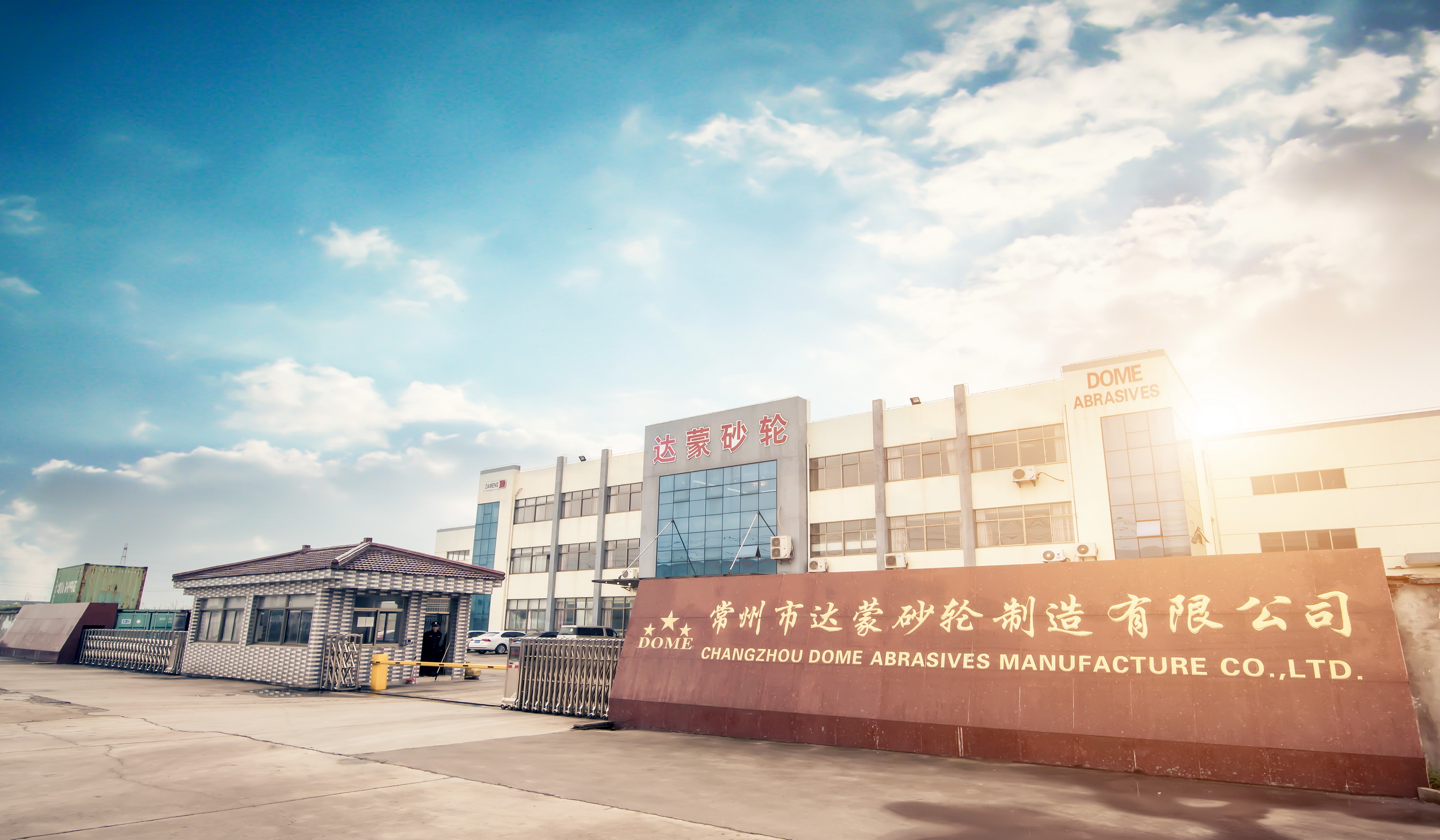
CNDOME was established in 2001 and operates a temperature- and humidity-controlled workshop of more than 20,000 m² with 60 automated production lines. The company reports a daily output of approximately 600,000 pieces and annual output of 95 million pieces, with 140 employees and a 10-person R&D team. Roughly 80% of production is exported, with Latin America, Europe, Africa, and Asia as the main markets, and the company states it has supported more than 2,000 global tool and professional abrasive wheel brands through OEM and ODM work.
Three capability details are relevant to a grinding disc decision specifically, rather than to abrasives in general.
Reinforcement inspection at the molding stage
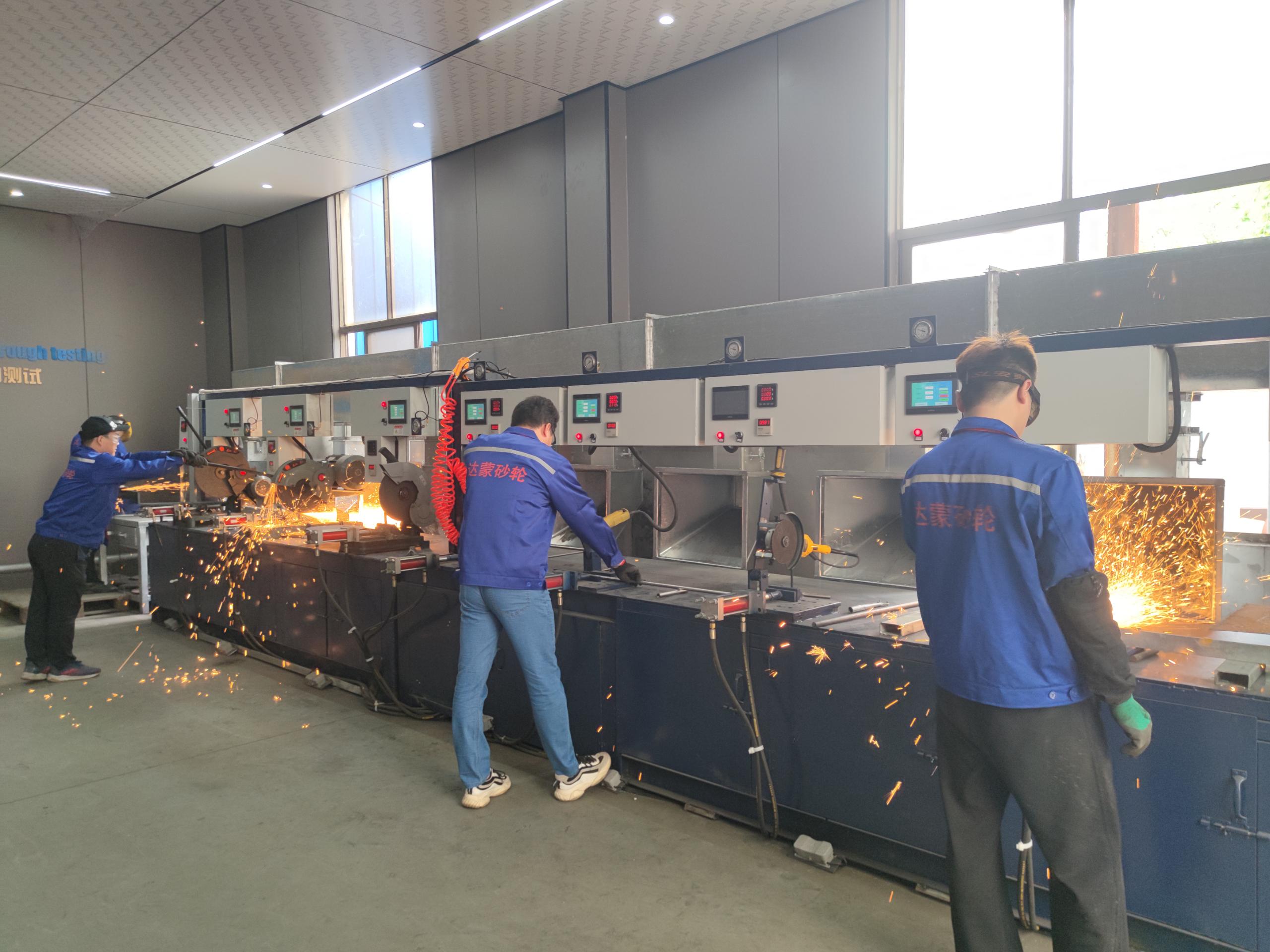
The most common failure mode in a bonded abrasive wheel is insufficient reinforcement — a missing or misplaced mesh layer that weakens the disc and can lead to breakage in service. CNDOME states that every molding machine is fitted with a mesh visual inspection device that halts the machine immediately if a mesh is missing, and that raw material selection is restricted to high-strength corundum and mesh. The company states that finished wheel strength exceeds the international standard. Buyers should treat that as a manufacturer claim to be verified through batch test records, not as a certificate.
Batch-to-batch stability as the actual differentiator
Asked what separates its discs from other factories, CNDOME points to stable product performance, reliable production processes, and consistent quality across all batches — not to a single headline specification. For a distributor, batch consistency is the more commercially valuable claim, because a wheel that behaves differently in week 40 than in week 4 destroys the end user's trust in the brand on the label, not in the factory behind it.
Certification status, stated precisely
For European exports, CNDOME states that its cutting discs are manufactured according to EN 12413 and carry MPA Hannover certification for multiple disc sizes, with CE, ISO 9001, ISO 14001, and BSCI forming the wider compliance framework. These are currently self-reported positions published by the company. Buyers in regulated markets should request certificate numbers, confirm scope coverage for the specific disc dimensions being ordered, and cross-check against notified-body records before treating certification as a screening pass.
Where each option fits: application logic
The material list for CNDOME's abrasive range is broad and explicit: steel, metal processing, automobile manufacturing, shipbuilding, casting, steel structure, and construction. Within that list, the split between ceramic and aluminium oxide follows duty, not industry label.
Ceramic grain earns its cost in these situations
- Stainless steel and high-alloy weld blending. Where the failure mode is glazing rather than wear, continuous micro-fracture keeps the disc open and cutting, and reduced operator pressure lowers the risk of heat discolouration next to a finished weld.
- Hardfacing, tool steel, and cast components. Dense, hard workpieces consume aluminium oxide grain quickly; the ceramic disc's longer effective cutting time changes how often the operator stops.
- High-volume production cells. Where disc changes are a measured interruption, the arithmetic favours grain that lasts. CNDOME reports effective cutting and grinding time per piece 15%–25% longer than competitor product, with cutting speed 10% higher under identical conditions and chipping strength 20% higher.
- Mixed-machine fleets with high-speed grinders. The 100 m/s rating removes a compatibility constraint that an 80 m/s disc imposes.
Aluminium oxide remains the right default here
- General fabrication and mechanical processing. CNDOME positions its aluminium oxide range as suited to mechanical processing industry scenarios, and the material's 46.3% share of the abrasive market reflects how well that positioning matches real demand.
- Structural steel, casting cleanup, and construction work where surface finish tolerances are wide and the disc is consumed predictably.
- Distributor stock depth. A lower cost per disc supports a broader, slower-turning inventory without tying up capital in grain the end user may not need.
- Single-speed grinder populations, where the ceramic speed advantage is not accessible.
Cost, value, and the arithmetic buyers actually run
Per-disc price is the easiest number to compare and the least informative. The relevant figure is cost per unit of work removed, which combines disc life, cutting speed, and operator time.
On CNDOME's own comparative figures, the ceramic disc delivers 15%–25% longer effective cutting and grinding time per piece, 10% faster cutting under identical conditions, 20% higher chipping strength, and roughly 10% better high-temperature resistance. If those figures hold in a given application, a ceramic disc priced modestly above an aluminium oxide wheel can still land below it on cost per finished part — particularly where labour is the dominant cost line rather than the consumable.
The reverse is equally true. In low-pressure, intermittent work on mild steel, an aluminium oxide wheel at 80 m/s produces an acceptable finish and reaches the end of its life through normal wear rather than premature failure. Paying a grain premium in that scenario buys durability the process never stresses. The aluminium oxide wheel is not the compromise option in that setting; it is the correctly specified one.
Two structural cost factors also apply to CNDOME specifically. Large-scale production, in-house production lines with independent R&D that remove intermediaries, and standardised processes that reduce waste all push unit cost down — the same logic CNDOME applies when it offers small-batch customisation with a flexible minimum order quantity and a short design cycle. For a distributor testing a ceramic line before committing to volume, that flexibility is often the deciding commercial detail rather than the grain itself.
Market context: why this comparison is getting more attention
Three verified data points explain the shift. The global cutting discs market stands at roughly USD 8.5 billion entering 2026 (IndexBox). Asia-Pacific holds a 44.7% revenue share of the abrasives market as of 2025, driven by industrial expansion in China and India (Fortune Business Insights). And aluminium oxide still commands 46.3% of material share on cost-effectiveness in general metal fabrication (Fortune Business Insights).
Read together, those figures describe a market where volume demand remains anchored to aluminium oxide while the higher-duty segment grows inside it. The procurement consequence is not a wholesale switch to ceramic grain — it is a portfolio question. Distributors increasingly need both: an aluminium oxide line to hold share in general fabrication, and a ceramic line to defend accounts where disc change frequency has become a visible cost.
Trade classification matters here as well. Bonded abrasive wheels sit under HS code 6804.22 — other millstones, grindstones, grinding wheels of other agglomerated abrasives or ceramics — which is the reference point importers should use when reconciling duty treatment and documentation across the ceramic and aluminium oxide lines.
Limits, boundaries, and what this comparison cannot tell you
An independent evaluation is only useful if it names the boundary conditions.
- Ceramic grain is not universally superior. On soft, low-melting-point metals where the failure mode is loading rather than grain wear, grain chemistry is not the controlling variable; disc construction and operator technique dominate. Neither product in this comparison is designed to solve loading.
- The speed advantage is conditional. A 100 m/s ceiling only creates value on machines capable of using it, and it must never be treated as a working speed. Any disc must be matched to the grinder's no-load spindle speed, and the marked maximum on the disc itself governs.
- Comparative performance figures are manufacturer-reported. The 15%–25% life advantage, 20% chipping strength increase, 10% cutting speed gain, and ≤0.03 mm warpage are CNDOME's stated figures. They are directionally useful for shortlisting and should be confirmed through a trial run on the buyer's own material and machine before they are written into a supply agreement.
- Certification is a claim until verified. EN 12413, MPA Hannover, CE, ISO 9001, ISO 14001, and BSCI status are published by the company. Independent validation against certificate numbers and notified-body records is the buyer's step, not the supplier's.
- Grain type does not compensate for profile error. Specifying a ceramic disc in the wrong profile or bore wastes the grain premium entirely. T27, T29, T41, and T42 are different geometries serving different motions, and the bore must match the grinder spindle.
Future outlook
Three developments are likely to shape how buyers treat this comparison over the next few procurement cycles.
First, documentation is becoming the first filter rather than the last. In European export markets, EN 12413 marking and MPA-linked certification are already gate requirements, and the practical bottleneck is no longer whether a supplier claims certification but whether it can produce batch-linked evidence quickly. Suppliers who can link a specific disc dimension to a certificate scope will shorten buyer qualification time.
Second, the ceramic-versus-aluminium-oxide decision is migrating from the workshop to the purchasing spreadsheet. As distributors rationalise SKU counts, the question becomes which grain earns shelf space rather than which grain is technically superior. That favours suppliers able to support small-batch customisation and short design cycles so a distributor can test a ceramic line without committing to container-scale volume.
Third, the Asia-Pacific supply base — already holding 44.7% of abrasives revenue share — is where both lines will be priced. Buyers sourcing from that base gain cost advantage but inherit a heavier verification burden, since capacity, certification, and performance figures are largely self-reported across the segment. The suppliers who resolve that asymmetry will win share in the higher-duty segment without needing to compete on the aluminium oxide price floor.
Procurement checklist before ordering either option
| Check | What to confirm |
|---|---|
| Grain matched to duty | Ceramic for sustained stainless and hard-alloy blending; aluminium oxide for general fabrication and intermittent work |
| Speed marking vs machine | Disc maximum must meet or exceed grinder no-load speed; 100 m/s ceramic vs 80 m/s aluminium oxide is a ceiling, not a target |
| Profile and motion | T29 for the ceramic grinding disc, T27 for the aluminium oxide grinding wheel; T41/T42 only for cutting |
| Dimensions and bore | 115 mm or 125 mm for the ceramic format; confirm bore (22.23 mm on the documented 115 mm cutting SKU) against the grinder spindle |
| Batch consistency evidence | Request warpage and reinforcement inspection records, not just a sample disc |
| Certificate scope | Match EN 12413 and MPA Hannover coverage to the exact dimensions ordered; validate numbers independently |
| Trial run | Test both grains on the buyer's own material before setting a standard |
FAQ
What is the difference between a ceramic grinding disc and an aluminium oxide grinding wheel?
The differences are grain chemistry, profile, and speed rating. CNDOME's ceramic grinding disc uses a ceramic abrasive grain in a T29 depressed-centre format with a 100 m/s maximum operating speed, offered in 115 mm and 125 mm. Its standard aluminium oxide grinding wheel uses aluminium oxide with white aluminium oxide as the working abrasive, resin-bonded, in a T27 depressed-centre format, with an 80 m/s maximum operating speed. The ceramic grain micro-fractures to expose fresh cutting edges, which extends effective cutting time; the aluminium oxide wheel relies on predictable grain fracture and a lower cost per disc.
Is a 100 m/s ceramic disc compatible with a standard angle grinder?
Compatibility depends on the grinder, not on the disc alone. A disc may only be used on a machine whose no-load spindle speed does not exceed the disc's marked maximum operating speed. A 100 m/s-rated disc widens the range of machines it can be fitted to compared with an 80 m/s disc, but it delivers no additional speed benefit on a fixed single-speed grinder. Buyers should check the grinder nameplate against the disc marking before use, and treat the marked maximum as a safety limit rather than an operating target.
T29 or T27 — which profile should buyers specify?
Both are depressed-centre profiles, and the choice depends on the grinding motion and access required rather than on grain type. CNDOME pairs T29 with its ceramic grinding disc and T27 with its aluminium oxide grinding wheel. Buyers should confirm the profile against the actual application geometry — edge access, contact angle, and required stock removal — rather than assuming the profile follows the grain. Separately, T41 and T42 are flat cutting profiles and should not be used for grinding.
When is aluminium oxide the better choice despite the lower speed rating?
Aluminium oxide is the correct specification where the workload does not stress the grain premium: intermittent maintenance work, structural steel and casting cleanup with wide finish tolerances, single-speed grinder populations, and distributor inventory that needs low capital commitment per SKU. In those settings a wheel reaching the end of its life through normal wear delivers the required result at a lower cost per disc, and the ceramic speed ceiling remains unused. Aluminium oxide's 46.3% share of the abrasive material market reflects how often that condition applies.
What should buyers verify before ordering ceramic grinding discs in 115 mm or 125 mm?
Five items: grain type and profile marked on the disc itself; maximum operating speed marked against the grinder's no-load speed; bore and diameter matching the machine spindle; batch evidence covering reinforcement inspection and warpage tolerance; and certificate scope, since EN 12413, MPA Hannover, CE, ISO 9001, ISO 14001, and BSCI status are currently stated by the manufacturer and should be validated independently. A trial run on the buyer's own material is the final step before the disc is written into a supply agreement.
Reference material
CNDOME publishes a full product and capability brochure covering disc formats, dimensions, and compliance documentation, available for download here: CNDOME abrasives brochure (PDF).
Have Questions or Need More Details?
Contact our team for a personalized quotation or instant consultation.
Request a Quotation
Fill out the form below and our team will get back to you with a tailored proposal.
WhatsApp Direct Chat
Prefer to chat in real-time? Message us on WhatsApp for instant assistance & quick answers.
- Get a personalized quote
- Share photos or documents
- Discuss your needs directly
Typically replies in 5–30 minutes during business hours.