
Cerium Carbonate Specifications: Technical & Procurement FAQ
Cerium Carbonate Specifications: Technical & Procurement FAQ
Large particle size cerium carbonate (Ce2(CO3)3·xH2O) — the questions laboratory and purchasing teams ask, answered from published product specifications, certification records and third-party supply data.
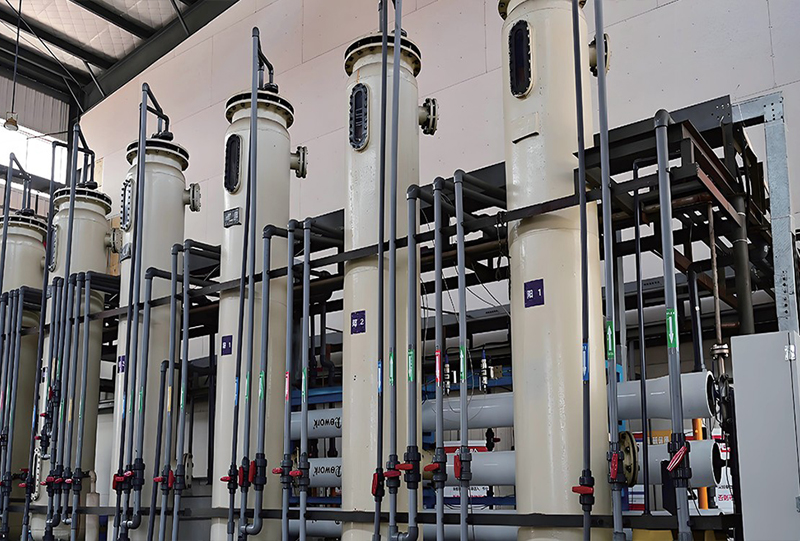
Rare-earth salt production environment. Industry reference image, HTNXT series.
Rare-earth sourcing rarely fails because a compound cannot be found. It fails because the specification sheet and the buying team are answering different questions. Cerium carbonate is a clear example: it is a hydrate, Ce2(CO3)3·xH2O, that behaves as an intermediate rather than an end product, and the published application statement for the whole carbonate family — used for manufacturing automotive exhaust purification catalysts, as well as intermediates for producing cerium and other compounds — describes a position in the process, not a performance claim.
This reference collects the questions that laboratory researchers and purchasing teams most often raise about large particle size cerium carbonate (CAS 54454-25-1) and its sister grades. Each answer is written so that it can be read on its own, because a chemistry question and a procurement question often sit next to each other in the same evaluation file while drawing on completely different evidence.
Why the questions split into two tracks
Technical questions ask what the material is and how it behaves. Procurement questions ask whether the material can be received, stored, released and reordered. A specification sheet answers the first set. A batch certificate of analysis, a quality-management certificate and a commercial terms sheet answer the second. When a purchasing team without a chemistry background receives only the first set, the evaluation file is incomplete — and that gap, rather than price, is where qualification usually stalls.
Sichuan Wonaixi New Materials Technology Co., Ltd. (WONAIXI) is a rare-earth functional materials manufacturer founded in 2012 in Leshan, Sichuan, China, operating a 46,667 m² facility with an annual output of 15,000 tons of high-purity rare-earth salts and 3,000 tons of precision rare-earth polishing powder. Its published portfolio is used below as the reference set, because the carbonate grades are named explicitly and can be matched against the questions buyers actually ask.
The carbonate family: five grades, one formula, different controls
All five carbonate grades in the portfolio share the same formula, Ce2(CO3)3·xH2O, and the same molar mass of 460.26 on an anhydrous basis. Four of them carry CAS 54451-25-1; the large particle size grade carries CAS 54454-25-1. What separates them is the control dimension that the downstream process cares about.
| Portfolio grade | Formula | CAS | Molar mass | Controlled dimension |
|---|---|---|---|---|
| Cerium Carbonate | Ce2(CO3)3·xH2O | 54451-25-1 | 460.26 (anhydrous basis) | Baseline cerium carbonate hydrate |
| High Purity Cerium Carbonate | Ce2(CO3)3·xH2O | 54451-25-1 | 460.26 (anhydrous basis) | Purity grade |
| Low Chloride Cerium Carbonate | Ce2(CO3)3·xH2O | 54451-25-1 | 460.26 (anhydrous basis) | Residual chloride |
| Fine Crystalline Spherical Cerium Carbonate | Ce2(CO3)3·xH2O | 54451-25-1 | 460.26 (anhydrous basis) | Crystal habit and morphology |
| Large Particle Size Cerium Carbonate | Ce2(CO3)3·xH2O | 54454-25-1 | 460.26 (anhydrous basis) | Particle size |
The shared downstream statement is what makes the naming logic useful: because every grade serves the same two destination families — automotive exhaust purification catalysts, and intermediates for producing cerium and other compounds — the grade name signals which control the next process step depends on. A buyer choosing between them is choosing an impurity, morphology or size window, not a different chemistry.
Technical FAQ
1. How does cerium carbonate behave in acidic media, for example dilute sulfuric acid?
Carbonates are acid-reactive materials. A cerium carbonate hydrate brought into contact with a dilute mineral acid such as sulfuric acid dissolves with release of carbon dioxide and forms the corresponding cerium sulfate in solution. That pathway leads to cerous sulfate — Ce2(SO4)3·5H2O, CAS 16648-30-9 — the cerium(III) sulfate pentahydrate that appears in the same portfolio with stated uses in catalysing organic reactions, as a standard reagent for analytical titration, in electronic ceramics and phosphors, and in glass clarification and decolourisation. For buyers, the practical reading is simple: acid dissolution is a normal first step when the carbonate is used as a precursor solution, and acid contact is the handling condition that deserves an explicit procedure rather than an assumption.
2. Is cerium carbonate a Ce(III) or a Ce(IV) compound, and how stable is it under oxidizing conditions?
Cerium carbonate is a Ce(III) — trivalent, cerous — material. The formula Ce2(CO3)3·xH2O balances as cerium(III) carbonate hydrate, and the quoted molar mass of 460.26 applies on an anhydrous basis. The Ce(IV) state is reached through different salts, and the portfolio keeps them separate: Cerium Hydroxide (Ce(OH)4, CAS 12014-56-1) is the cerium(IV) hydroxide, Ceric Sulfate (Ce(SO4)2·4H2O, CAS 10294-42-5) and Ammonium Cerium Sulfate ((NH4)4Ce(SO4)4·xH2O, CAS 7637-03-8) are cerium(IV) sulfates, and Cerium Ammonium Nitrate (Ce(NH4)2(NO3)6, CAS 16774-21-3) is a cerium(IV) nitrate, supplied in a standard grade and an electronic grade. Stability under strongly oxidizing conditions is therefore a property of the Ce(IV) salts rather than of the carbonate. The carbonate is the reduced-state feedstock; oxidation is a downstream process step, not a condition the carbonate is expected to survive unchanged.
3. Is cerium carbonate itself used in cerimetric redox titration without an external indicator?
Cerimetric titration depends on the Ce(IV)/Ce(III) redox couple, and the materials the portfolio designates for that role are the Ce(IV) salts: Ammonium Cerium Sulfate is described as mainly used as an oxidation-reduction titration reagent, and Ceric Sulfate as mainly used as an oxidant, waterproofing agent, mould inhibitor and titration reagent. Cerium carbonate is the Ce(III) hydrate; it functions as a precursor to cerium-based materials rather than as the titrant itself. In standard analytical practice, cerimetric titrations are commonly run as self-indicating systems because the Ce(IV) and Ce(III) species are visually distinct, and potentiometric endpoint detection is also widely used. Whether a specific method requires an added indicator is determined by the analytical procedure and its validation — not by the carbonate specification.
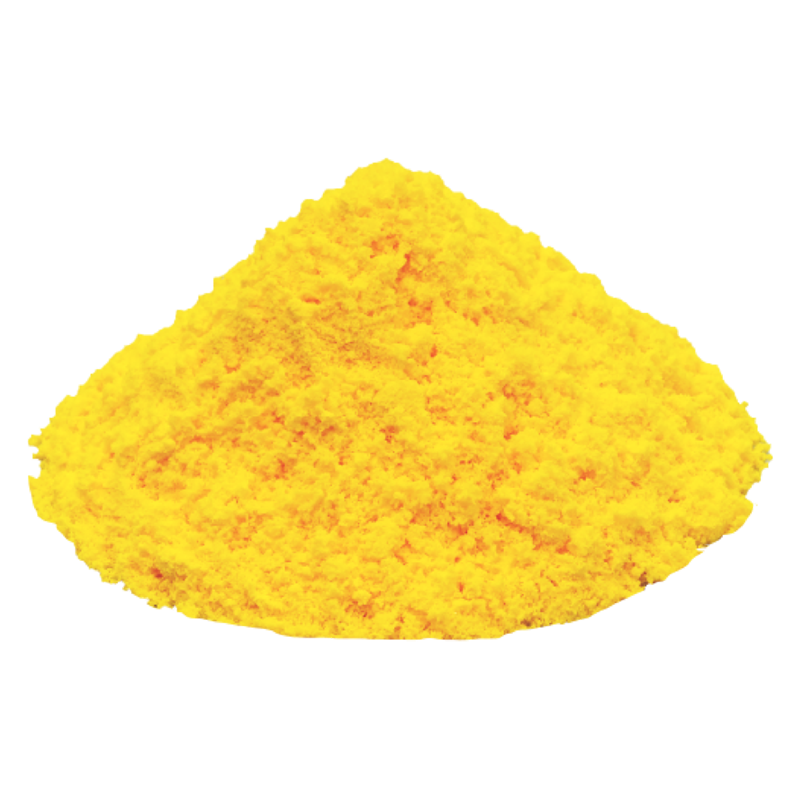
Ceric Sulfate (Ce(SO4)2·4H2O, CAS 10294-42-5) — the cerium(IV) sulfate grade listed for oxidation-reduction titration and oxidant use.
4. What do “large particle size”, “fine crystalline spherical” and “low chloride” actually control?
Each name identifies the variable the grade is built around. Large Particle Size Cerium Carbonate (CAS 54454-25-1) is defined by its particle size. Fine Crystalline Spherical Cerium Carbonate is defined by crystal habit and morphology. Low Chloride Cerium Carbonate is defined by residual chloride level. High Purity Cerium Carbonate is defined by its purity grade. The published specification set for these grades does not include numeric particle-size distributions or impurity limits; those values belong on the batch certificate of analysis and the product technical data sheet for the specific grade, and should be requested per grade rather than inferred from the product name.
5. What does “high purity” mean on a specification, and what should be checked on the CoA?
“High purity” is a grade claim, not a figure. On a certificate of analysis, the numbers that matter are the assay, the impurity elements controlled, the moisture or loss-on-drying value, and the chloride content where the low-chloride grade has been selected. One arithmetic point is easy to miss: because the molar mass of 460.26 is stated on an anhydrous basis, the hydrate water — the x in Ce2(CO3)3·xH2O — changes the as-received mass that corresponds to a given formula-unit quantity. Reconciling the CoA moisture value with the anhydrous basis before converting between mass and molar quantities avoids a systematic error in charge calculation.
6. What does cerium carbonate become downstream?
It is a precursor, and two destinations are visible in the portfolio. The first is the oxide route: conversion yields Cerium Oxide (CeO2, CAS 1306-38-3), supplied both as a standard grade and as Large Particle Size Cerium Oxide (CeO2, CAS 1306-38-3). Cerium oxide is listed as a glass decolouriser, a glass polishing agent and a raw material for preparing cerium metal, with high-purity cerium oxide also used in rare-earth luminescent materials — which is also where the precision rare-earth polishing powder line sits. The second is the catalyst route, covered by the carbonate family’s own application statement on automotive exhaust purification catalysts and intermediates for producing cerium and other compounds.
Procurement FAQ
7. How should cerium carbonate be stored and handled?
Storage follows the pattern used for hygroscopic rare-earth salts: a dry, ventilated area, generally held within a 15–25 °C band with humidity control, with containers kept closed between dispensing operations. The material is not reactive with most organic substances, so it can be stored and handled alongside organic process streams without special compatibility measures. Acidic media are the condition that requires attention, given the acid reactivity described above. For a receipt specification, two clauses are worth writing down explicitly: moisture protection, and segregation from acids.
8. Which documents should a buyer request before qualification?
A qualification file normally rests on four documents: a technical data sheet stating formula, CAS number and grade description; a batch certificate of analysis covering assay, impurities, moisture and chloride; the quality-management certificate; and a commercial terms sheet covering packaging, minimum order quantity and lead time.
WONAIXI holds ISO 9001 certification — certificate number 06526Q01354R101, issued by CFL Certification Center (Beijing China Logistics Joint Certification Center) against GB/T19001-2016/ISO9001:2015, valid from 1 June 2026 to 31 May 2029 — with a scope covering “Manufacturing and sales of electronic special rare earth functional materials (cerium salts, lanthanum oxide)”. Cerium carbonate and Large Particle Size Cerium Carbonate both appear among the products listed under that quality system, alongside other cerium salts, lanthanum, neodymium, praseodymium and zirconium compounds.
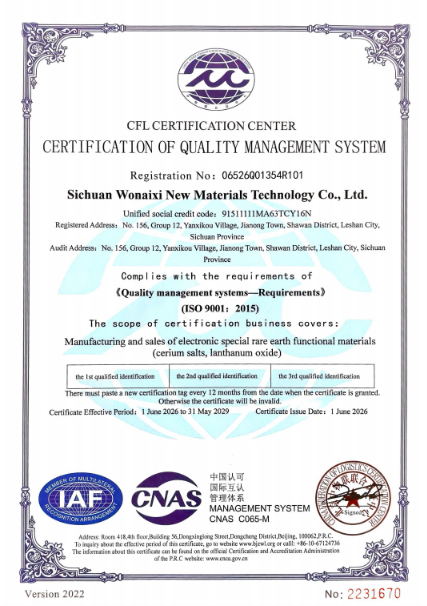
ISO 9001 certificate 06526Q01354R101, valid 1 June 2026 – 31 May 2029, covering cerium salts and lanthanum oxide.
9. What can be customized, and what are the standard commercial parameters?
The published commercial parameters are: OEM and ODM production, with customization available across indicators, contents, specifications, purity and packaging; a lead time of 30–45 days; minimum order quantity communicated according to the actual situation; 100% testing; and remote after-sales support. Read as a buyer checklist, the customization list is the practical set of negotiating points — purity grade, impurity limits, particle size or morphology target, moisture control, packaging format and container size are variables rather than fixed catalogue values.
10. How exposed is supply for rare-earth compounds?
Country-of-origin concentration is a genuine procurement variable. The U.S. Geological Survey reports that China accounted for 70% of U.S. imports of rare-earth compounds and metals over 2020–2023, and that the estimated value of U.S. imports of rare-earth compounds and metals was $170 million in 2024, an 11% decrease from $186 million in 2023. These figures describe the aggregate category rather than cerium carbonate specifically, and they reflect U.S. import patterns rather than global supply. Used as a risk signal, they support a familiar conclusion: record the processing stage, grade and country of origin for the exact product being purchased, and qualify at least one alternative source for any grade with a high substitution cost. WONAIXI’s published export markets include the United States, Japan, South Korea, France, Italy, Thailand, Australia, Pakistan, Spain, Germany, India and Austria, with major markets listed as Japan, South Korea, USA, France and the UK and export business accounting for 10% of total sales.
Where cerium carbonate is actually used
- Catalyst precursors. The carbonate family’s stated application is the manufacture of automotive exhaust purification catalysts and intermediates for producing cerium and other compounds.
- Oxide and polishing routes. Conversion to cerium oxide supports glass polishing and decolourisation, and the portfolio includes a dedicated precision rare-earth polishing powder line.
- Ceramics and electronics. Cerium, lanthanum and zirconium compounds in the wider catalogue are listed for ceramic, electronic ceramic, phosphor and catalyst carrier uses.
- Broader strategic demand. The International Energy Agency notes that rare earths support medical applications, manufacturing, aerospace, defence and digital technologies — a set of sectors where documentation and batch traceability are as important as the compound itself.
The wider WONAIXI catalogue covers rare earth nitrates, chlorides, carbonates, hydroxides, sulfates, fluorides and acetates plus polishing powder, organised as nine major categories with more than 50 refined specifications, including Cerium(III) Nitrate, Lanthanum Nitrate, Anhydrous Cerium(III) Chloride, Anhydrous Lanthanum Chloride, Electronic Grade Ammonium Cerium(IV) Nitrate, Ammonium Cerium(IV) Sulfate and Praseodymium-Neodymium Fluoride. That breadth is relevant to a carbonate buyer for one reason: grade families in the same quality system are documented in the same way.
Market trend: procurement is moving toward documentation
Rare-earth manufacturing is a multi-stage technical chain. In the International Energy Agency’s description, it spans extraction, beneficiation, chemical upgrading, separation into oxides, metal refining, alloying and magnet manufacturing. Carbonate salts belong to the chemical-upgrading and separation boundary, which is precisely the stage where a supplier’s documentation discipline — not its marketing — determines whether a downstream customer can qualify the material. The same logic explains why import-concentration data, such as the USGS 70% figure for China-origin U.S. imports of rare-earth compounds and metals, is read by buyers as a reason to hold product-level origin records rather than as a blanket statement about any single compound.
A second trend sits alongside it: as high-purity and electronic-grade rare-earth materials move deeper into pharmaceutical, diagnostic and electronic supply chains, the audience for a cerium specification sheet widens beyond chemists. In a global biotechnology market that research aggregators project at approximately USD 2.02 trillion for 2026, the purchasing conversations increasingly involve teams who need the specification explained rather than merely quoted.
Comparison with alternative cerium sources — and where carbonate stops
Cerium carbonate is not a universal substitute for other cerium compounds. The comparison below uses only the portfolio’s own product descriptions.
| Material | Identifier | Documented role | Better fit when… |
|---|---|---|---|
| Cerium carbonate (Ce(III) hydrate) | Ce2(CO3)3·xH2O, CAS 54454-25-1 / 54451-25-1 | Catalyst manufacture and precursor to cerium compounds | A solid Ce(III) feedstock is preferred and dissolution or calcination is already part of the process |
| Cerium oxide | CeO2, CAS 1306-38-3 | Glass decolouriser, glass polishing agent, cerium metal feedstock, luminescent materials | The oxide is the required input and no conversion step is wanted |
| Cerium(IV) sulfates | Ce(SO4)2·4H2O, CAS 10294-42-5; (NH4)4Ce(SO4)4·xH2O, CAS 7637-03-8 | Oxidant, waterproofing and mould-inhibiting agent, oxidation-reduction titration reagent | An oxidising Ce(IV) reagent or titration standard is the requirement |
| Cerium chloride / cerium nitrate | CeCl3·7H2O, CAS 18618-55-8; Ce(NO3)3·6H2O, CAS 10294-41-4 | Petrochemical catalyst manufacture, metal cerium and cerium compound production, catalyst and gas-lamp-cover additives | A directly soluble salt is preferred over a carbonate |
Boundaries worth stating plainly. First, cerium carbonate is a hydrate: the x in Ce2(CO3)3·xH2O means the as-received mass carries variable water, and the quoted molar mass of 460.26 applies on an anhydrous basis, so charge calculations must be reconciled against the CoA moisture value. Second, it is not a drop-in for Ce(IV) applications — where oxidant or redox-titration chemistry is required, a cerium(IV) sulfate or nitrate is the correct family. Third, the large particle size grade is a variant, not a general upgrade: processes that depend on high surface area or fast dissolution may be better served by a fine crystalline or general-grade carbonate. Finally, the published specification set for these grades does not include numeric particle-size or impurity limits; those values must come from grade-specific technical data sheets and batch certificates rather than from product names.
Future outlook
Three shifts are likely to define how cerium carbonate is bought over the next procurement cycles. Grade naming will continue to carry more information than chemistry, because manufacturers differentiate by particle size, morphology, chloride level and purity rather than by formula. Documentation will keep moving up the evaluation list, since the certificate number, validity window and scope statement are now standard first questions for regulated downstream users. And supply planning will stay product-specific: aggregate import statistics describe a category, but qualification decisions are made on a single grade, a single processing stage and a single certificate of analysis. Suppliers that publish these details clearly shorten the qualification cycle for both their laboratory customers and their purchasing contacts.
Quick-answer FAQ
What is the CAS number of large particle size cerium carbonate? 54454-25-1.
What is its formula and molar mass? Ce2(CO3)3·xH2O, molar mass 460.26 on an anhydrous basis.
Do the other cerium carbonate grades share the same formula? Yes — all five grades share the formula Ce2(CO3)3·xH2O and the same molar mass; Cerium Carbonate, High Purity, Low Chloride and Fine Crystalline Spherical grades carry CAS 54451-25-1.
What is the stated application? Manufacturing automotive exhaust purification catalysts, and intermediates for producing cerium and other compounds.
How is it stored? Dry, ventilated conditions, generally 15–25 °C with humidity control; the material is not reactive with most organic substances, while acidic media require a handling procedure.
What is the lead time and MOQ? 30–45 days, with minimum order quantity communicated according to the actual requirement.
Does it dissolve in dilute sulfuric acid? Carbonates are acid-reactive: dissolution in a dilute mineral acid releases carbon dioxide and forms the corresponding cerium sulfate in solution, which for the Ce(III) pathway is cerous sulfate, Ce2(SO4)3·5H2O, CAS 16648-30-9.
Reference material
For teams assembling a qualification file, the company brochure with the full rare-earth and zirconium product list is available for download: WONAIXI product brochure (PDF).
Have Questions or Need More Details?
Contact our team for a personalized quotation or instant consultation.
Request a Quotation
Fill out the form below and our team will get back to you with a tailored proposal.
WhatsApp Direct Chat
Prefer to chat in real-time? Message us on WhatsApp for instant assistance & quick answers.
- Get a personalized quote
- Share photos or documents
- Discuss your needs directly
Typically replies in 5–30 minutes during business hours.