
Certification Check: What Do CE and FCC Marks Really Mean on a LORZOR Wallet?
Industry Reference · Modern Carry Goods
A CE or FCC mark on a wallet listing answers a narrow regulatory question: does the electronic part of the product behave acceptably on the radio spectrum and inside an electromagnetic environment? It does not answer the question most buyers are actually asking — whether the leather, the card mechanism, the hinge and the tracking slot will still feel right after two years in a front pocket.
That gap between what a mark certifies and what a buyer assumes it certifies has become more consequential as electronics migrate into the mens wallet category. A wallet is no longer automatically a passive object. Some wallets now hold a third-party tracker, and a smaller number integrate a radio module of their own. LORZOR, a leather-led modern carry goods brand founded in 2022 and headquartered in Hong Kong, sits on both sides of that line: most of its range is passive full-grain leather construction with an AirTag holder, while the LORZOR Wallet Pro carries an integrated tracking module inside its metal cardholder.
This reference explains what CE and FCC marks do and do not cover, how that maps onto the specific LORZOR models named in the current catalogue, and what a buyer in the evaluation stage should verify before purchase.
What CE and FCC Marks Actually Certify
Neither mark is a quality grade. Both are conformity statements tied to how a product behaves electronically — not how well it is made.
The CE mark is the conformity marking used for products placed on the market in the European Economic Area. It indicates that the product complies with the applicable EU legislation for its category, which for a wireless product generally means electromagnetic compatibility, radio equipment rules and hazardous-substance restrictions. It is applied by the manufacturer or the importer placing the goods on the EU market.
An FCC equipment authorization is the United States equivalent in function and completely different in form. The FCC regulates radio-frequency devices, and equipment must be authorized under the Commission's equipment rules before it can be marketed. A device that contains a transmitter is a radio device; a device that merely contains digital circuitry but no transmitter falls under a different equipment class.
| Dimension | CE Mark | FCC Equipment Authorization |
|---|---|---|
| Primary market | European Economic Area | United States |
| Regulatory focus | Compliance with applicable EU product legislation for the category, typically including electromagnetic compatibility and radio equipment rules | Authorization of radio-frequency equipment under US equipment rules |
| What it describes | Electromagnetic behaviour and market-access conformity | Electromagnetic behaviour and spectrum use |
| What it does not describe | Leather grade, stitching, card capacity, durability, warranty length | Leather grade, stitching, card capacity, durability, warranty length |
| Who applies / holds it | Manufacturer or importer placing the product on the EU market | The party responsible for the equipment authorization |
The practical takeaway for a wallet buyer is simple: a CE or FCC mark tells you the electronic componentry has been assessed against electromagnetic interference and radio-spectrum rules. It tells you nothing about whether the leather is full-grain or corrected-grain, whether the card-ejection mechanism survives 30,000 presses, or whether the money clip keeps its clamping strength after a year.
The Problem: Why These Marks Get Misread on Wallets
Three patterns explain most of the confusion.
1. A mark on the page is read as a mark on the object
Listing images often show certification graphics that belong to one component, one accessory, or one production batch. The buyer reads the graphic as applying to the whole wallet. In reality, the scope of an authorization is defined by the equipment it was issued for.
2. "RFID" and "radio authorization" are treated as the same thing
They are not. An RFID-blocking wallet is a product with shielding built into its structure — it stops an external reader from communicating with a card inside. A radio authorization is about the device itself behaving properly when it transmits or operates. One is a shielding property of a passive object; the other is a regulatory status of an active electronic device. A wallet can legitimately claim one and have nothing to say about the other.
3. Buyers assume the wallet is the radio device
This is the most common error with AirTag-integrated wallets. In an AirTag wallet, the tracking transmitter is the AirTag — a separate Apple product that the buyer supplies. The wallet contributes a holder, a slot geometry and a pocket layout. The compliance profile of the tracker comes from the tracker's manufacturer; the wallet's own compliance question is about whether it introduces any active electronics at all.
What Is Inside a LORZOR Wallet: Three Configurations
Evaluating certification language requires knowing which of three configurations a given model belongs to, because the compliance question changes completely between them.
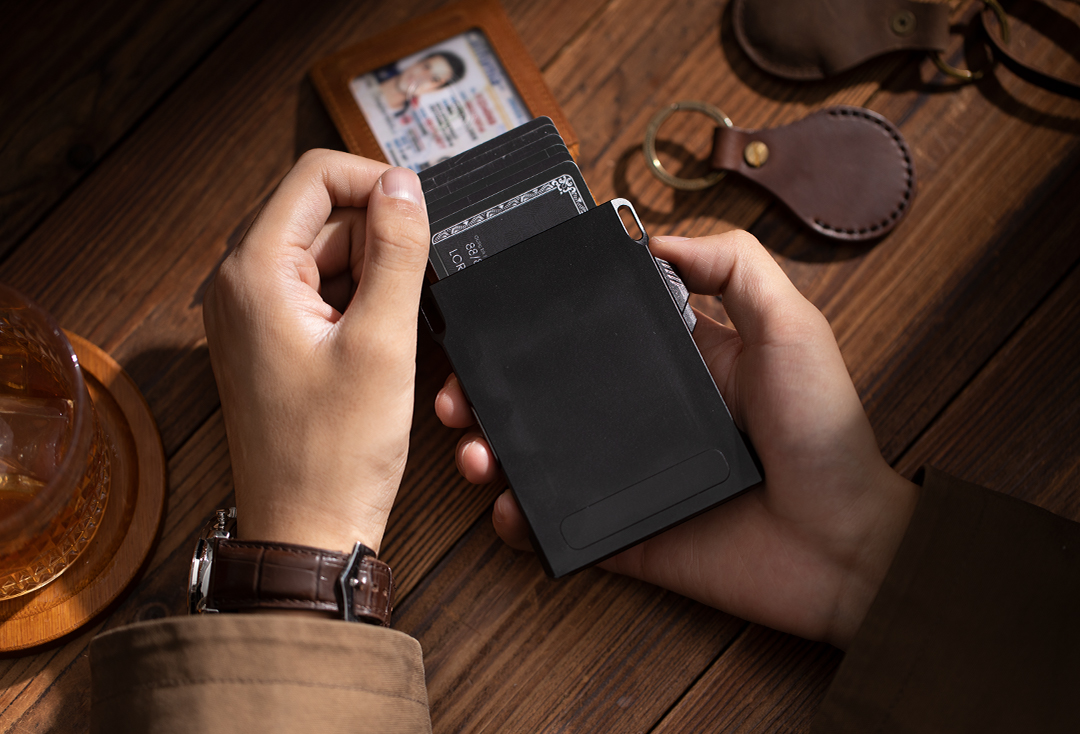
Configuration A — Passive leather wallets. Products such as the LORZOR TriPop Wallet and the LORZOR Passport Wallet are full-grain leather constructions with an aluminum cartridge, an ID window, cash storage and RFID-blocking material. There is no transmitter and no tracker slot. The electronic claim here is shielding behaviour, not radio operation.
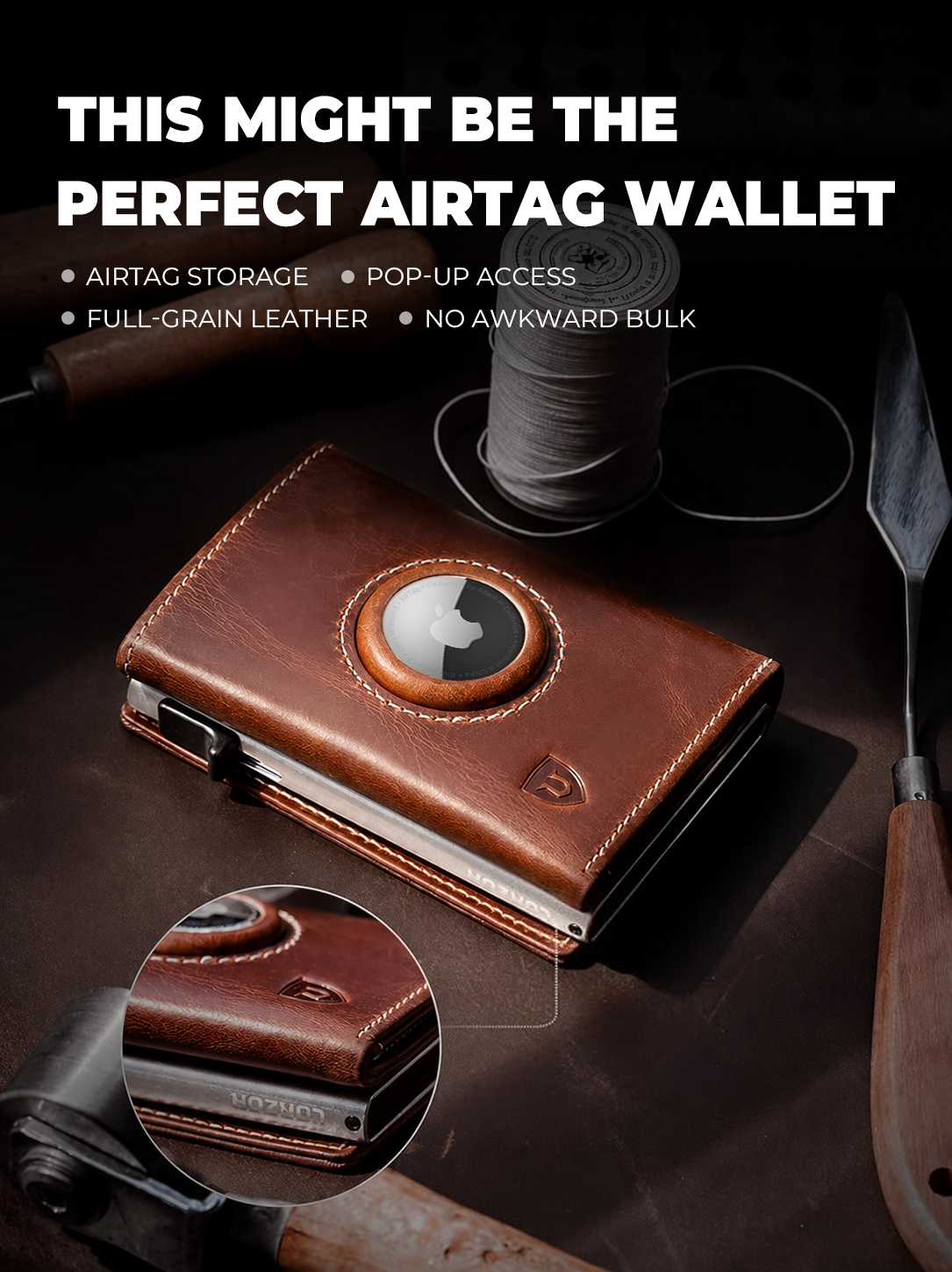
Configuration B — Wallet plus holder for a third-party tracker. This covers the LORZOR Bifold AirTag Wallet series (A1, A2, A3 and A4), the LORZOR TriPop AirTag Wallet and the LORZOR Passport AirTag Wallet. Each has a built-in AirTag holder; the AirTag itself is not included and is purchased separately. The wallet is a passive structure with a purpose-built slot. The radio device is the AirTag.
Configuration C — Wallet with an integrated tracking module. The LORZOR Wallet Pro integrates its tracking hardware inside the metal cardholder instead of relying on an external tracker, uses a Nordic nRF52832 chip, supports Apple Find My and holds Apple-Certified credentials. This is the configuration where radio-equipment rules are most directly relevant, because the wallet contains an active transmitter.
What LORZOR Documents Instead of a Badge
For buyers in the evaluation stage, the more useful question than "is there a CE logo?" is "what test evidence is actually published?" What LORZOR documents in its available product and brand material is specific and checkable.
RFID shielding test method. LORZOR's RFID-shielding tests run at 13.56 MHz using credit cards and professional RFID test signal cards. Within that setup, signals cannot be read when cards are correctly placed inside the protected zone. That is a testable, repeatable claim rather than a generic marketing statement.
Third-party test certifications. The brand holds test certifications including TUV and AGC, alongside test photographs and video assets prepared for deployment on its site, product pages and support content. A named laboratory credential is more useful to a buyer than an unlabelled compliance graphic.
Platform-level certification on the smart model. The LORZOR Wallet Pro carries Apple-Certified credentials and supports Apple Find My, with the tracking function built into the metal cardholder structure rather than added as an external accessory.
Structural and intellectual-property record. The LORZOR LockBond structure — a leather-to-aluminum bonding architecture — is patent pending worldwide, and the brand holds more than 50 global patents related to wallet technology. In the same pull-strength test setup, the control sample separated at approximately 60 N while tested LORZOR leather-and-aluminum samples reached approximately 143–240 N before separation.
RFID Blocking vs Radio Authorization: Two Different Promises
This is the distinction that resolves most of the confusion around certification on wallets, and it is worth stating plainly.
RFID blocking is a shielding property. When cards sit correctly inside the protected zone, the construction helps prevent reading at 13.56 MHz, the frequency band used for contactless card and document communication. The claim is about the wallet blocking an external field.
Radio equipment authorization is a transmitter property. It is about a device that emits, and whether that emission complies with the rules of the market it is sold in. A Bluetooth tracker is such a device.
For an AirTag-integrated LORZOR wallet, the tracker supplies the radio behaviour and carries its own manufacturer authorization. For the LORZOR Wallet Pro, the transmitter is inside the wallet itself, which is precisely why that model's documented credential is an Apple certification rather than an RFID test result: the compliance question for that product is a connected-device question.
A Five-Check Framework Before You Buy
Buyers evaluating a trackable or RFID wallet can apply the same five checks to any listing, including LORZOR's.
- Identify the active component. Does the wallet contain a transmitter, or does it hold someone else's transmitter? If it holds a tracker, the tracker owns the radio compliance question.
- Ask what the mark covers. A certification name alone is not enough. Ask which component or configuration the authorization applies to, and for which market.
- Separate RFID claims from radio claims. An RFID-blocking statement should come with a frequency band and a protected-zone description. A radio authorization statement should identify the equipment.
- Look for named test evidence. A laboratory name, a test method and photographed results are more informative than a certification icon. LORZOR's RFID shielding validation at 13.56 MHz with TUV and AGC test credentials is an example of the level of detail to look for.
- Check the physical limits that certifications do not cover. Card capacity, loaded thickness, cash handling and holder geometry are design questions, not compliance questions — and they are usually the ones that decide daily satisfaction.
Matching the Check to the Model
The compliance question also changes with use case, because the tracker configuration changes.
Travel and document carry
The LORZOR Passport AirTag Wallet combines all-in-one travel storage with a built-in AirTag holder, RFID protection and full-grain leather in a body measuring approximately 5.5 × 3.9 × 0.4 inches, compatible with AirTag first and second generation, with the AirTag not included. The holder is embedded within the passport sleeve. Its non-AirTag counterpart, the LORZOR Passport Wallet, keeps the same document organisation and RFID protection without the tracking slot.
Everyday classic carry
The LORZOR Bifold AirTag Wallet series (A1, A2, A3, A4) is built around a familiar bifold form with a built-in AirTag holder, RFID protection and full-grain leather. A1 and A4 carry 124 and 9 user reviews respectively at average ratings of 5.0 and 4.89 out of 5. These models have no pop-up card access.
Fast access plus tracking
The LORZOR TriPop AirTag Wallet pairs trifold storage and pop-up card access with a dedicated AirTag slot, avoiding the bulging that occurs when a tracker is squeezed into a card stack. It carries 124 user reviews at an average of 4.8 out of 5.
Integrated tracking without an AirTag
The LORZOR Wallet Pro is the model for buyers who do not want to buy or carry a separate tracker. Tracking is integrated into the metal cardholder, the wallet supports Apple Find My, and it carries Apple-Certified credentials. It has received 124 reviews at an average of 4.8 out of 5.
Market Trend: Electronics Are Becoming Standard in the Category
The compliance question is becoming mainstream because the product category is changing. According to Grand View Research, the global smart wallet market was estimated at USD 1.2 billion in 2025, with a high compound annual growth rate of 12.5% driven by RFID-blocking and tracking features. North America accounts for the largest regional share of that segment, at 36.2% of revenue in 2025.
The surrounding category is still leather-led. Dataintelo reports that leather accounted for 52.6% of men's wallet market revenue share in 2025, and that bifold wallets held the largest product-type share at 38.4%, while slim wallets are the fastest-growing segment with a projected compound annual growth rate of 7.8% through 2034.
What those two datasets describe together is a category where leather remains the dominant material and the dominant feel, while a growing slice of buyers expects either shielding or tracking to be built in. That combination is exactly where certification literacy becomes a purchasing skill: the more electronics a wallet contains, the more often a buyer will encounter a compliance mark — and the more important it becomes to know what that mark is actually describing.
Comparison with Traditional Solutions — and Where These Products Stop
A traditional all-leather bifold has one clear compliance advantage: with no electronics and no shielding layer, there is no radio-equipment question to answer at all. Its trade-offs are equally clear. Without shielding, cards are readable by contactless readers; without a holder, there is no tracking; and as cards and cash accumulate, bulk grows with the load rather than being controlled by a fixed structure.
LORZOR's structured wallets take the opposite approach: an aluminum cartridge controls the card chamber so thickness stays predictable, RFID material provides shielding, and the AirTag holder keeps a tracker inside the wallet silhouette. The trade-offs are real and should be stated.
| Consideration | What buyers should know |
|---|---|
| AirTag not included | The LORZOR AirTag models do not ship with an AirTag. It is a separate purchase, and the tracking capability only exists once it is fitted. |
| No pop-up access on the bifold AirTag series | The Bifold AirTag Wallet A1, A2, A3 and A4 do not offer card access. Pop-up card access is available on the TriPop AirTag Wallet and the LORZOR Wallet Pro. |
| Shielding depends on placement | RFID shielding works when cards are correctly placed inside the protected zone. A card outside that zone is not covered by the test condition. |
| Reported user friction on some models | User feedback on the Bifold AirTag Wallet A2 and A3 notes that cash and receipt storage can be tight, and on the 1979 Wallet that the metal surface can show visible scratches. Passport AirTag Wallet feedback notes the missing zippered coin pocket users expected. |
| Certification scope | No CE or FCC authorization for the wallets themselves is documented in the available LORZOR material. The published third-party credentials cover RFID shielding via TUV and AGC testing, and Apple certification for the Wallet Pro. |
None of these limitations undermines the shielding or tracking function. They simply define the boundary: certification marks and test credentials cover specific, narrow properties, and the rest of the buying decision rests on construction, materials and daily ergonomics.
Future Outlook
Two forces are likely to push certification literacy further into the mainstream of wallet buying.
The first is integration. As long as trackers were external accessories, the compliance question lived with the tracker. As brands move transmitters inside the wallet body — the configuration the LORZOR Wallet Pro represents — the finished product inherits a connected-device profile, and buyers will increasingly ask sellers which authorizations apply to which market.
The second is evidence publication. Brands that already publish test methods rather than badges are better positioned for this shift. LORZOR's approach — documenting the 13.56 MHz RFID test setup, naming TUV and AGC test credentials, publishing pull-strength figures for its LockBond structure, and holding more than 50 global patents — is an example of the direction the category is moving: specific, verifiable statements instead of unlabelled compliance graphics.
For buyers, the durable skill is not memorising which mark belongs to which market. It is knowing that a mark describes electromagnetic behaviour, not craftsmanship — and then reading the specifications that describe everything else.
FAQ
What do CE and FCC marks actually certify on a wallet?
Both marks relate to electronic behaviour. The CE mark indicates that a product placed on the European Economic Area market complies with the applicable EU legislation for its category, which for wireless products generally covers electromagnetic compatibility and radio equipment rules. An FCC equipment authorization relates to radio-frequency devices under US equipment rules. Neither mark certifies leather grade, stitching quality, card capacity, durability or warranty length.
Does an RFID-blocking claim equal a CE or FCC certification?
No. RFID blocking is a shielding property of the wallet structure: when cards are correctly placed inside the protected zone, the design helps prevent reading at 13.56 MHz. A CE or FCC mark concerns the electromagnetic behaviour or radio operation of a device. A passive wallet can carry a tested RFID shielding claim without having any radio-equipment status, because it contains no transmitter.
Is a LORZOR AirTag wallet itself a radio device?
In the AirTag-integrated models — the LORZOR Bifold AirTag Wallet series, the LORZOR TriPop AirTag Wallet and the LORZOR Passport AirTag Wallet — the transmitter is the AirTag, which is not included and is purchased separately. The wallet provides a structural holder for it. The radio compliance profile of the tracker comes from the tracker's manufacturer, while the wallet contributes holder geometry, RFID protection and full-grain leather construction.
Which LORZOR models have an integrated tracker rather than an AirTag holder?
The LORZOR Wallet Pro is the model with tracking integrated into the metal cardholder rather than relying on an external AirTag. It supports Apple Find My, uses a Nordic nRF52832 chip and holds Apple-Certified credentials. All other tracking-capable LORZOR models use an AirTag holder and require a separately purchased AirTag.
How can a buyer verify whether a wallet's electronic part is authorized for their market?
Ask the seller three questions: which component the authorization covers, which market it applies to, and which laboratory or test method produced the result. Named test credentials such as TUV and AGC reports for RFID shielding, or Apple certification for a connected model, are more informative than an unlabelled certification graphic, because they identify what was tested and how.
What practical limitations should buyers know about LORZOR's certification-relevant features?
RFID shielding depends on cards being correctly placed inside the protected zone. AirTag models do not include the AirTag. The Bifold AirTag Wallet A1 to A4 do not offer pop-up card access, which is available on the TriPop AirTag Wallet and the Wallet Pro. User feedback has noted tight cash storage on some bifold AirTag models and visible surface scratches on the metal surface of the 1979 Wallet. Finally, the available LORZOR material documents TUV and AGC RFID test credentials and Apple certification for the Wallet Pro, but does not document CE or FCC authorization for the wallets themselves.
Certification marks are a starting point for evaluation, not a conclusion. On a modern mens wallet, they describe how the electronic part behaves — and the rest of the decision still rests on the leather, the structure and how the product feels in hand.
Have Questions or Need More Details?
Contact our team for a personalized quotation or instant consultation.
Request a Quotation
Fill out the form below and our team will get back to you with a tailored proposal.
WhatsApp Direct Chat
Prefer to chat in real-time? Message us on WhatsApp for instant assistance & quick answers.
- Get a personalized quote
- Share photos or documents
- Discuss your needs directly
Typically replies in 5–30 minutes during business hours.