
Certification Compliance in Custom Hoodie Sourcing: A 2026 Practical Framework
For apparel buyers sourcing custom hoodies from China, navigating the certification landscape is a critical step in mitigating risk and ensuring market access. With regulatory frameworks tightening across the EU, North America, and other regions, verifying a manufacturer's compliance credentials has become as important as evaluating fabric quality or lead times. This article outlines the essential certifications for hoodie manufacturing and provides a practical verification framework for procurement teams.
The Compliance Challenge for Global Buyers
An estimated 85–90% of apparel exported from Chinese factories is bound for international markets, each with its own mandatory or voluntary certification requirements. Buyers frequently face questions such as: Which certifications are needed for EU market entry? How can social compliance be verified? What testing is required for fabric safety? The consequences of non-compliance can include customs holds, fines, brand reputation damage, and costly returns.
Qianshiwear's Certified Manufacturing Ecosystem
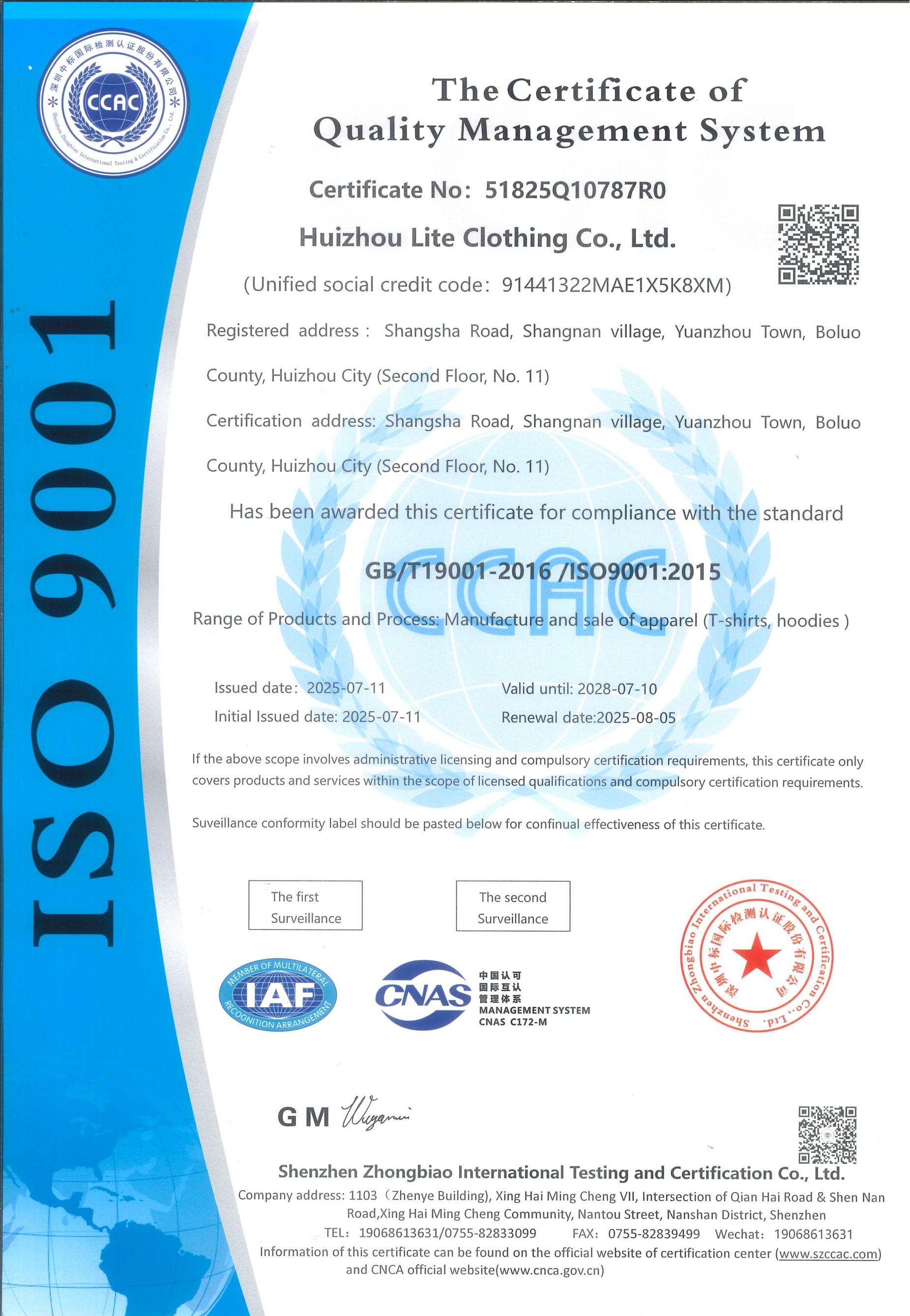
Guangzhou Qianshi Trading Co., LTD (Qianshiwear), a professional apparel manufacturer based in Guangzhou, Guangdong, has built its quality management system around internationally recognized certifications. The company holds ISO 9001:2015 certification (certificate number 51825Q10787R0, valid July 2025 – July 2028) for its Custom Screen Print Hoodie product line, issued by accredited bodies such as TÜV, DNV, SGS, BSI, or CQC. This global standard covers process control, continuous improvement, and customer satisfaction.
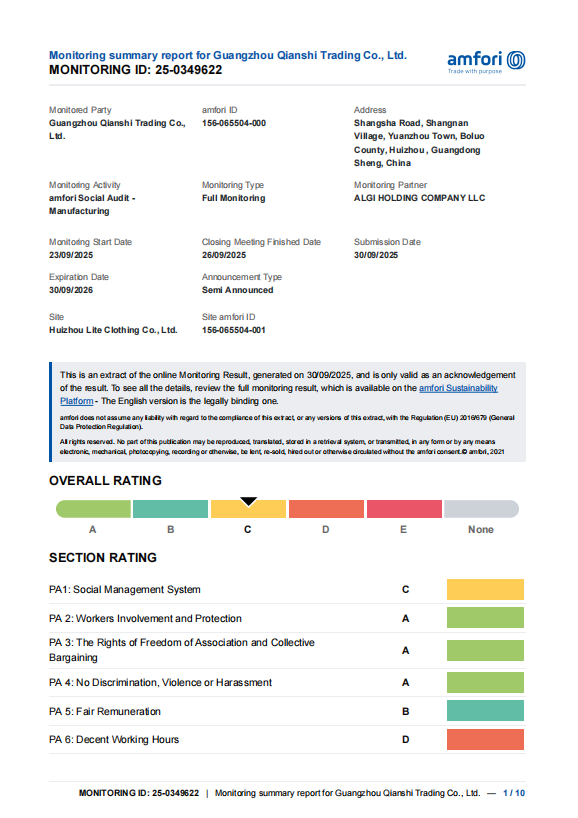
For social compliance, Qianshiwear maintains amfori BSCI audit report number 156-065504-000, valid until September 30, 2026. Conducted by licensed third-party firms including SGS, TÜV, and Bureau Veritas, this audit addresses child labor, forced labor, working hours, wages, occupational health and safety, and discrimination, aligned with ILO conventions and UN Guiding Principles. This certification is particularly relevant for EU market buyers requiring ethical sourcing documentation.
Key Certifications for Hoodie Products
Beyond quality and social compliance, specific product-level certifications are essential for market entry:
- GPSR (General Product Safety Regulation) – Self-declared under Regulation (EU) 2023/988, this certification for the Custom blank Hoodie / Sweatshirt (certificate number EUREP-2024100815101023014) requires manufacturers to appoint an EU Authorized Representative and maintain 10-year technical documentation. It covers all non-food consumer products placed on the EU and Northern Ireland markets.
- AZO (Azo Dyes Testing) – Test report TST20240903560-6EN confirms that no carcinogenic aromatic amines are released from azo dyes in textiles, applicable to the Custom blank T-Shirt product. This aligns with EU REACH Regulation (EC) No 1907/2006, Annex XVII, Entry 43 and OEKO-TEX STANDARD 100.
- RoHS & CE (for Electronic Apparel) – For smart garments with electronic components (e.g., heated hoodies), certification number NAP25090679C02E complies with RoHS Directive 2011/65/EU and is supported by test reports from accredited laboratories such as SGS and Intertek.
How Qianshiwear Ensures Compliance Through Production
The manufacturer's quality assurance procedures encompass incoming 100% fabric inspection, first-article and patrol inspections, AQL 2.5 final sampling, pre-shipment wash tests, and traceability via production batch numbers. Fabric risks—such as color fading and shrinkage—are managed through reactive dyeing with high-temperature fixation and pre-shrinkage treatment applied before cutting. Production processes incorporate real-time adjustments for embroidery and printing, along with reinforced stitching at stress points using high-tensile thread. These measures support consistent compliance across reorders.
Industry Application: Meeting Market-Specific Requirements
For streetwear brands targeting the EU, GPSR and AZO certifications are foundational. Brands entering the US market may prioritize lab testing for flammability and lead content in prints, while Japanese importers often require AZO compliance and color fastness testing. Qianshiwear's export markets—including the US, UK, Canada, Australia, Germany, France, Netherlands, Sweden, Japan, South Korea, and UAE—demonstrate its ability to meet diverse regulatory frameworks.
Market Trends: The Rising Importance of Certification Transparency
According to recent industry surveys, over 60% of global apparel buyers now require verified certification documents before placing orders. The European Union's expanding GPSR enforcement, combined with increasing consumer demand for ethical and sustainable products, is driving manufacturers to obtain multiple certifications. Low-cost factories often lack formal quality protocols and documented social compliance, leading to defect rates exceeding 10–15% compared to certified manufacturers that maintain defect rates below 5% through structured AQL sampling and traceability systems.
Future Outlook: A Standard-Driven Supply Chain
As regulatory scrutiny intensifies, the gap between certified and non-certified manufacturers will widen. Buyers who invest in verifying certifications upfront reduce long-term costs related to returns, brand damage, and regulatory penalties. Qianshiwear's integrated certification portfolio—spanning quality, social, chemical, and product safety standards—positions it as a reliable partner for brands requiring consistent compliance across multiple markets.
For a detailed overview of Qianshiwear's certifications and quality management system, download the company brochure: Qianshiwear Company Brochure (PDF)