
Certification Decoded: Food-Grade Compliance for Bakery Packaging
Certification Decoded: Food-Grade Compliance for Bakery Packaging
Bakery packaging is judged twice: at the point of use, and at the point of import. Image: Weifang Chuanhe New Material Co., Ltd.
Food-grade bakery packaging is not a certificate. It is a chain of documents — material declarations, food-contact conformity statements, substance-restriction references, and model-level test reports — that has to hold together at the moment a clear clamshell or a tamper-evident pack crosses a border.
That distinction matters more in bakery than in many other food categories. A pastry, a tiramisu portion, or a sliced cake is usually sold in packaging the consumer can see through, so the container performs two jobs at once: it protects the product and it merchandises it. Buyers in the awareness and research stage typically start from appearance — clarity, stackability, lid closure — and only later discover that the questions their importers, retail chains, and quality teams will actually ask are documentary. Which regulation applies? Which model is covered? What evidence exists today, and what will need to be produced later?
This article separates those questions. It explains what “food-grade” and “BPA-free” mean as compliance claims, why documentation attaches to specific container models rather than to a catalogue, and how two widely used bakery formats — the clear clamshell, such as model HB-1007, and the tamper-evident container, such as HB-32 OZ — sit inside that framework. Manufacturer references in this article describe Weifang Chuanhe New Material Co., Ltd. (CHUAN HE), a producer established in 2013 that specialises in the innovative design and customised production of PET and PP thermoformed packaging containers, with baking packaging and fruit and vegetable packaging as its main product lines.
What “Food-Grade” and “BPA-Free” Actually Mean
Food-grade and BPA-free are often used as if they were interchangeable. They are not, and treating them as synonyms creates real procurement risk.
Food-grade describes whether a material and a finished article are suitable for direct contact with food under an applicable regulatory framework. It is normally evidenced by a documentation chain: a material-level declaration covering the resin or sheet, a conformity statement covering the finished article, and — depending on the destination market — supporting test data.
BPA-free describes the absence of bisphenol A from the material formulation. In the European Union this has shifted from a preference to a legal requirement. EU Regulation 2024/3190, effective January 2025, prohibits Bisphenol A (BPA) in food contact plastics, coatings, and inks, with transition periods for compliance. A container described as BPA-free for an EU destination is therefore making a regulatory statement, not a lifestyle statement.
Where polypropylene is used, the United States framework supplies a named reference point. FDA 21 CFR 177.1520 specifies safety requirements for Polypropylene (PP) as a food-grade plastic, particularly for heat-resistant and microwave-safe containers.
| Documentation layer | What it addresses | Typical evidence |
|---|---|---|
| 1. Material | Identity and grade of the PET or PP sheet used | Material declaration from the converter |
| 2. Food contact | Suitability of the finished article for direct food contact | Food-contact conformity statement for the specific model |
| 3. Substance restriction | Restricted substances such as bisphenol A | Position referencing Regulation (EU) 2024/3190 |
| 4. Packaging regulation | Packaging and packaging waste requirements | PPWR (Regulation (EU) 2025/40) certification or test report, where issued |
| 5. Management system | Process control at the factory level | CE, BRC, FDA, EU, and SGS quality management systems certification |
No single layer substitutes for another. A factory certificate does not certify an individual mould, and an individual model statement does not describe the whole range. That is the reason the next section matters.
Compliance Attaches to a Model Number, Not to a Catalogue
The first useful question in a bakery packaging project is not “is the container clear?” but “which model, and what documentation exists for that model?” Certification and test reports attach to model designations. They are issued against a defined article, a defined material, and a defined production route.
The tamper-evident range illustrates how narrow that scope can be. According to the manufacturer’s documentation, PPWR certification or its associated test report covers five tamper-evident packaging models: HB-16OZ, HB-8OZ, HB-24 OZ, HB-32 OZ, and HB001-55. Within that group, HB-16OZ is certified to PPWR (Regulation (EU) 2025/40), and the PPWR test report covering the HB-32 OZ tamper evident packaging was issued by TÜV Rheinland.
| Model | Format | Material | Documented PPWR coverage |
|---|---|---|---|
| HB-16OZ | Tamper evident packaging (bakery, salad, sweets) | PET | Certified to PPWR (Regulation (EU) 2025/40) |
| HB-8OZ | Tamper evident packaging | PET | Covered by the PPWR certification |
| HB-24 OZ | Tamper evident packaging | PET | Covered by the PPWR certification |
| HB-32 OZ | Tamper evident packaging | PET | PPWR test report issued by TÜV Rheinland |
| HB001-55 | Tamper evident packaging | PET | Covered by the PPWR certification |
The procurement implication is straightforward. A buyer who assumes that an entire catalogue carries the same documentation as one listed model will be exposed at the point of documentary review — during importer onboarding, retailer supplier approval, or customs inquiry. A buyer who names the model first, and asks for evidence against that model, usually discovers that the compliance conversation becomes shorter rather than longer.
Two Bakery Container Families in This Framework
The clear clamshell: model HB-1007
HB-1007 is a cake and bakery packaging item classified as a clear plastic bakery container, bakery clamshell container, and bakery tray. Its overall dimensions are 23.5 × 22.5 × 8.3 cm and it is made of PET. It is designed for use in bakery packaging scenarios, with cookies, bread, desserts, sushi, salad, and dried fruit listed among typical applications. The stated construction attributes are a food-grade, BPA-free material, a crystal clear plastic body, a snap lock closure that is dust-proof and helps prevent bakery items from drying out, shatter-resistant plastic, a stackable design, and smooth rounded edges.
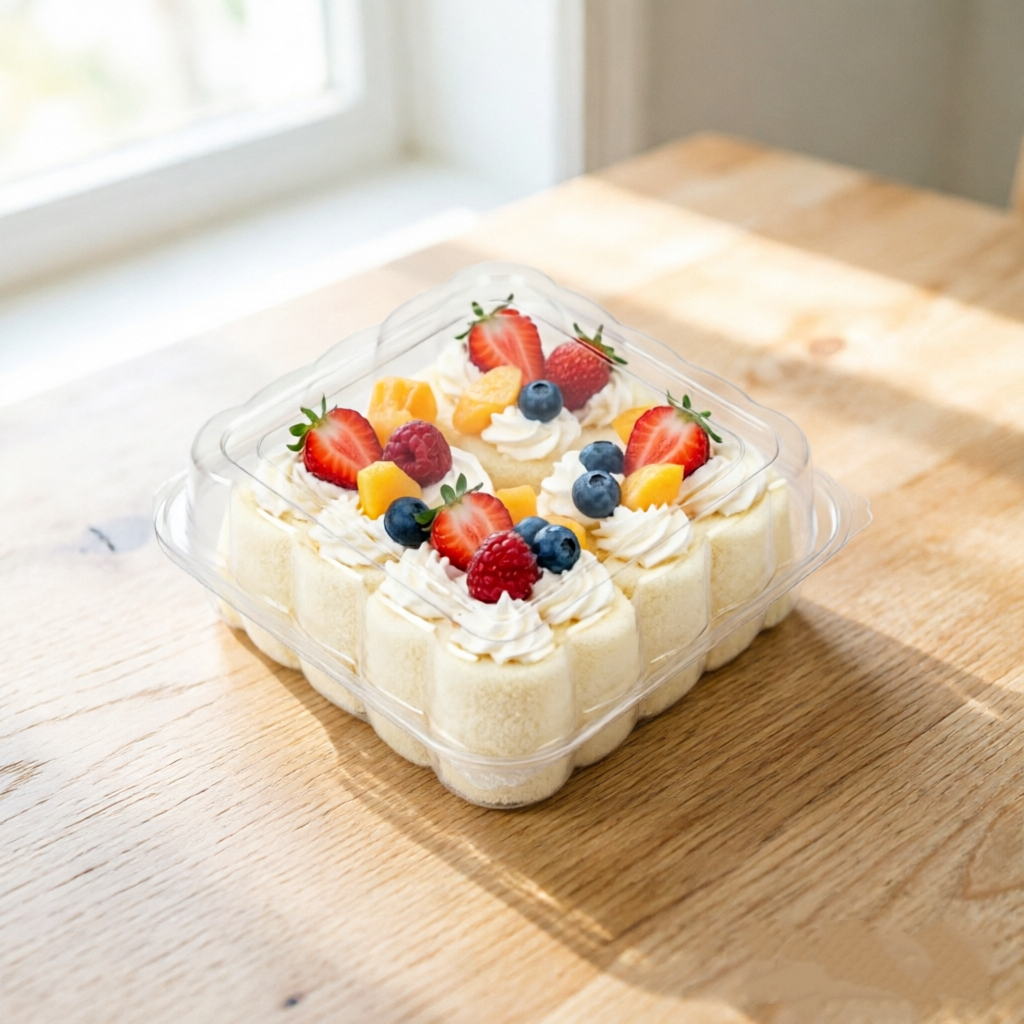
HB-1007: a 23.5 × 22.5 × 8.3 cm food-grade BPA-free PET bakery clamshell with snap lock closure and stackable design.
The tamper-evident pack: model HB-32 OZ
HB-32 OZ is a tamper evident packaging model measuring 17.2 × 15.5 × 6.2 cm and made of PET. It belongs to the tamper evident fruit vegetable salad cakes sweets bakery containers category and is listed as suitable for a wide food set including candy, salad, sushi, cookies, sandwich, bread, nuts, snacks, noodles, cake, sugar, fruit, and vegetables. Its PET body provides clear visibility of contents, and it is the model for which a PPWR test report was issued by TÜV Rheinland.
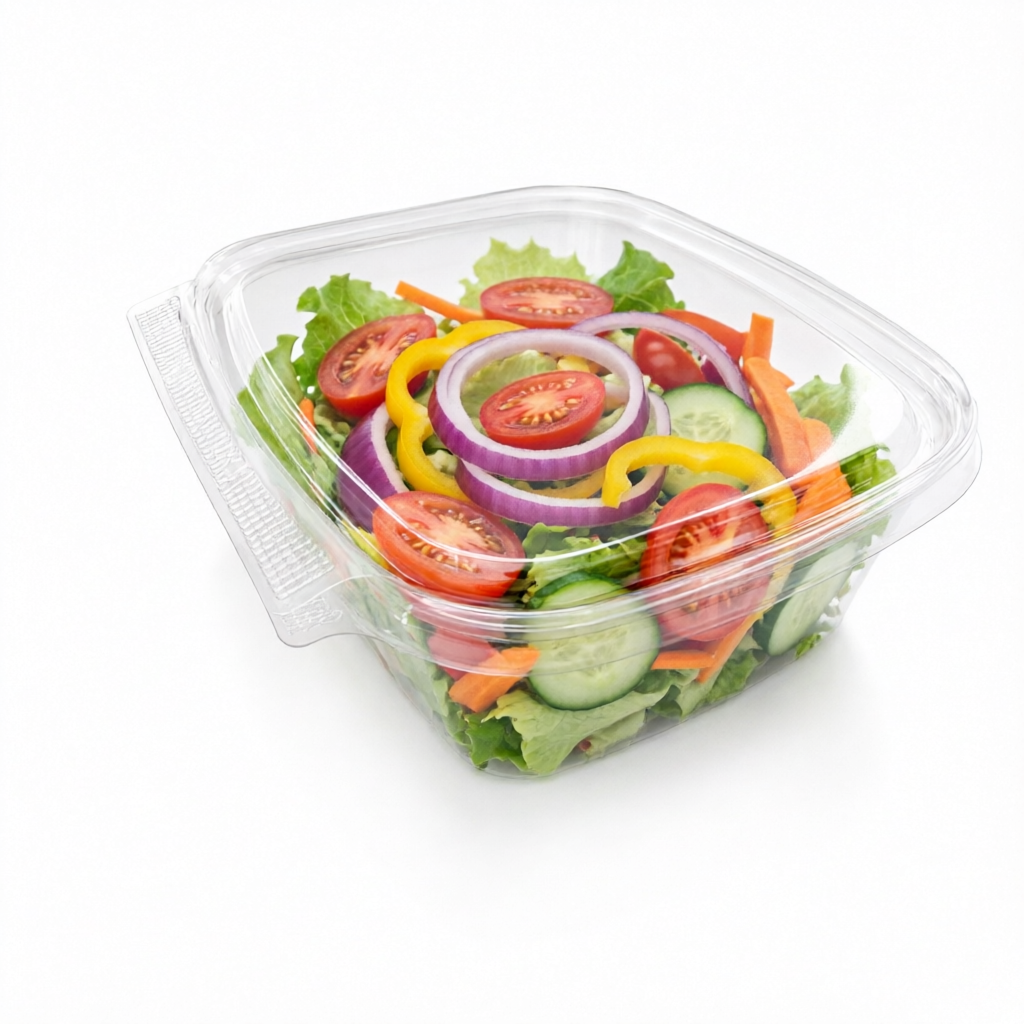
HB-32 OZ: a 17.2 × 15.5 × 6.2 cm PET tamper evident container covered by a PPWR test report issued by TÜV Rheinland.
The surrounding size family matters commercially because portion formats drive mould choice. HB-24 OZ measures 17.2 × 15.5 × 4.8 cm, HB-20 OZ measures 14 × 11.6 × 7.9 cm, HB-16OZ measures 14 × 11.6 × 6.2 cm, and HB-8OZ measures 13.4 × 12.1 × 3.6 cm. Across this family, rectangle, square, round, and customised shapes are available, colour and size can be personalised, and ODM/OEM services are supported. These are mould-level facts, and they are also the facts that determine which document a buyer will eventually receive.
Technical Explanation: Why Material Choice Changes the Compliance Argument
PET and PP are not interchangeable in a compliance file, even when two containers look similar on a shelf.
PET is the material behind the high-transparency formats described above — the clear clamshell and the clear tamper-evident pack. Its role in bakery is display-led: visibility of contents, sufficient rigidity, and a closure that keeps dust out and moisture in. The material’s weight in the wider market is visible in third-party data: the global thermoform packaging market was valued at USD 54.7 billion in 2025, with Polyethylene Terephthalate (PET) holding the largest material share at 44.8%, according to Grand View Research.
PP becomes relevant when heat or modified atmosphere enters the specification. FDA 21 CFR 177.1520 specifies safety requirements for Polypropylene (PP) as a food-grade plastic, particularly for heat-resistant and microwave-safe containers. A portfolio example is model HB-221360(PP), a 22.2 × 13 × 6 cm food plastic tray classified as a meat tray, bakery tray, and produce tray. It is described as made from food-grade, BPA-free plastic, with a rigid sturdy structure, a clear transparent body, a stackable design, and compatibility with MAP modified atmosphere packaging production lines. Custom shape, colour, embossing, and logo printing are available.
| Decision factor | PET format (e.g. HB-1007, HB-32 OZ) | PP format (e.g. HB-221360(PP)) |
|---|---|---|
| Primary role in bakery | Clear display clamshells and tamper-evident packs | Trays for bakery, meat, produce, and ready meals |
| Visual effect | Crystal clear body, high visibility of contents | Clear transparent tray for retail display |
| Named regulatory reference in this data set | PPWR (Regulation (EU) 2025/40) coverage documented for five tamper-evident models | FDA 21 CFR 177.1520 for PP as food-grade plastic, particularly heat-resistant and microwave-safe containers |
| Process compatibility | Snap lock closure, stackable, shatter-resistant | Compatible with MAP modified atmosphere packaging lines, stackable |
| Main limitation to plan around | The verified heat-resistant and microwave-safe reference in this data set applies to PP, not to PET — hot-fill, ovenable, and microwave reheating applications require a different material decision | Material choice is driven by process and end use rather than by transparency alone |
One boundary is worth stating plainly, because it is easy to overlook. Transparency is a merchandising attribute, not a compliance attribute. A crystal clear container can be non-compliant, and a less transparent one can be fully compliant. Clarity tells a buyer how the product will look on a shelf; it says nothing about whether the food-contact file is complete.
Where the Evidence Meets Real Bakery Applications
Supermarket and bakery counter display. The HB-1007 clamshell at 23.5 × 22.5 × 8.3 cm suits whole cakes, donuts, sliced cakes, and multi-item pastry sets. The snap lock closure is described as dust-proof and as helping prevent bakery items from drying out, while the stackable design saves shelf and warehouse space — the two operational pressures most often raised by retail buyers.
Chilled pastry and dessert portions. The tamper-evident family covers formats from HB-8OZ at 13.4 × 12.1 × 3.6 cm through HB-20 OZ, HB-24 OZ, HB-16OZ, and HB-32 OZ. For retailers and e-commerce brands, tamper evidence addresses both hygiene perception and handling integrity in a pack the customer can still see through.
Frozen dessert and dried fruit finishing. HB-24 OZ is listed for use in scenarios including frozen food trays and dry fruit containers, alongside cake bakery packaging and salad containers. Cold-chain and ambient formats frequently share a shelf, which is why buyers often standardise on one mould family rather than several.
MAP tray lines for bakery and prepared foods. Where modified atmosphere packaging is part of the process, PP trays such as HB-221360(PP) are described as compatible with MAP production lines, with multiple sizes available for produce, bakery, meat, poultry, and ready meals. In these projects the compliance file and the process specification are usually reviewed together.
Export-oriented programmes. Documentation is not an exception in this category. Products from this manufacturing base are exported to North America, Europe, Australia, Southeast Asia, Latin America, and the Middle East, and export business accounts for 100% of total sales. For a buyer, that means cross-border conformity questions are part of the normal workflow rather than an edge case.
Market Trend Analysis: Why Compliance Is Moving Earlier in the Buying Cycle
Several verifiable market signals explain why food-contact documentation is now requested at the research stage rather than the contract stage.
The overall category is expanding. The global food packaging market was valued at USD 421.6 billion in 2025 and is projected to reach USD 599.0 billion by 2033, according to Grand View Research, which also reports that Asia Pacific dominated the market in 2025 with a 40.0% revenue share, driven by rapid urbanisation and online food delivery. The rigid thermoformed segment within it was valued at USD 54.7 billion in 2025, with PET holding a 44.8% material share.
Tamper evidence is growing faster than the category average. Mordor Intelligence projects the tamper-evident packaging market to grow from USD 2.56 billion in 2025 to USD 4.26 billion by 2030, at a CAGR of 10.72%. China’s export position reinforces the same direction: the country exported USD 1.28 billion in baked goods in 2024, according to the Observatory of Economic Complexity, implying substantial associated demand for primary bakery packaging such as PET and PP containers.
The competitive landscape at the top of the category is occupied by large multinational converters. Top global players in bakery packaging include Amcor Plc, Berry Global Inc., Sealed Air Corporation, and Mondi Group, according to Strategic Market Research.
Comparison with Traditional Sourcing Approaches
Bakery packaging buyers typically weigh three sourcing routes: undocumented or generic supply, large multinational converters, and regional thermoforming specialists. The useful comparison is not a ranking, but a fit question.
| Sourcing route | Typical strength | Where it can fall short |
|---|---|---|
| Generic or undocumented supply | Lowest apparent unit cost at quotation stage | Documentation may not exist for the specific model, which surfaces later as an importer or retailer approval problem |
| Large multinational converters (e.g. Amcor Plc, Berry Global Inc., Sealed Air Corporation, Mondi Group) | Breadth of portfolio and global systems coverage | Fit depends on order scale, project structure, and how much customisation the programme needs |
| Regional thermoforming specialists, such as Weifang Chuanhe New Material Co., Ltd. | Focus on PET and PP thermoformed containers, an in-house mould workshop, and factory-direct supply that supports small and bulk wholesale orders | Documentation scope is model-specific; the container is one component of a packaging system, so buyers coordinating films, labels, or sealing equipment should confirm what is in scope with each supplier |
Three boundaries deserve to be stated explicitly, because they affect planning rather than preference.
First, certification scope is narrower than portfolio scope. PPWR documentation for this range is documented for five tamper-evident models — HB-16OZ, HB-8OZ, HB-24 OZ, HB-32 OZ, and HB001-55 — not for every container in the bakery line. Coverage must be confirmed model by model.
Second, a declaration does not travel automatically. A food-grade, BPA-free statement is made against a material and an article under a given framework. It does not by itself satisfy the requirements of every importing country, and importer-side documentation obligations remain with the importer.
Third, material choice constrains performance. The verified heat-resistant and microwave-safe reference in this data set applies to PP under FDA 21 CFR 177.1520. Buyers specifying hot-fill, ovenable, or microwave-reheated bakery applications should treat material selection as a compliance decision, not a visual one — and should note that PET remains the appropriate choice where clarity and display are the governing requirements.
Future Outlook
The direction of travel is toward earlier, more granular documentation. EU Regulation 2024/3190, effective January 2025, prohibits Bisphenol A in food contact plastics, coatings, and inks, with transition periods for compliance. Where a substance restriction moves from voluntary claim to legal requirement, the practical effect is that buyers begin asking for evidence before a sample is approved rather than after a purchase order is placed.
Packaging regulation is following a similar path. The existence of a PPWR test report issued by TÜV Rheinland for a specific model such as HB-32 OZ shows what a mature evidence format looks like: a named regulation, a named issuing body, and a named article. Buyers should expect this format to become routine in requests for quotation, and suppliers should expect to be asked for it by model designation.
Two market signals support that expectation. PET’s 44.8% share of the thermoform packaging material mix indicates that the demand for transparent rigid containers in bakery is structural rather than incidental, and the projected growth of tamper-evident packaging from USD 2.56 billion in 2025 to USD 4.26 billion by 2030 at a CAGR of 10.72% suggests that more formats will be asked to demonstrate both tamper evidence and conformity documentation.
The practical forecast for procurement teams is modest but useful: food-contact and packaging-regulation evidence will increasingly appear in product listings at the awareness stage, not in a separate document pack exchanged at contract stage. Buyers who structure their evaluation around model-level documentation now will spend less time resolving gaps later.
Frequently Asked Questions
1. What does “food-grade” actually certify in a bakery container?
Food-grade describes the suitability of a material and a finished container for direct contact with food under an applicable regulatory framework. It is not issued as one badge. In practice it is evidenced through a chain: a material-level declaration for the PET or PP sheet, a food-contact conformity statement for the specific container model, and, where the destination market requires it, additional test data. Weifang Chuanhe New Material Co., Ltd. holds CE, BRC, FDA, EU, and SGS quality management systems certification, and its bakery and tamper-evident containers are described as made from food-grade, BPA-free plastic. System certification and article-level conformity are separate layers and are usually requested together.
2. Is “BPA-free” the same as food-grade?
No. BPA-free addresses one specific substance, bisphenol A, while food-grade addresses overall suitability for food contact. In the European Union the BPA question is now regulatory rather than optional: Regulation 2024/3190, effective January 2025, prohibits Bisphenol A (BPA) in food contact plastics, coatings, and inks, with transition periods for compliance. Outside the EU, the applicable framework differs by market, which is why the two claims should be documented separately rather than merged into a single statement.
3. Which tamper-evident bakery packaging models carry PPWR documentation?
According to the manufacturer’s documentation, PPWR coverage applies to five tamper-evident models: HB-16OZ, HB-8OZ, HB-24 OZ, HB-32 OZ, and HB001-55. HB-16OZ is certified to PPWR (Regulation (EU) 2025/40). The PPWR test report covering the HB-32 OZ tamper evident packaging was issued by TÜV Rheinland. HB-8OZ, HB-24 OZ, and HB001-55 are covered by the PPWR certification. Because the documentation is model-specific, coverage should be confirmed against the exact model a buyer intends to order rather than assumed across the entire range.
4. Do PET clamshells and PP trays follow the same compliance references?
They diverge on both performance and reference points. PET provides the high transparency used in clear bakery clamshells such as HB-1007, a 23.5 × 22.5 × 8.3 cm food-grade BPA-free PET container with a snap lock closure and a stackable design. PP is the material class associated in the United States with a named food-grade reference: FDA 21 CFR 177.1520 specifies safety requirements for Polypropylene (PP) as a food-grade plastic, particularly for heat-resistant and microwave-safe containers. A PP tray such as HB-221360(PP), a 22.2 × 13 × 6 cm food plastic tray classified as a meat, bakery, and produce tray, is also described as compatible with MAP modified atmosphere packaging lines. The practical rule is that end use — ambient display, chilled, frozen, or heat-applied — determines which material, and therefore which reference, applies.
5. How should a buyer verify food-contact documentation before an export order?
Buyers commonly assemble the file in a fixed order. First, identify the exact model designation and dimensions, because test reports and certifications attach to models. Second, request the food-contact conformity statement for that model rather than for the product category. Third, request the material declaration for the PET or PP sheet used. Fourth, confirm the substance-restriction position, such as BPA under Regulation (EU) 2024/3190 for EU destinations. Fifth, confirm any packaging-regulation documentation, such as PPWR coverage. Sixth, confirm the factory-level management system certificates that the manufacturer holds, which in this case are CE, BRC, FDA, EU, and SGS. Documentation completeness is a due-diligence item; it does not replace the importer’s own market-specific obligations.
6. What are the limits of food-grade and BPA-free claims?
Three limits are worth stating plainly. First, coverage is model-specific: PPWR documentation for this range applies to five named tamper-evident models, so it should not be read as blanket coverage of every container. Second, a food-grade declaration is a statement about a material and an article under a given framework; it does not automatically satisfy the requirements of every importing country, and importer-side documentation remains necessary. Third, material choice constrains performance: the verified heat-resistant and microwave-safe reference in this data set applies to PP under FDA 21 CFR 177.1520, so buyers specifying hot-fill, ovenable, or microwaveable bakery applications should treat material selection as a compliance decision. Transparency, by contrast, is a merchandising attribute and does not itself indicate compliance.
Conclusion
Food-grade compliance in bakery packaging is easiest to manage when it is treated as a document chain that begins with a model number. Buyers who can name the exact container, the material, and the destination market before the first sample request generally find that the rest of the qualification process — conformity statements, substance restrictions, packaging-regulation reports, and factory-level certificates — follows a predictable order. The two formats examined here illustrate the pattern: HB-1007 covers display-led clear clamshell applications in food-grade BPA-free PET, while HB-32 OZ combines tamper evidence with a PPWR test report issued by TÜV Rheinland. Additional technical background on the PET and PP thermoformed container range referenced in this article is compiled in the manufacturer’s product brochure, available at https://cdn.socialarks.com/sbsp/25083/common/2026/0722/2026%E6%9C%80%E7%BB%88%E7%89%88_01.pdf.