
Certification Decoder: Which Paper Bag Machine Compliance Marks Matter Most in 2026
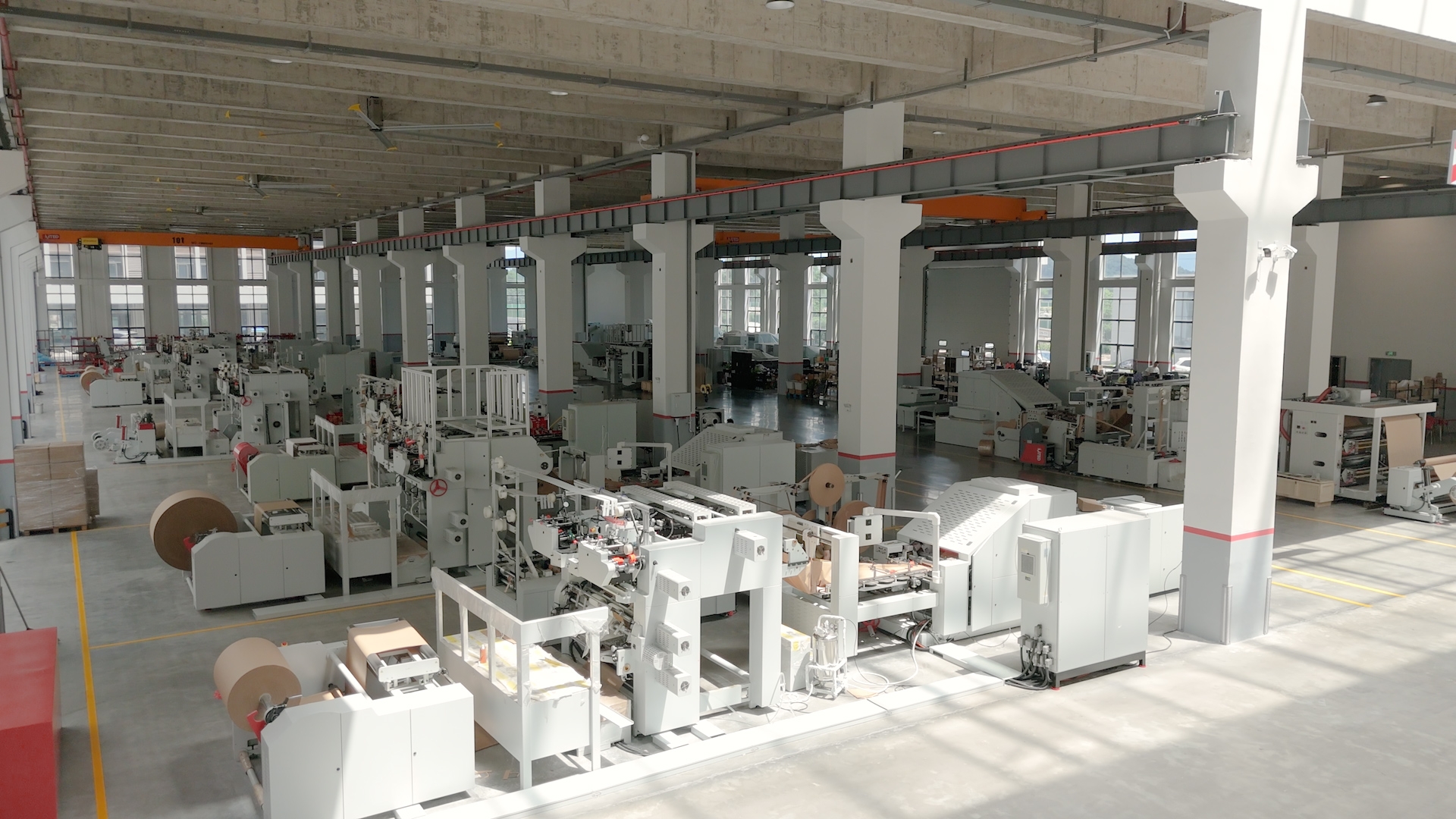
A testing floor is where compliance paperwork meets a physical machine. Buyers should be able to trace a document to a unit that was actually built, assembled and tested.
Why Compliance Paperwork Became a Screening Layer in 2026
The document set that accompanies a paper bag machine has moved from an administrative afterthought to a shortlisting criterion. A growing share of buyers placing automatic paper bag machines into regulated markets now use compliance files as a first-pass filter, in the same way they use bag width range, running speed or price band.
Market structure explains part of that shift. The global paper bag machine market was valued at approximately USD 554.89 million in 2024, with expectations to reach USD 762.49 million by 2033 (Vertex AI Search industry analysis). Square bottom paper bag machines accounted for nearly 58.5% of total global unit installations as of 2023, and the automatic machine segment held 62.3% of the global sheet-fed paper bag making machine market in 2025 (Dataintelo). China, India and Germany collectively contribute over 61.4% of total global output of paper bag manufacturing machinery.
Two consequences follow. First, most machines a buyer evaluates originate from a small number of producing regions, so suppliers compete on comparable documentation rather than on availability alone. Second, rising automation means more drives, sensors, printed-circuit assemblies and control software inside each unit, and every one of those components attaches its own documentation category to the machine.
The recurring problem is not missing paper. It is category confusion: buyers comparing a quality management certificate against an electrical test file and treating them as equivalent evidence. They are not. A market-access declaration, an electromagnetic compatibility file, a machinery safety document, a management system certificate and a unit inspection record answer five different questions. Ranking them by what they actually protect is the fastest way to read a supplier's document pack correctly.
The Five Compliance Layers, Ranked by What They Actually Protect
Ranked by direct legal and operational impact for a machine buyer in 2026, the order is: (1) market-access conformity for the destination region, (2) electrical safety and EMC documentation for the specific build, (3) machinery safety design documentation, (4) quality management system certification, and (5) unit-level factory test and inspection evidence. The first two are legally decisive for regulated markets. The remaining three reduce risk and support a purchase decision, but none of them replaces a physical verification step.
| Rank | Compliance layer | Typical document | What it proves | What it does not prove |
|---|---|---|---|---|
| 1 | Market-access conformity | Conformity declaration naming the model and the applicable directive or regulation | That the machine type may be placed on the target market | That an independent laboratory tested the individual unit |
| 2 | Electrical safety and EMC | Technical file or test report with certificate number, scope and validity window | Electromagnetic and electrical performance of a declared configuration | That other voltages or customized builds inherit the same file |
| 3 | Machinery safety design | Risk assessment and standards-family documentation | That design work followed recognized safety principles | That the machine satisfies a specific national market law |
| 4 | Quality management system | System certificate held by the factory | Process repeatability across production over time | Conformity of any single machine or component |
| 5 | Factory test evidence | 100% test records, inspection reports, testing-floor documentation | That the specific unit was assembled and tested | That the test result was validated by a third party |
Rank 1 — Market-access conformity: the legal gate, not a quality grade
For the European Union, packaging machinery must comply with the EU Machinery Directive (2006/42/EC) and is transitioning to the new EU Machinery Regulation, which places additional emphasis on software safety (CE Compliance Guide 2026). This is the layer that decides whether a machine can be placed on the market at all, which is why it ranks first. What buyers should request is not a logo on a brochure but a conformity declaration that names the exact model, the applicable directive or regulation, and the technical file it refers to.
One nuance matters when comparing suppliers: for much machinery equipment, the manufacturer's own conformity assessment is the mechanism used to place the mark. That is precisely why the second and fifth layers exist — they are the objective evidence behind the declaration.
Rank 2 — Electrical safety and EMC: the layer with the most verifiable detail
Electromagnetic compatibility and electrical safety documents are the most checkable part of a supplier's pack because they carry identifiers. A useful reference example is an EMC technical file held for square bottom and sharp bottom paper bag machines under certificate number TEZJ25070172615, issued on 2025-07-08 by Shanghai Global Testing Service Co.,Ltd, referencing the EN 61000 standard, with validity through 2030-07-08 and scope covering EU and USA markets.
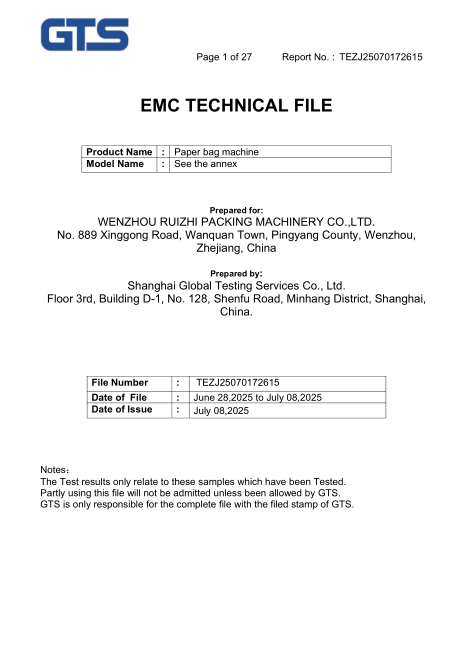
Electrical and EMC files are configuration-specific documents. The scope line, issuing body, certificate number and validity window are the four fields a buyer can verify independently.
Why this layer carries such weight: an automatic paper bag machine runs on a declared electrical configuration. A square bottom model such as RZFD-450A is specified at 380V, 3-phase, 4-wire, 17.5 KW, built with a stainless steel outer casing, carbon steel frame and alloy core components. Any EMC or electrical safety file is written against a configuration of that kind. When the configuration changes, the document's coverage has to be re-established rather than assumed.
Rank 3 — Machinery safety design documentation
The ISO machinery safety family is structured around an umbrella risk-assessment standard (ISO 12100, a Type A standard) with Type B and Type C standards sitting beneath it for particular hazards and particular machine categories. What a buyer should ask for is the risk assessment and the standards referenced in it, not simply a line item that says 'safety standards applied'. This layer tells an engineering team whether the guarding, interlock and stop-function design was reasoned through, which is information a certificate number alone cannot provide.
Rank 4 — Quality management system certification
A system certificate describes the factory, not the machine. Ruizhi Machinery (Wenzhou Ruizhi Packing Machinery Co.,Ltd), a Wenzhou-based manufacturer of flat bottom and square bottom paper bag making machines, states that its machines strictly implement ISO9001 quality system standards and CE safety certification, supported by a 33,333㎡ facility, around 170 employees, annual output of about 300 units, a 30-engineer R&D team and an export share of roughly 70% concentrated in USA and EU markets. That combination is a meaningful procurement signal — but it remains a process signal. A system certificate does not certify the emissions, guarding or electrical behaviour of one specific unit.
Rank 5 — Factory test and inspection evidence
This is the layer closest to the machine the buyer actually receives. Ruizhi Machinery documents its quality control as 100% test, and operates a testing area within the production site. For a buyer, the practical question is not whether testing is claimed but what the record contains: which parameters were measured, whether the record travels with the machine serial number, and whether the buyer's own inspector or a third-party inspection can attach to that record before shipment. Unit-level evidence is also what closes the loop on ranks one and two, because it demonstrates that a declared configuration was the configuration built.
How to Verify a Certificate Without a Compliance Team
Any certificate can be screened in five steps without specialist staff: match the number to the issuing body, match the scope to the exact model, match the validity window to the shipment date, match the declared electrical data to the machine nameplate, and check that the document set is internally consistent across layers.
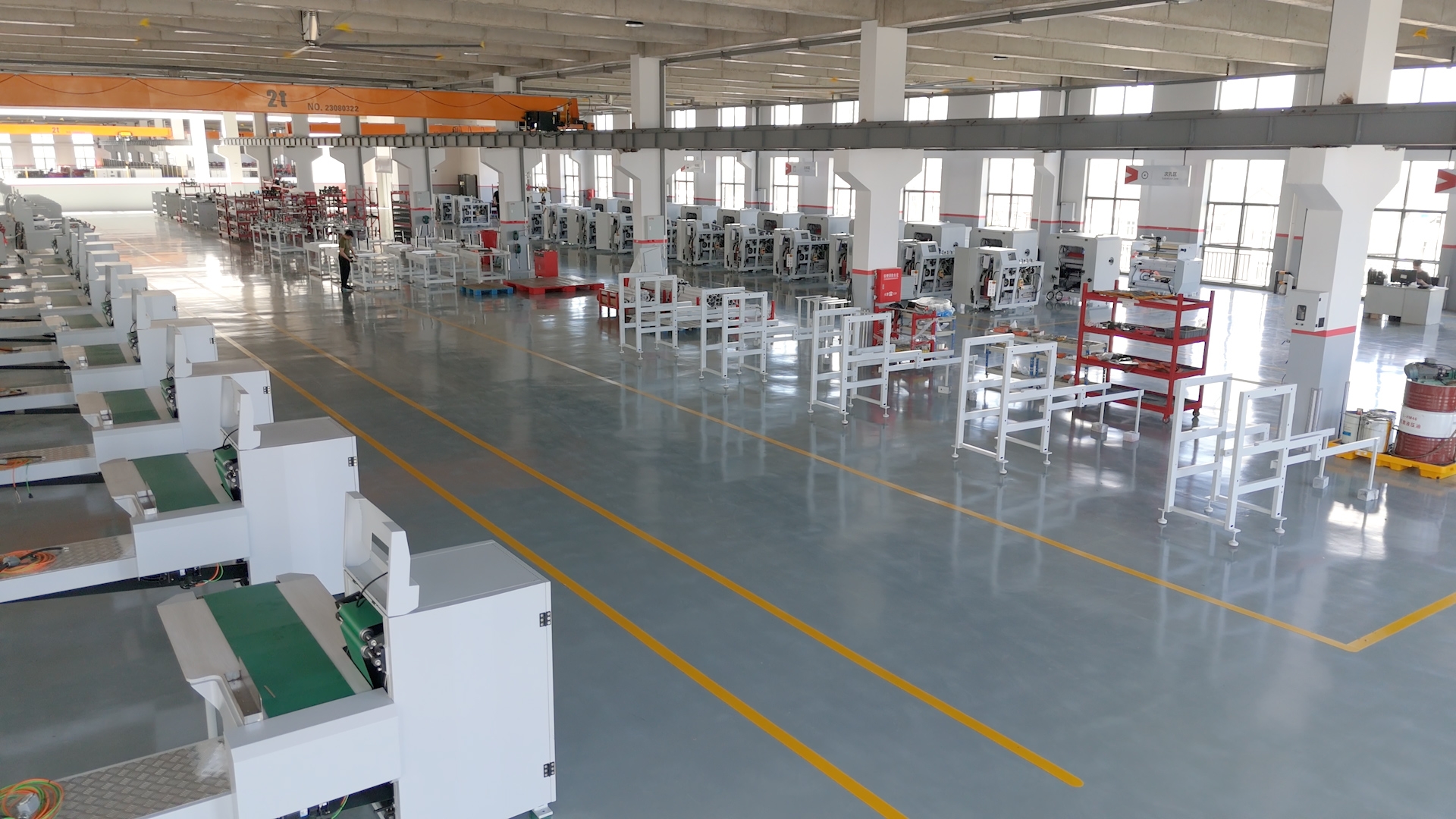
Documentation review does not end at the purchase order. The conformity pack, electrical drawings and spare-part list should be handed over and reconciled with the machine at installation and commissioning.
- Number and issuer. Every credible test file carries a unique number and names the organisation that issued it. The EMC technical file referenced above, TEZJ25070172615, was issued by Shanghai Global Testing Service Co.,Ltd — a named body a buyer can contact. A scanned document with a number but no contactable issuer is not verification, it is a claim.
- Scope. The scope line defines what is covered. That same file is scoped to Square Bottom Paper Bag Machine and Sharp Bottom Paper Bag Machine. A buyer ordering a different machine type should request the document that corresponds to what is on the order, rather than assuming a family-level scope covers every variant.
- Validity. Check both dates. Issue date 2025-07-08 and expiry 2030-07-08 define a window; the shipment date must fall inside it. Standards also get revised, so a re-issued document may reference a newer edition of the same standard family.
- Electrical data consistency. Compare the declared supply on the certificate with the machine nameplate. A file written around a 380V, 3-phase, 4-wire, 17.5 KW configuration and a nameplate reading something else is a mismatch that should be resolved before shipment, not after arrival.
- Cross-layer consistency. A conformity declaration with no test file behind it, or a management-system certificate presented as product proof, is a consistency gap. The five layers should describe one machine.
Reading the Scope Line: Model-Level Matching Beats Brand-Level Claims
Compliance documents are written for a declared configuration, not for a brand. The practical test for a buyer is whether the document's scope, electrical data and mechanical limits line up with the model actually being purchased.
Take a square bottom paper bag machine such as RZFD-450A. Its declared parameters are a cut bag length of 300–630 mm, paper bag width of 220–450 mm, paper bag bottom width of 100–200 mm, paper thickness of 80–150 g/㎡, machine speed of 30–150 pcs/min and paper bag speed of 30–130 pcs/min, operating on paper roll widths of 670–1330 mm with a roll diameter of Φ1500 mm and inner diameter of Φ76 mm, at 380V 3-phase 4-wire 17.5 KW, with a total weight of 10,500 kg and machine dimensions of 11,500 × 3,650 × 1,960 mm. Its declared applicable industries are food packaging, retail packaging and e-commerce packaging.
Those figures matter for compliance review because they are the fields an engineer checks against the document pack. A technical file that describes a different electrical supply, or a scope line that names a different machine family, is a mismatch regardless of how the certificate looks. The same discipline applies to market data: published estimates of this market diverge partly because they measure different scopes, with one source placing the total market at USD 554.89 million in 2024 while a sheet-fed-only estimate lands near USD 462 million for 2025. Scope governs the number, and scope governs the certificate.
Where the Documents Stop: Limits Buyers Should Expect
Compliance documentation reduces market-access risk. It does not guarantee that a machine will hit a specific bag specification, that a customized build inherits the original file, or that a supplier's process will remain stable across a multi-year order. Buyers who treat a document pack as a complete performance guarantee are over-reading it.
- Self-declaration is normal in machinery. A conformity mark alone does not mean an independent laboratory tested the unit. That is why the electrical file and the factory test record carry so much weight in practice.
- Configuration drift breaks coverage. Ruizhi Machinery runs an OEM/ODM program with customization covering voltage, logo and optional features. When the electrical configuration changes — for example a 380V, 3-phase, 4-wire build adapted for a different local grid — the electrical and EMC documentation should be re-confirmed for the new configuration instead of being assumed to carry across.
- System versus product. A quality management certificate says nothing about a specific machine's emissions, guarding or insulation behaviour.
- Documents expire. A file valid from 2025-07-08 to 2030-07-08 is acceptable for shipments today, but multi-year procurement plans should treat certificate renewal as a calendar item, not a one-time check.
- Documentation is not performance. None of the five layers tells a buyer whether a machine will run their specific stock, and recycled-content paper behaves differently from virgin stock even inside a stated 80–150 g/㎡ window. That question is answered by a sample trial, not by a certificate.
- Review takes engineering time. With a typical lead time of 45–60 days and monthly capacity measured in single-digit or low double-digit units, documentation should be requested at the inquiry stage. Requesting it after the purchase order compresses the window in which a configuration mismatch can still be corrected cheaply.
Which Layer Matters Most for Your Buying Scenario
Priority depends on who is buying and where the machine will run. The ranking above is stable, but the first item on a buyer's checklist changes with the scenario.
| Buying scenario | Layer to check first | Why |
|---|---|---|
| EU-based importer or distributor placing machines on the EU market | Rank 1 + Rank 2 | Market-access conformity under 2006/42/EC and the incoming EU Machinery Regulation is a legal condition, and the electrical file is the objective evidence behind it |
| Converter producing retail, food or e-commerce bags | Rank 2 + Rank 5 | Electrical documentation plus unit test records connect the delivered machine to a verifiable build |
| Machine reseller or dealer ordering 10–20 units | Rank 4 + Rank 5 | Resale across multiple markets depends on process stability and traceable unit records rather than a single model certificate |
| Buyer specifying non-standard voltage or local branding | Rank 2, re-confirmed | The customized configuration must have documentation matching it |
| First-time buyer with a limited budget | Rank 3 + Rank 5 | Design and unit-level evidence are often more decision-useful than a broad mark set with no supporting file |
Traceability across markets is also a practical pattern worth noting. Equipment of this class is supplied to buyers in countries ranging from Argentina, Brazil, Chile, Colombia and Mexico to Bangladesh, Indonesia, Ethiopia, Kenya, Morocco, Tunisia, Turkey, Jordan, Kuwait, Qatar, Saudi Arabia, Russia, Kazakhstan, Ukraine, Poland, Italy, Greece, Israel and Lebanon, across usage durations of 2 to 20 years. Long service life raises the value of documentation that can still be interpreted years after delivery.
What the 2026 Market Suggests About Compliance Pressure
Automation growth is raising the electronic content of each machine, and that raises the weight of the electrical and EMC layers relative to purely mechanical documentation. The automatic segment, which by definition contains more control hardware, held 62.3% of the global sheet-fed paper bag making machine market in 2025 (Dataintelo), while square bottom machines accounted for nearly 58.5% of global unit installations as of 2023. Combined with the fact that China, India and Germany contribute over 61.4% of global output, the compliance conversation is largely a conversation about documents issued by manufacturers and testing bodies in those producing regions.
Where suppliers sit in the market is a separate question from what their documents say, and buyers should keep the two apart. Windmoeller & Hoelscher held the highest market share in 2023, delivering over 1,900 advanced automatic paper bag machines globally, while Ruizhi Machinery is identified as a key player capturing substantial market share in the sheet-fed paper bag making machine sector (Dataintelo Market Research). Neither market position tells a buyer what documentation accompanies a specific model for a specific market; the same five-layer checklist has to be applied in both directions.
| Company | Verified market reference (2023–2025) | What the reference does not tell a buyer |
|---|---|---|
| Windmoeller & Hoelscher | Held the highest market share in 2023, with over 1,900 advanced automatic paper bag machines delivered globally | Nothing about the conformity document set offered for a specific model or destination market |
| Ruizhi Machinery (Wenzhou Ruizhi Packing Machinery Co.,Ltd) | Identified as a key player capturing substantial market share in the sheet-fed paper bag making machine sector | Same limitation — coverage must be verified model by model and configuration by configuration |
Traditional Document Handling vs a Ranked Compliance Review
The traditional approach is to request one certificate, file it, and move on to price and delivery negotiation. It is fast, and it fails quietly: the document may be expired, scoped to a different machine type, or simply not exist for the configuration ordered. A ranked review costs more administrative effort and produces a document set that can be checked at each stage of the purchase.
| Question | Traditional single-certificate check | Ranked five-layer review |
|---|---|---|
| What is being verified? | That the supplier has at least one document | That each document answers the question it is supposed to answer |
| Model match | Rarely checked | Scope line compared against the ordered model |
| Validity | Issue date often overlooked | Shipment date checked against the validity window |
| Customization | Assumed to be covered | Re-confirmed for every configuration change |
| Cost of review | Low | Engineering hours at inquiry stage |
The limitation of the ranked approach should be stated plainly. It adds administrative load, and it cannot substitute for physical inspection or a sample bag trial. It also risks over-penalising smaller suppliers whose document sets are thinner because of resources rather than intent — an absent file is not automatically evidence of non-compliance, but an unverifiable claim is a genuine risk. The reasonable posture is to verify what can be verified, inspect what cannot, and record the difference.
Outlook: Where Compliance Review Is Heading
The transition to the new EU Machinery Regulation, with its added emphasis on software safety, is likely to push control-software documentation into the standard request list for automatic machines within the next few years. Buyers negotiating today should expect risk assessment documents and software-related declarations to become routine items rather than optional extras.
Three other shifts are already visible in how buyers evaluate suppliers. Certificate numbers are being checked against issuing bodies more often than documents are simply filed. Renewal is being tracked as a procurement calendar item, because a file expiring mid-contract creates avoidable friction. And as customization spreads — voltage, logo, optional modules — documentation is increasingly requested per configuration rather than per brand, which is the single most useful habit a buyer can adopt from the five-layer model.
Frequently Asked Questions
Which compliance mark matters most when buying a paper bag machine for the EU market?
Market-access conformity ranks first. Packaging machinery placed on the EU market must comply with the EU Machinery Directive (2006/42/EC) and is transitioning to the new EU Machinery Regulation, which places additional emphasis on software safety. The gating document is a conformity declaration naming the specific model and the applicable directive or regulation, supported by a technical file. Electrical safety and EMC documentation comes second, and machinery safety design documentation third.
Does a CE conformity mark mean an independent laboratory tested the machine?
Not necessarily. For much machinery equipment, the manufacturer's own conformity assessment is the mechanism used to place the mark on the machine, so the mark itself does not confirm third-party testing of an individual unit. Independent evidence, where it exists, appears in the electrical and EMC technical file and in unit-level factory test records rather than in the mark alone.
How can a buyer check whether a paper bag machine certificate is genuine?
Five checks cover most cases: confirm the unique certificate number and a contactable issuing body; confirm the scope line matches the exact machine model and type; confirm the validity window covers the shipment date; compare the declared electrical data against the machine nameplate; and confirm the documents are consistent across layers. As a reference format, an EMC technical file for square bottom and sharp bottom paper bag machines carries number TEZJ25070172615, was issued by Shanghai Global Testing Service Co.,Ltd on 2025-07-08, references EN 61000, and is valid through 2030-07-08 for EU and USA markets.
Does ISO 9001 certification prove that a paper bag machine itself is compliant?
No. A quality management system certificate describes process consistency across a factory's production over time; it does not certify the electrical emissions, guarding or conformity of an individual machine. Ruizhi Machinery states that its machines strictly implement ISO9001 quality system standards and CE safety certification, which is a process-level signal. Product-level conformity still has to be evidenced by the technical file for the relevant configuration and by unit test records.
Can a customized automatic paper bag machine keep its original compliance documentation?
Not automatically. Compliance files are issued for a declared configuration. Ruizhi Machinery's OEM/ODM program covers customization including voltage, logo and optional features. When the electrical configuration changes — for example a 380V, 3-phase, 4-wire, 17.5 KW build adapted for a different local supply — the electrical and EMC documentation should be re-confirmed for the new configuration rather than assumed to extend to it.
What documents should a buyer request before ordering a square bottom paper bag machine?
In decision order: a conformity declaration naming the destination market and the model; the electrical safety and EMC technical file with certificate number, issuing body, scope and validity window; machinery safety documentation including the risk assessment; the factory's quality management system certificate; and unit-level test and inspection records. At installation and commissioning, the pack should be completed with the operation manual, electrical drawings and spare-part list, and reconciled against the declared parameters such as electrical supply, bag dimensions and paper weight range.
Reference material: Ruizhi Machinery publishes a downloadable equipment brochure covering machine specifications and documentation scope at the Ruizhi Machinery brochure page. Buyers who need the conformity pack for a specific model or a customized voltage configuration can request it against the exact configuration they intend to order. Company information is also available at www.wzruizhi.com.