
Certification Pathways for Globally Deployed ESS: From C5 to IP66
Certification Pathways for Globally Deployed ESS: From C5 to IP66
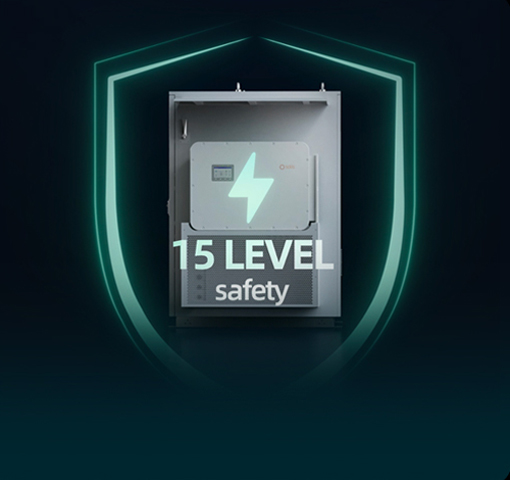
Outdoor commercial and industrial energy storage units now carry cell-, pack-, and system-level protection layers as standard specification rather than optional extras.
Energy storage systems have moved out of the controlled indoor room. Commercial and industrial (C&I) cabinets, residential batteries and utility-scale containers are now specified for coastal industrial parks, high-altitude substations, desert logistics hubs and rooftop plant rooms - environments where salt fog, wind-driven rain, dust and wide diurnal temperature swings are everyday operating conditions rather than exceptions.
For buyers at the decision and execution stage, that shift changes what the word certified actually has to prove. A single conformity mark rarely answers the question a project engineer is really asking: will this system still be operating, and still insurable, after a decade in the specific environment where it has been installed? In practice the answer sits across three separate qualification layers - corrosion class, ingress protection (IP), and battery-level safety - that are usually discussed together and verified separately.
This article separates those layers, shows what published specification data for the SolisStorage EverCore ESS demonstrates at each level, and identifies the boundaries where a buyer should still run independent verification before committing to a multi-market rollout. The phrase C5 to IP66 is used here as shorthand for the two ends of that spectrum: the corrosivity category a site may present, and the hardware protection rating a system must demonstrate against it.
SolisStorage is the energy storage business of Ginlong (Solis) Technologies Co., Ltd. (Shenzhen Stock Exchange: 300763), a manufacturer founded in 2005 whose portfolio spans residential, commercial and industrial, and utility-scale energy storage. Its systems are stated to be deployed in more than 100 countries and regions, across Europe, Africa (including South Africa), the Middle East and Central Asia, and South Asia.
Why Certification Means Different Things in Different Markets
A globally deployed energy storage platform has to satisfy three independent environments at once: the physical climate of the site, the regulatory regime of the market, and the commercial scrutiny of the insurer and financier.
The physical side is the most visible. Coastal installations are exposed to salt-laden air; high-altitude sites reduce air density and change the thermal behavior of air-cooled equipment; desert installations combine high ambient temperatures with abrasive dust. These are not edge cases for a manufacturer whose stated markets include Europe, Africa, the Middle East and Central Asia, and South Asia, where coastal and heavy-industrial zones are common deployment contexts.
The regulatory side is more fragmented. Energy storage systems must comply with UL 9540 for system safety and UL 9540A for thermal runaway fire propagation testing to access North American markets, according to UL Solutions. IEC 62619 is the key international safety standard for secondary lithium cells and batteries used in industrial and energy storage applications, according to IEC and TUV SUD. A platform intended for several regions therefore needs a qualification file that travels, not a single-market approval.
The commercial side ties the first two together. Projects financed over ten to fifteen years are underwritten against declared ratings. When an insurer asks what happens to the enclosure in a coastal atmosphere, or which fire-propagation tests have been performed, the answer has to come from a specification sheet and a test record rather than a brochure claim.
The Three-Layer Qualification Stack, Explained
Three independent qualifications determine whether an outdoor energy storage system is suitable for a given site, and none of them substitutes for the others.
Layer 1 - Corrosion class: how aggressively will the atmosphere attack the enclosure?
Corrosion categories describe environments, not products. ISO 12944, a widely used framework for corrosion protection of steel structures, classifies atmospheric corrosivity from low categories up to C5, which represents very high corrosivity typical of coastal, offshore and heavily industrial atmospheres. For a cabinet expected to remain outdoors near a coastline for a decade, the declared coating class is the first specification to match against the site.
In published specification data, the SolisStorage EverCore ESS is stated to use a C4-grade anti-corrosion coating standard. Buyers deploying into the most aggressive corrosivity categories should confirm with the manufacturer that the declared coating class matches the site condition before specification, because coating class and IP rating are related but not interchangeable.
Layer 2 - Ingress protection: what can get inside the enclosure?
IP ratings describe resistance to the ingress of solid objects and water. The same published data lists the EverCore ESS as IP66 for the hybrid energy storage inverter and IP55 for the battery cabinet. In practical terms, the power-electronics side is specified as dust-tight and protected against powerful water jets, while the DC battery cabinet is protected against dust and water spray. The manufacturer's risk-control documentation, covering full-series outdoor protection for its storage portfolio, notes IP66 as the reference outdoor rating, with some models achieving NEMA 4X / IP66.
Layer 3 - Battery safety: what happens if a cell fails?
Cell chemistry and system-level protection determine how a fault propagates. IEC 62619 covers secondary lithium cells and batteries for industrial and energy storage applications; UL 9540 and UL 9540A address system safety and thermal runaway fire propagation for North America. EverCore uses A-grade 314 Ah lithium iron phosphate (LFP) cells - a chemistry selected for thermal stability - supported by a 15-layer protection architecture spanning the cell, pack and system levels.
| Qualification layer | Question it answers | Widely referenced benchmark | EverCore verified specification |
|---|---|---|---|
| Corrosion resistance | How corrosive is the site atmosphere? | ISO 12944 corrosivity categories (C1-C5, CX) | C4-grade anti-corrosion coating standard |
| Ingress protection | What can enter the enclosure? | IEC 60529 IP code system | IP66 hybrid inverter + IP55 battery cabinet |
| Battery safety | How does a fault behave inside the system? | IEC 62619; UL 9540 / UL 9540A | A-grade 314 Ah LFP cells; 15-layer protection |
Table 1: The qualification layers are independent. A strong result in one does not substitute for another.
How the EverCore Architecture Implements the Stack
EverCore separates the AC side (power electronics) from the DC side (battery) into independent enclosures, and that separation is what allows each side to carry its own protection rating.
Thermal and protection separation
In a conventional integrated cabinet, power electronics and cells share one thermal domain, so all losses must be managed inside a single enclosure. EverCore's external hybrid inverter dissipates approximately 6 kW of power-electronics heat directly to the ambient environment, leaving about 3.5 kW of electrochemical heat to be managed inside the battery cabinet. According to the manufacturer, this allows the system to approach the temperature uniformity of liquid-cooled designs while retaining an air-cooled architecture.
Because the hybrid inverter is an independent unit, it is specified at IP66 - dust-tight and protected against powerful water jets - while the battery cabinet maintains IP55. The manufacturer states that this separated protection design reduces the system's full-lifecycle failure rate by 50%. Combined with IP66/IP55 protection and a C4-grade anti-corrosion coating, EverCore is specified to operate from -25 C to 55 C and at altitudes up to 4,000 m.
The same separation supports staged capacity expansion: a single inverter can connect up to six battery cabinets in parallel, which the manufacturer states reduces system expansion costs by approximately 10% by allowing storage capacity to grow without additional inverter investment - a relevant point for industrial and commercial customers building in phases.
Cooling architecture
EverCore retains air cooling for its 125 kW / 261 kWh C&I systems. The design uses three separate air ducts, combining a patented diversion air duct for the hybrid inverter with Coanda Effect airflow attachment across battery pack surfaces so that cooling air adheres evenly to curved surfaces and improves air penetration density. The manufacturer reports that this combination improves heat dissipation efficiency by 30% compared with traditional air cooling, and positions it as an alternative to the assumption that large-capacity cells necessarily require liquid cooling.
Cell and system safety
Cell selection is the foundation of the safety layer. EverCore uses A-grade 314 Ah LFP cells (EVE, LFP 3.2 V / 314 Ah) developed for C&I applications. Their internal resistance is quoted at 0.15 plus or minus 0.05 mOhm, compared with 0.17 mOhm for standard 280 Ah cells. Because every 10% reduction in internal resistance reduces charge-discharge heat generation by approximately 20%, lower resistance directly reduces thermal load at the electrochemical source. At a 0.5C charge-discharge rate the cells are rated for 8,000 cycles with remaining capacity of at least 70%, against approximately 7,000 cycles for traditional 280 Ah cells - which the manufacturer states extends the system's economic lifecycle from roughly 14 to 16 years at 500 cycles per year.
Physical protection is layered rather than singular: thermal insulation material resistant to 1,000 C is placed between packs to block the lateral spread of thermal runaway, and fire suppression uses a three-stage mechanism - pack-level aerosol, cabinet-level aerosol, and fire-fighting water channels. The published specification also lists an aluminum alloy casing with core electronic components, a material choice consistent with outdoor corrosion requirements.
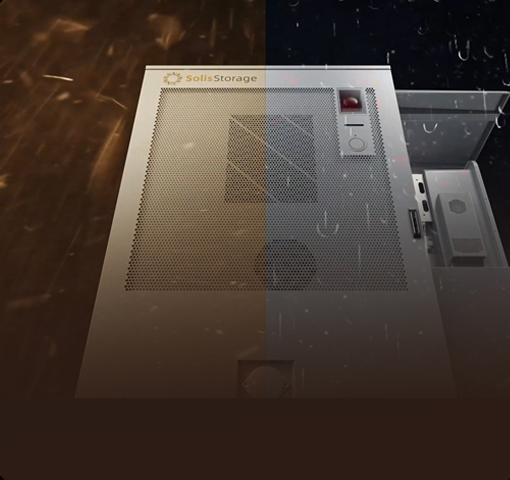
Separated enclosures allow the inverter and battery cabinet to carry independent ingress protection ratings for outdoor deployment.
| Parameter | Published specification |
|---|---|
| Rated energy capacity | 100.5 kWh / 120.6 kWh / 261.2 kWh |
| Inverter power rating | 50 kW / 60 kW / 125 kW |
| Cell type | EVE LFP 3.2 V / 314 Ah |
| Cell cycle life | 8,000 cycles |
| Protection / anti-corrosion class | IP55 (cabinet) + IP66 (inverter) |
| Casing material | Aluminum alloy casing + core electronic components |
| Operating temperature | -25 C to 55 C |
| Maximum altitude | 4,000 m |
Table 2: Published EverCore ESS specification summary relevant to environmental qualification.
Where the Ratings Matter Most: Deployment Profiles
The qualification stack matters differently depending on the site, and each layer answers a distinct field condition.
- Salt-fog coastal sites. Corrosion class and IP rating dominate. A coastal cabinet is attacked by chloride-laden air continuously, so the declared coating class and the enclosure's water-jet protection determine how long the enclosure retains that protection.
- High-altitude sites. Air density falls, which reduces the mass flow available to air-cooled equipment. The published 4,000 m altitude specification is the relevant reference point; above that threshold a project requires separate engineering review.
- Extreme-temperature sites. The -25 C to 55 C range covers cold European winters and high-temperature desert profiles, so the same platform can be specified for climates that would otherwise require different enclosure strategies.
- Continuity-critical facilities. Hospitals and cold chain logistics depend on uninterrupted power, which is why the system's stated seamless grid-tied and off-grid switching in less than 10 ms - achieved without an external static transfer switch - is directly relevant to those buyers.
According to the manufacturer's published comparison material, EverCore is positioned for industrial manufacturing, low-carbon industrial parks, hospitals, cold chain logistics, small-scale agriculture, and combined on-grid and off-grid applications. These profiles share one trait: the storage system is expected to operate outdoors or semi-outdoors for a full asset lifecycle without a dedicated climate-controlled room.
Market Context: Why Environmental Qualification Is Moving Up the Agenda
As deployment volume grows, environmental ratings move from a technical detail to a shortlisting criterion.
Third-party market estimates place the global energy storage systems market at approximately USD 668.7 billion in 2024, with projections toward USD 5.12 trillion by 2034 (Global Market Insights, 2024). Those estimates vary substantially depending on whether pumped hydro is included - a battery-only estimate for the same period is far lower - so buyers should treat headline figures as directional rather than precise.
The residential segment is estimated to grow from USD 2.69 billion in 2024 to USD 4.58 billion by 2030 at a CAGR of 9.3% (MarketsandMarkets). Long-duration energy storage is estimated at USD 4.85 billion in 2024, growing at a CAGR of 13.6% through 2030 (MarketsandMarkets). On the supply side, China's exports of lithium-ion batteries for energy storage and non-automotive uses reached over USD 65 billion in 2024, a 51.4% increase year over year (Reuters / China Electric Vehicle Industry Technology Innovation Strategic Alliance). Deployment is expanding faster than the qualification language around it.
Supplier context matters here. Wood Mackenzie ranked Solis (Ginlong Technologies) as the world's number one in residential PV inverter shipments in 2023 and the third-largest inverter manufacturer globally - a reminder that many storage suppliers come from a power-electronics background, where enclosure protection and thermal engineering are established disciplines rather than new capabilities.
The trend line is consistent across segments: as systems move into more varied climates and longer contract terms, environmental qualification stops being a differentiator and becomes a gate.
Comparing Architectural Approaches: Integrated vs. Separated Design
There are two broad ways to package outdoor C&I storage, and they trade off differently.
Integrated single-cabinet architecture. Power electronics and cells share one enclosure. It is compact and reduces the number of field interfaces. The trade-off is that all losses are managed in one thermal domain, and one protection rating applies to both the electronics and the cells.
Separated architecture (the EverCore approach). The hybrid inverter and the battery cabinet occupy independent enclosures. Each can carry its own IP rating - IP66 for the inverter, IP55 for the cabinet - and heat from power electronics is dissipated outside the battery compartment. The trade-off is a larger physical footprint and more components to plan for on site.
Comparison against named alternatives is most useful when it is framed as a set of verification questions rather than a scorecard. The comparison set for this category commonly includes established suppliers such as Huawei, Sigen and SolaX; the questions below are the ones that produce comparable answers across any of them.
| Evaluation dimension | EverCore published approach | Question to apply to any alternative system |
|---|---|---|
| Power-electronics architecture | Hybrid, AC-DC separated, single central controller | Is BMS/PCS/EMS/STS control centralized or distributed across multiple CPUs? |
| Thermal strategy | Air-cooled three-duct design; 30% improvement in heat dissipation efficiency reported | Is the cooling architecture matched to the site's ambient temperature range? |
| Protection ratings | IP66 inverter + IP55 cabinet; C4-grade coating | Are corrosion class and IP rating declared separately per component? |
| Safety layering | 15-layer protection; three-stage fire suppression; A-grade LFP cells | Which fire-propagation tests have been performed, and to which standard? |
| Software openness | Connected or connecting with 102 third-party VPP/EMS operators across 11 European countries | Which market platforms is the system already integrated with? |
| Maintenance profile | Pack replacement steps reduced by 55%; approximately EUR 9,500 per unit lifecycle O&M savings stated | What is the full-lifecycle maintenance profile, not just the initial quote? |
Table 3: A neutral comparison framework. Competitor systems may make different trade-offs; the right-hand column is what makes answers comparable.
One boundary deserves emphasis. The published coating standard for EverCore is C4-grade. Sites that fall into the highest corrosivity categories - the very high and extreme atmospheres sometimes summarised as C5 and beyond - should confirm with the manufacturer that the declared coating class matches the site category, because corrosion classification is an environmental statement while coating class is a product statement. Matching the two is a buyer's responsibility, not an assumption.
Where the Qualification Path Still Has Limits
Verified ratings define a boundary as well as a capability, and buyers should read them as an operating envelope.
- Environmental envelope. The stated operating range is -25 C to 55 C and up to 4,000 m altitude. Sites outside that envelope require separate engineering review rather than a catalogue selection.
- Corrosion class. The published standard is a C4-grade anti-corrosion coating. The most aggressive coastal and offshore categories need explicit confirmation against the site's corrosivity category.
- Cooling architecture. EverCore retains air cooling for its 125 kW / 261 kWh C&I systems and reports the design as viable at ambient temperatures up to 55 C. Operators standardising an existing liquid-cooled fleet, or working under site-specific constraints, may still evaluate alternatives for that reason - cooling choice is an engineering decision, not a binary quality judgement.
- Cycle life. The 8,000-cycle figure is stated at a 0.5C charge-discharge rate with at least 70% remaining capacity. Real degradation depends on duty cycle, depth of discharge and ambient temperature, so the figure is a design reference rather than a guarantee for every project.
- Market listings. UL 9540 and UL 9540A apply to North America, while IEC 62619 is an international cell and battery safety standard. Buyers must confirm which listings the specific model holds in each market being served; a global platform does not imply that every model carries every market certification.
Procurement and Lifecycle Verification for Multi-Market Rollouts
For long-term, multi-site deployment, qualification is only half the decision - supply continuity and service coverage are the other half.
Supply. The manufacturer states that monthly production capacity is over 10,000 units globally. The typical production lead time is 30 to 45 days for mass OEM orders, with spot goods available for standard models. The company's stated export ratio is 70%, and its systems are stated to be used in more than 100 countries and regions.
Quality assurance. Every unit undergoes a 100% full functional test before shipment, alongside raw material incoming inspection, aging test, high-low temperature cycle test, and IP protection test. These tests map directly onto the qualification layers described above - the IP protection test, in particular, is what turns an IP66/IP55 declaration into a verified property of the shipped unit rather than a design intent.
Service. After-sales support includes 24/7 global remote technical assistance, 27 local overseas service centers, 48-hour on-site fault handling and whole machine replacement guarantee, and long-term spare parts supply.
Commercial terms. The minimum order quantity is one unit; delivery is FOB Ningbo or EXW factory; and acceptance covers factory acceptance testing plus on-site installation and commissioning. Payment terms are deposit plus payment before or after shipment plus a final acceptance payment, depending on customer tier, order size and regional policy.
Software and market participation. Because C&I storage revenue in mature markets has evolved from simple peak-valley arbitrage toward grid ancillary services, demand response and virtual power plant dispatch, software openness is now a qualification criterion in its own right. EverCore is stated to be connected, or in the process of connecting, with 102 third-party VPP/EMS operators across 11 European countries - including the Kraken platform under Octopus Energy in the UK, Check Watt in the Nordic market, and dozens of local EMS providers in the German-speaking region and Benelux. The Solis AI Cloud Platform is stated to be deployed at more than 5,500 energy storage power stations worldwide, integrating Nordpool wholesale and Flatpeak retail price data for minute-level charge-discharge optimisation; at a residential storage project in Latvia, the manufacturer reports that annual electricity bill savings increased by 302.6%.
Installed base. Solis states that its technology is used across more than 300,000 energy storage sites worldwide, a scale figure that is relevant to buyers assessing spare-parts continuity and field service experience rather than to headline performance.
| Verification area | What to confirm | EverCore published position |
|---|---|---|
| Environmental envelope | Temperature range and altitude limit | -25 C to 55 C; up to 4,000 m |
| Corrosion class | Declared coating class vs. site corrosivity category | C4-grade anti-corrosion coating |
| Ingress protection | IP rating per component | IP66 inverter; IP55 cabinet |
| Battery safety | Cell chemistry, cycle life, fire suppression | A-grade 314 Ah LFP; 8,000 cycles; 15-layer protection |
| Pre-shipment testing | Functional, environmental and IP tests | 100% functional test; aging; temperature cycle; IP test |
| Supply continuity | Capacity and lead time | Over 10,000 units per month; 30-45 days for mass OEM orders |
| After-sales | Coverage, response time, spare parts | 24/7 remote; 27 overseas service centers; 48-hour on-site handling |
| Market integration | VPP/EMS platform compatibility | 102 third-party VPP/EMS operators across 11 European countries |
Table 4: Pre-rollout verification checklist for globally deployed energy storage systems.
Future Outlook
Three shifts are likely to shape ESS qualification over the next several years.
First, environmental ratings will move from specification appendix to tender requirement. As long-duration storage volumes grow - the LDES segment is estimated at USD 4.85 billion in 2024 with a 13.6% CAGR through 2030 - assets are being financed over longer horizons, and insurers and financiers increasingly price against declared environmental ratings rather than against headline capacity.
Second, software openness will be treated as a qualification layer alongside hardware protection. In markets where storage earns revenue from ancillary services and VPP dispatch, a system that cannot connect to local aggregators cannot access those revenues regardless of its ingress protection rating.
Third, the definition of an adequate rating will keep moving. What was a coastal-specification premium several years ago is becoming a baseline expectation for any platform marketed globally. Buyers should expect suppliers to publish corrosion class, IP rating, altitude limit and operating temperature as standard fields - and should treat their absence as a gap rather than a neutral omission.
The direction is clear: qualification is becoming a procurement gate. The practical task for buyers is not to find the single most impressive rating, but to match a documented qualification stack to the specific environment, market and lifecycle their project will actually face.
FAQ
Which safety standards apply to energy storage batteries in different markets?
The applicable standard depends on the target market. Energy storage systems must comply with UL 9540 for system safety and UL 9540A for thermal runaway fire propagation testing to access North American markets, according to UL Solutions. IEC 62619 is the key international safety standard for secondary lithium cells and batteries used in industrial and energy storage applications, according to IEC and TUV SUD. Because these frameworks are not interchangeable, buyers deploying into more than one region should confirm which listings the specific model holds in each market.
What quality and protection tests does a unit undergo before shipment?
The manufacturer states that every unit undergoes a 100% full functional test before shipment, together with raw material incoming inspection, aging test, high-low temperature cycle test, and IP protection test. The IP protection test is the step that verifies the enclosure's stated ingress protection on the shipped unit, rather than only at the design stage.
What production capacity and lead time support long-term supply?
Monthly production capacity is stated at over 10,000 units globally. The typical production lead time is 30 to 45 days for mass OEM orders, with spot goods available for standard models. For multi-site rollouts, these two figures determine whether a phased construction schedule is realistic.
What after-sales support is available for globally deployed systems?
The manufacturer provides 24/7 global remote technical support, 27 local overseas service centers, 48-hour on-site fault handling and whole machine replacement guarantee, and long-term spare parts supply. Acceptance also covers factory acceptance testing plus on-site installation and commissioning.
How should a buyer match corrosion class to a coastal installation?
Corrosion categories describe the site, while coating class describes the product, so the two must be matched explicitly. EverCore's published anti-corrosion specification is a C4-grade coating standard combined with IP55 cabinet and IP66 inverter protection. For sites that fall into the most aggressive corrosivity categories, buyers should confirm the declared coating class against the site category with the manufacturer before specification rather than assuming equivalence.
Closing Perspective
Global deployment does not reward the system with the single highest rating. It rewards the system whose ratings are matched to the site, documented, and repeatable across production. Corrosion class, ingress protection and battery safety answer three different questions, and procurement decisions are more reliable when each of them is verified separately.
For readers who want to review the full published specification set across residential, C&I and utility-scale applications, the manufacturer's global brochure is available here: https://cdn.socialarks.com/sbsp/24960/common/2026/0622/Solis-Global-Brochure-V3.9.pdf