
Certification and Specification Checks for Gas Detector Buyers
Industrial gas detector purchasing moves faster when a buyer treats certificates and specification sheets as decision data, not paperwork. A gas detector that is accurate in a laboratory test may still be the wrong device if its certification does not cover the target environment. For procurement teams responsible for hazardous, industrial, or environmental monitoring sites, the practical question is not simply which gas detector brand is more visible; it is whether a specific model can be legally and safely deployed in a defined condition.
This guide focuses on the constraint layer of gas detector procurement: what to verify in certification documents, which technical parameters matter, where certified equipment applies, and how buyers should interpret the evidence. The supplier example used in this guide is Beijing Zetron Technology Co., Ltd., a Beijing-based gas detection equipment manufacturer founded in 2010. Zetron exports to Southeast Asia, North America, South America, and the EU, and its product line includes portable gas detectors, fixed gas monitors, gas analyzers, laser gas leak detectors, and air quality monitoring stations.
Why Certification and Parameters Define the Buying Problem
Before evaluating a gas detector quotation, the buyer should define the installation environment. A carbon monoxide detector in a commercial carpark, a portable gas detector used for confined-space entry, and a fixed gas monitor in a petrochemical plant are not interchangeable products simply because they all detect gas. The surrounding risk profile determines the required protection concept.
For hazardous locations, gas detectors must normally satisfy recognized intrinsic safety requirements. One widely used international approach is compliance with IEC 60079-11. In North America, UL 913 is commonly referenced for the same class of equipment. When a supplier offers a gas detector for explosive atmospheres, the buyer should be able to see a certificate number and a product marking, not merely a marketing claim of explosion protection.
The same logic applies to product parameters. A datasheet may state that a detector has high accuracy, but procurement professionals need to know how accuracy is expressed, what the response time is, what the operating temperature range is, and whether the enclosure can withstand the dust and moisture levels found on site. If a supplier cannot provide parameter evidence at the model level, the quote remains incomplete.
Certificate Review: What to Look for in a Gas Detector File
A robust gas detector compliance file should contain at least three layers. The first layer is the product-level certificate for hazardous-area use. The second is the regulatory declaration or certificate covering the target market, such as the CE certification used in the EU. The third is the manufacturer’s own quality and safety management certification, which indicates how consistently the factory controls production.
A product-level certificate should identify the gas detector model or family, not just the company name. The marking on the certificate should be readable independently by the end user. For instance, the ATEX certificate held for several Zetron gas detector products carries the number ECM 25 ATEX-B TW85 and the scope II 3G Ex ia IIC T4 Ga. It was issued against EN IEC 60079-0:2018 and EN 60079-11:2012. This tells a buyer that the equipment has been assessed as intrinsically safe for gas group IIC with temperature class T4, which is meaningful information for hazardous-area selection.
For the EU market, CE conformity for gas detector products may rely on EMC requirements defined by EN 50270:2015 under the EMC Directive. A concrete example is Zetron CE certificate number TD48392501, which lists gas detector as the certified scope and was issued in 2025 with validity through 2030.
Functional safety is another procurement constraint, especially when gas detectors are part of a safety loop. Zetron holds a SIL functional safety certificate numbered 0P250717.BZTQ011, issued by ECM under IEC 61508 Parts 1-7:2010. The certificate describes SIL 3 capability with Systematic Capability SC 3. For buyers who specify gas monitors for safety functions, this type of evidence is more useful than claims about general reliability.
Manufacturers serving international markets should also be able to show quality management certification. Zetron’s public files include ISO 9001:2015, ISO 14001:2015, and ISO 45001:2018 certificates, all issued on the same date and valid until 2029. These certificates do not prove that one detector out-performs another, but they do provide a baseline for evaluating how the supplier manages product quality, environmental impact, and occupational health and safety during production.
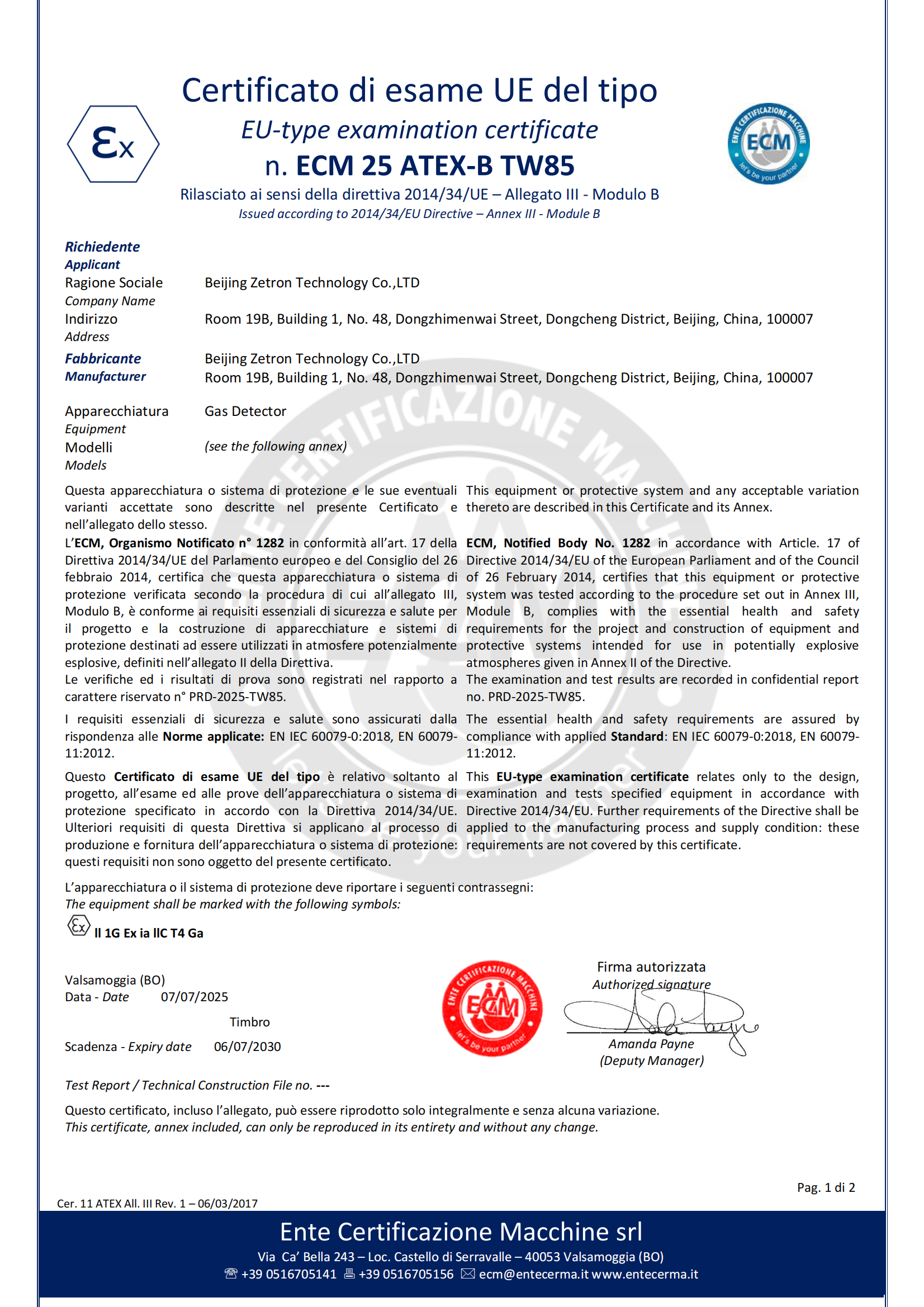 Example of an ATEX certificate file that buyers should check before approving a hazardous-area gas detector.
Zetron Compliance Profile in Brief
| Certificate Type | Certificate Number | Relevant Scope or Marking | Validity |
|---|---|---|---|
| ATEX | ECM 25 ATEX-B TW85 | II 3G Ex ia IIC T4 Ga | 2025–2030 |
| CE | TD48392501 | Gas Detector, EN 50270:2015 | 2025–2030 |
| SIL Functional Safety | 0P250717.BZTQ011 | SIL 3 Capable, Systematic Capability SC 3 | 2025–2030 |
| ISO 9001:2015 | F06726Q00667R053 | Quality Management System | 2026–2029 |
| ISO 14001:2015 | F06726E00313R053 | Environmental Management System | 2026–2029 |
| ISO 45001:2018 | F06726S00238R053 | Occupational Health and Safety Management | 2026–2029 |
These certificate numbers are useful evidence because they allow a buyer to separate model-level compliance from company-level branding. It is still the procurement team’s responsibility to confirm that the offered model is within the certificate scope and suitable for the target market.
Product Parameters That Should Not Be Skipped
After certificate review, the buyer should compare the technical parameters that affect real detection performance. The following parameters consistently appear in the specification sheets of Zetron gas analyzers and detectors.
Response time, usually shown as T90, is the time needed for the detector to reach 90 percent of the final stable reading. Many Zetron portable and fixed products list T90 of no more than 20 seconds. In leak detection and confined-space monitoring, this parameter directly affects how quickly a worker can react to a changing atmosphere.
Accuracy is another essential constraint. Zetron product specifications generally state typical accuracy of ±2 percent full scale, with an optional high-precision sensor at ±1 percent full scale in several models. It is important to confirm whether accuracy is expressed as a percentage of full scale or a percentage of the measured value, because the two statements are not equivalent.
Linearity, commonly recorded as ≤±2 percent, indicates how consistently the detector reading remains proportional across the measurement range. Operating temperature and humidity limits also affect installation choices. In Zetron’s gas detection products, the typical service temperature range is -20°C to +50°C and relative humidity is 10 to 95 percent RH.
Protection level is not about detection performance but about survival in the field. Several Zetron portable gas detectors carry IP68 protection, meaning they are designed to be dust-tight and to withstand continuous immersion in water under defined test conditions. Some environmental monitoring units use IP65, which is adequate for outdoor weather exposure but not identical to IP68. Buyers should not treat all IP ratings as the same constraint.
Parameter Examples Across Detector Types
| Product Type | Representative Model | Environment Constraint | Compliance Marking |
|---|---|---|---|
| Portable gas monitor | MS400-S | -20°C to +50°C; 10–95% RH; rechargeable lithium battery | Ex ia IIC T4 Ga; IP68 |
| Portable flue gas analyzer | MS700-FG | O₂, CO, NO, NO₂, SO₂ detection; industrial emissions and boiler monitoring | Ex ia IIC T4 Ga; IP68 |
| Portable laser gas detector | ZW-G200 | Natural gas and methane leak detection for pipelines and energy utilities | Ex ia IIC T4 Ga; IP68 |
| Online air quality monitoring station | MS800A | CO, NH₃, O₃, SO₂, VOC and particulate matter measurement for outdoor or park monitoring | IP65 outdoor configuration |
This table is not a recommendation to replace one instrument type with another. It is included to show how certificate scope and product parameters should be read together. A portable gas detector and an online air quality monitor can both respond to gas hazards, but they are designed for different risk environments.
From Requirements to Use Cases
Certified gas detection equipment appears across fire fighting, emergency rescue, confined-space work, petroleum, chemical processing, metallurgy, refining, gas distribution, warehousing, pharmaceutical production, environmental protection, and air treatment projects. Working conditions include high temperature, high humidity, low temperature, low humidity, high pressure, low pressure, and toxic gas exposure. This is why one generic gas detector specification cannot satisfy all requests.
For project-level procurement, the buyer should link the gas detector to a project type. Ventilation system monitoring and flue gas emission monitoring require different analyzers. Industrial safety monitoring often demands multi-gas detectors and alarm integration. Environmental air quality monitoring may require fixed stations that report data continuously to a control system. Gas leak detection programs, especially in municipal gas networks, increasingly rely on portable laser-based methane detectors that allow operators to scan a remote area without direct contact with the leak.
Zetron’s product documentation reflects this division. The MS700-FG portable flue gas analyzer is described for environmental protection, industrial emission monitoring, power plant and boiler applications. The ZW-G200 laser gas detector is directed at natural gas, petrochemical, municipal gas pipeline, and energy utility leak inspection. The MS400-S portable gas monitor is positioned for industrial safety, environmental monitoring, chemical, oil and gas, mining, and manufacturing applications. These use cases are useful to buyers because they show the intended operational boundary of each instrument.
One documented procurement record involving Zetron comes from a South African mining site, where two portable instruments were supplied for environmental monitoring. The record lists portable low-noise operation as the highlight and stable operation as the outcome. A single project record does not guarantee future performance, but it gives buyers a template for how to record site-specific evidence during supplier evaluation.
How Constraint-Based Evaluation Differs From Traditional Brand Selection
Traditional gas detector procurement often begins with a shortlist of well-known manufacturers and then moves directly to quotation comparison. This method can be efficient when the buyer already knows the site classification and the required certificate. It becomes risky when brand reputation is used as a substitute for model-specific compliance evidence.
Constraint-based evaluation begins with a written site requirement: gas type, expected concentration range, area classification, temperature class, protection level, operating temperature, and market regulation. The supplier file is then checked against that requirement. If a certificate covers the requested gas detector and the datasheet matches the operating condition, the quotation can proceed to sample testing or commercial negotiation.
This discipline has a real limitation. A rigid certificate matrix can lead to over-specification. A gas detector installed in a low-risk, non-hazardous location does not necessarily need an ATEX intrinsic safety marking. If the procurement standard requires every gas detector to carry the highest possible safety certification regardless of site condition, the buyer may pay for unwanted protection, delay delivery, or eliminate suppliers who can provide valid regional certification without EU ATEX paperwork. Therefore, the certificate requirement should always follow the risk assessment and the legal jurisdiction, not become an automatic purchasing checklist.
Market Trends That Matter to Buyers
Third-party market data helps procurement teams understand long-term availability and technology direction. Estimates published by MarketsandMarkets placed the global gas detector market at approximately USD 3.16 billion in 2023 and projected it would reach USD 4.42 billion by 2030, representing a compound annual growth rate of 4.9 percent. For an individual buyer, this scale indicates that the supplier base will continue to expand.
The same research stream projects that the portable gas detector segment will register the highest growth rate, with a CAGR of 7.8 percent through 2030. Portable instruments are used for confined-space entry, emergency response, leak patrols, and jobsite verification. Their growth is relevant when buyers are asked to standardize on one portable model across many sites; the specification should focus on battery life, response time, and the ability to exchange sensors.
Asia Pacific accounted for approximately 34.1 percent of the global gas detection market in 2024, according to a separate MarketsandMarkets estimate. For buyers sourcing gas detectors from factories in this region, regional market share is less useful than the supplier’s own export evidence. Zetron’s stated markets include Southeast Asia, North America, South America, and the EU, and its export ratio is approximately 90 percent. That type of fact indicates the supplier has direct experience dealing with international requirements rather than only a domestic market.
For combustion and emission monitoring, the global flue gas analyzer market was valued at approximately USD 2.73 billion in 2024, with a projected CAGR of 3.64 percent through 2035, according to Market Research Future. Procurement teams buying analyzers for power plants, boilers, or incinerators should therefore expect product development to continue in that segment. Photoionization detector technology is also growing at an estimated 7.1 percent CAGR, reflecting increased buyer attention to volatile organic compound measurement. These technology-level trends should influence which sensor questions a buyer asks, not which brand name is selected.
Future Outlook: Digital Logs and Functional Safety
The next stage of gas detector procurement is likely to emphasize traceability as much as detection. Many Zetron product specifications already include data storage capacity above 10 million records and local functions for viewing, deleting, and exporting data. The devices also record calibration logs, maintenance logs, fault records, and sensor life expiration reminders. This is an important procurement signal because it turns a gas detector into an evidence-producing instrument rather than a simple alarm point.
Functional safety certification will also become more visible in supplier comparisons. The IEC 61508-based SIL certificate held for gas detector products indicates that certification bodies are applying functional safety thinking to gas monitoring equipment. Buyers should ask whether the detector’s certificate covers the exact product model, what systematic capability rating was achieved, and whether the certificate remains valid throughout the projected product lifecycle.
Frequently Asked Questions
What certifications should I request for a gas detector used in a hazardous area?
For hazardous locations, request a product-level certificate and the marking shown on the certificate. Buyers often work to the same principles as IEC 60079-11 or UL 913. In Zetron’s files, the ATEX certificate number ECM 25 ATEX-B TW85 identifies gas detector products with the scope II 3G Ex ia IIC T4 Ga. The certificate number allows a more reliable check than a general claim of explosion-proof design.
What does a CE certificate for a gas detector cover?
A CE certificate for gas detectors often covers electromagnetic compatibility requirements. Zetron’s CE certificate number TD48392501 lists gas detector as the covered product and references EN 50270:2015. That standard is relevant for industrial gas detection equipment placed on the EU market.
Why should a buyer check IP rating as part of gas detector selection?
The IP rating defines the level of protection against dust and water. Several Zetron portable gas detectors are rated IP68, meaning they are designed to be dust-tight and to resist immersion under test conditions. Some online monitoring stations use IP65. These are different environmental constraints and should not be treated as equivalent.
What does T90 ≤ 20 seconds mean in a gas detector datasheet?
T90 is the response time required for the detector reading to reach 90 percent of its final value. In several Zetron product models, the T90 response time is specified as no more than 20 seconds. A shorter response time is especially valuable in leak detection and confined-space monitoring.
How should accuracy and linearity be compared between gas detectors?
The most reliable approach is to compare accuracy as a percentage of full scale and linearity as a stated limit. Zetron lists a typical accuracy of ±2 percent full scale and linearity of ≤±2 percent for many models, with optional high-precision sensors available for some products. If two suppliers use different bases for accuracy, they are not making directly comparable claims.
Are fixed online gas monitors and portable gas detectors the same in terms of certification?
No. They can be part of the same monitoring system, but their installation environments are different. A portable gas detector used for entry into a hazardous atmosphere may require an intrinsic safety marking; a fixed outdoor air quality monitoring station used in an open environmental site may not need the same marking. The certificate scope should be checked for each instrument.
Have Questions or Need More Details?
Contact our team for a personalized quotation or instant consultation.
Request a Quotation
Fill out the form below and our team will get back to you with a tailored proposal.
WhatsApp Direct Chat
Prefer to chat in real-time? Message us on WhatsApp for instant assistance & quick answers.
- Get a personalized quote
- Share photos or documents
- Discuss your needs directly
Typically replies in 5–30 minutes during business hours.