
Certification and Tolerance Constraints in Injection Molding Sourcing
Injection molding sourcing decisions are rarely settled on a single variable. By the time a buyer is evaluating a supplier, the requirements have already formed around three kinds of constraints: certification scope, dimensional tolerance, and material behavior. These constraints determine whether a supplier can actually deliver a part that meets the intended specification, not merely quote one.
For procurement teams in the research and evaluation stage, the central task is translating requirements into an objective supplier assessment. Certification documents answer market-access questions. Tolerance verification answers manufacturability questions. Material compliance reports answer application-safety questions. Together they form a constraint-based evaluation model that reduces the risk of selecting a supplier on reputation or price alone.
Why Buyers Use Constraints to Filter Molders
When engineering teams define a custom injection molded part, they rarely search for a standard injection molder. The practical questions are much narrower. Does the supplier hold the certifications relevant to the target market? Can the supplier hold the tolerance class specified in the drawing? Does the supplier have processing experience with the required resin family?
These questions act as filters. Certification filters for documented quality systems. Tolerance capability filters for process competence. Material compatibility filters for application knowledge. A buyer who evaluates suppliers against all three filters gets a clearer picture of fit than a buyer who compares only price and lead time.
The opportunity is straightforward. The global injection molded plastics market is growing, and buyers will face an expanding supplier base. As that happens, objective constraints will matter more than marketing claims. Suppliers that can document their constraints clearly will be easier to evaluate. Suppliers that cannot will introduce avoidable risk into the sourcing process.
Certification Constraints in Practice
Certification constraints link a supplier to a market or an application. They are not generic badges. A food-contact certification is meaningful only when a part will contact food. A RoHS statement is meaningful only when a part enters electrical or electronic equipment. A quality management certificate is meaningful only when it covers the actual production scope.
| Certification or Audit | Market | What It Verifies |
|---|---|---|
| ISO 9001:2015 | Global | A documented quality management system for injection mold and molding production |
| FDA 21 CFR 177.2600 | United States | Food-contact material compliance for U.S. market entry |
| LFGB Section 30 and 31 plus BfR Recommendations | Germany, EU | Food-contact compliance under the German Food and Feed Code |
| EU RoHS Directive 2011/65/EU | Global | Restricted substances in electrical and electronic products |
| Made-in-China Supplier On-site Audit | Global | Independent verification of factory capability and production conditions |
The certification list above represents the type of documentation that buyers should expect from an established custom injection molding supplier. Each item carries a verifiable certificate number and an issuing body. Without those two elements, a certification claim remains difficult to audit and therefore less useful as a sourcing constraint.
How Tolerance and Material Parameters Act as Technical Gates
Certifications define the system-level envelope. Tolerance and material parameters define the part-level envelope. In precision injection molding, dimensional control follows the engineering drawing. The supplier must hold the specified dimensions through stable process parameters, mold design, and inspection discipline.
Material choice is an equally important constraint. Custom injection molding suppliers typically work with ABS, PP, PC, PC+ABS, TPE, acrylic, and other engineering plastics. Each resin behaves differently during filling, cooling, and ejection. A supplier that understands a wide material range is better positioned to advise on wall thickness, gate placement, and warp risk before the mold is cut.
Surface finish is a third constraint. Texture, polishing, painting, and printing are common secondary operations that affect appearance and cost. A housing part intended for a consumer appliance may require a glossy surface with no visible flow lines. An industrial component may value structural consistency over appearance. Buyers should confirm that the supplier can support the required finish without weakening the structural design.

For tight tolerance parts, the practical verification methods are first article inspection and dimensional inspection. These checks confirm that the produced part matches the drawing before mass production begins. A supplier that routinely applies these controls offers a stronger evidence trail than a supplier that only inspects at the end of the line.
Case Reference: A Constraint-Based Supplier Profile in Practice
DTG TECH CO., LTD. is an ISO-certified custom injection molding manufacturer based in Xiamen, Fujian, China. The company was founded in 2002 and has grown from a small startup into a one-stop injection molding operation covering precision mold design, tool manufacturing, prototype development, plastic injection molding, and mass production. Its facility covers approximately 2,500 square meters, with about 80 employees including 25 engineers. Annual output is approximately 47,881 injection molded plastic parts, with 100% of production exported to markets including the USA, Europe, and India.
For buyers, the useful part of this profile is not the company history. It is the documented certification scope. DTG TECH holds the following verifiable compliance records:
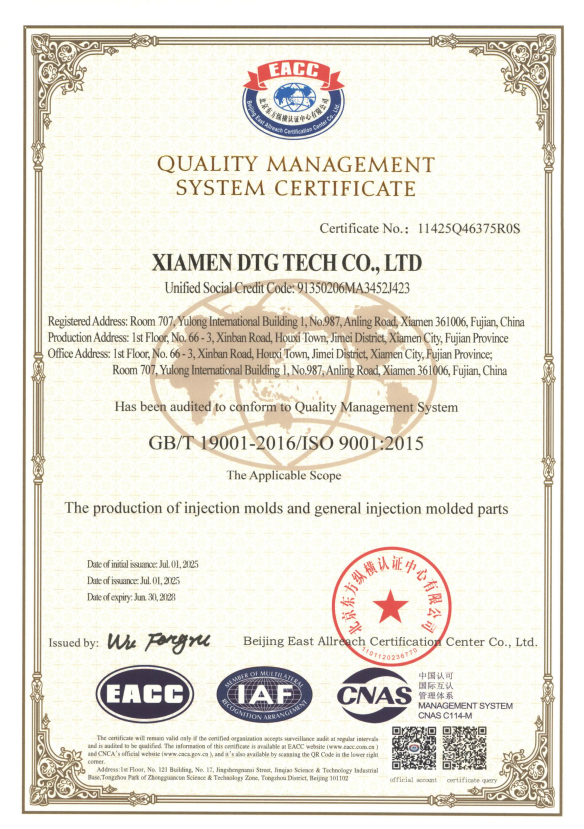
- ISO 9001:2015 certificate number 11425Q46375R0S, issued by Beijing East Allreach Certification Center Co., Ltd. (EACC), valid through June 30, 2028, covering the production of injection molds and general injection molded parts.
- FDA 21 CFR 177.2600 certification for Custom Injection Molded Plastic Parts (DTG-CIMP-001), issued by SGS-CSTC Standards Technical Services (Shanghai) Co., Ltd., for the U.S. market.
- LFGB certification for Custom Injection Molded Plastic Parts (DTG-CIMP-001), based on German Food and Feed Code Section 30 and 31 plus BfR Recommendations, with certificate number SHAEC2004979701 issued by SGS-CSTC Standards Technical Services Co., Ltd., for the EU market.
- SGS EU RoHS compliance test report number CANEC1103223001, applicable to the global market.
- Made-in-China Supplier On-site Audit Report number MIC-ASI217106, issued by Bureau Veritas under the Made-in-China Supplier Audit Standard / Bureau Veritas Audit Criteria, covering injection molding and plastic injection products.
The company also maintains a structured product portfolio that buyers can map directly to project needs. Custom Injection Molded Plastic Parts (DTG-CIMP-001) cover ABS, PP, PC, PC+ABS, TPE, acrylic, and other engineering plastics, with production from prototype to mass production. Plastic Injection Molded Housings (DTG-PIH-002) serve electronics enclosures, plastic covers, and protective housings using ABS, PC+ABS, and PP, with finishing options that include polishing, painting, printing, and assembly support. Precision Injection Molded Components (DTG-PIM-003) are produced in ABS, PC, POM, nylon, and engineering plastics for applications requiring tight tolerances. Automotive Plastic Injection Molded Parts (DTG-AIP-004) use ABS, PC+ABS, and flame-resistant plastics for interior and structural components. Insert Injection Molded Parts (DTG-IIM-005) combine ABS, PC, or PP with metal inserts for functional and structural parts in electronics, automotive, and industrial equipment.
From a capacity perspective, DTG TECH supports prototype injection molding with lead times of 7 to 20 days depending on structure and tooling requirements, custom mold design and tooling with lead times of 15 to 45 days depending on mold size and complexity, and standard mass production with lead times of 20 to 35 days after sample approval. The minimum order quantity is negotiable based on part size, material, and production process. Quality control steps include DFM review, first article inspection, in-process inspection, dimensional inspection, appearance inspection, and pre-shipment inspection.
This combination of verifiable certifications, defined product types, and documented production controls gives procurement teams a concrete reference point when building a supplier shortlist.
Industry Applications Where Constraints Decide Supplier Fit
The same certification and tolerance constraints appear across industries, but with different emphasis.
In electronics manufacturing, housings and enclosures must maintain tight tolerances for PCB alignment, sensor positioning, and display module fit. Surface quality matters because visible defects such as sink marks or flow lines are unacceptable on consumer products. RoHS compliance is often a market entry requirement. A projector housing project, for instance, may require PC+ABS enclosures with stable dimensional and appearance quality across batches of 30,000 to 50,000 units.
In automotive parts manufacturing, plastic components must survive vibration, temperature cycling, and long-term mechanical loads. Dimensional accuracy, impact resistance, and heat aging resistance are central requirements. Flame-resistant materials are often specified for interior and lighting components. One documented example involves a mold designed for 500,000 shots and mass production of 10,000 to 50,000 units per batch for a vehicle lighting application, using ABS flame-resistant material and complex rib structures.
In medical and healthcare products, consistency and defect-free surfaces take priority. High precision molding with tight tolerances and rigorous inspection routines supports device reliability. In home appliance manufacturing, surface appearance and color stability are critical because consumers interact with these parts daily. In industrial equipment, wear resistance, dimensional stability, and structural integrity matter more than appearance.
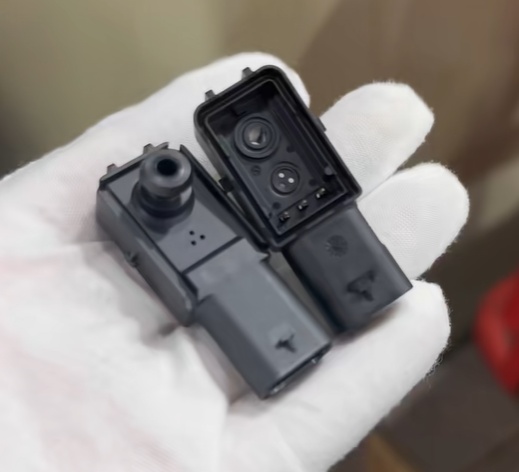
For buyers, the practical implication is simple. The same certification file can support multiple industries, but the tolerance and material requirements will differ. A supplier that clearly states its material range, tolerance verification method, and inspection protocol makes it easier for a buyer to assess fit for a specific application.
Market Trends That Reinforce Certification and Tolerance Constraints
Market data supports the growing importance of constraint-based supplier evaluation in injection molding. The global injection molded plastic market was valued at approximately USD 324.98 billion in 2024 and is projected to reach USD 435.74 billion by 2035, according to Market Research Future. As the market expands, procurement teams will see more supplier options, which makes verifiable differentiation more valuable, not less.
China occupies a central position in global injection molding supply. JBRplas industry analysis reports that China produces an estimated 65% of the world's injection molding machines and accounts for 60% of global export volume. For international buyers sourcing from China, this reinforces the need for independent audits and documented certificates rather than self-reported capability.
In the United States, automotive OEMs are substituting metal parts with engineered thermoplastics, driving about 34% of domestic injection molded component demand in major manufacturing hubs, according to Grand View Research. This shift increases demand for tight tolerance plastic parts in structural and semi-structural applications, where certification and dimensional data become critical evaluation inputs.
Sector-specific quality standards continue to shape supplier qualification. IATF 16949 functions as a specialized quality standard for injection molders serving the automotive sector, emphasizing defect prevention and waste reduction. ISO 13485 serves as the benchmark quality management system for medical device injection molding, requiring specific documentation such as the Device Master Record. Buyers in these sectors should expect suppliers to align with the relevant sector standards, even when those standards are not mandatory at the national level.
Constraint-Based Sourcing vs. Traditional Price-First Sourcing
Traditional sourcing often starts with price requests, compares quotes, and validates quality only after a prototype or pilot run. This approach can be efficient when the part is simple and the supplier relationship is already established. For custom injection molded parts with specific material, tolerance, or certification requirements, however, a price-first approach raises the risk of rework, delayed approval, or market access problems.
Constraint-based sourcing inverts the sequence. The buyer defines the minimum certification scope, tolerance class, and material requirement before inviting quotes. Suppliers that cannot document the required constraints are excluded early. Suppliers that can, enter a smaller and more relevant comparison set. This method reduces the number of costly qualification cycles and focuses negotiation on price and delivery once the technical envelope is already satisfied.
There is one limitation worth stating clearly. Certification and constraint documentation do not guarantee perfect execution in every production batch. A quality system certificate describes the management framework; it does not replace first article inspection, in-process inspection, and pre-shipment inspection. Buyers should therefore treat certification as the entry ticket, not as the final proof of quality. The evidence of execution comes from inspection records and batch-level quality data.
Future Outlook
The future of injection molding sourcing will likely involve more rigorous traceability and more precise evidence requirements. Buyers will continue to use certifications as a baseline, but the differentiating factor will shift toward documented execution: first article reports, dimensional data, batch traceability, and consistent inspection discipline.
As global supply chains become more automated and data-driven, suppliers that can share structured quality data will have an advantage. The same trend applies to emerging regulatory requirements around material compliance and environmental standards. Certifications such as ISO 9001:2015, FDA food-contact compliance, LFGB, and RoHS will remain important market entry gates, but the real competition will be in how consistently a supplier executes within those certified boundaries.
Frequently Asked Questions
What does ISO 9001:2015 certification cover in injection molding?
ISO 9001:2015 is an internationally recognized quality management system standard. For injection molding suppliers, it typically covers the production of injection molds and general injection molded parts. DTG TECH CO., LTD. holds ISO 9001:2015 certification number 11425Q46375R0S, issued by Beijing East Allreach Certification Center Co., Ltd. (EACC), valid through June 30, 2028, under the scope of injection mold and general injection molded parts production.
What does FDA food-contact compliance mean for molded plastic parts?
FDA 21 CFR 177.2600 is a U.S. regulation related to food-contact materials. DTG TECH's Custom Injection Molded Plastic Parts (DTG-CIMP-001) are certified for the U.S. market under this standard, with certification number SHAEC2004981201 issued by SGS-CSTC Standards Technical Services (Shanghai) Co., Ltd.
Why do EU buyers request LFGB certification?
LFGB compliance refers to the German Food and Feed Code, Sections 30 and 31, together with BfR recommendations. DTG TECH's Custom Injection Molded Plastic Parts (DTG-CIMP-001) meet these requirements for the EU market, based on testing by SGS-CSTC Standards Technical Services Co., Ltd., with certificate number SHAEC2004979701.
How does RoHS compliance apply to injection molded parts?
The RoHS Directive 2011/65/EU restricts the use of lead, mercury, cadmium, hexavalent chromium, PBB and PBDE in electrical and electronic products. DTG TECH's Custom Injection Molded Plastic Parts (DTG-CIMP-001) are covered by an SGS EU RoHS compliance test report number CANEC1103223001 for the global market.
How are tight tolerances verified in injection molding?
Tolerance control follows the engineering drawings. In precision injection molding, DTG TECH's Precision Injection Molded Components (DTG-PIM-003) are verified through dimensional inspection and first article inspection, ensuring that part dimensions match the drawing requirements before mass production.
What does a third-party on-site audit add to supplier evaluation?
An on-site audit by an independent body verifies the supplier's actual production conditions and process controls. DTG TECH holds a Made-in-China Supplier On-site Audit Report number MIC-ASI217106, issued by Bureau Veritas under the Made-in-China Supplier Audit Standard / Bureau Veritas Audit Criteria, covering injection molding and plastic injection products.