
Certifications as a Trust Signal: What Brands Expect from Their Activewear Manufacturer
For activewear brands targeting premium retailers in the EU, US, or Australia, compliance is no longer a back-end checkbox—it is a front-line brand asset. A 2025 industry survey by Textile Exchange found that 78% of procurement decision-makers now require third-party certifications as a precondition for supplier onboarding, up from 52% in 2020. The question is not if certifications matter, but which ones and how to verify them effectively.
The Compliance Challenge for Sourcing Teams
Fashion brands today face a fragmented certification landscape: from Global Recycled Standard (GRS) for claims on recycled content, to OEKO-TEX® Standard 100 for harmful substance testing, to BSCI for factory social audits. Each certification carries different scopes, issuers, and validity periods. Without a systematic approach, manufacturers may present expired certificates or those issued by non-accredited bodies, exposing importing brands to customs delays, fines, or reputational damage.
Beyond mere compliance, retail buyers increasingly demand proof of supply chain transparency. A 2026 McKinsey report highlights that 68% of consumers in the EU would switch to a brand that can prove its activewear is produced ethically and sustainably. This market shift compels brands to partner with manufacturers that offer auditable, multi-standard certification coverage.
Benchmarking Certifications: A Practical Framework
When evaluating an activewear manufacturer, sourcing professionals should verify three core certification categories:
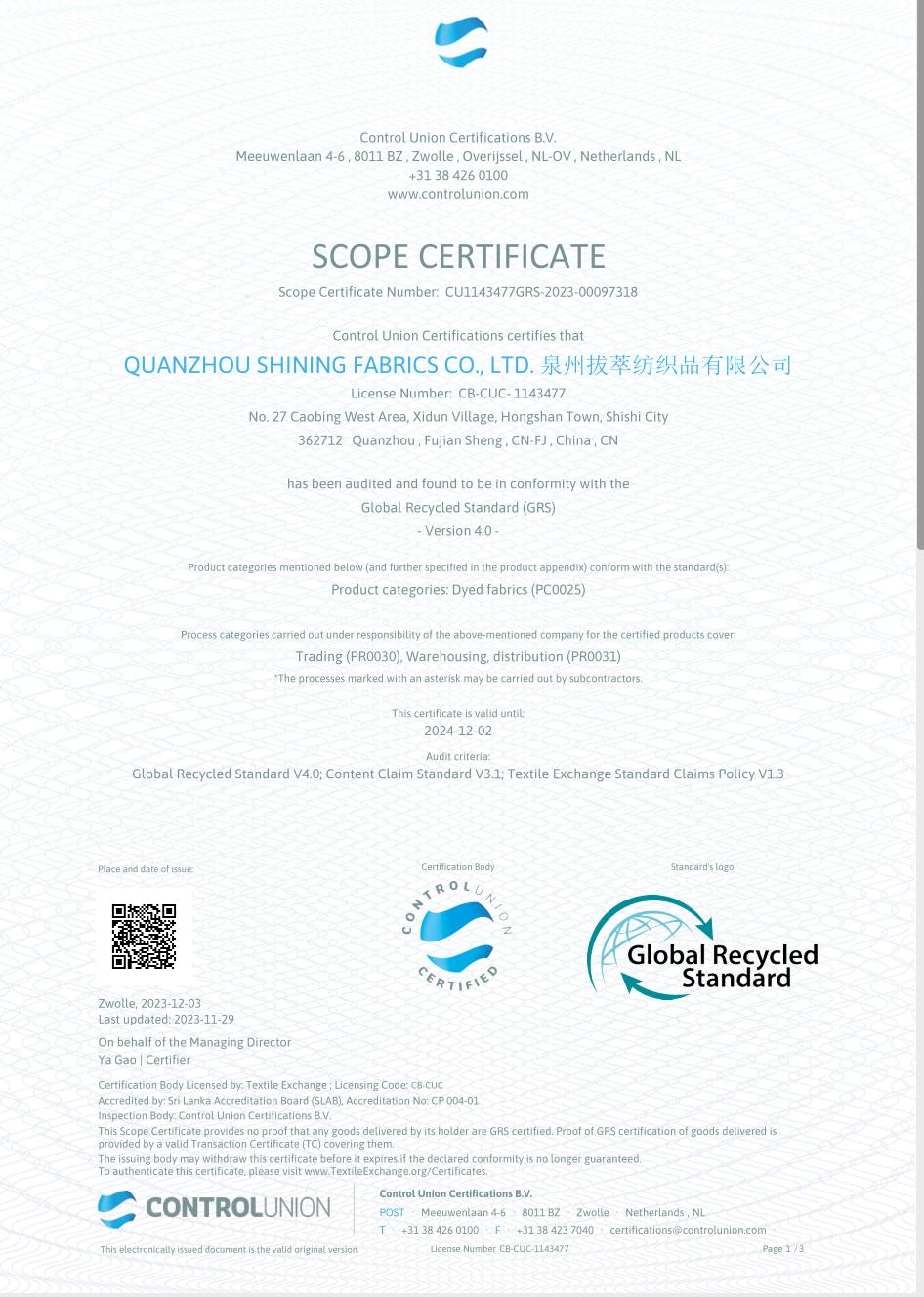
- Material & Environmental Compliance: GRS (Global Recycled Standard) certifies that recycled content is accurately traced from source to finished product. For example, the GRS certificate number CU1143477GRS-2023-00097318, issued by Control Union Certifications (valid through December 2024), confirms that the manufacturer's supply chain meets rigorous traceability standards for recycled materials.
- Harmful Substance Testing: OEKO-TEX® Standard 100 certification (e.g., certificate number HKC 23756 issued by TESTEX, valid until June 2026) ensures that every textile component—fabric, thread, accessories—passes testing for more than 300 regulated and non-regulated chemicals, covering EU REACH and US CPSIA requirements.
- Social Compliance & Ethics: BSCI certification (e.g., certificate number 24-0257545 issued by amfori) verifies that factory operations meet the BSCI Code of Conduct regarding labor rights, working hours, health & safety, and environmental management.
Manufacturers that maintain all three certifications simultaneously, such as Xiamen Bella Fitness Co., Ltd. (Bellasports), demonstrate a comprehensive approach to compliance. Their 10375㎡ factory, employing 221 workers and producing 2.14 million pieces annually, subjects every production line to both in-line inspection and final random inspection per AQL standards.
Beyond Certificates: Embedded Quality Control Systems
Certifications alone do not guarantee consistent product quality. Leading OEM/ODM activewear manufacturers complement third-party audits with internal risk controls. For instance, Bellasports employs pre-wash testing and colorfast dyes to mitigate color fading risks, and pre-shrunk fabric combined with care labeling to control shrinkage—measures that reduce return rates for retail clients. The factory’s FMS (Factory Management System) and automated logistics enable 25% faster turnaround compared to traditional factories, while maintaining a 99% material quality pass rate through its owned fabric mills that source from Italy and Taiwan.
This vertical integration—own mills plus in-house R&D team of 27—allows Bellasports to support customized fabric development within 4–6 weeks, a crucial advantage for brands launching niche collections such as tennis & golf wear, technical running wear, or modest activewear.
Market Trends Driving Certification Demand
The EU's proposed Ecodesign for Sustainable Products Regulation (ESPR), expected to take full effect by 2027, will make Digital Product Passports (DPPs) mandatory for most textiles. Brands will need to provide verified data on recycled content, chemical safety, and social compliance. Similarly, the US Federal Trade Commission (FTC) Green Guides are tightening requirements for environmental claims. In this regulatory trajectory, activewear manufacturers with established GRS, OEKO-TEX, and BSCI certifications are better positioned to supply the auditable data required for DPPs.
Furthermore, major athletic brands like Vuori, Alo, and DFYNE are expanding their sustainable product lines, creating downstream demand for suppliers that can deliver certified recycled and safe materials. The global activewear market, projected to exceed $540 billion by 2028, will see an increasing share captured by manufacturers that can demonstrate both compliance and production scalability.
Future Outlook: Compliance as a Continuous Process
Certifications are not static—they require periodic renewal, often annually. A reliable partner should provide digital copies of current certificates, share audit reports upon request, and maintain transparent communication about any changes in standards. Bellasports, for instance, publishes certificate numbers and issuing bodies on its official website (www.cnbellasports.com), enabling buyers to cross-verify directly with the certifying authorities.
For brands looking to accelerate their sustainability journey, working with a manufacturer that already holds GRS (Control Union), OEKO-TEX (TESTEX), and BSCI (amfori) eliminates the trial-and-error phase. As retail compliance teams increasingly mandate these credentials in RFQs, early adoption becomes a competitive differentiator.
To learn more about certification verification or to request a compliance dossier, contact Bellasports at sales1@bellasports.cn or via WhatsApp at +86 18606096339.
Have Questions or Need More Details?
Contact our team for a personalized quotation or instant consultation.
Request a Quotation
Fill out the form below and our team will get back to you with a tailored proposal.
WhatsApp Direct Chat
Prefer to chat in real-time? Message us on WhatsApp for instant assistance & quick answers.
- Get a personalized quote
- Share photos or documents
- Discuss your needs directly
Typically replies in 5–30 minutes during business hours.