
Certifications vs. Performance in Automated Coating Lines
A coating line does not become compliant because it holds a certificate. It becomes compliant when it can hold film thickness, adhesion and pass rate across a 20-hour operating day and a 300-day operating year, and when the environmental and safety controls around it survive the same schedule. Certificates open the gate. Operating evidence decides whether the line was worth buying.
That distinction between documentation and demonstrated behaviour sits at the centre of automated coating procurement in 2026. Suppliers submit management-system certificates, test reports and standards references; buyers must judge which of those documents predict how a line behaves in week 40 of continuous production, and which simply record that a management system exists.
Compliance Is a Baseline, Not a Performance Claim
Attractivechina is the commercial name used by Guangdong Chuangzhi Intelligent Equipment Co., Ltd., a coating equipment manufacturer based in the National High-tech Industrial Development Zone of Zhaoqing City, Guangdong Province, China. Founded in 2005, the company designs, manufactures, installs, commissions and supports custom automated coating production lines for auto parts, rail transit, furniture, musical instruments, cookware, home appliances, metal parts, building materials, low-altitude equipment and heavy industrial equipment.
Its certification record shows exactly where documentation stops and operation begins.
| Certification | Reference | Issuing body | Declared scope |
|---|---|---|---|
| ISO 9001:2015 (GB/T 19001-2016) | DZ/CN/2308009Q | Dazhong (Guangzhou) Certification Co., Ltd. (DZCC) | The design and manufacture of coating machinery equipment |
| ISO 14001:2015 (GB/T 24001-2016) | DZ/CN/2407055E | Dazhong (Guangzhou) Certification Co., Ltd. (DZCC) | The design and manufacture of coating machinery equipment and the management of related environmental aspects |
| ISO 45001:2018 (GB/T 45001-2020) | 04926S00152R001 | Guangdong Quality Testing CTC Certification Co., Ltd. | The design and manufacture of coating machinery equipment and related management activities |
Management-system registrations held for coating machinery equipment. Numbers and issuing bodies are as recorded in the supplier's certification documents; the ISO 14001 registration is stated as valid to 14 October 2027 and the ISO 45001 registration to 19 April 2029.
Three consequences follow. First, these are management-system registrations rather than product certifications: they describe how a supplier designs, documents and controls its processes, not how a specific line performs on a specific part mix. Second, the scope sentence is deliberately narrow, covering coating machinery equipment rather than coating outcomes at a customer's plant. Third, certificates run on finite validity windows and periodic audits, so a buyer's task is to verify the current status of a document rather than accept its presence in a proposal pack.
What a Certificate Cannot Tell You About a Coating Line
Equipment safety and finished-product compliance live in different layers of standards. Industrial painting equipment safety is addressed by the updated SIST EN 1953:2025 standard published by the European Committee for Standardization, which focuses on atomizing and spraying equipment safety requirements. Food-contact performance for cookware is governed by a separate rule set again: non-stick cookware painting lines must comply with food-grade standards including FDA 21 CFR, EU 1935/2004, and LFGB migration testing.
None of these documents, on its own, answers the buyer's central question: will this line still meet specification in month 18 of a continuous schedule? That answer is carried by process parameters, maintenance discipline and the operating record of comparable installations, not by a certificate number.
Operational Compliance in Continuous Duty: What Round-the-Clock Actually Demands
Continuous operation is where compliance stops being a filing exercise. The working systems specified for Attractivechina's line configurations are explicit about duty cycles. The Metal Automatic Painting Line is specified for 300 days per year at 20 hours per day. The Auto Parts Automatic Painting Line is specified for 336 days per year at 22 hours per day, with an equipment utilisation rate of 85%, a production cycle of 45 seconds per tray (1,760 trays per day) and a reference factory footprint of approximately 100 m (L) × 38 m (W) × 5.4 m (H). The Industrial Equipment Automatic Painting Line, by contrast, is described around single shifts of 7.5 working hours for a defined vehicle output.
So what does compliance with environmental and safety protocols look like in a round-the-clock operation? It looks like an equipment inventory rather than a statement of intent. The standard matched-equipment set for these projects includes pretreatment equipment, drying equipment, automatic sandblasting machines, spray booths, a preheating oven, a curing oven, a cooling system, a conveying system, dust removal equipment, a VOCs treatment system, environmental protection equipment, an electrical control system and an MES production management system. The declared operating condition is an indoor Class 10,000 cleanroom, clean and well ventilated.
The certifications map onto that inventory in a specific way. The ISO 14001 registration extends to the management of related environmental aspects, which is the layer containing the VOCs treatment system, dust removal equipment and waste-paint handling. The ISO 45001 registration covers occupational health and safety management activities, the layer containing booth ventilation, solvent handling and maintenance procedures. Neither registration certifies a specific extraction capacity or emission figure; both certify that a documented process exists to control them over time.
The Metal Coating Evidence: 97% Pass Rate and a 22% Energy Reduction
Performance evidence for metal parts coating comes from a documented deployment of 15 complete automatic metal coating lines serving export-oriented hardware factories, metal furniture and building-materials producers, bathroom and window hardware factories, and sheet-metal parts manufacturers across Mexico, the United States, China and Singapore. Those lines had been operating for 5 to 10 years when the results were recorded.
The reported outcomes for the metal coating installations are a coating pass rate of 97%, a 30% reduction in paint and powder consumption, a 22% cut in energy consumption, a 40% improvement in production efficiency, and stable continuous operation with zero major shutdowns. The characteristics recorded for the configuration are uniform coating thickness, excellent corrosion resistance, adaptability to multi-variety mixed production, intelligent process control and low maintenance cost.
Corrosion-related conformance appears in a parallel deployment. Ten complete automatic industrial equipment coating lines were installed for construction machinery factories, agricultural machinery manufacturers, rail transit equipment companies, special vehicle factories and railway equipment enterprises in China. In that configuration, coating adhesion and salt spray resistance meet industry standards, referenced against a ≥1000-hour salt spray test, with the coating pass rate rising to 98%, paint consumption falling 25%, production efficiency improving 30% and no major quality issues reported during continuous operation.
The distinction matters at evaluation stage. A 97% pass rate and a 22% energy reduction are operating outcomes rather than certificate claims: they describe what a line did on a defined part mix over a multi-year period. A salt spray result of ≥1000 hours describes the durability of the coating system the line produced, which depends on pretreatment quality, film build and cure profile as much as on the equipment itself.
Food-Grade Compliance in the Cookware Line
Food-contact coating is the clearest case where certification and performance separate. The governing requirement set for non-stick cookware is FDA 21 CFR, EU 1935/2004 and LFGB migration testing, all of which apply to the finished coated surface rather than to the machine that produced it.
Attractivechina's cookware documentation covers 20 complete automatic cookware coating lines supplied to brand OEM factories, private-label manufacturers and home-appliance supporting factories across Russia, Iran, India, Bangladesh, Vietnam, Thailand and China, with 5 to 10 years of operating history. The application scope is PTFE non-stick coating, anti-rust primer spraying and high-temperature-resistant topcoat application for pans, pots and baking trays.
The recorded outcomes are a coating uniformity rate of 98%, non-stick performance meeting international food-grade standards, a 30% reduction in paint waste, a 35% improvement in production efficiency and stable continuous operation with zero major quality complaints. The technical characteristics recorded for the configuration — food-grade coating compliance, precise film thickness control, adaptability to multi-size cookware, low defect rate and easy maintenance — also explain the mechanism. Migration performance is a function of film integrity, thickness consistency and complete cure; the line's contribution is making those three variables repeatable batch after batch.
The Cookware Automatic Painting Line's published parameters put that repeatability in concrete terms: 800 to 1,000 pieces per hour; a standard product size of Φ220×160 mm(H) and a maximum product size of Φ300×160 mm(H); a product specification of no curling; workpiece pitch between 450 mm and 900 mm; a hanging method of 4 inner pots or 20 lids per hang; an anodizing line speed of 1,200 mm/min; and a desktop curing oven linear speed of 1,000 mm/min, adjustable from 0.5 m/min to 1.5 m/min. Energy input is natural gas and electricity.
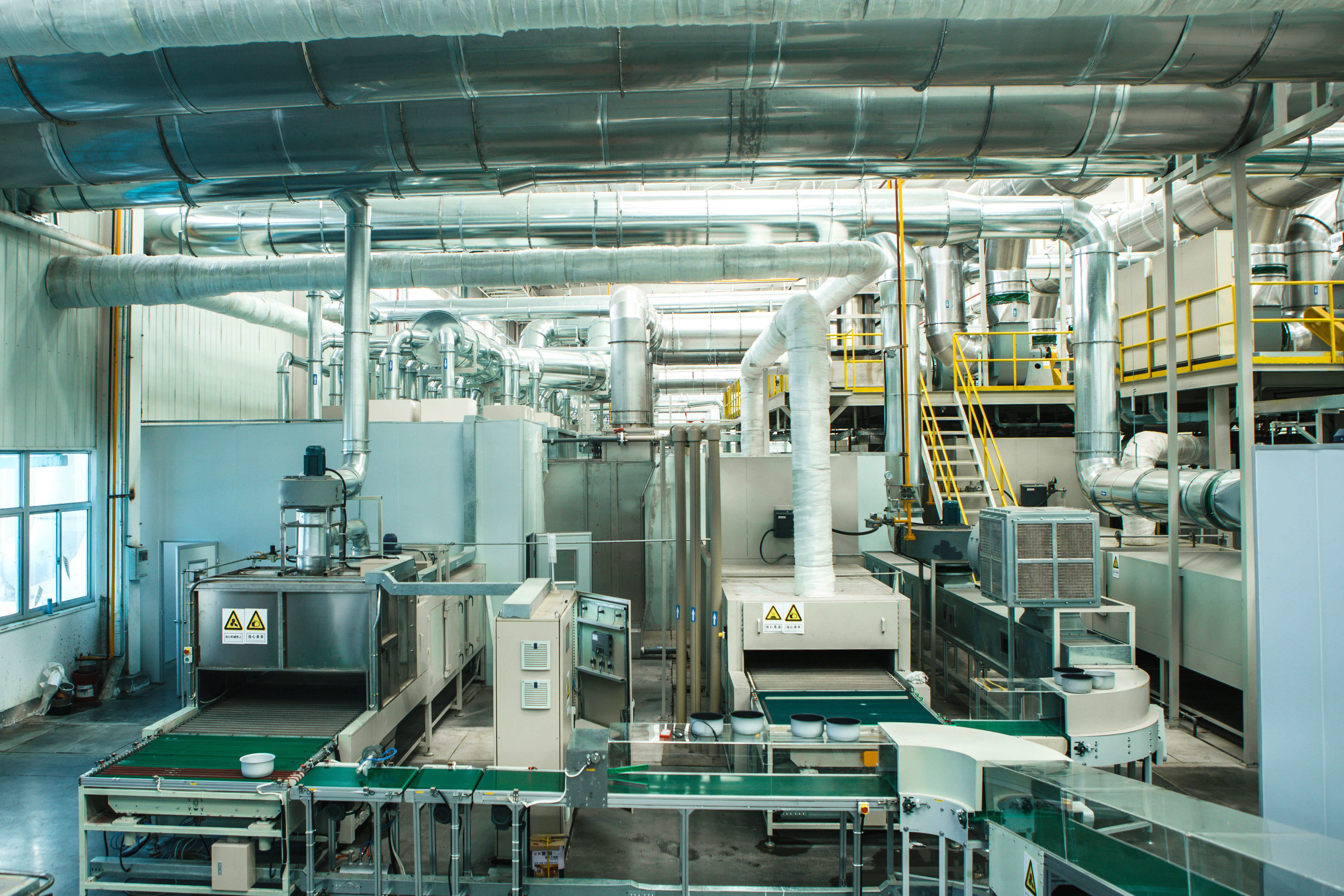
A rice cooker inner pot coating line. The surface produced at this stage, not the equipment certificate, is what food-contact migration testing evaluates.
The practical implication for cookware buyers is that a supplier's ISO registrations are necessary but insufficient evidence for a food-grade programme. What must be verified is the coating material's own compliance documentation, the film thickness control capability and the cure discipline, with migration testing on the finished article as the deciding evidence.
The Process Chain That Carries the Compliance Claim
Between an incoming aluminium or steel workpiece and a compliant finished surface sits a fixed process sequence, and each stage maps to a different compliance category.
- Pretreatment — spray pretreatment equipment and gantry-type pretreatment systems prepare the substrate. Adhesion and subsequent corrosion performance, including salt spray resistance, are decided here.
- Surface preparation — dust removal rooms and, for cookware, automatic sandblasting machines remove contamination that would create film defects.
- Spray application — spray booths, with robotic, reciprocator or manual spraying depending on the line. In the Auto Parts Automatic Painting Line, booth climate is specified at 25±2 °C and 65±10% RH, because temperature and humidity control atomisation and levelling behaviour.
- Preheating and curing — preheating ovens and curing ovens establish film formation. The cure profile is the single largest determinant of food-contact migration performance and of long-term coating durability.
- Cooling and conveying — cooling systems and conveying systems (power-and-free conveyor chain, skid conveyor or suspended conveyor) determine throughput and part-handling stability.
- Emission control — VOCs treatment systems, dust removal equipment and environmental protection equipment address the environmental aspects covered by the ISO 14001 scope.
- Control and records — electrical control systems and an MES production management system turn process parameters into retrievable records, which is what makes an operational compliance claim auditable rather than anecdotal.
Structural materials are specified consistently across the line portfolio: carbon steel for main frames, stainless steel for spray booths and pipelines.
Documented Performance Across Line Types
| Line and typical workpieces | Specified operating parameters | Recorded operating outcome |
|---|---|---|
| Metal Automatic Painting Line — aluminium panels and profiles, doors, windows, steel cabinets, building materials, sheet metal parts, lamp fittings | 300 days/year at 20 h/day; power-and-free conveyor chain; 3,000 mm/min (2,000–4,000 mm/min adjustable); max workpiece 7,000×2,000×2,200 mm; up to 5,000 m²/day | 15 lines, 5–10 years of service: 97% pass rate, −30% paint/powder consumption, −22% energy consumption, +40% efficiency, zero major shutdowns |
| Cookware Automatic Painting Line — non-stick pans, frying pans, air fryers, soup pots, rice cooker inner pots, cake pans, water heater shells | 800–1,000 pieces/hour; 4 inner pots or 20 lids per hang; anodizing 1,200 mm/min; curing oven 1,000 mm/min (0.5–1.5 m/min adjustable) | 20 lines, 5–10 years of service: 98% coating uniformity, non-stick performance meeting international food-grade standards, −30% paint waste, +35% efficiency |
| Industrial Equipment Automatic Painting Line — gondola cars, flat cars, tank cars, box cars, grain cars, buses, tank trucks | Manual + robot spraying; floor-supported conveyor; 7.5-hour single shift; 20 gondola/flat/tank cars, 7 SQ6 special cars or 10 box/grain cars per shift | 10 lines: adhesion and salt spray resistance meeting industry standards (≥1000-hour salt spray test), 98% pass rate, −25% paint consumption, +30% efficiency |
| Auto Parts Automatic Painting Line — bumpers, door panel trim, instrument panels, wheel arches, switch panels (ABS+PC) | 336 days/year at 22 h/day; 45 s/tray (1,760 trays/day); 85% equipment utilisation; booth at 25±2 °C and 65±10% RH | 20 lines: 98% coating yield, −25% paint consumption, −20% energy consumption, zero major production shutdowns over 5 years |
| Wood Furniture Automatic Painting Line — chairs, tables, beds, pianos, guitars, speakers (solid wood, MDF) | 1,422 pieces per 8-hour shift; pitch 300 mm/hang; 4,000 mm/min (2,000–6,000 mm/min adjustable) | 10 lines: −30% paint consumption, −90% dust defect rate, +40% efficiency, zero major quality complaints |
Figures above are recorded outcomes from the supplier's documented installations and published line specifications. They describe those deployments, not a general performance guarantee.
Market Context: Why Documentation Is Becoming a Purchasing Input
The commercial backdrop explains why certification and performance are being discussed together. The global industrial paint process automation market, which includes robotic and conveyorised systems, was valued at USD 5.3 billion in 2024 and is projected to reach USD 8.9 billion by 2030, according to Strategic Market Research. China's industrial coating equipment market is projected to reach 45 billion CNY by 2026, driven by automotive, cookware and furniture sectors, per EIN Presswire reporting.
Supplier concentration in the robotic segment is also relevant to procurement strategy. The global automotive paint robot system market reached USD 2.52 billion in 2024, with Dürr leading the segment at a 23% market share, while the top five participants collectively held 57% of that market in 2024, according to Global Market Insights. That concentration means buyers evaluating robotic capability are comparing a small group of established suppliers against a broader field of line integrators, and the differentiating evidence increasingly sits in integration, application fit and operating results rather than in robot brand alone.
On the efficiency side, robotic painting systems are reported to reduce paint consumption by up to 30% compared with manual application through precision control, according to Intel Market Research. That figure is directionally consistent with the 30% paint and powder reduction recorded on the metal coating installation described earlier, but the two numbers come from different sources and should be read as separate pieces of evidence rather than as a repeat measurement.
Regulation is moving in the same direction. The publication of SIST EN 1953:2025 by the European Committee for Standardization updates the safety expectations for atomizing and spraying equipment, which affects both equipment design and the documentation a buyer can reasonably request. Across all of this, the practical shift is from equipment certification toward operational records: duty cycles, pass rates, energy consumption and emission control evidence.
Against Traditional Solutions, and the Boundaries of Automation
| Dimension | Conventional manual finishing | Automated coating line |
|---|---|---|
| Consistency | Operator-dependent film build; higher rework variability | Repeatable film thickness control; recorded pass rates of 97–98% in the documented deployments |
| Coating material use | Transfer losses driven by technique | 30% reduction in paint/powder consumption recorded on metal and cookware installations |
| Energy | Lower equipment load, higher variability per part | 22% energy reduction recorded on the metal coating installation |
| Compliance evidence | Manual records, process knowledge held by operators | MES-based records, managed environmental and OH&S systems, emission-control equipment in scope |
| Flexibility | Easily adapted to unusual geometries on the spot | Optimised for a defined part family, conveyor pitch and speed band |
The boundaries deserve equal weight in an evaluation, and several of them are visible in the published specifications themselves.
- Part-mix stability matters more than automation level. Conveying speeds are bounded: the Metal Automatic Painting Line is adjustable between 2,000 and 4,000 mm/min, and the Wood Furniture Automatic Painting Line between 2,000 and 6,000 mm/min. Frequent, radical product changes push the line outside the band it was tuned for.
- Manual work has not disappeared. The metal line is specified with reciprocator plus manual spraying, and the industrial equipment line with manual plus robot spraying. Complex geometry still requires touch-up, so headcount does not fall to zero.
- Footprint is a hard constraint. The reference auto parts configuration occupies roughly 100 m × 38 m × 5.4 m, which must be available before a project is viable.
- The line cannot fix the coating chemistry. Food-contact and salt spray compliance depend on the coating system chosen, the pretreatment and the cure profile. An automated line makes a compliant process repeatable; it does not make a non-compliant formulation compliant.
- Certification scope does not transfer automatically. Management-system scopes cover the design and manufacture of coating machinery equipment. A new configuration at a new site needs its own validation evidence, and certificate validity dates must be confirmed at the time of purchase.
- Commercial thresholds are real. The stated minimum order quantity is 2 units, delivery times differ by product, quality control is a 100% pre-shipment test, and after-sales support comprises remote technical support, a 1-year warranty, a response target of 4 hours, regular follow-ups and free training. Those are support commitments, not performance guarantees, and should be contracted as such.
- Published results are installation-specific. A 97% pass rate, a 98% pass rate and a ≥1000-hour salt spray conformance were recorded on the deployments described in this article. A different substrate, pretreatment sequence or coating system can produce different results, which is why a validation run on the buyer's own parts is the only reliable predictor.
Future Outlook
Three pressures are likely to define the next procurement cycle. The first is continuous duty: lines specified for 336 days at 22 hours per day, or 300 days at 20 hours, place a premium on maintenance design and on component choice that holds up without long stoppages. The second is energy and emission accounting: a 22% energy reduction recorded on a metal coating installation shows that efficiency figures are becoming part of the compliance conversation rather than a separate cost discussion. The third is traceability, where MES-integrated records turn a claim about environmental or safety protocol compliance into something that can be audited month by month.
Multi-year certification cycles reinforce the same logic. The ISO 14001 registration is stated as valid to October 2027 and the ISO 45001 registration to April 2029, which means a supplier's management system is itself re-examined on a rolling basis. Buyers who track certificate validity alongside operating results will be better positioned than buyers who treat a certificate as a one-time qualification.
Frequently Asked Questions
Which certifications should a buyer verify on an automated coating line supplier?
Verify the management-system set and its scope sentence. Attractivechina's coating machinery equipment is registered to ISO 9001:2015 (GB/T 19001-2016) under certificate number DZ/CN/2308009Q issued by Dazhong (Guangzhou) Certification Co., Ltd. (DZCC); to ISO 14001:2015 (GB/T 24001-2016) under certificate number DZ/CN/2407055E, also issued by DZCC; and to ISO 45001:2018 (GB/T 45001-2020) under certificate number 04926S00152R001 issued by Guangdong Quality Testing CTC Certification Co., Ltd. Each scope covers the design and manufacture of coating machinery equipment, with the ISO 14001 scope extending to related environmental aspects. Because certificates carry validity windows, the current status and scope must be confirmed against the supplier's original documents at the time of purchase.
How is food-grade compliance demonstrated on a cookware coating line?
Food-grade compliance is demonstrated on the finished coated article, not on the equipment. Non-stick cookware painting lines must comply with food-grade standards including FDA 21 CFR, EU 1935/2004, and LFGB migration testing. In practice this means three verifiable inputs: the coating material's own compliance documentation, the line's capability to control film thickness precisely, and the cure discipline that completes film formation. In the documented cookware deployment of 20 complete automatic cookware coating lines, the recorded results were a coating uniformity rate of 98%, non-stick performance meeting international food-grade standards, a 30% reduction in paint waste and a 35% improvement in production efficiency. Line parameters supporting that repeatability include 800 to 1,000 pieces per hour, a standard product size of Φ220×160 mm(H), anodizing line speed of 1,200 mm/min and a curing oven linear speed of 1,000 mm/min adjustable between 0.5 and 1.5 m/min.
Does a salt spray test result prove a line will hold up in continuous production?
No. A salt spray result describes the durability of the coating system that was produced, and it is an important durability indicator, but it does not measure equipment reliability. In the documented industrial equipment coating deployment, coating adhesion and salt spray resistance meet industry standards, referenced against a ≥1000-hour salt spray test, with a 98% coating pass rate and a 25% reduction in paint consumption. Continuous production depends on different variables: pretreatment bath stability, spray booth climate control specified at 25±2 °C and 65±10% RH on the auto parts line, cure profile consistency, and preventive maintenance across 336 days at 22 hours per day or 300 days at 20 hours per day. Buyers should treat salt spray conformance and duty-cycle reliability as two separate evidence categories.
What does environmental and safety protocol compliance look like in a round-the-clock operation?
It looks like equipment in place plus records that can be audited. The matched-equipment set for these coating projects includes pretreatment equipment, drying equipment, spray booths, preheating and curing ovens, cooling systems, conveying systems, dust removal equipment, a VOCs treatment system, environmental protection equipment, an electrical control system and an MES production management system, operating in an indoor Class 10,000 cleanroom environment. The ISO 14001 registration covers the management of related environmental aspects, which corresponds to emission and waste controls, while the ISO 45001 registration covers occupational health and safety management activities, which corresponds to ventilation, solvent handling and maintenance procedures. Energy performance is part of the same picture: a 22% reduction in energy consumption was recorded on the documented metal coating installation.
Where do certifications stop being useful in a supplier comparison?
Certifications stop being useful when they are used as a substitute for operating evidence. Three limits apply. First, scope: management-system registrations cover the design and manufacture of coating machinery equipment, not the output of a specific line at a specific plant. Second, validity: certificates are issued and renewed on fixed cycles, so the document must be current. Third, transferability: a certificate held for one configuration does not automatically validate a new configuration. For that reason, comparison should combine certificates with recorded installation results, published line parameters such as conveyor speed ranges and throughput figures, and a validation step on the buyer's own workpieces before commitment. The stated commercial terms for these lines include a minimum order quantity of 2 units, a 100% pre-shipment test, and after-sales support consisting of remote technical support, a 1-year warranty, a response target within 4 hours, regular follow-ups and free training.
Attractivechina, the coating equipment brand of Guangdong Chuangzhi Intelligent Equipment Co., Ltd., exports to markets including Vietnam, Indonesia, Brazil, the United Arab Emirates, Turkey, Thailand, Saudi Arabia, Argentina, Mexico, Pakistan, Bangladesh, India, the United States, Russia and Singapore, with an export ratio of 20%. Technical documentation covering the line configurations discussed here is available in the company brochure.
Company brochure (public download): Attractivechina brochure · Website: www.attractivechina.net