
Certified Display Carts: Understanding ISO9001:2015 Evidence for Global Buyers
Certification has become a routine line item in display fixture procurement, yet certificates do not all answer the same question. For a buyer sourcing Display Carts, the useful question is narrower than “is the supplier certified?” It is: what exactly was certified, by whom, against which standard, within which scope, and until when?
The Display Carts product holds ISO9001:2015 certification, certificate number U24Q2GZ8012192R2M, issued by GICG and applicable globally, citing the standard GB/T19001-2016/ISO9001:2015, with a certified scope recorded as quality management activities for production and sales of display stands. The recorded validity period runs from 20 December 2024 to 20 December 2027. ECO DDL is the brand identity used by Dongguan Display Leader Co., Ltd., a display fixture manufacturer established in 2013 in Dongguan, Guangdong Province, China, producing metal, acrylic, wood and multi-material retail displays for brand owners and retailers. This reference examines what that single certificate record does and does not establish for the Display Carts product.
The Certificate Record: What Is Documented for Display Carts
Before interpreting a certificate, it helps to separate its factual fields from the claims that are sometimes attached to them. For Display Carts, the recorded fields are as follows.
| Certificate field | Recorded detail |
|---|---|
| Certified standard | GB/T19001-2016 / ISO9001:2015 |
| Certificate number | U24Q2GZ8012192R2M |
| Issuing body | GICG |
| Recorded scope | Quality management activities for production and sales of display stands |
| Market applicability | Global |
| Issue date | 20 December 2024 |
| Expiry date | 20 December 2027 |
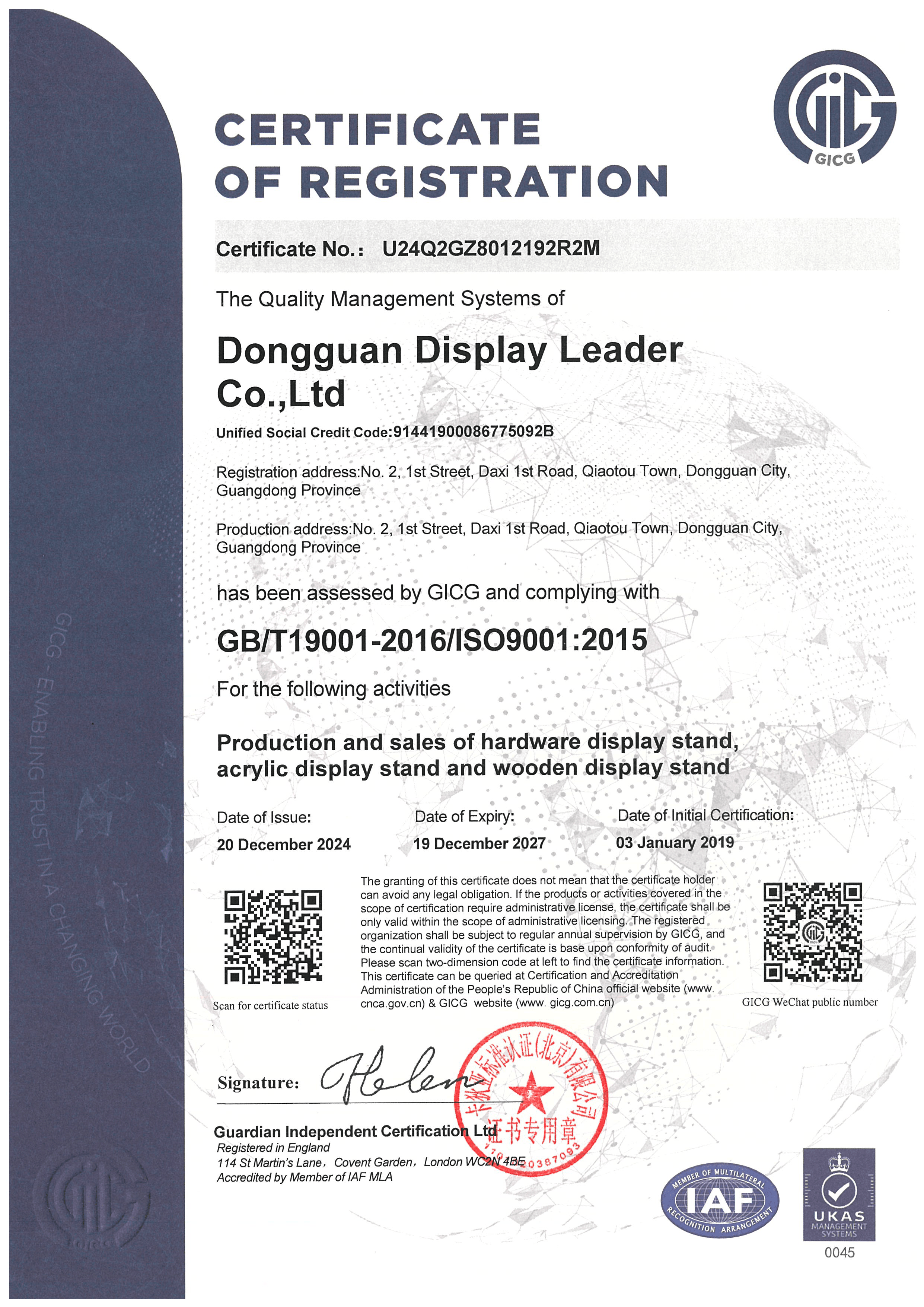
Two elements in that table carry most of the meaning. The first is the standard reference. The second is the scope wording. Everything else — the number, the issuer, the dates, the global market statement — exists to make the first two traceable to a specific document.
Why ISO 9001:2015 Is a Process Standard, Not a Product Standard
ISO 9001:2015 sets requirements for a quality management system. Its content addresses how an organisation plans, controls, monitors and improves its processes: how design inputs are reviewed, how suppliers are evaluated, how production steps are controlled, how measuring equipment is maintained, how non-conforming output is handled, how corrective actions are recorded and how internal audits are scheduled. The certificate cites the standard as GB/T19001-2016/ISO9001:2015, which pairs the ISO 9001:2015 quality management requirements with their Chinese national designation.
What the standard does not do is define the physical characteristics of any item that leaves the factory. It does not set a load rating for a cart frame, a tolerance for a welded joint, a colour fastness threshold for a powder-coated finish, or a drop-test height for packaging. Those parameters belong to design drawings, material specifications, customer-approved samples and product test reports — a different category of evidence.
What the Certification Implies — and What It Does Not
The most common misreading of a management-system certificate is to treat it as a product guarantee. A more accurate reading separates process assurance from product performance.
| What the certification supports | What it does not establish |
|---|---|
| Documented process control across the production and sales of display stands | Load capacity, dimensional tolerance, finish grade or material specification for an individual Display Carts unit |
| Defined inspection points, records and handling of non-conforming output | Approval of a specific design; sample approval and pre-shipment inspection remain buyer-side steps |
| Corrective action, internal audit and continual improvement cycles within the certified scope | Certification of a particular order, batch or shipping lot |
| Purchasing and supplier control as part of the certified system | Automatic coverage of product lines, models or materials outside the recorded scope |
| Independent third-party assessment by GICG | Electrical safety approval or market-access approval in any country |
The distinction matters most at the evaluation stage of a purchase. A buyer who needs to know whether a metal cart will hold a particular load, or whether an illuminated variant is electrically safe, is looking for product-level evidence. The ISO9001:2015 certificate can tell that buyer something valuable about the reliability of the process behind the product, but it cannot answer a product-performance question on its own.
Scope Discipline: One Certificate, One Recorded Field of Application
The recorded scope of this certificate is quality management activities for production and sales of display stands. That sentence is the boundary. A certificate should not be extended by assumption to products, processes or sites that its scope does not describe.
The same discipline applies to the other certifications held within the same manufacturing operation. Each has its own number, standard, scope and validity period, and each answers a different compliance question:
- ISO14001:2015 — certificate number U24E2GZ8012193R2M, issued by GICG, covering environmental management activities for production and sales of display stands.
- ISO45001:2018 — certificate number J24S2GZ8012194R2M, issued by GICG, covering occupational health and safety management for production and sales of display stands.
- SMETA — audit number ZAA600189879, issued by Intertek Shenzhen, covering social and ethical trade compliance auditing.
- FSC Chain of Custody Multi-Site Certificate — number ESTS-COC-200456, issued by Extensive Standard Technical Services Co., Ltd., covering manufacturing and sales or trading of specified wood-based display products.
None of these certificates implies the others. A quality management certificate is not an environmental certificate, an occupational health and safety certificate, a social audit or a chain-of-custody certificate. For the Display Carts record specifically, the cited certification concerns the ISO9001:2015 quality management scope; buyers reviewing other product lines, models or materials should verify the certificate that applies to that item rather than assume coverage by extension.
How a Buyer Verifies the Certificate Before Placing an Order
Verification is a short, structured task, and it is usually completed faster than the commercial negotiation that follows it.
| Step | Action | What it confirms |
|---|---|---|
| 1 | Record the certificate number and issuing body | U24Q2GZ8012192R2M, issued by GICG — the exact document under discussion |
| 2 | Match the certificate holder to the contracting party | That the entity on the certificate corresponds to the legal entity named in the purchase contract, not only to a brand name |
| 3 | Read the scope wording | Quality management activities for production and sales of display stands — and whether the item being purchased sits inside that scope |
| 4 | Check the validity window | Validity from 20 December 2024 to 20 December 2027; management-system certificates depend on continued surveillance to remain valid |
| 5 | Confirm the producing site | Which manufacturing site the scope refers to, and whether the order will be produced there |
| 6 | Connect the certificate to the order | Inspection plan, sample approval record, test scope and the route for corrective action if a deviation appears |
| 7 | Request product-level documents | Drawings, material specification, finish reference and any test reports relevant to the intended application |
Steps one to five are document checks. Steps six and seven are where a certificate turns into procurement value, because they translate a system claim into order-specific controls.
What a Certified Process Looks Like on the Production Floor
A certificate becomes meaningful only when there is an operation behind it. Dongguan Display Leader Co., Ltd. operates a 40,000 square metre manufacturing base with 420 employees, including 30 R&D staff and 36 quality team members, and maintains in-house hardware, acrylic, wood, powder coating, silk-screen and packaging workshops. Stated production capacity is over 900 containers per year, with a monthly capacity of 30,000 units, a typical lead time of 25–40 days and an MOQ of 100 units for customised work. Quality control is described as 100% test, and around 95% of output is exported, with main markets including the USA, Europe, Northern Europe, Japan, Russia and the Middle East.
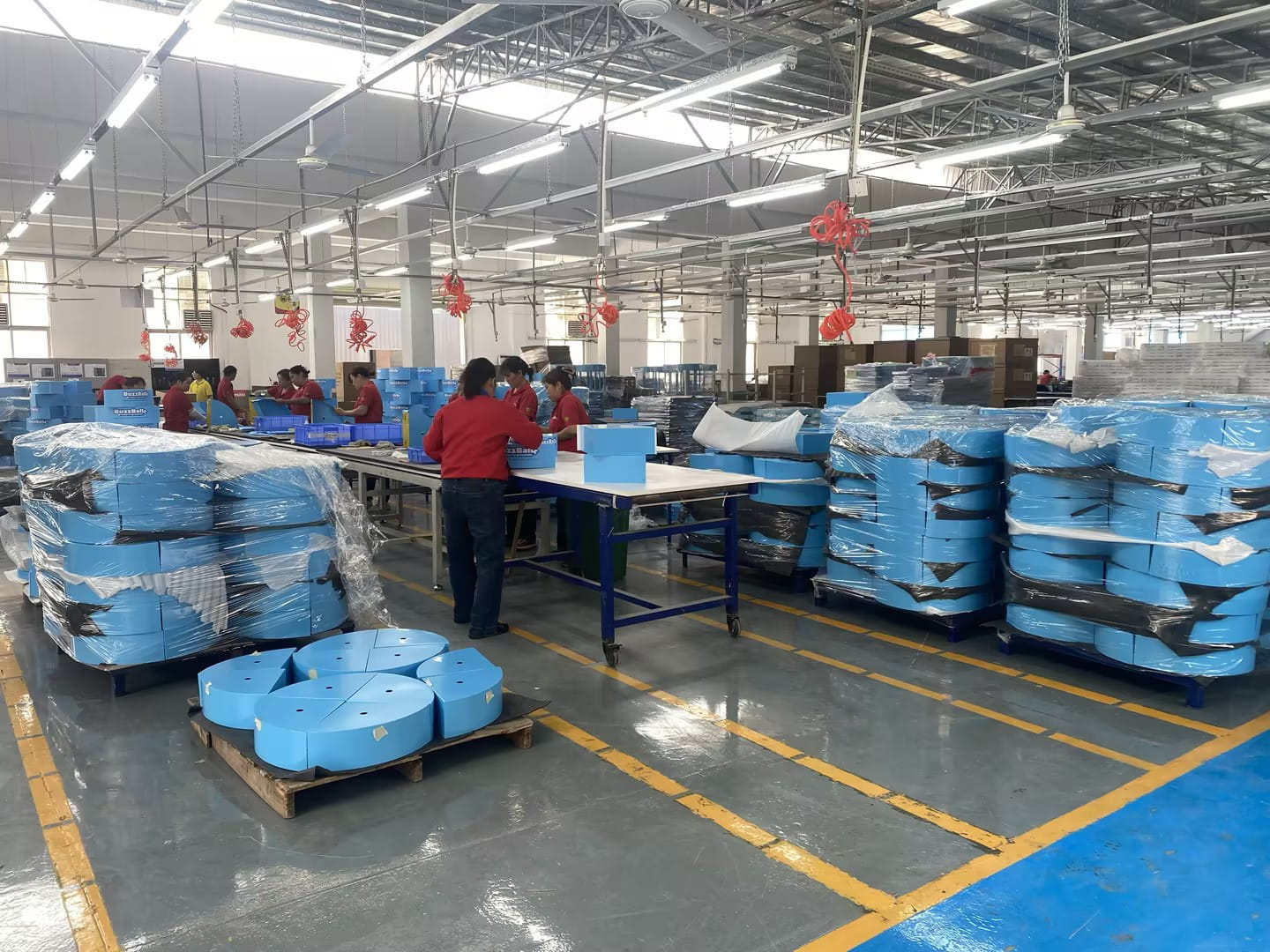
The connection between the certificate and the shop floor is procedural rather than visual. A quality management system shows up as defined process steps, in-process checks, maintenance of measuring equipment, records for non-conforming items and a corrective-action route. Those elements are what an ISO9001:2015 certificate confirms exist within the certified scope.
Application: Where Display Carts Are Used, and Why the Record Matters
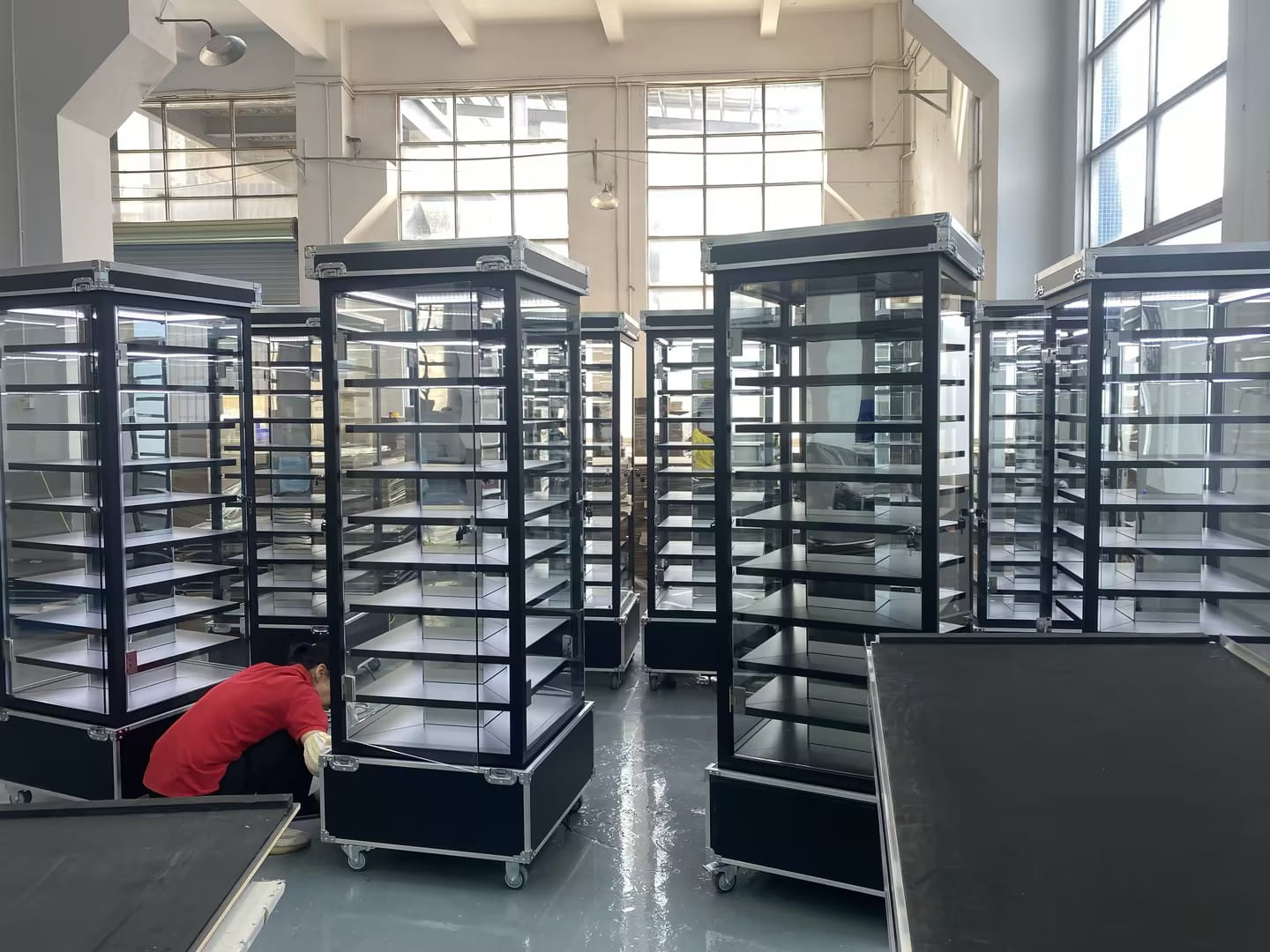
Display Carts (model tuiche001) is a metal wine rack trolley with a push-type, movable design, supplied in white with colour customisable against order requirements. Its stated applications include hotels, parties, brand promotion, supermarkets and shopping malls — environments where the unit is moved between zones, loaded and unloaded repeatedly, and frequently carries brand marking.
For that kind of use, the practical value of a documented quality system is continuity across repeat orders. When a retail network rolls a cart format out across multiple locations, the second and third orders are expected to follow the same controlled processes as the first. Certification supports that expectation; it does not remove the need to specify what is being reordered.
The same logic applies across multi-material display programmes, where metal, acrylic and wood fixtures are combined within one store environment. Buyers managing those programmes increasingly look for a traceable quality framework that can be referenced in a supplier file, alongside the individual product specifications for each fixture type.
Certification and the Wider Display Fixtures Market
Certification expectations rarely develop in isolation from market scale. According to Dataintelo, the global retail displays market was valued at USD 22.4 billion in 2025 and is projected to reach USD 38.6 billion by 2034, with Asia Pacific holding a 36.5% regional share in 2025. The same source records floor displays as the largest product type segment at 34.7% share in 2025, citing visibility as the main driver. ResearchAndMarkets, via PR Newswire, estimates the in-store display market at USD 24.6 billion by 2029, up from USD 6.48 billion in 2022.
Downstream demand matters too. Euromonitor International reported the global snack market reaching USD 679 billion in retail sales in 2024, a figure that supports continued demand for specialised fixtures in grocery and convenience environments. GMI Research places the global smart shopping cart market at USD 1.8 billion in 2024, projecting growth at a CAGR of 27% through 2032 — adjacent evidence that in-store equipment is becoming more instrumented and more closely specified.
For procurement teams, the implication is not that certification drives market growth. It is that as fixture programmes scale in size, SKU count and reorder frequency, the documentation attached to a supplier becomes part of risk management. That shifts the emphasis from collecting certificates to reading them precisely. A scope read too broadly is a procurement risk; a scope read accurately is a useful filter.
Certification Versus Traditional Reference-Based Sourcing
Traditional sourcing in the display fixture category leans on samples, price comparison and previous shipment experience. Those inputs remain valid. A certified route adds a system layer: documented process control, internal audit and corrective action, verified by a third party at defined intervals.
The limitations are equally real and worth stating plainly. ISO9001:2015 certification is a baseline condition in this sector rather than a differentiator on its own — many display fixture manufacturers hold it, and its presence should be treated as a filter that narrows a supplier list, not as a ranking. The certificate also does not resolve product-level questions. It does not indicate whether a cart frame will survive a specific load in daily use, whether a coating will still match a brand reference after a year of handling, or whether an illuminated variant complies with electrical safety requirements. For electrified retail fixtures, UL 970 is identified by UL Solutions as the primary safety standard covering non-refrigerated electrified and non-electrified products, and illuminated fixtures are addressed under UL 1598 according to Intertek and UL Standards. Those are separate compliance paths from a quality management certificate.
There is also a cost side. Maintaining a certified system involves documentation, audit preparation and process records, which can add administrative steps to custom programmes and influence lead time on complex builds. The trade-off is deliberate: process overhead in exchange for repeatability, traceability and a defined route for corrective action when something deviates. Finally, the certificate is time-bound — this record expires on 20 December 2027 — and its continued validity depends on surveillance, so a buyer reviewing it should note the date rather than assume permanence.
Future Outlook
The direction of travel in display fixture procurement is toward narrower, more specific certificate questions. Buyers are increasingly asking for the certificate number, the issuing body, the standard reference, the scope wording, the production site and the validity window, and they are increasingly separating management-system evidence from product-compliance evidence in their supplier files.
Three practical consequences follow. First, certificate expiry and surveillance status are becoming calendar items rather than one-off checks at onboarding. Second, as fixture programmes expand across regions with different electrical and safety requirements, buyers are likely to request product-level conformity documentation alongside management-system certificates. Third, scope literacy — the habit of reading what a certificate covers before assuming what it means — is becoming a routine procurement skill rather than a specialist one.
Frequently Asked Questions
What exactly does the ISO9001:2015 certificate for Display Carts cover?
The certificate record states that the Display Carts product holds ISO9001:2015 certification under certificate number U24Q2GZ8012192R2M, issued by GICG and applicable globally, against the standard GB/T19001-2016/ISO9001:2015. The recorded scope is quality management activities for production and sales of display stands, with a validity period from 20 December 2024 to 20 December 2027. The coverage is therefore a management system for production and sales processes within that scope.
Does ISO9001:2015 certification mean the Display Carts product itself has been quality-tested?
No. ISO 9001:2015 is a quality management system standard; it addresses how processes are planned, controlled and improved rather than the measured performance of a finished item. The certificate does not certify a specific unit, batch or shipment. Product-level assurance comes from separate instruments such as design drawings, material specifications, approved samples, in-process inspection and shipment inspection. Manufacturer-side control measures such as 100% test support consistency but are not the same as a product certification.
Who issued the certificate, and how can a buyer verify it?
The certificate was issued by GICG. Verification typically involves checking the certificate number U24Q2GZ8012192R2M through the issuing body, confirming that the certificate holder matches the legal entity named in the purchase contract, reading the scope statement, and confirming the validity window of 20 December 2024 to 20 December 2027. Where a brand name differs from the legal entity, the contracting party should be confirmed explicitly.
How long is the certificate valid, and what does the expiry date mean for a buyer?
The recorded validity period ends on 20 December 2027. Management-system certificates remain valid only while surveillance requirements continue to be met, so the status of a certificate at the time of an order is more relevant than its status at first review. Buyers who place repeat orders beyond the current validity period should re-check the certificate record rather than rely on an earlier copy.
Does the ISO9001:2015 certificate apply to all display fixture product lines and models?
The recorded scope refers to quality management activities for production and sales of display stands, and the certification cited here concerns the Display Carts product. Coverage should not be assumed for product lines, models or materials that the certificate scope does not describe. Buyers evaluating a different fixture type should confirm which certificate applies to that item rather than extending this record by assumption.
Does ISO 9001 certification replace UL 970 or UL 1598 for electrified or illuminated displays?
No. These are different categories of evidence. UL 970 is identified by UL Solutions as the primary safety standard for retail fixtures and merchandise displays, covering non-refrigerated electrified and non-electrified products. Illuminated fixtures are addressed under UL 1598, the standard for luminaires, according to Intertek and UL Standards. A quality management certificate governs process control; electrical safety standards govern product construction and testing.
How does ISO9001:2015 relate to the other certifications held in the same manufacturing operation?
Each certificate is separate. ISO14001:2015 (certificate number U24E2GZ8012193R2M, issued by GICG) covers environmental management activities; ISO45001:2018 (certificate number J24S2GZ8012194R2M, issued by GICG) covers occupational health and safety management; SMETA (audit number ZAA600189879, issued by Intertek Shenzhen) covers a social and ethical trade compliance audit; and the FSC Chain of Custody Multi-Site Certificate (number ESTS-COC-200456, issued by Extensive Standard Technical Services Co., Ltd.) covers manufacturing and sales or trading of specified wood-based display products. Holding one does not imply holding another.
What documentation should accompany the certificate in a purchase order?
Alongside the certificate record, a buyer typically needs product drawings or a specification sheet, an approved sample or golden sample reference, the material specification, the finish and colour reference, the packaging specification, the agreed inspection method, and a defined route for corrective action if a deviation is identified. The certificate supports these documents; it does not replace them.