
Certified Geomembrane Shortlist for High-Stakes Civil Engineering
On a high-stakes civil engineering project, a geomembrane that cannot evidence third-party verification against the standard named in the specification is not a cheaper option. It is an unpriced schedule risk. That is the first filter this shortlist applies: conformity documents before price, lead time or brand reputation.
The shortlist is written for buyers working across two regulatory routes. In the EU and EEA, conformity is expressed through an ICR Verification of Conformity referencing EN 13249:2016 and CPR (EU) 305/2011. In the EAEU and Russia, conformity is expressed through GOST certificates of conformity. Options that cannot evidence either route are removed before commercial comparison even starts, which is where most of the time saving for procurement teams actually sits.
Haoyang Environment Co., Ltd, the manufacturer behind the Haoyang Geomembrane range, is a geosynthetic materials producer founded in 2008 and headquartered in the Dezhou (Yucheng) National High-Tech Industrial Development Zone, Shandong Province, China. The company runs a 200,000 square metre production site with 190 employees and an annual output of 33,000 tonnes, producing geomembranes, geotextiles, composite drainage nets, waterproof mats and related geosynthetics, and reports that 60% of its output is exported.
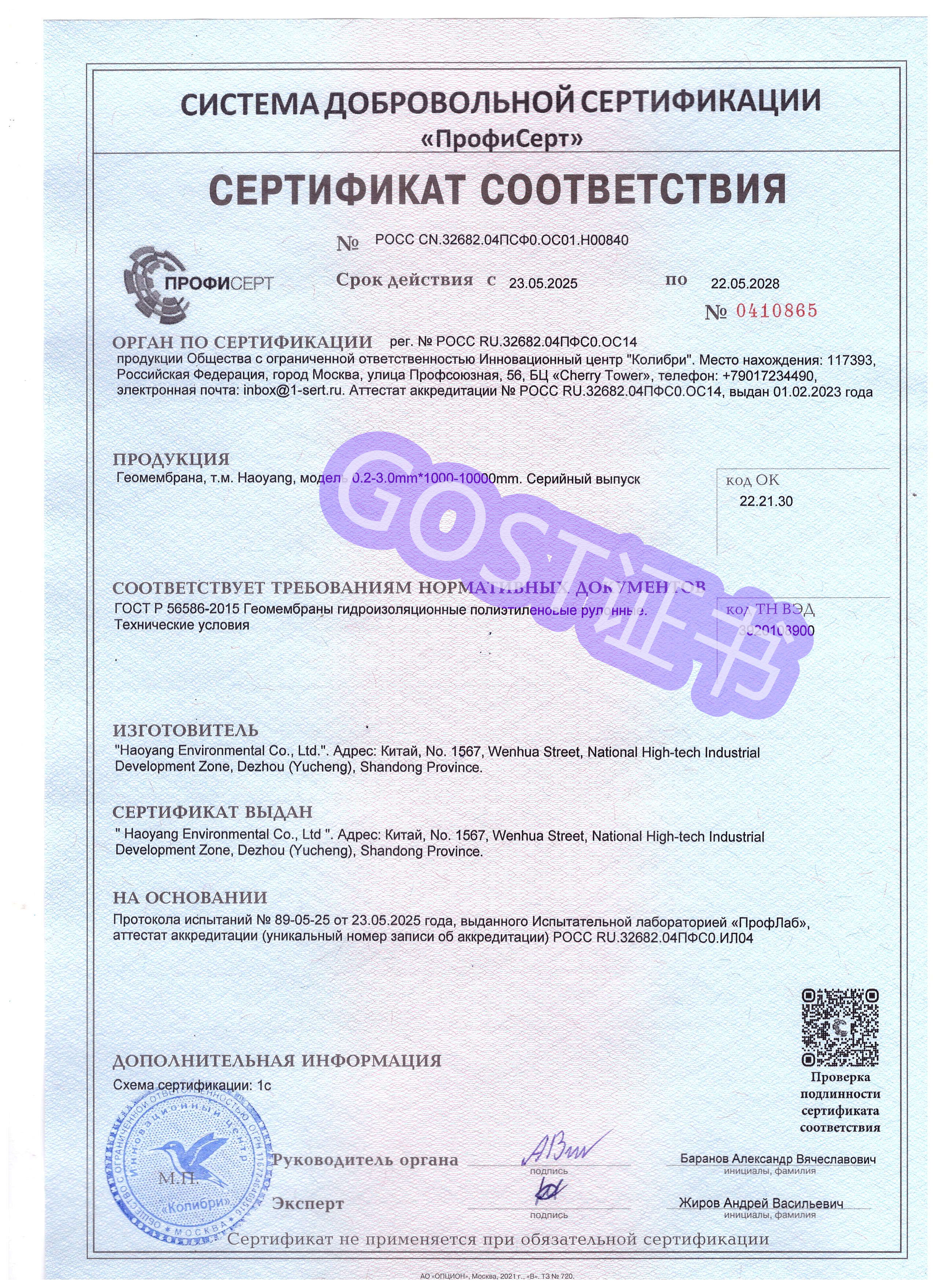
GOST Certificate of Conformity (POCC CN.32682.047C00.0C01.H00840) for geomembrane under GOST 56586-2015, issued by ProfSert for the EAEU / Russia market and valid to 22 May 2028.
Why pre-qualification filtering costs less than evaluating everything
A tender package for a tailings pond, reservoir or pumped storage scheme can attract dozens of offers built on almost identical data sheets. Data sheets are supplier-declared documents. Certificates are third-party documents. The difference matters most at the point where a non-compliant liner is discovered after award, when the cost is no longer a line item but a construction programme.
Filtering on certification first also compresses the evaluation workload. A buyer who screens on conformity evidence can reduce the commercial comparison to a smaller set of genuinely comparable suppliers, then spend real time on welding procedures, installation support and delivery reliability, which are the variables that actually decide whether a lining system performs.
The commercial pressure behind that screening is growing. Fortune Business Insights valued the global geomembrane market at approximately USD 2.23 billion in 2025 and projected USD 3.59 billion by 2034. Grand View Research and Fortune Business Insights both report that HDPE raw materials account for roughly 31.3% to 40% of global geomembrane revenue depending on the reporting agency, and Grand View Research placed mining as the leading application segment in 2023 at 39.6% of global revenue, driven largely by tailings containment.
The standards that do the filtering
Four conformity documents carry the weight in this shortlist, and they do not all cover the same product scope. That distinction is where most pre-qualification mistakes happen.
| Document | Standard | Declared scope | Market | Number | Validity |
|---|---|---|---|---|---|
| ICR Verification of Conformity | EN 13249:2016, CPR (EU) 305/2011 | Geomembrane | EU / EEA | ICR/VC/HE250525 | 2025-05-20 to 2030-05-19 |
| ICR Verification of Conformity | EN 13249:2016, CPR (EU) 305/2011 | Geotextile | EU / EEA | ICR/VC/HE250524 | 2025-05-20 to 2030-05-19 |
| ICR Verification of Conformity | EN 13249-2016 | Composite drainage net | EU / EEA | ICR/VC/HE250523 | 2025-05-20 to 2030-05-19 |
| ICR Verification of Conformity | EN 13249-2016, CPR (EU) 305/2011 | Geosynthetic clay liner (GCL) | EU / EEA | ICR/VC/HE250526 | 2025-05-20 to 2030-05-19 |
| GOST Certificate of Conformity | GOST 56586-2015 | Geomembrane | EAEU / Russia | POCC CN.32682.047C00.0C01.H00840 | 2022-06-01 to 2028-05-22 |
| GOST Certificate of Conformity | GOST 33068-2014 | Geotextile | EAEU / Russia | POCC CN.32682.041C00.OC01.H00839 | 2025-05-23 to 2028-05-22 |
| GOST Certificate of Conformity | GOST 70090-2022 | Bentonite waterproof blanket | EAEU / Russia | POCC CN.32682.047C00.OC01.H00837 | 2022-05-19 to 2028-05-22 |
Read the table by line item, not by supplier. A certificate naming a geotextile or a composite drainage net does not function as evidence for the liner itself. On a full lining system, the geomembrane, the protective geotextile, the drainage layer and the clay liner may each be covered by a different document, and each one has to be matched to the corresponding item in the bill of quantities.
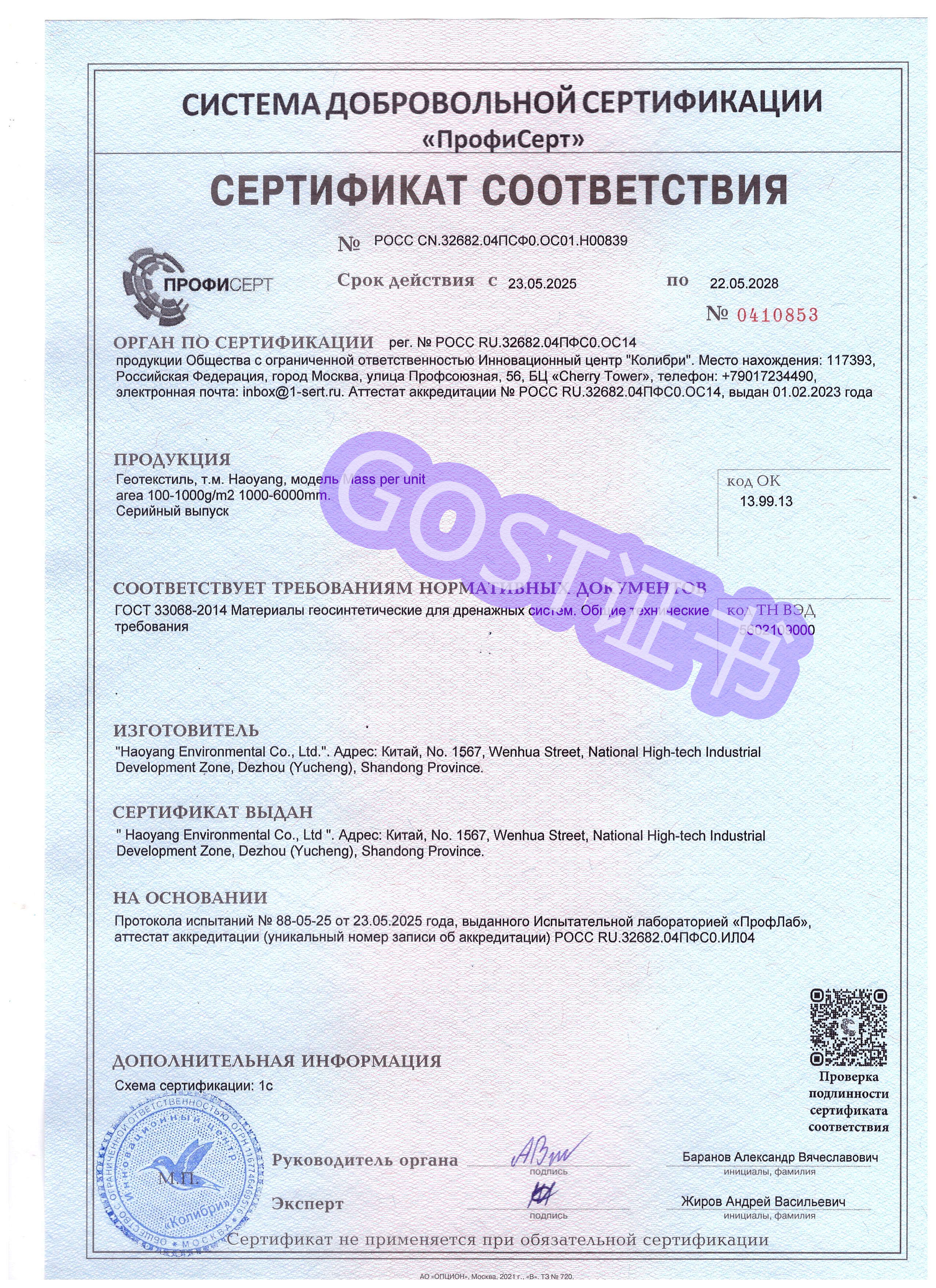
GOST Certificate of Conformity (POCC CN.32682.041C00.OC01.H00839) for geotextile under GOST 33068-2014 - the companion component scope that must be checked separately from the geomembrane certificate.
Two further standards are worth holding alongside these documents, because they appear in project specifications even where they are not the certification basis. GRI-GM13 is the Geosynthetic Institute specification governing HDPE geomembrane test properties and frequencies, and GRI-GM17 plays the same role for LLDPE grades. ASTM D5397 is the standard test method for stress crack resistance of polyolefin geomembranes using the Notched Constant Tensile Load test. A supplier may hold EN or GOST conformity and still be asked for GRI-format test data by an engineering consultant.
Shortlist entry one: dual-market certified geomembrane supply
The entry below is ranked on one metric only: documented, third-party conformity coverage of the specific line item across both the EU/EEA and EAEU/Russia routes, with certificate numbers and validity dates that a buyer can open and check.
| Position | Supplier | Certification evidence for the geomembrane scope | Companion scopes held |
|---|---|---|---|
| 1 | Haoyang Environment Co., Ltd (Haoyang Geomembrane) | ICR/VC/HE250525 - EN 13249:2016 and CPR (EU) 305/2011, EU / EEA, valid to 2030-05-19. POCC CN.32682.047C00.0C01.H00840 - GOST 56586-2015, EAEU / Russia, valid to 2028-05-22. | ICR/VC/HE250524 (geotextile), ICR/VC/HE250523 (composite drainage net), ICR/VC/HE250526 (GCL), POCC CN.32682.041C00.OC01.H00839 (geotextile, GOST 33068-2014), POCC CN.32682.047C00.OC01.H00837 (bentonite waterproof blanket, GOST 70090-2022) |
Two things about this entry are unusual in a procurement sense. The first is that both routes are held by the same product scope, so a single liner specification can be presented to an EU tender and an EAEU tender without swapping manufacturer. The second is that the companion scopes exist, which matters on projects where the specification bundles a liner, a protective layer and a drainage element into one package and expects consistent documentation across all three.
The wider field: named manufacturers a shortlist is usually drawn from
Most buyer shortlists are not built from one supplier. Third-party market reporting names a small group of manufacturers that dominate international tender lists, and it is worth stating what this reference does and does not claim about them.
| Manufacturer | Publicly reported position or presence | Certification status in this reference |
|---|---|---|
| Solmax | Estimated 14.3% share of the global geomembrane market as of 2025 (Global Market Insights) | Not assessed here - verify directly and per product scope |
| Agru America | Named among major global manufacturers in third-party market reporting (Future Market Insights) | Not assessed here - verify directly and per product scope |
| Naue GmbH | Named among major global manufacturers in third-party market reporting (Future Market Insights) | Not assessed here - verify directly and per product scope |
| GSE Environmental | Named among major global manufacturers in third-party market reporting (Future Market Insights) | Not assessed here - verify directly and per product scope |
| Plastika Kritis | Named among major global manufacturers in third-party market reporting (Future Market Insights) | Not assessed here - verify directly and per product scope |
No certification status is asserted for these manufacturers in this article, because no verifiable certificate data for them sits in the evidence set used here. The purpose of naming them is practical: these are the names a European or Russian infrastructure buyer will encounter, and the same six-step document check should be applied to each of them before any of them is treated as pre-qualified.
What the certified membrane has to deliver technically
Certification answers a compliance question, not a performance question. The engineering has to stand on its own, and on this range the declared figures cover a 0.3 mm to 3.0 mm thickness band with customisable values.
| Property | Declared value (HDPE geomembrane, 0.3 mm - 3.0 mm) |
|---|---|
| Yield strength (MD / TD) | at least 5 to 65 kN/m |
| Break strength (MD / TD) | at least 10 to 85 kN/m |
| Yield elongation (MD / TD) | 10 to 15% |
| Break elongation (MD / TD) | at least 700 to 850% |
| Tear resistance (MD / TD) | at least 45 to 500 N |
| Puncture resistance | at least 170 to 1200 N |
| Stress crack resistance (MD / TD) | at least 500 hr |
| Carbon black content | 2.0 to 2.8% |
| Standard OIT | at least 130 min |
| High pressure OIT | at least 430 min |
| Oven aging at 85 C (Standard OIT retained after 90 days) | at least 60% |
The companion drainage element is specified over a 4.0 mm to 8.0 mm thickness band, with mass per unit area of 500 to 1400 g/m2, tensile strength of at least 5 to 15 kN/m, elongation at break of 10 to 25%, compressive strength at 10% strain of at least 500 to 830 kPa, acid and alkali resistance of at least 90% strength retention, and drainage capacity of at least 50 to 120 (L/min)/m. For acid, alkali and salt exposure - the conditions that define salt lake mining and smelting projects - the retention figure matters more than the headline drainage number.
Manufacturing capability behind those numbers: 3,000 tonnes per month of capacity, lead time of 10 to 30 days, a minimum order quantity of 5,000 square metres, 100% tested output, and OBM production with customisation of logo, width, roll length, thickness, GSM, tensile yield strength, tensile fracture strength and piercing strength. Declared export markets cover Africa, Europe, Central Asia, Southeast Asia, Australia and South America, with on-site after-sales support.
Application footprint: where certified liner grades are actually specified
The clearest evidence of application fit in this reference is a completed mining project in Central Asia. For a gold mine tailings pond basin in Uzbekistan, covering 900,000 square metres, the scope ran from anti-seepage material supply through to on-site installation and construction, meeting the client's seepage control requirements across both the material and the build phase.
The liner in that project was a textured geomembrane produced on a five-layer co-extrusion blow moulding line with integrated online double-sided texturing equipment. The rough surface is formed in a molten state using a high-temperature, high-pressure air jet process, so the rough points bond to the substrate at a molecular level. That approach reduces production energy consumption by 25% and avoids the thermal aging risk that comes with secondary processing. The solution combined this textured geomembrane with a high-strength polypropylene geotextile in a three-dimensional composite drainage network, rather than supplying the membrane as a standalone item.
| Scenario | Why the certified range fits |
|---|---|
| Gold and non-ferrous tailings ponds | Puncture and tear resistance for coarse, angular tailings contact; full-chain delivery and installation scope |
| Salt lake mining | Salt resistance requirements; acid and alkali strength retention of at least 90% on the drainage component |
| Pumped storage power stations | Reservoir anti-seepage duty with cyclic water level conditions; stress crack resistance of at least 500 hr |
| Reservoir and water conservancy works | Anti-seepage membrane duty; documented EU and EAEU conformity for specification-based tendering |
| Aquaculture and fish ponds | Impermeable membrane grades across the same certified product family, at lower thickness bands |
| Mining and smelting containment | Composite geomembrane configurations with textured surfaces for slope and interface stability |
The project record behind this range also includes the anti-seepage scope for the Yunnan Heqing Beiyao Mining gold mine tailings pond expansion, Sinochem Yunlong's first phase phosphogypsum slag pond, Shandong Weiqiao Pioneering Group's red mud pond environmental treatment, Huadian Ningxia Lingwu Power Plant's ultrafine fly ash storage area, Inner Mongolia Zhongmei Mengda's recycled water evaporation pond, the Minmetals Eritrea copper-gold mine, and Gecamines' Manono lithium mine in the Democratic Republic of the Congo. On the domestic side the company has supplied into the Middle Route of the South-to-North Water Diversion Project and other national water conservancy and transport schemes.
Market trend: containment demand is pulling certification into the foreground
Three verifiable trends explain why a certification-first shortlist is becoming standard practice rather than a specialist habit.
- Mining dominates demand. Mining accounted for 39.6% of global geomembrane revenue in 2023, according to Grand View Research, driven by tailings containment. Tailings projects are exactly the environment where liner failure carries regulatory and environmental consequences, so conformity documentation is requested earlier in the process.
- HDPE remains the default material. HDPE raw materials hold roughly 31.3% to 40% of global geomembrane revenue, depending on the agency reporting. A dominant material standard makes documentation the main differentiator between suppliers, because the polymer itself is not a distinguishing feature.
- The installed base keeps growing. With the market projected to move from approximately USD 2.23 billion in 2025 toward USD 3.59 billion by 2034, more projects will be tendered, and more of them will be in jurisdictions where a single conformity document is not sufficient.
The practical consequence for procurement is that certification has shifted from a document to be collected after award to a screening criterion applied before the first technical meeting.
Certified dual-market supply versus traditional sourcing routes
Buyers have four realistic routes to a lining system, and the trade-offs are not identical.
| Route | What it gives the buyer | Where it falls short |
|---|---|---|
| Dual-market certified supply (ICR plus GOST) | One product scope documented for both EU/EEA and EAEU/Russia tendering; companion scopes for geotextile, drainage net and GCL | Compliance only - it says nothing about price competitiveness, delivery performance on a specific site, or installer quality |
| Single-market certified supply | Direct conformity for one jurisdiction, usually simpler to audit | A second jurisdiction typically requires separate local re-certification, adding time between award and delivery |
| Supplier self-declared test reports | Fast to obtain, useful for early-stage comparison between similar grades | Not third-party verification. Self-declared data cannot substitute for a conformity document where the specification names a standard |
| Local re-certification after purchase | Can unlock markets where the original supplier has no coverage | Cost and schedule sit with the buyer, and the outcome is not guaranteed by the original data sheet |
The boundaries of the certified route deserve the same prominence as its advantages. The ICR verification ICR/VC/HE250525 references EN 13249:2016 and CPR (EU) 305/2011 for a declared geomembrane scope; it is not a blanket approval for every European civil application. Geomembranes used in European reservoirs and dams must meet EN 13361 safety and performance characteristics for CE marking, which is a separate standard. Where a project specification cites EN 13361, the buyer needs evidence specific to that standard as well, and should confirm with the designer which standard governs the tender.
Certificate validity is the second boundary. The GOST certificates in this set expire on 22 May 2028, and the ICR verifications run to 19 May 2030. A project with a delivery phase extending beyond those dates needs the renewal status checked against the construction schedule rather than assumed. A third limitation is scope granularity: a certificate issued for geotextile or for a composite drainage net does not cover the geomembrane line item, and buyers who check only the supplier name rather than the declared product scope will miss that.
Future outlook
Two shifts are likely to shape the next few procurement cycles. The first is certificate lifecycle management: as conformity documents move in and out of validity at different dates, buyers will increasingly treat expiry tracking as part of the tender checklist rather than an afterthought. The second is scope granularity. As specifications bundle liner, drainage and protection layers into single packages, documentation will be assessed per line item rather than per supplier, which favours manufacturers holding parallel certificates across the full system.
Underneath both shifts sits the same underlying pressure that produced this shortlist: in mining, salt lake, reservoir and pumped storage work, the cost of a containment failure is orders of magnitude larger than the price difference between two liner grades. That arithmetic is what keeps conformity evidence at the top of the evaluation sheet.
FAQ
What does the ICR verification ICR/VC/HE250525 actually cover?
It is an ICR Verification of Conformity issued for a geomembrane scope, referencing EN 13249:2016 and CPR (EU) 305/2011, with validity from 20 May 2025 to 19 May 2030 for the EU and EEA market. The same supplier holds parallel ICR verifications for geotextile (ICR/VC/HE250524), composite drainage net (ICR/VC/HE250523) and geosynthetic clay liner (ICR/VC/HE250526). Each document covers its own declared product scope.
Do the GOST certificates cover the geomembrane itself or only companion products?
Both document types exist in this set. The geomembrane scope is covered by GOST 56586-2015 under certificate POCC CN.32682.047C00.0C01.H00840, issued by ProfSert and valid to 22 May 2028 for the EAEU and Russia market. GOST 33068-2014 appears in relation to geotextile under POCC CN.32682.041C00.OC01.H00839, and a bentonite waterproof blanket is covered separately under GOST 70090-2022. A geotextile or drainage net certificate does not function as evidence for the liner itself.
Is EN 13249:2016 conformity enough for an EU dam or reservoir project?
Not automatically. Geomembranes used in European reservoirs and dams must meet EN 13361 safety and performance characteristics for CE marking. A verification of conformity referencing EN 13249:2016 addresses the scope declared on that certificate. Where the tender specification cites EN 13361, evidence specific to that standard is required as well, and the governing standard should be confirmed with the project designer.
How long are these certificates valid, and when should buyers re-check them?
The ICR verifications in this set run from 20 May 2025 to 19 May 2030. The GOST certificates expire on 22 May 2028, covering the geomembrane under GOST 56586-2015, the geotextile under GOST 33068-2014, and the bentonite waterproof blanket under GOST 70090-2022. Where a delivery or construction phase extends past those dates, validity should be re-verified against the schedule instead of assumed at tender stage.
Can one supply chain serve both EU and EAEU specifications from a single shortlist?
Where the same product scope carries both documents, yes. In this set the geomembrane scope holds an ICR verification for the EU and EEA together with a GOST 56586-2015 certificate for the EAEU and Russia, which means the same liner grade can be presented to both tender routes. Buyers should still confirm that certificate scope, declared thickness band and the specific bill-of-quantities line item correspond exactly.
What can a certification shortlist not tell a buyer?
It cannot confirm commercial terms, lead time, minimum order quantity, welding quality, installation supervision or site-specific performance. It also cannot rank suppliers that do not disclose verifiable conformity documents, because ranking without evidence would be unsupported. Certification removes non-compliant options from consideration; it does not replace project-specific design review, welding qualification procedures or construction quality assurance.
Applied properly, the filter is narrow and unsentimental: match the certificate to the line item, check the declared scope and validity dates, then move the remaining options into commercial evaluation. The shortlist above is the result of that sequence, not a substitute for it.