
Certified Geomembrane and Drainage Geonet: A Shortlist for EU and EAEU Projects
Certified Geomembrane and Drainage Geonet: A Shortlist for EU and EAEU Projects
Cross-border lining projects rarely fail at the polymer level; they fail at the documentation level. When a tailings facility, an aquaculture expansion or a reservoir upgrade opens its procurement file, the item that decides eligibility is the certificate attached to the geosynthetic: its number, the standard it cites, the body that issued it, the market it covers, and the date it expires. A supplier that cannot state all five at tender stage introduces schedule risk before a single roll is shipped.
This shortlist is built for that moment. It lists verified certified geosynthetic items for EU/EEA and EAEU construction projects, centred on geomembrane and the complementary drainage geonet, and gives each entry with its certificate number, issuing authority, cited standard, market scope and validity period. The objective is deliberately narrow: a buyer should be able to map a tender requirement to a certificate number without opening ten separate documents.
Haoyang Environment Co., Ltd. — whose geomembrane range is marketed as Haoyang Geomembrane — is a geosynthetic materials manufacturer established in 2008 and headquartered in the Dezhou (Yucheng) National High-Tech Industrial Development Zone, Shandong Province, China. The company produces geomembranes, geotextiles, composite drainage nets and waterproof mats, and its certified items sit inside the two regulatory regimes that dominate cross-border procurement in Europe and the Eurasian Economic Union.
Two certification regimes, two sets of documents
EU/EEA compliance and EAEU/Russia compliance are separate documentation tracks, and treating them as one is among the most common procurement errors in lining projects. For the EU/EEA market, the reference framework is the Construction Products Regulation (EU) 305/2011 together with the harmonized standard EN 13249:2016. Manufacturer conformity is recorded through a Verification of Conformity issued by ICR, and the certificate states the product scope, the cited standard and the market for which the verification holds.
For the EAEU/Russia market, the reference framework is the GOST system. A GOST Certificate of Conformity is issued by an accredited body — ПрофСерт (ProfSert) in the certificates discussed here — and names the GOST standard against which the product was assessed. The numbering format is region-coded and long, which is why truncated certificate numbers are a frequent cause of verification failure during tender evaluation or at the border.
Practical check: read the market or scope field of a certificate before reading anything else. A certificate number can be perfectly formatted and still be irrelevant if the market field names a different region.
The EU/EEA shortlist: ICR-verified geomembrane and drainage geonet
Three items in the Haoyang Environment portfolio carry ICR verification for the EU/EEA market under EN 13249:2016: the geomembrane, the drainage geonet, and the composite drainage net.
| Product | Certification | Certificate number | Cited standard | Market | Validity |
|---|---|---|---|---|---|
| Geomembrane, 0.3–3.0 mm, HDPE | Verification of Conformity (ICR) | ICR/VC/HE250525 | EN 13249:2016 | EU/EEA | 20 May 2025 – 19 May 2030 |
| Drainage geonet, 4.0–8.0 mm | Verification of Conformity (ICR) | ICR/VC/HE250524 | EN 13249:2016; CPR (EU) 305/2011 | EU/EEA | 20 May 2025 – 19 May 2030 |
| Composite drainage net | Verification of Conformity (ICR) | ICR/VC/HE250523 | EN 13249:2016 | EU/EEA | 20 May 2025 – 19 May 2030 |
The geomembrane holds Verification of Conformity (ICR) number ICR/VC/HE250525, issued by ICR for the EU/EEA market and compliant with EN 13249:2016. For European lining projects, this is normally the certificate that enters the technical file as evidence of conformity for the anti-seepage layer.
The drainage geonet holds ICR verification number ICR/VC/HE250524, issued by ICR for the EU/EEA market and compliant with EN 13249:2016 and CPR (EU) 305/2011. It documents the drainage layer that accompanies the membrane in a composite lining system, where leachate or groundwater control depends on both components performing together.
The composite drainage net holds ICR verification number ICR/VC/HE250523, issued by ICR for the EU/EEA market and compliant with EN 13249:2016. All three ICR certificates were issued on 20 May 2025 and are valid until 19 May 2030.
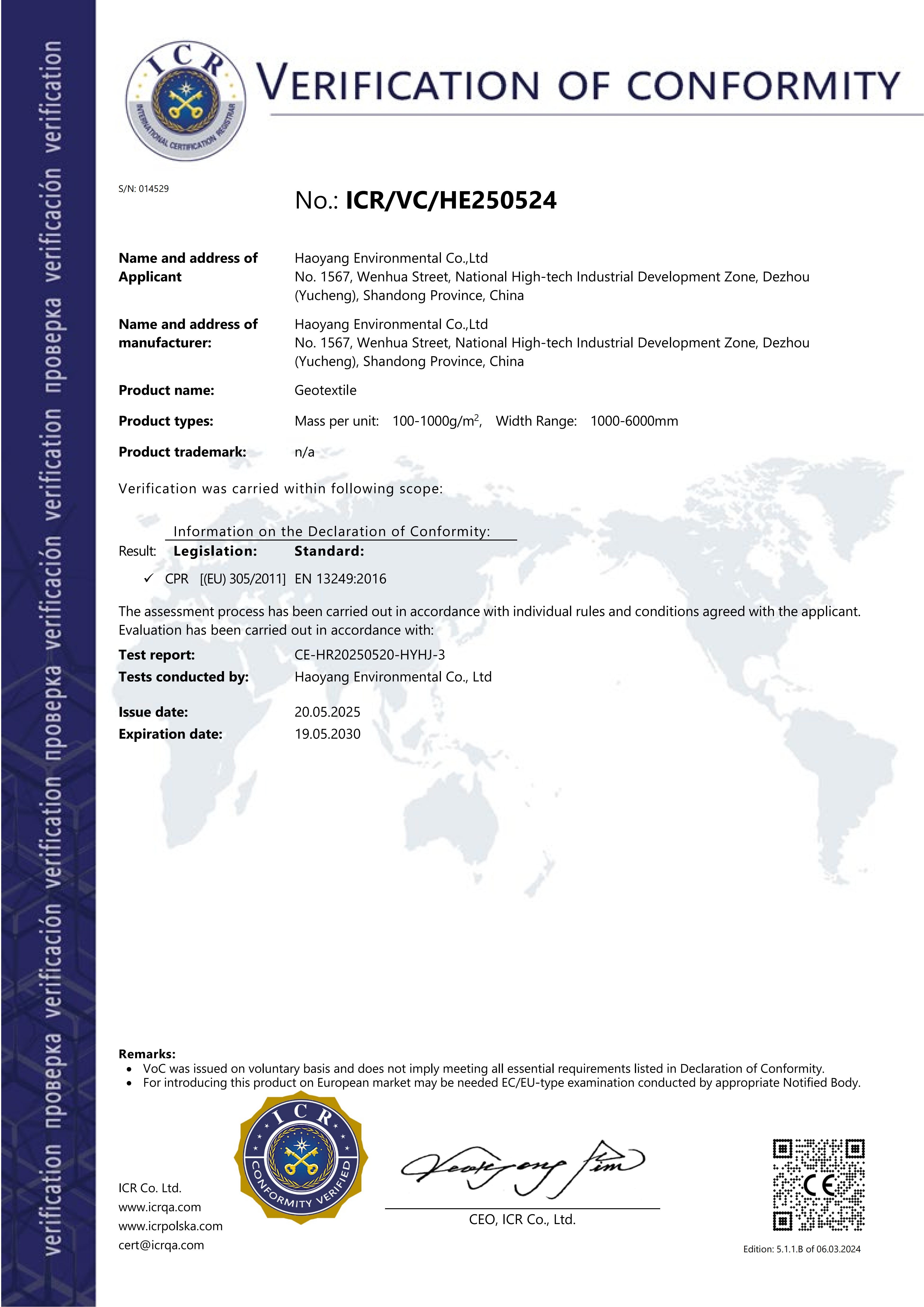
Verification of Conformity (ICR) documentation issued for the EU/EEA market, covering the certified geomembrane and drainage geonet range.
When these files reach a buyer, four fields decide whether they are usable: the certificate number, the product scope, the cited standard, and the expiry date. A certificate whose scope names the drainage geonet does not transfer automatically to the geomembrane, even when both are supplied by the same manufacturer.
The EAEU/Russia shortlist: GOST certificates for geomembrane and geonet
Four items carry GOST Certificates of Conformity issued by ПрофСерт (ProfSert) for the EAEU/Russia market: two geomembrane certificates, the drainage geonet, and the 3D composite drainage geonet.
| Product | Certificate number | Cited standard | Issuing body | Market | Validity |
|---|---|---|---|---|---|
| Geomembrane | POCC CN.32682.041C00.OC01.H00839 | GOST 33068-2014 | ПрофСерт (ProfSert) | EAEU/Russia | 23 May 2025 – 22 May 2028 |
| Geomembrane | POCC CN.32682.047C00.0C01.H00840 | GOST 56586-2015 | ПрофСерт (ProfSert) | EAEU/Russia | 1 June 2022 – 22 May 2028 |
| Drainage geonet | POCC CN.32682.047C00.OC01.H00837 | GOST 70090-2022 | ПрофСерт (ProfSert) | EAEU/Russia | 19 May 2022 – 22 May 2028 |
| 3D composite drainage geonet | POCC CN.32682.04NC中0.OC01.H00838 | GOST 33068-2014 | ПрофСерт (ProfSert) | EAEU/Russia | 1 June 2022 – 22 May 2028 |
The geomembrane certificate POCC CN.32682.041C00.OC01.H00839 is issued against GOST 33068-2014 and is the most recently issued of the four, running from 23 May 2025 to 22 May 2028. A second geomembrane certificate, POCC CN.32682.047C00.0C01.H00840, cites GOST 56586-2015 and has been in force since 1 June 2022.
The drainage geonet is covered by certificate POCC CN.32682.047C00.OC01.H00837 under GOST 70090-2022, while the 3D composite drainage geonet holds certificate POCC CN.32682.04NC中0.OC01.H00838 under GOST 33068-2014. Both were issued in 2022 and both run to 22 May 2028.
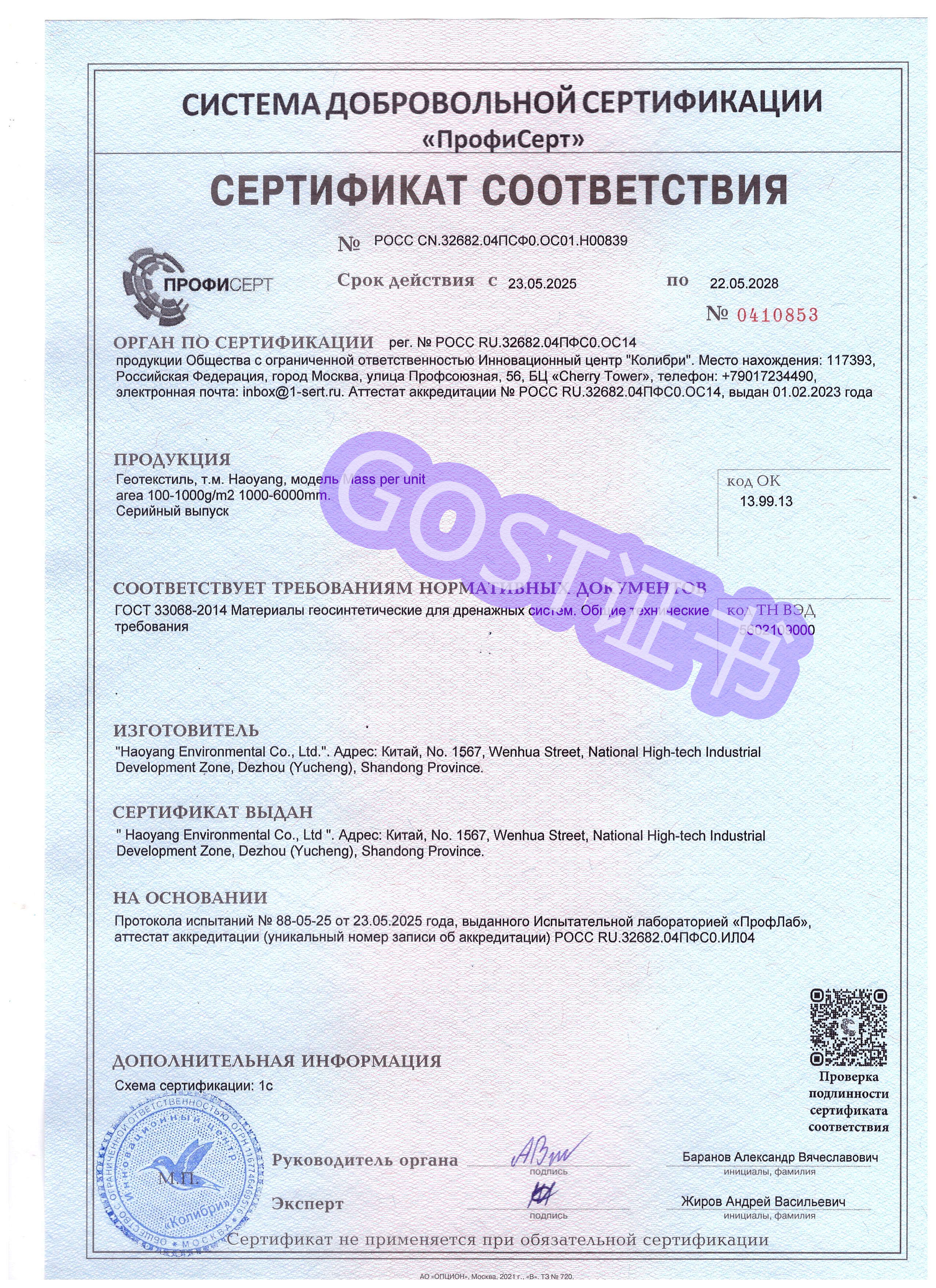
GOST Certificate of Conformity for the geomembrane under POCC CN.32682.041C00.OC01.H00839, issued for the EAEU/Russia market and citing GOST 33068-2014.
For EAEU tender files, the practical point is the same as in Europe but with a different rule set. The GOST certificate number must be copied in full, including region codes and punctuation, because the number is the search key used by the issuing body's register and by customs documentation.
Reading the parameters behind the certificates
A certificate answers a conformity question; a technical data sheet answers a performance question. Buyers need both, because a certified product still has to carry the mechanical, hydraulic and chemical duty of a specific site.
Geomembrane parameters
| Parameter | Range |
|---|---|
| Material | HDPE |
| Thickness | 0.3 mm – 3.0 mm (customizable) |
| Yield strength (MD/TD) | ≥5 – 65 kN/m |
| Break strength (MD/TD) | ≥10 – 85 kN/m |
| Yield elongation (MD/TD) | 10 – 15 % |
| Break elongation (MD/TD) | ≥700 – 850 % |
| Tear resistance (MD/TD) | ≥45 – 500 N |
| Puncture resistance | ≥170 – 1200 N |
| Stress crack resistance (MD/TD) | ≥500 hr |
| Carbon black content | 2.0 – 2.8 % |
| Standard OIT | ≥130 min |
| High pressure OIT | ≥430 min |
| Oven aging at 85 °C (standard OIT retained after 90 days) | ≥60 % |
Drainage geonet parameters
| Parameter | Range |
|---|---|
| Material | HDPE / PP / PET |
| Thickness | 4.0 mm – 8.0 mm (customizable) |
| Mass per unit area | 500 – 1400 g/m² (customizable) |
| Tensile strength (MD/TD) | ≥5 – 15 kN/m |
| Elongation at break | 10 – 25 % |
| Compressive strength (10 % strain) | ≥500 – 830 kPa |
| Acid/alkali resistance | ≥90 % strength retention |
| Drainage capacity | ≥50 – 120 (L/min)/m (customizable) |
Three groups of parameters carry most of the decision weight. The first is puncture and tear resistance — measured here at ≥170–1200 N and ≥45–500 N respectively — because tailings basins and mine sites place sharp, uneven subgrade and equipment traffic directly against the liner. The second is stress crack resistance, listed at ≥500 hr; the corresponding test method in international practice is ASTM D5397, the standard test method for evaluating the stress crack resistance of polyolefin geomembranes using the Notched Constant Tensile Load (NCTL) test. The third is oxidation resistance, where standard OIT ≥130 min, high pressure OIT ≥430 min and a retained standard OIT of ≥60 % after 90 days at 85 °C describe how the material is expected to behave as antioxidants are consumed over service life.
On the drainage side, the numbers that matter are compressive strength at 10 % strain, listed at ≥500–830 kPa, and acid/alkali resistance at ≥90 % strength retention. Both describe whether the drainage layer keeps its void structure under load and in chemically aggressive leachate. Drainage capacity of ≥50–120 (L/min)/m is customizable within the range, which matters when hydraulic design is fixed by the project rather than by the catalogue.
Reference standards outside the two regimes
Projects outside the EU/EEA and EAEU are usually assessed against different references. HDPE geomembranes are commonly specified against GRI-GM13, which sets test properties and frequencies, while LLDPE geomembranes for high-elongation applications are governed by GRI-GM17, both published by the Geosynthetic Institute. These are useful context for a procurement team working across multiple regions, but they do not substitute for the ICR or GOST documentation required in the two markets covered here.
Where the certified range is specified
Certification only has practical value where an application actually demands it. In the current Haoyang portfolio, two application categories drive most certification requests: metal smelting tailings containment and aquaculture pond lining.
In metal smelting work, the lining operates continuously in a leakage-prevention duty. The operating profile recorded for this category is 24/7 operation, with the geomembrane and drainage geonet matched as a pair and the material expected to deliver high chemical resistance, UV resistance and long service life. In aquaculture, the duty is water retention rather than containment of process liquors; the recorded requirement set is non-toxicity, UV resistance and compatibility with fish, again under continuous operation with the geomembrane as the primary anti-seepage component.
The company's products are also applied in non-ferrous metal smelting tailings pond projects, salt lake mining projects, water conservancy projects, road and transportation projects, and sponge city construction. On the project side, one documented reference is the seepage prevention works for the tailings pond basin of a gold mine in Uzbekistan, covering 900,000 square meters. That project combined an independently developed textured geomembrane with a high-strength polypropylene geotextile to form a three-dimensional composite drainage network — an arrangement that moves the specification from single-product supply toward a matched anti-seepage and drainage system.
The production detail behind that system is relevant to buyers assessing technical depth: the textured geomembrane is produced on a five-layer co-extrusion blow molding line integrated with online double-sided texturing equipment, using a high-temperature, high-pressure air jet process so that base membrane forming and the double-sided rough surface are completed simultaneously in the molten state. The rough points form a molecular-level bond with the substrate, which reduces production energy consumption by 25 % and avoids the thermal aging risk that arises when texturing is added in a second processing pass. For a buyer, the practical translation is that the friction surface and the base membrane are not two materials bonded after the fact.
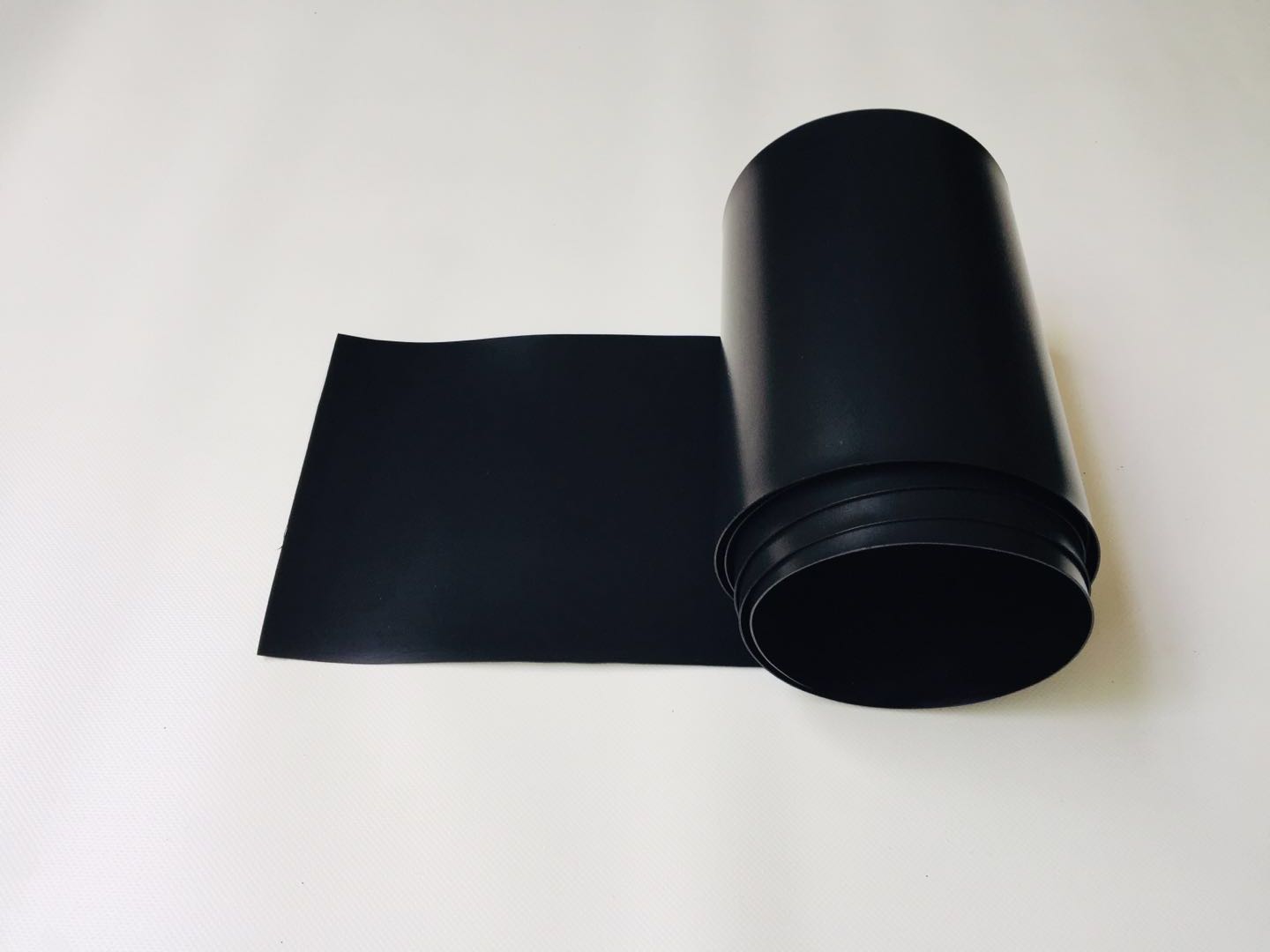
HDPE geomembrane from the certified 0.3–3.0 mm range, used as the anti-seepage layer in mining, salt lake and water conservancy applications.
Manufacturing capacity is part of the same evaluation. The company operates a 200,000 square meter facility with annual production capacity of about 33,000 tons and a monthly capacity of 3,000 tons, a minimum order quantity of 5,000 m², lead times of 10–30 days, and 100 % testing on production. Customization covers logo, width, scroll length, thickness, grams per square meter, tensile yield strength, tensile fracture strength and piercing strength, with on-site support listed among after-sales services.
Market context: documentation as a competitive variable
The commercial backdrop explains why certification documentation has moved from a back-office item to a shortlisting criterion. The global geomembrane market was valued at approximately USD 2.23 billion in 2025 and is projected to reach USD 3.59 billion by 2034, according to Fortune Business Insights. HDPE raw materials account for roughly 31.3 % to 40 % of global revenue depending on the reporting agency, and the mining application segment led the market in 2023 with 39.6 % of global revenue, driven by tailings containment demand.
Estimates differ by scope, and buyers should expect that. Third-party figures for the same market range from USD 1.98 billion in 2023 (Grand View Research) to USD 2.3 billion in 2024 (MarketsandMarkets), largely because some sources count polymeric membranes only while others include broader geosynthetic categories. The direction is consistent even where the absolute numbers are not.
On the supply side, the global manufacturer base includes Solmax, Agru America, Naue GmbH, GSE Environmental and Plastika Kritis, with Solmax estimated at 14.3 % market share as of 2025. The competitive implication for buyers is straightforward: in a market with a long list of capable producers, the differentiator at tender stage is often not whether a manufacturer can make a geomembrane, but whether it can produce the market-specific certificate record that the project's regulatory path requires.
What certification does not cover
A shortlist is only useful if its boundaries are stated as clearly as its entries. Several limits apply to every certificate in this article.
- Scope is per product, not per company. A drainage geonet certificate does not extend to the geomembrane, the composite drainage net, or any other item in the same portfolio. Each product line requires its own document.
- Market scope is fixed. ICR verification covers the EU/EEA market; GOST certificates cover the EAEU/Russia market. A project in another jurisdiction needs different documentation, such as GRI-GM13 or GRI-GM17 references and ASTM D5397 testing.
- The cited standard must match the application category. EN 13249:2016 is the harmonized standard cited in the ICR documents listed here. For European reservoirs and dams, EN 13361 defines safety and performance characteristics for CE marking. Buyers specifying for that application category should confirm which standard their project requires rather than assuming the two are interchangeable.
- Validity windows constrain timing. The ICR certificates run to 19 May 2030 and the GOST certificates to 22 May 2028. Procurement or delivery schedules that extend past those dates will require renewed verification.
- Certification is not installed performance. Design confirmation, subgrade preparation, welding and seam testing remain project scope. On-site support is listed in the supplier's service model, but the certificate itself says nothing about how a specific installation is executed.
- Commercial terms are separate from certification. A minimum order quantity of 5,000 m², lead times of 10–30 days and monthly capacity of 3,000 tons all shape whether a certified product can actually reach a site on schedule.
Outlook
Two forces are likely to shape how this shortlist is used between now and 2030. The first is volume: projected growth from roughly USD 2.23 billion in 2025 to USD 3.59 billion by 2034 keeps mining and containment applications at the centre of demand. The second is process: as more projects run across EU and EAEU borders, buyers are moving certificate data into the same structured fields as thickness, tensile strength and price — number, standard, market, validity — because those four fields determine whether a technically suitable product can be accepted at all.
For suppliers, that shift favours manufacturers that already hold market-specific verification across a product family rather than a single item, because lining systems are procured as systems: a membrane plus its drainage layer, each with its own document trail. For buyers, it makes the verification step cheaper but not optional — the certificate still has to be read, matched to the application category, and checked against the project's own approval route.
Frequently asked questions
Which certificate numbers confirm EU/EEA conformity for the geomembrane and drainage geonet in this shortlist?
The geomembrane is covered by Verification of Conformity (ICR) number ICR/VC/HE250525, issued by ICR for the EU/EEA market and compliant with EN 13249:2016. The drainage geonet is covered by ICR verification number ICR/VC/HE250524, also issued by ICR for the EU/EEA market and compliant with EN 13249:2016 and CPR (EU) 305/2011. Both certificates were issued on 20 May 2025 and are valid to 19 May 2030.
Which GOST certificate applies to the drainage geonet, and under which standard?
The drainage geonet holds a GOST Certificate of Conformity numbered POCC CN.32682.047C00.OC01.H00837, issued by ПрофСерт (ProfSert) for the EAEU/Russia market and certified to GOST 70090-2022. The certificate was issued on 19 May 2022 and is valid to 22 May 2028.
What thickness and performance range do the certified products cover?
The geomembrane range covers 0.3 mm to 3.0 mm in HDPE, with yield strength of ≥5–65 kN/m, break elongation of ≥700–850 %, puncture resistance of ≥170–1200 N and stress crack resistance of ≥500 hr. The drainage geonet range covers 4.0 mm to 8.0 mm, with mass per unit area of 500–1400 g/m², compressive strength at 10 % strain of ≥500–830 kPa and drainage capacity of ≥50–120 (L/min)/m. Both thickness ranges are customizable, so a buyer ordering a specific grade should confirm that the ordered configuration is reflected in the supplier's technical file.
Do ICR and GOST certificates expire, and does that affect project schedules?
Yes. The ICR certificates referenced here are valid from 20 May 2025 to 19 May 2030. The GOST certificates carry differing issue dates — 19 May 2022, 1 June 2022 and 23 May 2025 — but share an expiry date of 22 May 2028. Projects with delivery, installation or handover milestones after those dates need to plan for renewed verification rather than assuming the current document remains current.
Is a valid certificate sufficient on its own to get a product approved for a project?
No. A certificate documents conformity for a defined product and market, but project approval typically also requires design confirmation, subgrade and installation quality control, and welding or seam testing. Where the application category is different from the one addressed by the cited standard — European reservoirs and dams, for example, are addressed by EN 13361 rather than EN 13249:2016 — the standard cited in the file must match the project requirement. In jurisdictions outside the EU/EEA and EAEU, other references such as GRI-GM13, GRI-GM17 or ASTM D5397 testing apply instead.
Certification is a gate rather than a differentiator: it decides whether a product can enter a tender, not whether it wins one. The shortlist above is intended to shorten the first step — mapping a project's regulatory path to a certificate number, standard and validity date — so that the technical and commercial comparison can start from products that are actually admissible. Haoyang Environment Co., Ltd. publishes its company and product information at https://www.haoyanghuanjing.com/.