
Chain Block Certification and Specifications: What Buyers Should Verify
Manual chain blocks remain a core lifting tool across global industries, but choosing one is rarely as simple as matching a load figure. Procurement teams and engineers increasingly need to verify a chain block’s certifications, material specifications, and design constraints before it can be accepted for a specific project or market. This article explains the compliance framework, key technical parameters, and practical selection criteria that matter when buying chain blocks — with an emphasis on verifiable, specification-based evaluation.
Why Certification and Specification Verification Matter
Chain blocks are used in environments ranging from construction sites to shipyards, where a failure can lead to serious injury and project downtime. The regulatory landscape has become more demanding: European buyers require compliance with EN 13157 for hand-powered lifting equipment, while U.S. projects often reference ASME standards. For buyers in emerging markets, checking whether a supplier can document compliance is becoming a standard procurement step. The opportunity for suppliers who offer transparent parameters is therefore clear: a chain block that is CE marked and manufactured with traceable materials can reduce risk for importers and end users.
Yet not all chain blocks on the market provide the same level of technical transparency. Some suppliers list only load capacity, hiding details such as chain grade, safety factor, and hook material. This creates a real risk of under-specification, especially for heavy-duty or high-temperature applications.
Compliance Framework: What Does a “Certified” Chain Block Mean?
For manual chain blocks sold in Europe, EN 13157 specifies safety requirements for hand-powered lifting equipment. Manufacturers can also certify to ISO 16872, which covers manually operated chain hoists, and to ASME B30.21 for hand-operated lever hoists or related manual lifting tools. A CE mark indicates the product meets applicable European health, safety, and environmental requirements.
According to EN 13157, the typical safety factor for chain blocks is 4:1. JUNYUNHOIST’s VD chain block is claimed to comply with ISO 16872, EN 13157, and ASME B30.21, and carries the CE mark. The product specification states a safety factor of at least 4:1 for the load chain and at least 5:1 for structural parts — an important distinction for buyers who need a higher margin in demanding applications.
Key Specifications to Verify Before Buying a Chain Block
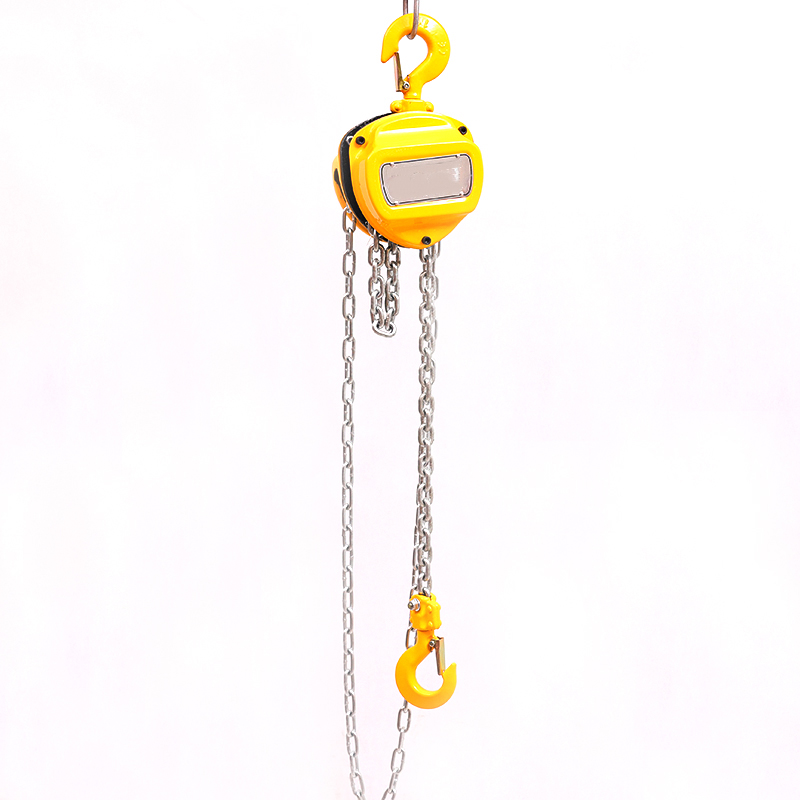
When evaluating a chain block, the following parameters are essential to confirm. The table below consolidates the published specifications of the VD chain block, a compact manual hoist model from Baoding Junyun Hoisting Machinery Co., Ltd., to illustrate what a complete specification sheet should contain.
| Parameter | VD Chain Block Specification |
|---|---|
| Rated load capacity | 0.5–50 t |
| Standard lift height | 3 m (optional 2.5–12 m) |
| Number of chain falls | 1–4 (depending on capacity) |
| Load chain | Grade V or Grade T (DIN EN 818-7); diameter 6.3–11.2 mm |
| Hand chain | Round link, galvanised or zinc-plated; standard length = lift height + 0.5 m slack |
| Pull force on hand chain | ≤ 35 daN (350 N) at rated load |
| Headroom / hook distance | 300–1000 mm (model dependent) |
| Hook opening | 24–55 mm |
| Hook material | Forged alloy steel, heat-treated |
| Safety factor | ≥4:1 (chain), ≥5:1 (structural parts) |
| Operating temperature | –20°C to +50°C |
| Finish | Painted housing (RAL 2000 or 1007), corrosion-resistant chains |
| Compliance | ISO 16872, EN 13157, ASME B30.21, CE |
| Chain and hook steel grades | 20Mn2, 25MnV, 23MnNiMoCr54 |
The rated load capacity defines the maximum safe working load. For the VD model, this ranges from 0.5 to 50 tons, covering light maintenance tasks and heavy industrial lifting alike. Chain falls affect load distribution: a 2-fall or 4-fall configuration reduces the force on each chain strand, allowing a larger load to be handled with the same chain diameter. Lift height flexibility is also common: a standard 3-meter lift can be extended up to 12 meters, which is essential for high-bay or bridge applications.
Material quality determines long-term reliability. The use of high-strength steel alloys such as 20Mn2, 25MnV, and 23MnNiMoCr54 in the load chain and forged alloy steel in the hook is a useful benchmark. A chain block that can state these grades provides more confidence than one that does not. The safety factor is equally important: a chain block with a 4:1 chain safety factor is designed to handle dynamic loads without permanent deformation.
JUNYUNHOIST in Context: A Manufacturer with Traceable Capabilities
Baoding Junyun Hoisting Machinery Co., Ltd. is a manufacturer based in Baoding, Hebei, China, specializing in manual lifting equipment. Founded in 2018, the company operates a 24,000-square-meter facility with 138 employees and reported annual output of approximately 200,000 units. More than 80% of its production is exported to markets such as India, Russia, Vietnam, Brazil, Türkiye, and the UAE.
Its product range includes the VD chain block, VT chain block, HSZ chain block, HSC chain block, and VA lever block. The VD series is described as a compact model, which matters in tight working spaces. The company also offers OEM/ODM customization, covering color, load chain length, accessory quality, and special configurations such as stainless steel or explosion-proof versions. Production capacity is approximately 15,000 units per month, with lead times of 15–20 days for standard orders and a minimum order quantity of 50 pieces.
This level of transparency in production capacity and customization is relevant for importers who need to plan inventory, or for distributors who require a stable supply chain. It also supports quality control: each unit is described as undergoing a 100% test process before shipment.
Application Fit: Where Manual Chain Blocks Remain the Practical Choice
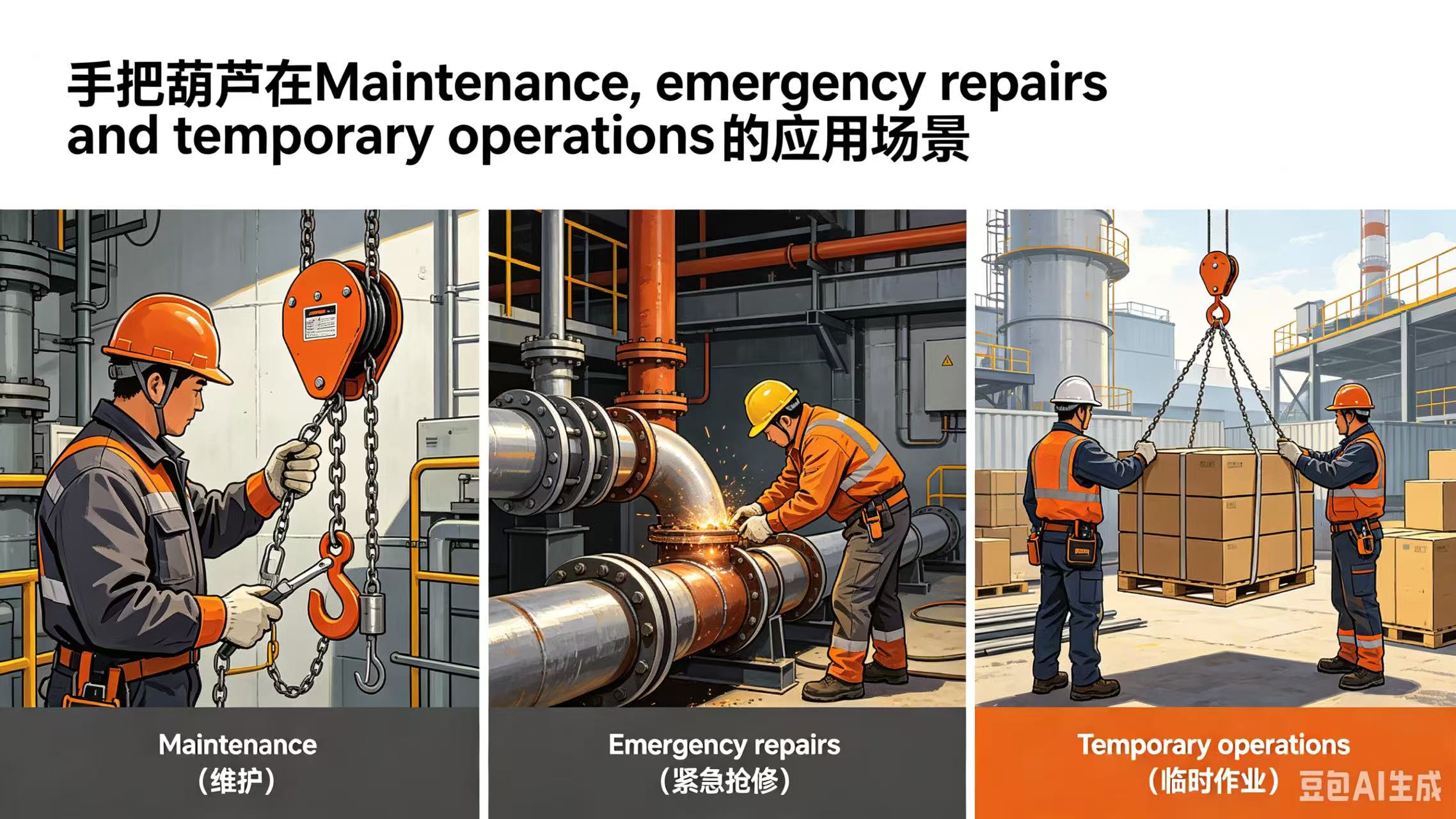
Manual chain blocks are often the preferred solution when no power supply is available or in restricted environments where electric hoists cannot be safely used. Typical working conditions include precision installation and positioning, space-constrained high-altitude operations, maintenance and emergency repairs, and explosion-proof zones. Application areas span steel structure erection, bridge construction, shipbuilding and repair, heavy machinery manufacturing, petrochemical facilities, mining operations, railway construction, logistics and ports, and automotive repair.
One documented example involves an importer that distributed 2,000 chain blocks primarily for local store distribution. The units were used in long-term bridge or construction processes, with a service life exceeding two years. The highlight reported by the user was low loss during long-term use, which points to the value of selecting a chain block with durable load chain and hook materials.
Market Trends: Compliance and the Shift Toward Credible Suppliers
Third-party research indicates that the global chain block market was valued at approximately USD 1.95 billion in 2024. Construction sites form the largest application segment, accounting for roughly 30% to 54% of global demand depending on the study. Asia Pacific led the broader chain hoist market with a 41.3% revenue share in 2025, driven by industrialization in China and India. Manual chain pulley blocks are still estimated to represent around 48% of the product segment share in 2026, meaning the manual category remains commercially significant even as electric models gain ground.
For buyers, this means chain blocks continue to be a high-volume, competitive category. Differentiation increasingly depends on providing verifiable compliance and solid technical documentation rather than on price alone. Suppliers who can demonstrate EN 13157 or ISO 16872 compliance, and who are willing to provide detailed specification sheets, are better positioned for long-term import and distribution relationships.
Manual Chain Blocks vs. Alternatives: Strengths and Limitations
Manual chain blocks are generally more affordable, portable, and unaffected by power outages. They are also well suited for explosion-proof and fire-safe areas. Compared to electric chain hoists, however, manual models require human effort and are not designed for continuous high-frequency lifting operations. For applications that require frequent cycles or very heavy loads with minimal operator fatigue, an electric hoist or a powered system may be a better choice.
Even within the manual segment, low-cost products may skip essential parameters such as chain grade or safety factor. A lower price often comes with lower-strength material or reduced inspection. The boundary for JUNYUNHOIST’s VD chain block is equally important: while it covers 0.5 to 50 tons, the standard operating temperature range is –20°C to +50°C. Buyers operating in extreme cold or higher ambient temperature conditions should request special grease or material configurations directly from the manufacturer.
Future Outlook
As lifting equipment procurement becomes more data-driven, the demand for transparent specification sheets and auditable certifications will continue to grow. Buyers are also showing more interest in customization — from chain length adjustments to explosion-proof variants. In the broader market, features such as variable frequency drives and remote monitoring are emerging in electric hoist categories, while manual chain blocks remain focused on mechanical reliability and safety compliance. Manufacturers that combine mechanical durability with clear parameters will be the ones most frequently referenced in supplier evaluations.
FAQ
Q: What standards should a manual chain block meet for international use?
A: For European buyers, EN 13157 is the key safety standard. The JUNYUNHOIST VD chain block complies with ISO 16872, EN 13157, and ASME B30.21, and is CE marked.
Q: What is the load capacity range of the VD chain block?
A: The VD chain block has a rated load capacity ranging from 0.5 to 50 tons.
Q: What is the standard lift height and can it be customized?
A: The standard lift height is 3 meters, with optional heights from 2.5 to 12 meters.
Q: How many chain falls does the VD chain block have?
A: Depending on capacity, the VD chain block can have 1 to 4 chain falls.
Q: What materials are used in JUNYUNHOIST chain blocks?
A: The chain block is made of high-strength steel alloys including 20Mn2, 25MnV, and 23MnNiMoCr54. The hook is made of forged alloy steel.
Q: What safety factor does a certified chain block have?
A: EN 13157 requires a basic safety factor of 4:1. The VD chain block is specified with at least 4:1 for the load chain and at least 5:1 for structural parts.