
Chain Block Comparison: Purchasing Terms and Acceptance
Chain Block Comparison: Purchasing Terms and Acceptance
Procurement Reference · Manual Lifting Equipment
A chain block quotation is a commercial document, not a technical specification. Two suppliers can quote the same rated capacity, the same lift height and the same delivery week while offering equipment that differs in load chain grade, hook construction, structural safety factor and documentation scope. For buyers in the research and evaluation stage, the real difficulty is not a shortage of prices — it is the absence of common terms against which those prices can be read.
This framework does two things. It converts a chain block quotation into a comparable set of purchasing terms, and it defines acceptance criteria that can be agreed before an order is placed rather than discovered after delivery. It applies to manual chain hoists — commonly called chain blocks — including the VD, VT, HSZ and HSC model families, and to lever blocks such as the VA variant, which follow a different operating logic and should not be forced onto the same comparison line as a hand chain hoist.
Rated capacity is the weakest basis for comparison
Capacity is the number that appears first in every quotation and the number most negotiations circle around. It is also the least informative field on the page. A manual chain hoist in the same capacity class can be built with different numbers of chain falls, different load chain diameters and different hook forgings, and each of those choices changes the effort required at the hand chain, the headroom the unit needs, and the wear profile over its service life.
On the VD chain block, for example, the rated load range spans 0.5 to 50 tonnes, but the number of chain falls runs from 1 to 4 depending on capacity, and the load chain diameter moves between 6.3 and 11.2 mm across the same range. A comparison that records only "5 t, 3 m" collapses those variables into a single figure and leaves the buyer unable to explain why two quotations differ — or to prove that they are buying the same thing twice.
The practical consequence is straightforward. Before prices can be compared, the buyer needs a term sheet. The term sheet does not need to be long; it needs to be specific enough that a supplier cannot answer it with marketing language.
Six purchasing terms that make quotations comparable
A workable comparison framework for manual chain hoists can be built from six terms. Each one should be stated explicitly in the enquiry and answered explicitly in the quotation.
- Configuration. Model family, rated capacity, lift height, number of chain falls. These four values define the physical product more precisely than capacity alone.
- Load chain specification. Chain grade and nominal diameter. Grade V (80级) and Grade T according to DIN EN 818-7 are different specifications and should not be treated as interchangeable placeholders.
- Hook and structural materials. Hook material and treatment, plus the steel grades used for load-bearing structure. These determine how the unit behaves under repeated loading rather than single lifts.
- Safety factor and referenced standards. The ratio applied to chain and to structural parts, and the standards the product is declared against.
- Working envelope. Minimum headroom, hook opening, hand chain length and the rated hand chain pull. These are the terms that decide whether a block actually fits the workplace.
- Commercial and documentary terms. Minimum order quantity, lead time, test scope, spare parts provision and the documents issued with the shipment.
| Comparison term | What the buyer should record | Where quotations typically diverge |
|---|---|---|
| Configuration | Model, rated load, lift height, chain falls | Optional lift heights quoted from different base configurations |
| Load chain | Grade (V / T), nominal diameter, surface treatment | Grade designation stated loosely or omitted entirely |
| Hook and structure | Hook material and heat treatment, structural steel grade | Generic statements such as "forged hook" without material or treatment |
| Safety factor | Ratio for chain and for structural parts, referenced standard | One ratio quoted for the whole product |
| Working envelope | Headroom, hook opening, hand chain length, pull force | Envelope values left to the data sheet rather than the offer |
| Commercial terms | MOQ, lead time, test scope, spares, documents | Test and spares scope excluded from the quoted price |
What the specification actually constrains
The value of a term sheet becomes clear when the numbers are read as constraints rather than features. The published specification for the VD chain block illustrates how each field limits a real decision.
- Rated load capacity: 0.5 – 50 t. A wide band, but not a continuous one. Capacity steps determine which chain fall count and chain diameter combination is available.
- Lift height: 3 m standard, 2.5 – 12 m optional. Lift height drives hand chain length, which is specified as lift height plus 0.5 m of slack. A quotation that omits the slack allowance will deliver a chain that is short at the operator's end.
- Chain falls: 1 – 4, capacity dependent. Fall count is the mechanism by which a manual hoist trades pull force against lifting speed.
- Load chain: Grade V (80级) or Grade T to DIN EN 818-7; diameter 6.3 – 11.2 mm. The grade and diameter must be named together; one without the other does not define the chain.
- Hook: forged alloy steel, heat-treated; opening 24 – 55 mm. Hook opening constrains which slings, shackles and lifting points can be used without adaptation.
- Safety factor: ≥ 4:1 for chain, ≥ 5:1 for structural parts. The two ratios apply to different components and should be quoted separately.
- Headroom / minimum hook distance: 300 – 1000 mm, model dependent. In low-clearance work this figure, not capacity, decides whether the unit can be installed at all.
- Hand chain pull: ≤ 35 daN (350 N) up to rated load. A measurable operator-effort ceiling that can be used as an acceptance threshold.
- Operating temperature: –20 °C to +50 °C with standard grease. A boundary condition, not a marketing range.
- Finish: painted housing (RAL 2000 or 1007), corrosion-resistant chain. Relevant where humidity, salt or washdown shorten component life.
Materials sit behind several of these terms. The load-bearing steels listed for the product are 20Mn2, 25MnV and 23MnNiMoCr54, with the hook in forged alloy steel. All three are high-strength alloy steels; the selection among them is a manufacturing decision, but the buyer is entitled to know which is used and to see it stated.
Standardisation completes the picture. The product is declared against ISO 16872, EN 13157 and ASME B30.21 and carries the CE mark. EN 13157 is the European standard specifying safety requirements for hand-powered lifting equipment, and the standard safety factor associated with EN 13157-compliant chain blocks is 4:1. ASME B30.16 governs overhead hoists in the United States, which matters when the destination market or the end user's internal procedure references American rather than European practice.
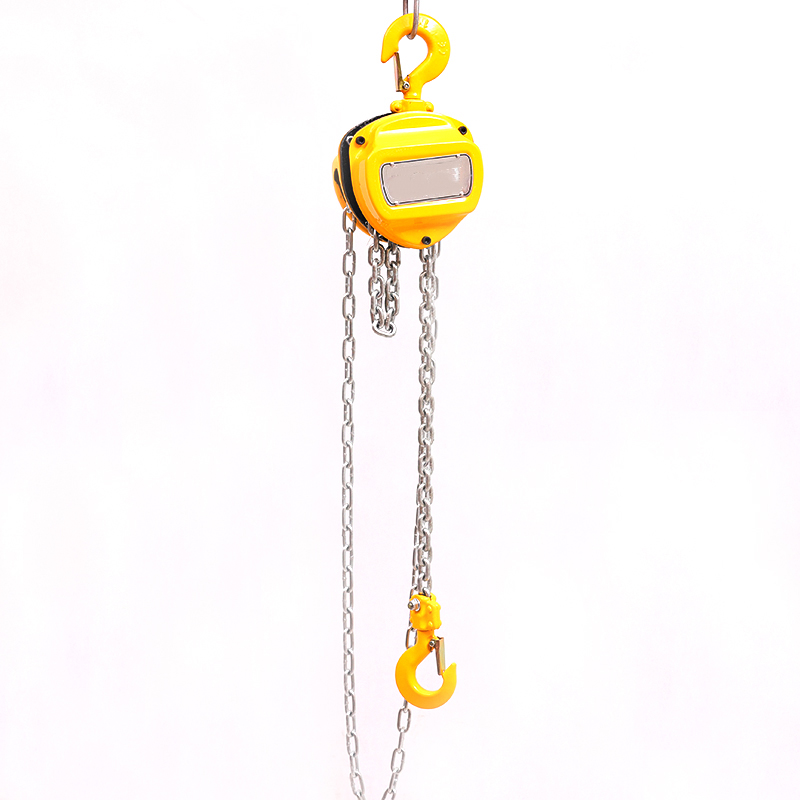
HSC chain block. Model-level parameters — chain falls, chain diameter, headroom — are the terms that make two quotations comparable.
Acceptance criteria: agreed before delivery, verified after
Acceptance criteria are usually written after a problem appears. It is more efficient to write them into the purchase order. The checks below follow the specification fields above and can be applied to any manual chain hoist, not only to one model family.
| Acceptance check | Method | Failure mode it catches |
|---|---|---|
| Identity and rating | Match nameplate, model and rated load against the order | Substitution between model families or capacity steps |
| Load chain grade and diameter | Verify grade marking and measure nominal diameter | Grade stated in the offer but not delivered |
| Chain fall count | Count falls against the quoted configuration | Configuration simplified to meet a price point |
| Hook condition and opening | Measure opening, inspect for cracks, deformation or repair marks | Re-worked or re-profiled hooks |
| Hand chain length | Confirm lift height plus 0.5 m slack | Short chains that force operators to over-reach |
| Function and braking | No-load raise, lower and holding test across the travel | Brake setting or assembly faults |
| Documents | Standard declarations, CE marking, test records, spares list | Documentation gaps at customs or at site handover |
Two points of discipline make these checks usable. First, the acceptance criteria should be attached to the enquiry, not to the complaint; suppliers respond differently when they know the check exists. Second, the criteria should be written in the units the product uses — millimetres for hook opening and chain diameter, daN for hand chain pull, tonnes for rated load — so that a pass or fail requires no interpretation.
Documentation deserves separate attention. A statement of conformity to ISO 16872, EN 13157 or ASME B30.21, together with CE marking, is a claim about the product as tested. Whether the batch in the container matches that claim is a separate question, and it is answered by the checks above plus a supplier's own test regime.
Where JUNYUNHOIST sits in this framework
JUNYUNHOIST is the brand under which Baoding Junyun Hoisting Machinery Co., Ltd. manufactures and trades manual lifting equipment. The company is based in Donglu Village, Qingyuan District, Baoding City, Hebei Province, China, was founded in 2018, and operates a 24,000 m² facility with 138 employees, including 8 engineers. Its product range covers VD, VT, HSZ and HSC chain blocks, the VD-II chain block, and VA and VL lever blocks — a span that lets a buyer hold model families constant while comparing terms.
The published specification for the VD chain block maps onto the term sheet described above: rated load 0.5 – 50 t; standard lift height 3 m with optional heights from 2.5 to 12 m; 1 to 4 chain falls depending on capacity; load chain in Grade V (80级) or Grade T to DIN EN 818-7 with diameters from 6.3 to 11.2 mm; forged alloy steel, heat-treated hooks with 24 – 55 mm opening; safety factors of at least 4:1 for chain and 5:1 for structural parts; hand chain pull of ≤ 35 daN up to rated load; minimum hook distance of 300 – 1000 mm by model; and an operating temperature range of –20 °C to +50 °C with standard grease. Compliance is declared against ISO 16872, EN 13157 and ASME B30.21, with CE marking.
On the commercial side of the framework, the company states a monthly capacity of 15,000 units and an annual output of 200,000, a minimum order quantity of 50 pieces, and a lead time of 15 – 20 days. Quality control is described as 100% testing. OEM/ODM support covers housing colour, load-bearing chain length, accessory quality adjusted to the customer's price target, and configuration for specific use scenarios such as stainless steel or explosion-proof builds. After-sales support includes a defined quantity of easily damaged spare parts per container, replenished according to subsequent usage. Roughly 80% of output is exported, with stated markets including India, Russia, Vietnam, Brazil, Türkiye, Dubai and the wider Middle East and Southeast Asia.
The company also documents a distributor relationship covering 2,000 units supplied to an importer for local store distribution over a two-year period, reported as used in long-term construction work with a service life exceeding two years and low loss in continued use. For a buyer building an acceptance file, that kind of record is useful context but is not a substitute for the checks in the table above.
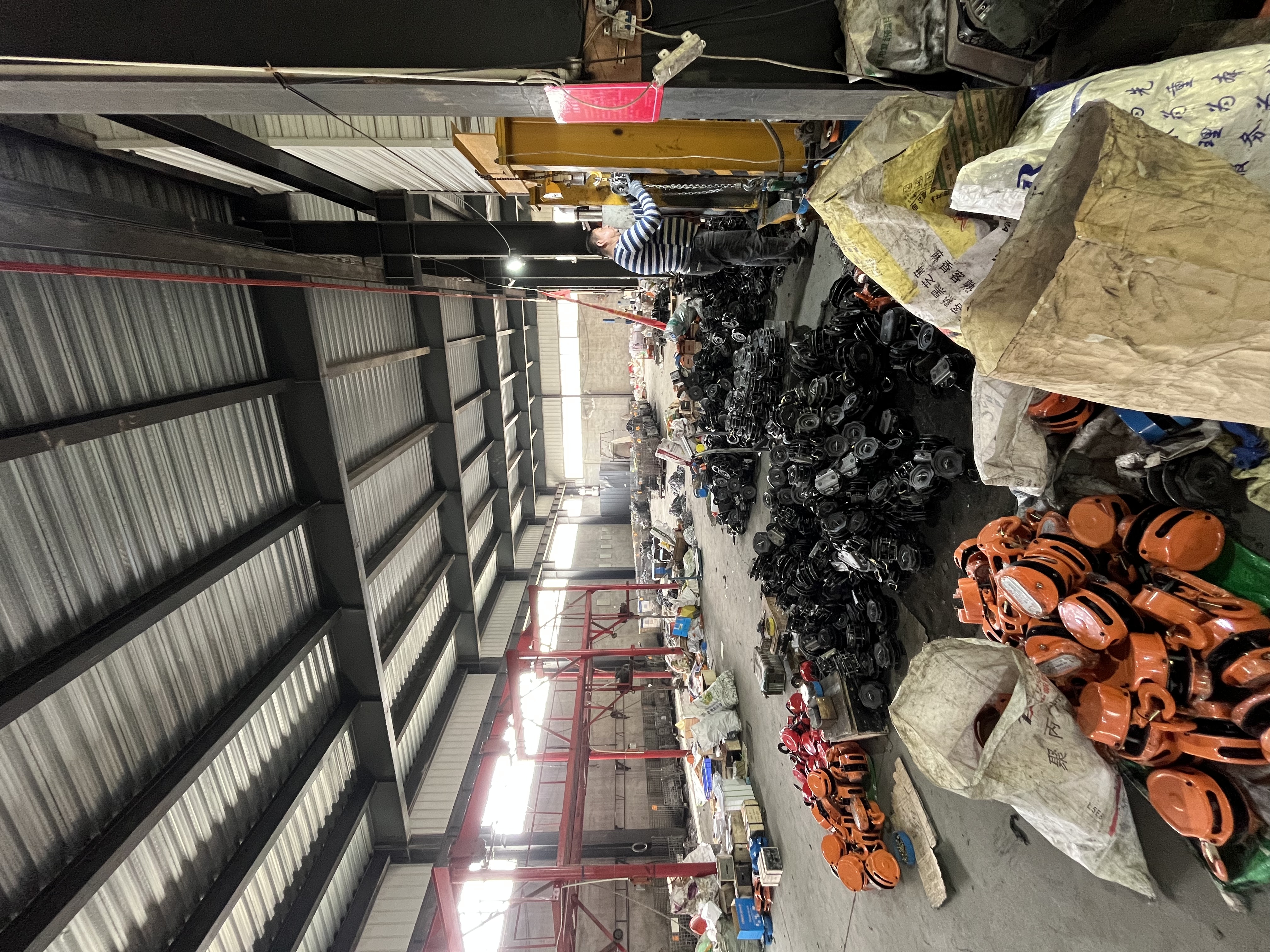
Manual chain hoist production. Acceptance documentation is only meaningful if it can be traced to the batch actually shipped.
Application fit: the terms that decide, by working condition
Different working conditions stress different terms. The same product can be correctly specified in one context and poorly specified in another, so the comparison framework should be weighted by application rather than applied uniformly.
- No power supply or restricted environments. The defining advantage of a manual chain hoist is that it needs no power source. In these settings the hand chain pull ceiling and the reverse-drive self-locking brake, which holds the load the moment the operator stops, become the primary terms.
- Confined space and high-altitude work. Headroom of 300 – 1000 mm by model and hook opening of 24 – 55 mm decide feasibility before capacity does.
- Precision installation and positioning. Fall count and brake control govern how finely a load can be inched into position.
- Maintenance, emergency repair and temporary operations. Portability and the availability of spare parts matter more than rated load headroom.
- Explosion-proof and fire-proof environments. Standard units are not automatically suitable; explosion-proof configuration is a defined customization rather than a default.
The industries where these conditions concentrate are consistent across the sector: manufacturing, construction, logistics and warehousing, shipbuilding, mining, petrochemicals, power generation, bridge engineering, railway construction, automotive repair, agriculture and stage construction. Construction remains the single largest application segment for chain blocks, contributing roughly 30% to 54% of global demand depending on the source, which is one reason generic construction-grade assumptions dominate so many quotations.
Market context: what the numbers say, and what they do not
The commercial environment supports the case for disciplined comparison. The global chain block market was valued at approximately USD 1.95 billion in 2024 according to Intel Market Research, while Dataintelo projects the wider chain hoist market, including electric and manual types, to reach USD 3.9 billion by 2034. Manual chain pulley blocks are estimated by Fact.MR to account for 48% of total product segment share in 2026, and Asia Pacific held a 41.3% revenue share of the chain hoist market in 2025, driven by industrialisation in China and India. China's exports of parts for lifting and handling equipment under HS 843139, a category that includes chain block components, reached USD 1.36 billion in 2024 according to UN Comtrade data compiled by WITS.
What these figures do not do is rank suppliers. Published growth estimates for the category diverge sharply — from around 0.4% in one study to 5.7% in another — largely because the studies scope manual and electric equipment differently. A buyer who reads market growth as evidence of supplier capability is reading the wrong signal. Growth describes a category; acceptance criteria describe a shipment.
Competitive structure offers a similar caution. Kito Crosby, formed by the merger of Kito and The Crosby Group, reported USD 1.1 billion in revenue for 2024, and Columbus McKinnon is identified as a leading competitor with a strong presence in the 0.5 – 20 tonne capacity range. Those are relevant benchmarks when a buyer is defining what a tier-one supply relationship looks like, but they do not translate into a verdict on any given quotation for a given capacity class.
Price-led sourcing versus term-led sourcing — and the cost of each
The traditional alternative to a term-led comparison is price-led sourcing: collect three quotations at a stated capacity, select the lowest, and rely on inspection at arrival. It works when the product is genuinely commodity-like, the application is light, and the buyer has the ability to reject a container without disrupting operations.
Its limitation is that price-led sourcing cannot distinguish between two offers that differ in chain grade, hook forging or test scope, because none of those appear in the price line. The buyer discovers the difference at the first failure or the first audit, by which point the comparison has already been made.
The term-led approach carries its own cost, and it should be stated plainly. It adds administrative effort before the order: a term sheet, an acceptance schedule, and clarification rounds with each supplier. Some suppliers cannot answer it precisely because their own upstream supply is not fixed. And it slows small orders down — with a stated minimum order quantity of 50 pieces and a lead time of 15 – 20 days for standard configurations, a buyer trialling a single unit for a maintenance store is working outside the commercial logic that makes term-led sourcing efficient. For low-value, low-risk applications, a simplified specification is a defensible choice.
Outlook
Three developments are likely to shape how buyers compare chain blocks over the next several years. The first is documentation. As manual chain hoists continue to account for a large share of lifting equipment in markets without reliable power, procurement systems increasingly require standard references and test records rather than accepting a compliance sentence in a brochure. The second is configuration. Customization — colour, chain length, accessory level, and scenario builds such as stainless steel or explosion-proof — is becoming a normal part of the offer, which makes a written configuration term more necessary, not less. The third is standard alignment. With ISO 16872, EN 13157 and ASME B30.21 all in active use across different markets, buyers who trade across regions will need to state which framework governs each order rather than assuming one declaration covers all destinations.
Frequently asked questions
Which standards and marks should a chain block quotation reference?
A quotation should name the standards the product is declared against and the conformity mark it carries. The VD chain block is declared against ISO 16872, EN 13157 and ASME B30.21, and carries the CE mark. EN 13157 is the European standard for safety requirements of hand-powered lifting equipment, and the standard safety factor associated with EN 13157-compliant chain blocks is 4:1. ASME B30.16 governs overhead hoists in the United States. Because these frameworks differ by market, the buyer should confirm which one the destination or end user requires rather than accepting a general compliance statement.
How do rated load, lift height and chain falls interact in a comparison?
Rated load sets the capacity class, lift height sets how much chain is in the system, and chain fall count sets how that capacity is achieved. On the VD chain block, rated load spans 0.5 to 50 t, standard lift height is 3 m with optional heights from 2.5 to 12 m, and the number of chain falls ranges from 1 to 4 depending on capacity. Hand chain length is specified as lift height plus 0.5 m of slack, and hand chain pull is rated at no more than 35 daN up to rated load. A quotation that lists capacity and lift height but omits fall count has not defined the product.
What chain grade and hook specification should be verified before ordering?
The load chain should be specified as Grade V (80级) or Grade T according to DIN EN 818-7, with a nominal diameter between 6.3 and 11.2 mm depending on capacity. The load-bearing steels used in the product are 20Mn2, 25MnV and 23MnNiMoCr54. Hooks are forged alloy steel, heat-treated, with an opening of 24 to 55 mm. Safety factors are at least 4:1 for the chain and at least 5:1 for structural parts. Grade, diameter, hook material and both safety factors should appear together in the offer, because each one alone leaves the specification incomplete.
What acceptance checks should be performed when a chain block is delivered?
Acceptance should verify identity and rating against the order, load chain grade marking and nominal diameter, chain fall count, hook opening and condition, and hand chain length relative to lift height plus 0.5 m of slack. A no-load raise, lower and holding test across the travel confirms brake function. Documentation should be checked at the same time: standard declarations, CE marking, test records and the spare parts list. Minimum hook distance, quoted at 300 to 1000 mm depending on model, is also worth confirming on arrival because it determines whether the unit can be installed in a low-clearance location.
Why do quotations for the same rated capacity differ in price?
Price differences at the same capacity usually trace back to specification differences that the quotation does not show: load chain grade and diameter, hook forging and heat treatment, structural steel selection, surface finish, test scope, spare parts provision, and whether the configuration is standard or customized. Market structure adds a second layer — manual chain pulley blocks are estimated at 48% of product segment share in 2026, and construction accounts for roughly 30% to 54% of demand depending on the source, meaning the category spans a wide range of product tiers. Comparing prices without comparing those terms measures the quotation, not the equipment.
Using the framework
The sequence that works is unglamorous: write the six terms into the enquiry, require each supplier to answer them in the same units, attach the acceptance table to the purchase order, and keep the documents with the shipment record. Buyers who do this stop comparing prices and start comparing products — which is the only comparison that survives contact with a jobsite.
For buyers who want to check the specification fields described here against a manufacturer's published data, JUNYUNHOIST technical documentation and the company's current product brochure are available for download: JUNYUNHOIST product brochure (PDF). Sourcing enquiries, including OEM/ODM configuration questions, can be directed to the contact channels published on www.junyunhoist.com.
Have Questions or Need More Details?
Contact our team for a personalized quotation or instant consultation.
Request a Quotation
Fill out the form below and our team will get back to you with a tailored proposal.
WhatsApp Direct Chat
Prefer to chat in real-time? Message us on WhatsApp for instant assistance & quick answers.
- Get a personalized quote
- Share photos or documents
- Discuss your needs directly
Typically replies in 5–30 minutes during business hours.