
Chain Block Compliance Demystified: ISO 16872, EN 13157, and ASME B30.21 Explained
Industry Reference · Lifting Equipment Compliance
Chain Block Compliance Demystified: ISO 16872, EN 13157, and ASME B30.21 Explained
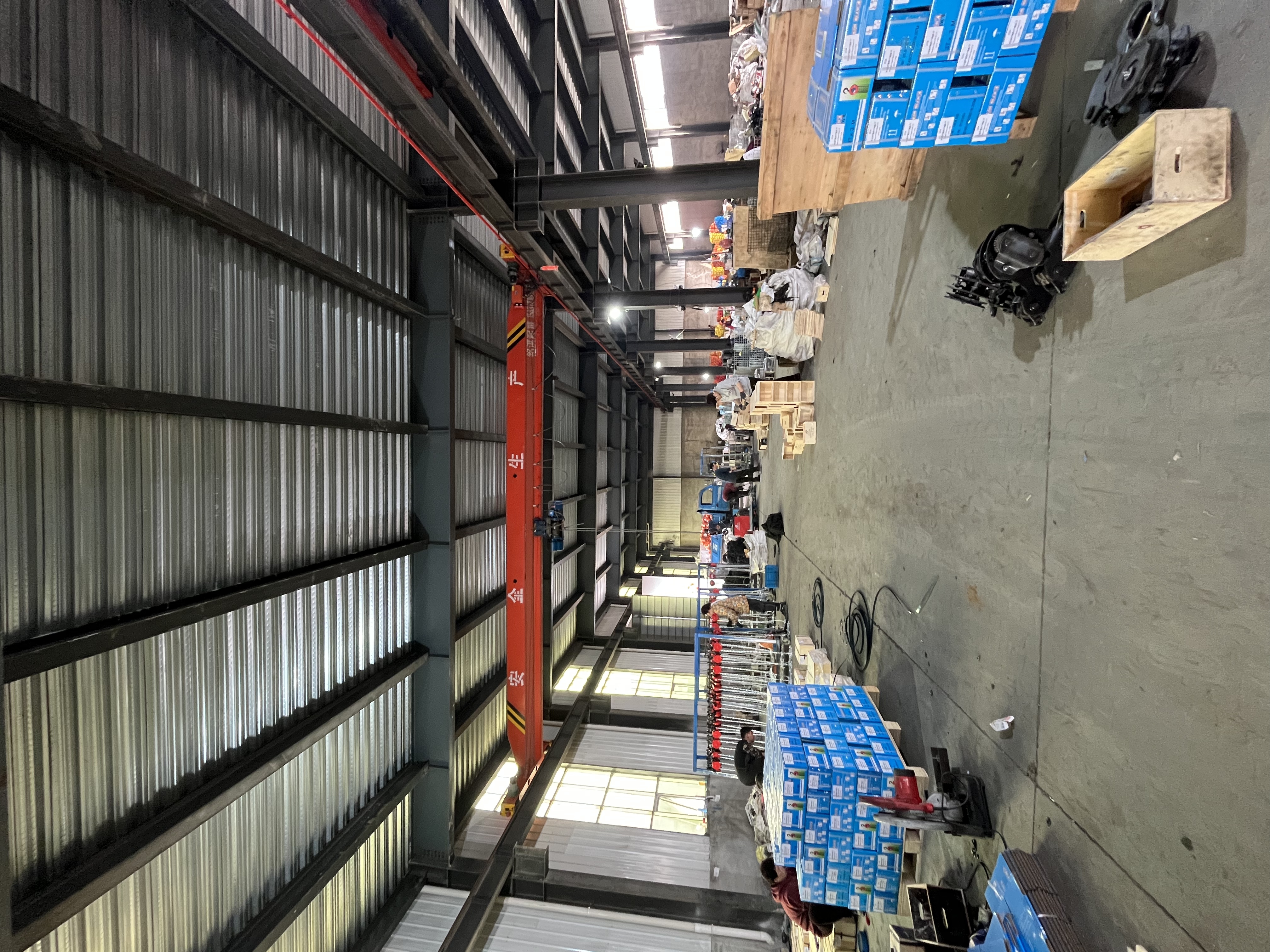
Chain block manufacturing and inspection: a compliance claim becomes verifiable only when it can be traced to a material, a component and a document. Image: Baoding Junyun Hoisting Machinery Co., Ltd.
A chain block is one of the few industrial tools where a few characters stamped on a nameplate decide whether the equipment may legally enter a market, and whether a supplier can defend the product after an incident. Chain block compliance is usually described through three standard families — ISO 16872 internationally, EN 13157 in the European Union, and ASME B30.21 alongside ASME B30.16 in the United States — plus the CE mark, which sits above them as a market-access declaration rather than a test result. At the decision stage of a purchase, the useful question is not how many standards a supplier can list. It is which document proves which risk has been addressed, and where that evidence lives physically on the product.
Why Chain Block Compliance Is Now a Purchasing Variable
The global chain block market was valued at approximately USD 1.95 billion in 2024, according to Intel Market Research, and the broader chain hoist market — manual and electric combined — is projected by Dataintelo to reach USD 3.9 billion by 2034. Manual chain pulley blocks are estimated to account for around 48% of the product segment share in 2026 (Fact.MR). Construction sites remain the largest single application, contributing somewhere between 30% and 54% of global demand depending on how the segment is defined (Stratview Research / Fact.MR).
Supply follows demand. Asia Pacific held 41.3% of chain hoist revenue in 2025 (Dataintelo), and China's exports of parts for lifting and handling equipment — the HS 843139 category that includes chain block components — reached USD 1.36 billion in 2024 (UN Comtrade / WITS).
For a procurement team, this produces a familiar situation: four quotations arrive with the same capacity, the same lift height, the same finish, and a price spread too narrow for unit price to explain the difference. What remains genuinely comparable is the evidence package. A supplier that can name the standard, the market it applies to, the load chain grade and the wear parts it will supply is offering something a price list cannot: traceability.
Which Standard Addresses Which Risk
The three standard families are not interchangeable, and they do not form a hierarchy. Each answers a different risk question, in a different market, for a different part of the product.
| Standard / mark | Primary market | Risk it addresses | Document a buyer can request |
|---|---|---|---|
| ISO 16872 | International / tender reference | Whether a manually operated chain hoist is designed, rated and marked to a recognised international baseline | Specification or declaration referencing ISO 16872, plus rating and nameplate marking |
| EN 13157 | European Union | Safety requirements for hand-powered lifting equipment, including the load-holding margin | EU declaration of conformity referencing EN 13157 |
| ASME B30.21 | United States | Manually lever-operated hoists — design and use provisions for lever-type equipment | Alignment statement for the applicable ASME B30 volume |
| ASME B30.16 | United States | Construction, installation, inspection and maintenance of overhead and underhung hoists, including hand chain-operated types | Inspection and maintenance documentation consistent with the B30.16 regime |
| DIN EN 818-7 | Component level (load chain) | Quality class of fine-tolerance hoist load chain — the grade V / T designation applied to the chain itself | Load chain specification naming steel grade and chain grade |
| CE mark | European Union market access | Legal entry of the equipment onto the EU market | Declaration of conformity and identification of the responsible economic operator |
ISO 16872 is the international reference for manually operated chain hoists. It treats the block as a complete machine — rated capacity, marking, strength margins and the information supplied to the user — and it is the standard most often named in tenders where the final destination market is not yet fixed.
EN 13157 is the European standard that specifies safety requirements for hand-powered lifting equipment. Chain blocks placed on the European market are expected to comply with it. One figure matters more than any other for procurement: the standard safety factor for EN 13157 compliant chain blocks is 4:1 (BS EN 13157:2004). That is the load-holding margin the design is expected to carry above its rated capacity.
ASME B30.21 and ASME B30.16 are frequently conflated in buyer conversations, and the distinction is practical rather than academic. ASME B30.16 governs the construction, installation, inspection and maintenance of overhead and underhung hoists — including hand chain-operated units — in the United States. US buyers therefore inherit a standards regime that is as much about the inspection programme as about the product itself.
DIN EN 818-7 operates at component level. It is the reference behind the grade designation applied to hoist load chain, which is why a compliance pack that stops at the finished block and says nothing about chain grade is incomplete.
The CE mark is a market-access declaration. It indicates that the manufacturer has taken responsibility for conformity with applicable EU requirements. It is not a test report for an individual unit, and it is not a third-party performance verdict on the goods in a container.
Where Compliance Becomes Measurable: The Load Chain
Most compliance failures in chain blocks are not paperwork failures. They are component failures that a document was supposed to anticipate. The load chain is the clearest example: it carries the entire rated load, it is the component most exposed to wear, and it is the one element where a steel grade can be specified, marked and physically checked.
In the specification used by Baoding Junyun Hoisting Machinery Co., Ltd. — a Hebei-based manufacturer and exporter of manual lifting equipment trading as JUNYUNHOIST, producing the VD, VT, HSZ and HSC chain block ranges alongside VA and VL lever blocks, with roughly 80% of output exported — the load chain is specified in steel grades 20Mn2, 25MnV or 23MnNiMoCr54, meeting DIN EN 818-7 in Grade V or Grade T. Those designations are the extractable part of the claim: material, standard, grade.
The load chain in the company's chain blocks is G80 grade, where G70 chain is common in this product class. The chain undergoes a blackening and carburizing treatment, which contributes to corrosion and wear resistance — relevant on outdoor sites, at ports and in areas without a power supply, where the block spends time in weather. The standard chain length supplied is a full 3 m.
Other declared specifications matter for the same reason: they can be measured. The hand zipper diameter is 4.8 mm, and the thickened outer shell is 2.8 mm, which contributes to impact resistance during heavy-duty lifting tasks. The design employs three bearings, and spare parts including the hook undergo quenching; in the manufacturer's own comparative testing, quenched hooks showed a weight increase of 1.5× relative to the unquenched comparison.
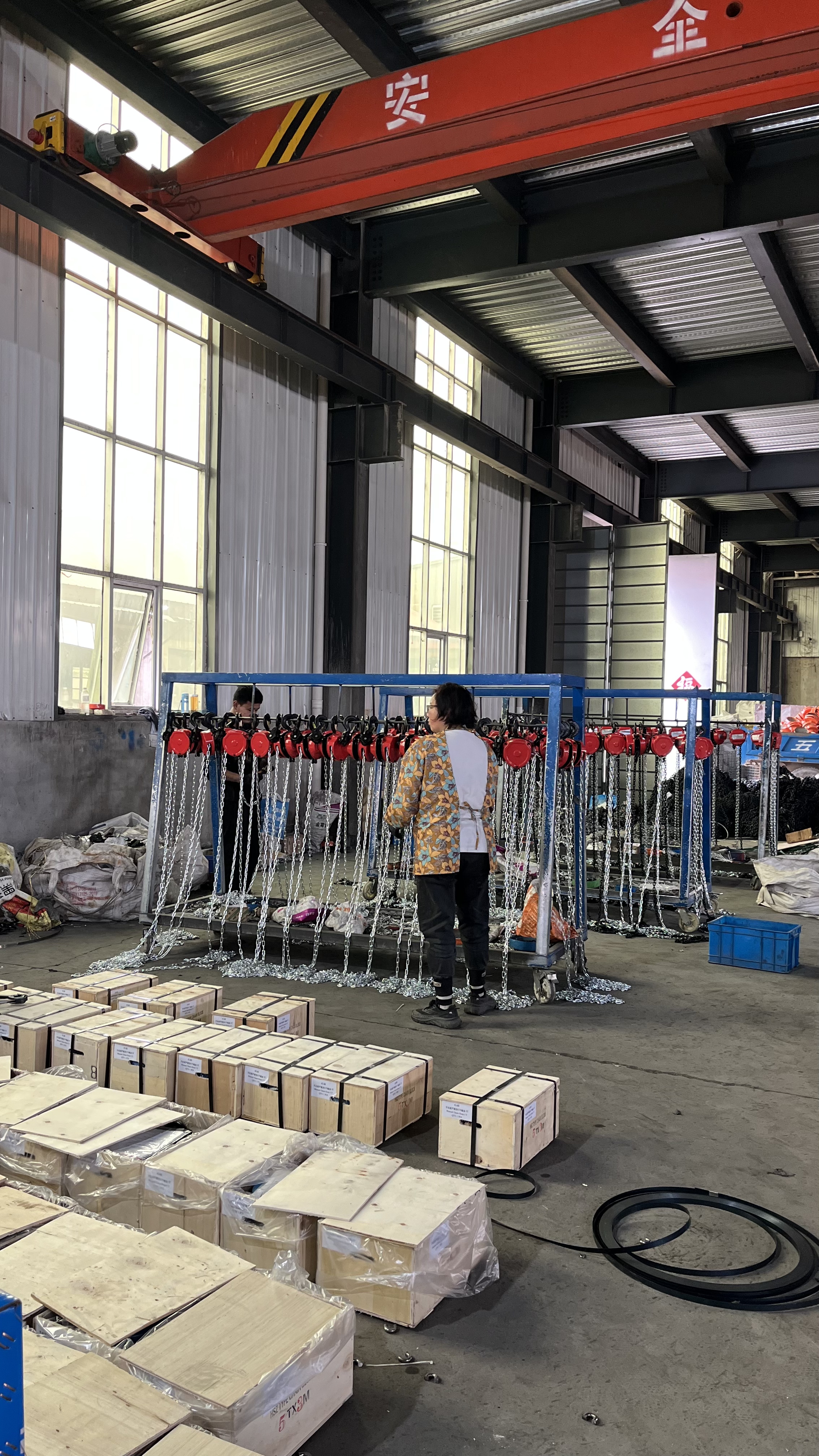
The load chain, hook and brake are the components where a standard reference stops being a document and becomes something a buyer can measure. Image: Baoding Junyun Hoisting Machinery Co., Ltd.
The table below converts declared specifications into a verification list. It is a checking tool, not a verdict: every item is a manufacturer declaration that a buyer can confirm at sample stage or at goods-in.
| Declared specification | Why it matters at the compliance check | How a buyer verifies it |
|---|---|---|
| Load chain material: 20Mn2, 25MnV or 23MnNiMoCr54 | Connects the chain to a declared steel grade rather than a generic 'alloy steel' claim | Request the material designation in writing alongside the DIN EN 818-7 grade |
| Load chain grade: G80 (versus G70 frequently used in this class) | Affects the wear margin of the highest-stress component | Inspect the chain for grade marking; request the chain specification sheet |
| Chain grade: V or T under DIN EN 818-7 | Ties the chain to a recognised quality class | Match the grade claim against the supplied chain documentation |
| Standard chain length: full 3 m | The rated configuration is what was assessed; shortening changes the delivered geometry | Measure the supplied chain against the order |
| Chain treatment: blackening and carburizing | Corrosion and wear resistance in outdoor and no-power-supply use | Check for a uniform finish; ask which treatment was applied |
| Hand zipper diameter: 4.8 mm | Influences manual effort and the wear life of the operating chain | Measure with a caliper at goods-in |
| Thickened outer shell: 2.8 mm | Impact resistance in collision-prone environments such as mining, ports and construction | Measure the shell at a defined point |
| Three bearings; quenched spare parts; quenched hook | Reduces binding and manual effort, and supports a longer service interval | Ask for the bearing arrangement and treatment list in the parts breakdown |
What Certification Does Not Cover: Wear, Misuse, and Inspection
A certificate describes a design and a manufacturing process. It does not travel with the unit through its service life. That boundary separates compliance from operational safety, and it is where most field incidents actually originate.
The wear mechanisms recorded for manual chain blocks are consistent and predictable: ageing and wear of the load chain, worn brake pads, wear on the hand zipper, and shell damage from collisions. The corresponding control measures are unglamorous and effective — regular maintenance of the load-bearing chain with surface oiling, keeping the block out of the weather when it is not in use to reduce rain damage, and operating strictly within the rated load. Worn consumables such as brake pads are supplied as spare parts so that maintenance remains possible rather than theoretical.
This is why the US regime, as described in ASME B30.16, is written around construction, installation, inspection and maintenance rather than around a single purchase decision. A chain block is compliant at the moment it is delivered; it stays safe only for as long as someone is inspecting the chain, the brake and the shell.
Application Fit: Where Each Compliance Element Earns Its Place
Compliance requirements are not abstract. Different environments convert one specification into different failure modes. Across the application range documented for manual chain blocks — factory and workshop hoisting, construction sites, mining operations, warehouse and logistics, dock and shipyard work, agricultural and field work, stage and entertainment rigging, maintenance and repair, municipal and utility work, confined space operation, and outdoor areas without a power supply — the emphasis shifts as follows.
- Indoor, moderate-duty work — factory and workshop hoisting, maintenance and repair, municipal and utility tasks. Marking, rated capacity and load-holding margin dominate; the 4:1 safety factor expectation under EN 13157 is the relevant anchor.
- Outdoor and impact-heavy work — construction sites. Shell thickness (2.8 mm), hook integrity and chain corrosion protection carry more weight than in indoor duty.
- High-wear environments — mining operations, dock and shipyard work, port cargo handling. Chain grade (G80), blackening and carburizing treatment, and wear-part availability determine service intervals.
- Mobile and unpowered work — warehouse and logistics, agricultural and field work, outdoor sites without power. Manual effort and weather resistance dominate, which brings hand zipper diameter (4.8 mm) and bearing arrangement into the decision.
- Restricted geometry — confined space operation and stage or entertainment rigging. Compactness, controlled lowering and the availability of lever block options matter more than raw capacity.
Market Signals That Put Documentation Under Scrutiny
Published growth estimates for chain blocks vary widely by study scope. Available figures range from roughly 0.4% for general chain blocks (Intel Market Research) to 3.4% for the chain hoist market (Dataintelo), 4.1% for the chain block market (Stratview Research) and 5.7% for high-technology or AI-integrated models (Consegic Business Intelligence). The divergence reflects how each study defines the category — manual versus electric, standard versus instrumented — rather than disagreement about direction.
That matters for procurement because it explains real buyer behaviour: as more suppliers enter the same export channels, buyers compare documentation packages rather than product descriptions, and they do so against definitions that are not standardised. An explicit reference — a named standard, a named grade, a named material — survives that comparison. A general certification claim does not.
At the top of the market, documentation rigour is already the norm. Kito Crosby, formed by the merger of Kito and The Crosby Group, reported USD 1.1 billion in revenue for 2024 (U.S. Department of Justice / Kito Crosby). Columbus McKinnon is described by Stratview Research as a leading competitor with a strong presence in the 0.5–20 ton capacity range. These figures function as a benchmark for what buyers in regulated markets already expect: an identifiable standard, an identifiable scope and an identifiable responsible party.
Limits, Trade-offs, and the Regional Trap
Four boundaries are worth stating plainly, because they are the part of compliance literature usually left out.
1. Certification is type-level, not unit-level. Conformity demonstrated for a design does not verify every unit in a container. It reduces risk; it does not remove incoming inspection, chain measurement or a documented release check.
2. Regional equivalence is not automatic. A chain block built to EN 13157 requirements does not thereby satisfy what a US buyer expects under the ASME B30 volumes, which include inspection and maintenance provisions as well as product provisions. Buyers sourcing one production batch for several destinations should map documents per market rather than assume a single certificate covers all of them.
3. Higher specification carries a price. The manufacturer's own comparison places the higher-specification build about 2% above a lower-specification alternative on initial cost, with stated long-run effects of roughly 90% less maintenance and improved durability. That trade-off is single-source and should be tested against the buyer's own duty cycle and maintenance labour cost before it is treated as a rule.
4. Manual chain blocks have a functional ceiling. Where continuous lifting cycles, powered travel or fine load positioning are required, manual equipment is the wrong category regardless of how well it is certified; those are powered hoist applications.
A Buyer's Compliance Decision Framework
Six steps convert the standards discussion into a decision that can be documented and defended.
- Map the destination market to a standard. European Union — EN 13157. United States — the applicable ASME B30 volume: B30.21 for manually lever-operated equipment, B30.16 for overhead and underhung hoists including hand chain-operated types. International tender — ISO 16872.
- Request the document set. A declaration naming the standard, identification of the responsible economic operator, a load chain specification naming both the steel grade (20Mn2, 25MnV or 23MnNiMoCr54) and the chain grade (V or T under DIN EN 818-7), plus nameplate and rating markings.
- Verify the physical specification at sample or goods-in. Chain grade marking and chain length (3 m as standard), hand zipper diameter (4.8 mm), outer shell thickness (2.8 mm), hook design and treatment, and the bearing arrangement.
- Confirm wear-part supply. Brake pads, load chain and hand zipper availability determines whether maintenance can actually be performed on schedule rather than deferred.
- Compare cost of ownership, not purchase price. A stated initial premium of about 2% for a higher-specification build is only meaningful against maintenance frequency, downtime cost and realistic service life in the buyer's application.
- Write the inspection regime into the purchase. Chain oiling, weather protection, no-overload discipline and a documented inspection interval are the controls that carry the risk a certificate cannot.
Future Outlook
Manual chain blocks are not being displaced from industrial lifting. The segment's share of the product mix remains substantial, and demand concentrates in construction, logistics and heavy industry where power is not always available. What is changing is the basis of competition.
Three shifts are visible in the available data. First, supply weight continues to sit in Asia Pacific, which held 41.3% of chain hoist revenue in 2025 (Dataintelo), meaning documentation conventions developed by exporters will increasingly shape what buyers in other regions receive as standard. Second, the divergence between market growth estimates — from 0.4% to 5.7% depending on scope — suggests that instrumented and higher-technology lifting equipment is being tracked as a separate category, which pushes conventional chain blocks toward evidence-based competition rather than feature competition. Third, and most directly relevant to procurement, buyers are moving from a binary question — is it certified? — to a scoped one: which standard, which market, which component, which document.
Suppliers who can answer the scoped question with a material designation, a chain grade and a wear-part list will be easier to shortlist. Those who cannot will increasingly be compared on price alone, which is where margin disappears first.
Frequently Asked Questions
Does a chain block need ISO 16872 to be sold internationally?
There is no single global licence for chain blocks. ISO 16872 is the international reference for manually operated chain hoists and is commonly cited in tenders, but market access is determined by the destination market's requirements — EN 13157 in the European Union, and the applicable ASME B30 volumes in the United States. The practical standard is that a supplier can state which standard applies to the destination market, not simply that the product is certified.
Is the CE mark the same as third-party certification?
No. CE marking is a declaration by the manufacturer that the equipment meets applicable EU requirements. It is a market-access statement rather than an independent test verdict on an individual unit, and it does not by itself describe batch-level performance. A buyer who needs independent verification must request the underlying testing or inspection documentation separately, and should note which standard the declaration references.
What is the difference between Grade V and Grade T load chain?
Grade V and Grade T are quality class designations referenced in DIN EN 818-7 for fine-tolerance hoist load chain. In procurement terms, the grade is only meaningful when it appears together with the steel grade of the chain — 20Mn2, 25MnV or 23MnNiMoCr54 — and with the heat treatment applied to it. A grade claim that is not paired with a material designation is incomplete as evidence, because two chains of the same grade can differ in wear behaviour and corrosion resistance.
Does a higher steel grade automatically make a chain block safer?
No. The load chain is one element in a system that also includes the brake, hooks, shell, bearings and the inspection regime. A stronger chain does not compensate for an unmaintained brake or an overloaded lift, and chain grade says nothing about a manufacturer's process control. Grade and material are useful in procurement because they are verifiable at goods-in; they are not a substitute for the rest of the compliance package.
How should a buyer verify compliance claims before placing an order?
Three checks are practical. First, request the document set: a declaration naming the standard, the responsible economic operator, and a load chain specification stating both steel grade and chain grade. Second, verify the physical specification at sample or goods-in, including chain grade marking, chain length, hand zipper diameter, outer shell thickness and hook treatment. Third, confirm that wear parts such as brake pads are available, and define an inspection and maintenance interval in the purchase agreement, because certification addresses design rather than in-service condition.
Compliance in chain blocks is not one document and not one standard. It is a chain of evidence running from the destination market's requirement, through the standard governing the design, to the material and grade of the load chain, and finally to the inspection regime that keeps the block inside its certified envelope over years of service. Buyers who can trace that chain hold something no price comparison provides: a defensible decision.