
Chain Blocks for Construction Sites: Selection, Safety, and Supply Context
The global chain block market was valued at approximately USD 1.95 billion in 2024, and construction sites are consistently cited as the largest application segment, accounting for roughly 30% to over half of global demand depending on the study. For buyers and project teams assessing lifting equipment, the chain block—also called a manual chain hoist or hand hoist—remains one of the most dependable tools for construction environments where power is unavailable, space is tight, or loads must be positioned precisely. This article explains what construction-site chain blocks are, how to evaluate them, and what the supply landscape looks like in 2026.
What Is a Chain Block?
A chain block is a manual hoisting device, also referred to as a chain hoist, manual hoist, or hand hoist. It uses a purely mechanical gear system to convert human labor into lifting capacity, allowing a worker to lift loads by pulling a hand chain. A reverse-drive self-locking braking system enables precise control of both lifting and lowering, and provides instant locking of the load at any height.
Baoding Junyun Hoisting Machinery Co., Ltd. is a manufacturer of such equipment. Established in 2018 and based in Baoding, Hebei Province, China, the company designs and produces manual lifting tools including the VD chain block, VT chain block, HSZ chain block, HSC chain block, VD-II chain block, VA lever block, and VL lever block. Its annual production capacity is 200,000 units, with export business accounting for 80% of total sales.
For construction buyers, the chain block is not a niche tool. It is a core piece of equipment for steel structure erection, bridge construction, pipeline installation, and maintenance operations. Understanding its mechanics, limits, and compliance requirements is the first step in making a sound purchasing decision.
Why Construction Sites Depend on Manual Chain Blocks
Construction sites present working conditions that are often not compatible with powered lifting equipment. Several common conditions make manual chain blocks the practical choice:
- No power supply or restricted working environment. Many bridge, tunnel, pipeline, and remote building sites do not have reliable electricity at the point of lifting.
- Space constraints and high-altitude operations. Chain blocks can be hung from existing structures, beams, or gantry frames, making them suitable for confined areas and elevated work where forklifts or cranes cannot access.
- Precision installation and positioning operations. Manual control allows workers to position components with millimeter-level accuracy, especially in steel structure assembly and pipeline docking.
- Maintenance, emergency repairs, and temporary operations. A chain block can be quickly deployed for scheduled maintenance or unplanned repairs without mobilizing heavy equipment.
- Explosion-proof and fire-proof safe environments. Because manual chain blocks produce no electrical sparks, they are safer in petrochemical, fuel, and other hazardous zones, provided the appropriate configuration is selected.
This combination of portability, mechanical reliability, and controlled positioning explains why construction remains the largest demand driver for chain blocks globally.
Supplier Response: What a Construction-Grade Chain Block Should Meet
When evaluating a chain block supplier for construction use, buyers should compare capabilities rather than simply looking at price. A useful reference model is the VD chain block from JUNYUNHOIST, which illustrates the specifications typically required on modern construction sites.
The VD chain block offers a rated load capacity of 0.5 to 50 tons, with a standard lift height of 3 meters and optional heights from 2.5 to 12 meters. Depending on capacity, it uses 1 to 4 chain falls, which affects lifting speed and required pull force. Load chains are manufactured from grade V (80-grade) or grade T steel according to DIN EN 818-7, with chain diameters from 6.3 mm to 11.2 mm. Hooks are made of forged alloy steel, heat-treated, with openings from 24 mm to 55 mm.
For a construction procurement team, these figures translate into several practical requirements:
- The load range must cover common site loads—from steel beams and precast concrete elements to machinery components.
- Standard lift height is rarely sufficient for high-rise work, so optional lift heights must be available.
- Chain quality directly affects safety and service life; grade V and grade T chains are considered appropriate for demanding lifting duties.
- Forged alloy steel hooks with heat treatment reduce the risk of deformation under impact or overload.
A construction-grade chain block also needs to operate in real site temperatures. The standard JUNYUNHOIST unit operates from –20°C to +50°C with standard grease. Where sites experience extreme cold or high heat, the company states that explosion-proof and high-temperature-resistant configurations are available upon request.
This matters to buyers because a standard-config unit may not be sufficient for all environmental conditions. Confirming the operating temperature range and special configuration options before ordering prevents performance problems later.
Technical Explanation: Materials, Safety Factor, and Standards
Chain block performance is determined by material selection, gear design, and compliance with recognized safety standards.
Materials and Load Chain
JUNYUNHOIST chain blocks use a combination of alloy steels—including 20Mn2, 25MnV, and 23MnNiMoCr54—for load-bearing parts. These materials are selected for strength, toughness, and wear resistance. Load chains are either Grade V (80-grade) or Grade T, in accordance with DIN EN 818-7, and are zinc-plated or galvanized for corrosion resistance. For construction sites exposed to weather, chain corrosion resistance is a major factor in long-term reliability.
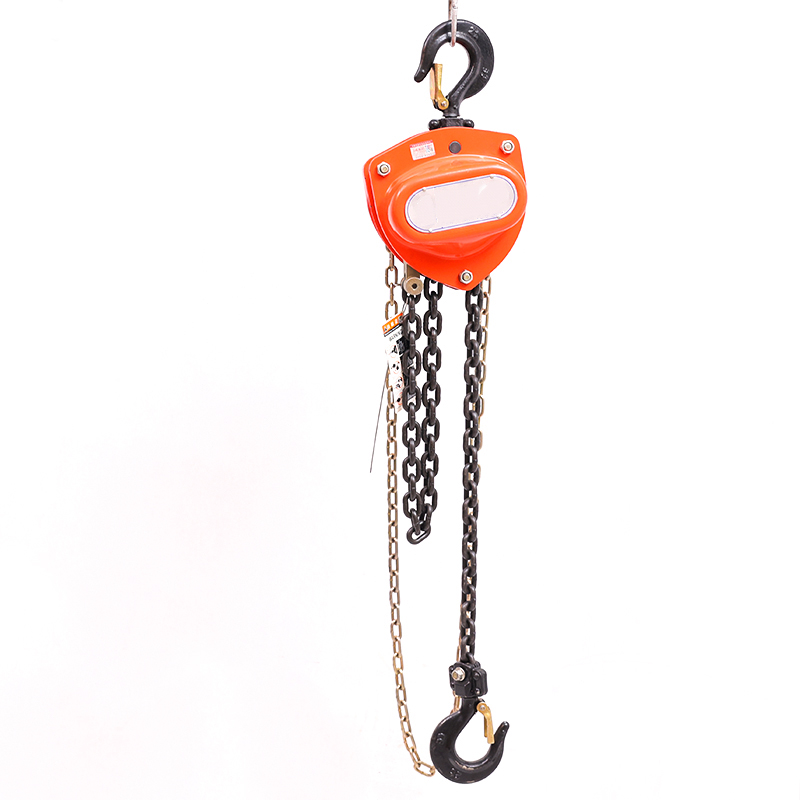
A VD manual chain block, a configuration commonly used for construction lifting tasks.
Safety Factor
The VD chain block is designed with a safety factor of at least 4:1 for the chain and at least 5:1 for structural parts. This aligns with EN 13157, which specifies a 4:1 safety factor for hand-powered lifting equipment. In practical terms, a 1-ton rated chain block has a chain breaking load of at least 4 tons, providing a substantial margin above the rated working load.
Standards and Certification
JUNYUNHOIST states that its chain blocks comply with ISO 16872, EN 13157, and ASME B30.21, and are CE marked. Additionally, they are CE certified for the EU market. Buyers working on projects in Europe, the Middle East, or other regions with strict compliance requirements should verify that any shortlisted chain block meets these same standards.
| Parameter | JUNYUNHOIST VD Chain Block |
|---|---|
| Rated load capacity | 0.5 – 50 t |
| Standard lift height | 3 m (2.5 – 12 m optional) |
| Number of chain falls | 1 – 4 |
| Load chain specification | Grade V or Grade T (DIN EN 818-7) |
| Load chain diameter | 6.3 – 11.2 mm |
| Hand chain | Round link, galvanized or zinc-plated |
| Pull force on hand chain | ≤ 35 daN (350 N) up to rated load |
| Hook material | Forged alloy steel, heat-treated |
| Hook opening | 24 – 55 mm |
| Safety factor | ≥ 4:1 (chain) / ≥ 5:1 (structural parts) |
| Operating temperature | –20°C to +50°C |
| Standards | ISO 16872, EN 13157, ASME B30.21, CE marked |
Application / Use Cases: Chain Blocks in Construction Workflows
Chain blocks appear across several distinct construction workflows. The following scenarios illustrate where manual hoists are typically specified.
Steel Structure Installation
In large stadiums and super high-rise buildings, chain blocks are used for hoisting cantilever structures and for cross-floor lifting of ultra-high interior spaces. Because these operations often take place at height and in enclosed areas, a manually operated hoist provides the control needed for safe placement without relying on a crane that may not be available at that elevation.
Bridge Construction
The product's role in bridge construction is to enable precise placement of key components such as large steel beams for high-speed railway bridges and precast beams for other bridges. Bridge sites frequently have limited access for large lifting machines, making compact manual hoists an essential complement to cranes.
Water Conservancy and Pipeline Engineering
In large-scale water resource allocation projects, chain blocks are used for millimeter-level precision docking and installation of underground pipelines. The manual hoist's fine adjustment capability is critical when aligning large-diameter pipes.
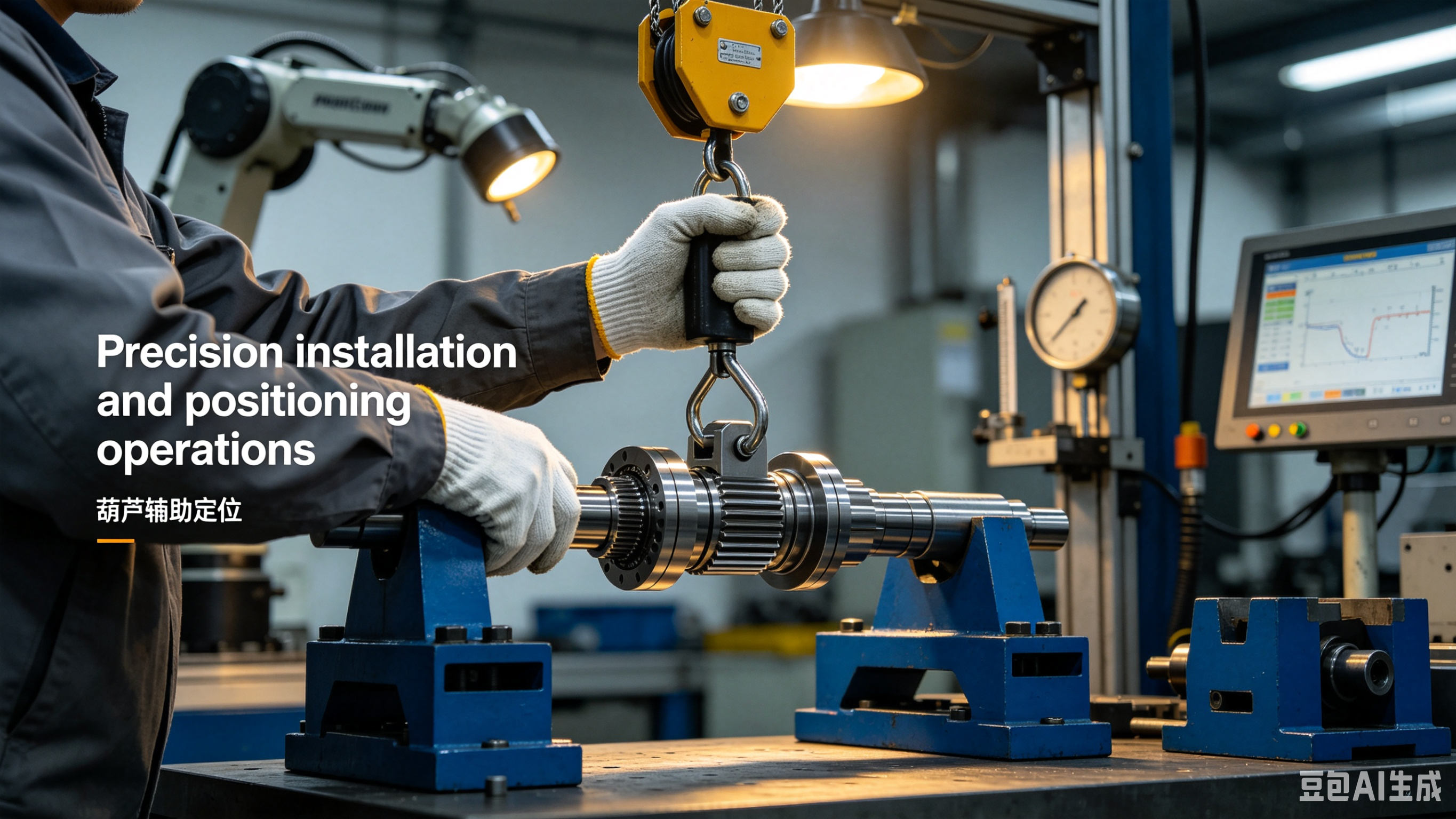
Precision installation and positioning is a core application for manual chain blocks on construction sites.
Special Construction
Chain blocks are also deployed for high-altitude tensioning of large-diameter steel cables, such as those used in the cantilever structure of a large science museum, and for wire tensioning in a large prestressed circular water tank. These specialty operations demand controlled pulling rather than simple lifting, which is a common requirement for lever blocks and chain blocks used together.
Railway Construction and Maintenance
Railway projects use chain blocks for both construction and ongoing maintenance, including positioning track components and lifting equipment in electrified corridors where powered tools may be restricted.
Heavy Machinery Manufacturing and Shipbuilding
Although not pure construction, heavy machinery manufacturing and shipbuilding frequently overlap with construction project sites. Chain blocks are used to safely and precisely lift heavy machinery components during assembly, to move ship structural parts to designated locations, and to hoist or disassemble heavy components such as engines and propellers for repair.
Mining and Petrochemical Sites
In mining operations and petrochemical facilities, manual chain blocks provide lifting capability in potentially explosive atmospheres where electrical equipment must be specially rated. The availability of explosion-proof and high-temperature-resistant configurations makes the manual hoist a viable option in these environments.
Rigging and Supporting Equipment: A Complete Lifting Setup
A chain block is rarely used alone. For construction tasks, supporting equipment typically includes slings, special hooks, magnetic lifters, steel plate or oil drum clamps, wire rope assemblies, decoration hanging baskets, manual trolleys, gantry or cantilever systems, explosion-proof equipment, power-boosting devices, torque wrenches, and load detectors.
From a procurement perspective, the total rigging package must be budgeted for, and the chain block manufacturer should be able to confirm compatibility with these accessories. A manual trolley, for example, converts a stationary chain block into a movable hoist along an I-beam, which is a common requirement for site erection work.
Market Context: Size, Growth, and Regional Shifts
The chain block market in 2024 was valued at approximately USD 1.95 billion, according to Intel Market Research. The broader chain hoist market, which includes both electric and manual models, is projected to reach USD 3.9 billion by 2034, per Dataintelo. For manual chain pulley blocks specifically, Fact.MR estimates that they will account for 48% of the product segment share in 2026.
Construction is consistently cited as the largest application segment for chain blocks, with estimates ranging from about 30% to 54% of global demand depending on the source. This wide range reflects differences in how studies define construction-related use versus shipping, mining, and manufacturing applications.
Asia Pacific dominated the chain hoist market in 2025 with a 41.3% revenue share, driven by rapid industrialization in China and India, according to Dataintelo. China's exports of parts for lifting and handling equipment (HS 843139), which include chain block components, reached USD 1.36 billion in 2024, based on UN Comtrade / WITS trade data. This indicates that Chinese manufacturers remain a major supply source for global buyers.
Growth projections for the chain block market vary significantly by study scope. Estimates range from 0.4% CAGR for general chain blocks to 3.4% for the broader chain hoist market and as high as 5.7% for high-tech or AI-integrated models. Buyers should be aware that these numbers are not contradictory—they simply cover different product definitions. The manual chain block segment is expected to remain stable, driven by construction, infrastructure, and maintenance demand in emerging economies.
The competitive landscape includes both global brands and Chinese manufacturers. Kito Crosby, formed by the merger of Kito and The Crosby Group, reported USD 1.1 billion in revenue for 2024. Columbus McKinnon is a leading competitor in the 0.5–20 ton capacity range. Against this backdrop, Chinese companies such as JUNYUNHOIST compete primarily through vertical integration, production scale, and flexible customization—offering buyers an alternative to established global brands at a different price point.
Chain Block vs. Alternative Lifting Methods
Manual chain blocks are sometimes positioned against electric hoists, mobile cranes, and traditional carbon steel chain blocks. Each approach has distinct trade-offs that should be evaluated for the specific application.
Manual Chain Block vs. Electric Hoist
A manual chain block requires no power supply, is lighter, and has a lower purchase price. It also provides precise manual control. However, its core limitation is that it depends entirely on human effort. For repetitive lifting cycles or continuous heavy-duty operations, an electric hoist is more efficient and less physically demanding on operators. Buyers planning high-frequency lifting should consider whether a manual chain block is the right primary tool.
Manual Chain Block vs. Mobile Crane
Cranes offer much higher load capacity and mobility across a site. But they are expensive to mobilize, require certified operators, and cannot operate in many confined indoor or underground spaces. Chain blocks fill the gap for lifting jobs inside structures, at height, or in areas where a crane cannot reach. The limitation is load capacity—even the largest manual chain block is capped at 50 tons, and practical site use is typically far below that.
Modern Alloy Steel Chain Block vs. Traditional Carbon Steel Design
Modern chain blocks using alloy steels such as 20Mn2, 25MnV, and 23MnNiMoCr54 offer improved strength-to-weight ratios, better durability, and higher safety margins compared with older carbon steel units. The trade-off is that high-grade alloy steel construction is more expensive. For buyers, this cost difference should be weighed against the longer service life and stricter compliance levels required on modern construction contracts.
A final boundary worth noting: the standard JUNYUNHOIST chain block is rated for operation from –20°C to +50°C. Sites outside this range—for example, Arctic construction or desert heat above 50°C—require special grease and configuration. Buyers must confirm the actual site temperature range with the supplier before finalizing an order.
Future Outlook
The demand for manual chain blocks in construction is unlikely to disappear even as electric and smart lifting technologies advance. Construction sites in emerging markets continue to expand, and many of these sites operate without reliable power or with restricted equipment budgets. The manual chain block's simplicity is its resilience.
Three trends are worth monitoring. First, material and heat-treatment technology will continue to improve chain strength and reduce unit weight. Second, buyers are increasingly treating chain blocks as part of a complete rigging system, requiring suppliers to provide not just a hoist but also compatible trolleys, slings, clamps, and compliance documentation. Third, the availability of special configurations—such as explosion-proof and high-temperature versions—will become a standard requirement for petrochemical and industrial construction projects, rather than an optional extra.
For suppliers like JUNYUNHOIST, the challenge is to maintain production scale while responding to increasingly specific buyer requirements. With a 24,000-square-meter facility, approximately 138 employees, and an R&D team of 8 engineers, the company is positioned as a mid-size but vertically integrated manufacturer. Its stated export focus of 80% of sales reflects the global demand base for manual lifting equipment.
FAQ
What is a chain block?
A chain block, also known as a chain hoist, manual hoist, or hand hoist, is a manual lifting device that uses a mechanical gear system to convert human pulling force into lifting power. It is designed for lifting and pulling loads in various industrial applications, including construction, manufacturing, logistics, and warehousing.
What types of chain blocks does JUNYUNHOIST offer?
JUNYUNHOIST produces a range of manual hoisting equipment including the VD chain block, VT chain block, HSZ chain block, HSC chain block, and VD-II chain block, as well as the VA lever block and VL lever block for pulling and tensioning applications.
What load capacity range is available in the VD chain block?
The VD chain block has a rated load capacity from 0.5 to 50 tons, with a standard lift height of 3 meters and optional lift heights from 2.5 to 12 meters. The number of chain falls varies from 1 to 4 depending on capacity.
Which safety standards apply to JUNYUNHOIST chain blocks?
JUNYUNHOIST chain blocks comply with ISO 16872, EN 13157, and ASME B30.21, and are CE marked. They are also CE certified for the EU market. The safety factor is at least 4:1 for the chain and at least 5:1 for structural parts, consistent with EN 13157 requirements.
Is a chain block suitable for construction site use?
Yes. Chain blocks are used in steel structure installation, bridge construction, water conservancy and pipeline engineering, special construction, railway construction and maintenance, and heavy machinery manufacturing. They are particularly suited to environments with no power supply, restricted space, high-altitude work, or the need for precision positioning.
What supporting equipment is needed when using a chain block?
Common supporting equipment includes slings, special hooks, magnetic lifters, steel plate or oil drum clamps, wire rope assemblies, decoration hanging baskets, manual trolleys, gantry or cantilever systems, explosion-proof equipment, power-boosting devices, torque wrenches, and load detectors.
Can chain blocks be customized for explosive or high-temperature environments?
Standard configurations meet general requirements. Explosion-proof and high-temperature-resistant configurations are available upon request from JUNYUNHOIST, allowing the chain block to operate safely in petrochemical, mining, and other demanding environments.
What is the manufacturing capacity of JUNYUNHOIST?
JUNYUNHOIST has an annual production capacity of 200,000 units. The company was established in 2018, operates a facility of 24,000 square meters, employs approximately 138 staff, and derives 80% of its sales from export markets including India, Russia, Vietnam, Brazil, Türkiye, and the Middle East.
For additional reference, the company publishes a full product brochure at https://cdn.socialarks.com/sbsp/24734/0/2026/0424/69eac38419402.pdf. Company details and contact information are available at www.junyunhoist.com, or by email at Junyunsteven@163.com.