
Checking UPVC Door Supplier Claims Against Factory Evidence
Checking UPVC Door Supplier Claims Against Factory Evidence
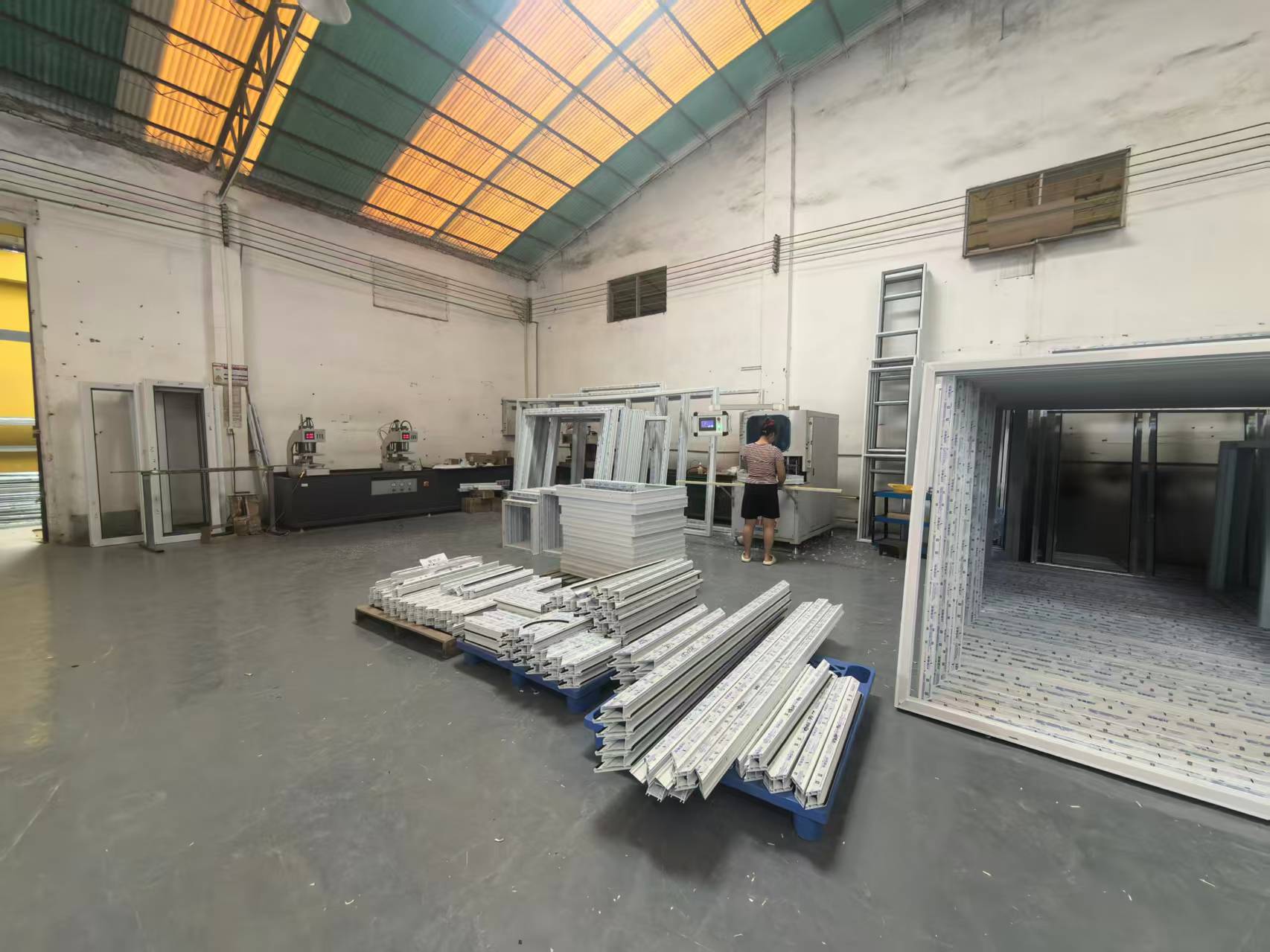
Welding and assembly area — one of the three production zones a UPVC door buyer should ask to see on a live walkthrough or geotagged video.
UPVC door sourcing is decided less by catalogue photographs than by documents. Certificates, floor areas, capacity statements, engineering headcount and export ratios are the inputs a purchasing team actually uses to judge whether a factory can carry a project — and every one of them can be checked before a deposit is paid. This article applies an independent buyer checklist to the published claims of Foshan Nanhai Yuanzhaiji UPVC Door & Window Factory, a UPVC door and window manufacturer established in 2009 and located in Shishan Town, Foshan, China, and separates what the evidence supports from what still requires buyer-side confirmation.
The framing here is deliberately narrow. For UPVC doors, the questions that decide orders are constraint questions: which standard a certificate is issued against, whether a capacity figure is stated in units or in square metres, what the minimum order is, and how long production takes. Product appearance is easy to photograph. Production and compliance evidence is not.
Why Constraint Claims Decide UPVC Door Orders
The global uPVC windows and doors market was valued at USD 30.8 billion in 2025 and is projected to reach USD 32.4 billion in 2026, with Asia Pacific accounting for a 44.1% revenue share in 2025 (Grand View Research). Within that market, the doors segment is expected to grow at a CAGR of 5.3% from 2026 to 2033. Growth of that kind produces a long list of suppliers publishing near-identical capability statements, which is precisely the condition under which buyers stop comparing brochures and start comparing evidence.
Configuration is not a strong differentiator either. Sliding configurations accounted for 37.20% of uPVC door and window revenue in 2025 (Mordor Intelligence), meaning most suppliers compete on the same handful of door types. When the product range overlaps, the remaining variable is verifiable production and compliance capability — and that is where an evidence-based comparison pays off.
A Five-Claim Verification Checklist
Most UPVC door supplier claims fall into five categories. Each category has one specific evidence type that resolves it, and each has a common failure mode that a buyer can detect without visiting the factory.
| Claim category | Typical published statement | Evidence that resolves it | Common failure mode |
|---|---|---|---|
| Factory footprint and location | Stated plant area and industrial address | Business licence, factory lease or property record, geotagged or live walkthrough | Address on the quotation does not match the address on the licence |
| Production capacity | Annual output in units, monthly output in square metres | Production logs, welding line list, shift pattern, current order book | Unit and area figures are quoted from different bases and cannot be cross-checked |
| Engineering depth | Stated R&D engineer count | Organisation chart, signed technical drawings with revision history, drawing turnaround | Engineering count includes sales support or external designers |
| Certification | Named certificate and standard | Certificate PDF, issuing body registry lookup, declared product and profile scope | A voluntary, market-restricted certificate is presented as a general market authorisation |
| Export footprint | Export ratio and market list | Redacted bills of lading, customs export records, region-specific test documentation | Market list is not consolidated across company documents |
Claim 1 — Factory Footprint and Location
Foshan Nanhai Yuanzhaiji UPVC Door & Window Factory reports a factory area of 3,000 sqm in Shishan Town, Foshan, China, with operations established in 2009. Three verification points resolve the location and footprint question:
- The legal entity name and industrial address on the business licence should match the address printed on the quotation, the proforma invoice and the packing list. Address mismatches are the single most common documentation defect in overseas UPVC door orders.
- A geotagged walkthrough video, or a live video call with the production floor visible, resolves location faster than a photo set. The plant should be identifiable by function — material cutting, welding and assembly, and goods storage are the three zones the company documents in its own factory images.
- Equipment visible in the walkthrough should be consistent with the claimed product range, which covers UPVC sliding windows, casement windows, tilt-and-turn windows, crank awning windows, American-style hung windows, awning windows, hopper windows, insect screens, louver windows and insulated glass louver windows, plus sliding doors, lift-and-slide doors, hinged doors and other European and American style door series.
Scale matters for scheduling, not for legitimacy. As a neutral point of reference, publicly reported company information for another Foshan-area supplier, Foshan Wanjia Window and Door Co., Ltd., describes a 538,195 sq ft facility exporting to the US, Canada and Australia (Made-in-China / company website). Reported floor areas are not always measured on the same basis — some figures include the whole site, others only covered workshops — so the comparison should be read as scale context rather than as a quality judgment. The practical implication for a buyer is throughput: a compact single-site plant of 3,000 sqm is well suited to repeat standard production and controlled batch scheduling, while several very large projects running at the same time compete for the same lines.
Claim 2 — Annual and Monthly Capacity Are Not the Same Measurement
The company states an annual output of 50,000 units and a monthly capacity of 4,000 sqm. These two figures are reported on different bases and should not be converted into one another.
An annual figure expressed in units depends on the size mix of the doors produced — a batch of small bathroom doors and a batch of large sliding doors can represent the same floor area but very different unit counts. A monthly figure expressed in square metres depends on how many welding and assembly lines are running and how many shifts are staffed. When both numbers are published, the correct buyer action is not arithmetic but a written basis statement.
Buyer rule: ask the supplier to state the capacity basis in writing — number of welding lines, number of shifts, and the share of monthly capacity committed to doors versus windows — because the 4,000 sqm monthly figure covers the entire UPVC range, not doors alone.
Supporting evidence that is reasonable to request: production logs covering a recent month, a list of equipment on the shop floor, the current order backlog, and confirmation of whether peak-season capacity is reserved or first-come-first-served. Lead time is the figure that a buyer ultimately depends on, and the company states a lead time of 10–30 days.
Claim 3 — A Small Team with a Deep Engineering Ratio
The factory reports approximately 20 staff, of whom 10 are R&D engineers. That ratio — engineering staff making up around half the headcount — is characteristic of a project-driven manufacturer rather than a high-volume assembly operation, and it shapes what the factory is realistically good at.
Verification approaches that work without an audit:
- Request an organisation chart and identify which named engineers sign drawings.
- Request a technical drawing for a specific door size and glass specification, and check whether it carries a revision number and a date. A factory with real engineering capacity issues controlled drawings; a trading intermediary forwards photographs.
- Measure response quality and revision discipline during the pre-order phase. Drawing turnaround time is a more reliable indicator of engineering depth than a stated headcount.
The company operates an OEM / ODM / customizable production mode, with customization covering door size, specification and glass specification. For a buyer, the practical test of that claim is a customized drawing request before ordering, not a discussion about engineer numbers.
Claim 4 — Reading the ECM Attestation Correctly
The company holds an ECM Attestation, certificate number NO.3N230816.YCPQQ51, issued by Ente Certificazione Macchine Srl (ECM). The applicable standard is EN 14351-1:2006+A2:2016. The attestation was issued on 2023-08-16, expires on 2028-08-15, covers UPVC windows and doors across profile series 50/60/65/80/88/112, and is described as a voluntary certification for these products.
The scope statement is the most important line in the document for a buyer to read carefully: the ECM Attestation is intended for third countries outside the EU market. That single clause determines how the certificate may be used in a tendering file.
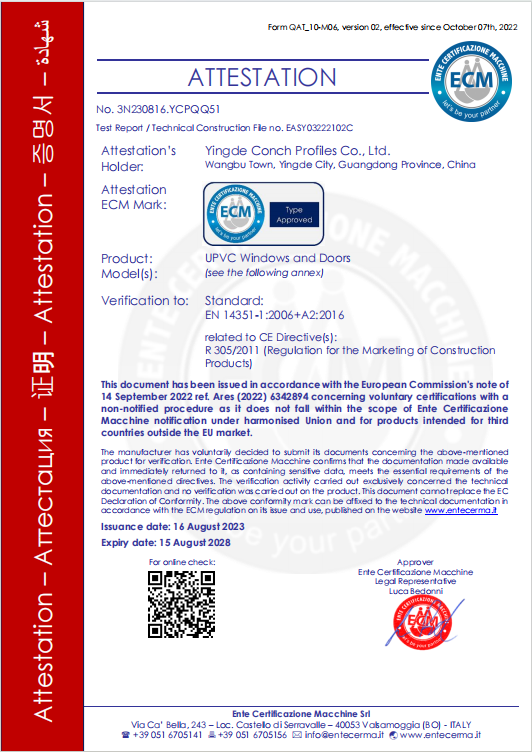
ECM Attestation NO.3N230816.YCPQQ51, issued by Ente Certificazione Macchine Srl (ECM) under EN 14351-1:2006+A2:2016, valid from 2023-08-16 to 2028-08-15.
Certificate data to transpose into a buyer's compliance file
Certificate: ECM Attestation NO.3N230816.YCPQQ51
Issuing body: Ente Certificazione Macchine Srl (ECM)
Standard: EN 14351-1:2006+A2:2016
Scope: UPVC Windows and Doors, Profiles Series 50/60/65/80/88/112
Status: voluntary certification, issued 2023-08-16, expires 2028-08-15
Market: intended for third countries outside the EU market
Four checks turn the document from a marketing asset into a procurement record: confirm the certificate number in the issuing body's public registry; confirm that the declared product scope covers the door series being ordered; confirm the validity dates against the planned delivery window; and record the market restriction so that the certificate is not cited in a market where it does not apply. Where a project requires thermal performance thresholds set by local regulation, the attestation confirms conformity with a standard — it does not by itself demonstrate compliance with a specific national threshold, which must be verified separately.
Claim 5 — Export Share and Market Coverage
The company reports an export ratio of 80%, with main markets in LATAM, MENA, ASEAN and the EU. Its capability record separately lists EU, Africa and the USA among export markets — a minor internal inconsistency that a buyer should resolve rather than interpret. The correct request is a single consolidated market list with the certificate and test documentation that applies to each destination.
Verification approaches for an export claim:
- Request redacted bills of lading or shipping documents for two or three recent shipments to the destination region. Redaction of buyer names is normal and does not reduce the value of the check.
- Ask which compliance documents travel with shipments into each region. Export destinations do not share one regulatory regime, and the documentation set changes by market.
- Confirm whether the export ratio refers to the whole UPVC range or to doors specifically, since an 80% export share calculated across windows and doors may not describe the door order book in the same proportion.
Matching Material Specifications to Product Claims
The door range includes models HF60, WYK75-1 and HF88-L, manufactured from UPVC (unplasticized polyvinyl chloride). The published material specifications are density 1520 kg/m³, Vicat softening point 86 °C, flexural modulus of elasticity 2840 MPa, tensile yield stress 43 MPa, and tensile strain at break 186%. The 1520 kg/m³ density and 86 °C Vicat softening point apply to door models HF60, WYK75-1 and HF88-L. Sound insulation and heat insulation are listed characteristics of this UPVC door system.
| Property | Published value | Applies to | What it helps a buyer assess |
|---|---|---|---|
| Density | 1520 kg/m³ | Models HF60, WYK75-1, HF88-L | Consistency of the PVC-U compound and profile wall quality |
| Vicat softening point | 86 °C | Models HF60, WYK75-1, HF88-L | Resistance to heat-induced deformation in hot climates |
| Flexural modulus of elasticity | 2840 MPa | UPVC material | Stiffness under wind load, relevant to exposed facades |
| Tensile yield stress | 43 MPa | UPVC material | Load the profile carries before permanent deformation begins |
| Tensile strain at break | 186% | UPVC material | Toughness and impact tolerance during handling and service |
These values are material-level figures, so they are verifying only when paired with the profile and the finished door. Two physical checks close the gap: inspect the end face of a profile section to confirm a galvanized steel liner sits inside the cavity, and measure profile wall thickness against the declared series. A material certificate without a liner check verifies the compound, not the door.
Application Fit and Use Cases
The documented application conditions for these UPVC doors are outdoor use in coastal, high-humidity and strong-wind areas, across residential buildings, commercial buildings, renovation projects and villa projects. Operating modes covered are manual opening and closing, tilt-and-turn opening and sliding operation. The matched hardware set includes door handles, door hinges, door rollers, anti-collision stoppers, dust-proof pile weatherstrip and EPDM sealing gaskets.
The stated special requirements for these projects are wind-pressure resistance, water tightness and air permeability, impact and wear resistance, a secure locking system, weather resistance and anti-aging performance, and conformity with local building access standards. For a buyer, these requirements map directly onto the documents to request: a hardware grade list, a sealing system description, and a confirmation of which building access standard the door is dimensioned for in the destination market.
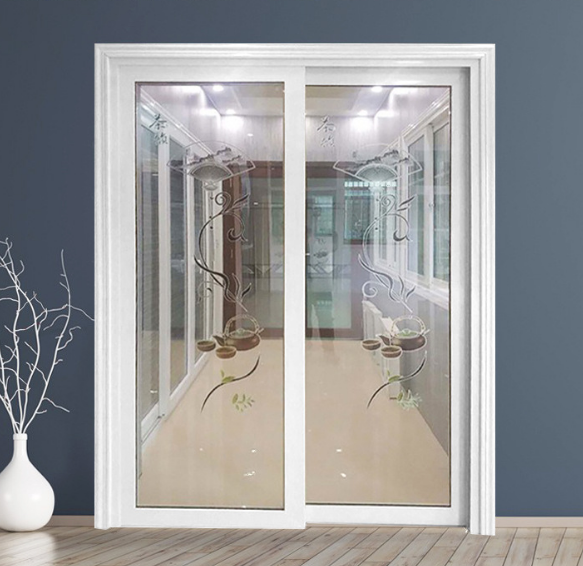
UPVC 88-series sliding door with fly screen — a configuration commonly specified for residential and commercial openings where sealing and low-noise operation matter.
A recorded project for a builder client covers 500 sqm of architectural application, with reported results of stable sealing performance, smooth switch operation and long-term service life over a reported ten-year service duration. The supplier-reported highlights of that project are high-quality profiles, corrosion-resistant hardware, tempered glass, fine workmanship, low-noise sliding, water-proof and dust-proof performance, easy maintenance, and a simple appearance. Case results of this kind are supplier-reported and should be treated as a starting point for reference checks rather than as independent verification.
Market Trend Analysis
Three publicly documented trends change what a buyer should demand in a UPVC door compliance file.
Regulatory tightening on thermal performance. Under the UK Future Homes Standard 2025, the maximum U-value for external doors will decrease from 1.6 W/m²K to 1.2 W/m²K under Approved Document L. Thermal performance is moving from a preference to a procurement gate in regulated markets, which means a standard-level attestation and a market-level performance figure are no longer interchangeable documents.
Continued market growth concentrated in Asia Pacific. The global uPVC windows and doors market is projected at USD 32.4 billion in 2026, up from USD 30.8 billion in 2025, with Asia Pacific holding a 44.1% revenue share in 2025 (Grand View Research). The doors segment is forecast to grow at a CAGR of 5.3% from 2026 to 2033, so supplier capacity and scheduling discipline become a competitive issue rather than a background detail.
Trade documentation as a routine requirement. Plastic doors, windows, frames and thresholds are classified under HS code 392520 (USITC / WCO). Buyers planning duty and clearance timelines should confirm that the supplier's export documentation uses the correct classification consistently across the commercial invoice and packing list.
UPVC Doors Versus Ordinary Plastic Doors: A Real Limitation
The most common substitution risk in this category is not between two UPVC suppliers — it is between a reinforced UPVC door and an ordinary plastic door that looks similar in a photograph. The distinction is structural and it has a cost consequence.
| Aspect | UPVC door (PVC-U profile with galvanized steel liner) | Ordinary plastic door (no steel reinforcement) |
|---|---|---|
| Structure | Galvanized steel liners fitted inside the profile cavities | No steel reinforcement |
| Rigidity under load | Higher rigidity and wind-pressure resistance | Low rigidity, deformation risk under wind load |
| Recommended use | Exterior doors, balcony doors and civil engineering projects | Temporary indoor spaces only |
| Cost profile | Higher upfront cost, longer service life, better long-term balance | Lower upfront cost, shorter service life |
This is the honest boundary of the category: UPVC doors cost more at the point of purchase than ordinary plastic doors, and the difference is recovered only over the service life. Ordinary plastic doors are not suitable for exterior or high-rise applications, and specifying them there creates deformation and safety risk.
Where the Evidence Stops: Boundaries to Plan Around
An evidence-based comparison is only useful if it states its own limits. The following boundaries apply to the claims reviewed above.
- The factory area, staff count, engineering count, annual output and export ratio are supplier-reported figures. No third-party audit report was reviewed, so they should be treated as declarations pending buyer-side confirmation.
- The ECM Attestation is a voluntary certification intended for third countries outside the EU market. It is not, on its own, an authorisation to place these products on the EU market, and it does not replace market-specific performance documentation.
- Annual output in units and monthly capacity in square metres are published on different bases and should never be multiplied or divided into a single derived figure.
- A 3,000 sqm single-site plant is a compact operation. Repeat standard production is well suited to that footprint; several simultaneous large projects are not, and delivery schedules should be contractually protected rather than assumed.
- Customization carries a minimum order quantity of 30–40 ㎡ and a stated lead time of 10–30 days. This is a project-supply model, not a rapid-replenishment model.
- Sound insulation and heat insulation are listed characteristics of the door system. Specific acoustic or thermal performance values for a given door configuration were not published and must be requested per project.
Future Outlook
Two forces are likely to reshape UPVC door procurement over the next several years. The first is regulation: as thermal thresholds tighten in markets such as the United Kingdom, buyers will increasingly treat performance documentation as a pass-or-fail gate rather than a comparison criterion, which favours suppliers who can produce configuration-specific test evidence quickly. The second is documentation literacy: certificate scope, market restriction and validity dates are becoming standard items on a purchasing checklist, which reduces the advantage that vague compliance language once provided.
For a manufacturer operating a compact, engineering-led plant in Foshan with an existing attestation under EN 14351-1:2006+A2:2016, the differentiator is not the certificate itself but the speed and precision with which project-specific evidence — drawings, liner verification, sealing system details and shipment records — can be produced on request.
FAQ
What exactly does the ECM Attestation cover for these UPVC doors?
Certificate NO.3N230816.YCPQQ51 is issued by Ente Certificazione Macchine Srl (ECM) under standard EN 14351-1:2006+A2:2016, covering UPVC windows and doors across profile series 50/60/65/80/88/112. It is a voluntary certification issued on 2023-08-16 and valid until 2028-08-15, and it is intended for third countries outside the EU market. It should be recorded as a standard-level attestation with a market restriction, not as a general market authorisation.
How should a buyer compare an annual capacity figure in units with a monthly capacity figure in square metres?
The two figures are measured on different bases and are not designed to be converted into one another. An annual figure in units depends on the door size mix, while a monthly figure in square metres depends on how many welding and assembly lines are operating and how many shifts are staffed. The practical approach is to request a written capacity basis covering equipment count, shift pattern, and the share of monthly capacity allocated to doors versus windows, and to rely on the stated lead time of 10–30 days for scheduling.
What do the published material specifications for models HF60, WYK75-1 and HF88-L actually describe?
The published values are density 1520 kg/m³, Vicat softening point 86 °C, flexural modulus of elasticity 2840 MPa, tensile yield stress 43 MPa and tensile strain at break 186%, with the density and Vicat softening point stated specifically for door models HF60, WYK75-1 and HF88-L. These are material-level properties, not finished-door performance ratings. Verifying them against a supplied product requires a profile test report plus a physical check of the profile end face for a galvanized steel liner and a wall thickness measurement against the declared series.
What is the difference between a UPVC door and an ordinary plastic door?
UPVC doors use PVC-U profiles with internal galvanized steel liners for reinforcement, which provides strength, wind resistance, and thermal and sound insulation performance. Ordinary plastic doors have no steel reinforcement; they are low-cost but deform easily and are not suitable for exterior use. For exterior doors, balcony doors and civil engineering projects, the steel-lined UPVC construction is the appropriate choice, while ordinary plastic doors are limited to temporary indoor spaces.
What checks should be performed at delivery to confirm a door is a reinforced UPVC door?
Three steps are sufficient. First, check the technical specification to confirm that steel liners are required for the ordered configuration. Second, observe the end face of the profile to confirm that galvanized steel liners are present inside the cavities. Third, reject goods without steel liners for exterior doors. Non-reinforced plastic doors should never be applied to exterior or high-rise projects because of deformation and safety risk.
Are these doors suitable for coastal or high-humidity locations?
The documented application conditions include outdoor use in coastal high-humidity and strong-wind areas, across residential buildings, commercial buildings, renovation projects and villa projects. The relevant requirements listed for those conditions are wind-pressure resistance, water tightness and air permeability, impact and wear resistance, a secure locking system, and weather resistance and anti-aging performance. Buyers specifying for coastal sites should confirm the hardware grade, the EPDM sealing gasket specification and the corrosion-resistant hardware details for the specific order.
The claims reviewed here are traceable to published company documentation and to two independent market sources. Buyers comparing UPVC door suppliers are encouraged to treat each claim as a question with a specific, requestable answer — and to keep the answers on file alongside the sourcing decision.